
Report Feature
Flower Delivery Market Trends and Forecast
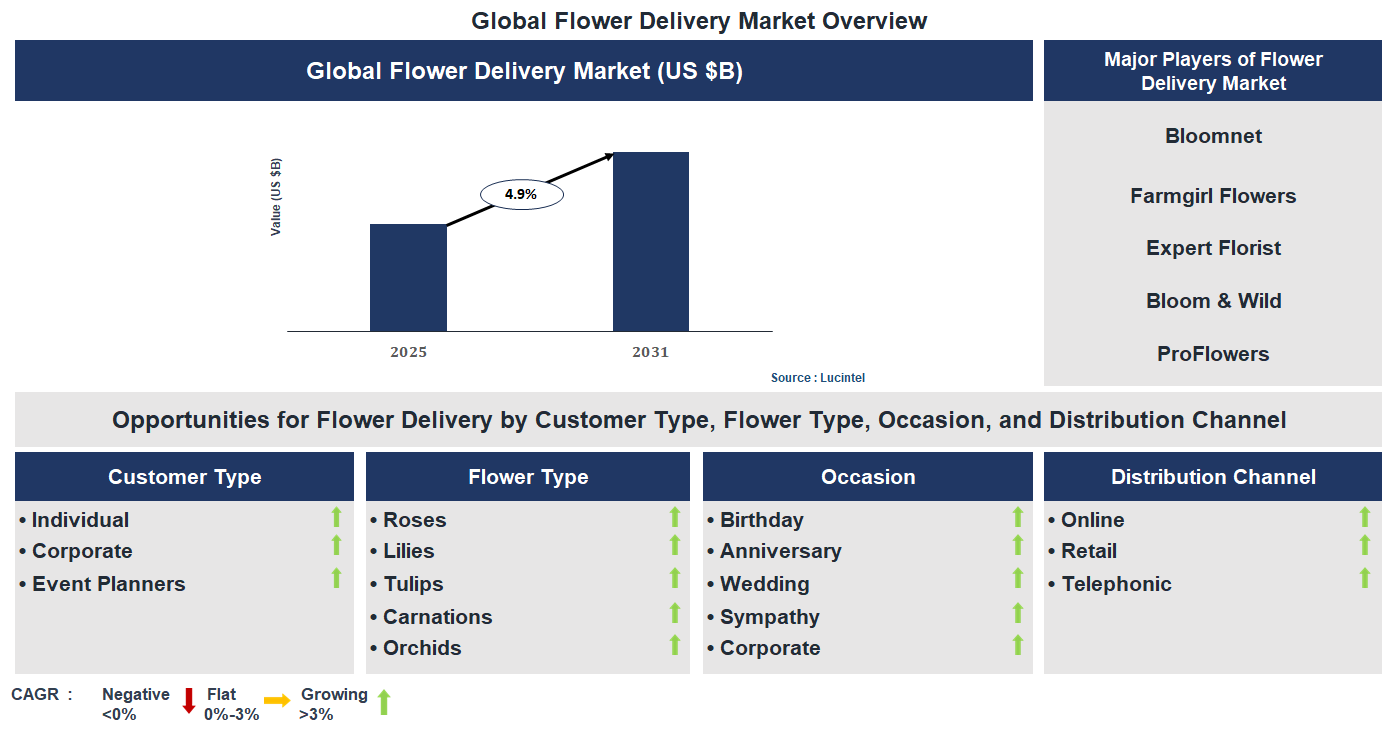
The future of the global flower delivery market looks promising with opportunities in the online, retail, and telephonic markets. The global flower delivery market is expected to grow with a CAGR of 4.9% from 2025 to 2031. The major drivers for this market are the increasing demand for online flower services, the rising popularity of same-day delivery options, and the growing trend of personalized gifting experiences.• Lucintel forecasts that, within the flower type category, rose is expected to witness higher growth over the forecast period.
• Within the distribution channel category, online is expected to witness the highest growth.
• In terms of region, North America is expected to witness the highest growth over the forecast period. Gain valuable insights for your business decisions with our comprehensive 150+ page report. Sample figures with some insights are shown below.
Emerging Trends in the Flower Delivery Market
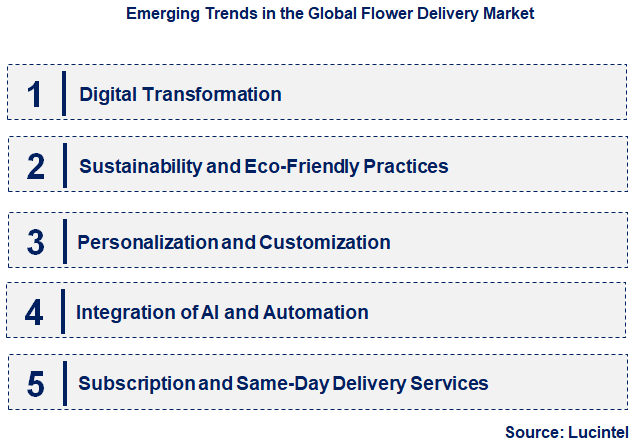
The flower delivery market is experiencing rapid transformation driven by technological advancements, changing consumer preferences, and evolving logistical capabilities. As consumers seek more personalized, sustainable, and convenient options, businesses are innovating to meet these demands. The market is also influenced by digital platforms, eco-conscious initiatives, and the integration of AI and automation. These developments are not only expanding market reach but also enhancing customer experience and operational efficiency. Understanding these emerging trends is crucial for stakeholders aiming to stay competitive and capitalize on new opportunities in this vibrant industry.• Digital Transformation: The rise of online platforms and mobile apps has revolutionized how consumers order flowers. E-commerce websites and social media channels enable easy browsing, customization, and instant ordering, broadening market access beyond traditional storefronts. This shift enhances convenience, allowing customers to place orders anytime and from anywhere, while also providing businesses with valuable data insights to personalize offerings and improve marketing strategies.
• Sustainability and Eco-Friendly Practices: Consumers are increasingly prioritizing environmentally responsible options. Flower delivery companies are adopting sustainable sourcing, biodegradable packaging, and carbon-neutral delivery methods. These initiatives appeal to eco-conscious customers and help brands differentiate themselves in a competitive market. Emphasizing sustainability not only aligns with global environmental goals but also builds brand loyalty and trust among consumers.
• Personalization and Customization: The demand for personalized floral arrangements is growing. Customers seek unique, meaningful bouquets tailored to specific occasions or preferences. Advanced technology, such as AI-driven recommendation systems and customization tools, enables businesses to offer bespoke products efficiently. This trend enhances customer satisfaction, encourages repeat business, and allows brands to stand out through creative and individualized offerings.
• Integration of AI and Automation: Artificial intelligence and automation are streamlining operations from inventory management to delivery logistics. AI algorithms optimize flower selection based on trends and customer preferences, while automated systems improve order processing and delivery scheduling. These innovations reduce costs, minimize errors, and accelerate service delivery, ultimately enhancing overall efficiency and customer experience.
• Subscription and Same-Day Delivery Services: Subscription models provide regular flower deliveries, catering to consumers seeking convenience and ongoing floral decor. Same-day delivery services meet the demand for instant gratification, especially for last-minute occasions. These services foster customer loyalty and expand market share by offering flexible, reliable options that cater to diverse needs and preferences. In summary, these emerging trends are reshaping the flower delivery market by making it more digital, sustainable, personalized, efficient, and customer-centric. They enable businesses to adapt to evolving consumer expectations, improve operational efficiency, and differentiate themselves in a competitive landscape, ensuring sustained growth and innovation in the industry.
Recent Development in the Flower Delivery Market
The flower delivery market has experienced significant growth and transformation driven by technological advancements, changing consumer preferences, and increased demand for convenience. As consumers seek quick, reliable, and personalized floral services, companies are innovating to meet these needs. The market is also influenced by seasonal trends, sustainability concerns, and the expansion of online platforms. These developments are shaping the competitive landscape and influencing consumer behavior, leading to new opportunities and challenges for industry players. Understanding these key trends is essential for stakeholders aiming to capitalize on emerging opportunities and adapt to evolving market dynamics.• Digital Platform Expansion: The rise of online flower delivery services has expanded market reach and improved customer convenience. Companies are investing in user-friendly websites and mobile apps, enabling easy ordering and tracking. This shift has increased sales, especially among younger consumers who prefer digital interactions. The convenience of online platforms also allows for personalized options and quick delivery, boosting customer satisfaction and loyalty.
• Sustainability Initiatives: Increasing environmental awareness has prompted companies to adopt eco-friendly practices. This includes sourcing sustainable flowers, reducing packaging waste, and implementing green logistics. These initiatives appeal to eco-conscious consumers and enhance brand reputation. As sustainability becomes a key purchasing factor, companies that prioritize eco-friendly practices are gaining a competitive edge in the market.
• Customization and Personalization: Consumers now demand personalized floral arrangements for occasions like weddings, birthdays, and corporate events. Companies are offering bespoke services, including custom bouquets and themed arrangements. This trend enhances customer engagement and satisfaction, leading to higher sales and repeat business. The ability to tailor products to individual preferences is becoming a critical differentiator in the market.
• Integration of Technology: Advanced technologies such as AI, AR, and same-day delivery logistics are transforming the market. AI helps in inventory management and personalized marketing, while AR allows customers to visualize arrangements before purchase. Same-day delivery services meet the demand for instant gratification, increasing market competitiveness. These technological innovations improve operational efficiency and customer experience.
• Market Expansion and Mergers: The market has seen increased expansion into emerging regions and strategic mergers among key players. This growth broadens consumer access and enhances service offerings. Mergers facilitate resource sharing, innovation, and market dominance. As companies expand geographically and consolidate, the overall market size and competitiveness are expected to grow significantly. In summary, these developments are collectively driving growth, enhancing customer experience, and promoting sustainability within the flower delivery market. The integration of digital technologies and personalized services is making the market more dynamic and competitive. Sustainability efforts are aligning the industry with global environmental goals, while expansion strategies are opening new opportunities. Overall, these trends are shaping a more innovative, customer-centric, and sustainable market landscape.
Strategic Growth Opportunities in the Flower Delivery Market
The flower delivery market is experiencing rapid growth driven by increasing consumer demand for convenience, personalized gifting options, and the rise of e-commerce platforms. As consumers seek quick and reliable floral services for various occasions, market players are exploring innovative strategies to expand their reach and enhance customer experience. Key applications such as online retail, corporate gifting, event decoration, subscription services, and same-day delivery are pivotal in shaping the market's future. These applications present significant opportunities for growth, driven by technological advancements, changing consumer preferences, and the expanding digital landscape. Below are five key growth opportunities across these applications.• Online Retail: Expansion of digital platforms enhances accessibility and convenience for consumers, leading to increased sales and market penetration. The integration of AI and AR technologies allows customers to visualize arrangements, boosting engagement and satisfaction. This growth opportunity significantly broadens the customer base and fosters brand loyalty, ultimately driving revenue growth in the flower delivery sector.
• Corporate Gifting: Growing corporate demand for personalized and timely floral gifts creates a lucrative market segment. Companies increasingly use flowers for branding, employee appreciation, and client gifting, which enhances brand image and strengthens relationships. This trend offers florists a steady revenue stream and encourages innovation in customized floral solutions tailored for corporate clients.
• Event Decoration: The rising popularity of weddings, parties, and corporate events fuels demand for professional floral decoration services. This application offers high-margin opportunities for florists and event planners to showcase creativity and premium offerings. The growth in this segment enhances market visibility and encourages the development of specialized floral design services.
• Subscription Services: The emergence of floral subscription models provides consumers with regular, curated flower deliveries, fostering ongoing customer engagement. This recurring revenue model stabilizes income streams and promotes brand loyalty. Subscription services also enable companies to gather valuable customer data, facilitating targeted marketing and personalized offerings.
• Same-Day Delivery: The demand for instant gratification and last-minute gifting drives the need for efficient same-day delivery solutions. Investment in logistics and supply chain innovations ensures quick, reliable service, attracting time-sensitive customers. This opportunity enhances customer satisfaction and positions companies as leaders in fast, dependable floral delivery. In summary, these growth opportunities are transforming the flower delivery market by expanding service offerings, improving customer engagement, and increasing operational efficiencies. As digitalization and consumer preferences evolve, these applications will continue to drive innovation, market expansion, and competitive advantage within the industry.
Flower Delivery Market Driver and Challenges
The flower delivery market is influenced by a variety of technological, economic, and regulatory factors that shape its growth and sustainability. Advances in e-commerce platforms and mobile technology have made ordering flowers more accessible and convenient for consumers worldwide. Economic factors such as disposable income levels and seasonal demand fluctuations significantly impact sales volumes. Regulatory considerations, including transportation laws and floral import/export restrictions, also play a crucial role in market operations. Additionally, consumer preferences for sustainable and eco-friendly products are driving innovation and differentiation within the industry. Understanding these drivers and challenges is essential for stakeholders aiming to capitalize on opportunities and mitigate risks in this dynamic market environment. The factors responsible for driving the flower delivery market include:• Technological Innovation: The integration of online platforms and mobile apps has revolutionized the way consumers purchase flowers. E-commerce websites and delivery apps enable customers to browse, customize, and order flowers with ease, providing a seamless shopping experience. Real-time tracking, secure payment gateways, and personalized recommendations enhance customer satisfaction and loyalty. Automation in order processing and delivery logistics has also increased efficiency, reducing costs and delivery times. As technology continues to evolve, the market benefits from improved operational capabilities and expanded reach, attracting a broader customer base and fostering growth.
• Growing E-commerce Adoption: The increasing penetration of the internet and smartphones has led to a surge in online flower shopping. Consumers prefer the convenience of ordering flowers from home or on-the-go, especially during special occasions and festivals. E-commerce platforms offer a wide variety of floral arrangements, competitive pricing, and quick delivery options, which traditional brick-and-mortar stores struggle to match. The rise of digital marketing and social media advertising further boosts visibility and sales. This shift towards online purchasing channels has significantly expanded market reach, enabling vendors to target geographically dispersed customers and tap into new markets.
• Changing Consumer Preferences: Modern consumers are increasingly seeking personalized, unique, and eco-friendly floral products. There is a rising demand for organic and sustainably sourced flowers, driven by environmental consciousness. Consumers also prefer customized arrangements for events like weddings, birthdays, and corporate functions, requiring vendors to offer bespoke services. Additionally, gifting trends and the desire for instant gratification have led to innovations such as same-day delivery and subscription services. These evolving preferences compel market players to innovate continuously, diversify their offerings, and adopt sustainable practices to stay competitive and meet customer expectations.
• Seasonal and Festive Demand: The flower delivery market experiences significant fluctuations aligned with seasonal and festive periods such as Valentine's Day, Mother’s Day, Christmas, and local festivals. During these times, demand surges as consumers purchase flowers for gifting and decoration. Vendors often prepare in advance with special promotions and exclusive arrangements, which boost sales volumes. However, this seasonal dependency also introduces challenges related to inventory management, supply chain logistics, and price volatility. Effective planning and marketing strategies are essential to capitalize on peak periods while maintaining profitability during off-peak times.
• Strategic Partnerships and Mergers: Collaborations between floral growers, logistics providers, and online platforms have become a key driver of market expansion. Strategic alliances enable access to a wider supply chain, better inventory management, and enhanced delivery capabilities. Mergers and acquisitions facilitate market consolidation, allowing companies to leverage economies of scale, expand their geographic footprint, and diversify product offerings. These partnerships also foster innovation through shared technology and expertise, improving customer service and operational efficiency. As the market matures, such collaborations are expected to play a pivotal role in sustaining growth and competitive advantage. The challenges facing this flower delivery market include:
• Regulatory and Logistic Constraints: The flower delivery market faces complex regulatory environments, including import/export restrictions, phytosanitary standards, and transportation laws that vary across regions. These regulations can delay shipments, increase costs, and limit market access. Additionally, logistical challenges such as maintaining flower freshness during transit, managing last-mile delivery, and handling perishable inventory require sophisticated supply chain management. Disruptions caused by customs procedures, transportation strikes, or adverse weather conditions further complicate operations. Overcoming these hurdles demands significant investment in compliance, infrastructure, and technology, which can strain smaller players and impact overall market growth.
• Seasonal Demand Fluctuations: While seasonal peaks drive revenue, off-peak periods pose a challenge for consistent cash flow and inventory management. During non-festive seasons, demand drops sharply, leading to excess inventory and increased storage costs. Vendors must strategize to maintain customer engagement year-round through promotions, subscription services, or diversified product offerings. Failure to effectively manage seasonal variations can result in financial instability, wastage, and reduced profitability. Balancing inventory levels and marketing efforts to smooth out demand fluctuations remains a critical challenge for market participants.
• Competition and Price Wars: The increasing number of online and offline flower vendors intensifies competition, often leading to price wars that erode profit margins. New entrants and local players compete on price, discounts, and promotional offers, making it difficult for established brands to maintain profitability. Differentiation becomes essential but challenging, especially when competing on price alone. Additionally, counterfeit products and imitation arrangements can undermine brand reputation and customer trust. Market players must invest in branding, quality assurance, and customer experience to sustain their market share amid fierce competition, which can be resource-intensive. In summary, the flower delivery market is shaped by technological advancements, changing consumer preferences, and seasonal demand cycles, which collectively drive growth and innovation. However, regulatory hurdles, logistical complexities, and intense competition pose significant challenges that require strategic planning and investment. The interplay of these drivers and challenges determines the market’s trajectory, influencing profitability, expansion opportunities, and sustainability. Companies that effectively leverage technological innovations and adapt to consumer trends while managing operational risks are positioned for long-term success in this evolving industry.
List of Flower Delivery Companies
Companies in the market compete on the basis of product quality offered. Major players in this market focus on expanding their manufacturing facilities, R&D investments, infrastructural development, and leverage integration opportunities across the value chain. With these strategies flower delivery companies cater increasing demand, ensure competitive effectiveness, develop innovative products & technologies, reduce production costs, and expand their customer base. Some of the flower delivery companies profiled in this report include-• Bloomnet
• Farmgirl Flowers
• Expert Florist
• Bloom & Wild
• ProFlowers
• florists.com
• Floom
• From You Flowers
• Seranata Flowers
• 1800Flowers
Flower Delivery Market by Segment
The study includes a forecast for the global flower delivery market by customer type, flower type, occasion, distribution channel, and region.Flower Delivery Market by Customer Type [Value from 2019 to 2031]:
• Individual
• Corporate
• Event Planners
Flower Delivery Market by Flower Type [Value from 2019 to 2031]:
• Roses
• Lilies
• Tulips
• Carnations
• Orchids
Flower Delivery Market by Occasion [Value from 2019 to 2031]:
• Birthday
• Anniversary
• Wedding
• Sympathy
• Corporate
Flower Delivery Market by Distribution Channel [Value from 2019 to 2031]:
• Online
• Retail
• Telephonic
Flower Delivery Market by Region [Value from 2019 to 2031]:
• North America
• Europe
• Asia Pacific
• The Rest of the World
Country Wise Outlook for the Flower Delivery Market
The flower delivery market has experienced significant growth and transformation driven by technological advancements, changing consumer preferences, and the impact of the COVID-19 pandemic. E-commerce platforms and mobile apps have made ordering flowers more convenient, while innovative delivery methods have improved service efficiency. Sustainability concerns have also influenced market trends, with a focus on eco-friendly packaging and locally sourced flowers. Countries are adopting new strategies to enhance customer experience and expand market reach. Here is a country-specific overview of recent developments in the flower delivery market for the United States, China, Germany, India, and Japan.• United States: The U.S. flower delivery market has seen a surge in online sales, with major players investing in mobile app development and personalized services. Subscription flower services and same-day delivery options are increasingly popular, catering to busy consumers. Companies are also emphasizing sustainable practices, such as biodegradable packaging and supporting local growers, to meet eco-conscious demand. The integration of AI and data analytics is enhancing customer experience through tailored recommendations and efficient logistics.
• China: The Chinese market has experienced rapid growth, driven by a rising middle class and increased internet penetration. E-commerce giants are expanding into flower delivery, offering innovative features like virtual flower arrangements and live tracking. Mobile payment integration and social media marketing are boosting sales. Additionally, there is a focus on premium and luxury floral products, catering to special occasions and gifting trends. Local flower farms are collaborating with online platforms to ensure freshness and quality.
• Germany: The German flower delivery market emphasizes sustainability and quality. Many companies are adopting eco-friendly packaging and supporting local horticulture. The market is characterized by a blend of traditional florists and online platforms, with a growing preference for organic and seasonal flowers. Innovative delivery options, such as drone delivery in urban areas, are being tested. Customer loyalty programs and personalized bouquets are also gaining popularity, enhancing the overall shopping experience.
• India: The Indian flower delivery market is expanding rapidly, fueled by festivals, weddings, and special occasions. Online platforms are offering a wide variety of flowers and customized arrangements. Same-day and midnight delivery services are becoming standard, catering to urgent needs. The market is also witnessing increased adoption of digital payment methods and mobile apps. Local flower markets are integrating with e-commerce platforms to ensure freshness and affordability, while regional floral traditions influence product offerings.
• Japan: The Japanese market focuses on high-quality, seasonal, and locally sourced flowers. Online flower delivery services are gaining popularity, especially for gifting during holidays like Valentine's Day and Mother's Day. Companies are incorporating advanced logistics and tracking systems to ensure timely delivery. Eco-friendly packaging and sustainable sourcing are important trends. Additionally, there is a growing interest in minimalist and elegant floral arrangements, reflecting Japanese aesthetic preferences, and the use of technology to personalize customer experiences.

Features of the Global Flower Delivery Market
Market Size Estimates: Flower delivery market size estimation in terms of value ($B). Trend and Forecast Analysis: Market trends (2019 to 2024) and forecast (2025 to 2031) by various segments and regions. Segmentation Analysis: Flower delivery market size by various segments, such as by customer type, flower type, occasion, distribution channel, and region in terms of value ($B). Regional Analysis: Flower delivery market breakdown by North America, Europe, Asia Pacific, and Rest of the World. Growth Opportunities: Analysis of growth opportunities in different customer types, flower types, occasions, distribution channels, and regions for the flower delivery market. Strategic Analysis: This includes M&A, new product development, and competitive landscape of the flower delivery market. Analysis of competitive intensity of the industry based on Porter’s Five Forces model.
FAQ
Q1. What is the growth forecast for flower delivery market? Answer: The global flower delivery market is expected to grow with a CAGR of 4.9% from 2025 to 2031. Q2. What are the major drivers influencing the growth of the flower delivery market? Answer: The major drivers for this market are the increasing demand for online flower services, the rising popularity of same-day delivery options, and the growing trend of personalized gifting experiences. Q3. What are the major segments for flower delivery market? Answer: The future of the flower delivery market looks promising with opportunities in the online, retail, and telephonic markets. Q4. Who are the key flower delivery market companies? Answer: Some of the key flower delivery companies are as follows:• Bloomnet
• Farmgirl Flowers
• Expert Florist
• Bloom & Wild
• ProFlowers
• florists.com
• Floom
• From You Flowers
• Seranata Flowers
• 1800Flowers Q5. Which flower delivery market segment will be the largest in future? Answer: Lucintel forecasts that, within the flower type category, rose is expected to witness higher growth over the forecast period. Q6. In flower delivery market, which region is expected to be the largest in next 5 years? Answer: In terms of region, North America is expected to witness the highest growth over the forecast period. Q7. Do we receive customization in this report? Answer: Yes, Lucintel provides 10% customization without any additional cost.
Table of Contents
List of Figures
List of Tables
Methodology
- In-depth interviews of the major players in this market
- Detailed secondary research from competitors’ financial statements and published data
- Extensive searches of published works, market, and database information pertaining to industry news, company press releases, and customer intentions
- A compilation of the experiences, judgments, and insights of Lucintel’s professionals, who have analyzed and tracked this market over the years.


Buy Now
Choose a license that fits your team. Instant PDF delivery.
Prices exclude taxes. Instant delivery. Custom licensing available on request.
Key Questions
- • What are some of the most promising, high-growth opportunities for the flower delivery market by customer type (individual, corporate, and event planners), flower type (roses, lilies, tulips, carnations, and orchids), occasion (birthday, anniversary, wedding, sympathy, and corporate), distribution channel (online, retail, and telephonic), and region (North America, Europe, Asia Pacific, and the Rest of the World)?
- • Which segments will grow at a faster pace and why?
- • Which region will grow at a faster pace and why?
- • What are the key factors affecting market dynamics? What are the key challenges and business risks in this market?
- • What are the business risks and competitive threats in this market?
- • What are the emerging trends in this market and the reasons behind them?
- • What are some of the changing demands of customers in the market?
- • What are the new developments in the market? Which companies are leading these developments?
- • Who are the major players in this market? What strategic initiatives are key players pursuing for business growth?
- • What are some of the competing products in this market and how big of a threat do they pose for loss of market share by material or product substitution?
- • What M&A activity has occurred in the last 5 years and what has its impact been on the industry? For any questions related to Flower Delivery Market, Flower Delivery Market Size, Flower Delivery Market Growth, Flower Delivery Market Analysis, Flower Delivery Market Report, Flower Delivery Market Share, Flower Delivery Market Trends, Flower Delivery Market Forecast, Flower Delivery Companies, write Lucintel analyst at email: helpdesk@lucintel.com. We will be glad to get back to you soon.


