
Report Feature
Flood Insurance Market Trends and Forecast
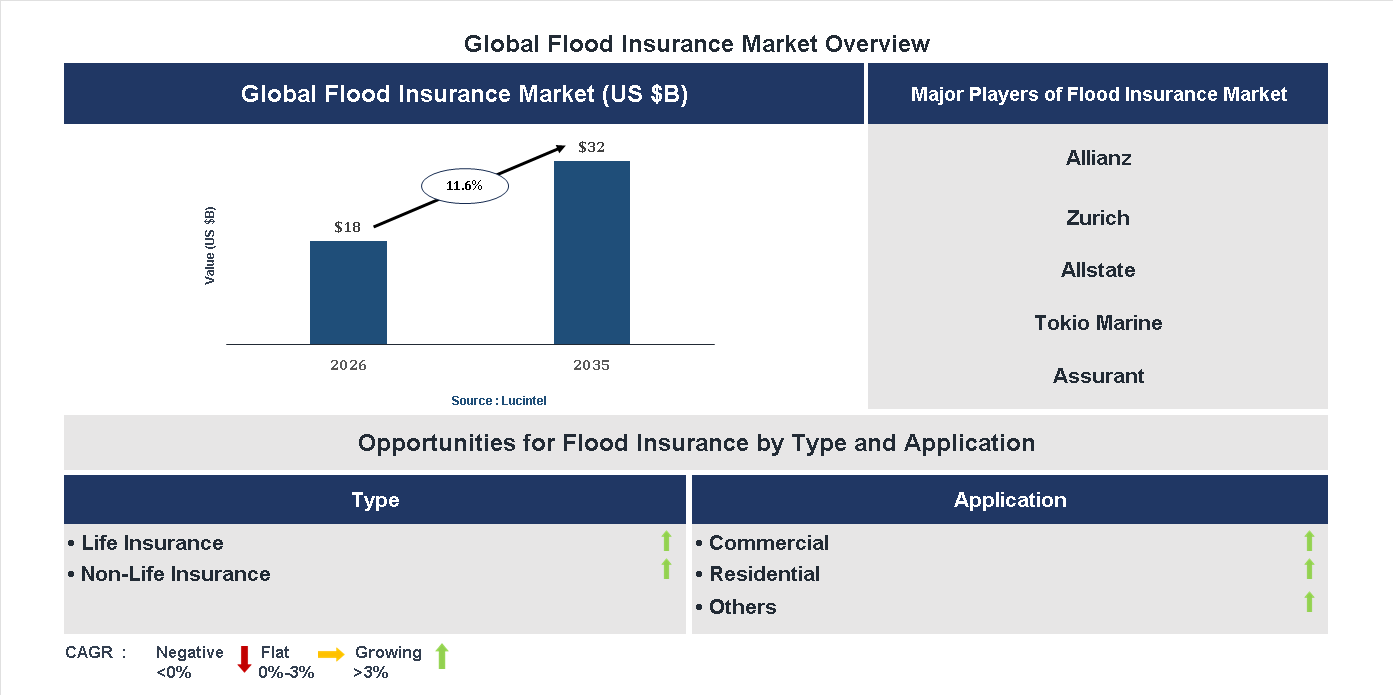
The future of the global flood insurance market looks promising with opportunities in the commercial and residential markets. The global flood insurance market is expected to reach an estimated $32 billion by 2035 with a CAGR of 11.6% from 2026 to 2035. The major drivers for this market are the rising frequency of floods due to climate change impacts, the growing infrastructure development in high risk flood zones, and the increasing adoption of disaster risk management strategies.• Lucintel forecasts that, within the type category, non-life insurance is expected to witness higher growth over the forecast period.
• Within the application category, residential is expected to witness higher growth.
• In terms of region, APAC is expected to witness the highest growth over the forecast period. Gain valuable insights for your business decisions with our comprehensive 150+ page report. Sample figures with some insights are shown below.
Emerging Trends in the Flood Insurance Market
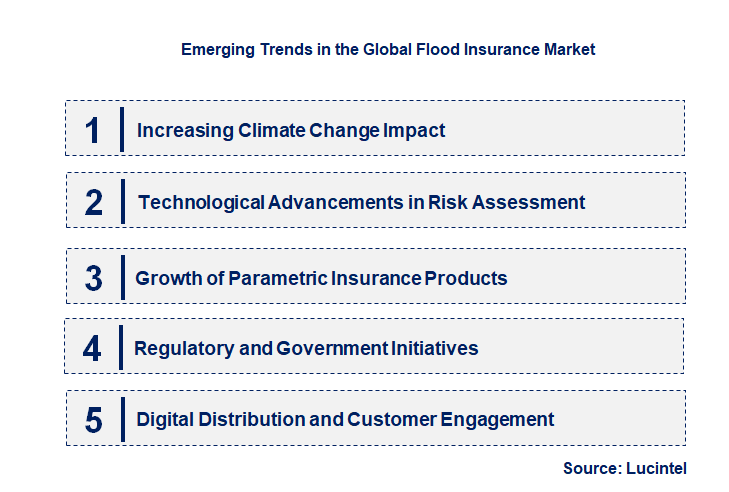
The flood insurance market is experiencing a significant transformation driven by climate change, technological advancements, and evolving regulatory frameworks. As flood risks become more frequent and severe, insurers are adapting their products and strategies to meet rising demand and mitigate losses. Innovations in data analytics, increased awareness among consumers, and government policies are shaping the future landscape of flood insurance. These developments are not only expanding market opportunities but also prompting a shift towards more comprehensive, accessible, and sustainable flood risk management solutions. Understanding these key trends is essential for stakeholders aiming to navigate and capitalize on this dynamic market environment.• Increasing Climate Change Impact: The rising frequency and severity of flooding events due to climate change are elevating the demand for flood insurance. Governments and insurers recognize the need for more robust coverage options to protect properties and livelihoods. This trend is prompting the development of specialized policies tailored to high-risk areas, encouraging proactive risk mitigation measures. As climate patterns become more unpredictable, the flood insurance market is expected to grow substantially, with insurers investing in risk assessment tools and expanding coverage to meet the evolving needs of consumers and businesses.
• Technological Advancements in Risk Assessment: The adoption of advanced data analytics, remote sensing, and Geographic Information Systems (GIS) is revolutionizing flood risk evaluation. These technologies enable insurers to more accurately assess individual property risks, leading to more precise pricing and underwriting. Enhanced data collection improves claims processing and reduces fraud, ultimately increasing efficiency. This trend allows insurers to offer customized policies, expand coverage options, and improve risk management strategies, thereby increasing market stability and customer confidence in flood insurance products.
• Growth of Parametric Insurance Products: Parametric flood insurance, which pays out based on predefined triggers such as flood depth or rainfall levels, is gaining popularity. This innovative approach offers faster claims settlement and reduces administrative costs, making it attractive to both insurers and policyholders. It is particularly useful in high-risk areas where traditional insurance may be limited or prohibitively expensive. The growth of parametric products is expanding market accessibility, encouraging more property owners to obtain flood coverage and fostering resilience against flood events.
• Regulatory and Government Initiatives: Governments worldwide are implementing policies to promote flood risk awareness and insurance uptake. Mandates for flood risk disclosure, subsidies, and public-private partnerships are increasing market penetration. Regulatory frameworks are also evolving to encourage insurers to develop comprehensive coverage options and improve affordability. These initiatives help bridge coverage gaps, especially in underserved regions, and foster a more resilient infrastructure. The supportive regulatory environment is crucial for market expansion and for incentivizing innovative insurance solutions.
• Digital Distribution and Customer Engagement: The rise of digital platforms, mobile apps, and online marketplaces is transforming how flood insurance is marketed and sold. Insurers are leveraging digital channels to reach a broader audience, streamline the purchasing process, and enhance customer engagement through personalized offerings. Digital tools also facilitate real-time risk monitoring and claims management, improving customer satisfaction. This trend reduces distribution costs and increases accessibility, especially for younger, tech-savvy consumers. As digital adoption accelerates, the flood insurance market is becoming more competitive, transparent, and customer-centric. These trends are collectively reshaping the flood insurance market by making coverage more accessible, accurate, and responsive to climate realities. They are fostering innovation, expanding market reach, and enhancing resilience, ultimately leading to a more sustainable and adaptive flood risk management landscape.
Recent Development in the Flood Insurance Market
The flood insurance market is experiencing rapid evolution driven by climate change, increasing urbanization, and regulatory reforms. These factors are expanding market opportunities and prompting innovation in coverage options, pricing models, and distribution channels. Stakeholders are focusing on risk assessment improvements and digital transformation to meet rising demand. The following developments highlight key areas shaping the future of flood insurance, offering insights into how the market is adapting to new challenges and opportunities.• Digital Transformation in Policy Management: The flood insurance market is increasingly adopting digital platforms for policy issuance, claims processing, and customer engagement. This shift enhances efficiency, reduces costs, and improves customer experience. Insurers are leveraging AI and data analytics to streamline operations and personalize offerings. Digital tools also facilitate faster claims settlement, boosting customer satisfaction and retention. Overall, digital transformation is making flood insurance more accessible and responsive to market needs.
• Expansion of Coverage Options: Insurers are diversifying flood insurance products to include more comprehensive and customizable coverage. New policies now address various flood risks, including urban flash floods and coastal surges, reflecting changing climate patterns. This expansion allows consumers to select plans tailored to their specific vulnerabilities, increasing market penetration. Enhanced coverage options also attract new customer segments, fostering growth and competitiveness within the industry.
• Use of Advanced Risk Assessment Technologies: The market is integrating sophisticated technologies like GIS, remote sensing, and AI for precise flood risk evaluation. These tools enable insurers to better predict flood events, set accurate premiums, and reduce underwriting losses. Improved risk assessment enhances pricing fairness and encourages coverage in high-risk areas previously underserved. This technological advancement supports sustainable growth by balancing risk management with market expansion.
• Regulatory Reforms and Public-Private Partnerships: Governments and regulators are implementing reforms to promote flood insurance adoption, including mandatory coverage in vulnerable regions and subsidies. Public-private partnerships are emerging to expand coverage and share risks, especially in high-exposure areas. These initiatives increase market stability, reduce reliance on government aid, and encourage private sector investment. Regulatory support is crucial for fostering a resilient flood insurance ecosystem amid climate uncertainties.
• Focus on Climate Resilience and Community Engagement: Insurers are emphasizing climate resilience initiatives, such as community-based risk mitigation programs and educational campaigns. These efforts aim to reduce flood damage and promote proactive risk management. Engaging communities helps build trust and awareness, leading to higher policy uptake. This focus on resilience not only mitigates losses but also aligns insurers with broader sustainability goals, strengthening market stability and social responsibility. These developments are significantly transforming the flood insurance market by enhancing technological capabilities, expanding coverage, and fostering regulatory support. The integration of digital tools and advanced risk assessment methods improves efficiency and accuracy, while innovative products and partnerships broaden market reach. Emphasizing climate resilience and community engagement ensures sustainable growth. Collectively, these opportunities are making flood insurance more accessible, affordable, and resilient, positively impacting market stability and customer confidence.
Strategic Growth Opportunities in the Flood Insurance Market
The flood insurance market is experiencing significant growth driven by increasing climate change impacts, urbanization, and regulatory reforms. Rising awareness of flood risks and government initiatives are expanding coverage options. Technological advancements in risk assessment and data analytics are enhancing policy offerings. The market is also benefiting from partnerships between insurers and government agencies, creating new distribution channels. As climate events become more frequent, the flood insurance sector is poised for sustained expansion, offering opportunities for innovative products and market penetration across residential, commercial, and industrial sectors.• Growing Climate Change Impacts and Urbanization Create Increased Flood Risks, Driving Demand for Specialized Flood Insurance Products: Flood risks are intensifying due to climate change and urban development, prompting homeowners, businesses, and governments to seek comprehensive coverage. This trend encourages insurers to develop tailored policies that address specific regional vulnerabilities, leading to market expansion. Enhanced risk awareness and regulatory mandates further support growth, making flood insurance a critical component of risk management strategies across diverse sectors.
• Technological Advancements Improve Risk Assessment and Underwriting Processes, Expanding Market Reach: Innovations in data analytics, remote sensing, and GIS technology enable more accurate flood risk modeling. These tools facilitate precise underwriting, reduce costs, and enable insurers to offer competitive premiums. Enhanced risk assessment capabilities also allow for the development of customized policies, attracting new customer segments. As technology continues to evolve, insurers can better predict flood events, improve claims management, and expand coverage options, fueling overall market growth.
• Regulatory Reforms and Government Initiatives Promote Flood Insurance Adoption and Market Stability: Governments worldwide are implementing policies to encourage flood insurance uptake, including mandatory coverage in high-risk zones and subsidies for vulnerable populations. Regulatory reforms streamline policy issuance and claims processes, increasing consumer confidence. Public-private partnerships are emerging to expand coverage and reduce financial burdens on governments. These initiatives foster a stable environment for insurers, stimulate market growth, and ensure broader access to flood risk mitigation tools.
• Increasing Awareness and Education about Flood Risks Drive Consumer Demand for Insurance Coverage: Public awareness campaigns and educational programs highlight the importance of flood preparedness and insurance. As individuals and businesses recognize the financial impact of flood events, demand for comprehensive coverage rises. Insurers are developing user-friendly products and digital platforms to facilitate policy purchase and claims processing. This heightened awareness supports market expansion by encouraging proactive risk management and fostering trust in flood insurance solutions.
• Expansion into Emerging Markets Offers New Growth Avenues For Flood Insurance Providers: Rapid urbanization and climate vulnerability in developing regions create significant opportunities for market entry. Insurers are forming strategic alliances and customizing products to suit local needs and affordability levels. Infrastructure development and government support further facilitate market penetration. As these regions adopt flood risk mitigation measures, the demand for insurance products will grow, enabling insurers to diversify portfolios and establish a strong presence in emerging markets. These growth opportunities collectively position the flood insurance market for sustained expansion, driven by technological innovation, regulatory support, increased risk awareness, and emerging market potential. As climate-related risks intensify, insurers that adapt to evolving needs and leverage strategic partnerships will play a vital role in enhancing resilience and expanding coverage. This dynamic environment promises long-term growth prospects, benefiting stakeholders across residential, commercial, and governmental sectors.
Flood Insurance Market Driver and Challenges
The flood insurance market is influenced by a complex interplay of technological advancements, economic conditions, and regulatory frameworks. As climate change intensifies, the frequency and severity of flooding events increase, prompting a need for innovative insurance solutions. Economic factors such as rising property values and urban development in flood-prone areas drive demand, while regulatory policies shape market accessibility and coverage standards. Technological innovations like data analytics and remote sensing enhance risk assessment and claims processing. However, challenges such as climate unpredictability, regulatory complexities, and market penetration barriers pose significant hurdles. Understanding these drivers and challenges is essential for stakeholders aiming to navigate and capitalize on this evolving market landscape. The factors responsible for driving the flood insurance market include:• Increasing Frequency of Flood Events: Climate change has led to more frequent and severe flooding incidents worldwide. This escalation heightens awareness among property owners and governments, creating a pressing need for comprehensive flood insurance coverage. As flood risks become more tangible, demand for specialized insurance products grows, encouraging insurers to develop tailored policies. Additionally, the rising economic damages from floods motivate both consumers and insurers to prioritize risk mitigation, fostering market expansion. This trend underscores the importance of adaptive insurance solutions that can address the evolving nature of flood risks effectively.
• Technological Advancements in Risk Assessment: Innovations such as remote sensing, Geographic Information Systems (GIS), and big data analytics have revolutionized flood risk evaluation. These technologies enable insurers to accurately map flood-prone areas, assess individual property vulnerabilities, and predict potential damages with greater precision. Improved data collection and analysis reduce underwriting uncertainties and enable more competitive pricing. Moreover, real-time monitoring and early warning systems facilitate proactive risk management, encouraging policy uptake. As technology continues to evolve, insurers can offer more customized and dynamic flood coverage, thereby expanding market reach and enhancing customer confidence.
• Regulatory Support and Government Initiatives: Governments worldwide are implementing policies to promote flood risk mitigation and insurance coverage. Regulations mandating flood risk disclosures and incentivizing insurance purchase increase market penetration. Public-private partnerships, such as government-backed flood insurance schemes, provide affordable coverage options, especially in high-risk areas. These initiatives also help standardize coverage terms and improve claims processes, boosting consumer trust. Regulatory frameworks that encourage data sharing and risk pooling further facilitate market growth. Such supportive policies are crucial in addressing coverage gaps and ensuring sustainable development in flood-prone regions.
• Growing Urbanization and Property Development: Rapid urbanization in flood-prone areas increases exposure to flood risks. As cities expand into vulnerable zones, the value of insured properties rises, driving demand for flood insurance. Infrastructure development and real estate investments in these regions necessitate comprehensive coverage to protect assets. Additionally, urban planning that incorporates flood risk mitigation measures can reduce potential damages, making insurance more attractive. The trend toward resilient infrastructure and smart city initiatives further supports market growth by integrating risk management into development projects, thereby encouraging property owners and developers to seek appropriate flood coverage.
• Rising Awareness and Consumer Education: Increased awareness about flood risks and the importance of insurance coverage is a significant market driver. Educational campaigns, media coverage, and community outreach programs inform property owners about potential damages and available protection options. As consumers become more informed, they are more likely to purchase flood insurance, especially in regions historically considered low-risk. Enhanced understanding of policy benefits and claims processes reduces skepticism and builds trust in insurance providers. This shift in consumer perception fosters higher market penetration and encourages insurers to develop innovative, accessible products tailored to diverse customer needs. The challenges facing this Market include:
• Climate Change Unpredictability: While climate change amplifies flood risks, it also introduces significant uncertainty in predicting future flood patterns. This unpredictability complicates risk modeling and underwriting processes, making it difficult for insurers to accurately price policies. The variability in weather patterns and the increasing frequency of extreme events challenge existing data and models, potentially leading to under- or over-estimation of risks. Consequently, insurers may face higher claim payouts or reluctance to offer coverage in certain areas, hindering market growth and stability. Addressing this challenge requires continuous technological innovation and adaptive risk management strategies.
• Regulatory Complexities and Policy Variability: The flood insurance landscape is often fragmented by diverse regulations across regions and countries. Variations in coverage mandates, pricing standards, and claim procedures create compliance complexities for insurers operating in multiple jurisdictions. Regulatory uncertainty can delay product development and market entry, limiting growth opportunities. Additionally, evolving policies related to climate adaptation and land use can impact existing insurance frameworks, necessitating frequent adjustments. Navigating these regulatory intricacies demands significant resources and expertise, posing a barrier for new entrants and potentially restricting market expansion.
• Market Penetration and Affordability Barriers: Despite rising risks, many property owners remain uninsured due to high premiums, lack of awareness, or limited access to insurance providers. Low-income communities and rural areas often face affordability challenges, resulting in coverage gaps that exacerbate vulnerability. Insurers may be hesitant to offer affordable policies in high-risk zones due to potential losses, further limiting coverage options. This low penetration hampers the overall effectiveness of flood risk mitigation efforts and leaves large segments of the population exposed. Overcoming these barriers requires innovative pricing models, government incentives, and targeted outreach to improve accessibility and affordability. The flood insurance market is shaped by a combination of technological progress, regulatory support, urban development, and increasing flood risks driven by climate change. While these drivers foster growth and innovation, challenges such as unpredictability, regulatory complexity, and coverage gaps pose significant hurdles. Addressing these issues through technological adaptation, policy harmonization, and inclusive strategies will be vital for sustainable market development. Overall, the markets future depends on balancing risk management with accessible, affordable insurance solutions to meet the rising demand and mitigate flood-related damages effectively.
List of Flood Insurance Companies
Companies in the market compete on the basis of product quality offered. Major players in this market focus on expanding their manufacturing facilities, R&D investments, infrastructural development, and leverage integration opportunities across the value chain. With these strategies flood insurance companies cater increasing demand, ensure competitive effectiveness, develop innovative products & technologies, reduce production costs, and expand their customer base. Some of the flood insurance companies profiled in this report include-• Allianz
• Zurich
• Allstate
• Tokio Marine
• Assurant
• Chubb
• PICC
• Sompo Japan Nipponkoa
• CPIC
• PingAn
Flood Insurance Market by Segment
The study includes a forecast for the global flood insurance market by type, application, and region.Flood Insurance Market by Type [Value from 2019 to 2035]:
• Life Insurance
• Non-Life Insurance
Flood Insurance Market by Application [Value from 2019 to 2035]:
• Commercial
• Residential
• Others
Flood Insurance Market by Region [Value from 2019 to 2035]:
• North America
• Europe
• Asia Pacific
• The Rest of the World
Country Wise Outlook for the Flood Insurance Market
The flood insurance market has experienced significant shifts globally, driven by climate change, increasing urbanization, and evolving regulatory frameworks. Countries are adapting their policies and expanding coverage options to address rising flood risks. Technological advancements, such as data analytics and remote sensing, are enhancing risk assessment and claims processing. Public-private partnerships are emerging to improve affordability and accessibility. Market players are also innovating product offerings to meet diverse consumer needs. These developments reflect a broader effort to mitigate flood-related damages and promote resilience in vulnerable regions across the United States, China, Germany, India, and Japan.• United States: The US flood insurance market has seen increased federal support through the National Flood Insurance Program (NFIP), with reforms aimed at expanding coverage and reducing premiums. Technological integration, such as GIS mapping, has improved risk assessment. Private insurers are entering the market, offering more customized policies. Climate change has prompted updates to flood zone maps, influencing policy pricing and availability. There is a growing emphasis on community-based flood risk management and resilience planning, alongside increased awareness campaigns to encourage coverage uptake.
• China: China has rapidly expanded its flood insurance offerings, especially in flood-prone regions like the Yangtze and Pearl River basins. The government promotes public-private partnerships to improve coverage and affordability. Digital platforms are increasingly used for policy distribution and claims processing, enhancing efficiency. Recent policies focus on integrating flood risk management with urban planning. The market is also witnessing the development of parametric insurance products that provide quick payouts based on predefined flood triggers. These efforts aim to bolster resilience amid rising flood incidents due to climate variability.
• Germany: Germanys flood insurance market has strengthened following severe flooding events, with reforms to improve coverage and risk mitigation. The market is characterized by a mix of statutory and private insurance providers offering comprehensive policies. Advances in flood risk modeling and early warning systems have been integrated into insurance products. The government has introduced incentives for flood-proofing properties, encouraging proactive risk reduction. Public awareness campaigns and community engagement initiatives are increasing, fostering a culture of preparedness. The market continues to evolve with a focus on sustainable and resilient infrastructure investments.
• India: India faces increasing flood risks due to monsoon variability and climate change, prompting market expansion. The government promotes flood insurance schemes like the Pradhan Mantri Fasal Bima Yojana, integrating crop and property coverage. Digital platforms facilitate wider reach, especially in rural areas. Innovative products, including micro-insurance and parametric policies, are being introduced to improve accessibility. Efforts are underway to strengthen data collection and risk assessment capabilities. Public awareness campaigns aim to increase policy adoption among vulnerable populations. The market is also exploring climate-resilient infrastructure investments to reduce future flood damage.
• Japan: Japans flood insurance market is highly developed, supported by advanced early warning systems and comprehensive risk management strategies. The government collaborates with private insurers to offer extensive coverage, especially in flood-prone urban areas. Recent developments include the integration of big data analytics and remote sensing for precise risk evaluation. Post-2011 Fukushima disaster, there has been a focus on enhancing resilience and insurance coverage for natural disasters. Innovative products, such as event-triggered parametric insurance, are gaining popularity. Public-private partnerships continue to strengthen, aiming to mitigate flood impacts amid changing climate patterns.

Features of the Global Flood Insurance Market
Market Size Estimates: Flood insurance market size estimation in terms of value ($B). Trend and Forecast Analysis: Market trends (2019 to 2025) and forecast (2026 to 2035) by various segments and regions. Segmentation Analysis: Flood insurance market size by type, application, and region in terms of value ($B). Regional Analysis: Flood insurance market breakdown by North America, Europe, Asia Pacific, and Rest of the World. Growth Opportunities: Analysis of growth opportunities in different types, applications, and regions for the flood insurance market. Strategic Analysis: This includes M&A, new product development, and competitive landscape of the flood insurance market. Analysis of competitive intensity of the industry based on Porter’s Five Forces model.
FAQ
Q1. What is the flood insurance market size? Answer: The global flood insurance market is expected to reach an estimated $32 billion by 2035. Q2. What is the growth forecast for flood insurance market? Answer: The global flood insurance market is expected to grow with a CAGR of 11.6% from 2026 to 2035. Q3. What are the major drivers influencing the growth of the flood insurance market? Answer: The major drivers for this market are the rising frequency of floods due to climate change impacts, the growing infrastructure development in high risk flood zones, and the increasing adoption of disaster risk management strategies. Q4. What are the major segments for flood insurance market? Answer: The future of the flood insurance market looks promising with opportunities in the commercial and residential markets. Q5. Who are the key flood insurance market companies? Answer: Some of the key flood insurance companies are as follows:• Allianz
• Zurich
• Allstate
• Tokio Marine
• Assurant
• Chubb
• PICC
• Sompo Japan Nipponkoa
• CPIC
• PingAn Q6. Which flood insurance market segment will be the largest in future? Answer: Lucintel forecasts that, within the type category, non-life insurance is expected to witness higher growth over the forecast period. Q7. In flood insurance market, which region is expected to be the largest in next 5 years? Answer: In terms of region, APAC is expected to witness the highest growth over the forecast period. Q8. Do we receive customization in this report? Answer: Yes, Lucintel provides 10% customization without any additional cost.
Table of Contents
List of Figures
List of Tables
Methodology
- In-depth interviews of the major players in this market
- Detailed secondary research from competitors’ financial statements and published data
- Extensive searches of published works, market, and database information pertaining to industry news, company press releases, and customer intentions
- A compilation of the experiences, judgments, and insights of Lucintel’s professionals, who have analyzed and tracked this market over the years.


Buy Now
Choose a license that fits your team. Instant PDF delivery.
Prices exclude taxes. Instant delivery. Custom licensing available on request.
Key Questions
- • What are some of the most promising, high-growth opportunities for the flood insurance market by type (life insurance and non-life insurance), application (commercial, residential, and others), and region (North America, Europe, Asia Pacific, and the Rest of the World)?
- • Which segments will grow at a faster pace and why?
- • Which region will grow at a faster pace and why?
- • What are the key factors affecting market dynamics? What are the key challenges and business risks in this market?
- • What are the business risks and competitive threats in this market?
- • What are the emerging trends in this market and the reasons behind them?
- • What are some of the changing demands of customers in the market?
- • What are the new developments in the market? Which companies are leading these developments?
- • Who are the major players in this market? What strategic initiatives are key players pursuing for business growth?
- • What are some of the competing products in this market and how big of a threat do they pose for loss of market share by material or product substitution?
- • What M&A activity has occurred in the last 7 years and what has its impact been on the industry? For any questions related to Flood Insurance Market, Flood Insurance Market Size, Flood Insurance Market Growth, Flood Insurance Market Analysis, Flood Insurance Market Report, Flood Insurance Market Share, Flood Insurance Market Trends, Flood Insurance Market Forecast, Flood Insurance Companies, write Lucintel analyst at email: helpdesk@lucintel.com. We will be glad to get back to you soon.


