
Market Report · July 22, 2026

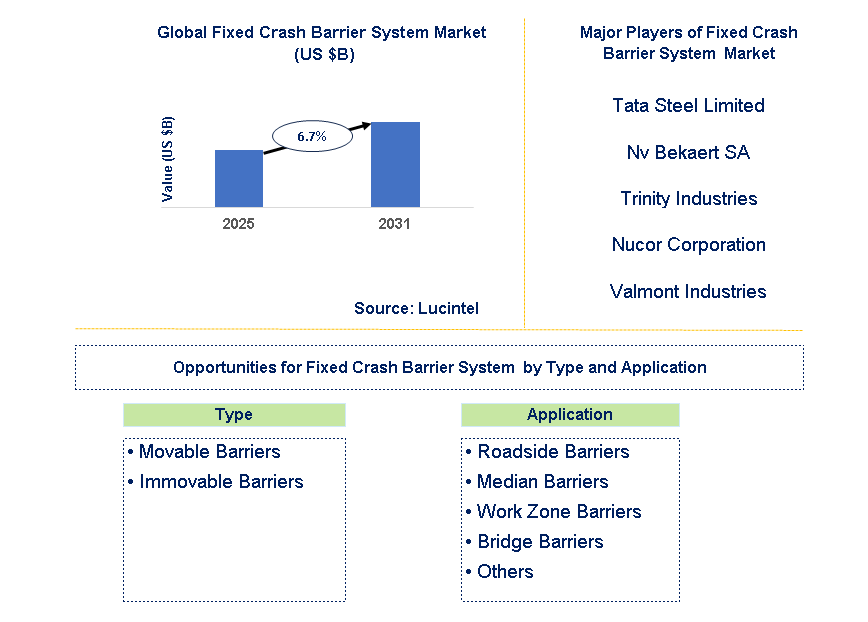
Key data points: The growth forecast = 6.7% annually for the next 7 years. Scroll below to get more insights. This market report covers Trends, opportunity and forecast in fixed crash barrier system market to 2031 by type (movable barriers and immovable barriers), application (roadside barriers, median barriers, work zone barriers, bridge barriers, and others), and region (North America, Europe, Asia Pacific, and the Rest of the World)
We'll send your sample report shortly.
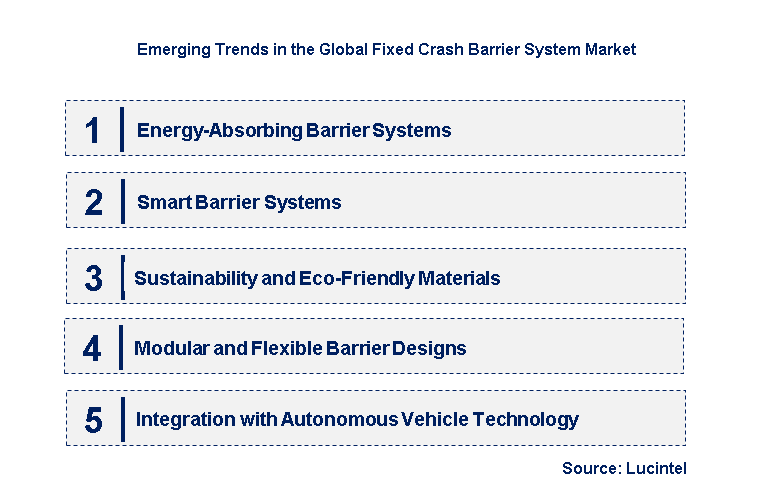
• Energy-Absorbing Barrier Systems: Energy-absorbing barrier systems are becoming a key trend in the Fixed Crash Barrier market. These systems are designed to absorb the kinetic energy during a crash, reducing the impact force on vehicles and passengers. This technology helps minimize fatalities and severe injuries in road accidents. As governments and regulatory bodies continue to push for higher safety standards, energy-absorbing barriers are gaining popularity in both urban and highway applications. Their adoption is expected to increase across various countries, making roads safer for all users.
• Smart Barrier Systems: The integration of smart technologies into fixed crash barrier systems is revolutionizing road safety. Smart barriers use sensors, cameras, and data analytics to monitor traffic conditions, detect accidents, and provide real-time updates to road authorities. This technology allows for faster responses in case of crashes, ensuring quicker accident clearance and reducing secondary accidents. Additionally, smart systems help optimize traffic flow by providing alerts for potential collisions or road hazards. The growing adoption of IoT and AI technologies in smart barrier systems is expected to significantly enhance road safety and management.
• Sustainability and Eco-Friendly Materials: Sustainability is a growing concern in the Fixed Crash Barrier market, and there is a strong emphasis on using eco-friendly materials for barrier construction. Manufacturers are turning to recycled materials, such as plastics, rubber, and steel, to create barriers that are both durable and environmentally friendly. This trend aligns with global efforts to reduce carbon footprints and promote recycling. Additionally, the use of low-carbon materials helps decrease the overall environmental impact of infrastructure projects. Sustainable barrier systems are likely to see increased demand as the construction industry prioritizes green initiatives.
• Modular and Flexible Barrier Designs: Modular and flexible barrier designs are gaining popularity due to their adaptability and ease of installation. These barriers can be customized to suit different road conditions and safety requirements. Their modular nature allows for easy replacement or expansion without major construction efforts. This trend is particularly useful in urban areas where road designs and conditions may change frequently. Modular barriers can be reconfigured as needed, offering flexibility in meeting evolving safety needs. The rise in demand for such systems reflects the need for more adaptable and cost-effective infrastructure solutions.
• Integration with Autonomous Vehicle Technology: The development of autonomous vehicles is influencing the design of fixed crash barrier systems. Barriers are being designed with features that consider the presence of self-driving cars, such as better visibility and clearer road markings to ensure safety in case of vehicle malfunctions. Additionally, crash barriers are being integrated into the broader smart infrastructure of autonomous vehicles, with features such as collision avoidance systems and automatic barrier activation. This trend is set to gain momentum as autonomous vehicles become more prevalent, and there is a need for crash barriers that support this emerging technology. The fixed crash barrier system market is being reshaped by trends such as energy-absorbing barriers, smart systems, sustainability, modular designs, and the integration of autonomous vehicle technology. These trends are driving innovation, improving road safety, and enhancing the overall performance of crash barriers worldwide.
• Energy-Absorbing Barrier Innovations: Innovations in energy-absorbing crash barrier systems are significantly improving safety in the market. These barriers are designed to dissipate the energy generated during a collision, reducing the force of the impact and minimizing damage to vehicles and passengers. The development of these barriers has made roads safer, and their adoption is expected to increase, particularly in high-risk areas like highways and urban zones.
• Smart Barrier Integration: The integration of smart technology in crash barriers is a noteworthy development. Smart barriers equipped with sensors and cameras allow for real-time monitoring of road conditions and traffic flow. These barriers can detect collisions, alert road authorities, and provide essential data on traffic incidents. The real-time data improves the efficiency of accident management and enhances overall road safety, especially in busy urban areas.
• Use of Sustainable Materials: The use of sustainable materials in the construction of fixed crash barrier systems is gaining traction. Manufacturers are increasingly turning to recycled and eco-friendly materials to reduce the environmental impact of barrier systems. This move not only helps reduce carbon emissions but also aligns with global efforts toward sustainability in construction and infrastructure. The trend towards green materials is expected to grow, especially in regions with stringent environmental regulations.
• Modular and Customizable Barrier Systems: Modular and customizable barrier systems have become a significant development in the market. These barriers offer flexibility and can be easily adjusted to meet the specific needs of different roads or locations. Their modular nature allows for quick repairs or replacements, reducing downtime and maintenance costs. This flexibility is especially useful in areas where road layouts frequently change, such as urban settings.
• Impact of Autonomous Vehicles: With the rise of autonomous vehicles, fixed crash barrier systems are being designed with new safety features. Barriers are now being developed to accommodate self-driving vehicles by incorporating technologies like adaptive sensors and clearer lane markings. These features are essential for ensuring the safety of autonomous cars in the event of a collision. As autonomous vehicle technology becomes more widespread, these new barrier systems will be crucial in maintaining safety standards on roads. Recent developments in the fixed crash barrier system market focus on improving safety, integrating smart technologies, using sustainable materials, and accommodating new vehicle technologies. These developments are poised to enhance the overall safety and efficiency of transportation networks worldwide.
• Highway Safety Enhancements: One of the primary growth opportunities in the fixed crash barrier system market lies in highway safety enhancements. With the increasing number of vehicles on highways, the need for effective crash barriers to protect both drivers and pedestrians is growing. Manufacturers are focusing on developing barriers that can withstand high-speed impacts and provide additional safety features, such as impact-absorbing materials and smart technology integration. This trend is expected to drive growth in both developed and developing countries.
• Urban Road Safety: Urban areas present a unique challenge for road safety due to dense traffic, narrow roads, and high pedestrian activity. The demand for Fixed Crash Barriers in urban environments is expected to increase as cities strive to improve road safety and reduce accidents. Smart barriers and modular systems that can be customized to urban settings are gaining traction. This offers significant opportunities for manufacturers to expand their offerings in urban infrastructure projects.
• Industrial Zones and Manufacturing Plants: Fixed Crash Barriers are also in demand in industrial zones and manufacturing plants where heavy vehicles and machinery are in use. These areas often pose unique safety risks, and crash barriers help mitigate the potential for accidents. Manufacturers can capitalize on this opportunity by offering robust and durable barrier systems designed to withstand heavy impacts and ensure safety in industrial settings.
• Public Transport Infrastructure: With the rise in public transportation systems, there is a growing need for Fixed Crash Barriers at bus depots, train stations, and tram lines. These systems need to protect pedestrians, vehicles, and the infrastructure from accidents. As public transportation systems expand globally, manufacturers can look to offer specialized crash barriers that can be integrated into public transport networks for enhanced safety.
• Vehicle Crash Simulation Testing Centers: Crash testing centers for vehicle manufacturers present a niche opportunity for Fixed Crash Barriers. These centers require highly specialized barriers for simulation tests, ensuring vehicles can be evaluated under controlled, safe conditions. Manufacturers can develop customized crash barriers for these testing facilities, which will drive growth in the market. Strategic growth opportunities in the fixed crash barrier system market exist in areas like highway safety, urban environments, industrial zones, public transport infrastructure, and crash simulation centers. These applications are expected to drive demand for advanced, customizable barrier systems globally.
• Tata Steel Limited
• NV Bekaert SA
• Trinity Industries
• Nucor Corporation
• Valmont Industries
• Lindsay Corporation
• Hill & Smith Holdings Plc
• Transpo Industries
• Arbus Limited
• Avon Barrier Corporation
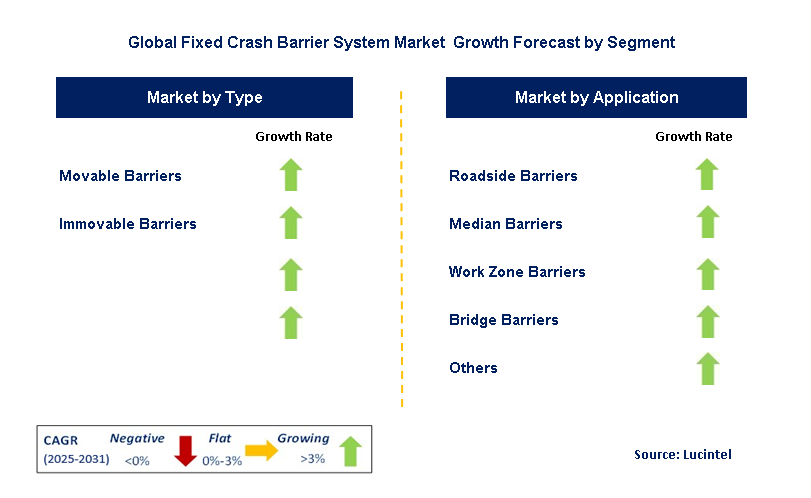
• Movable Barriers
• Immovable Barriers
• Roadside Barriers
• Median Barriers
• Work Zone Barriers
• Bridge Barriers
• Others
• North America
• Europe
• Asia Pacific
• The Rest of the World
• United States: In the United States, recent developments in the fixed crash barrier system market are largely driven by a focus on road safety and reducing fatalities. The country is incorporating more advanced materials, such as high-strength steel and composite materials, into barrier systems for increased durability and impact resistance. Additionally, there is a growing trend towards barrier systems that are energy-absorbing, which helps minimize the damage in collisions. The U.S. has also seen an increased investment in smart barrier systems, integrating technologies like sensors to monitor crash zones and manage traffic more effectively.
• China: China is also expanding the fixed crash barrier system market, especially for urban areas and highways, as various infrastructure projects are under way. The government aims to improve the safety of the roads with new regulations and barrier technology. Chinese companies are manufacturing barriers that can take the most serious impacts, while complying with international standards. There is an increase in the use of eco-friendly materials in barrier construction, mainly because of recycled plastics and low-carbon materials. China is also investing in smarter, more flexible barrier systems to ensure public safety in the face of growing traffic volumes.
• Germany: Germany continues at the top in the fixed crash barrier system market by offering advanced engineering solutions in view of road safety. The country is focusing on high-performance, modular barriers that can be easily adapted to different road conditions and safety requirements. Germany is also focusing on integrating technology into its barriers, such as crash detection and automatic damage reporting systems. This enables quicker responses to accidents and enhances safety measures on highways. The increasing pressure to maintain superior environmental standards and the rising development of new systems using sustainable and recyclable materials are other prominent factors in the market.
• India: fixed crash barrier system in India is showing rapid growth, mainly because the country's developing road network necessitates a rising demand for road safety. The government is urging stronger safety barriers on highways and rural roads. It is demanding that the barriers be cost-effective but strong. Local manufacturers are taking up international standards and advanced materials to make barriers more effective. The rise in vehicle traffic and increased road accidents have led to a greater demand for reliable crash barriers, especially in high-risk zones like hilly regions and expressways.
• Japan: In Japan, advancements in the fixed crash barrier system market are influenced by a combination of cutting-edge technology and stringent road safety regulations. Japan is incorporating crash barriers with advanced materials like carbon fiber and steel composites to enhance impact resistance. Furthermore, Japan is adopting intelligent systems that monitor traffic conditions and provide real-time data on barrier performance. The country is also prioritizing the development of barrier systems that can withstand natural disasters such as earthquakes and tsunamis, ensuring that road safety infrastructure remains intact even in extreme conditions.


• Tata Steel Limited
• NV Bekaert SA
• Trinity Industries
• Nucor Corporation
• Valmont Industries
• Lindsay Corporation
• Hill & Smith Holdings Plc
• Transpo Industries
• Arbus Limited
• Avon Barrier Corporation Q5. Which fixed crash barrier system market segment will be the largest in future? Answer: Lucintel forecasts that movable barriers is expected to witness the highest growth over the forecast period. Q6. In fixed crash barrier system market , which region is expected to be the largest in next 5 years? Answer: APAC is expected to witness the highest growth over the forecast period. Q7. Do we receive customization in this report? Answer: Yes, Lucintel provides 10% customization without any additional cost.


Choose a license that fits your team. Instant PDF delivery.
Prices exclude taxes. Instant delivery. Custom licensing available on request.
Market Report · July 22, 2026
Market Report · July 17, 2026
Market Report · July 17, 2026
Trusted partner for strategic intelligence and business growth


Receive a complimentary market analysis tailored to your industry. Our analysts will identify key growth opportunities and competitive dynamics specific to your business.

Market size, growth rate, and key trend analysis for your specific sector.

Top competitor positioning and market share analysis.

Strategic recommendations backed by data-driven insights.
Get curated market intelligence and competitive moves straight to your inbox.
By subscribing, you agree to receive our monthly insights. Unsubscribe anytime.
Receive a complimentary market analysis tailored to your industry. Our analysts will identify key growth opportunities and competitive dynamics specific to your business.
Market size, growth rate, and key trend analysis for your specific sector.
Top competitor positioning and market share analysis.
Strategic recommendations backed by data-driven insights.
Get curated market intelligence, emerging trends, and competitive moves straight to your inbox each month.
By subscribing, you agree to receive our monthly insights. Unsubscribe anytime.
We'll send your sample report shortly.