
Market Report · May 16, 2026

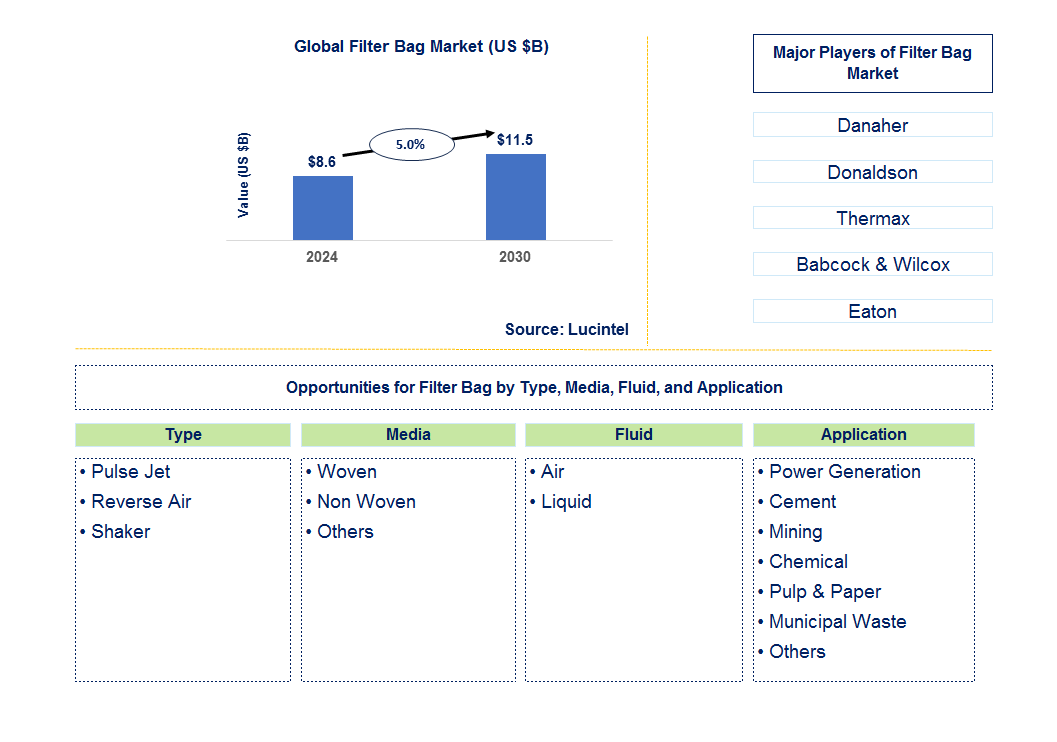
Key data points: The market size in 2030 = $11.5 billion, growth forecast = 5.0% annually next 6 years. Scroll below to get more insights. This market report covers trends, opportunities, and forecast in the global filter bag market to 2030 by type (pulse jet, reverse air, and shaker), media (woven, non woven, and others), fluid (air and liquid), application (power generation, cement, mining, chemical, pulp & paper, municipal waste, and others), and region (North America, Europe, Asia Pacific, and the Rest of the World)
We'll send your sample report shortly.
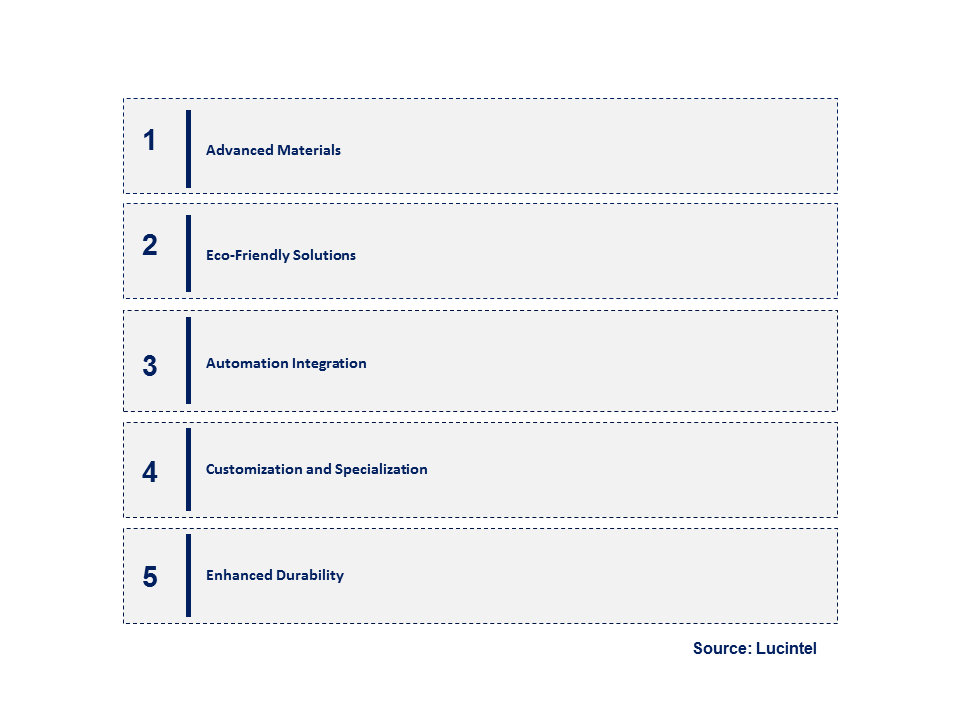
• Advanced Materials: The use of advanced materials such as nanofibers and PTFE coatings is becoming more common. These materials enhance filtration performance and lifespan of filter bags thereby making them capable of meeting higher demands under harsh conditions.
• Eco-Friendly Solutions: Sustainability focus has increased with companies developing green eco-friendly filter bags made out of recycled or bio-degradable materials as indicated elsewhere. This trend follows increased regulatory pressure due to consumer demand for greener products.
• Automation Integration: There has been an increase in integration with fully automatic filtration systems over recent times. Automated systems improve operational efficiency and reduce maintenance needs hence making them better tools for handling different industrial settings than traditional ones do currently, therefore making them effective and manageable options even within other industries’ applications where they are applied systematically only lessens operation costs significantly rather than eliminating need for constant supervision if not total elimination altogether unlike management cases would be without any human intervention whatsoever.
• Customization and Specialization: There is a growing tendency in the market towards customizing and specializing of filter bags for different industrial targets. This approach improves performance as well as helps to overcome specific challenges noticed within various sectors.
• Enhanced Durability: One of the key points to improving durability of filter bags is intent to use advanced manufacturing technologies and high-performance materials in their production. Better durability leads to less replacement frequency or maintenance which means cost savings and higher reliability. These trends have contributed to innovation and transformation in the filter bag market characterized by products made of advanced materials, eco-friendly orientation, automation, customization, durability etc., and at times affecting functionality across various industrial realms.
• Nanofiber Technology: By incorporating nanofiber technology into filter bags it’s possible to increase filtration efficiency and performance of those filters. Such microfibers help capture particles more efficiently while decreasing pressure drop-situations that make such bags highly effective for other relevant uses.
• Sustainable Materials: Producers are now making filter bags from recycled or biodegradable materials due to this trend that favors sustainable products. This way companies satisfy certain environmental requirements promoting global sustainability goals on earth.
• Automation in Manufacturing: Advances in manufacturing automation improve production efficiency and consistency of filter bags. Automated systems reduce labor costs while ensuring high quality products thus stimulating growth within the market.
• High-Efficiency Filters: The development of high-efficiency filters with advanced coatings and multi-layered fabrics addresses increasing demands for better performance under harsh conditions. Thus contamination is decreased considerably, moreover filter bags’ life is extended.
• Regulatory Compliance: New stringent environmental regulations call for high-performance filter bags. This has resulted in manufacturers focusing on air and water quality regulation compliance which led to innovations in filtration technology. There are recent developments that have manifested themselves within filter bag technology like nanofiber integration, sustainable materials, manufacturing automation, high-efficiency filters, and regulatory compliance. These changes will shape the market as a whole thus enhancing efficiency and sustainability of filtration solutions.
• Power Generation: The power generation sector offers significant growth potential due to the need for high-efficiency filtration solutions. Highly efficient filter bags are important in controlling emissions from power plants thereby ensuring adherence to environmental standards.
• Cement Industry: The cement industry presents growth opportunities for filter bags because it is characterized by high dust and particulate levels during production. Advanced filter bags can help improve air quality and meet regulatory requirements.
• Mining Sector: Mining requires robust and high performing filters that would cope with heavy dust loadings. Therefore, it is possible for them to create special-purpose filters adjusted specifically for operation under mining conditions using them as an expansion driver.
• Chemical Industry: The chemical industry requires filters that can resist chemicals at harsh temperatures. Growth prospects include development of chemically resistant filters with improved durability as well. These strategic growth opportunities in power generation, cement, mining, chemical industries, and municipal waste management highlight the potential for market expansion through tailored solutions and advanced filter bag technologies. Development in these areas could drive innovation to reduce industrial problems.
• Danaher
• Donaldson
• Thermax
• Babcock & Wilcox
• Eaton
• Mitsubishi Hitachi Power System
• General Electric
• Camfil Farr
• BWF Envirotech
• Lenntech
• Pulse Jet
• Reverse Air
• Shaker
• Woven
• Non Woven
• Others
• Air
• Liquid
• Power Generation
• Cement
• Mining
• Chemical
• Pulp & Paper
• Municipal Waste
• Others
• North America
• Europe
• Asia Pacific
• The Rest of the World
• United States: Advancements in filter bag technology in the US include nanofiber incorporation for improved filtration efficiency. Also, there has been an emphasis on sustainable operations where most firms are increasingly using eco-friendly components alongside introducing recycling programs. Regulatory shifts have led to increased demand for higher performing filters in sectors such as energy generation and chemical manufacturing.
• China: China’s rapid industrialization along with tighter environmental rules is responsible for the fast growth of its filter bag market. Advanced manufacturing techniques have been introduced to increase local production capacity as recent trends indicate. To deal with air pollution problems as well as water pollution issues, the government also encourages the use of high-efficiency filter bags.
• Germany: Germany concentrates on technological advancements in filter bag designs including multi-layered fabrics that improve performance as well as lifespan through advanced coatings. Besides, investments into research aimed at meeting stringent environmental standards have increased significantly after years of declining fortunes for highly efficient filtration solutions.
• India: There has been a growing focus on affordability combined with domestic manufacturing process within India’s filter bag industry recently. Some new developments involve expansion of production facilities, which have been done cheaply. Industrialization is growing in size at an increasing pace and more attention is being paid to improving the quality of air and water.
• Japan: Japan’s filter bag market has turned into a growth industry that specializes in high tech solutions for various industrial applications. Major developments include better media technologies for filters and more integration with automated equipment. Durability and operational efficiency are thus emphasized by Japan when choosing filter bags to meet demanding requirements.


• Danaher
• Donaldson
• Thermax
• Babcock & Wilcox
• Eaton
• Mitsubishi Hitachi Power System
• General Electric
• Camfil Farr
• BWF Envirotech
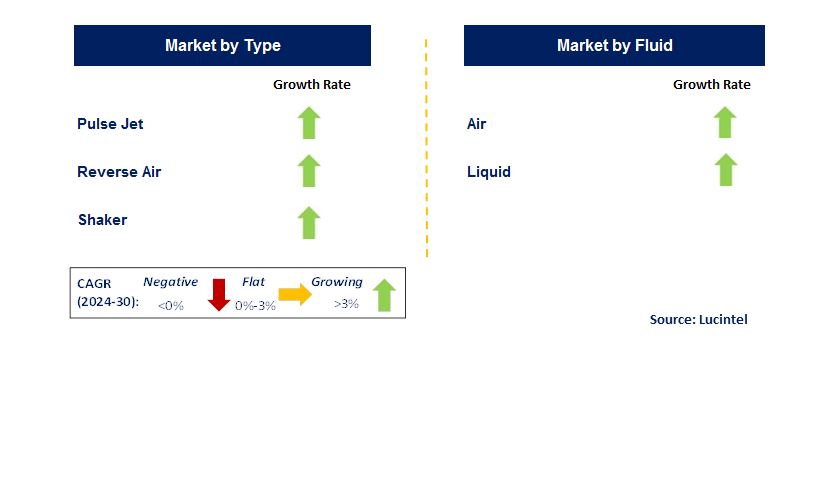
• Lenntech Q6. Which filter bag market segment will be the largest in future? Answer: Lucintel forecasts that pulse jet is expected to witness the highest growth over the forecast period because it improves operating efficiency in areas such as cement manufacture, electricity generation, chemicals, and municipal waste management. Q7. In filter bag market, which region is expected to be the largest in next 5 years? Answer: APAC will remain the largest region over the forecast period due to increasing environmental regulations on pollution from cement and electricity production units. Q.8 Do we receive customization in this report? Answer: Yes, Lucintel provides 10% customization without any additional cost.


Choose a license that fits your team. Instant PDF delivery.
Prices exclude taxes. Instant delivery. Custom licensing available on request.
Market Report · May 16, 2026
Market Report · May 16, 2026
Market Report · May 16, 2026
Trusted partner for strategic intelligence and business growth


Receive a complimentary market analysis tailored to your industry. Our analysts will identify key growth opportunities and competitive dynamics specific to your business.

Market size, growth rate, and key trend analysis for your specific sector.

Top competitor positioning and market share analysis.

Strategic recommendations backed by data-driven insights.
Get curated market intelligence and competitive moves straight to your inbox.
By subscribing, you agree to receive our monthly insights. Unsubscribe anytime.
Receive a complimentary market analysis tailored to your industry. Our analysts will identify key growth opportunities and competitive dynamics specific to your business.
Market size, growth rate, and key trend analysis for your specific sector.
Top competitor positioning and market share analysis.
Strategic recommendations backed by data-driven insights.
Get curated market intelligence, emerging trends, and competitive moves straight to your inbox each month.
By subscribing, you agree to receive our monthly insights. Unsubscribe anytime.
We'll send your sample report shortly.