
Market Report · July 31, 2026

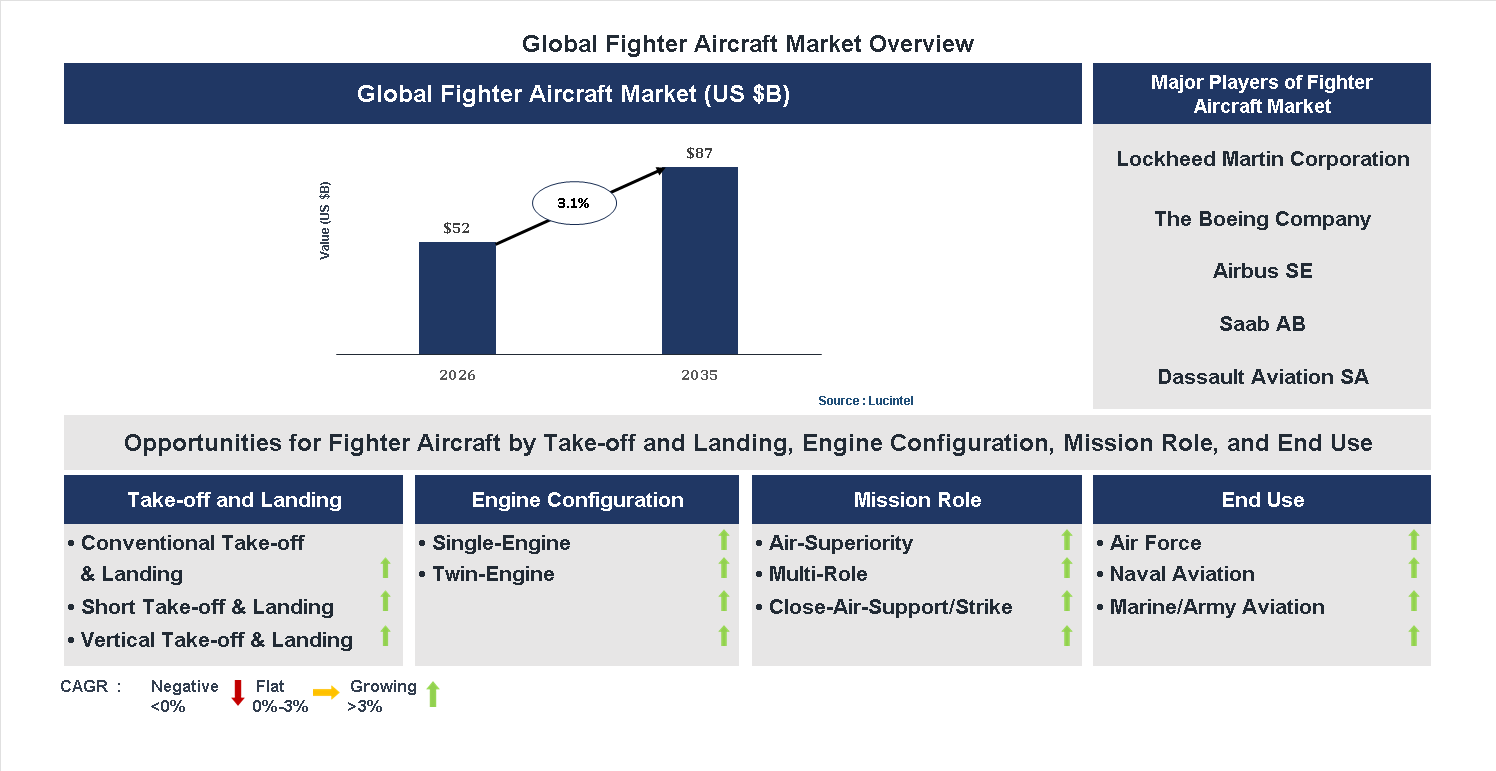
Key data points: The market size in 2035 = $7 billion, growth forecast = 2.8% annually for the next 8 years. Scroll below to get more insights. This market report covers trends, opportunities and forecasts in fighter aircraft market to 2035 by take-off and landing (conventional take-off & landing, short take-off & landing, and vertical take-off & landing), engine configuration (single-engine and twin-engine), mission role (air-superiority, multi-role, and close-air-support/strike), end use (air force, naval aviation, and marine/army aviation), and region (North America, Europe, Asia Pacific, and the Rest of the World)
We'll send your sample report shortly.
• Lucintel forecasts that, within the take-off and landing category, conventional take-off & landing is expected to witness the highest growth over the forecast period.
• Within the application category, naval aviation is expected to witness the highest growth.
• In terms of region, APAC is expected to witness the highest growth over the forecast period. Gain valuable insights for your business decisions with our comprehensive 150+ page report. Sample figures with some insights are shown below.
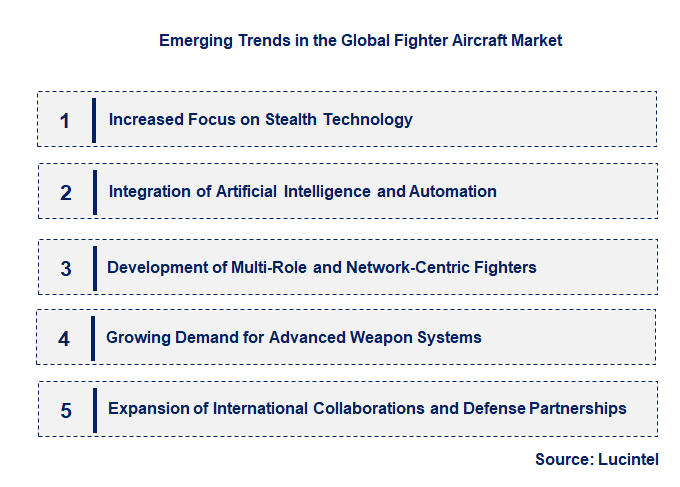
• Increased Focus on Stealth Technology: Enhanced stealth capabilities are becoming a priority to reduce radar cross-section and improve survivability. Manufacturers are integrating advanced materials and design techniques to develop aircraft that can evade detection, thereby increasing mission success rates and operational effectiveness. This trend is driven by the need to counter sophisticated enemy defenses and is leading to the development of next-generation fighters with superior stealth features.
• Integration of Artificial Intelligence and Automation: AI and automation are transforming fighter aircraft operations by enabling autonomous decision-making, improved targeting, and real-time data analysis. These technologies enhance pilot situational awareness and reduce workload, allowing for more precise and efficient missions. The adoption of AI-driven systems is also paving the way for semi-autonomous and fully autonomous fighter aircraft, which could revolutionize aerial combat strategies.
• Development of Multi-Role and Network-Centric Fighters: Modern fighters are increasingly designed to perform multiple roles, including air superiority, ground attack, and reconnaissance. They are also being integrated into network-centric warfare systems, allowing seamless communication and coordination with other military assets. This trend enhances operational flexibility and situational awareness, enabling forces to adapt quickly to dynamic battlefield conditions and improve overall mission effectiveness.
• Growing Demand for Advanced Weapon Systems: The market is witnessing a surge in the development and deployment of sophisticated weaponry, such as hypersonic missiles, directed energy weapons, and advanced targeting systems. These enhancements significantly boost the destructive power and precision of fighter aircraft, providing a strategic edge. The focus on integrating these advanced weapons is driven by evolving threats and the need for superior offensive and defensive capabilities.
• Expansion of International Collaborations and Defense Partnerships: Countries are increasingly engaging in joint development programs, technology sharing, and defense alliances to access cutting-edge fighter aircraft technology. This trend reduces costs, accelerates innovation, and strengthens geopolitical ties. Notable examples include multinational projects like the FCAS (Future Combat Air System) and Tempest programs, which aim to develop next-generation fighters through collaborative efforts. These trends are collectively reshaping the fighter aircraft market by emphasizing technological innovation, operational versatility, and international cooperation. The focus on stealth, AI, multi-role capabilities, advanced weaponry, and global partnerships is driving the development of more sophisticated, adaptable, and survivable fighter aircraft. As these trends continue to evolve, they will influence military strategies, defense spending, and geopolitical dynamics, ultimately leading to a more technologically advanced and interconnected aerial combat environment.
• Stealth Technology Advancements: Enhanced stealth capabilities are reducing aircraft radar cross-sections, allowing fighters to operate undetected in hostile environments. Innovations in materials and design are making aircraft less visible to enemy radar systems, increasing survivability and mission success rates. These improvements are driving demand for next-generation fighters with superior stealth features, impacting procurement strategies worldwide. Countries prioritize stealth to gain tactical advantages, leading to increased competition among defense contractors to develop more advanced, cost-effective stealth aircraft.
• Integration of Artificial Intelligence: AI is revolutionizing fighter aircraft by enabling autonomous operations, real-time data processing, and improved decision-making. AI-powered systems assist pilots in targeting, navigation, and threat detection, enhancing combat efficiency. This integration reduces pilot workload and increases mission success probabilities. Defense agencies are investing heavily in AI research to develop smarter, more adaptable fighters. The adoption of AI is expected to accelerate, creating new market segments and fostering innovation in aircraft design and operational tactics.
• Development of Supersonic and Hypersonic Fighters: The push for faster aircraft capable of reaching supersonic and hypersonic speeds is gaining momentum. These fighters offer strategic advantages by reducing response times and increasing survivability. Technological breakthroughs in propulsion and materials are enabling the development of such aircraft. Countries are prioritizing hypersonic capabilities to counter emerging threats and maintain technological edge. This trend is expected to open new markets for high-speed fighter aircraft, prompting significant R&D investments and international collaborations.
• Focus on Multi-Role and Network-Centric Capabilities: Modern fighters are increasingly designed for multi-role versatility, including air-to-air, air-to-ground, and electronic warfare. Network-centric systems enable fighters to operate seamlessly within integrated battle networks, sharing real-time data with other assets. This enhances situational awareness and operational coordination. The demand for adaptable, multi-role fighters is driving innovation in modular design and advanced communication systems. Governments seek versatile platforms to maximize operational flexibility, influencing procurement and development priorities across the industry.
• Emphasis on Sustainable and Cost-Effective Solutions: Environmental concerns and budget constraints are prompting the industry to develop more sustainable fighter aircraft. Innovations include the use of lighter, more durable materials and fuel-efficient propulsion systems. Cost-effective manufacturing processes are also being adopted to reduce lifecycle expenses. These developments aim to make advanced fighters more accessible to a broader range of countries while minimizing environmental impact. The focus on sustainability is shaping future design philosophies and influencing market competition, encouraging manufacturers to balance performance with ecological responsibility. These developments are significantly transforming the fighter aircraft market by fostering innovation, enhancing capabilities, and expanding market opportunities. Countries are increasingly investing in advanced technologies to secure strategic advantages, leading to a dynamic and competitive industry landscape. The integration of stealth, AI, high-speed capabilities, multi-role versatility, and sustainability is driving growth, shaping future military aviation strategies worldwide.
• Increasing Defense Budgets Drive Market Expansion: Rising defense spending globally, especially in North America, Asia-Pacific, and the Middle East, fuels demand for modern fighter aircraft. Governments prioritize upgrading their air forces with advanced, multirole jets to ensure national security. This financial commitment supports research, development, and procurement activities, creating a robust market environment. The focus on sovereignty and technological superiority further accelerates investments in next-generation fighter programs, fostering long-term growth opportunities for manufacturers and suppliers.
• Technological Innovations Enhance Fighter Capabilities: Advancements in stealth technology, supersonic speeds, and integrated avionics are transforming fighter aircraft. Developments in artificial intelligence, sensor fusion, and electronic warfare systems improve operational efficiency and survivability. These innovations enable aircraft to perform complex missions, including air superiority, ground attack, and reconnaissance. As technology matures, the market sees increased demand for highly sophisticated fighters, encouraging R&D investments and collaborations among defense contractors to develop cutting-edge solutions.
• Growing Demand for Multirole and Next-Generation Fighters: The shift towards multirole fighters capable of executing diverse missions is a key growth driver. Countries seek versatile aircraft that can adapt to evolving threats without multiple platforms. Next-generation fighters with enhanced stealth, agility, and network-centric warfare capabilities are gaining prominence. This trend opens opportunities for aircraft like the F-35, Su-57, and future prototypes, fostering competition and innovation. The need for cost-effective, adaptable platforms is expected to sustain market growth over the coming decades.
• Emerging Markets Present New Opportunities: Countries in Asia, Africa, and Latin America are increasing their defense budgets and modernizing their air forces. These regions seek affordable, reliable fighter aircraft to bolster national security. Local manufacturing partnerships, technology transfer agreements, and government incentives are facilitating market entry. The rising demand for light fighters, trainer aircraft, and upgrade kits creates a diverse sub-segment landscape. This expansion into emerging markets diversifies revenue streams and encourages global collaboration among defense firms.
• Strategic Collaborations and Defense Alliances Accelerate Market Growth: International partnerships, joint ventures, and defense alliances facilitate technology sharing and co-development of fighter aircraft. Countries forming strategic alliances benefit from access to advanced technologies and reduced procurement costs. Collaborative programs like NATOs initiatives and bilateral agreements enhance interoperability and operational readiness. These alliances foster innovation, streamline supply chains, and expand market reach for manufacturers. The trend towards joint development and procurement is expected to sustain growth and strengthen the global fighter aircraft industry. The overall impact of these opportunities is a highly dynamic and expanding fighter aircraft market, driven by technological progress, geopolitical needs, and strategic collaborations. Industry players are positioned to capitalize on emerging demand segments, fostering innovation and competitiveness. As nations prioritize air superiority and multirole capabilities, the market is poised for sustained growth, shaping the future of aerial combat and defense strategies worldwide.
• Technological Innovation: The continuous development of advanced materials, stealth technology, and avionics systems enhances aircraft capabilities, making them more effective and appealing to defense agencies. Innovations like artificial intelligence and drone integration are transforming fighter aircraft, increasing their operational efficiency and survivability. This technological progress attracts investments and accelerates market growth, as countries seek to modernize their fleets with cutting-edge solutions to maintain strategic superiority.
• Increasing Defense Budgets: Many countries are allocating substantial funds toward modernizing their air forces, driven by geopolitical tensions and security concerns. Rising defense budgets enable procurement of next-generation fighter aircraft, upgrades of existing fleets, and development of indigenous technologies. This financial commitment sustains demand in the market, encouraging manufacturers to innovate and expand their product offerings to meet the evolving needs of global militaries.
• Geopolitical Tensions and Security Concerns: Rising regional conflicts and international rivalries prompt nations to enhance their air combat capabilities. The need for rapid deployment, superior maneuverability, and advanced weapon systems drives demand for modern fighter aircraft. Countries seek to secure strategic advantages, leading to increased procurement and development activities, which significantly propel market growth.
• Strategic Alliances and Defense Partnerships: International collaborations, joint ventures, and defense pacts facilitate technology transfer and co-development of fighter aircraft. These alliances reduce costs, improve technological capabilities, and expand market reach. Such partnerships foster innovation and enable countries to access advanced aircraft models, thereby stimulating market expansion and competitiveness.
• Export Opportunities and Military Modernization Programs: Countries with surplus defense budgets and strategic ambitions seek to export fighter aircraft, opening new markets for manufacturers. Additionally, ongoing military modernization programs worldwide create sustained demand for new and upgraded aircraft. These export and modernization initiatives are vital drivers, fueling industry growth and technological advancement. The challenges facing the fighter aircraft market are:-
• High Development and Procurement Costs: Developing advanced fighter aircraft involves significant investment in research, testing, and manufacturing. Procurement costs for end-users are also substantial, often limiting procurement to wealthier nations. These high costs can restrict market growth, delay procurement cycles, and pose financial risks for manufacturers and buyers alike.
• Regulatory and Export Restrictions: Stringent export controls, international sanctions, and compliance standards complicate the sale and transfer of fighter aircraft technology. These regulations can delay deals, restrict market access, and increase compliance costs. Navigating complex regulatory environments is a persistent challenge that hampers global market expansion.
• Rapid Technological Obsolescence: The fast pace of technological innovation can render existing fighter aircraft obsolete quickly. Manufacturers face pressure to continuously upgrade and innovate, increasing R&D costs and complicating long-term planning. This rapid obsolescence risk can deter investment and affect the overall stability of the market. The fighter aircraft market is shaped by significant technological advancements, increasing defense spending, geopolitical tensions, and strategic alliances, which collectively drive growth. However, high costs, regulatory hurdles, and rapid technological changes pose substantial challenges. These factors create a dynamic environment requiring continuous innovation, strategic planning, and regulatory navigation. Overall, the markets future depends on balancing these drivers and challenges to sustain growth and technological leadership in global defense.
• Lockheed Martin Corporation
• The Boeing Company
• Airbus SE
• Saab AB
• Dassault Aviation SA
• BAE Systems plc
• United Aircraft Corporation
• Hindustan Aeronautics Limited
• Mitsubishi Heavy Industries, Ltd.
• Korea Aerospace Industries, Ltd.
• Conventional Take-off & Landing
• Short Take-off & Landing
• Vertical Take-off & Landing
• Single-Engine
• Twin-Engine
• Air-Superiority
• Multi-Role
• Close-Air-Support/Strike
• Air Force
• Naval Aviation
• Marine/Army Aviation
• North America
• Europe
• Asia Pacific
• The Rest of the World
• United States: The US continues to lead the fighter aircraft market with the ongoing development of the F-35 Lightning II, which incorporates advanced stealth, sensor fusion, and AI capabilities. The US Air Force is also investing in the next-generation fighter, the F-X program, aiming for superior agility and multi-role versatility. Recent upgrades include enhanced electronic warfare systems and increased procurement to maintain air dominance. The US is also exploring unmanned fighter variants and integrating drone technology into existing platforms, emphasizing innovation and technological superiority.
• China: China has made rapid advancements with its J-20 Mighty Dragon stealth fighter, focusing on stealth, supercruise, and advanced avionics. The country is expanding its domestic defense industry, aiming for self-sufficiency in fighter aircraft production. Recent developments include the introduction of the J-16 and J-10 variants, along with improvements in missile technology and electronic warfare systems. China’s focus on indigenous technology and regional deployment strategies aims to challenge US dominance and expand its influence in Asia-Pacific.
• Germany: Germany is modernizing its Eurofighter Typhoon fleet, emphasizing interoperability within NATO and integrating new weapon systems and sensors. The country is investing in upgrades such as improved radar, electronic warfare capabilities, and precision-guided munitions. Germany also collaborates with European partners on the Future Combat Air System (FCAS) project, aiming to develop a next-generation fighter with stealth and AI features. These efforts reflect Germany’s commitment to maintaining a technologically advanced and interoperable air force within the European defense framework.
• India: India is advancing its indigenous fighter program with the HAL Tejas and the development of the 5th-generation fighter, the Advanced Medium Combat Aircraft (AMCA). The country is also procuring Rafale jets from France to bolster its capabilities. Recent efforts focus on enhancing stealth, avionics, and missile technology. India aims to reduce dependency on foreign suppliers and strengthen its regional defense posture amid border tensions. The country is also exploring joint ventures and technology transfers to accelerate domestic fighter aircraft production.
• Japan: Japan is modernizing its fleet with the F-35A Lightning II, emphasizing stealth, sensor fusion, and networked warfare capabilities. The country is also investing in the development of the Mitsubishi F-X, a next-generation fighter designed to replace aging aircraft and ensure regional security. Japan’s focus includes advanced radar, electronic warfare, and integrated defense systems to counter regional threats. The government is increasing defense budgets and fostering collaborations with allies to enhance its aerial combat capabilities and maintain strategic stability in the Asia-Pacific region.


• Lockheed Martin Corporation
• The Boeing Company
• Airbus SE
• Saab AB
• Dassault Aviation SA
• BAE Systems plc
• United Aircraft Corporation
• Hindustan Aeronautics Limited
• Mitsubishi Heavy Industries, Ltd.
• Korea Aerospace Industries, Ltd. Q6. Which fighter aircraft market segment will be the largest in future? Answer: Lucintel forecasts that, within the take-off and landing category, conventional take-off & landing is expected to witness the highest growth over the forecast period. Q7. In fighter aircraft market, which region is expected to be the largest in next 8 years? Answer: In terms of region, APAC is expected to witness the highest growth over the forecast period. Q8. Do we receive customization in this report? Answer: Yes, Lucintel provides 10% customization without any additional cost.


Choose a license that fits your team. Instant PDF delivery.
Prices exclude taxes. Instant delivery. Custom licensing available on request.
Market Report · July 31, 2026
Market Report · July 31, 2026
Market Report · July 22, 2026
Trusted partner for strategic intelligence and business growth


Receive a complimentary market analysis tailored to your industry. Our analysts will identify key growth opportunities and competitive dynamics specific to your business.

Market size, growth rate, and key trend analysis for your specific sector.

Top competitor positioning and market share analysis.

Strategic recommendations backed by data-driven insights.
Get curated market intelligence and competitive moves straight to your inbox.
By subscribing, you agree to receive our monthly insights. Unsubscribe anytime.
Receive a complimentary market analysis tailored to your industry. Our analysts will identify key growth opportunities and competitive dynamics specific to your business.
Market size, growth rate, and key trend analysis for your specific sector.
Top competitor positioning and market share analysis.
Strategic recommendations backed by data-driven insights.
Get curated market intelligence, emerging trends, and competitive moves straight to your inbox each month.
By subscribing, you agree to receive our monthly insights. Unsubscribe anytime.
We'll send your sample report shortly.