
Report Feature
Fibre Reinforced Polymer Market Trends and Forecast
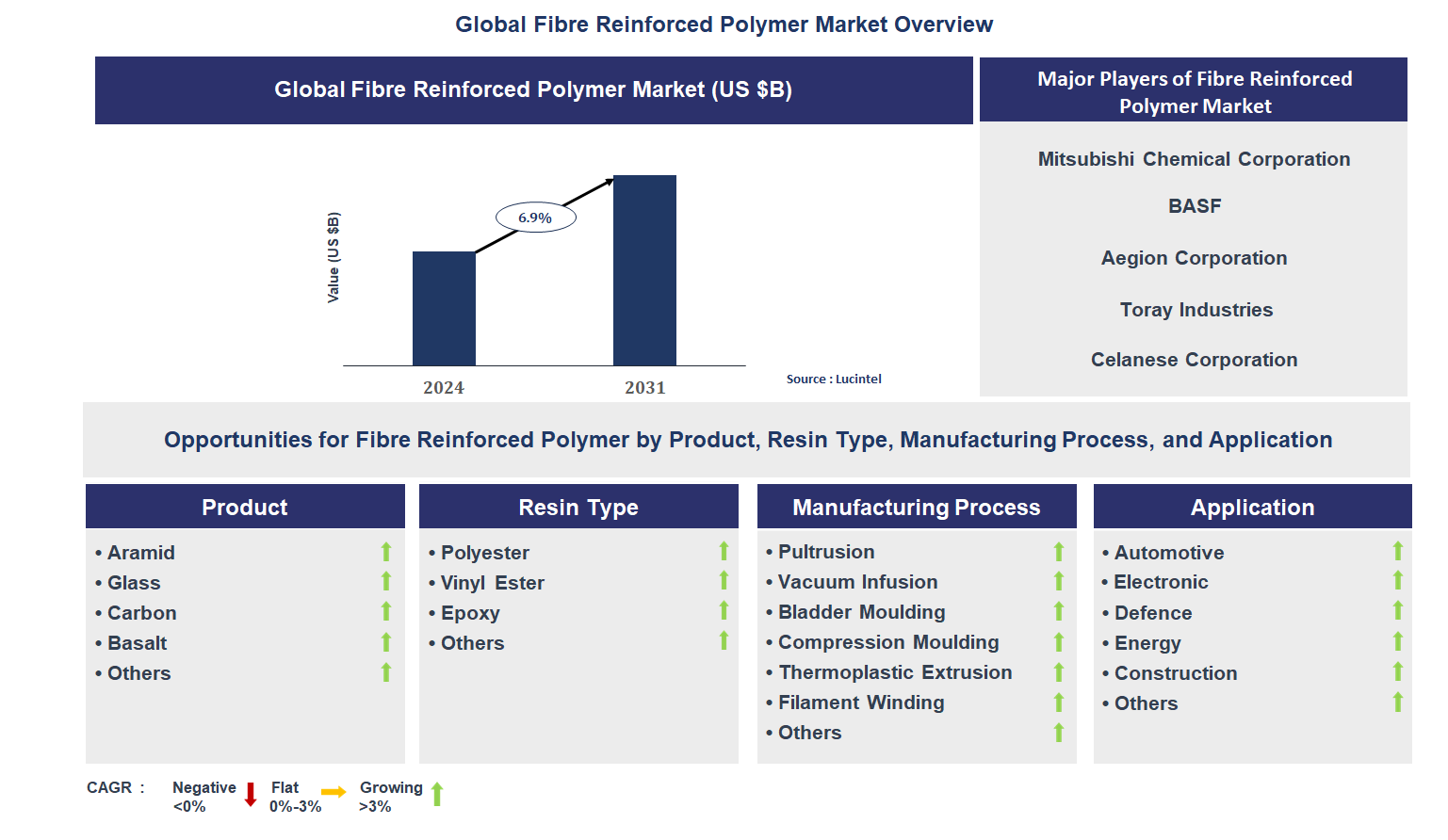
The future of the global fibre reinforced polymer market looks promising with opportunities in the automotive, electronic, defense, energy, and construction markets. The global fibre reinforced polymer market is expected to grow with a CAGR of 6.9% from 2025 to 2031. The major drivers for this market are the increasing demand for lightweight composite materials, the rising adoption in construction for durability, and the growing use in automotive for performance enhancement.• Lucintel forecasts that, within the product category, carbon is expected to witness the highest growth over the forecast period.
• Within the application category, automotive is expected to witness the highest growth.
• In terms of region, APAC is expected to witness the highest growth over the forecast period. Gain valuable insights for your business decisions with our comprehensive 150+ page report. Sample figures with some insights are shown below.
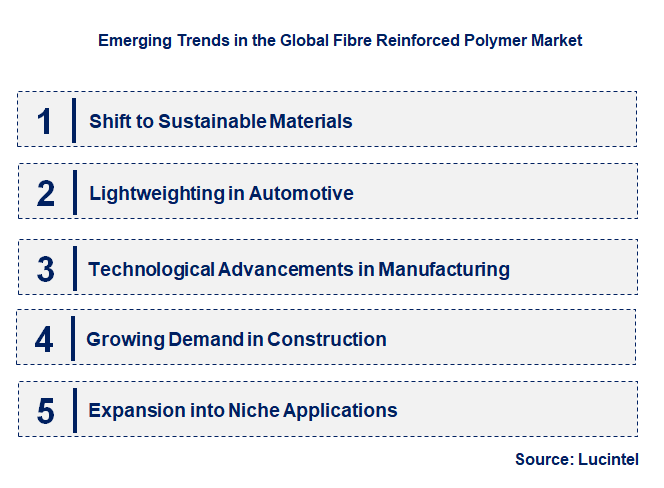
Emerging Trends in the Fibre Reinforced Polymer Market
The fibre reinforced polymer market is being reshaped by several powerful trends that are pushing the industry towards greater sustainability, efficiency, and advanced functionality. These emerging developments reflect a global response to environmental concerns and the demand for smarter materials. The focus is shifting from a commodity-based market to one that provides innovative, high-value solutions.• Shift to Sustainable Materials: This trend involves using recycled plastics, bio-based resins, and natural fibers to create FRP composites. Its impact is a reduction in the carbon footprint and reliance on virgin materials, appealing to environmentally conscious consumers and helping companies meet sustainability targets.
• Lightweighting in Automotive: The automotive industry is increasingly adopting FRP composites to reduce vehicle weight. This trend directly impacts fuel efficiency and reduces emissions, which is a major regulatory and consumer concern. FRPs offer a high strength-to-weight ratio, making them ideal for a range of components.
• Technological Advancements in Manufacturing: Innovations in production, such as automated fiber placement and 3D printing, are becoming more prevalent. This leads to the production of high-performance grades with superior mechanical properties, improved dimensional stability, and reduced manufacturing costs and time.
• Growing Demand in Construction: There is an increasing demand for FRPs to retrofit aging infrastructure and as a replacement for steel rebar. This trend is driven by FRP’s corrosion resistance and durability. The impact is a growing market for materials that can improve structural integrity and extend the lifespan of bridges, buildings, and other infrastructure.
• Expansion into Niche Applications: FRPs are finding new uses in high-value sectors such as wind energy, aerospace, and defense. This diversifies the market, creating new, high-margin segments and driving demand for specialized grades with properties like high fatigue resistance and excellent ballistic properties. These trends are collectively reshaping the fibre reinforced polymer market, driving it towards a more sustainable, technologically advanced, and diversified future. The industry is moving from a traditional manufacturing model to one that is driven by innovation and a commitment to circularity, creating a more responsible and dynamic market.
Recent Development in the Fibre Reinforced Polymer Market
The fibre reinforced polymer market is currently undergoing significant developments driven by a combination of technological advancements, evolving end-user needs, and a global push for sustainability. These recent changes are impacting production methods, material composition, and overall market dynamics, signaling a shift toward a more efficient and environmentally conscious industry.• Increased Production of High-Performance Grades: Manufacturers are investing in new facilities and technologies to produce a wider variety of high heat-resistant and high-impact grades. The impact of this is the creation of products with enhanced functionalities, such as improved thermal stability and durability, which allows them to replace metal parts in more demanding applications.
• Shift to Sustainable and Bio-based Production: The industry is heavily investing in research and development to create FRP composites from renewable and recycled sources. This development’s impact is a direct effort to reduce dependence on petrochemicals, lower the environmental footprint, and meet the growing demand for sustainable materials.
• Strategic Partnerships and Acquisitions: Leading companies are engaging in mergers, acquisitions, and partnerships to expand their global reach and technology portfolios. The impact is a consolidation of the market, which strengthens key players and accelerates innovation by pooling resources and expertise. This helps companies serve a broader customer base and improve efficiency.
• Integration into Lightweighting Initiatives: FRP composites are increasingly being used in industries, especially automotive and aerospace, for "lightweighting" applications. The impact of this is a significant improvement in fuel efficiency and a reduction in greenhouse gas emissions. FRP’s high strength-to-weight ratio makes it ideal for these applications.
• Adoption of Advanced Manufacturing Techniques: New production methods, such as automated fiber placement and advanced injection molding processes, are being adopted to create higher-quality products. This development leads to increased operational efficiency, reduced material waste, and the ability to produce more intricate parts with consistent quality and precision. These recent developments are collectively transforming the fibre reinforced polymer market by pushing it towards a more sustainable and technologically sophisticated future. The industry is moving from a traditional, volume-based approach to a more innovative, value-driven one, ensuring it remains a vital and responsible player in the global economy.
Strategic Growth Opportunities in the Fibre Reinforced Polymer Market
Strategic growth opportunities in the fibre reinforced polymer market are emerging across a diverse range of applications, driven by the demand for high-performance, durable, and cost-effective components. These opportunities extend beyond traditional uses, enabling manufacturers to innovate and expand their market presence.• Automotive and Transportation: The automotive industry’s push for improved fuel efficiency and reduced emissions offers a significant opportunity for FRPs. The impact is a growing market for lightweight plastic components for car bodies, structural parts, and interior trim, which contributes to overall vehicle weight reduction and enhances performance.
• Aerospace and Defense: The aerospace and defense industries offer a major opportunity for FRPs due to their high strength-to-weight ratio and fatigue resistance. The impact is a growing market for components in aircraft, drones, and military vehicles, where reducing weight is crucial for fuel efficiency and performance.
• Construction and Infrastructure: The construction sector presents a key opportunity for FRPs in new and retrofitting applications. The impact is a growing demand for corrosion-resistant rebar, structural supports, and bridge components, which improves durability and extends the lifespan of infrastructure.
• Wind Energy: The renewable energy sector, particularly wind power, provides a significant growth opportunity for FRPs. The impact is a growing market for lightweight, high-strength composite materials used in the manufacturing of large wind turbine blades, which improves efficiency and power generation.
• Sports and Consumer Goods: The sports and consumer goods market presents a high-value opportunity for specialized FRPs. The impact is a growing market for products like tennis rackets, skis, and bicycle frames, where the lightweight and durable properties of FRPs are highly valued by consumers. These strategic growth opportunities are reshaping the fibre reinforced polymer market by diversifying its applications and pushing for innovation. By targeting these high-growth sectors, manufacturers can not only expand their market share but also create high-value products that meet the specific needs of a modern and discerning customer base.
Fibre Reinforced Polymer Market Driver and Challenges
The fibre reinforced polymer market is a dynamic industry shaped by a combination of powerful drivers and significant challenges. The major drivers include increasing demand for lightweight and high-performance materials and innovation in manufacturing, while key challenges such as high production costs and disposal concerns pose hurdles. The factors responsible for driving the fibre reinforced polymer market include: 1. Growing Automotive Industry: The increasing production of vehicles and the push for lightweighting to improve fuel efficiency is a primary driver. The implication is a continuous high demand for FRPs as a lighter and more cost-effective alternative to metal, especially in electric vehicles. 2. Rising Demand from Construction: The growing need for durable, corrosion-resistant materials for new and aging infrastructure is a key driver. The implication is an increased use of FRPs in construction, as they offer superior longevity and lower maintenance costs compared to traditional steel and concrete. 3. Excellent Mechanical Properties: FRPs are highly valued for their exceptional properties, including high strength-to-weight ratio, high stiffness, and fatigue resistance. The implication is that these properties make them ideal for precision components in a wide range of applications, driving demand from various industrial sectors. 4. Technological Innovation: Ongoing advancements in manufacturing processes and material science are a major driver. The implication is the development of FRPs with superior properties, which allows them to penetrate new, more demanding applications and become a viable alternative to traditional materials. 5. Focus on Fuel Efficiency: Stringent government regulations on vehicle emissions and fuel economy are a major driver. The implication is that manufacturers are compelled to use lightweight FRPs to reduce vehicle weight, which directly contributes to better fuel efficiency and helps meet regulatory requirements. Challenges in the fibre reinforced polymer market are: 1. High Production Costs: The production of FRPs, particularly those with carbon fiber, is expensive due to the high cost of raw materials and complex manufacturing processes. The implication is that this limits their adoption in cost-sensitive industries, and manufacturers must consistently innovate to reduce costs and remain competitive. 2. Recycling and Disposal Issues: The thermoset nature of many FRPs makes them difficult to recycle, leading to significant environmental concerns. The implication is that this raises disposal issues and forces the industry to invest heavily in research and development of more sustainable and recyclable materials. 3. Limited Awareness and Standardization: There is a lack of widespread awareness and standardized testing procedures for FRPs in some industries. The implication is that this can hinder their adoption, as potential users may be hesitant to switch from traditional materials due to a lack of familiarity or certified performance data. The fibre reinforced polymer market is at a pivotal point, with its growth being propelled by strong demand from key industries, while simultaneously navigating significant economic and environmental challenges. The industry’s ability to innovate towards sustainable solutions and overcome regulatory hurdles will determine its long-term viability and success.List of Fibre Reinforced Polymer Companies
Companies in the market compete on the basis of product quality offered. Major players in this market focus on expanding their manufacturing facilities, R&D investments, infrastructural development, and leverage integration opportunities across the value chain. With these strategies fibre reinforced polymer companies cater increasing demand, ensure competitive effectiveness, develop innovative products & technologies, reduce production costs, and expand their customer base. Some of the fibre reinforced polymer companies profiled in this report include-• Mitsubishi Chemical Corporation
• BASF
• Aegion Corporation
• Toray Industries
• Celanese Corporation
• Advanced Composites
• SGL Carbon
Fibre Reinforced Polymer Market by Segment
The study includes a forecast for the global fibre reinforced polymer market by product, resin type, manufacturing process, application, and region.Fibre Reinforced Polymer Market by Product [Value from 2019 to 2031]:
• Aramid
• Glass
• Carbon
• Basalt
• Others
Fibre Reinforced Polymer Market by Resin Type [Value from 2019 to 2031]:
• Polyester
• Vinyl Ester
• Epoxy
• Others
Fibre Reinforced Polymer Market by Manufacturing Process [Value from 2019 to 2031]:
• Pultrusion
• Vacuum Infusion
• Bladder Moulding
• Compression Moulding
• Thermoplastic Extrusion
• Filament Winding
• Others
Fibre Reinforced Polymer Market by Application [Value from 2019 to 2031]:
• Automotive
• Electronic
• Defence
• Energy
• Construction
• Others
Fibre Reinforced Polymer Market by Region [Value from 2019 to 2031]:
• North America
• Europe
• Asia Pacific
• The Rest of the World
Country Wise Outlook for the Fibre Reinforced Polymer Market
The fibre reinforced polymer market is experiencing a significant transformation, driven by the increasing global demand for lightweight, high-strength, and durable materials. Recent developments are focused on advanced applications in automotive, aerospace, and construction. This is supported by a growing emphasis on sustainability and the development of specialized grades to meet the rigorous demands of various industries.• United States: The U.S. market is a leader in adopting advanced FRP composites, particularly for its automotive and aerospace industries. Recent developments are focused on using high-performance carbon and glass fibers to meet stringent safety and durability standards. There is a growing trend towards replacing metal parts with FRP to reduce weight and enhance fuel efficiency.
• China: As a major global player, China’s FRP market is expanding rapidly, with recent developments centered on boosting domestic production and improving quality. The country is diversifying its applications, particularly in its booming automotive, wind energy, and construction sectors. The market is also seeing investments in new production facilities to meet this rising demand.
• Germany: Germany’s market is defined by its strong emphasis on precision and engineering. Recent advancements are focused on developing specialized, high-quality FRP grades for its dominant automotive and industrial machinery industries. The market is also influenced by strict EU regulations, which are driving the development of sustainable, eco-friendly grades.
• India: India’s FRP market is experiencing strong growth, fueled by its burgeoning automotive and construction sectors. Recent developments are focused on expanding domestic manufacturing to reduce reliance on imports and to meet the increasing demand for lightweight and durable materials. The market is seeing a rise in new investments to cater to these growing needs.
• Japan: The Japanese market is distinguished by a strong emphasis on high-performance and functional grades. Recent developments include continuous innovation in polymerization and processing technologies. The market is also focused on creating specialized solutions for high-tech applications in electronics and medical devices, where precision and durability are crucial.

Features of the Global Fibre Reinforced Polymer Market
Market Size Estimates: Fibre reinforced polymer market size estimation in terms of value ($B). Trend and Forecast Analysis: Market trends (2019 to 2024) and forecast (2025 to 2031) by various segments and regions. Segmentation Analysis: Fibre reinforced polymer market size by various segments, such as by product, resin type, manufacturing process, application, and region in terms of value ($B). Regional Analysis: Fibre reinforced polymer market breakdown by North America, Europe, Asia Pacific, and Rest of the World. Growth Opportunities: Analysis of growth opportunities in different products, resin types, manufacturing processes, applications, and regions for the fibre reinforced polymer market. Strategic Analysis: This includes M&A, new product development, and competitive landscape of the fibre reinforced polymer market. Analysis of competitive intensity of the industry based on Porter’s Five Forces model.
FAQ
Q1. What is the growth forecast for fibre reinforced polymer market? Answer: The global fibre reinforced polymer market is expected to grow with a CAGR of 6.9% from 2025 to 2031. Q2. What are the major drivers influencing the growth of the fibre reinforced polymer market? Answer: The major drivers for this market are the increasing demand for lightweight composite materials, the rising adoption in construction for durability, and the growing use in automotive for performance enhancement. Q3. What are the major segments for fibre reinforced polymer market? Answer: The future of the fibre reinforced polymer market looks promising with opportunities in the automotive, electronic, defense, energy, and construction markets. Q4. Who are the key fibre reinforced polymer market companies? Answer: Some of the key fibre reinforced polymer companies are as follows:• Mitsubishi Chemical Corporation
• BASF
• Aegion Corporation
• Toray Industries
• Celanese Corporation
• Advanced Composites
• SGL Carbon Q5. Which fibre reinforced polymer market segment will be the largest in future? Answer: Lucintel forecasts that, within the product category, carbon is expected to witness the highest growth over the forecast period. Q6. In fibre reinforced polymer market, which region is expected to be the largest in next 5 years? Answer: In terms of region, APAC is expected to witness the highest growth over the forecast period. Q7. Do we receive customization in this report? Answer: Yes, Lucintel provides 10% customization without any additional cost.
Table of Contents
List of Figures
List of Tables
Methodology
- In-depth interviews of the major players in this market
- Detailed secondary research from competitors’ financial statements and published data
- Extensive searches of published works, market, and database information pertaining to industry news, company press releases, and customer intentions
- A compilation of the experiences, judgments, and insights of Lucintel’s professionals, who have analyzed and tracked this market over the years.


Buy Now
Choose a license that fits your team. Instant PDF delivery.
Prices exclude taxes. Instant delivery. Custom licensing available on request.
Key Questions
- • What are some of the most promising, high-growth opportunities for the fibre reinforced polymer market by product (aramid, glass, carbon, basalt, and others), resin type (polyester, vinyl ester, epoxy, and others), manufacturing process (pultrusion, vacuum infusion, bladder moulding, compression moulding, thermoplastic extrusion, filament winding, and others), application (automotive, electronic, defence, energy, construction, and others), and region (North America, Europe, Asia Pacific, and the Rest of the World)?
- • Which segments will grow at a faster pace and why?
- • Which region will grow at a faster pace and why?
- • What are the key factors affecting market dynamics? What are the key challenges and business risks in this market?
- • What are the business risks and competitive threats in this market?
- • What are the emerging trends in this market and the reasons behind them?
- • What are some of the changing demands of customers in the market?
- • What are the new developments in the market? Which companies are leading these developments?
- • Who are the major players in this market? What strategic initiatives are key players pursuing for business growth?
- • What are some of the competing products in this market and how big of a threat do they pose for loss of market share by material or product substitution?
- • What M&A activity has occurred in the last 5 years and what has its impact been on the industry? For any questions related to Fibre Reinforced Polymer Market, Fibre Reinforced Polymer Market Size, Fibre Reinforced Polymer Market Growth, Fibre Reinforced Polymer Market Analysis, Fibre Reinforced Polymer Market Report, Fibre Reinforced Polymer Market Share, Fibre Reinforced Polymer Market Trends, Fibre Reinforced Polymer Market Forecast, Fibre Reinforced Polymer Companies, write Lucintel analyst at email: helpdesk@lucintel.com. We will be glad to get back to you soon.


