
Report Feature
Fiberglass Pipe Market Trends and Forecast
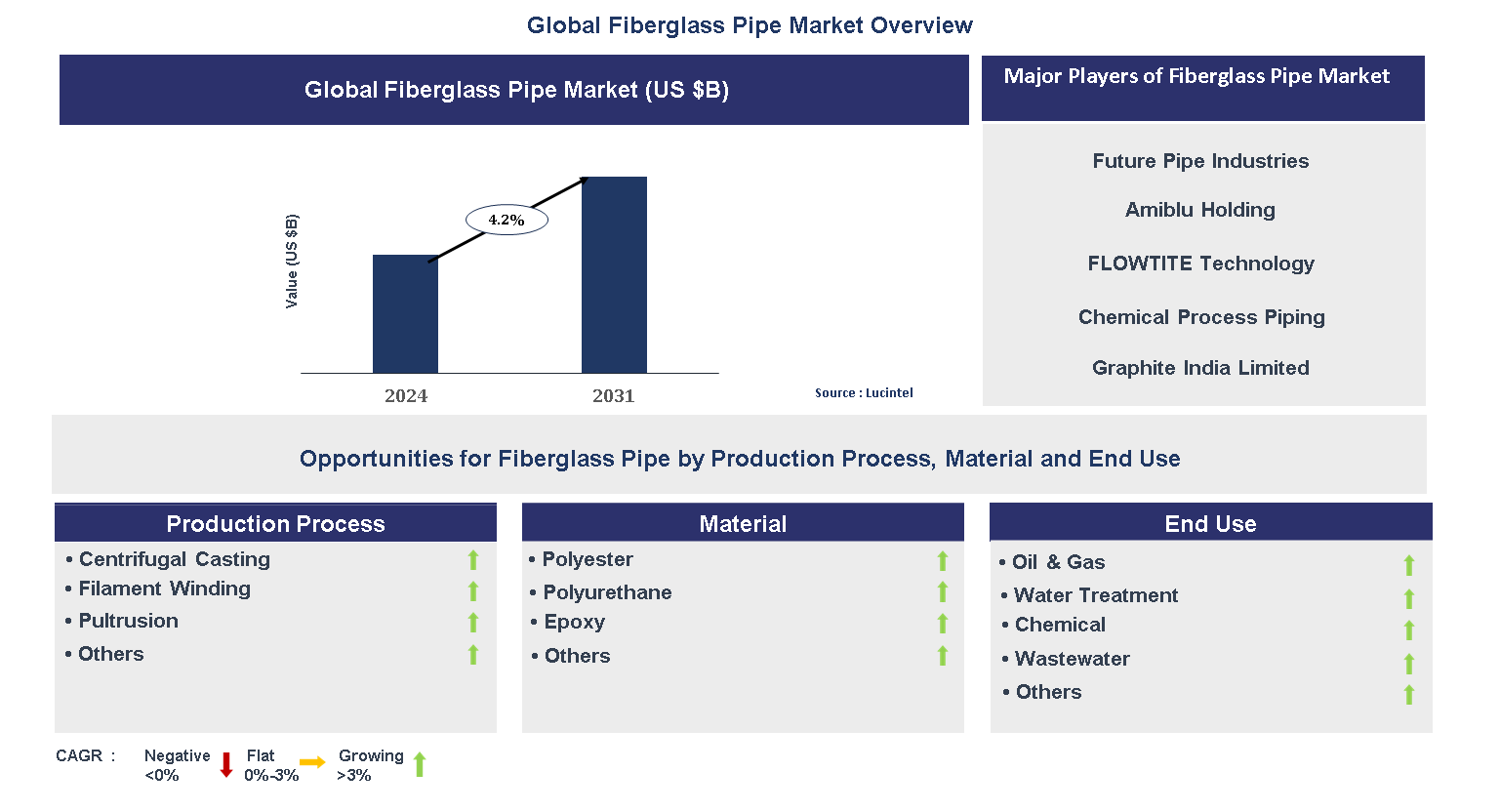
The future of the global fiberglass pipe market looks promising with opportunities in the oil & gas, water treatment, chemical, and wastewater markets. The global fiberglass pipe market is expected to grow with a CAGR of 4.2% from 2025 to 2031. The major drivers for this market are the increasing demand for corrosion-resistant pipes, the rising use in chemical industries, and the growing need for lightweight materials.• Lucintel forecasts that, within the production process category, filament winding is expected to witness the highest growth over the forecast period.
• Within the end use category, oil & gas is expected to witness the highest growth.
• In terms of region, APAC is expected to witness the highest growth over the forecast period. Gain valuable insights for your business decisions with our comprehensive 150+ page report. Sample figures with some insights are shown below.
Emerging Trends in the Fiberglass Pipe Market
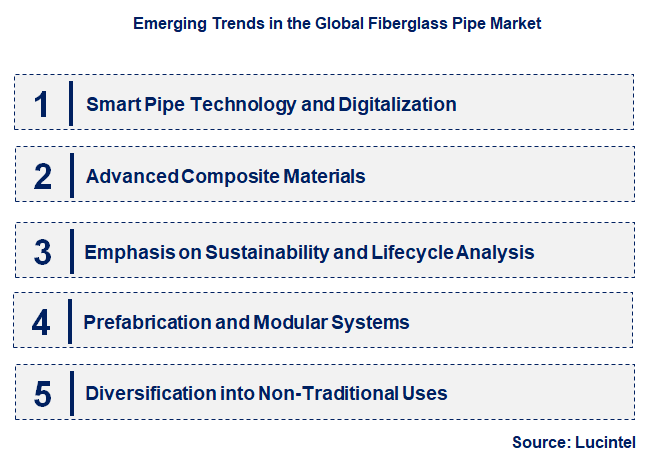
The market for fiberglass pipe is being redefined by a number of strong emerging trends that are fundamentally changing the way materials are being carried across different industries. These trends are in direct response to the need for efficiency, longevity, and sustainability in infrastructure and industrial uses. They are pushing beyond the historic application of fiberglass pipes, placing them as a central part of new, resilient infrastructure.• Smart Pipe Technology and Digitalization: Sensor integration and digital monitoring systems are one of the key trends. Smart pipes have the potential to offer live pressures, temperatures, and material flow data, and leak as well as structural fault detection. This trend is affecting the market by allowing predictive maintenance, lowering the expense of failures, and enhancing the efficiency of operations as a whole. It makes the pipe a dynamic, data-producing asset as opposed to a static element and enhances system reliability and safety.
• Advanced Composite Materials: The trend is towards creating advanced composite materials for fiberglass pipes. This involves using nanotechnology and specialized resins to improve properties like strength, chemical resistance, and fire retardancy. This trend is transforming the market by broadening the scope of applications for fiberglass pipes into more severe environments, like high-temperature chemical plants and high-pressure oil and gas fields, thus making them more competitive against conventional materials.
• Emphasis on Sustainability and Lifecycle Analysis: The industry is experiencing heightened emphasis on the overall lifecycle of a product, from production to disposal. This is brought about by a call for environmentally friendly products with a reduced carbon footprint and longer lifespan. Manufacturers are meeting this challenge by adopting more sustainable materials and by creating pipes that can be recycled after their service life, which is establishing a competitive edge for businesses with an environmentally sound solution.
• Prefabrication and Modular Systems: Prefabrication and modular systems are increasingly being adopted, especially for massive projects. Off-site production of pipes is carried out in modular forms that can be rapidly assembled on-site. It is influencing the market through reduced installation time and labor cost, both of which are among the biggest costs in major infrastructure projects. It enhances quality control as the manufacturing process is undertaken in a controlled factory environment.
• Diversification into Non-Traditional Uses: Though heretofore used in oil and gas and water treatment, fiberglass pipes are increasingly being utilized in other industries like renewable energy, marine, and mining. This move is transforming the market by diversifying revenue streams and lessening its reliance on the volatile oil and gas industry. The corrosion resistance and light weight of fiberglass pipes make them a best fit for novel and new applications, including for the transportation of a slurry in mining operations. These developments are deeply transforming the fiberglass pipe industry by making the technology smarter, greener, and more flexible. The move from a reactive to proactive service model, fueled by digitalization and new materials, is building a more resilient and dynamic market better poised to manage the complexities of today’s industrial and infrastructure needs.
Recent Development in the Fiberglass Pipe Market
The fiberglass pipe industry has seen several recent developments, fueled by the ever-present demand for efficiency and cost savings in a wide range of industrial applications. These advancements represent a transition from rudimentary operating tools to advanced, integrated systems that offer improved capabilities and increased performance. The foremost developments are a testament to the determination of the industry to innovate and its reaction to the realities of contemporary infrastructure.• Advanced Manufacturing Technologies: One of the most important developments is the extensive use of advanced manufacturing methods, including continuous filament winding and automated production lines. These technologies are enhancing the uniformity and quality of fiberglass pipes as well as lowering production costs. The effect of this innovation is the rise in the capacity of the market to produce high-quality pipes at a reduced cost, thereby making them more competitive with conventional materials such as steel and concrete.
• Creation of Spoilable Pipes: The recent improvements have been made on the production of spoilable fiberglass pipes, which are continuous flexible pipes that can be coiled onto a big reel. This is important for remote or difficult installations where hard rigid pipes are impossible to transport and install. The effect is a decrease in labor time and cost of installation, especially in the gas and oil industry and in trenchless work on water infrastructure projects, hence making fiberglass a more effective solution.
• Improved Joining and Connection Systems: One of the major developments is the enhancement of joining and connection systems of fiberglass pipes. Companies are creating new coupling technologies and adhesive systems with stronger, more reliable, and easier-to-install joints. This innovation is important because it minimizes the likelihood of leaks and failures, which can be expensive and hazardous. It also makes installation easier for workers and shortens overall project duration.
• More Use of Glass Reinforced Epoxy (GRE) Pipes: The market is witnessing a significant trend of greater use of GRE pipes, which possess better corrosion resistance and high pressure-bearing properties. This is most critical for the oil and gas and chemical industries, where pipes are exposed to highly corrosive chemicals. The effect of this trend is a growth in the market share of fiberglass pipes in high-end, high-performance applications that have traditionally been controlled by metallic pipes.
• Emphasis on Fire Retardant Characteristics: Another recent trend is emphasis on the development of fiberglass pipes with improved fire retardant characteristics. This is important for use in buildings and industrial plants where fire safety is a primary concern. They are introducing flame-retardant chemicals into the resin and formulating protective coatings to enhance fire resistance. The innovation is affecting the market by increasing the application of fiberglass pipes in more diverse applications where fire safety is a major issue. These advancements are significantly affecting the market for fiberglass pipes by increasing the capability, reliability, and intelligence of the technology. They are allowing fiberglass pipes to emerge as a go-to solution for an extended range of applications, firmly establishing themselves as a needed tool in the new-age infrastructure.
Strategic Growth Opportunities in the Fiberglass Pipe Market
The market for fiberglass pipe provides many strategic growth opportunities in various applications, as companies respond to demands for better and longer-lasting solutions in a turbulent industrial environment. Targeting specific areas of application means that companies can create specialized products and services tailored to individual customer requirements and ride new wave trends of demand. These opportunities are not selling products but offering end-to-end solutions that overcome the particular problems of each industry.• Water and Wastewater Management: One key strategic growth opportunity is to supply fiberglass pipes for old water and wastewater infrastructure. As cities everywhere struggle to replace rusting steel and concrete pipes, fiberglass provides a corrosion-proof, durable, and lightweight option. The potential is in offering customized solutions for city projects, such as main transmission lines and smaller sewage and distribution pipes, where low maintenance and a long life are essential for long-term sustainability.
• Oil and Gas Industry: The oil and gas industry is a big growth opportunity with its requirement for pipes that will handle corrosive fluids and high pressures. The business opportunity is in offering high-pressure, high-temperature (HPHT) pipes in onshore and offshore exploration and production. The segment requires high performance and reliability, and fiberglass pipes, especially GRE, are increasingly becoming a go-to replacement for steel because of their resistance to corrosion, which is essential in saving costs on maintenance and providing assurance of the lifespan of pipelines.
• Industrial Applications and Chemical Processing: The chemical processing sector is a high-value growth market, as it demands pipes that are capable of safely conveying highly corrosive and acidic fluids. The opportunity is to supply customized pipes with intended chemical resistance capabilities and high-temperature strength. This use demands intimate knowledge of the customer’s chemical processes and significant levels of engineering expertise, providing a competitive advantage to specialized manufacturers who can deliver customized high-performance products.
• Infrastructure and Construction: The world’s demand for new infrastructure projects, such as bridges, tunnels, and city development, is a huge growth potential. Fiberglass pipes are a lightweight yet strong alternative to traditional materials for sewerage, storm water management, and utility runs. The challenge is in offering pipes that are not only long-lasting but also quick to install in intricate urban landscapes, where a smaller footprint and shorter installation time are essential to the success and profitability of projects.
• Renewable Energy and Marine Uses: With the world moving towards renewable energy, fiberglass pipe is also discovering strategic opportunities within marine and offshore wind uses. They are utilized in cable protection, water intake, and drainage systems of wind farms. The potential is supplying customized pipes resistant to saltwater corrosion and high-impact environments. This is a long-term growth market that supports global sustainability objectives, making fiberglass pipe manufacturers central partners in the transition towards energy. These opportunities are transforming the fiberglass pipe industry by compelling it to shift towards a more specialized and application-specific business. If companies concentrate on high-growth, high-value segments, they can differentiate themselves and get a stronger business model, stepping away from commodity-like products to become key partners in cracking the complex problems of advanced industrial and infrastructure.
Fiberglass Pipe Market Driver and Challenges
The fiberglass pipe industry is a dynamic sector that is influenced by a multifaceted interaction of drivers that drive its development and challenges that limit its potential. The principal drivers and challenges are numerous technological, economic, and regulatory drivers. The comprehension of these drivers is important for stakeholders to navigate the market effectively. On the one hand, drivers are directing the market towards growth and innovation, and on the other, challenges are compelling firms to evolve and come up with new methods to generate value. The factors responsible for driving the fiberglass pipe market include: 1. Corrosion Resistance: One of the main drivers is the higher corrosion resistance of fiberglass pipes, particularly in hostile environments. Unlike other steel pipes that rust in the presence of water, chemicals, or saltwater, fiberglass pipes remain intact, increasing their life expectancy and lowering maintenance costs. This characteristic makes them a favorite in industries such as the oil and gas sector, water treatment, and chemical processing, where corrosion is critical and the number one cause of pipe failure. 2. Easy to Install and Lightweight: Fiberglass pipes’ lightweight quality is a key inducer of their growth in the market. They weigh much less compared to steel or concrete pipes, minimizing transportation costs and the effort of installation. This characteristic makes them suited for remote or hard-to-reach areas because they need less heavy equipment and labor for installation. The simplicity of installation and handling also means a quicker project completion rate, which is an important selling point for a range of different projects. 3. Rising Infrastructure Development: The global drive towards infrastructure development, especially in emerging economies, is a key driver. Governments as well as private investors are laying new water supply lines, sewage lines, and industrial pipelines, thus fueling a huge demand for pipes that are long-lasting and trouble-free. Fiberglass pipes, being long-lasting and maintenance-free, are a favorite among such long-term infrastructure projects. 4. Oil and Gas Industry Demand: The oil and gas industry is a leading sector owing to its requirement for pipes to transport highly corrosive fluids and high-pressure fluid. Fiberglass pipes are being applied more and more for onshore as well as offshore services, such as saltwater disposal and crude oil transportation. Cost-cutting and long-term asset integrity concerns of the industry have prompted fiberglass pipes to be a viable choice over traditional materials. 5. Advances in Manufacturing Technology: The ongoing improvement in manufacturing technologies like filament winding and centrifugal casting is a key driver of growth. These technologies are enabling the manufacture of better-quality, longer-lasting pipes at reduced costs, which is making them more price-competitive with conventional materials. This technological progress is enabling manufacturers to make pipes of greater variety and pressure classes, even further increasing their range of application. Challenges in the fiberglass pipe market are: 1. High Initial Cost: One challenge is the increased initial cost of fiberglass pipes when compared to some conventional materials. This can be a deterrent to adoption, especially in cost-restrained projects or in markets where cost is the major purchase driver. Although the life cycle cost of fiberglass pipes tends to be less because of less maintenance and a longer lifespan, the initial investment can be a turn-off to prospective buyers who are not interested in long-term value. 2. Lack of Technical Expertise: One of the main challenges is the low level of awareness and technical knowledge necessary for proper installation. Steel pipes can be welded, but fiberglass pipes need special joining technology and trained specialists for a secure installation. This could be an adoption barrier, as the absence of adequately trained installers can result in failure and reputational loss for manufacturers and installers alike. 3. Material Compatibility Restrictions: Although fiberglass pipes are extremely resistant to corrosion, they are limited in their compatibility with certain chemicals and high-temperature exposures. This can limit their application in a number of specialty applications where other materials, like stainless steel or specialized alloys, must be utilized. This is a problem that necessitates that manufacturers properly define the restrictions of their products and offer extensive material compatibility charts to their customers. Lastly, the fiberglass pipe industry stands at a crossroads, with strong drivers urging technology development and diversification into new uses, while major challenges such as increased up-front cost and a shortage of technical know-how pose obstacles. The cumulative impact of all of these is a marketplace that is increasingly segmented and defined by a double focus: on developing high-technology, value-added solutions for sophisticated industrial uses and on making cost-efficient, uncomplicated products for everyday use.List of Fiberglass Pipe Companies
Companies in the market compete on the basis of product quality offered. Major players in this market focus on expanding their manufacturing facilities, R&D investments, infrastructural development, and leverage integration opportunities across the value chain. With these strategies fiberglass pipe companies cater increasing demand, ensure competitive effectiveness, develop innovative products & technologies, reduce production costs, and expand their customer base. Some of the fiberglass pipe companies profiled in this report include-• Future Pipe Industries
• Amiblu Holding
• FLOWTITE Technology
• Chemical Process Piping
• Graphite India Limited
• Saudi Arabian Amiantit
• Fibrex Corporation
Fiberglass Pipe Market by Segment
The study includes a forecast for the global fiberglass pipe market by production process, material, end use, and region.Fiberglass Pipe Market by Production Process [Value from 2019 to 2031]:
• Centrifugal Casting
• Filament Winding
• Pultrusion
• Others
Fiberglass Pipe Market by Material [Value from 2019 to 2031]:
• Polyester
• Polyurethane
• Epoxy
• Others
Fiberglass Pipe Market by End Use [Value from 2019 to 2031]:
• Oil & Gas
• Water Treatment
• Chemical
• Wastewater
• Others
Fiberglass Pipe Market by Region [Value from 2019 to 2031]:
• North America
• Europe
• Asia Pacific
• The Rest of the World
Country Wise Outlook for the Fiberglass Pipe Market
The market for fiberglass pipe is undergoing a dramatic transformation based on its superior characteristics over conventional materials such as steel and concrete. Recent innovations are focused on enhancing the performance, longevity, and economics of the pipes for a variety of uses in oil and gas, water treatment, and infrastructure. These developments are rendering fiberglass pipes an increasingly popular option for corrosive and challenging environments where low maintenance and a long life are essential.• United States: The US market is the technology leader in fiberglass pipes, led by the requirement to replace outdated water and sewage systems and the growth of the oil and gas industry. New technologies are aimed at high-pressure, high-temperature (HPHT) applications, with advancements being made in Glass Reinforced Epoxy (GRE) pipes for application in harsh environments. The market is also experiencing the drive for digitalization and intelligent sensors in pipes to facilitate real-time monitoring and predictive maintenance, increasing operational efficiency and safety for mega-sized projects.
• China: China’s market is the biggest in the world due to high-speed industrialization, urbanization, and government spending on infrastructure. The recent trends are centered on high-volume, affordable production and the application of fiberglass pipes in giant water management and chemical process ventures. The nation is also a world leader in producing raw materials, which renders it competitive. There has been an increased trend of modernizing the manufacturing process to enhance product quality and address increasing domestic and international demand for corrosion-resistant, durable pipes.
• Germany: Germany’s market is a world leader in high-quality precision engineered products for specialized municipal and industrial use. New developments are being based on material science, with a target to create advanced resin systems that improve chemical resistance. The market is also spurred by strict environmental regulations and concentration on sustainable manufacturing, which fosters the creation of durable, environmentally friendly pipes. German manufacturers have the reputation for delivering customized, high-performance solutions for intricate, high-pressure projects.
• India: The Indian market is growing at a fast pace due to government policies in infrastructure development, like the Jal Jeevan Mission, and oil and gas sector investments. There has been recent emphasis on offering durable and economical solutions for water supply, irrigation, and sewage, respectively. The market is highly competitive, and there is a growing induction of contemporary manufacturing technologies to improve product quality and match the rising domestic demand for durable, long-running pipes.
• Japan: Japan’s technologically sophisticated and highly specialized market concentrates on quality and reliability in critical applications, especially marine and high-technology industrial applications. High-performance materials and digital technology integration for remote monitoring are the recent trends. Materials science expertise of the country is used to develop specialized fiberglass pipe compositions that can resist harsh conditions with a long life expectancy and low maintenance requirements.

Features of the Global Fiberglass Pipe Market
Market Size Estimates: Fiberglass pipe market size estimation in terms of value ($B). Trend and Forecast Analysis: Market trends (2019 to 2024) and forecast (2025 to 2031) by various segments and regions. Segmentation Analysis: Fiberglass pipe market size by production process, material, end use, and region in terms of value ($B). Regional Analysis: Fiberglass pipe market breakdown by North America, Europe, Asia Pacific, and Rest of the World. Growth Opportunities: Analysis of growth opportunities in different production processes, materials, end uses, and regions for the fiberglass pipe market. Strategic Analysis: This includes M&A, new product development, and competitive landscape of the fiberglass pipe market. Analysis of competitive intensity of the industry based on Porter’s Five Forces model.
FAQ
Q1. What is the growth forecast for fiberglass pipe market? Answer: The global fiberglass pipe market is expected to grow with a CAGR of 4.2% from 2025 to 2031. Q2. What are the major drivers influencing the growth of the fiberglass pipe market? Answer: The major drivers for this market are the increasing demand for corrosion-resistant pipes, the rising use in chemical industries, and the growing need for lightweight materials. Q3. What are the major segments for fiberglass pipe market? Answer: The future of the fiberglass pipe market looks promising with opportunities in the oil & gas, water treatment, chemical, and wastewater markets. Q4. Who are the key fiberglass pipe market companies? Answer: Some of the key fiberglass pipe companies are as follows:• Future Pipe Industries
• Amiblu Holding
• FLOWTITE Technology
• Chemical Process Piping
• Graphite India Limited
• Saudi Arabian Amiantit
• Fibrex Corporation Q5. Which fiberglass pipe market segment will be the largest in future? Answer: Lucintel forecasts that, within the production process category, filament winding is expected to witness the highest growth over the forecast period. Q6. In fiberglass pipe market, which region is expected to be the largest in next 5 years? Answer: In terms of region, APAC is expected to witness the highest growth over the forecast period. Q7. Do we receive customization in this report? Answer: Yes, Lucintel provides 10% customization without any additional cost.
Table of Contents
List of Figures
List of Tables
Methodology
- In-depth interviews of the major players in this market
- Detailed secondary research from competitors’ financial statements and published data
- Extensive searches of published works, market, and database information pertaining to industry news, company press releases, and customer intentions
- A compilation of the experiences, judgments, and insights of Lucintel’s professionals, who have analyzed and tracked this market over the years.


Buy Now
Choose a license that fits your team. Instant PDF delivery.
Prices exclude taxes. Instant delivery. Custom licensing available on request.
Key Questions
- • What are some of the most promising, high-growth opportunities for the fiberglass pipe market by production process (centrifugal casting, filament winding, pultrusion, and others), material (polyester, polyurethane, epoxy, and others), end use (oil & gas, water treatment, chemical, wastewater, and others), and region (North America, Europe, Asia Pacific, and the Rest of the World)?
- • Which segments will grow at a faster pace and why?
- • Which region will grow at a faster pace and why?
- • What are the key factors affecting market dynamics? What are the key challenges and business risks in this market?
- • What are the business risks and competitive threats in this market?
- • What are the emerging trends in this market and the reasons behind them?
- • What are some of the changing demands of customers in the market?
- • What are the new developments in the market? Which companies are leading these developments?
- • Who are the major players in this market? What strategic initiatives are key players pursuing for business growth?
- • What are some of the competing products in this market and how big of a threat do they pose for loss of market share by material or product substitution?
- • What M&A activity has occurred in the last 5 years and what has its impact been on the industry? For any questions related to Fiberglass Pipe Market, Fiberglass Pipe Market Size, Fiberglass Pipe Market Growth, Fiberglass Pipe Market Analysis, Fiberglass Pipe Market Report, Fiberglass Pipe Market Share, Fiberglass Pipe Market Trends, Fiberglass Pipe Market Forecast, Fiberglass Pipe Companies, write Lucintel analyst at email: helpdesk@lucintel.com. We will be glad to get back to you soon.


