
Report Feature
Feminine Care Gel Market Trends and Forecast
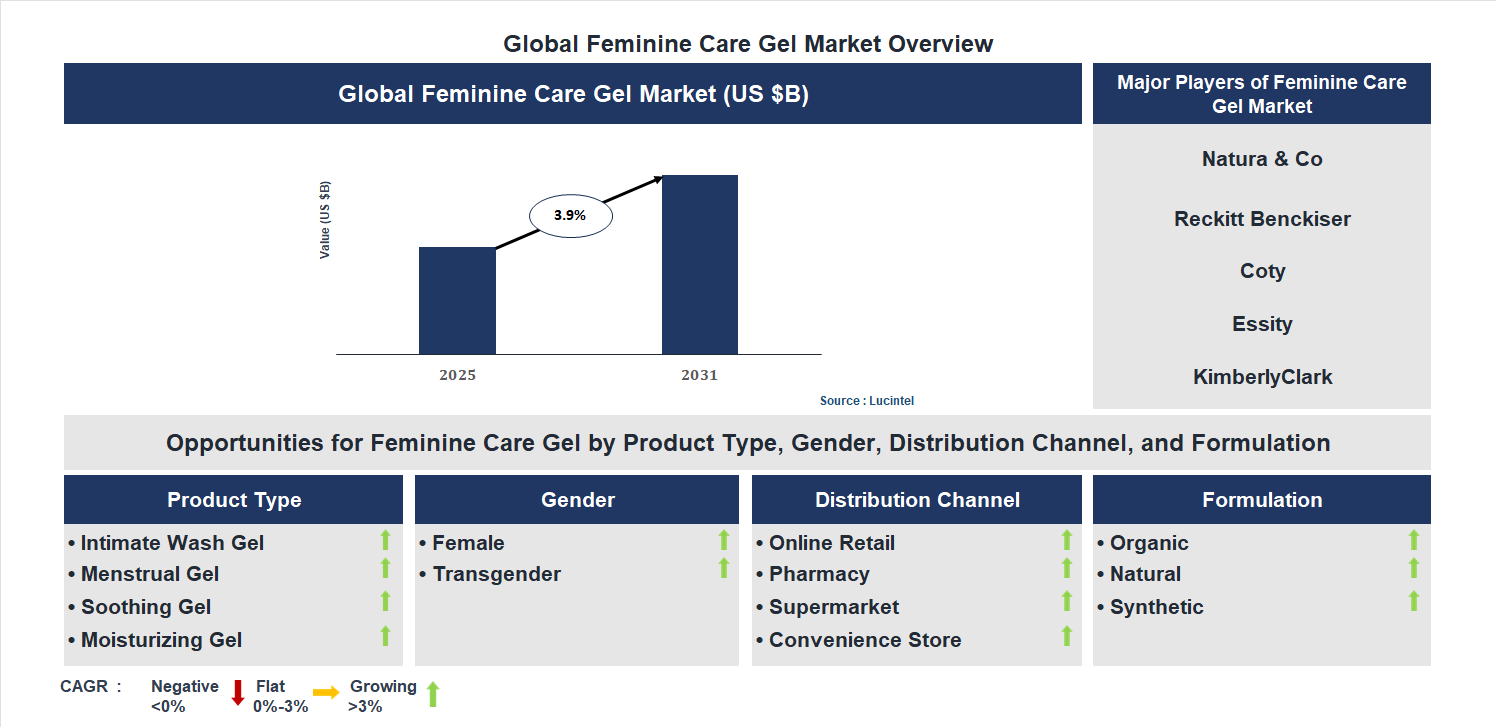
The future of the global feminine care gel market looks promising with opportunities in the intimate wash gel, menstrual gel, soothing gel, and moisturizing gel markets. The global feminine care gel market is expected to grow with a CAGR of 3.9% from 2025 to 2031. The major drivers for this market are the increasing awareness of intimate hygiene & health among women, the rising demand for organic, chemical-free feminine care products, and the growing focus on sustainability & eco-friendly product formulations.• Lucintel forecasts that, within the formulation category, organic is expected to witness the highest growth over the forecast period.
• Within the product type category, intimate wash gel is expected to witness the highest growth.
• In terms of region, APAC is expected to witness the highest growth over the forecast period. Gain valuable insights for your business decisions with our comprehensive 150+ page report. Sample figures with some insights are shown below.
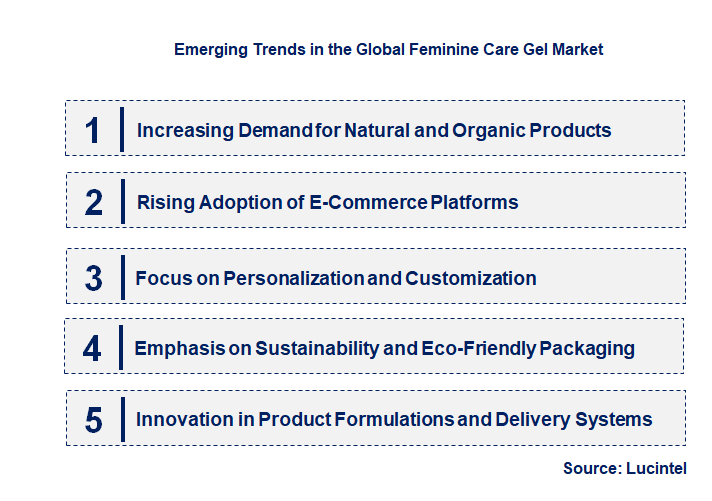
Emerging Trends in the Feminine Care Gel Market
The feminine care gel market is experiencing rapid growth driven by increasing awareness of feminine hygiene, changing societal attitudes, and advancements in product formulations. Consumers are seeking products that offer comfort, safety, and discretion, prompting brands to innovate and diversify their offerings. The market is also influenced by rising health consciousness and a preference for natural and organic ingredients. Additionally, e-commerce platforms are expanding access to a broader customer base, while regulatory standards are evolving to ensure product safety. These developments are collectively shaping a dynamic landscape that emphasizes personalization, sustainability, and health-focused solutions, ultimately transforming how feminine care gels are developed, marketed, and consumed.• Increasing Demand for Natural and Organic Products: Growing consumer awareness about health and environmental issues is driving demand for natural, organic, and chemical-free feminine care gels. Customers prefer products with plant-based ingredients that are gentle on sensitive skin and free from synthetic chemicals. This trend encourages brands to innovate with eco-friendly formulations, leading to a shift towards sustainable sourcing and transparent labeling. The impact is a more health-conscious market that values safety and environmental responsibility, fostering trust and loyalty among consumers seeking cleaner feminine hygiene options.
• Rising Adoption of E-commerce Platforms: The expansion of online retail channels is significantly influencing the feminine care gel market. Consumers appreciate the convenience, privacy, and wider product selection available online. E-commerce enables brands to reach a global audience, offer personalized recommendations, and gather customer feedback for continuous improvement. This trend also facilitates the launch of niche and innovative products that might not be available in traditional stores. As a result, the market experiences increased sales, greater consumer engagement, and accelerated product innovation driven by digital marketing strategies.
• Focus on Personalization and Customization: Consumers are increasingly seeking personalized feminine care solutions tailored to their specific needs, preferences, and sensitivities. Brands are responding by offering customizable products, such as different formulations for sensitive skin or varying scents and textures. This trend enhances customer satisfaction and brand loyalty by providing a more targeted experience. It also encourages innovation in product development, with companies investing in research to create versatile and adaptable formulations. Personalization is reshaping the market by emphasizing individual needs and fostering a more inclusive approach to feminine hygiene.
• Emphasis on Sustainability and Eco-Friendly Packaging: Environmental concerns are prompting brands to adopt sustainable practices, including eco-friendly packaging and biodegradable materials. Consumers are more conscious of the environmental impact of their purchases and prefer brands that demonstrate social responsibility. This trend leads to innovations in packaging design, such as refillable containers and minimalistic, recyclable materials. The market benefits from enhanced brand reputation and consumer trust, while also contributing to global sustainability goals. Overall, sustainability is becoming a key differentiator in product positioning and marketing strategies within the feminine care gel industry.
• Innovation in Product Formulations and Delivery Systems: Advances in formulation technology are enabling the development of more effective, comfortable, and discreet feminine care gels. Innovations include long-lasting, odor-neutralizing, and soothing formulations, as well as novel delivery systems like applicators and discreet packaging. These improvements enhance user experience, promote hygiene, and address specific concerns such as odor control and skin sensitivity. The impact is a broader product range that caters to diverse consumer needs, fostering market growth and differentiation. Continuous innovation ensures the market remains competitive and aligned with evolving consumer expectations for efficacy and convenience. These trends are collectively transforming the Feminine Care Gel Market by emphasizing health, sustainability, personalization, and technological innovation. They are driving product development, shaping consumer preferences, and expanding market reach, ultimately leading to a more inclusive, responsible, and dynamic industry landscape.
Recent Development in the Feminine Care Gel Market
The feminine care gel market is experiencing rapid growth driven by increasing awareness of feminine hygiene, rising demand for natural and organic products, and expanding consumer preferences for comfort and convenience. Innovations in product formulations and packaging are also contributing to market expansion. As consumers become more health-conscious and seek discreet, effective solutions, companies are investing heavily in research and development. This evolving landscape presents significant opportunities for brands to capture market share and meet diverse consumer needs globally.• Growing Demand for Natural and Organic Products: The shift towards organic feminine care gels is driven by consumer concerns over chemical ingredients, leading to increased sales of natural formulations. This trend enhances market growth by attracting health-conscious consumers seeking safer, eco-friendly options. Companies investing in organic ingredients and sustainable packaging are gaining a competitive advantage and expanding their customer base. The demand also encourages innovation in product development, fostering a more diverse and inclusive market.
• Rising Awareness of Feminine Hygiene: Increased education and awareness campaigns about feminine hygiene are encouraging women to adopt specialized gels for comfort and health. This awareness boosts market demand as consumers seek products that address hygiene concerns, odor control, and skin sensitivity. Brands are leveraging digital platforms and social media to promote product benefits, resulting in higher adoption rates. The focus on health and wellness is making feminine care gels a vital part of daily personal care routines.
• Innovation in Product Formulations and Packaging: Companies are introducing advanced formulations with soothing, moisturizing, and antimicrobial properties to meet diverse needs. Innovative packaging, such as discreet, travel-friendly containers, enhances user convenience and privacy. These developments improve user experience, increase brand loyalty, and expand market reach. Continuous innovation also helps brands differentiate themselves in a competitive landscape, attracting new consumers and retaining existing ones.
• Expansion in Emerging Markets: Growing urbanization and rising disposable incomes in emerging economies are creating new opportunities for feminine care gel brands. Localized marketing strategies and affordable product options are driving adoption in these regions. Market expansion is supported by increasing awareness and changing cultural attitudes towards feminine hygiene. This growth not only boosts sales but also encourages companies to tailor products to regional preferences, fostering global market diversification.
• Impact of Digital and E-commerce Channels: The rise of online shopping platforms has made feminine care gels more accessible to a broader audience. Digital marketing and e-commerce enable brands to reach niche segments and provide personalized product recommendations. This channel expansion accelerates market penetration, especially among younger consumers who prefer online purchasing. The convenience and privacy offered by e-commerce are key factors driving sales growth and market competitiveness. These developments are significantly transforming the feminine care gel market by fostering innovation, expanding consumer choices, and increasing accessibility. The focus on natural ingredients, awareness, and digital channels is driving growth and market penetration across regions. As consumer preferences evolve towards healthier, more sustainable options, companies that adapt quickly will secure a competitive edge. Overall, these opportunities are shaping a dynamic, inclusive, and expanding market landscape.
Strategic Growth Opportunities in the Feminine Care Gel Market
The feminine care gel market is experiencing rapid growth driven by increasing awareness of feminine hygiene, rising demand for natural and organic products, and expanding consumer preferences for convenience and comfort. Innovations in formulations and packaging, along with a focus on health and wellness, are further fueling market expansion. Companies are investing in research and development to meet diverse consumer needs, creating new opportunities for market players. This evolving landscape presents significant potential for strategic growth and market penetration across various regions and customer segments.• Growing Demand for Natural and Organic Feminine Care Gels: Increasing consumer awareness about health and environmental concerns is driving demand for natural, organic, and chemical-free feminine care gels. Consumers prefer products with plant-based ingredients, free from synthetic fragrances and parabens, which are perceived as safer and more sustainable. This trend encourages brands to innovate with organic formulations, expand product lines, and target health-conscious demographics, ultimately boosting market growth and differentiation.
• Expansion of E-commerce Channels for Market Penetration: The rise of online shopping platforms offers a significant opportunity for brands to reach a broader consumer base. E-commerce provides convenience, discreet purchasing, and access to a wide range of products, especially in emerging markets. Companies investing in digital marketing, user-friendly websites, and targeted advertising can enhance brand visibility, gather consumer insights, and increase sales, thereby accelerating market expansion and capturing new customer segments.
• Innovation in Product Formulations and Packaging: Continuous innovation in product formulations, such as adding soothing, moisturizing, or antimicrobial properties, caters to diverse consumer needs. Additionally, eco-friendly and ergonomic packaging solutions improve user experience and sustainability credentials. These innovations help brands differentiate themselves, meet evolving preferences, and foster brand loyalty, ultimately driving growth in the competitive feminine care gel market.
• Increasing Focus on Menstrual and Personal Hygiene Education: Educational initiatives aimed at raising awareness about feminine hygiene and dispelling social stigmas are expanding the market. Governments, NGOs, and brands are promoting menstrual health education, which encourages product adoption and usage. This increased awareness leads to higher demand for feminine care gels, especially in regions with low penetration, creating opportunities for market expansion and social impact.
• Strategic Partnerships and Mergers for Market Expansion: Collaborations between established brands and startups facilitate innovation, distribution, and market reach. Mergers and acquisitions enable companies to diversify product portfolios, enter new geographical markets, and leverage shared expertise. These strategic moves strengthen market positioning, accelerate growth, and foster competitive advantages, ultimately shaping a more dynamic and resilient feminine care gel industry. These growth opportunities collectively enhance the markets potential by addressing consumer preferences, expanding distribution channels, fostering innovation, and promoting awareness. Companies that strategically capitalize on these trends are poised to achieve sustainable growth, strengthen their market presence, and meet the evolving needs of consumers in the feminine care gel industry.
Feminine Care Gel Market Driver and Challenges
The feminine care gel market is influenced by a variety of technological, economic, and regulatory factors that shape its growth trajectory. Advances in product formulation and delivery methods have enhanced consumer experience and safety. Economic factors such as increasing disposable income and changing lifestyles drive demand for specialized feminine hygiene products. Regulatory frameworks ensure product safety and quality, impacting market entry and innovation. Additionally, societal shifts towards greater awareness and acceptance of feminine health issues further propel market expansion. However, challenges such as regulatory hurdles, cultural stigmas, and competition from alternative products also influence market dynamics. Understanding these drivers and challenges is essential for stakeholders aiming to capitalize on emerging opportunities and navigate potential risks effectively. The factors responsible for driving the feminine care gel market include:• Technological Innovations: The development of advanced formulations and delivery systems has improved product efficacy and user comfort. Innovations such as pH-balanced gels, natural ingredients, and discreet packaging cater to evolving consumer preferences. These technological advancements enable brands to differentiate themselves and expand their market share. Moreover, R&D investments foster the creation of safer, more effective products, boosting consumer confidence and loyalty. As technology continues to evolve, the market is expected to see increased adoption of innovative feminine care gels that meet diverse needs, thereby fueling overall growth.
• Rising Awareness and Changing Societal Attitudes: Increased awareness about feminine hygiene and health issues has led to greater acceptance and demand for specialized products. Campaigns, education, and social media influence have reduced the stigma associated with feminine care, encouraging women to seek effective solutions. This shift in societal attitudes promotes regular use of feminine care gels, expanding the customer base. Additionally, the destigmatization fosters open conversations, which further drive product innovation and marketing strategies tailored to women’s health needs, ultimately contributing to sustained market growth.
• Economic Growth and Increasing Disposable Income: As economies grow, disposable incomes rise, enabling consumers to spend more on premium and specialized feminine care products. This economic upliftment allows brands to introduce higher-quality, innovative gels that cater to specific preferences, such as organic or hypoallergenic options. The affordability of these products encourages regular use, expanding the market. Furthermore, increased purchasing power supports marketing efforts and distribution channels, making products more accessible. Overall, economic development directly correlates with increased demand and market expansion in the feminine care gel sector.
• Regulatory Environment and Standards: Stringent regulations regarding product safety, labeling, and ingredients influence market dynamics significantly. Compliance ensures consumer trust and brand credibility, but also poses barriers for new entrants due to high costs and complex approval processes. Regulatory standards promote innovation by encouraging the development of safer, more effective products that meet health guidelines. Conversely, inconsistent regulations across regions can hinder international expansion. Navigating these regulatory landscapes is crucial for market players aiming to maintain compliance while innovating, ultimately impacting the pace and scope of market growth.
• Growing Preference for Natural and Organic Products: Consumers increasingly favor natural, organic, and chemical-free feminine care gels due to health and environmental concerns. This trend drives brands to formulate products with plant-based ingredients and eco-friendly packaging. The demand for natural products encourages innovation and diversification within the market, attracting health-conscious consumers. Companies investing in organic formulations can differentiate themselves and capture niche segments. However, sourcing high-quality natural ingredients and maintaining product efficacy pose challenges. Overall, this preference significantly influences product development strategies and market positioning. The challenges facing this feminine care gel market include:
• Regulatory Hurdles and Compliance Costs: Navigating complex regulatory frameworks across different regions can be time-consuming and costly. Stringent safety and labeling requirements may delay product launches and increase R&D expenses. Non-compliance risks legal penalties and damage to brand reputation. Smaller companies may find it difficult to meet these standards, limiting market entry and innovation. Additionally, evolving regulations require continuous monitoring and adaptation, which can strain resources. These hurdles can slow market growth and restrict the introduction of new, innovative feminine care gels, impacting overall industry development.
• Cultural Stigmas and Social Taboos: Despite increasing awareness, cultural stigmas surrounding feminine hygiene persist in many regions. These taboos hinder open discussions and limit product acceptance, especially in conservative societies. Women may feel uncomfortable purchasing or using feminine care gels publicly, reducing market penetration. This social barrier restricts marketing strategies and consumer education efforts, impeding growth. Overcoming these stigmas requires targeted awareness campaigns and culturally sensitive branding, which can be resource-intensive and slow to yield results, thereby challenging market expansion.
• Competition from Alternative Products and Market Saturation: The presence of multiple alternatives, such as wipes, powders, and traditional hygiene products, intensifies competition. Market saturation in developed regions limits growth opportunities, forcing companies to innovate or expand into emerging markets. Price wars and brand loyalty also impact profit margins. Additionally, the rise of DIY solutions and natural remedies can reduce demand for commercial gels. Companies must continuously differentiate their offerings through innovation, branding, and distribution strategies to maintain market share, which can be challenging in a highly competitive environment. In summary, the feminine care gel market is driven by technological advancements, societal shifts, economic growth, regulatory standards, and consumer preferences for natural products. However, regulatory complexities, cultural stigmas, and intense competition pose significant challenges. These factors collectively influence the pace and direction of market growth. While opportunities for innovation and expansion are substantial, overcoming social and regulatory barriers is crucial for sustained success. Stakeholders must strategically navigate these drivers and challenges to capitalize on emerging trends and ensure long-term market stability.
List of Feminine Care Gel Companies
Companies in the market compete on the basis of product quality offered. Major players in this market focus on expanding their manufacturing facilities, R&D investments, infrastructural development, and leverage integration opportunities across the value chain. With these strategies feminine care gel companies cater increasing demand, ensure competitive effectiveness, develop innovative products & technologies, reduce production costs, and expand their customer base. Some of the feminine care gel companies profiled in this report include-• Natura & Co
• Reckitt Benckiser
• Coty
• Essity
• KimberlyClark
• Edgewell Personal Care
• Church & Dwight
• Procter & Gamble
• Ceres Resources
• Beiersdorf
Feminine Care Gel Market by Segment
The study includes a forecast for the global feminine care gel market by product type, gender, distribution channel, formulation, and region.Feminine Care Gel Market by Product Type [Value from 2019 to 2031]:
• Intimate Wash Gel
• Menstrual Gel
• Soothing Gel
• Moisturizing Gel
Feminine Care Gel Market by Gender [Value from 2019 to 2031]:
• Female
• Transgender
Feminine Care Gel Market by Distribution Channel [Value from 2019 to 2031]:
• Online Retail
• Pharmacy
• Supermarket
• Convenience Store
Feminine Care Gel Market by Formulation [Value from 2019 to 2031]:
• Organic
• Natural
• Synthetic
Feminine Care Gel Market by Region [Value from 2019 to 2031]:
• North America
• Europe
• Asia Pacific
• The Rest of the World
Country Wise Outlook for the Feminine Care Gel Market
The feminine care gel market has experienced significant growth driven by increasing awareness of feminine hygiene, rising demand for natural and organic products, and expanding consumer markets worldwide. Technological innovations and evolving consumer preferences are shaping the landscape, with key players investing in product development and marketing strategies. Regulatory changes and cultural shifts also influence market dynamics across different regions. As awareness about feminine health continues to grow, countries are adopting new formulations, eco-friendly packaging, and targeted marketing campaigns to capture consumer interest. The following summarizes recent developments in the United States, China, Germany, India, and Japan.• United States: The market has seen a surge in organic and natural feminine gels, driven by health-conscious consumers. Major brands are launching products with plant-based ingredients and eco-friendly packaging. There is increased focus on marketing campaigns promoting feminine health awareness, including partnerships with healthcare providers. Regulatory standards are tightening, prompting companies to ensure product safety and transparency. E-commerce sales are expanding rapidly, making online platforms a key distribution channel. Additionally, gender-neutral marketing approaches are gaining traction, reflecting broader social shifts.
• China: Rapid urbanization and rising disposable incomes are fueling market growth. Consumers are increasingly seeking premium and innovative feminine gels, including those with herbal and traditional Chinese medicine ingredients. Local brands are gaining prominence alongside international players. E-commerce platforms like Tmall and JD.com are vital for distribution, with social media marketing boosting brand visibility. Government initiatives promoting womens health are encouraging product adoption. There is also a growing trend toward eco-friendly and sustainable packaging, aligning with global environmental concerns. Market players are investing in R&D to develop tailored products for diverse consumer needs.
• Germany: The market is characterized by a strong preference for organic, hypoallergenic, and dermatologically tested products. Consumer awareness about feminine health and hygiene is high, leading to demand for high-quality, safe gels. Several local brands are innovating with natural ingredients and environmentally friendly packaging. Regulatory compliance with EU standards is a priority, ensuring product safety and transparency. The market also sees a rise in products targeting sensitive skin and specific health concerns. Retail chains and online platforms are equally important distribution channels. Consumer education campaigns are prevalent, emphasizing the importance of feminine hygiene.
• India: The market is experiencing rapid growth due to increasing awareness and changing social attitudes toward feminine hygiene. Consumers are shifting from traditional products to modern feminine gels, seeking convenience and comfort. Local brands are expanding their product portfolios with herbal and Ayurvedic formulations. E-commerce is a significant growth driver, with platforms like Amazon and Flipkart facilitating access to a broader audience. Government initiatives promoting menstrual health are encouraging product adoption. Eco-friendly packaging and natural ingredients are gaining popularity among consumers. The market is also witnessing increased investment in marketing and awareness campaigns to destigmatize feminine hygiene.
• Japan: The market is mature, with a focus on high-quality, innovative, and discreet feminine gels. Consumers prioritize safety, comfort, and natural ingredients. There is a strong preference for products with added skincare benefits, such as moisturizing and soothing properties. Local brands dominate, often emphasizing traditional ingredients and eco-conscious packaging. Regulatory standards are strict, ensuring product safety and efficacy. The trend toward minimalistic and discreet packaging aligns with consumer preferences for convenience and aesthetics. Digital marketing and influencer collaborations are effective strategies for engaging consumers. Overall, the market continues to evolve with a focus on health, safety, and sustainability.

Features of the Global Feminine Care Gel Market
Market Size Estimates: Feminine care gel market size estimation in terms of value ($B). Trend and Forecast Analysis: Market trends (2019 to 2024) and forecast (2025 to 2031) by various segments and regions. Segmentation Analysis: Feminine care gel market size by various segments, such as by product type, gender, distribution channel, formulation, and region in terms of value ($B). Regional Analysis: Feminine care gel market breakdown by North America, Europe, Asia Pacific, and Rest of the World. Growth Opportunities: Analysis of growth opportunities in different product types, gender, distribution channels, formulations, and regions for the feminine care gel market. Strategic Analysis: This includes M&A, new product development, and competitive landscape of the feminine care gel market. Analysis of competitive intensity of the industry based on Porter’s Five Forces model.
FAQ
Q1. What is the growth forecast for feminine care gel market? Answer: The global feminine care gel market is expected to grow with a CAGR of 3.9% from 2025 to 2031. Q2. What are the major drivers influencing the growth of the feminine care gel market? Answer: The major drivers for this market are the increasing awareness of intimate hygiene & health among women, the rising demand for organic, chemical-free feminine care products, and the growing focus on sustainability & eco-friendly product formulations. Q3. What are the major segments for feminine care gel market? Answer: The future of the feminine care gel market looks promising with opportunities in the intimate wash gel, menstrual gel, soothing gel, and moisturizing gel markets. Q4. Who are the key feminine care gel market companies? Answer: Some of the key feminine care gel companies are as follows:• Natura & Co
• Reckitt Benckiser
• Coty
• Essity
• KimberlyClark
• Edgewell Personal Care
• Church & Dwight
• Procter & Gamble
• Ceres Resources
• Beiersdorf Q5. Which feminine care gel market segment will be the largest in future? Answer: Lucintel forecasts that, within the formulation category, organic is expected to witness the highest growth over the forecast period. Q6. In feminine care gel market, which region is expected to be the largest in next 5 years? Answer: In terms of region, APAC is expected to witness the highest growth over the forecast period. Q7. Do we receive customization in this report? Answer: Yes, Lucintel provides 10% customization without any additional cost.
Table of Contents
List of Figures
List of Tables
Methodology
- In-depth interviews of the major players in this market
- Detailed secondary research from competitors’ financial statements and published data
- Extensive searches of published works, market, and database information pertaining to industry news, company press releases, and customer intentions
- A compilation of the experiences, judgments, and insights of Lucintel’s professionals, who have analyzed and tracked this market over the years.


Buy Now
Choose a license that fits your team. Instant PDF delivery.
Prices exclude taxes. Instant delivery. Custom licensing available on request.
Key Questions
- • What are some of the most promising, high-growth opportunities for the feminine care gel market by product type (intimate wash gel, menstrual gel, soothing gel, and moisturizing gel), gender (female and transgender), distribution channel (online retail, pharmacy, supermarket, and convenience store), formulation (organic, natural, and synthetic), and region (North America, Europe, Asia Pacific, and the Rest of the World)?
- • Which segments will grow at a faster pace and why?
- • Which region will grow at a faster pace and why?
- • What are the key factors affecting market dynamics? What are the key challenges and business risks in this market?
- • What are the business risks and competitive threats in this market?
- • What are the emerging trends in this market and the reasons behind them?
- • What are some of the changing demands of customers in the market?
- • What are the new developments in the market? Which companies are leading these developments?
- • Who are the major players in this market? What strategic initiatives are key players pursuing for business growth?
- • What are some of the competing products in this market and how big of a threat do they pose for loss of market share by material or product substitution?
- • What M&A activity has occurred in the last 6 years and what has its impact been on the industry? For any questions related to Feminine Care Gel Market, Feminine Care Gel Market Size, Feminine Care Gel Market Growth, Feminine Care Gel Market Analysis, Feminine Care Gel Market Report, Feminine Care Gel Market Share, Feminine Care Gel Market Trends, Feminine Care Gel Market Forecast, Feminine Care Gel Companies, write Lucintel analyst at email: helpdesk@lucintel.com. We will be glad to get back to you soon.


