
Market Report · July 24, 2026

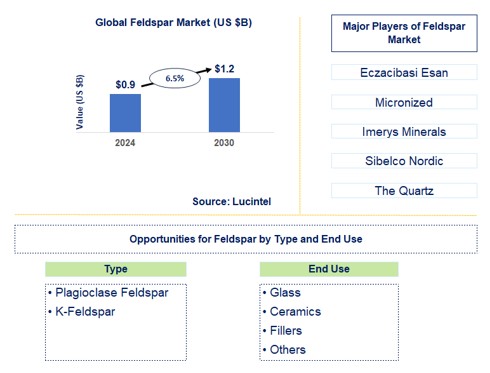
Key data points: The market size in 2030 = $1.2 billion, growth forecast = 6.5% annually for the next 6 years. Scroll below to get more insights. This market report covers trends, opportunities, and forecasts in the global feldspar market to 2030 by type (plagioclase feldspar and k-feldspar), end use (glass, ceramics, fillers, and others), and region (North America, Europe, Asia Pacific, and the Rest of the World)
We'll send your sample report shortly.
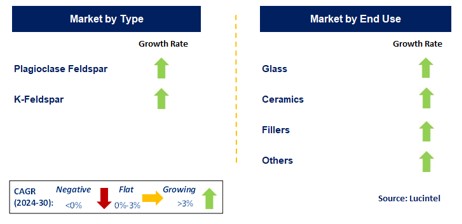
• Lucintel forecasts that, within the type category, plagioclase feldspar will remain the larger segment over the forecast period due to easy availability at a cost-effective rate.
• Within the end use category, glass will remain the largest segment due to the significantly growing production of ceramic floor tiles.
• In terms of regions, APAC is expected to witness the highest growth over the forecast period due to growing demand for feldspars within the domestic glass and ceramics sectors. Gain valuable insights for your business decisions with our comprehensive 150+ page report. Recent developments in the feldspar market are showing significant shifts resulting from evolving industrial needs and advances in technology. Changes are occurring in terms of production, consumption, and market behavior across major regions, with feldspar being an important natural resource used in ceramics, glass, and other industries. The trends observed in the United States, China, Germany, India, and Japan are driven by factors such as increased industrial activity, technological innovations, and changes in regulatory environments.
• United States: In the United States, the feldspar market is currently undergoing expansion due to increased demand from the ceramics and glass industries. Technological developments have improved extraction techniques as well as processing efficiency while maintaining product quality. Moreover, there has been a growing emphasis on sustainability, including better waste management practices and efficient utilization of resources. A resurgence of domestic manufacturing companies is reducing import dependence, thus enhancing local production and stabilizing the market.
• China: China remains the dominant player in the world’s feldspar industry due to advancements in mining technologies and processing methods, whether for ornamental or decorative purposes or for ceramic ware such as floor tiles and bathroom fixtures. Furthermore, China has invested heavily in sophisticated processing plants aimed at improving the quality of feldspar products. Environmental regulations imposed by the government necessitate cleaner production approaches, reshaping the industry landscape and facilitating sustainable development.
• Germany: Germany is concentrating on high-value applications of feldspar, mainly within the ceramics and glass sectors. High-purity feldspar for specialty applications can be produced by employing state-of-the-art processing technologies, which Germany is heavily investing in. Additionally, research by German scientists is ongoing to formulate new uses and improve performance levels, further enhancing product quality. Germany’s strict environmental laws have promoted the adoption of green feldspar mining and processing practices, aligning with the EU’s overall environmental priorities.
• India: The feldspar business in India has been growing due to increased domestic and export demand, most notably in the ceramic and glass sectors. The modernization of mines and new processing facilities are helping to increase efficiency and improve the quality of feldspar production. Moreover, the Indian government is working to make mining more environmentally friendly by reducing its ecological impact, including extracting feldspar from soils that are unsuitable for agriculture or reforestation projects. The use of nitrogen-fixing plants like Bracharia seeds and the planting of cereals to provide shade and reduce evaporation are part of this initiative. Due to its market size and potential new applications in various industries, India is now one of the largest feldspar producers.
• Japan: Japan produces high-quality feldspar products through technological improvements made over time. Japan has modernized its feldspar processing facilities to meet precise specifications required in the ceramics and glass industries. At the same time, there is a strong emphasis on research to update product performance and discover new uses. These efforts have led to the adoption of eco-friendly practices within feldspar mining and processing, in compliance with national environmental policies, making Japan even more competitive globally. A more than 150-page report is developed to help in your business decisions.
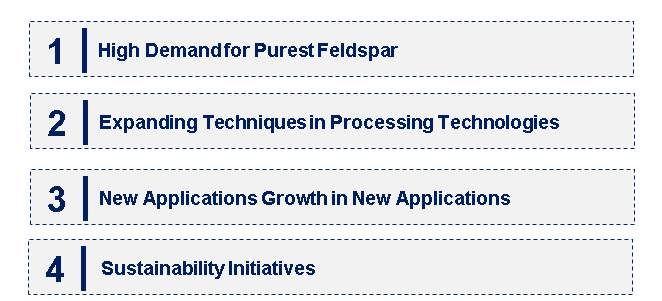
• High Demand for Purest Feldspar: The demand for the purest feldspar has surged due to its indispensable role in niche applications such as advanced ceramics and glass manufacturing. Industries are looking for feldspars with specific chemical compositions that can improve the quality of products and meet stringent quality standards. This development necessitates the discovery of refined methods for producing high-purity feldspar, which supports high-technology industry needs, thus propelling a growing market.
• Expanding Techniques in Processing Technologies: Advancements in feldspar processing technologies are enhancing efficiency and improving product quality. These innovations include automation, improved separation methods, and real-time analysis, among others. These technologies help make feldspar production much more precise, leading to increased accuracy levels. Cost reductions, more output, and higher-quality feldspars result from this approach, helping promote the higher-end production of this mineral. Such developments have caused significant improvements within the sector, making it more efficient and sustainable.
• Growth in New Applications: Another important trend observed among consumers is the growing number of areas where feldspars are used beyond traditional applications (diversification). Electronics, pharmaceuticals, and construction sectors, among others, now require new types of specialized feldspars. Research has been carried out on the potential uses and varieties of feldspar, expanding its range and opening up new growth paths and opportunities for diversification.
• Sustainability Initiatives: Sustainability initiatives are becoming increasingly popular within the feldspar market, primarily aimed at reducing environmental pollution and improving resource productivity. Companies are adopting environmentally friendly mining practices, waste management solutions, and energy-saving technologies. These undertakings are in line with global environmental objectives and also make the feldspar business more attractive to environmentally conscious consumers and regulators. The feldspar industry is undergoing a transformation brought about by emerging trends such as high demand for pure products, advances in processing technology, growing applications for feldspar, sustainability initiatives, and changing patterns of trade. These trends indicate innovation within the industry, leading to growth opportunities and other factors influencing market dynamics. Stakeholders must stay updated on these developments to capitalize on emerging opportunities for success in this ever-shifting marketplace.
• Expansion of Production Capacities: A significant expansion is being witnessed across major regions in terms of production capacities within the feldspar market. The global supply of feldspar has grown due to investments in new mining operations and the expansion of existing facilities. This trend is being driven by increased demand from the ceramic and glass manufacturing sectors. Improved availability due to enhanced production capabilities is stabilizing prices, facilitating a rising regional trade share for this commodity by meeting increasing industrial demands.
• Technological Advancements in Processing: Efficiency and product quality have increased because technology has improved processing for feldspar. Streamlining processes such as using advanced separation techniques, automated processing systems, and real-time quality control helps facilitate innovations in this area. As a result, costs are reduced while output increases, leading to higher-purity feldspar production. Competitiveness regarding products made from such minerals has been boosted, and industry growth continues to improve.
• Sustainability and Environmental Regulations: The development of environmental safeguards focused on sustainability initiatives provides direction toward sustainable practices among companies dealing with feldspar. To reduce their environmental impacts, these enterprises have embraced waste management technologies alongside eco-friendly mining procedures. With stricter regulations aimed at driving greener practices within the sector, it has become essential for firms operating under UN Global Compact principles to position themselves as "green" producers in order to attract environmentally conscious customers.
• Shifts in Trade Patterns: The feldspar market has been affected by changes in global trade patterns recently. Changes in trade policies, tariffs, and geopolitical factors have led to shifting flows of feldspar between countries. These trends make companies rethink and optimize their supply chains, explore new markets, and adjust their trading strategies on a global scale, thus ensuring their continued survival. The feldspar market has seen significant recent developments, such as increased production capacity, technological advancements, sustainability initiatives, and changing trade patterns, among others. These developments are greatly impacting the industry. Improvements in production efficiency and market dynamics, along with driving growth, are some of the changes witnessed. Market participants must be aware of these shifts as they occur so that they can respond effectively and not be left behind.
• Ceramics Industry: The feldspar market continues to present a major growth opportunity for the ceramics industry. The demand for high-quality feldspar is being propelled by the growing need for ceramic products in construction, automotive, and consumer goods. Developments in ceramic technology and the creation of new applications are leading to a broader market. As the ceramics sector grows, companies can benefit from product improvements and access to emerging markets.
• Glass Manufacturing: A significant area for growth in the glass industry is the role played by feldspar. Glass consumption in packaging, automotive, and architectural applications is increasing. Demand for high-purity feldspar, which has been driven by advances in glass production technologies and a need for specialized glass products, is steadily rising. Therefore, manufacturers can develop more customized feldspar products to meet the exact needs of the glass industry.
• Electronics and High-Tech Applications: The expansion of feldspar applications in electronics and high-tech industries presents a growth opportunity. Technological advancements have contributed to an increase in its use as an ingredient in electronic components like semiconductors and displays. New markets can be opened up through innovative research on tailored feldspar products used within these technological sectors.
• Construction Sector: Opportunities for feldspar are emerging in the construction sector, which is rapidly gaining a foothold as a key area of growth. The uses of feldspar are expanding, particularly in construction materials such as tiles and cement, among others. Rapid urbanization is driving residential construction projects as well as infrastructure expansion, which means that demand for feldspar will tend to increase. Companies should position themselves with innovative products targeting the building sector to meet current customers' needs. The growth of the feldspar industry across ceramics, glass manufacturing, electronics, construction, and specialty applications is driven by strategic growth prospects. By focusing on these areas, companies can take advantage of emerging trends, build a stronger market presence, and capitalize on new opportunities for business. To thrive in the ever-changing feldspar market, it is important for stakeholders to recognize and pursue these growing areas.
• Technological Advancements: Technological advancements are a major driver in the feldspar market. Innovations in mining, processing, and quality control technologies have improved efficiency and product quality. These developments result in lower production costs and increased output, while allowing for niche products made from feldspar. This technology adoption has stimulated the expansion of the business while keeping competition among feldspar companies high.
• Increased Demand from End-Use Industries: The feldspar market is driven by rising demand from end-use industries such as ceramics, glass, and construction. There is an increased requirement for quality feldspar due to the growth in these sectors. Firms are meeting this demand by increasing capacity and developing new applications. Consequently, this trend will foster market expansion and stimulate innovation in the feldspar industry.
• Sustainability and Environmental Regulations: The feldspar market has been shaped by sustainability and environmental regulations. To comply with stringent rules regarding environmental concerns, companies are adopting sustainable mining approaches and investing in waste disposal techniques. These steps are making the industry more attractive to environmentally conscious consumers, contributing toward global sustainability targets. By complying with these guidelines, businesses can achieve successful operations and growth in their respective markets. Challenges in the feldspar market are:
• Market Competition: The feldspar industry faces stiff competition as one of its major challenges. The factors upon which firms compete include price, quality, and innovation, among others. Price pressures from many players within the sector necessitate continuous improvement processes. Therefore, technological advancements must be pursued by firms, which should also offer superior products while providing clients with exceptional support services if they wish to remain competitive.
• Supply Chain Disruptions: The feldspar market is faced with supply chain disruptions that pose serious problems. Issues such as geopolitical concerns between countries or changes in trade policies can affect feldspar movement between regions, just as other logistics issues can do. Therefore, sourcing strategies must be adjusted, as companies could incur significant costs leading to shortages if disruptions occur in their supply chains. Supply chains should be strengthened to ensure that even when disruptions happen, alternative ways to obtain commodities at reasonable prices are available, thus minimizing the impact on these items. Technological advances, increased demand from end-use industries, sustainability initiatives, supply chain disruptions, and market competition are some of the drivers and challenges that shape the feldspar market. A proper understanding of these factors is key for stakeholders to navigate the market effectively, take advantage of growth opportunities, and overcome challenges. As a result, when companies adapt to these factors and address the issues affecting them, their market positions will be strengthened, leading to greater success in the feldspar industry.
• Eczacibasi Esan
• Micronized
• Imerys Minerals
• Sibelco Nordic
• The Quartz
• Plagioclase Feldspar
• K-Feldspar
• Glass
• Ceramics
• Fillers
• Others
• North America
• Europe
• Asia Pacific
• The Rest of the World


• Eczacibasi Esan
• Micronized
• Imerys Minerals
• Sibelco Nordic
• The Quartz Q6. Which feldspar market segment will be the largest in future? Answer: Lucintel forecasts that plagioclase feldspar will remain the larger segment over the forecast period due to easy availability at a cost-effective rate. Q7. In feldspar market, which region is expected to be the largest in next 5 years? Answer: APAC is expected to witness the highest growth over the forecast period due to growing demand for feldspars within the domestic glass and ceramics sectors. Q.8 Do we receive customization in this report? Answer: Yes, Lucintel provides 10% customization without any additional cost.


Choose a license that fits your team. Instant PDF delivery.
Prices exclude taxes. Instant delivery. Custom licensing available on request.
Market Report · July 24, 2026
Market Report · July 20, 2026
Market Report · July 20, 2026
Trusted partner for strategic intelligence and business growth


Receive a complimentary market analysis tailored to your industry. Our analysts will identify key growth opportunities and competitive dynamics specific to your business.

Market size, growth rate, and key trend analysis for your specific sector.

Top competitor positioning and market share analysis.

Strategic recommendations backed by data-driven insights.
Get curated market intelligence and competitive moves straight to your inbox.
By subscribing, you agree to receive our monthly insights. Unsubscribe anytime.
Receive a complimentary market analysis tailored to your industry. Our analysts will identify key growth opportunities and competitive dynamics specific to your business.
Market size, growth rate, and key trend analysis for your specific sector.
Top competitor positioning and market share analysis.
Strategic recommendations backed by data-driven insights.
Get curated market intelligence, emerging trends, and competitive moves straight to your inbox each month.
By subscribing, you agree to receive our monthly insights. Unsubscribe anytime.
We'll send your sample report shortly.