Federated Learning Market Trends and Forecast
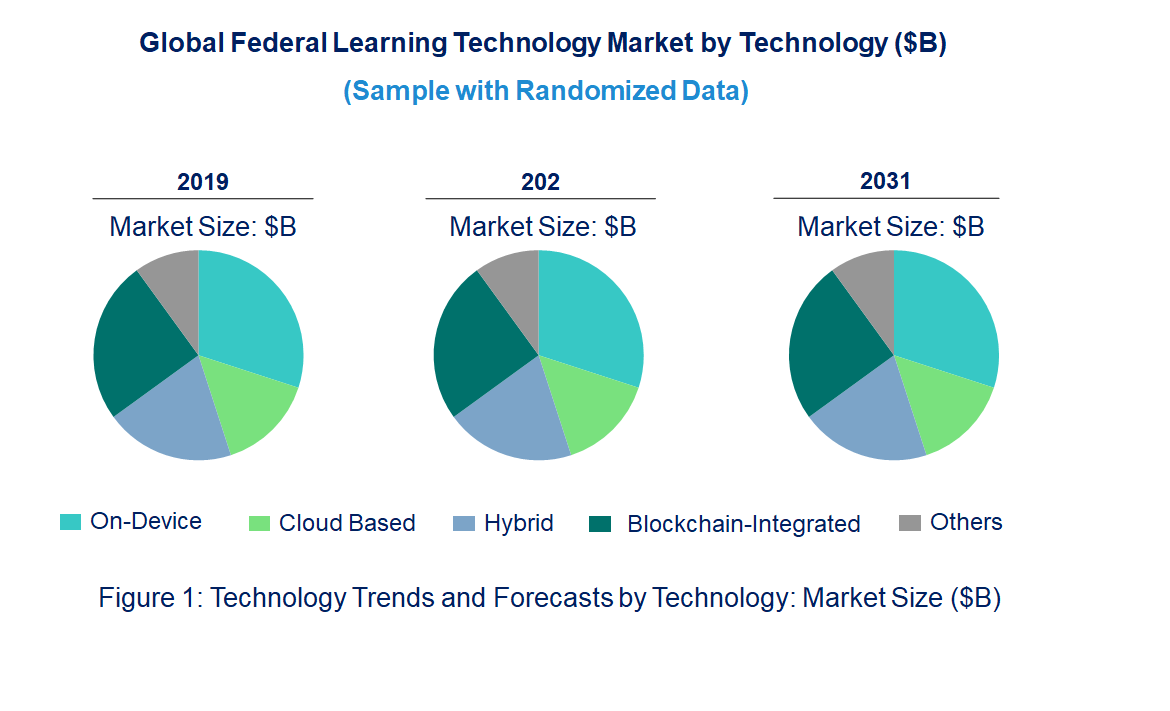
The technologies in the federated learning market have undergone significant changes in recent years, with a shift from on-device learning, cloud-based models, hybrid solutions, and blockchain-integrated systems to more innovative approaches like edge computing and distributed learning models. These shifts are driven by the increasing need for data privacy, decentralized machine learning, and real-time processing capabilities. On-device federated learning allows for training models directly on user devices, reducing latency and improving privacy. Cloud-based solutions, while providing scalability and computational power, are being complemented by hybrid approaches that combine both on-device and cloud resources for enhanced efficiency and flexibility. Blockchain-integrated federated learning is gaining traction for its ability to provide secure, decentralized management of data and models, ensuring greater transparency and accountability. These evolving technologies enable faster, more efficient, and secure machine learning applications across various industries.
Emerging Trends in the Federated Learning Market
Federated learning has emerged as a transformative approach in the field of machine learning, enabling privacy-preserving data processing across decentralized devices and systems. As industries increasingly rely on AI and machine learning, the need for secure, scalable, and efficient data handling solutions has risen. Federated learning meets these needs by allowing models to be trained across multiple devices without transferring sensitive data to centralized servers. This trend is reshaping industries such as healthcare, automotive, retail, and telecommunications. Below are the key emerging trends in the federated learning market that are driving this evolution:
• Privacy-Preserving Machine Learning: Federated learning’s emphasis on privacy and data security is reshaping how sensitive data is used for training machine learning models in healthcare, finance, and telecom.
• Edge Computing Integration: With the rise of IoT devices, federated learning is increasingly integrated with edge computing, enabling real-time processing and decision-making closer to the data source.
• Hybrid Federated Learning Models: The adoption of hybrid federated learning models, combining on-device and cloud-based learning, is becoming more prevalent for increased flexibility and resource optimization.
• Blockchain for Federated Learning: The integration of blockchain with federated learning ensures transparent, secure, and decentralized sharing of data, improving trust and traceability in applications like financial services.
• Increased Adoption Across Industries: As the benefits of federated learning become more apparent, its applications are expanding across various sectors, including healthcare, automotive, and retail, where data privacy and efficiency are critical.
These trends demonstrate how federated learning is adapting to the evolving technological landscape, enabling more efficient and secure machine learning applications while enhancing data privacy across industries.
Federated Learning Market : Industry Potential, Technological Development, and Compliance Considerations
Federated learning (FL) has emerged as a groundbreaking approach to machine learning, enabling models to be trained across decentralized devices while keeping data localized. This technology allows businesses and organizations to harness the power of artificial intelligence (AI) without compromising data privacy, making it particularly valuable in sectors like healthcare, finance, and telecommunications. The potential of federated learning lies in its ability to train models using sensitive data without transferring it to centralized servers, addressing privacy concerns while enabling the development of robust AI models.
• Technology Potential:
Federated learning has immense potential to revolutionize industries by allowing organizations to train models on edge devices (such as smartphones and IoT devices), which reduces the need for large-scale data transfer. This enables real-time, personalized AI models while respecting privacy laws, such as GDPR. It also facilitates collaboration between organizations without sharing raw data, opening up new opportunities in data-sensitive industries like healthcare, banking, and e-commerce.
• Degree of Disruption:
Federated learning disrupts traditional centralized AI models by decentralizing the training process. It challenges conventional machine learning frameworks and offers the opportunity for more secure, privacy-preserving AI solutions.
• Level of Current Technology Maturity:
Federated learning is still in its early stages of adoption, but has made significant strides in research and application, particularly with tech giants like Google and IBM leading the way.
• Regulatory Compliance:
Federated learning supports compliance with data protection regulations, such as GDPR, HIPAA, and CCPA, by ensuring data never leaves the device, maintaining privacy and security.
Federated learning holds immense potential to drive privacy-preserving, secure, and decentralized AI applications. As the technology matures and overcomes scalability and standardization challenges, it is poised to become a key component of data-driven industries, fostering innovation while ensuring regulatory compliance.
Recent Technological development in Federated Learning Market by Key Players
Federated learning is rapidly evolving as a key technology that allows decentralized training of machine learning models while ensuring data privacy. Major players in the technology space are actively developing and deploying federated learning solutions to address the growing need for secure, scalable AI solutions across various industries. From healthcare to finance to retail, these developments are reshaping how businesses approach data privacy, security, and efficiency in machine learning. Below are some of the most notable advancements made by key players in the federated learning market:
• Acuratio: Acuratio has developed a federated learning platform focusing on enabling privacy-preserving machine learning in healthcare, particularly in genomic research, enhancing model performance without exposing sensitive data.
• Cloudera: Cloudera is integrating federated learning into its enterprise data platforms, enabling organizations to train models across decentralized datasets, improving data security and regulatory compliance.
• Edge Delta: Edge Delta is pioneering the use of federated learning at the edge, providing real-time analytics and machine learning capabilities without moving sensitive data to centralized cloud systems.
• Enveil: Enveil focuses on building privacy-preserving AI models using federated learning, with a particular emphasis on data encryption and secure computations for industries like finance and government.
• FedML: FedML offers an open-source federated learning platform, focusing on making federated learning accessible for research and development while enhancing its applicability across various sectors, including healthcare and automotive.
• Google: Google’s TensorFlow Federated is a major development in the federated learning space, allowing for decentralized machine learning across devices while ensuring privacy and data security.
• IBM: IBM is integrating federated learning into its AI solutions, emphasizing the need for privacy and regulatory compliance, particularly in healthcare and financial services.
• Intel: Intel is advancing federated learning capabilities through hardware optimization, aiming to make federated models more efficient and scalable for industries like automotive and telecommunications.
• Lifebit: Lifebit is enabling federated learning in healthcare to create AI models that respect privacy regulations, such as GDPR, allowing for secure multi-party collaborations on genomic data.
• NVIDIA: NVIDIA is enhancing federated learning by offering GPU-accelerated solutions that improve the speed and scalability of machine learning models across edge devices.
These developments reflect the growing importance of federated learning as a solution for data privacy, scalability, and efficient model training across decentralized systems.
As the federated learning market continues to expand, these advancements by leading players demonstrate the technology’s increasing sophistication and its potential to transform industries such as healthcare, finance, automotive, and more. By addressing critical issues around data privacy, scalability, and efficiency, federated learning is establishing itself as a cornerstone for decentralized, secure AI applications. These developments signal a promising future for federated learning, with more widespread adoption expected across sectors that rely on sensitive data and complex machine learning models.
Federated Learning Market Driver and Challenges
Federated learning is gaining traction as a powerful solution for privacy-preserving machine learning, particularly as industries handle an increasing volume of sensitive data. The growing demand for secure AI models, regulatory pressure for data privacy, and technological advancements in edge computing are driving the adoption of federated learning across various sectors. However, despite its potential, the market also faces several challenges, including scalability issues, integration complexities, and the need for standardization. Below, we explore the key drivers and challenges influencing the federated learning market:
The factors responsible for driving the global federated learning market are:
• Data Privacy and Security: The rising concern over data privacy, especially in industries like healthcare, finance, and telecommunications, is a major driver. Federated learning allows organizations to train machine learning models without transferring sensitive data, meeting stringent regulatory requirements like GDPR.
• Decentralized Data Storage: The shift towards decentralized data storage, enabled by edge computing, has made federated learning a natural fit for real-time applications. This trend is particularly evident in industries like automotive and IoT, where data is generated on devices and needs to be processed locally.
• Regulatory Compliance: Governments and regulatory bodies are increasingly enforcing data protection laws, such as the GDPR and HIPAA, which are driving organizations to adopt federated learning as a way to comply with these regulations while still leveraging data for AI-driven insights.
• Technological Advancements: Innovations in machine learning algorithms, computing power, and communication protocols are helping improve the efficiency and scalability of federated learning, making it more viable for real-world applications.
Challenges facing the global federated learning market are:
• Scalability and Computational Demands: One of the significant challenges of federated learning is scalability, especially in large-scale environments with millions of edge devices. Training models efficiently across a vast network of devices can result in significant computational and communication overhead.
• Data Heterogeneity: Federated learning often deals with diverse and unstructured data sources, which can cause issues with model consistency and performance. Ensuring uniformity across data from different devices or organizations is a challenge.
• Lack of Standardization: The lack of standardized protocols for federated learning platforms and frameworks makes it difficult for businesses to implement solutions across different environments. The absence of a common framework complicates inter-organizational collaboration and cross-industry adoption.
The drivers of federated learning, particularly its ability to ensure privacy, comply with regulations, and leverage decentralized data, are propelling its adoption across industries. However, challenges related to scalability, data consistency, and standardization still need to be addressed. Overcoming these barriers will be crucial for the continued growth of federated learning, allowing it to fulfill its promise of enabling secure, efficient AI applications in an increasingly data-driven world. As technological advancements continue, federated learning will likely become a more accessible and reliable solution for organizations seeking to harness the power of AI without compromising privacy.
List of Federated Learning Companies
Companies in the market compete on the basis of product quality offered. Major players in this market focus on expanding their manufacturing facilities, R&D investments, infrastructural development, and leverage integration opportunities across the value chain. With these strategies federated learning companies cater increasing demand, ensure competitive effectiveness, develop innovative products & technologies, reduce production costs, and expand their customer base. Some of the federated learning companies profiled in this report includes.
• Acuratio
• Cloudera
• Edge Delta
• Enveil
• Fedml
• Google
Federated Learning Market by Technology
• Technology Readiness by Technology Type: On-device federated learning is mature, with widespread use in mobile and IoT devices, demonstrating solid competitive readiness and strong privacy compliance. Cloud-based federated learning is in advanced stages, offering scalable solutions across sectors like healthcare and finance, but facing regulatory hurdles. Hybrid federated learning is gaining ground as it combines the strengths of on-device and cloud-based models, though it’s still evolving. Blockchain-integrated federated learning is emerging, with its potential for secure, transparent data management making it highly competitive in data-sensitive industries, but still in early development for mainstream use. All technologies are progressing, each focusing on meeting market demand for privacy, security, and scalability.
Competitive Intensity and Regulatory Compliance: The competitive intensity in the federated learning market is growing as companies race to deploy secure, efficient models in various industries. On-device federated learning is gaining traction due to its potential for privacy and reduced data transfer, which complies with privacy regulations like GDPR and HIPAA. Cloud-based federated learning offers scalability but faces challenges in regulatory compliance, especially regarding data security and transfer. Hybrid federated learning presents a balanced solution, competing on both privacy and performance. Blockchain-integrated federated learning adds a layer of trust and transparency, with compliance aligning with evolving regulatory standards. As adoption increases, all technologies must navigate privacy laws and ethical considerations.
• Disruption Potential by Technology Type: The federated learning market offers diverse technological approaches with different levels of disruption. On-device federated learning disrupts centralized AI models by leveraging edge devices for localized training, providing a solution that prioritizes privacy and efficiency. Cloud-based federated learning brings scalability, allowing global collaboration while maintaining secure data models. Hybrid federated learning combines on-device and cloud models, optimizing for both performance and privacy. Blockchain-integrated federated learning enhances trust by providing secure, transparent data-sharing and model updates. Each technology offers distinct advantages, from decentralization to increased trust, all of which contribute to reshaping AI models and data privacy across industries.
Federated Learning Market Trend and Forecast by Technology [Value from 2019 to 2031]:
• On-Device
• Cloud-Based
• Hybrid
• Blockchain-Integrated
• Others
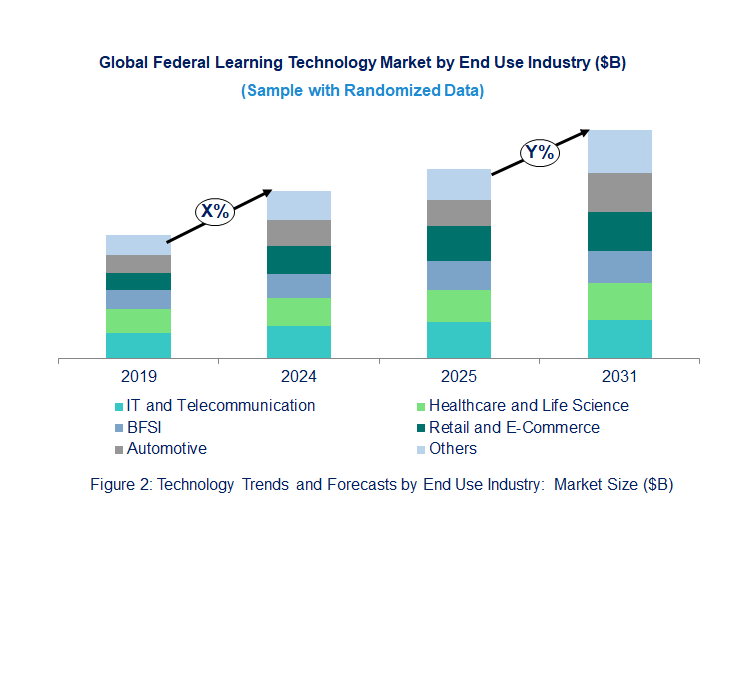
Federated Learning Market Trend and Forecast by End Use [Value from 2019 to 2031]:
• IT & Telecommunications
• Healthcare & Life Sciences
• BFSI
• Retail & E-Commerce
• Automotive
• Others
Federated Learning Market by Region [Value from 2019 to 2031]:
• North America
• Europe
• Asia Pacific
• The Rest of the World
• Latest Developments and Innovations in the Federated Learning Technologies
• Companies / Ecosystems
• Strategic Opportunities by Technology Type
Features of the Global Federated Learning Market
Market Size Estimates: Federated learning market size estimation in terms of ($B).
Trend and Forecast Analysis: Market trends (2019 to 2024) and forecast (2025 to 2031) by various segments and regions.
Segmentation Analysis: Technology trends in the global federated learning market size by various segments, such as end use and technology in terms of value and volume shipments.
Regional Analysis: Technology trends in the global federated learning market breakdown by North America, Europe, Asia Pacific, and the Rest of the World.
Growth Opportunities: Analysis of growth opportunities in different end uses, technologies, and regions for technology trends in the global federated learning market.
Strategic Analysis: This includes M&A, new product development, and competitive landscape for technology trends in the global federated learning market.
Analysis of competitive intensity of the industry based on Porter’s Five Forces model.
This report answers following 11 key questions
Q.1. What are some of the most promising potential, high-growth opportunities for the technology trends in the global federated learning market by technology (on-device, cloud-based, hybrid, blockchain-integrated, and others), end use (it & telecommunications, healthcare & life sciences, bfsi, retail & e-commerce, automotive, and others), and region (North America, Europe, Asia Pacific, and the Rest of the World)?
Q.2. Which technology segments will grow at a faster pace and why?
Q.3. Which regions will grow at a faster pace and why?
Q.4. What are the key factors affecting dynamics of different technology? What are the drivers and challenges of these technologies in the global federated learning market?
Q.5. What are the business risks and threats to the technology trends in the global federated learning market?
Q.6. What are the emerging trends in these technologies in the global federated learning market and the reasons behind them?
Q.7. Which technologies have potential of disruption in this market?
Q.8. What are the new developments in the technology trends in the global federated learning market? Which companies are leading these developments?
Q.9. Who are the major players in technology trends in the global federated learning market? What strategic initiatives are being implemented by key players for business growth?
Q.10. What are strategic growth opportunities in this federated learning technology space?
Q.11. What M & A activities did take place in the last five years in technology trends in the global federated learning market?