
Report Feature
Face Mask Market Trends and Forecast
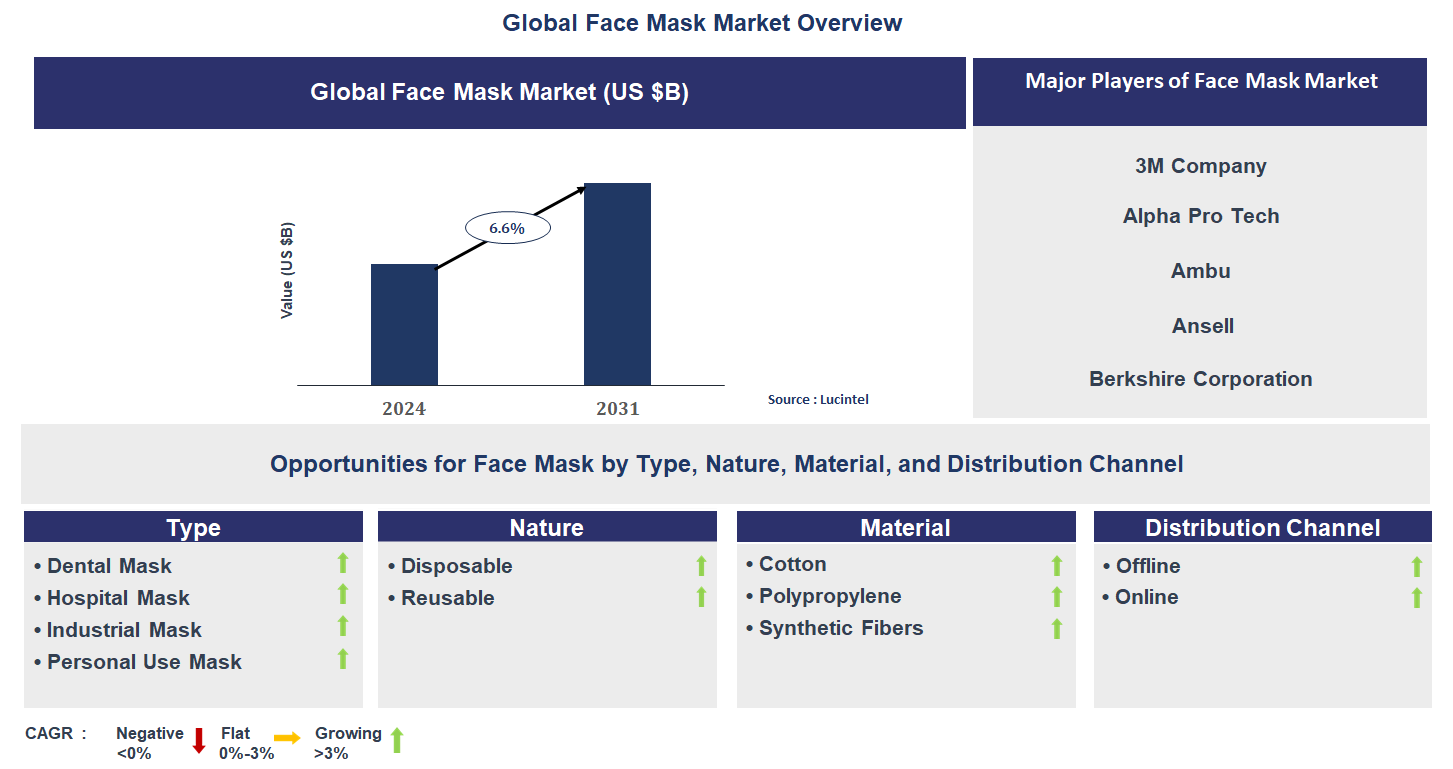
The future of the global face mask market looks promising with opportunities in the cotton, polypropylene, and synthetic fiber markets. The global face mask market is expected to grow with a CAGR of 6.6% from 2025 to 2031. The major drivers for this market are the increasing demand for skincare solutions, the rising popularity of self-care routines, and the growing awareness of skin protection benefits.• Lucintel forecasts that, within the type category, personal use mask is expected to witness the highest growth over the forecast period.
• Within the material category, polypropylene is expected to witness the highest growth.
• In terms of region, APAC is expected to witness the highest growth over the forecast period. Gain valuable insights for your business decisions with our comprehensive 150+ page report. Sample figures with some insights are shown below.
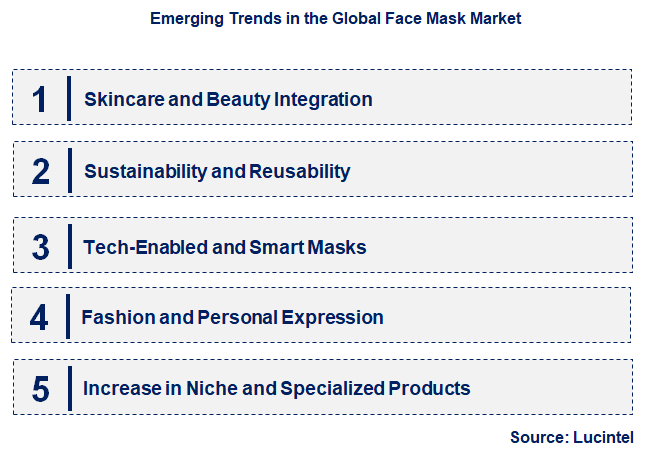
Emerging Trends in the Face Mask Market
The face mask industry is being redefined by a new wave of emerging trends that are pushing the business beyond its fundamental role as a protective barrier. These trends are indicative of a wider change in consumer values, where products not only have to be functional but also need to fit into personal style, health aspirations, and environmental awareness. The market is getting more diversified and specialized with more emphasis on user experience and ethical manufacturing. The following are five of the most important trends that are leading to this change.• Skincare and Beauty Integration: One of the new trends is the integration of protective masks with beauty masks. Whereas protective masks were originally an independent product category, there is currently a movement to fill protective masks with skincare elements. For instance, there are certain masks that are constructed with inner layers that emit moisturizers or other active ingredients to avoid skin irritation. Secondly, the segment of beauty masks is expanding with products that are specially formulated with a range of natural and organic ingredients to address particular skincare requirements in response to the increasing wellness consumer.
• Sustainability and Reusability: There is a significant shift in the market towards sustainable and reusable versions due to environmental worries over single-use plastic. This trend is driving manufacturers to adopt environmentally friendly materials such as bamboo, organic cotton, or recycled material. Reusable masks with exchangeable filters are also growing in demand because they present an economical and eco-friendly alternative.
• Tech-Enabled and Smart Masks: One of the key trends is the launch of smart masks with in-built technology. These tech-enabled masks have sensors that can detect air quality, monitor breathing patterns, or even analyze dermal health. These masks can be linked to a smartphone app to relay real-time information and customized suggestions. This movement is particularly attractive to those who are technologically aware and who have particular health requirements, such as those with respiratory issues or allergies.
• Fashion and Personal Expression: The face mask is now a fashion item and means of personal expression. This phenomenon is most visible in urban areas, where consumers are employing the use of masks to add a finishing touch to their attire and express their own personal style. Brands, from high-fashion design houses, are joining the fray with a vast array of patterns, colors, and designs. This phenomenon has turned the face mask from a utilitarian product to a lifestyle product, leading to consumer buying for cosmetic purposes as much as for safety.
• Increase in Niche and Specialized Products: There is a new trend towards creating niche and specialized masks for particular uses. These range from products developed for sports enthusiasts with high breathing capabilities, masks for kids with smaller dimensions and playful designs, to masks for individuals who have particular sensitivities. This diversification enables brands to address distinct consumer groups and provide customized solutions. Together, these new trends are collectively redefining the face mask industry by making it more attuned to contemporary consumer values. The emphasis on technology and sustainability is redressing global concerns and launching new product categories. The convergence with beauty and fashion is changing the product from a functional requirement to an aspirational lifestyle. The emergence of niche masks is pushing the market into new segments and usages.
Recent Development in the Face Mask Market
The face mask industry has seen a string of quick and significant changes in recent history, most of which are the result of a worldwide health pandemic that sped up innovation and altered consumer attitudes. These changes are propelling the industry away from a straightforward commodity and toward a more sophisticated, consumer-oriented business. The emphasis is no longer just on fundamental protection but also on sustainability, comfort, and aesthetics. The following five major developments point to the way in which the market is changing.• Towards Reusable and Sustainable Materials: One of the major developments has been the market-wide transition towards reusable and sustainable masks. Due to the sheer amount of environmental waste caused by disposable masks, governments and consumers alike have been demanding alternatives. Consequently, masks have gone mainstream from being created using washable, long-lasting fabrics. Manufacturers are also employing materials such as organic cotton and recyclable plastics.
• Filtration Technology Advancement: There has been a significant improvement in filtration technology, especially in non-N95 masks. Businesses are incorporating new materials and designs to enhance the breathability and filtration efficiency of common masks. This incorporates the application of replaceable filters made of improved non-woven technologies and structures that create a tighter fit. This is improving the ability of masks to resist airborne particles and pollutants, which is propelling their adoption even after the pandemic phase has passed.
• Greater Emphasis on Comfort and Ergonomics: One notable advancement is the greater emphasis on comfort and ergonomics. As a large percentage of people wear masks over extended durations, consumer feedback regarding discomfort has driven innovation in products. Brands are now creating masks with adjustable ear loops, nose wires, and various shapes to accommodate a broader range of facial structures. This adaptation is essential in accelerating consumer acceptance and usage of masks on a daily basis.
• Anti-Viral and Anti-Bacterial Coating Integration: One of the most significant developments is the integration of anti-viral and anti-bacterial coatings into mask materials. These coatings, which are usually created using copper or silver ions, have the ability to kill germs on the surface of the mask. This aspect adds an extra layer of protection and is one of the biggest attractions for consumers. It is a product development that is assisting with rebuilding consumer confidence in the efficacy of masks and a demonstration of ongoing product development.
• Foray into Skincare and Cosmetic Masks: The business is experiencing a significant evolution with the foray into the skincare and cosmetic mask business. Brands are now launching a variety of facial sheet masks, clay masks, and gel masks that hydrate, brighten, or cleanse the skin. This trend is part of a wider global phenomenon in which consumers are focusing more on self-care and do-it-yourself beauty treatments. It is a very lucrative business that is generating a lot of innovation in ingredients and formulation. These recent changes are collectively shaping the face mask market towards a more sustainable, comfortable, and specialized direction. The move towards green materials is solving a significant environmental issue, while improvements in product performance are coming through breakthroughs in technology. The emphasis on ergonomics and diversification into new segments such as skin care are opening up fresh growth opportunities and channels for differentiation.
Strategic Growth Opportunities in the Face Mask Market
The face mask market provides several strategic opportunities for growth, as it is driven by shifting consumer trends and development toward more niche applications. To take advantage of these opportunities, businesses need to innovate and serve particular consumer groups and applications. By departing from a one-size-fits-all model, brands can develop a distinct value proposition and achieve a better competitive positioning.• Entering the Healthcare and Institutional Market: Expanding into the healthcare and institutional market represents a huge opportunity for growth. Although much of this market has been established, there is potential for growth by offering specialized high-quality protective masks for hospitals, dental clinics, and laboratories. Companies can concentrate on creating masks with better filtration, breathability, and comfort for extended wear by medical professionals. This segment provides a stable, high-volume revenue stream and a platform for brand visibility.
• Seizing the Niche Consumer Market: There is a great growth potential in addressing niche consumer needs. These involve creating masks for particular groups like sportspeople, kids, or allergy sufferers. For instance, having a mask with improved breathability for sports use or with playful, child-friendly colors and a firm hold. By targeting a particular segment, brands can create a devoted client base and stand out from other brands that sell generic products.
• Creating a Premium, Green Product Line: One of the growth opportunities is to create a premium product line around sustainability. The strategy includes working with 100% biodegradable or recycled materials in masks and packaging. This appeals to the increasing consumer segment that values the environment and will pay extra for products that share the same values. It also assists a brand in creating a solid ethical reputation, which is a significant differentiator in a competitive marketplace.
• Capitalizing on the Beauty and Skincare Segment: The beauty and skincare segment offers tremendous growth potential. Brands can enlarge their product range to encompass a variety of sheet masks, clay masks, and gel masks that target particular skin issues. This approach takes advantage of the global self-care and in-home beauty treatment trend. Through innovation in novel ingredients and formulations, a brand can win over a new, highly active consumer and build a lucrative new revenue stream.
• Venturing into Emerging Markets: There is also a strategic growth opportunity in venturing into emerging markets. With rising disposable incomes and urbanization, there will be a rising demand for affordable, yet effective face masks. Brands are able to enter these markets by providing a variety of decent but reasonably priced products, ranging from simple surgical masks to more sophisticated ones. This enables the companies to achieve a sustainable growth path and gain a first-mover advantage in less crowded markets. These strategic growth prospects are combined to shape the face mask industry by driving it toward a more specialized and consumer-centric future. By targeting niche applications and populations, firms are broadening the market’s reach. The push for sustainability and new segments such as skincare is opening new channels for premium, value-based products. The strategic expansion into new markets also guarantees that the industry will keep growing and evolving to meet global consumers’ needs.
Face Mask Market Driver and Challenges
The face mask market is influenced by a multifaceted interplay of key drivers and challenges that are affecting its growth and trajectory. The growth of the market is mainly driven by increased global consciousness about personal health and sanitation, as well as growing environmental pollution. Yet, the sector also has to deal with some major challenges, ranging from plastic waste concerns, cutthroat competition, and changes in consumer trends as pandemic lockdowns recede. The factors responsible for driving the face mask market include: 1. Increased Health and Hygiene Consciousness: The main driver is increasing worldwide awareness of personal hygiene and health, significantly spurred by recent global pandemics. Customers are increasingly aware of the necessity of safeguarding themselves from air-borne infection and toxins. This is a cultural change that has increased the use of face masks in everyday life, even outside of pandemics. This increased awareness is a major driver of steady and sustainable demand. 2. Growing Air Pollution: The growing levels of air pollution in cities and industries across the globe are the prime propeller for the market. Face masks are more and more being used by people in order to shield themselves from fine particulate matter and toxic pollutants. This is especially seen in fast-growing countries where the growth of cities and industries is making the air unhealthy. Protection against pollution is a persistent and rising cause of demand. 3. Public Health Mandates and Government Regulations: Public health mandates and government regulations are also important drivers. In most nations, face mask use continues to be mandated in healthcare facilities and public transportation systems. Such mandates provide a consistent and stable demand for protective masks. They also support the cultural perception of wearing masks as a health and safety essential, which motivates sustained use. 4. Product Innovation and Technology: Ongoing product innovation is a key contributor. Producers are continuously enhancing their products by incorporating features such as better filtration, improved breathability, and antimicrobial treatments. Not only do these technologies enhance the performance of the masks, but they also make them more comfortable to wear. This innovation provides justification for a premium price point as well as maintaining customer interest in the product category, particularly in a competitive market. 5. Growth of Beauty and Skincare Uses: The increasing popularity of skincare and beauty is a prime driver. Face masks are not merely protective products anymore; they are now an essential part of many individuals beauty regimes. The innovation of sheet masks, clay masks, and other beauty masks that are filled with skin-beneficial ingredients is the biggest growth area. This trend is recruiting new consumers to the category and is broadening the products use. Challenges in the face mask market are: 1. Plastic Waste Environmental Impact: One of the biggest challenges is the environmental impact of throwaway masks. Virtually all of these items are produced using non-recyclable plastic and are part of a global waste emergency. This is an issue of great concern to green consumers and is a public relations headache for manufacturers. The requirement for brands to transition to sustainable materials and create new ways to dispose of them is a tricky and expensive challenge. 2. Saturation of the Market and Price War: The market is being severely tested by market saturation and aggressive price war. The excessive demand during the pandemic resulted in a surge of new producers, and there has been an oversupply of commodities. This has created a price war, which is squeezing profit margins. The test for brands is how to make their offerings different and command a premium price based on quality and innovation as opposed to competing on price. 3. Slumping Demand After the Pandemic: One of the biggest challenges is a slump in demand once the fear of a pandemic has passed and public measures are relaxed. Although some areas, such as healthcare and pollution protection, will continue to be robust, the overall consumer market for everyday protective masks could decline. This compels brands to rethink their strategy and discover new uses or markets for their goods. The combined effect of these drivers and challenges is a market of constant change. The drivers, particularly the growing emphasis on health, pollution, and personal hygiene, are driving the industry into innovation and diversification. Brands are reacting by developing high-tech, specialized, and eco-friendly products. But the difficulties, especially environmental issues and intense competition, are serving as a driving force toward change, compelling firms to be strategic and accountable.List of Face Mask Companies
Companies in the market compete on the basis of product quality offered. Major players in this market focus on expanding their manufacturing facilities, R&D investments, infrastructural development, and leverage integration opportunities across the value chain. With these strategies face mask companies cater increasing demand, ensure competitive effectiveness, develop innovative products & technologies, reduce production costs, and expand their customer base. Some of the face mask companies profiled in this report include-• 3M Company
• Alpha Pro Tech
• Ambu
• Ansell
• Berkshire Corporation
• Breathe Easy Labs
• Cardinal Health
• Demetech Corporation
• Drägerwerk
• DuPont de Nemours
Face Mask Market by Segment
The study includes a forecast for the global face mask market by type, nature, material, distribution channel, and region.Face Mask Market by Type [Value from 2019 to 2031]:
• Dental Mask
• Hospital Mask
• Industrial Mask
• Personal Use Mask
Face Mask Market by Nature [Value from 2019 to 2031]:
• Disposable
• Reusable
Face Mask Market by Material [Value from 2019 to 2031]:
• Cotton
• Polypropylene
• Synthetic Fibers
Face Mask Market by Distribution Channel [Value from 2019 to 2031]:
• Offline
• Online
Face Mask Market by Region [Value from 2019 to 2031]:
• North America
• Europe
• Asia Pacific
• The Rest of the World
Country Wise Outlook for the Face Mask Market
The face mask industry globally has experienced a stunning transformation, evolving from a specialty medical product into a ubiquitous piece of personal protection and skincare. This was largely triggered by the COVID-19 pandemic, which revolutionized consumer behavior and production priorities. The current trends are now fueled by a blend of sustained health awareness, an increasing emphasis on sustainability, and extensive technological advancements. Every major nation—the United States, China, Germany, India, and Japan—is grappling with these changes in its own market dynamics specific to its own culture, economy, and regulatory framework.• United States: In the United States, the market for face masks is experiencing a transition from pandemic-led demand for protective masks to a more segmented market. Although demand for surgical and N95 masks is still high in medical environments, consumer demand for reusable and fashionable masks for everyday use against pollution and allergens is on the rise. The beauty and skincare mask market is also growing strongly, with an emphasis on new and innovative ingredients and natural formulations.
• China: China’s face mask market is huge and is powered by health and beauty factors. With high levels of pollution in most cities, protective masks have become a daily essential for many people. This has brought a surge in demand for high-filtration masks, like KN95. At the same time, the beauty and skincare category is growing rapidly, driven by increasing disposable incomes and social media consumption.
• Germany: The German face mask market is dominated by a keen consumer focus on product quality, safety, and eco-friendliness. German consumers are sophisticated and sensitive to green efforts, which creates a high level of demand for reusable masks and products with low or recyclable packaging. While the medical-grade mask demand continues to be a priority for clinical use, the overall consumer market is gravitating toward masks constructed from organic cotton or other eco-friendly materials. German innovation emphasizes developing high-quality and robust masks that are compliant with very high national quality and safety requirements.
• India: The Indian face mask market is growing at a fast clip due to urbanization, increased air pollution, and an increasing concern about health. Though the market for cheap, universal surgical masks is still prevalent, a definite trend is toward high-end products, such as N95 and fashionable reusable ones. The skincare and beauty industry is also a major growth segment, with increasing demands for products with targeted skin solutions brought about by pollution. E-commerce websites and social media are playing a central role in making the products available and informing consumers about the advantages of using a face mask.
• Japan: The Japanese face mask market is mature and highly embedded in daily life, powered by a long-festering cultural practice of mask-wearing for cleanliness, especially during winter and flu seasons. Recent trends involve a high emphasis on high-performance materials and comfort, with products having special features such as cooling properties or increased breathability. The face mask market is a trendsetter in innovation, with specialized ingredients and cutting-edge formulations used in products.

Features of the Global Face Mask Market
Market Size Estimates: Face mask market size estimation in terms of value ($B). Trend and Forecast Analysis: Market trends (2019 to 2024) and forecast (2025 to 2031) by various segments and regions. Segmentation Analysis: Face mask market size by various segments, such as by type, nature, material, distribution channel, and region in terms of value ($B). Regional Analysis: Face mask market breakdown by North America, Europe, Asia Pacific, and Rest of the World. Growth Opportunities: Analysis of growth opportunities in different types, nature, materials, distribution channels, and regions for the face mask market. Strategic Analysis: This includes M&A, new product development, and competitive landscape of the face mask market. Analysis of competitive intensity of the industry based on Porter’s Five Forces model.
FAQ
Q1. What is the growth forecast for face mask market? Answer: The global face mask market is expected to grow with a CAGR of 6.6% from 2025 to 2031. Q2. What are the major drivers influencing the growth of the face mask market? Answer: The major drivers for this market are the increasing demand for skincare solutions, the rising popularity of self-care routines, and the growing awareness of skin protection benefits. Q3. What are the major segments for face mask market? Answer: The future of the face mask market looks promising with opportunities in the cotton, polypropylene, and synthetic fiber markets. Q4. Who are the key face mask market companies? Answer: Some of the key face mask companies are as follows:• 3M Company
• Alpha Pro Tech
• Ambu
• Ansell
• Berkshire Corporation
• Breathe Easy Labs
• Cardinal Health
• Demetech Corporation
• Drägerwerk
• DuPont de Nemours Q5. Which face mask market segment will be the largest in future? Answer: Lucintel forecasts that, within the type category, personal use mask is expected to witness the highest growth over the forecast period. Q6. In face mask market, which region is expected to be the largest in next 5 years? Answer: In terms of region, APAC is expected to witness the highest growth over the forecast period. Q7. Do we receive customization in this report? Answer: Yes, Lucintel provides 10% customization without any additional cost.
Table of Contents
List of Figures
List of Tables
Methodology
- In-depth interviews of the major players in this market
- Detailed secondary research from competitors’ financial statements and published data
- Extensive searches of published works, market, and database information pertaining to industry news, company press releases, and customer intentions
- A compilation of the experiences, judgments, and insights of Lucintel’s professionals, who have analyzed and tracked this market over the years.


Buy Now
Choose a license that fits your team. Instant PDF delivery.
Prices exclude taxes. Instant delivery. Custom licensing available on request.
Key Questions
- • What are some of the most promising, high-growth opportunities for the face mask market by type (dental mask, hospital mask, industrial mask, and personal use mask), nature (disposable and reusable), material (cotton, polypropylene, and synthetic fibers), distribution channel (offline and online), and region (North America, Europe, Asia Pacific, and the Rest of the World)?
- • Which segments will grow at a faster pace and why?
- • Which region will grow at a faster pace and why?
- • What are the key factors affecting market dynamics? What are the key challenges and business risks in this market?
- • What are the business risks and competitive threats in this market?
- • What are the emerging trends in this market and the reasons behind them?
- • What are some of the changing demands of customers in the market?
- • What are the new developments in the market? Which companies are leading these developments?
- • Who are the major players in this market? What strategic initiatives are key players pursuing for business growth?
- • What are some of the competing products in this market and how big of a threat do they pose for loss of market share by material or product substitution?
- • What M&A activity has occurred in the last 5 years and what has its impact been on the industry? For any questions related to Face Mask Market, Face Mask Market Size, Face Mask Market Growth, Face Mask Market Analysis, Face Mask Market Report, Face Mask Market Share, Face Mask Market Trends, Face Mask Market Forecast, Face Mask Companies, write Lucintel analyst at email: helpdesk@lucintel.com. We will be glad to get back to you soon.


