
Close Lucintel Chat
Didn't Find What You're Looking for?
Call us at +1972 636 5056 or write at helpdesk@Lucintel.com
Ask an Expert Provide Custom Requirements Download Sample Report Search Available Reports
  • helpdesk@Lucintel.com
  • |
  • Call Lucintel +1 972 636 5056
  • |
  • Login
  • |
  • Register
  • |
  • Search
  • |
'
...

The Impact of COVID-19 is included in Eye Shadow Market Report. Buy it today to get an advantage.

Request the impact of COVID-19 on your product or industry


Eye Shadow Market Trends and Forecast

The future of the global eye shadow market looks promising with opportunities in the glitter, matte, metallic, pearl, satin, and shimmer markets. The global eye shadow market is expected to grow with a CAGR of 6.2% from 2025 to 2031. The major drivers for this market are the increasing demand for innovative eye makeup products, the rising preference for long-lasting makeup formulas, and the growing influence of social media beauty trends.

• Lucintel forecasts that, within the formulation type category, liquid is expected to witness the highest growth over the forecast period.
• Within the product finish category, matte is expected to witness the highest growth.
• In terms of region, APAC is expected to witness the highest growth over the forecast period.
Gain valuable insights for your business decisions with our comprehensive 150+ page report. Sample figures with some insights are shown below.
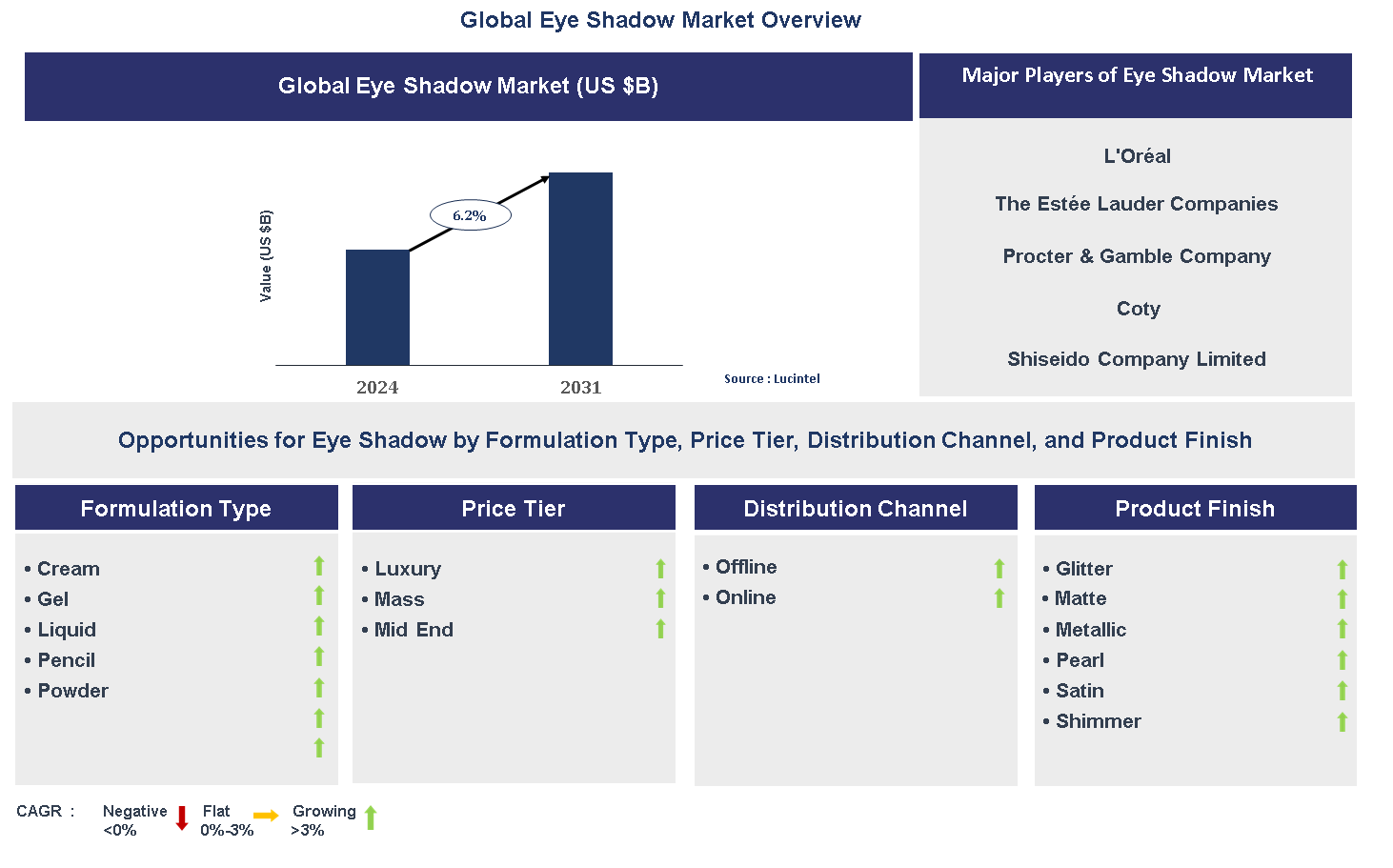
Eye Shadow Market Trends and Forecast

Emerging Trends in the Eye Shadow Market

The eye shadow market is currently defined by several key trends, moving beyond traditional color cosmetics. These shifts are influenced by consumer demand for personal expression, ingredient transparency, and environmental responsibility. Brands are adapting by introducing innovative products that offer unique textures, clean formulations, and sustainable packaging, all while leveraging digital platforms to connect with a global audience.
• Hybrid Formulas: This trend involves eye shadows that combine color with skincare benefits, such as moisturizing or anti-aging properties. This innovation caters to consumers seeking multi-functional products that streamline their beauty routine and offer added value beyond aesthetics. It meets the demand for efficiency and high-quality, ingredient-conscious formulations, merging makeup and skincare into a single, convenient product.
• Sustainability in Packaging: There is a growing focus on using sustainable materials for eye shadow packaging, including recycled plastic, glass, and refillable options. This trend is driven by heightened environmental awareness among consumers. It influences purchasing decisions, with many consumers actively choosing brands that demonstrate a commitment to reducing their ecological footprint through eco-friendly and reusable designs.
• Social Media Driven Trends: Viral trends on platforms like TikTok and Instagram are rapidly shaping consumer preferences and driving product development. Eye shadows with unique finishes, like chrome or multi-chrome, and vibrant, artistic looks gain significant traction. This trend shortens the product lifecycle, compelling brands to innovate quickly and engage with a digitally active audience through content and influencer collaborations.
• Clean and Vegan Formulations: A significant trend is the increasing demand for eye shadows made without parabens, phthalates, and other harsh chemicals. Vegan and cruelty-free formulas are also in high demand. This shift is driven by a health-conscious consumer base that is more informed about ingredients and animal welfare. It pushes brands to reformulate their products to meet these ethical and safety standards.
• Personalization: Consumers are increasingly seeking personalized eye shadow palettes and shades. This trend includes customizable palettes where individuals can select their preferred colors and finishes to create a unique collection. It allows for greater creative freedom and caters to diverse individual styles, moving away from one-size-fits-all products and fostering a more tailored and engaging consumer experience.
These trends are collectively reshaping the eye shadow market by pushing brands toward greater innovation, ethical practices, and consumer-centric product development. The focus on hybrid formulas and sustainability reflects a move beyond aesthetics, while the influence of social media and personalization highlights the importance of consumer engagement and tailored experiences. The clean beauty movement reinforces a commitment to health and safety, driving significant changes in product formulation and marketing.
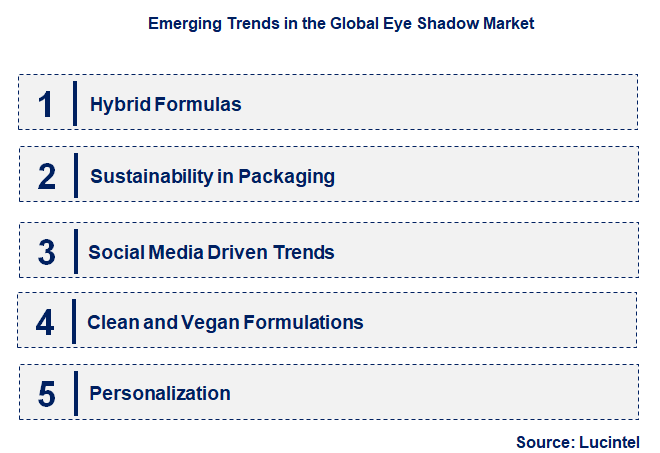
Emerging Trends in the Eye Shadow Market

Recent Development in the Eye Shadow Market

The eye shadow market is undergoing significant transformations driven by consumer behavior, technological advancements, and a growing emphasis on ethical and sustainable practices. These developments reflect a dynamic industry that is constantly adapting to meet evolving consumer expectations. From new product formats to innovative marketing strategies, the market is moving towards greater customization, transparency, and a more interactive consumer experience.
• Rise of Liquid and Cream Formulations: Liquid and cream eye shadows are gaining popularity due to their ease of application, bendability, and long-lasting wear. These formulations often provide a more intense color payoff and a smooth, crease-free finish. This development has expanded the market beyond traditional powder shadows, attracting new consumers who prefer a quicker and more modern makeup routine with high-performance results.
• Integration of AI and AR Technology: Brands are leveraging artificial intelligence (AI) and augmented reality (AR) to enhance the consumer shopping experience. Virtual try-on features and personalized shade recommendations help consumers make informed purchasing decisions. This technology reduces the friction of online shopping, builds consumer confidence, and allows brands to offer a more interactive and personalized experience from the comfort of the user’s home.
• Focus on Multi-Use Products: There is a growing trend of eye shadows designed for multiple uses, such as serving as a highlighter, eyeliner, or brow product. This development caters to consumers who value efficiency and minimalism in their beauty routines. Multi-use products offer greater value and reduce waste, aligning with a consumer mindset that seeks versatile and practical solutions that simplify their makeup collection.
• Shift Towards Skinimalism: The skinimalism trend, which prioritizes a natural and minimalist look, is influencing eye shadow formulations. Consumers are seeking sheer, buildable, and natural-looking shades that enhance their features rather than covering them up. This development pushes brands to create products with lighter textures and more subtle finishes, promoting a healthier, more effortless beauty aesthetic that aligns with wellness trends.
• Expansion of Direct-to-Consumer Channels: Eye shadow brands are increasingly selling directly to consumers through their own websites and social media platforms. This DTC approach allows brands to build a direct relationship with their customers, gather valuable feedback, and control their brand image. It also bypasses traditional retail markups, allowing for more competitive pricing and exclusive product offerings that foster brand loyalty.
These developments are having a profound impact on the eye shadow market by transforming how products are developed, marketed, and sold. They are pushing brands to be more innovative, transparent, and consumer-focused. The rise of new product formats, the adoption of technology, and a focus on multi-use products are all contributing to a more dynamic and personalized market that caters to the diverse and evolving needs of modern consumers.

Strategic Growth Opportunities in the Eye Shadow Market

The eye shadow market presents several strategic growth opportunities across various applications, driven by evolving consumer demands and technological advancements. These opportunities are focused on creating specialized products that cater to specific consumer needs and occasions. By targeting these niche applications, brands can differentiate themselves, build brand loyalty, and capture new segments of the market.
• Professional Makeup Application: This segment offers a significant growth opportunity by targeting professional makeup artists and beauty schools with high-quality, long-wearing, and highly pigmented formulas. Products designed for professional use, such as extensive palettes with a wide range of shades, can secure a loyal customer base and establish brand credibility. This focus on the professional market can also enhance the brand’s image and influence consumer perceptions.
• Everyday Wear and Natural Look: With the rise of the "no-makeup makeup" trend, there is a substantial opportunity for eye shadows that offer a natural, subtle finish for daily wear. Brands can focus on creating easy-to-use, single-shade products or small palettes with neutral colors. This market targets consumers who prefer a minimalist beauty routine, offering products that enhance their natural features with minimal effort.
• Special Occasion and Bridal Makeup: The demand for long-lasting, smudge-proof, and high-impact eye shadows for events like weddings, parties, and festivals is a key growth area. Products with shimmer, metallic, and glitter finishes are particularly popular in this segment. By creating dedicated collections for special occasions, brands can tap into a lucrative market that values durability and an exceptional aesthetic appeal for important events.
• Skincare-Infused Eye Shadow: A significant opportunity lies in developing eye shadows that contain active skincare ingredients like hyaluronic acid or antioxidants. These products appeal to a health-conscious consumer base that wants their makeup to also provide skin benefits. This application blurs the line between makeup and skincare, offering a unique value proposition that attracts consumers looking for multi-functional products that support skin health.
• Sustainable and Ethical Products: The market for sustainable and ethically produced eye shadows is growing rapidly. This includes products made with organic, vegan, and cruelty-free ingredients, as well as those with eco-friendly packaging. By focusing on this application, brands can attract environmentally and ethically conscious consumers, building a strong brand identity and fostering customer loyalty based on shared values beyond product performance.
These strategic opportunities are reshaping the eye shadow market by encouraging specialization and innovation. They are moving the industry beyond a one-size-fits-all approach and towards a more segmented and targeted strategy. By focusing on specific applications like professional, everyday, and special occasion wear, along with ethical and skincare-infused products, brands can better meet the diverse and evolving needs of modern consumers and secure long-term growth.

Eye Shadow Market Driver and Challenges

The eye shadow market is shaped by a complex interplay of major drivers and key challenges, including various technological, economic, and regulatory factors. The market’s growth is fueled by consumer demand for innovative, personalized, and high-quality products, while challenges like intense competition and changing regulatory landscapes require brands to be agile and responsive. Understanding these dynamics is crucial for navigating the market effectively.
The factors responsible for driving the eye shadow market include:
1. Growing E-commerce and Social Media Influence: The expansion of e-commerce platforms and the power of social media have made eye shadows more accessible to a global audience. Platforms like Instagram and TikTok drive trends and product discovery, enabling brands to reach new consumers directly. This digital landscape lowers market entry barriers and allows for targeted marketing, significantly boosting product visibility and sales.
2. Rising Demand for Clean Beauty Products: Consumer awareness of the ingredients in their cosmetics has led to a surge in demand for "clean," non-toxic, and natural eye shadow formulations. This trend is driven by a focus on health and wellness, prompting brands to reformulate products to be free of harmful chemicals. This driver is pushing the industry toward greater transparency and the use of more sustainable ingredients.
3. Innovation in Product Formulations: Continuous innovation in eye shadow formulas, including liquid, cream, and hybrid products with skincare benefits, is a key driver. These new formats offer superior performance, such as long-lasting wear and intense color payoff, appealing to a wider range of consumers. This focus on innovation keeps the market dynamic and encourages repeat purchases by offering new and improved experiences.
4. Increasing Disposable Income in Developing Regions: In countries like India and China, rising disposable income is enabling more consumers to spend on discretionary products like cosmetics. This economic driver is fueling significant market growth by expanding the consumer base for eye shadows and creating new opportunities for both local and international brands to enter these lucrative markets.
5. Celebrity and Influencer Endorsements: The influence of celebrities and social media influencers on consumer purchasing decisions is a major market driver. Endorsements and collaborations can create viral trends and build strong brand loyalty. This driver highlights the importance of leveraging digital opinion leaders to connect with and persuade a target audience, creating a powerful marketing channel for the industry.
Challenges in the eye shadow market are:
1. Intense Market Competition: The eye shadow market is highly saturated with both established global brands and new, fast-growing indie brands. This intense competition puts pressure on pricing, innovation, and marketing budgets. It can be challenging for new entrants to gain a foothold and for existing brands to maintain their market share without continuous investment in product development and aggressive marketing strategies.
2. Stringent Regulatory Standards: The cosmetics industry is subject to strict regulations regarding product safety, ingredient lists, and marketing claims in many countries. Naviding these varied and often complex regulations can be a significant challenge for brands, especially those operating internationally. Non-compliance can lead to product recalls, fines, and reputational damage, making regulatory adherence a critical concern.
3. Supply Chain Disruptions: Like many industries, the eye shadow market is vulnerable to global supply chain disruptions, which can impact the availability of raw materials and packaging components. These disruptions can lead to production delays, increased costs, and shortages, making it difficult for brands to meet consumer demand and maintain consistent product availability on store shelves and online.
The eye shadow market is experiencing a period of significant change, driven by shifts in consumer behavior and technology. The growth drivers—like the rise of e-commerce, demand for clean beauty, and innovative products—are propelling the industry forward. However, challenges such as intense competition and regulatory hurdles require brands to be strategic and adaptable to succeed in a dynamic and increasingly demanding market.

List of Eye Shadow Companies

Companies in the market compete on the basis of product quality offered. Major players in this market focus on expanding their manufacturing facilities, R&D investments, infrastructural development, and leverage integration opportunities across the value chain. With these strategies eye shadow companies cater increasing demand, ensure competitive effectiveness, develop innovative products & technologies, reduce production costs, and expand their customer base. Some of the eye shadow companies profiled in this report include-
• LOréal
• The Estée Lauder Companies
• Procter & Gamble Company
• Coty
• Shiseido Company Limited
• LVMH Moët Hennessy Louis Vuitton
• Revlon
• Amorepacific Corporation
• KOSÉ Corporation
• Kao Corporation

Eye Shadow Market by Segment

The study includes a forecast for the global eye shadow market by formulation type, price tier, distribution channel, product finish, and region.

Eye Shadow Market by Formulation Type [Value from 2019 to 2031]:


• Cream
• Gel
• Liquid
• Pencil
• Powder

Eye Shadow Market by Price Tier [Value from 2019 to 2031]:


• Luxury
• Mass
• Mid End

Eye Shadow Market by Distribution Channel [Value from 2019 to 2031]:


• Offline
• Online

Eye Shadow Market by Product Finish [Value from 2019 to 2031]:


• Glitter
• Matte
• Metallic
• Pearl
• Satin
• Shimmer

Eye Shadow Market by Region [Value from 2019 to 2031]:


• North America
• Europe
• Asia Pacific
• The Rest of the World

Country Wise Outlook for the Eye Shadow Market

Recent developments in the eye shadow market reflect a global shift towards innovation, personalization, and sustainability. Consumers in key markets are seeking products that offer more than just color; they want multifunctional formulas, clean ingredients, and sustainable packaging. These trends are driving brands to develop new product lines that cater to diverse preferences and ethical considerations, reshaping the competitive landscape across continents.
• United States: The U.S. market is witnessing a surge in demand for clean beauty products, with a focus on non-toxic, vegan, and cruelty-free eye shadows. Brands are also innovating with unique textures and finishes, such as liquid and cream formulas that offer long-lasting wear and easy application. This shift is fueled by a growing consumer base that prioritizes health, ethical sourcing, and high-performance products.
• China: In China, a strong emphasis on e-commerce and social media marketing is driving market growth. Chinese consumers are drawn to vibrant, highly pigmented palettes and products that align with local beauty trends, often popularized by key opinion leaders (KOLs). Local brands are gaining significant traction by offering affordable, trendy, and high-quality products that resonate with a digitally savvy audience.
• Germany: The German market shows a strong preference for natural and organic cosmetics. Consumers are increasingly seeking eye shadows made with plant-based ingredients and sustainable packaging. Brands are responding by launching eco-friendly product lines and promoting transparency about their sourcing and manufacturing processes. This trend reflects a broader cultural commitment to environmental responsibility and holistic wellness.
• India: The Indian eye shadow market is expanding rapidly, driven by the increasing disposable income and the influence of global beauty trends. Consumers are embracing bold, colorful palettes for special occasions and daily wear. Local brands are competing effectively by offering products that are specifically formulated to suit Indian skin tones and are available at various price points to cater to a wide range of consumers.
• Japan: Japans market is characterized by a demand for high-quality, subtle, and sophisticated eye shadows. Consumers prefer multi-functional products that provide a natural, dewy finish. The market is also seeing an increase in hybrid products, like eyeshadows with skincare benefits. This reflects a preference for minimalist beauty routines and high-end formulations that deliver both aesthetic and functional value.

Lucintel Analytics Dashboard

Features of the Global Eye Shadow Market

Market Size Estimates: Eye shadow market size estimation in terms of value ($B).
Trend and Forecast Analysis: Market trends (2019 to 2024) and forecast (2025 to 2031) by various segments and regions.
Segmentation Analysis: Eye shadow market size by various segments, such as by formulation type, price tier, distribution channel, product finish, and region in terms of value ($B).
Regional Analysis: Eye shadow market breakdown by North America, Europe, Asia Pacific, and Rest of the World.
Growth Opportunities: Analysis of growth opportunities in different formulation types, price tier, distribution channels, product finish, and regions for the eye shadow market.
Strategic Analysis: This includes M&A, new product development, and competitive landscape of the eye shadow market.
Analysis of competitive intensity of the industry based on Porter’s Five Forces model.

Lucintel Consulting Services

FAQ

Q1. What is the growth forecast for eye shadow market?
Answer: The global eye shadow market is expected to grow with a CAGR of 6.2% from 2025 to 2031.
Q2. What are the major drivers influencing the growth of the eye shadow market?
Answer: The major drivers for this market are the increasing demand for innovative eye makeup products, the rising preference for long-lasting makeup formulas, and the growing influence of social media beauty trends.
Q3. What are the major segments for eye shadow market?
Answer: The future of the eye shadow market looks promising with opportunities in the glitter, matte, metallic, pearl, satin, and shimmer markets.
Q4. Who are the key eye shadow market companies?
Answer: Some of the key eye shadow companies are as follows:
• LOréal
• The Estée Lauder Companies
• Procter & Gamble Company
• Coty
• Shiseido Company Limited
• LVMH Moët Hennessy Louis Vuitton
• Revlon
• Amorepacific Corporation
• KOSÉ Corporation
• Kao Corporation
Q5. Which eye shadow market segment will be the largest in future?
Answer: Lucintel forecasts that, within the formulation type category, liquid is expected to witness the highest growth over the forecast period.
Q6. In eye shadow market, which region is expected to be the largest in next 5 years?
Answer: In terms of region, APAC is expected to witness the highest growth over the forecast period.
Q7. Do we receive customization in this report?
Answer: Yes, Lucintel provides 10% customization without any additional cost.

This report answers following 11 key questions:

Q.1. What are some of the most promising, high-growth opportunities for the eye shadow market by formulation type (cream, gel, liquid, pencil, and powder), price tier (luxury, mass, and mid end), distribution channel (offline and online), product finish (glitter, matte, metallic, pearl, satin, and shimmer), and region (North America, Europe, Asia Pacific, and the Rest of the World)?
Q.2. Which segments will grow at a faster pace and why?
Q.3. Which region will grow at a faster pace and why?
Q.4. What are the key factors affecting market dynamics? What are the key challenges and business risks in this market?
Q.5. What are the business risks and competitive threats in this market?
Q.6. What are the emerging trends in this market and the reasons behind them?
Q.7. What are some of the changing demands of customers in the market?
Q.8. What are the new developments in the market? Which companies are leading these developments?
Q.9. Who are the major players in this market? What strategic initiatives are key players pursuing for business growth?
Q.10. What are some of the competing products in this market and how big of a threat do they pose for loss of market share by material or product substitution?
Q.11. What M&A activity has occurred in the last 5 years and what has its impact been on the industry?

For any questions related to Eye Shadow Market, Eye Shadow Market Size, Eye Shadow Market Growth, Eye Shadow Market Analysis, Eye Shadow Market Report, Eye Shadow Market Share, Eye Shadow Market Trends, Eye Shadow Market Forecast, Eye Shadow Companies, write Lucintel analyst at email: helpdesk@lucintel.com. We will be glad to get back to you soon.
                                           Table of Contents

            1. Executive Summary

            2. Market Overview

                        2.1 Background and Classifications
                        2.2 Supply Chain

            3. Market Trends & Forecast Analysis

                        3.1 Macroeconomic Trends and Forecasts
                        3.2 Industry Drivers and Challenges
                        3.3 PESTLE Analysis
                        3.4 Patent Analysis
                        3.5 Regulatory Environment
                        3.6 Global Eye Shadow Market Trends and Forecast Market Trends and Forecast

            4. Global Eye Shadow Market by Formulation Type

                        4.1 Overview
                        4.2 Attractiveness Analysis by Formulation Type
                        4.3 Cream : Trends and Forecast 2025 to 2031
                        4.4 Gel : Trends and Forecast 2025 to 2031
                        4.5 Liquid : Trends and Forecast 2025 to 2031
                        4.6 Pencil : Trends and Forecast 2025 to 2031
                        4.7 Powder : Trends and Forecast 2025 to 2031

            5. Global Eye Shadow Market by Price Tier

                        5.1 Overview
                        5.2 Attractiveness Analysis by Price Tier
                        5.3 Luxury : Trends and Forecast 2025 to 2031
                        5.4 Mass : Trends and Forecast 2025 to 2031
                        5.5 Mid End : Trends and Forecast 2025 to 2031

            6. Global Eye Shadow Market by Distribution Channel

                        6.1 Overview
                        6.2 Attractiveness Analysis by Distribution Channel
                        6.3 Offline : Trends and Forecast 2025 to 2031
                        6.4 Online : Trends and Forecast 2025 to 2031

            7. Global Eye Shadow Market by Product Finish

                        7.1 Overview
                        7.2 Attractiveness Analysis by Product Finish
                        7.3 Glitter : Trends and Forecast 2025 to 2031
                        7.4 Matte : Trends and Forecast 2025 to 2031
                        7.5 Metallic : Trends and Forecast 2025 to 2031
                        7.6 Pearl : Trends and Forecast 2025 to 2031
                        7.7 Satin : Trends and Forecast 2025 to 2031
                        7.8 Shimmer : Trends and Forecast 2025 to 2031

            8. Regional Analysis

                        8.1 Overview
                        8.2 Global Eye Shadow Market by Region

            9. North American Eye Shadow Market

                        9.1 Overview
                        9.2 North American Eye Shadow Market by Type
                        9.3 North American Eye Shadow Market by Application
                        9.4 The United States Eye Shadow Market
                        9.5 Canadian Eye Shadow Market
                        9.6 Mexican Eye Shadow Market

            10. European Eye Shadow Market

                        10.1 Overview
                        10.2 European Eye Shadow Market by Type
                        10.3 European Eye Shadow Market by Application
                        10.4 German Eye Shadow Market
                        10.5 French Eye Shadow Market
                        10.6 Italian Eye Shadow Market
                        10.7 Spanish Eye Shadow Market
                        10.8 The United Kingdom Eye Shadow Market

            11. APAC Eye Shadow Market

                        11.1 Overview Overview
                        11.2 APAC Eye Shadow Market by Type Overview
                        11.3 APAC Eye Shadow Market by Application Overview
                        11.4 Chinese Eye Shadow Market Overview
                        11.5 Indian Eye Shadow Market Overview
                        11.6 Japanese Eye Shadow Market Overview
                        11.7 South Korean Eye Shadow Market Overview
                        11.8 Indonesian Eye Shadow Market Overview

            12. ROW Eye Shadow Market

                        12.1 Overview Overview
                        12.2 ROW Eye Shadow Market by Type Overview
                        12.3 ROW Eye Shadow Market by Application Overview
                        12.4 Middle Eastern Eye Shadow Market Overview
                        12.5 South American Eye Shadow Market Overview
                        12.6 African Eye Shadow Market Overview

            13. Competitor Analysis

                        13.1 Product Portfolio Analysis Overview
                        13.2 Operational Integration Overview
                        13.3 Porter’s Five Forces Analysis Overview
                                    • Competitive Rivalry
                                    • Bargaining Power of Buyers
                                    • Bargaining Power of Suppliers
                                    • Threat of Substitutes
                                    • Threat of New Entrants
                        13.4 Market Share Analysis Overview

            14. Opportunities & Strategic Analysis

                        14.1 Value Chain Analysis Overview
                        14.2 Growth Opportunity Analysis Overview
                                    14.2.1 Growth Opportunity by Formulation Type
                                    14.2.2 Growth Opportunity by Price Tier
                                    14.2.3 Growth Opportunity by Distribution Channel
                                    14.2.4 Growth Opportunity by Product Finish
                        14.3 Emerging Trends in the Global Eye Shadow Market Overview
                        14.4 Strategic Analysis Overview
                                    14.4.1 New Product Development
                                    14.4.2 Certification and Licensing
                                    14.4.3 Mergers, Acquisitions, Agreements, Collaborations, and Joint Ventures

            15. Company Profiles of the Leading Players Across the Value Chain

                        15.1 Competitive Analysis Overview
                        15.2 LÄX%$%XOréal Overview
                                    • Company Overview
                                    • Eye Shadow Market Business Overview
                                    • New Product Development
                                    • Merger, Acquisition, and Collaboration
                                    • Certification and Licensing
                        15.3 The Estée Lauder Companies Overview
                                    • Company Overview
                                    • Eye Shadow Market Business Overview
                                    • New Product Development
                                    • Merger, Acquisition, and Collaboration
                                    • Certification and Licensing
                        15.4 Procter & Gamble Company Overview
                                    • Company Overview
                                    • Eye Shadow Market Business Overview
                                    • New Product Development
                                    • Merger, Acquisition, and Collaboration
                                    • Certification and Licensing
                        15.5 Coty Overview
                                    • Company Overview
                                    • Eye Shadow Market Business Overview
                                    • New Product Development
                                    • Merger, Acquisition, and Collaboration
                                    • Certification and Licensing
                        15.6 Shiseido Company Limited Overview
                                    • Company Overview
                                    • Eye Shadow Market Business Overview
                                    • New Product Development
                                    • Merger, Acquisition, and Collaboration
                                    • Certification and Licensing
                        15.7 LVMH Moët Hennessy Louis Vuitton Overview
                                    • Company Overview
                                    • Eye Shadow Market Business Overview
                                    • New Product Development
                                    • Merger, Acquisition, and Collaboration
                                    • Certification and Licensing
                        15.8 Revlon Overview
                                    • Company Overview
                                    • Eye Shadow Market Business Overview
                                    • New Product Development
                                    • Merger, Acquisition, and Collaboration
                                    • Certification and Licensing
                        15.9 Amorepacific Corporation Overview
                                    • Company Overview
                                    • Eye Shadow Market Business Overview
                                    • New Product Development
                                    • Merger, Acquisition, and Collaboration
                                    • Certification and Licensing
                        15.10 KOSÉ Corporation Overview
                                    • Company Overview
                                    • Eye Shadow Market Business Overview
                                    • New Product Development
                                    • Merger, Acquisition, and Collaboration
                                    • Certification and Licensing
                        15.11 Kao Corporation Overview
                                    • Company Overview
                                    • Eye Shadow Market Business Overview
                                    • New Product Development
                                    • Merger, Acquisition, and Collaboration
                                    • Certification and Licensing

            16. Appendix

                        16.1 List of Figures Overview
                        16.2 List of Tables Overview
                        16.3 Research Methodology Overview
                        16.4 Disclaimer Overview
                        16.5 Copyright Overview
                        16.6 Abbreviations and Technical Units Overview
                        16.7 About Us Overview
                        16.8 Contact Us Overview

                                               List of Figures


            Chapter 1

                        Figure 1.1: Trends and Forecast for the Global Eye Shadow Market

            Chapter 2

                        Figure 2.1: Usage of Eye Shadow Market
                        Figure 2.2: Classification of the Global Eye Shadow Market
                        Figure 2.3: Supply Chain of the Global Eye Shadow Market

            Chapter 3

                        Figure 3.1: Trends of the Global GDP Growth Rate
                        Figure 3.2: Trends of the Global Population Growth Rate
                        Figure 3.3: Trends of the Global Inflation Rate
                        Figure 3.4: Trends of the Global Unemployment Rate
                        Figure 3.5: Trends of the Regional GDP Growth Rate
                        Figure 3.6: Trends of the Regional Population Growth Rate
                        Figure 3.7: Trends of the Regional Inflation Rate
                        Figure 3.8: Trends of the Regional Unemployment Rate
                        Figure 3.9: Trends of Regional Per Capita Income
                        Figure 3.10: Forecast for the Global GDP Growth Rate
                        Figure 3.11: Forecast for the Global Population Growth Rate
                        Figure 3.12: Forecast for the Global Inflation Rate
                        Figure 3.13: Forecast for the Global Unemployment Rate
                        Figure 3.14: Forecast for the Regional GDP Growth Rate
                        Figure 3.15: Forecast for the Regional Population Growth Rate
                        Figure 3.16: Forecast for the Regional Inflation Rate
                        Figure 3.17: Forecast for the Regional Unemployment Rate
                        Figure 3.18: Forecast for Regional Per Capita Income
                        Figure 3.19: Driver and Challenges of the Eye Shadow Market

            Chapter 4

                        Figure 4.1: Global Eye Shadow Market by Formulation Type in 2019, 2024, and 2031
                        Figure 4.2: Trends of the Global Eye Shadow Market ($B) by Formulation Type
                        Figure 4.3: Forecast for the Global Eye Shadow Market ($B) by Formulation Type
                        Figure 4.4: Trends and Forecast for Cream in the Global Eye Shadow Market (2019-2031)
                        Figure 4.5: Trends and Forecast for Gel in the Global Eye Shadow Market (2019-2031)
                        Figure 4.6: Trends and Forecast for Liquid in the Global Eye Shadow Market (2019-2031)
                        Figure 4.7: Trends and Forecast for Pencil in the Global Eye Shadow Market (2019-2031)
                        Figure 4.8: Trends and Forecast for Powder in the Global Eye Shadow Market (2019-2031)

            Chapter 5

                        Figure 5.1: Global Eye Shadow Market by Price Tier in 2019, 2024, and 2031
                        Figure 5.2: Trends of the Global Eye Shadow Market ($B) by Price Tier
                        Figure 5.3: Forecast for the Global Eye Shadow Market ($B) by Price Tier
                        Figure 5.4: Trends and Forecast for Luxury in the Global Eye Shadow Market (2019-2031)
                        Figure 5.5: Trends and Forecast for Mass in the Global Eye Shadow Market (2019-2031)
                        Figure 5.6: Trends and Forecast for Mid End in the Global Eye Shadow Market (2019-2031)

            Chapter 6

                        Figure 6.1: Global Eye Shadow Market by Distribution Channel in 2019, 2024, and 2031
                        Figure 6.2: Trends of the Global Eye Shadow Market ($B) by Distribution Channel
                        Figure 6.3: Forecast for the Global Eye Shadow Market ($B) by Distribution Channel
                        Figure 6.4: Trends and Forecast for Offline in the Global Eye Shadow Market (2019-2031)
                        Figure 6.5: Trends and Forecast for Online in the Global Eye Shadow Market (2019-2031)

            Chapter 7

                        Figure 7.1: Global Eye Shadow Market by Product Finish in 2019, 2024, and 2031
                        Figure 7.2: Trends of the Global Eye Shadow Market ($B) by Product Finish
                        Figure 7.3: Forecast for the Global Eye Shadow Market ($B) by Product Finish
                        Figure 7.4: Trends and Forecast for Glitter in the Global Eye Shadow Market (2019-2031)
                        Figure 7.5: Trends and Forecast for Matte in the Global Eye Shadow Market (2019-2031)
                        Figure 7.6: Trends and Forecast for Metallic in the Global Eye Shadow Market (2019-2031)
                        Figure 7.7: Trends and Forecast for Pearl in the Global Eye Shadow Market (2019-2031)
                        Figure 7.8: Trends and Forecast for Satin in the Global Eye Shadow Market (2019-2031)
                        Figure 7.9: Trends and Forecast for Shimmer in the Global Eye Shadow Market (2019-2031)

            Chapter 8

                        Figure 8.1: Trends of the Global Eye Shadow Market ($B) by Region (2019-2024)
                        Figure 8.2: Forecast for the Global Eye Shadow Market ($B) by Region (2025-2031)

            Chapter 9

                        Figure 9.1: Trends and Forecast for the North American Eye Shadow Market (2019-2031)
                        Figure 9.2: North American Eye Shadow Market by Formulation Type in 2019, 2024, and 2031
                        Figure 9.3: Trends of the North American Eye Shadow Market ($B) by Formulation Type (2019-2024)
                        Figure 9.4: Forecast for the North American Eye Shadow Market ($B) by Formulation Type (2025-2031)
                        Figure 9.5: North American Eye Shadow Market by Price Tier in 2019, 2024, and 2031
                        Figure 9.6: Trends of the North American Eye Shadow Market ($B) by Price Tier (2019-2024)
                        Figure 9.7: Forecast for the North American Eye Shadow Market ($B) by Price Tier (2025-2031)
                        Figure 9.8: North American Eye Shadow Market by Distribution Channel in 2019, 2024, and 2031
                        Figure 9.9: Trends of the North American Eye Shadow Market ($B) by Distribution Channel (2019-2024)
                        Figure 9.10: Forecast for the North American Eye Shadow Market ($B) by Distribution Channel (2025-2031)
                        Figure 9.11: North American Eye Shadow Market by Product Finish in 2019, 2024, and 2031
                        Figure 9.12: Trends of the North American Eye Shadow Market ($B) by Product Finish (2019-2024)
                        Figure 9.13: Forecast for the North American Eye Shadow Market ($B) by Product Finish (2025-2031)
                        Figure 9.14: Trends and Forecast for the United States Eye Shadow Market ($B) (2019-2031)
                        Figure 9.15: Trends and Forecast for the Mexican Eye Shadow Market ($B) (2019-2031)
                        Figure 9.16: Trends and Forecast for the Canadian Eye Shadow Market ($B) (2019-2031)

            Chapter 10

                        Figure 10.1: Trends and Forecast for the European Eye Shadow Market (2019-2031)
                        Figure 10.2: European Eye Shadow Market by Formulation Type in 2019, 2024, and 2031
                        Figure 10.3: Trends of the European Eye Shadow Market ($B) by Formulation Type (2019-2024)
                        Figure 10.4: Forecast for the European Eye Shadow Market ($B) by Formulation Type (2025-2031)
                        Figure 10.5: European Eye Shadow Market by Price Tier in 2019, 2024, and 2031
                        Figure 10.6: Trends of the European Eye Shadow Market ($B) by Price Tier (2019-2024)
                        Figure 10.7: Forecast for the European Eye Shadow Market ($B) by Price Tier (2025-2031)
                        Figure 10.8: European Eye Shadow Market by Distribution Channel in 2019, 2024, and 2031
                        Figure 10.9: Trends of the European Eye Shadow Market ($B) by Distribution Channel (2019-2024)
                        Figure 10.10: Forecast for the European Eye Shadow Market ($B) by Distribution Channel (2025-2031)
                        Figure 10.11: European Eye Shadow Market by Product Finish in 2019, 2024, and 2031
                        Figure 10.12: Trends of the European Eye Shadow Market ($B) by Product Finish (2019-2024)
                        Figure 10.13: Forecast for the European Eye Shadow Market ($B) by Product Finish (2025-2031)
                        Figure 10.14: Trends and Forecast for the German Eye Shadow Market ($B) (2019-2031)
                        Figure 10.15: Trends and Forecast for the French Eye Shadow Market ($B) (2019-2031)
                        Figure 10.16: Trends and Forecast for the Spanish Eye Shadow Market ($B) (2019-2031)
                        Figure 10.17: Trends and Forecast for the Italian Eye Shadow Market ($B) (2019-2031)
                        Figure 10.18: Trends and Forecast for the United Kingdom Eye Shadow Market ($B) (2019-2031)

            Chapter 11

                        Figure 11.1: Trends and Forecast for the APAC Eye Shadow Market (2019-2031)
                        Figure 11.2: APAC Eye Shadow Market by Formulation Type in 2019, 2024, and 2031
                        Figure 11.3: Trends of the APAC Eye Shadow Market ($B) by Formulation Type (2019-2024)
                        Figure 11.4: Forecast for the APAC Eye Shadow Market ($B) by Formulation Type (2025-2031)
                        Figure 11.5: APAC Eye Shadow Market by Price Tier in 2019, 2024, and 2031
                        Figure 11.6: Trends of the APAC Eye Shadow Market ($B) by Price Tier (2019-2024)
                        Figure 11.7: Forecast for the APAC Eye Shadow Market ($B) by Price Tier (2025-2031)
                        Figure 11.8: APAC Eye Shadow Market by Distribution Channel in 2019, 2024, and 2031
                        Figure 11.9: Trends of the APAC Eye Shadow Market ($B) by Distribution Channel (2019-2024)
                        Figure 11.10: Forecast for the APAC Eye Shadow Market ($B) by Distribution Channel (2025-2031)
                        Figure 11.11: APAC Eye Shadow Market by Product Finish in 2019, 2024, and 2031
                        Figure 11.12: Trends of the APAC Eye Shadow Market ($B) by Product Finish (2019-2024)
                        Figure 11.13: Forecast for the APAC Eye Shadow Market ($B) by Product Finish (2025-2031)
                        Figure 11.14: Trends and Forecast for the Japanese Eye Shadow Market ($B) (2019-2031)
                        Figure 11.15: Trends and Forecast for the Indian Eye Shadow Market ($B) (2019-2031)
                        Figure 11.16: Trends and Forecast for the Chinese Eye Shadow Market ($B) (2019-2031)
                        Figure 11.17: Trends and Forecast for the South Korean Eye Shadow Market ($B) (2019-2031)
                        Figure 11.18: Trends and Forecast for the Indonesian Eye Shadow Market ($B) (2019-2031)

            Chapter 12

                        Figure 12.1: Trends and Forecast for the ROW Eye Shadow Market (2019-2031)
                        Figure 12.2: ROW Eye Shadow Market by Formulation Type in 2019, 2024, and 2031
                        Figure 12.3: Trends of the ROW Eye Shadow Market ($B) by Formulation Type (2019-2024)
                        Figure 12.4: Forecast for the ROW Eye Shadow Market ($B) by Formulation Type (2025-2031)
                        Figure 12.5: ROW Eye Shadow Market by Price Tier in 2019, 2024, and 2031
                        Figure 12.6: Trends of the ROW Eye Shadow Market ($B) by Price Tier (2019-2024)
                        Figure 12.7: Forecast for the ROW Eye Shadow Market ($B) by Price Tier (2025-2031)
                        Figure 12.8: ROW Eye Shadow Market by Distribution Channel in 2019, 2024, and 2031
                        Figure 12.9: Trends of the ROW Eye Shadow Market ($B) by Distribution Channel (2019-2024)
                        Figure 12.10: Forecast for the ROW Eye Shadow Market ($B) by Distribution Channel (2025-2031)
                        Figure 12.11: ROW Eye Shadow Market by Product Finish in 2019, 2024, and 2031
                        Figure 12.12: Trends of the ROW Eye Shadow Market ($B) by Product Finish (2019-2024)
                        Figure 12.13: Forecast for the ROW Eye Shadow Market ($B) by Product Finish (2025-2031)
                        Figure 12.14: Trends and Forecast for the Middle Eastern Eye Shadow Market ($B) (2019-2031)
                        Figure 12.15: Trends and Forecast for the South American Eye Shadow Market ($B) (2019-2031)
                        Figure 12.16: Trends and Forecast for the African Eye Shadow Market ($B) (2019-2031)

            Chapter 13

                        Figure 13.1: Porter’s Five Forces Analysis of the Global Eye Shadow Market
                        Figure 13.2: Market Share (%) of Top Players in the Global Eye Shadow Market (2024)

            Chapter 14

                        Figure 14.1: Growth Opportunities for the Global Eye Shadow Market by Formulation Type
                        Figure 14.2: Growth Opportunities for the Global Eye Shadow Market by Price Tier
                        Figure 14.3: Growth Opportunities for the Global Eye Shadow Market by Distribution Channel
                        Figure 14.4: Growth Opportunities for the Global Eye Shadow Market by Product Finish
                        Figure 14.5: Growth Opportunities for the Global Eye Shadow Market by Region
                        Figure 14.6: Emerging Trends in the Global Eye Shadow Market

                                               List of Tables


            Chapter 1

                        Table 1.1: Growth Rate (%, 2023-2024) and CAGR (%, 2025-2031) of the Eye Shadow Market by Formulation Type, Price Tier, Distribution Channel, and Product Finish
                        Table 1.2: Attractiveness Analysis for the Eye Shadow Market by Region
                        Table 1.3: Global Eye Shadow Market Parameters and Attributes

            Chapter 3

                        Table 3.1: Trends of the Global Eye Shadow Market (2019-2024)
                        Table 3.2: Forecast for the Global Eye Shadow Market (2025-2031)

            Chapter 4

                        Table 4.1: Attractiveness Analysis for the Global Eye Shadow Market by Formulation Type
                        Table 4.2: Market Size and CAGR of Various Formulation Type in the Global Eye Shadow Market (2019-2024)
                        Table 4.3: Market Size and CAGR of Various Formulation Type in the Global Eye Shadow Market (2025-2031)
                        Table 4.4: Trends of Cream in the Global Eye Shadow Market (2019-2024)
                        Table 4.5: Forecast for Cream in the Global Eye Shadow Market (2025-2031)
                        Table 4.6: Trends of Gel in the Global Eye Shadow Market (2019-2024)
                        Table 4.7: Forecast for Gel in the Global Eye Shadow Market (2025-2031)
                        Table 4.8: Trends of Liquid in the Global Eye Shadow Market (2019-2024)
                        Table 4.9: Forecast for Liquid in the Global Eye Shadow Market (2025-2031)
                        Table 4.10: Trends of Pencil in the Global Eye Shadow Market (2019-2024)
                        Table 4.11: Forecast for Pencil in the Global Eye Shadow Market (2025-2031)
                        Table 4.12: Trends of Powder in the Global Eye Shadow Market (2019-2024)
                        Table 4.13: Forecast for Powder in the Global Eye Shadow Market (2025-2031)

            Chapter 5

                        Table 5.1: Attractiveness Analysis for the Global Eye Shadow Market by Price Tier
                        Table 5.2: Market Size and CAGR of Various Price Tier in the Global Eye Shadow Market (2019-2024)
                        Table 5.3: Market Size and CAGR of Various Price Tier in the Global Eye Shadow Market (2025-2031)
                        Table 5.4: Trends of Luxury in the Global Eye Shadow Market (2019-2024)
                        Table 5.5: Forecast for Luxury in the Global Eye Shadow Market (2025-2031)
                        Table 5.6: Trends of Mass in the Global Eye Shadow Market (2019-2024)
                        Table 5.7: Forecast for Mass in the Global Eye Shadow Market (2025-2031)
                        Table 5.8: Trends of Mid End in the Global Eye Shadow Market (2019-2024)
                        Table 5.9: Forecast for Mid End in the Global Eye Shadow Market (2025-2031)

            Chapter 6

                        Table 6.1: Attractiveness Analysis for the Global Eye Shadow Market by Distribution Channel
                        Table 6.2: Market Size and CAGR of Various Distribution Channel in the Global Eye Shadow Market (2019-2024)
                        Table 6.3: Market Size and CAGR of Various Distribution Channel in the Global Eye Shadow Market (2025-2031)
                        Table 6.4: Trends of Offline in the Global Eye Shadow Market (2019-2024)
                        Table 6.5: Forecast for Offline in the Global Eye Shadow Market (2025-2031)
                        Table 6.6: Trends of Online in the Global Eye Shadow Market (2019-2024)
                        Table 6.7: Forecast for Online in the Global Eye Shadow Market (2025-2031)

            Chapter 7

                        Table 7.1: Attractiveness Analysis for the Global Eye Shadow Market by Product Finish
                        Table 7.2: Market Size and CAGR of Various Product Finish in the Global Eye Shadow Market (2019-2024)
                        Table 7.3: Market Size and CAGR of Various Product Finish in the Global Eye Shadow Market (2025-2031)
                        Table 7.4: Trends of Glitter in the Global Eye Shadow Market (2019-2024)
                        Table 7.5: Forecast for Glitter in the Global Eye Shadow Market (2025-2031)
                        Table 7.6: Trends of Matte in the Global Eye Shadow Market (2019-2024)
                        Table 7.7: Forecast for Matte in the Global Eye Shadow Market (2025-2031)
                        Table 7.8: Trends of Metallic in the Global Eye Shadow Market (2019-2024)
                        Table 7.9: Forecast for Metallic in the Global Eye Shadow Market (2025-2031)
                        Table 7.10: Trends of Pearl in the Global Eye Shadow Market (2019-2024)
                        Table 7.11: Forecast for Pearl in the Global Eye Shadow Market (2025-2031)
                        Table 7.12: Trends of Satin in the Global Eye Shadow Market (2019-2024)
                        Table 7.13: Forecast for Satin in the Global Eye Shadow Market (2025-2031)
                        Table 7.14: Trends of Shimmer in the Global Eye Shadow Market (2019-2024)
                        Table 7.15: Forecast for Shimmer in the Global Eye Shadow Market (2025-2031)

            Chapter 8

                        Table 8.1: Market Size and CAGR of Various Regions in the Global Eye Shadow Market (2019-2024)
                        Table 8.2: Market Size and CAGR of Various Regions in the Global Eye Shadow Market (2025-2031)

            Chapter 9

                        Table 9.1: Trends of the North American Eye Shadow Market (2019-2024)
                        Table 9.2: Forecast for the North American Eye Shadow Market (2025-2031)
                        Table 9.3: Market Size and CAGR of Various Formulation Type in the North American Eye Shadow Market (2019-2024)
                        Table 9.4: Market Size and CAGR of Various Formulation Type in the North American Eye Shadow Market (2025-2031)
                        Table 9.5: Market Size and CAGR of Various Price Tier in the North American Eye Shadow Market (2019-2024)
                        Table 9.6: Market Size and CAGR of Various Price Tier in the North American Eye Shadow Market (2025-2031)
                        Table 9.7: Market Size and CAGR of Various Distribution Channel in the North American Eye Shadow Market (2019-2024)
                        Table 9.8: Market Size and CAGR of Various Distribution Channel in the North American Eye Shadow Market (2025-2031)
                        Table 9.9: Market Size and CAGR of Various Product Finish in the North American Eye Shadow Market (2019-2024)
                        Table 9.10: Market Size and CAGR of Various Product Finish in the North American Eye Shadow Market (2025-2031)
                        Table 9.11: Trends and Forecast for the United States Eye Shadow Market (2019-2031)
                        Table 9.12: Trends and Forecast for the Mexican Eye Shadow Market (2019-2031)
                        Table 9.13: Trends and Forecast for the Canadian Eye Shadow Market (2019-2031)

            Chapter 10

                        Table 10.1: Trends of the European Eye Shadow Market (2019-2024)
                        Table 10.2: Forecast for the European Eye Shadow Market (2025-2031)
                        Table 10.3: Market Size and CAGR of Various Formulation Type in the European Eye Shadow Market (2019-2024)
                        Table 10.4: Market Size and CAGR of Various Formulation Type in the European Eye Shadow Market (2025-2031)
                        Table 10.5: Market Size and CAGR of Various Price Tier in the European Eye Shadow Market (2019-2024)
                        Table 10.6: Market Size and CAGR of Various Price Tier in the European Eye Shadow Market (2025-2031)
                        Table 10.7: Market Size and CAGR of Various Distribution Channel in the European Eye Shadow Market (2019-2024)
                        Table 10.8: Market Size and CAGR of Various Distribution Channel in the European Eye Shadow Market (2025-2031)
                        Table 10.9: Market Size and CAGR of Various Product Finish in the European Eye Shadow Market (2019-2024)
                        Table 10.10: Market Size and CAGR of Various Product Finish in the European Eye Shadow Market (2025-2031,)
                        Table 10.11: Trends and Forecast for the German Eye Shadow Market (2019-2031)
                        Table 10.12: Trends and Forecast for the French Eye Shadow Market (2019-2031)
                        Table 10.13: Trends and Forecast for the Spanish Eye Shadow Market (2019-2031)
                        Table 10.14: Trends and Forecast for the Italian Eye Shadow Market (2019-2031)
                        Table 10.15: Trends and Forecast for the United Kingdom Eye Shadow Market (2019-2031)

            Chapter 11

                        Table 11.1: Trends of the APAC Eye Shadow Market (2019-2024)
                        Table 11.2: Forecast for the APAC Eye Shadow Market (2025-2031)
                        Table 11.3: Market Size and CAGR of Various Formulation Type in the APAC Eye Shadow Market (2019-2024)
                        Table 11.4: Market Size and CAGR of Various Formulation Type in the APAC Eye Shadow Market (2025-2031)
                        Table 11.5: Market Size and CAGR of Various Price Tier in the APAC Eye Shadow Market (2019-2024)
                        Table 11.6: Market Size and CAGR of Various Price Tier in the APAC Eye Shadow Market (2025-2031)
                        Table 11.7: Market Size and CAGR of Various Distribution Channel in the APAC Eye Shadow Market (2019-2024)
                        Table 11.8: Market Size and CAGR of Various Distribution Channel in the APAC Eye Shadow Market (2025-2031)
                        Table 11.9: Market Size and CAGR of Various Product Finish in the APAC Eye Shadow Market (2019-2024)
                        Table 11.10: Market Size and CAGR of Various Product Finish in the APAC Eye Shadow Market (2025-2031)
                        Table 11.11: Trends and Forecast for the Japanese Eye Shadow Market (2019-2031)
                        Table 11.12: Trends and Forecast for the Indian Eye Shadow Market (2019-2031)
                        Table 11.13: Trends and Forecast for the Chinese Eye Shadow Market (2019-2031)
                        Table 11.14: Trends and Forecast for the South Korean Eye Shadow Market (2019-2031)
                        Table 11.15: Trends and Forecast for the Indonesian Eye Shadow Market (2019-2031)

            Chapter 12

                        Table 12.1: Trends of the ROW Eye Shadow Market (2019-2024)
                        Table 12.2: Forecast for the ROW Eye Shadow Market (2025-2031)
                        Table 12.3: Market Size and CAGR of Various Formulation Type in the ROW Eye Shadow Market (2019-2024)
                        Table 12.4: Market Size and CAGR of Various Formulation Type in the ROW Eye Shadow Market (2025-2031)
                        Table 12.5: Market Size and CAGR of Various Price Tier in the ROW Eye Shadow Market (2019-2024)
                        Table 12.6: Market Size and CAGR of Various Price Tier in the ROW Eye Shadow Market (2025-2031)
                        Table 12.7: Market Size and CAGR of Various Distribution Channel in the ROW Eye Shadow Market (2019-2024)
                        Table 12.8: Market Size and CAGR of Various Distribution Channel in the ROW Eye Shadow Market (2025-2031)
                        Table 12.9: Market Size and CAGR of Various Product Finish in the ROW Eye Shadow Market (2019-2024)
                        Table 12.10: Market Size and CAGR of Various Product Finish in the ROW Eye Shadow Market (2025-2031)
                        Table 12.11: Trends and Forecast for the Middle Eastern Eye Shadow Market (2019-2031)
                        Table 12.12: Trends and Forecast for the South American Eye Shadow Market (2019-2031)
                        Table 12.13: Trends and Forecast for the African Eye Shadow Market (2019-2031)

            Chapter 13

                        Table 13.1: Product Mapping of Eye Shadow Suppliers Based on Segments
                        Table 13.2: Operational Integration of Eye Shadow Manufacturers
                        Table 13.3: Rankings of Suppliers Based on Eye Shadow Revenue

            Chapter 14

                        Table 14.1: New Product Launches by Major Eye Shadow Producers (2019-2024)
                        Table 14.2: Certification Acquired by Major Competitor in the Global Eye Shadow Market

.

Buy full report or by chapter as follows

Limited Time Offer

Price by License Type:
[-] Hide Chapter Details
[Chapter Number] [Chapter Name] [Chapter Number Of Pages] [Chapter Price]
Title/Chapter Name Pages Price
Full Report: Eye Shadow Market Report: Trends, Forecast and Competitive Analysis to 2031 Full Report $ 2,990
A 150 Page Report
Lucintel has been in the business of market research and management consulting since 2000 and has published over 1000 market intelligence reports in various markets / applications and served over 1,000 clients worldwide. This study is a culmination of four months of full-time effort performed by Lucintel's analyst team. The analysts used the following sources for the creation and completion of this valuable report:
  • In-depth interviews of the major players in this market
  • Detailed secondary research from competitors’ financial statements and published data 
  • Extensive searches of published works, market, and database information pertaining to industry news, company press releases, and customer intentions
  • A compilation of the experiences, judgments, and insights of Lucintel’s professionals, who have analyzed and tracked this market over the years.
Extensive research and interviews are conducted across the supply chain of this market to estimate market share, market size, trends, drivers, challenges, and forecasts. Below is a brief summary of the primary interviews that were conducted by job function for this report.
 
Thus, Lucintel compiles vast amounts of data from numerous sources, validates the integrity of that data, and performs a comprehensive analysis. Lucintel then organizes the data, its findings, and insights into a concise report designed to support the strategic decision-making process. The figure below is a graphical representation of Lucintel’s research process. 
 

Please sign in below to get report brochure - Eye Shadow Market Report.

At Lucintel, we respect your privacy and maintain the confidentiality of information / data provided by you
(Please enter your corporate email. * These fields are mandatory )

Follow us on