
'
...

The Impact of COVID-19 is included in Extended Reality (XR) Market Report. Buy it today to get an advantage.

Request the impact of COVID-19 on your product or industry


Extended Reality (XR) Market Trends and Forecast

The future of the global extended reality (XR) market looks promising with opportunities in the small & medium-sized enterprise and large enterprise markets. The global extended reality (XR) market is expected to reach an estimated $450 billion by 2035 with a CAGR of 23.5% from 2026 to 2035. The major drivers for this market are the growing adoption of virtual collaboration tools in remote work, the increasing demand for immersive gaming experiences, and the growing demand for popularity of ar & vr devices among consumers.

• Lucintel forecasts that, within the type category, business engagement is expected to witness higher growth over the forecast period.
• Within the organization size category, large enterprise is expected to witness the highest growth.
• In terms of region, APAC is expected to witness the highest growth over the forecast period.
Gain valuable insights for your business decisions with our comprehensive 150+ page report. Sample figures with some insights are shown below.
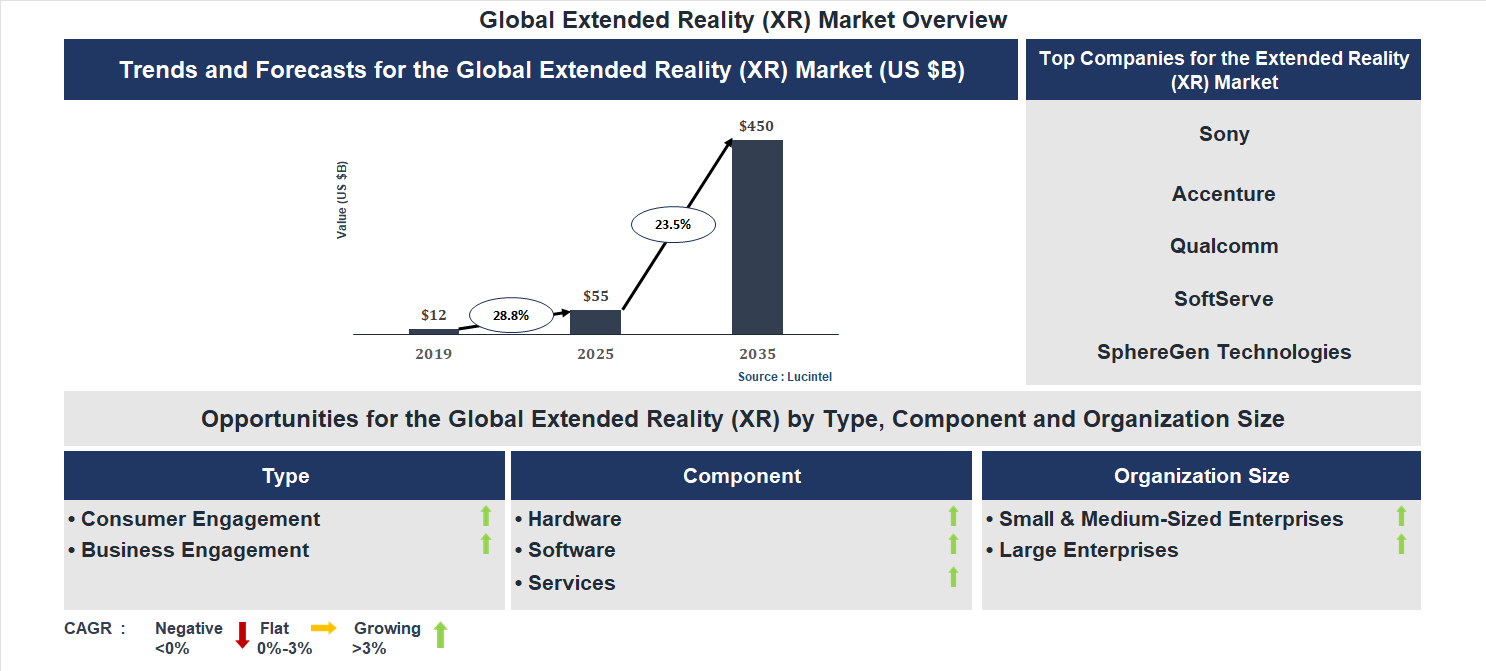
Extended Reality (XR) Market Trends and Forecast

Emerging Trends in the Extended Reality (XR) Market

The extended reality (XR) market, including Augmented Reality, Virtual Reality, and Mixed Reality, is rapidly evolving as a core technology across industries such as gaming, healthcare, education, manufacturing, retail, and defense. The market is experiencing strong momentum due to advancements in artificial intelligence, 5G connectivity, spatial computing, and immersive content creation tools. Organizations are increasingly adopting XR solutions to enhance training efficiency, improve customer engagement, and enable remote collaboration. Hardware innovation, software ecosystem expansion, and rising investments from technology leaders are further accelerating market growth. These developments are creating new opportunities for immersive experiences and reshaping how users interact with digital environments globally.

• Artificial Intelligence Integration In XR : Artificial intelligence is significantly enhancing XR experiences by enabling real-time object recognition, environment mapping, and adaptive user interactions. AI-powered XR systems are improving personalization in gaming, training simulations, and virtual collaboration platforms. Recent advancements include generative AI tools that create immersive 3D environments faster and more efficiently. AI is also optimizing motion tracking, gesture recognition, and voice interaction, making XR systems more intuitive. Businesses are leveraging AI-driven XR for predictive analytics and digital twin simulations. This integration is reducing content creation costs while improving realism, scalability, and user engagement across multiple industries, accelerating overall XR adoption globally.
• Growing Adoption of Enterprise XR Solutions : Enterprises are increasingly adopting XR technologies for training, remote assistance, and product design applications. Industries such as manufacturing, healthcare, and automotive are using VR simulations to improve workforce efficiency and safety. AR-based tools are supporting real-time maintenance and complex assembly processes. Recent developments show rising investment in virtual collaboration platforms for hybrid workplaces. Companies are integrating XR into digital transformation strategies to reduce operational costs and improve productivity. Enterprise XR adoption is also supported by cloud computing, enabling scalable deployment across global teams. This trend is driving consistent demand for enterprise-focused XR hardware and software solutions.
• Expansion of Lightweight AR and VR Devices : The XR market is witnessing strong growth in lightweight and wearable AR glasses and compact VR headsets. Companies are focusing on improving device comfort, battery life, and display resolution to enhance user experience. Recent innovations include standalone headsets that eliminate the need for external computing devices. The introduction of sleek AR glasses for daily use is expanding consumer and enterprise adoption. Improved optics, micro-displays, and spatial audio technologies are making devices more immersive. This trend is reducing entry barriers and increasing accessibility, driving wider adoption across gaming, education, healthcare, and retail sectors globally.
• Growth of 5G and Cloud XR Infrastructure : The rollout of 5G networks and cloud-based XR platforms is transforming the performance and scalability of immersive applications. High-speed connectivity is enabling low-latency streaming of complex XR environments. Cloud XR solutions are reducing the need for high-end local hardware, making experiences more accessible. Recent developments include edge computing integration for real-time rendering and improved responsiveness. This trend is particularly impactful in remote collaboration, gaming, and virtual training environments. It is also enabling multi-user immersive experiences at scale. The combination of 5G and cloud infrastructure is significantly expanding the commercial viability of XR technologies across industries.
• Rising Use of XR in Education and Training : XR is increasingly being used in education and professional training to create interactive and immersive learning experiences. Virtual classrooms, AR-based textbooks, and VR simulations are enhancing knowledge retention and engagement. Recent developments include medical training simulations and engineering design visualization tools. Educational institutions and corporate training programs are adopting XR to reduce costs and improve learning outcomes. This trend is also expanding access to practical training in remote and underserved regions. The ability to simulate real-world scenarios safely and efficiently is making XR a valuable tool in skill development across multiple sectors.
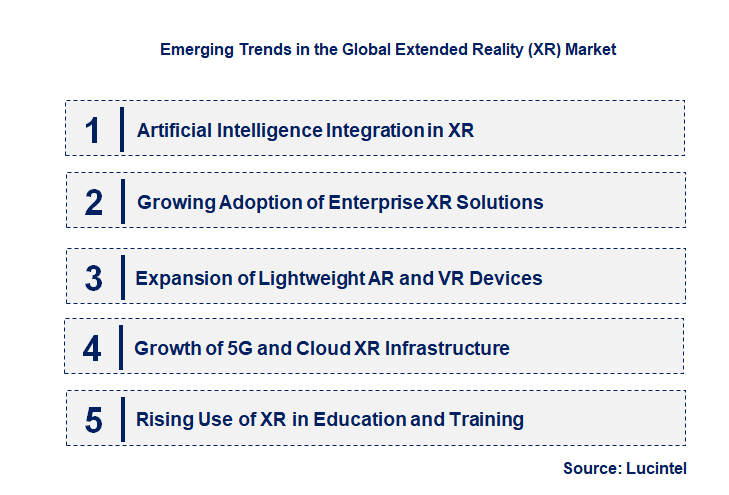
These emerging trends are collectively transforming the XR market by improving accessibility, enhancing realism, and expanding application areas across industries. The integration of AI, cloud computing, and 5G is making XR systems more powerful and scalable, while advancements in hardware are increasing user adoption. Enterprise and educational use cases are driving strong demand beyond entertainment applications. As innovation continues, XR is evolving into a mainstream technology that supports digital transformation, immersive communication, and next-generation human-computer interaction, reshaping global industry practices and consumer experiences.
Emerging Trends in the Extended Reality (XR) Market

Recent Developments in the Extended Reality (XR) Market

The extended reality (XR) market is witnessing rapid transformation driven by continuous technological advancements and increasing cross-industry adoption. The integration of artificial intelligence, cloud computing, 5G connectivity, and spatial computing is reshaping immersive digital experiences. Organizations are leveraging XR for training, simulation, design, healthcare, education, and retail applications. Growing investments from global technology companies and startups are accelerating innovation in hardware, software, and content ecosystems. These developments are enhancing realism, reducing costs, and improving accessibility. As adoption expands across enterprises and consumers, XR is becoming a critical enabler of next-generation digital transformation strategies worldwide.

• AI Powered XR Platform Development: Artificial intelligence integration in XR platforms is significantly improving immersion, automation, and personalization. Recent developments include AI-driven spatial mapping, real-time environment adaptation, and generative 3D content creation tools. These advancements are enabling faster development of immersive applications across gaming, healthcare, and enterprise training. AI also enhances gesture recognition, voice interaction, and predictive analytics within XR environments. Companies are using AI-powered XR platforms to reduce production costs and improve scalability. This development is strengthening user engagement and making XR solutions more intelligent, adaptive, and efficient across multiple industries, driving broader adoption globally and improving operational performance consistently.
• Expansion of Enterprise XR Deployment: Enterprises are rapidly adopting XR solutions for workforce training, remote collaboration, and industrial design applications. Recent developments include increased use of VR simulations for employee safety training and AR tools for real-time equipment maintenance. Organizations are integrating XR into digital transformation strategies to enhance productivity and reduce operational risks. Cloud-based XR deployment is enabling scalable access across global teams. Industries such as manufacturing, automotive, and healthcare are leading adoption. This expansion is improving efficiency, reducing training costs, and enabling real-time problem solving. Enterprise XR deployment is becoming a core component of modern industrial and business workflows worldwide.
• Growth of Lightweight XR Hardware Devices: The XR hardware market is advancing with the development of lightweight AR glasses and compact VR headsets. Recent innovations focus on improving comfort, battery efficiency, and visual clarity. Companies are introducing standalone devices that eliminate dependency on external computing systems. Enhanced optics, micro-displays, and spatial audio systems are improving user experience significantly. These devices are becoming more affordable and accessible, encouraging adoption among both consumers and enterprises. This development is expanding XR usage in gaming, education, healthcare, and retail sectors. Improved portability and usability are making XR devices suitable for everyday applications and increasing global market penetration steadily.
• Cloud and 5G Enabled XR Ecosystem Expansion: The integration of cloud computing and 5G networks is transforming XR performance and scalability. Recent developments include edge computing-based rendering and low-latency streaming of immersive environments. Cloud XR platforms are reducing hardware dependency while improving accessibility. 5G connectivity is enabling real-time multi-user collaboration and high-quality immersive experiences. This development is particularly impactful in remote training, virtual collaboration, and interactive gaming applications. Businesses are leveraging cloud XR to deploy solutions globally with reduced infrastructure costs. The combined impact of cloud and 5G technologies is accelerating XR adoption and enabling seamless, high-performance immersive experiences across industries.

• Rising Adoption of XR In Education And Healthcare: XR technologies are increasingly being deployed in education and healthcare sectors for immersive learning and simulation-based training. Recent developments include VR-based surgical training systems and AR-assisted medical procedures. Educational institutions are using XR for interactive classrooms and virtual laboratories. These solutions are improving learning outcomes and practical skill development. Healthcare providers are adopting XR for patient therapy, diagnostics, and rehabilitation programs. This development is enhancing accessibility to advanced training tools and reducing operational costs. The growing use of XR in these critical sectors is significantly improving efficiency, accuracy, and engagement in real-world applications.

These recent developments are significantly accelerating the growth of the XR market by enhancing technological capabilities and expanding application areas. Innovations in AI, hardware design, cloud infrastructure, and connectivity are making XR solutions more immersive, scalable, and cost-effective. Increasing enterprise and sector-specific adoption is driving strong demand across industries such as healthcare, education, manufacturing, and retail. As these advancements continue, XR is evolving into a mainstream technology that supports digital transformation, improves operational efficiency, and delivers highly engaging user experiences, thereby reshaping global business models and consumer interactions.

Strategic Growth Opportunities in the Extended Reality (XR) Market

The extended reality (XR) market technologies, including Augmented Reality, Virtual Reality, and Mixed Reality, are creating strong growth opportunities across multiple application areas. Industries are increasingly adopting immersive solutions to improve training efficiency, enhance customer engagement, and enable real-time collaboration. Advancements in artificial intelligence, cloud computing, and 5G connectivity are further expanding XR capabilities. Organizations across healthcare, education, retail, manufacturing, and entertainment are investing in immersive platforms to improve productivity and reduce operational costs. As digital transformation accelerates globally, XR is becoming a key enabler of next-generation interactive and experiential applications.

• Healthcare Training and Surgical Simulation Applications are Expanding Rapidly: XR is transforming healthcare through immersive surgical training, patient rehabilitation, and medical visualization applications. Hospitals and medical institutions are adopting VR-based simulations to improve surgeon accuracy and reduce procedural risks. AR tools are assisting doctors during complex surgeries by providing real-time data overlays. Recent developments include virtual anatomy labs and remote consultation platforms. These innovations are improving medical education, reducing training costs, and enhancing patient outcomes. XR adoption in healthcare is also supporting telemedicine growth. This application area is expected to witness strong expansion as healthcare systems prioritize precision, efficiency, and advanced digital tools globally.
• Education and Skill Development Platforms are Driving Immersive Learning Adoption: XR is reshaping education by enabling interactive and experiential learning environments. Schools, universities, and training centers are using VR classrooms and AR textbooks to improve student engagement and knowledge retention. Recent developments include virtual science labs, history simulations, and engineering design environments. Corporate training programs are also adopting XR for employee skill development and safety training. These technologies are making education more accessible, especially in remote regions. XR-based learning reduces dependency on physical infrastructure while improving learning outcomes. This growth opportunity is expanding rapidly as institutions focus on digital transformation and personalized education models.
• Retail and E-commerce Virtual Shopping Experiences are Expanding: XR is transforming retail by enabling immersive virtual shopping environments and product visualization tools. Consumers can now try products virtually using AR applications before purchasing. Retailers are adopting VR showrooms to enhance customer engagement and reduce return rates. Recent developments include virtual fitting rooms and interactive product displays. E-commerce platforms are integrating XR to improve user experience and increase conversion rates. This application is helping brands build stronger customer relationships and differentiate themselves in competitive markets. The retail sector is increasingly investing in XR technologies to create personalized, engaging, and immersive shopping experiences globally.
• Manufacturing and Industrial Digital Twin Applications are Increasing: XR is playing a critical role in manufacturing through digital twin technology, equipment simulation, and workforce training. Companies are using AR-based maintenance tools to improve operational efficiency and reduce downtime. VR simulations are helping engineers design and test products in virtual environments before production. Recent developments include factory planning tools and real-time monitoring systems. These applications are improving safety, reducing costs, and enhancing productivity. XR is also supporting predictive maintenance and remote assistance in industrial operations. Manufacturing industries are increasingly adopting XR as part of Industry 4.0 initiatives to optimize production processes and improve decision-making.
• Entertainment and Gaming Immersive Experience Development is Accelerating: XR is revolutionizing entertainment and gaming by delivering highly immersive and interactive experiences. Game developers are integrating VR and AR technologies to create realistic environments and enhanced user engagement. Recent developments include location-based entertainment centers and mixed reality gaming platforms. The integration of haptic feedback and motion tracking is improving realism in gaming experiences. Film and media industries are also exploring XR for virtual production and storytelling. This application is driving strong consumer demand for advanced headsets and immersive content. The entertainment sector remains one of the largest contributors to XR market growth globally.

These strategic growth opportunities are significantly accelerating the expansion of the XR market across multiple industries. Healthcare, education, retail, manufacturing, and entertainment are leveraging immersive technologies to improve efficiency, engagement, and outcomes. Continuous advancements in hardware, software, and connectivity are making XR more accessible and scalable. As organizations prioritize digital transformation, XR is becoming a critical tool for innovation and competitiveness. The growing adoption across diverse applications is reshaping user experiences and business models, positioning XR as a foundational technology for future interactive and immersive digital ecosystems worldwide.

Extended Reality (XR) Market Driver and Challenges

The extended reality (XR) market is experiencing rapid expansion driven by a combination of technological innovation, economic investment, and evolving regulatory frameworks. The major drivers and challenges include advancements in artificial intelligence, 5G connectivity, immersive hardware development, and increasing enterprise adoption across industries. At the same time, economic constraints, high deployment costs, and data privacy regulations are influencing market growth. Organizations are adopting XR to enhance productivity, training efficiency, and customer engagement. However, disparities in infrastructure readiness and regulatory uncertainties continue to shape market dynamics. These combined factors are creating both strong opportunities and significant constraints for global XR adoption and scalability.

The factors responsible for driving the extended reality (XR) market include:
• Increasing Demand for Immersive Digital Experiences: The growing demand for immersive experiences across gaming, education, healthcare, and retail is a major driver of the XR market. Consumers and enterprises are increasingly seeking interactive and realistic digital environments to improve engagement and outcomes. Advancements in VR headsets, AR applications, and mixed reality platforms are enabling more realistic simulations. Businesses are using XR to enhance customer experience and brand engagement. Educational institutions are adopting immersive learning tools to improve knowledge retention. This rising demand is encouraging companies to invest heavily in XR content creation, hardware development, and software integration, significantly accelerating global market expansion and innovation.
• Rising Adoption of Enterprise Digital Transformation: Enterprises across industries are integrating XR technologies into their digital transformation strategies to improve productivity and efficiency. XR is being widely used for employee training, remote collaboration, and product design visualization. Industries such as manufacturing, automotive, and healthcare are leveraging XR to reduce operational risks and costs. Cloud-based XR platforms are enabling scalable deployment across global organizations. Companies are increasingly adopting virtual collaboration tools in hybrid work environments. This growing enterprise adoption is driving consistent demand for XR solutions, making it a core component of modern business operations and industrial innovation strategies worldwide.
• Advancements in Artificial Intelligence and 5G Connectivity: The integration of artificial intelligence and 5G technology is significantly enhancing XR capabilities. AI enables real-time object recognition, gesture tracking, and personalized immersive experiences. 5G connectivity ensures low-latency and high-speed data transmission, improving XR performance. These advancements are enabling more complex and interactive applications in gaming, healthcare, and industrial training. Cloud-based XR platforms supported by AI are reducing hardware dependency and improving scalability. The combination of AI and 5G is making XR more efficient, responsive, and accessible. This technological convergence is accelerating innovation and expanding XR adoption across multiple industries globally.
• Expansion of Affordable XR Hardware and Devices: The development of cost-effective and lightweight XR devices is driving widespread market adoption. Companies are introducing standalone VR headsets and AR glasses with improved battery life, comfort, and display quality. These innovations are making XR more accessible to consumers and enterprises. Reduced hardware costs are encouraging adoption in education, healthcare, and retail sectors. Advances in micro-displays, spatial audio, and motion tracking are enhancing user experience. The availability of affordable devices is lowering entry barriers for new users and organizations. This expansion is significantly contributing to increased penetration of XR technologies across global markets.

The challenges facing this extended reality (XR) market include:
• High Implementation and Infrastructure Costs: One of the major challenges in the XR market is the high cost of implementation, including hardware, software, and infrastructure requirements. Advanced XR systems require powerful computing devices, high-quality headsets, and stable network connectivity. Many small and medium enterprises face difficulties in adopting XR due to budget constraints. Additionally, content development and system integration add to overall costs. Cloud-based XR solutions help reduce some expenses, but initial investment remains high. These cost barriers are slowing down widespread adoption, particularly in developing regions, limiting market growth potential despite strong technological advancements and demand.
• Data Privacy and Security Concerns: XR systems collect and process large amounts of user data, including behavioral patterns, biometric information, and environmental mapping. This raises significant privacy and security concerns among users and regulators. Companies must comply with strict data protection laws, which vary across regions. Ensuring secure data transmission and storage is a major challenge for XR providers. Cybersecurity risks, including data breaches and unauthorized access, can affect user trust. These concerns are forcing companies to invest heavily in security infrastructure. Regulatory compliance complexities are slowing down deployment in sensitive industries such as healthcare and defense, impacting overall market expansion.
• Limited Infrastructure and Technical Barriers: The adoption of XR technologies is constrained by limited infrastructure and technical challenges in many regions. High-speed internet, 5G networks, and advanced computing systems are essential for optimal XR performance. However, many areas still lack adequate connectivity and digital infrastructure. Technical issues such as latency, device compatibility, and system integration also hinder seamless user experience. Additionally, XR content development requires specialized skills, which are currently limited. These infrastructure and technical barriers are restricting large-scale deployment and slowing adoption rates, especially in emerging markets, despite increasing global interest in immersive technologies.

The XR market is shaped by strong technological drivers such as immersive experience demand, enterprise adoption, AI and 5G integration, and affordable hardware expansion. However, challenges including high costs, data privacy concerns, and infrastructure limitations continue to influence growth dynamics. While developed regions are rapidly advancing XR deployment, emerging economies face adoption barriers. Overall, the balance between innovation and constraints is defining market evolution. As technology matures and costs decline, XR is expected to achieve broader adoption, becoming a critical enabler of digital transformation across industries worldwide.

List of Extended Reality (XR) Companies

Companies in the market compete on the basis of product quality offered. Major players in this market focus on expanding their manufacturing facilities, R&D investments, infrastructural development, and leverage integration opportunities across the value chain. With these strategies extended reality (XR) companies cater increasing demand, ensure competitive effectiveness, develop innovative products & technologies, reduce production costs, and expand their customer base. Some of the extended reality (XR) companies profiled in this report include-
• Sony
• Accenture
• Qualcomm
• SoftServe
• SphereGen Technologies
• HTC Corporation
• Google

Extended Reality (XR) Market by Segment

The study includes a forecast for the global extended reality (XR) market by type, component, organization size, and region.

Extended Reality (XR) Market by Type [Value from 2019 to 2035]:


• Consumer Engagement
• Business Engagement

Extended Reality (XR) Market by Component [Value from 2019 to 2035]:


• Hardware
• Software
• Services

Extended Reality (XR) Market by Organization Size [Value from 2019 to 2035]:


• Small & Medium-Sized Enterprises
• Large Enterprises

Extended Reality (XR) Market by Region [Value from 2019 to 2035]:


• North America
• Europe
• Asia Pacific
• The Rest of the World

Country Wise Outlook for the Extended Reality (XR) Market

The extended reality (XR) market, which includes Augmented Reality (AR), Virtual Reality (VR), and Mixed Reality (MR), is rapidly evolving across global markets due to advances in AI integration, 5G connectivity, display technologies, and immersive computing platforms. Recent developments show strong momentum in enterprise adoption, consumer XR devices, and industry-specific applications such as training, healthcare, education, and retail. Countries like the United States, China, Germany, India, and Japan are actively investing in XR ecosystems, supported by tech giants, startups, and government-backed innovation programs. These regions are also witnessing increased collaboration between hardware manufacturers, software developers, and content creators to accelerate XR commercialization and real-world deployment.

• United States: The United States is leading XR innovation with strong contributions from companies such as Meta, Apple, Microsoft, and Google, focusing on advanced mixed reality headsets and AI-powered spatial computing platforms. Recent developments include improved enterprise XR applications in training, design, and remote collaboration, along with growing consumer adoption of smart glasses and VR headsets. Integration of generative AI into XR ecosystems is accelerating content creation and interaction. U.S. firms are also investing heavily in lightweight AR glasses and cloud-based XR processing. Strong venture capital funding and research initiatives in Silicon Valley continue to drive hardware-software convergence and ecosystem expansion across multiple industry verticals.
• China: China is witnessing rapid expansion in XR hardware manufacturing, especially in AR smart glasses and cost-effective VR devices. Companies such as ByteDance (Pico) and Xreal are focusing on lightweight AR wearables and immersive entertainment applications. Recent developments highlight strong growth in AR glasses demand, while VR adoption faces slower momentum in consumer markets. The government is supporting XR integration in industrial training, education, and smart city applications. Chinese firms are also investing in XR chip development and display technologies to reduce dependency on foreign supply chains. The market is increasingly driven by local innovation, e-commerce integration, and strong domestic manufacturing capabilities.
• Germany: Germany is advancing XR adoption mainly through industrial and enterprise applications, particularly in automotive, engineering, and manufacturing sectors. Companies are using XR for digital twins, product design visualization, and workforce training to improve efficiency and reduce costs. Recent developments include increased use of VR-based simulation in automotive prototyping and AR tools for factory maintenance. Research institutions and startups are collaborating on precision optics, industrial metaverse platforms, and immersive engineering solutions. Germany’s strong Industry 4.0 framework is supporting XR integration into smart factories. Regulatory focus on data protection and workplace safety is also shaping secure and structured XR deployment across enterprise environments.
• India: India is emerging as a growing XR market driven by demand in education, gaming, healthcare, and skill development sectors. Recent developments include increased adoption of AR/VR-based learning platforms and immersive training solutions in engineering and medical education. Startups are focusing on affordable XR content creation tools tailored for local industries. Government initiatives supporting digital learning and smart classroom infrastructure are accelerating XR usage in education. IT service companies are also integrating XR into enterprise training and remote collaboration solutions. Although hardware penetration remains limited, India is showing strong potential due to rising digital adoption, expanding 5G networks, and a large youth population driving demand.
• Japan: Japan is a key innovator in XR hardware and robotics integration, with strong focus on entertainment, gaming, and industrial applications. Companies like Sony and Panasonic are advancing VR headsets, haptic feedback systems, and high-resolution display technologies. Recent developments include increased use of XR in automotive design, robotics training, and virtual tourism experiences. Japan is also investing in ultra-realistic mixed reality systems for gaming and simulation-based learning. Government-backed research programs are supporting next-generation display technologies and human-machine interaction systems. The market benefits from strong consumer electronics expertise and a culture of early adoption in gaming and immersive entertainment technologies.

Lucintel Analytics Dashboard

Features of the Global Extended Reality (XR) Market

Market Size Estimates: Extended reality (XR) market size estimation in terms of value ($B).
Trend and Forecast Analysis: Market trends (2019 to 2025) and forecast (2026 to 2035) by various segments and regions.
Segmentation Analysis: Extended reality (XR) market size by type, component, organization size, and region in terms of value ($B).
Regional Analysis: Extended reality (XR) market breakdown by North America, Europe, Asia Pacific, and Rest of the World.
Growth Opportunities: Analysis of growth opportunities in different type, component, organization size, and regions for the extended reality (XR) market.
Strategic Analysis: This includes M&A, new product development, and competitive landscape of the extended reality (XR) market.
Analysis of competitive intensity of the industry based on Porter’s Five Forces model.

Lucintel Consulting Services

FAQ

Q1. What is the extended reality (XR) market size?
Answer: The global extended reality (XR) market is expected to reach an estimated $450 billion by 2035.
Q2. What is the growth forecast for extended reality (XR) market?
Answer: The global extended reality (XR) market is expected to grow with a CAGR of 23.5% from 2026 to 2035.
Q3. What are the major drivers influencing the growth of the extended reality (XR) market?
Answer: The major drivers for this market are the growing adoption of virtual collaboration tools in remote work, the increasing demand for immersive gaming experiences, and the growing demand for popularity of ar & vr devices among consumers.
Q4. What are the major segments for extended reality (XR) market?
Answer: The future of the extended reality (XR) market looks promising with opportunities in the small & medium-sized enterprise and large enterprise markets.
Q5. Who are the key extended reality (XR) market companies?
Answer: Some of the key extended reality (XR) companies are as follows:
• Sony
• Accenture
• Qualcomm
• SoftServe
• SphereGen Technologies
• HTC Corporation
• Google
Q6. Which extended reality (XR) market segment will be the largest in future?
Answer: Lucintel forecasts that, within the type category, business engagement is expected to witness higher growth over the forecast period.
Q7. In extended reality (XR) market, which region is expected to be the largest in next 8 years?
Answer: In terms of region, APAC is expected to witness the highest growth over the forecast period.
Q8. Do we receive customization in this report?
Answer: Yes, Lucintel provides 10% customization without any additional cost.

This report answers following 11 key questions:

Q.1. What are some of the most promising, high-growth opportunities for the extended reality (XR) market by type (consumer engagement and business engagement), component (hardware, software, and services), organization size (small & medium-sized enterprises and large enterprises), and region (North America, Europe, Asia Pacific, and the Rest of the World)?
Q.2. Which segments will grow at a faster pace and why?
Q.3. Which region will grow at a faster pace and why?
Q.4. What are the key factors affecting market dynamics? What are the key challenges and business risks in this market?
Q.5. What are the business risks and competitive threats in this market?
Q.6. What are the emerging trends in this market and the reasons behind them?
Q.7. What are some of the changing demands of customers in the market?
Q.8. What are the new developments in the market? Which companies are leading these developments?
Q.9. Who are the major players in this market? What strategic initiatives are key players pursuing for business growth?
Q.10. What are some of the competing products in this market and how big of a threat do they pose for loss of market share by material or product substitution?
Q.11. What M&A activity has occurred in the last 5 years and what has its impact been on the industry?

For any questions related to Extended Reality (XR) Market, Extended Reality (XR) Market Size, Extended Reality (XR) Market Growth, Extended Reality (XR) Market Analysis, Extended Reality (XR) Market Report, Extended Reality (XR) Market Share, Extended Reality (XR) Market Trends, Extended Reality (XR) Market Forecast, Extended Reality (XR) Companies, write Lucintel analyst at email: helpdesk@lucintel.com. We will be glad to get back to you soon.
                                           Table of Contents

            1. Executive Summary

            2. Market Overview

                        2.1 Background and Classifications
                        2.2 Supply Chain

            3. Market Trends & Forecast Analysis

                        3.1 Macroeconomic Trends and Forecasts
                        3.2 Industry Drivers and Challenges
                        3.3 PESTLE Analysis
                        3.4 Patent Analysis
                        3.5 Regulatory Environment
                        3.6 Global Extended Reality (XR) Market Trends and Forecast

            4. Global Extended Reality (XR) Market by Type

                        4.1 Overview
                        4.2 Attractiveness Analysis by Type
                        4.3 Consumer Engagement : Trends and Forecast (2019 to 2035)
                        4.4 Business Engagement : Trends and Forecast (2019 to 2035)

            5. Global Extended Reality (XR) Market by Component

                        5.1 Overview
                        5.2 Attractiveness Analysis by Component
                        5.3 Hardware : Trends and Forecast (2019 to 2035)
                        5.4 Software : Trends and Forecast (2019 to 2035)
                        5.5 Services : Trends and Forecast (2019 to 2035)

            6. Global Extended Reality (XR) Market by Organization Size

                        6.1 Overview
                        6.2 Attractiveness Analysis by Organization Size
                        6.3 Small & Medium-Sized Enterprises : Trends and Forecast (2019 to 2035)
                        6.4 Large Enterprises : Trends and Forecast (2019 to 2035)

            7. Regional Analysis

                        7.1 Overview
                        7.2 Global Extended Reality (XR) Market by Region

            8. North American Extended Reality (XR) Market

                        8.1 Overview
                        8.2 North American Extended Reality (XR) Market by Type
                        8.3 North American Extended Reality (XR) Market by Organization Size
                        8.4 The United States Extended Reality (XR) Market
                        8.5 Canadian Extended Reality (XR) Market
                        8.6 Mexican Extended Reality (XR) Market

            9. European Extended Reality (XR) Market

                        9.1 Overview
                        9.2 European Extended Reality (XR) Market by Type
                        9.3 European Extended Reality (XR) Market by Organization Size
                        9.4 German Extended Reality (XR) Market
                        9.5 French Extended Reality (XR) Market
                        9.6 Italian Extended Reality (XR) Market
                        9.7 Spanish Extended Reality (XR) Market
                        9.8 The United Kingdom Extended Reality (XR) Market

            10. APAC Extended Reality (XR) Market

                        10.1 Overview
                        10.2 APAC Extended Reality (XR) Market by Type
                        10.3 APAC Extended Reality (XR) Market by Organization Size
                        10.4 Chinese Extended Reality (XR) Market
                        10.5 Indian Extended Reality (XR) Market
                        10.6 Japanese Extended Reality (XR) Market
                        10.7 South Korean Extended Reality (XR) Market
                        10.8 Indonesian Extended Reality (XR) Market

            11. ROW Extended Reality (XR) Market

                        11.1 Overview
                        11.2 ROW Extended Reality (XR) Market by Type
                        11.3 ROW Extended Reality (XR) Market by Organization Size
                        11.4 Middle Eastern Extended Reality (XR) Market
                        11.5 South American Extended Reality (XR) Market
                        11.6 African Extended Reality (XR) Market

            12. Competitor Analysis

                        12.1 Product Portfolio Analysis
                        12.2 Operational Integration
                        12.3 Porter’s Five Forces Analysis
                                    • Competitive Rivalry
                                    • Bargaining Power of Buyers
                                    • Bargaining Power of Suppliers
                                    • Threat of Substitutes
                                    • Threat of New Entrants
                        12.4 Market Share Analysis

            13. Opportunities & Strategic Analysis

                        13.1 Value Chain Analysis
                        13.2 Growth Opportunity Analysis
                                    13.2.1 Growth Opportunity by Type
                                    13.2.2 Growth Opportunity by Component
                                    13.2.3 Growth Opportunity by Organization Size
                                    13.2.4 Growth Opportunity by Region
                        13.3 Emerging Trends in the Global Extended Reality (XR) Market
                        13.4 Strategic Analysis
                                    13.4.1 New Product Development
                                    13.4.2 Certification and Licensing
                                    13.4.3 Mergers, Acquisitions, Agreements, Collaborations, and Joint Ventures

            14. Company Profiles of the Leading Players Across the Value Chain

                        14.1 Competitive Analysis Overview
                        14.2 Sony
                                    • Company Overview
                                    • Extended Reality (XR) Market Business Overview
                                    • New Product Development
                                    • Merger, Acquisition, and Collaboration
                                    • Certification and Licensing
                        14.3 Accenture
                                    • Company Overview
                                    • Extended Reality (XR) Market Business Overview
                                    • New Product Development
                                    • Merger, Acquisition, and Collaboration
                                    • Certification and Licensing
                        14.4 Qualcomm
                                    • Company Overview
                                    • Extended Reality (XR) Market Business Overview
                                    • New Product Development
                                    • Merger, Acquisition, and Collaboration
                                    • Certification and Licensing
                        14.5 SoftServe
                                    • Company Overview
                                    • Extended Reality (XR) Market Business Overview
                                    • New Product Development
                                    • Merger, Acquisition, and Collaboration
                                    • Certification and Licensing
                        14.6 SphereGen Technologies
                                    • Company Overview
                                    • Extended Reality (XR) Market Business Overview
                                    • New Product Development
                                    • Merger, Acquisition, and Collaboration
                                    • Certification and Licensing
                        14.7 HTC Corporation
                                    • Company Overview
                                    • Extended Reality (XR) Market Business Overview
                                    • New Product Development
                                    • Merger, Acquisition, and Collaboration
                                    • Certification and Licensing
                        14.8 Google
                                    • Company Overview
                                    • Extended Reality (XR) Market Business Overview
                                    • New Product Development
                                    • Merger, Acquisition, and Collaboration
                                    • Certification and Licensing

            15. Appendix

                        15.1 List of Figures
                        15.2 List of Tables
                        15.3 Research Methodology
                        15.4 Disclaimer
                        15.5 Copyright
                        15.6 Abbreviations and Technical Units
                        15.7 About Us
                        15.8 Contact Us

                                               List of Figures


            Chapter 1

                        Figure 1.1: Trends and Forecast for the Global Extended Reality (XR) Market

            Chapter 2

                        Figure 2.1: Usage of Extended Reality (XR) Market
                        Figure 2.2: Classification of the Global Extended Reality (XR) Market
                        Figure 2.3: Supply Chain of the Global Extended Reality (XR) Market

            Chapter 3

                        Figure 3.1: Trends of the Global GDP Growth Rate
                        Figure 3.2: Trends of the Global Population Growth Rate
                        Figure 3.3: Trends of the Global Inflation Rate
                        Figure 3.4: Trends of the Global Unemployment Rate
                        Figure 3.5: Trends of the Regional GDP Growth Rate
                        Figure 3.6: Trends of the Regional Population Growth Rate
                        Figure 3.7: Trends of the Regional Inflation Rate
                        Figure 3.8: Trends of the Regional Unemployment Rate
                        Figure 3.9: Trends of Regional Per Capita Income
                        Figure 3.10: Forecast for the Global GDP Growth Rate
                        Figure 3.11: Forecast for the Global Population Growth Rate
                        Figure 3.12: Forecast for the Global Inflation Rate
                        Figure 3.13: Forecast for the Global Unemployment Rate
                        Figure 3.14: Forecast for the Regional GDP Growth Rate
                        Figure 3.15: Forecast for the Regional Population Growth Rate
                        Figure 3.16: Forecast for the Regional Inflation Rate
                        Figure 3.17: Forecast for the Regional Unemployment Rate
                        Figure 3.18: Forecast for Regional Per Capita Income
                        Figure 3.19: Driver and Challenges of the Extended Reality (XR) Market

            Chapter 4

                        Figure 4.1: Global Extended Reality (XR) Market by Type in 2019, 2025, and 2035
                        Figure 4.2: Trends of the Global Extended Reality (XR) Market ($B) by Type
                        Figure 4.3: Forecast for the Global Extended Reality (XR) Market ($B) by Type
                        Figure 4.4: Trends and Forecast for Consumer Engagement in the Global Extended Reality (XR) Market (2019-2035)
                        Figure 4.5: Trends and Forecast for Business Engagement in the Global Extended Reality (XR) Market (2019-2035)

            Chapter 5

                        Figure 5.1: Global Extended Reality (XR) Market by Component in 2019, 2025, and 2035
                        Figure 5.2: Trends of the Global Extended Reality (XR) Market ($B) by Component
                        Figure 5.3: Forecast for the Global Extended Reality (XR) Market ($B) by Component
                        Figure 5.4: Trends and Forecast for Hardware in the Global Extended Reality (XR) Market (2019-2035)
                        Figure 5.5: Trends and Forecast for Software in the Global Extended Reality (XR) Market (2019-2035)
                        Figure 5.6: Trends and Forecast for Services in the Global Extended Reality (XR) Market (2019-2035)

            Chapter 6

                        Figure 6.1: Global Extended Reality (XR) Market by Organization Size in 2019, 2025, and 2035
                        Figure 6.2: Trends of the Global Extended Reality (XR) Market ($B) by Organization Size
                        Figure 6.3: Forecast for the Global Extended Reality (XR) Market ($B) by Organization Size
                        Figure 6.4: Trends and Forecast for Small & Medium-Sized Enterprises in the Global Extended Reality (XR) Market (2019-2035)
                        Figure 6.5: Trends and Forecast for Large Enterprises in the Global Extended Reality (XR) Market (2019-2035)

            Chapter 7

                        Figure 7.1: Trends of the Global Extended Reality (XR) Market ($B) by Region (2019-2025)
                        Figure 7.2: Forecast for the Global Extended Reality (XR) Market ($B) by Region (2026-2035)

            Chapter 8

                        Figure 8.1: Trends and Forecast for the North American Extended Reality (XR) Market (2019-2035)
                        Figure 8.2: North American Extended Reality (XR) Market by Type in 2019, 2025, and 2035
                        Figure 8.3: Trends of the North American Extended Reality (XR) Market ($B) by Type (2019-2025)
                        Figure 8.4: Forecast for the North American Extended Reality (XR) Market ($B) by Type (2026-2035)
                        Figure 8.5: North American Extended Reality (XR) Market by Component in 2019, 2025, and 2035
                        Figure 8.6: Trends of the North American Extended Reality (XR) Market ($B) by Component (2019-2025)
                        Figure 8.7: Forecast for the North American Extended Reality (XR) Market ($B) by Component (2026-2035)
                        Figure 8.8: Trends and Forecast for the United States Extended Reality (XR) Market ($B) (2019-2035)
                        Figure 8.9: Trends and Forecast for the Mexican Extended Reality (XR) Market ($B) (2019-2035)
                        Figure 8.10: Trends and Forecast for the Canadian Extended Reality (XR) Market ($B) (2019-2035)

            Chapter 9

                        Figure 9.1: Trends and Forecast for the European Extended Reality (XR) Market (2019-2035)
                        Figure 9.2: European Extended Reality (XR) Market by Type in 2019, 2025, and 2035
                        Figure 9.3: Trends of the European Extended Reality (XR) Market ($B) by Type (2019-2025)
                        Figure 9.4: Forecast for the European Extended Reality (XR) Market ($B) by Type (2026-2035)
                        Figure 9.5: European Extended Reality (XR) Market by Component in 2019, 2025, and 2035
                        Figure 9.6: Trends of the European Extended Reality (XR) Market ($B) by Component (2019-2025)
                        Figure 9.7: Forecast for the European Extended Reality (XR) Market ($B) by Component (2026-2035)
                        Figure 9.8: Trends and Forecast for the German Extended Reality (XR) Market ($B) (2019-2035)
                        Figure 9.9: Trends and Forecast for the French Extended Reality (XR) Market ($B) (2019-2035)
                        Figure 9.10: Trends and Forecast for the Spanish Extended Reality (XR) Market ($B) (2019-2035)
                        Figure 9.11: Trends and Forecast for the Italian Extended Reality (XR) Market ($B) (2019-2035)
                        Figure 9.12: Trends and Forecast for the United Kingdom Extended Reality (XR) Market ($B) (2019-2035)

            Chapter 10

                        Figure 10.1: Trends and Forecast for the APAC Extended Reality (XR) Market (2019-2035)
                        Figure 10.2: APAC Extended Reality (XR) Market by Type in 2019, 2025, and 2035
                        Figure 10.3: Trends of the APAC Extended Reality (XR) Market ($B) by Type (2019-2025)
                        Figure 10.4: Forecast for the APAC Extended Reality (XR) Market ($B) by Type (2026-2035)
                        Figure 10.5: APAC Extended Reality (XR) Market by Component in 2019, 2025, and 2035
                        Figure 10.6: Trends of the APAC Extended Reality (XR) Market ($B) by Component (2019-2025)
                        Figure 10.7: Forecast for the APAC Extended Reality (XR) Market ($B) by Component (2026-2035)
                        Figure 10.8: Trends and Forecast for the Japanese Extended Reality (XR) Market ($B) (2019-2035)
                        Figure 10.9: Trends and Forecast for the Indian Extended Reality (XR) Market ($B) (2019-2035)
                        Figure 10.10: Trends and Forecast for the Chinese Extended Reality (XR) Market ($B) (2019-2035)
                        Figure 10.11: Trends and Forecast for the South Korean Extended Reality (XR) Market ($B) (2019-2035)
                        Figure 10.12: Trends and Forecast for the Indonesian Extended Reality (XR) Market ($B) (2019-2035)

            Chapter 11

                        Figure 11.1: Trends and Forecast for the ROW Extended Reality (XR) Market (2019-2035)
                        Figure 11.2: ROW Extended Reality (XR) Market by Type in 2019, 2025, and 2035
                        Figure 11.3: Trends of the ROW Extended Reality (XR) Market ($B) by Type (2019-2025)
                        Figure 11.4: Forecast for the ROW Extended Reality (XR) Market ($B) by Type (2026-2035)
                        Figure 11.5: ROW Extended Reality (XR) Market by Component in 2019, 2025, and 2035
                        Figure 11.6: Trends of the ROW Extended Reality (XR) Market ($B) by Component (2019-2025)
                        Figure 11.7: Forecast for the ROW Extended Reality (XR) Market ($B) by Component (2026-2035)
                        Figure 11.8: Trends and Forecast for the Middle Eastern Extended Reality (XR) Market ($B) (2019-2035)
                        Figure 11.9: Trends and Forecast for the South American Extended Reality (XR) Market ($B) (2019-2035)
                        Figure 11.10: Trends and Forecast for the African Extended Reality (XR) Market ($B) (2019-2035)

            Chapter 12

                        Figure 12.1: Porter’s Five Forces Analysis of the Global Extended Reality (XR) Market
                        Figure 12.2: Market Share (%) of Top Players in the Global Extended Reality (XR) Market (2025)

            Chapter 13

                        Figure 13.1: Growth Opportunities for the Global Extended Reality (XR) Market by Type
                        Figure 13.2: Growth Opportunities for the Global Extended Reality (XR) Market by Component
                        Figure 13.3: Growth Opportunities for the Global Extended Reality (XR) Market by Organization Size
                        Figure 13.4: Growth Opportunities for the Global Extended Reality (XR) Market by Region
                        Figure 13.5: Emerging Trends in the Global Extended Reality (XR) Market

                                               List of Tables


            Chapter 1

                        Table 1.1: Growth Rate (%, 2024-2025) and CAGR (%, 2026-2035) of the Extended Reality (XR) Market by Type, Component, and Organization Size
                        Table 1.2: Attractiveness Analysis for the Extended Reality (XR) Market by Region
                        Table 1.3: Global Extended Reality (XR) Market Parameters and Attributes

            Chapter 3

                        Table 3.1: Trends of the Global Extended Reality (XR) Market (2019-2025)
                        Table 3.2: Forecast for the Global Extended Reality (XR) Market (2026-2035)

            Chapter 4

                        Table 4.1: Attractiveness Analysis for the Global Extended Reality (XR) Market by Type
                        Table 4.2: Market Size and CAGR of Various Type in the Global Extended Reality (XR) Market (2019-2025)
                        Table 4.3: Market Size and CAGR of Various Type in the Global Extended Reality (XR) Market (2026-2035)
                        Table 4.4: Trends of Consumer Engagement in the Global Extended Reality (XR) Market (2019-2025)
                        Table 4.5: Forecast for Consumer Engagement in the Global Extended Reality (XR) Market (2026-2035)
                        Table 4.6: Trends of Business Engagement in the Global Extended Reality (XR) Market (2019-2025)
                        Table 4.7: Forecast for Business Engagement in the Global Extended Reality (XR) Market (2026-2035)

            Chapter 5

                        Table 5.1: Attractiveness Analysis for the Global Extended Reality (XR) Market by Component
                        Table 5.2: Market Size and CAGR of Various Component in the Global Extended Reality (XR) Market (2019-2025)
                        Table 5.3: Market Size and CAGR of Various Component in the Global Extended Reality (XR) Market (2026-2035)
                        Table 5.4: Trends of Hardware in the Global Extended Reality (XR) Market (2019-2025)
                        Table 5.5: Forecast for Hardware in the Global Extended Reality (XR) Market (2026-2035)
                        Table 5.6: Trends of Software in the Global Extended Reality (XR) Market (2019-2025)
                        Table 5.7: Forecast for Software in the Global Extended Reality (XR) Market (2026-2035)
                        Table 5.8: Trends of Services in the Global Extended Reality (XR) Market (2019-2025)
                        Table 5.9: Forecast for Services in the Global Extended Reality (XR) Market (2026-2035)

            Chapter 6

                        Table 6.1: Attractiveness Analysis for the Global Extended Reality (XR) Market by Organization Size
                        Table 6.2: Market Size and CAGR of Various Organization Size in the Global Extended Reality (XR) Market (2019-2025)
                        Table 6.3: Market Size and CAGR of Various Organization Size in the Global Extended Reality (XR) Market (2026-2035)
                        Table 6.4: Trends of Small & Medium-Sized Enterprises in the Global Extended Reality (XR) Market (2019-2025)
                        Table 6.5: Forecast for Small & Medium-Sized Enterprises in the Global Extended Reality (XR) Market (2026-2035)
                        Table 6.6: Trends of Large Enterprises in the Global Extended Reality (XR) Market (2019-2025)
                        Table 6.7: Forecast for Large Enterprises in the Global Extended Reality (XR) Market (2026-2035)

            Chapter 7

                        Table 7.1: Market Size and CAGR of Various Regions in the Global Extended Reality (XR) Market (2019-2025)
                        Table 7.2: Market Size and CAGR of Various Regions in the Global Extended Reality (XR) Market (2026-2035)

            Chapter 8

                        Table 8.1: Trends of the North American Extended Reality (XR) Market (2019-2025)
                        Table 8.2: Forecast for the North American Extended Reality (XR) Market (2026-2035)
                        Table 8.3: Market Size and CAGR of Various Type in the North American Extended Reality (XR) Market (2019-2025)
                        Table 8.4: Market Size and CAGR of Various Type in the North American Extended Reality (XR) Market (2026-2035)
                        Table 8.5: Market Size and CAGR of Various Component in the North American Extended Reality (XR) Market (2019-2025)
                        Table 8.6: Market Size and CAGR of Various Component in the North American Extended Reality (XR) Market (2026-2035)
                        Table 8.7: Trends and Forecast for the United States Extended Reality (XR) Market (2019-2035)
                        Table 8.8: Trends and Forecast for the Mexican Extended Reality (XR) Market (2019-2035)
                        Table 8.9: Trends and Forecast for the Canadian Extended Reality (XR) Market (2019-2035)

            Chapter 9

                        Table 9.1: Trends of the European Extended Reality (XR) Market (2019-2025)
                        Table 9.2: Forecast for the European Extended Reality (XR) Market (2026-2035)
                        Table 9.3: Market Size and CAGR of Various Type in the European Extended Reality (XR) Market (2019-2025)
                        Table 9.4: Market Size and CAGR of Various Type in the European Extended Reality (XR) Market (2026-2035)
                        Table 9.5: Market Size and CAGR of Various Component in the European Extended Reality (XR) Market (2019-2025)
                        Table 9.6: Market Size and CAGR of Various Component in the European Extended Reality (XR) Market (2026-2035)
                        Table 9.7: Trends and Forecast for the German Extended Reality (XR) Market (2019-2035)
                        Table 9.8: Trends and Forecast for the French Extended Reality (XR) Market (2019-2035)
                        Table 9.9: Trends and Forecast for the Spanish Extended Reality (XR) Market (2019-2035)
                        Table 9.10: Trends and Forecast for the Italian Extended Reality (XR) Market (2019-2035)
                        Table 9.11: Trends and Forecast for the United Kingdom Extended Reality (XR) Market (2019-2035)

            Chapter 10

                        Table 10.1: Trends of the APAC Extended Reality (XR) Market (2019-2025)
                        Table 10.2: Forecast for the APAC Extended Reality (XR) Market (2026-2035)
                        Table 10.3: Market Size and CAGR of Various Type in the APAC Extended Reality (XR) Market (2019-2025)
                        Table 10.4: Market Size and CAGR of Various Type in the APAC Extended Reality (XR) Market (2026-2035)
                        Table 10.5: Market Size and CAGR of Various Component in the APAC Extended Reality (XR) Market (2019-2025)
                        Table 10.6: Market Size and CAGR of Various Component in the APAC Extended Reality (XR) Market (2026-2035)
                        Table 10.7: Trends and Forecast for the Japanese Extended Reality (XR) Market (2019-2035)
                        Table 10.8: Trends and Forecast for the Indian Extended Reality (XR) Market (2019-2035)
                        Table 10.9: Trends and Forecast for the Chinese Extended Reality (XR) Market (2019-2035)
                        Table 10.10: Trends and Forecast for the South Korean Extended Reality (XR) Market (2019-2035)
                        Table 10.11: Trends and Forecast for the Indonesian Extended Reality (XR) Market (2019-2035)

            Chapter 11

                        Table 11.1: Trends of the ROW Extended Reality (XR) Market (2019-2025)
                        Table 11.2: Forecast for the ROW Extended Reality (XR) Market (2026-2035)
                        Table 11.3: Market Size and CAGR of Various Type in the ROW Extended Reality (XR) Market (2019-2025)
                        Table 11.4: Market Size and CAGR of Various Type in the ROW Extended Reality (XR) Market (2026-2035)
                        Table 11.5: Market Size and CAGR of Various Component in the ROW Extended Reality (XR) Market (2019-2025)
                        Table 11.6: Market Size and CAGR of Various Component in the ROW Extended Reality (XR) Market (2026-2035)
                        Table 11.7: Trends and Forecast for the Middle Eastern Extended Reality (XR) Market (2019-2035)
                        Table 11.8: Trends and Forecast for the South American Extended Reality (XR) Market (2019-2035)
                        Table 11.9: Trends and Forecast for the African Extended Reality (XR) Market (2019-2035)

            Chapter 12

                        Table 12.1: Product Mapping of Extended Reality (XR) Suppliers Based on Segments
                        Table 12.2: Operational Integration of Extended Reality (XR) Manufacturers
                        Table 12.3: Rankings of Suppliers Based on Extended Reality (XR) Revenue

            Chapter 13

                        Table 13.1: New Product Launches by Major Extended Reality (XR) Producers (2019-2025)
                        Table 13.2: Certification Acquired by Major Competitor in the Global Extended Reality (XR) Market
 
.

Buy full report or by chapter as follows

Price by License Type:
[-] Hide Chapter Details
[Chapter Number] [Chapter Name] [Chapter Number Of Pages] [Chapter Price]
Title/Chapter Name Pages Price
Full Report: Extended Reality (XR) Market Report: Trends, Forecast and Competitive Analysis to 2035 Full Report $ 4,850
A 150 Page Report
Lucintel has been in the business of market research and management consulting since 2000 and has published over 1000 market intelligence reports in various markets / applications and served over 1,000 clients worldwide. This study is a culmination of four months of full-time effort performed by Lucintel's analyst team. The analysts used the following sources for the creation and completion of this valuable report:
  • In-depth interviews of the major players in this market
  • Detailed secondary research from competitors’ financial statements and published data 
  • Extensive searches of published works, market, and database information pertaining to industry news, company press releases, and customer intentions
  • A compilation of the experiences, judgments, and insights of Lucintel’s professionals, who have analyzed and tracked this market over the years.
Extensive research and interviews are conducted across the supply chain of this market to estimate market share, market size, trends, drivers, challenges, and forecasts. Below is a brief summary of the primary interviews that were conducted by job function for this report.
 
Thus, Lucintel compiles vast amounts of data from numerous sources, validates the integrity of that data, and performs a comprehensive analysis. Lucintel then organizes the data, its findings, and insights into a concise report designed to support the strategic decision-making process. The figure below is a graphical representation of Lucintel’s research process. 
 

Please sign in below to get report brochure - Extended Reality (XR) Market Report.

At Lucintel, we respect your privacy and maintain the confidentiality of information / data provided by you
(Please enter your corporate email. * These fields are mandatory )

Follow us on

