
Report Feature
Enterprise Robotic Process Automation Market Trends and Forecast
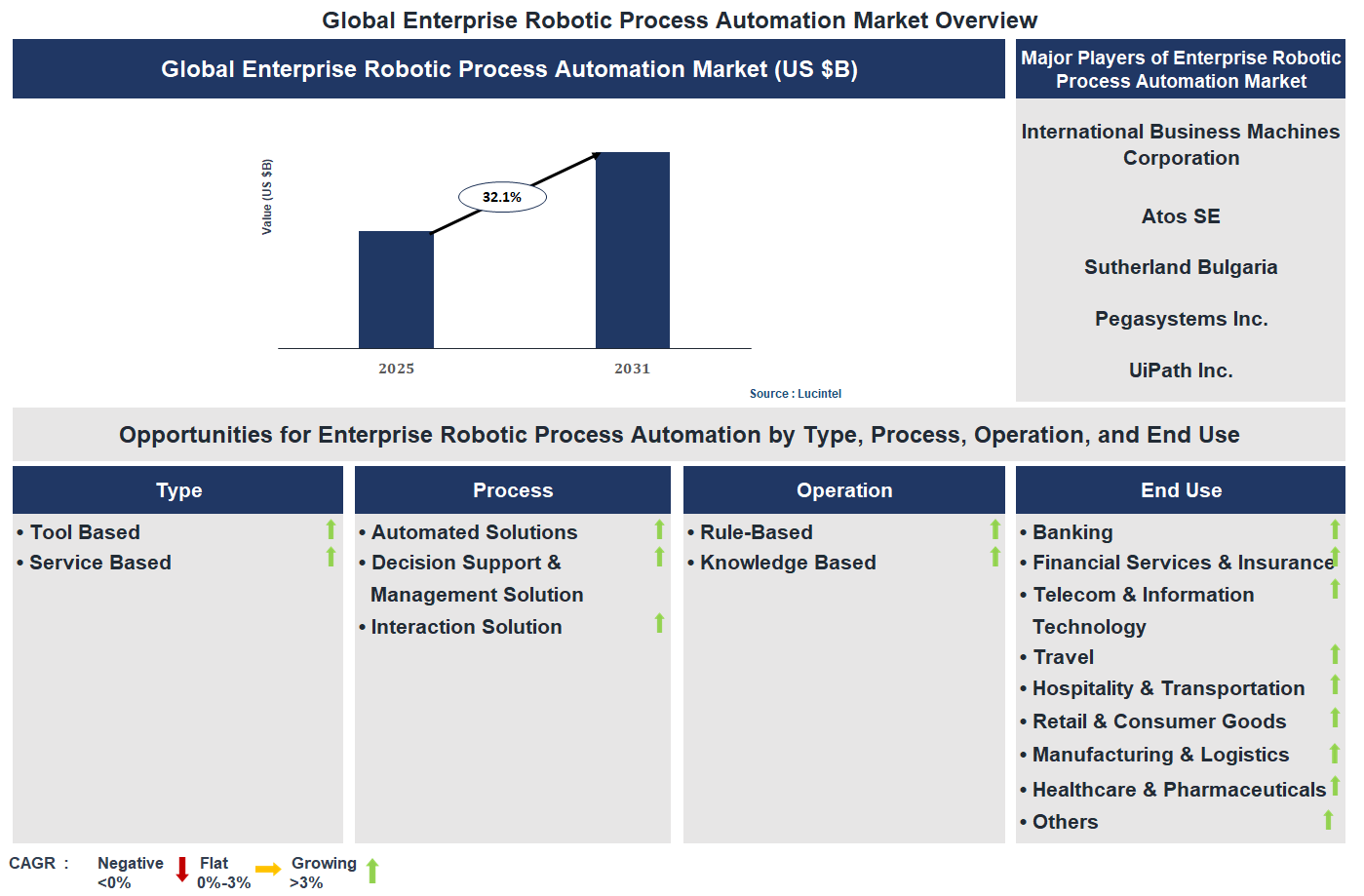
The future of the global enterprise robotic process automation market looks promising with opportunities in the banking, financial services & insurance, telecom & information technology, travel, hospitality & transportation, retail & consumer good, manufacturing & logistic, and healthcare & pharmaceutical markets. The global enterprise robotic process automation market is expected to grow with a CAGR of 32.1% from 2025 to 2031. The major drivers for this market are the increasing demand for operational efficiency, the rising need for cost reduction solutions, and the growing adoption of ai in automation.• Lucintel forecasts that, within the type category, service based is expected to witness higher growth over the forecast period.
• Within the end use category, financial services & insurance is expected to witness the highest growth.
• In terms of region, APAC is expected to witness the highest growth over the forecast period. Gain valuable insights for your business decisions with our comprehensive 150+ page report. Sample figures with some insights are shown below.
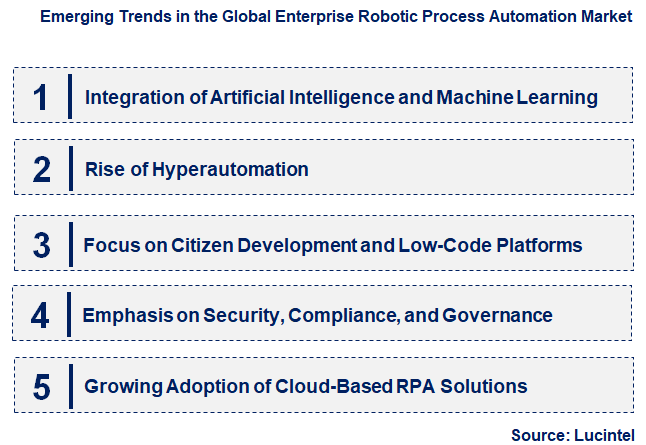
Emerging Trends in the Enterprise Robotic Process Automation Market
The enterprise robotic process automation market is experiencing rapid growth driven by technological advancements, increasing demand for operational efficiency, and the need for cost reduction across industries. As organizations seek to automate repetitive tasks, the market is evolving with innovative solutions that integrate AI, machine learning, and advanced analytics. These developments are transforming traditional workflows, enabling smarter automation, and fostering a competitive edge. The following key trends highlight the current trajectory of the RPA market, illustrating how it is reshaping enterprise operations and strategic planning in a dynamic digital landscape.• Integration of Artificial Intelligence and Machine Learning: RPA solutions are increasingly incorporating AI and ML capabilities, enabling bots to handle more complex tasks that require decision-making, pattern recognition, and natural language processing. This integration enhances automation accuracy, reduces human intervention, and allows for more adaptive workflows. As a result, organizations can automate a broader range of processes, from customer service to data analysis, leading to improved efficiency and better insights.
• Rise of Hyperautomation: Hyperautomation involves combining RPA with other advanced technologies such as process mining, analytics, and AI to automate complex, end-to-end business processes. This trend is driven by the need for comprehensive automation strategies that optimize entire workflows rather than isolated tasks. Hyperautomation enables organizations to identify bottlenecks, streamline operations, and achieve significant cost savings, ultimately transforming their operational models and increasing agility.
• Focus on Citizen Development and Low-Code Platforms: The market is witnessing a shift towards empowering non-technical users through low-code and no-code RPA platforms. Citizen developers can create and modify automation workflows without extensive programming knowledge, accelerating deployment and fostering innovation. This democratization of automation reduces dependency on IT teams, shortens project timelines, and encourages a broader adoption of RPA across departments, enhancing overall organizational productivity.
• Emphasis on Security, Compliance, and Governance: As RPA adoption expands, so does the importance of ensuring security, regulatory compliance, and proper governance. Vendors are integrating advanced security features, audit trails, and compliance frameworks into their solutions to address concerns related to data privacy and operational risks. This focus helps organizations mitigate potential vulnerabilities, maintain trust, and adhere to industry standards, which is crucial for scaling RPA initiatives in sensitive or regulated environments.
• Growing Adoption of Cloud-Based RPA Solutions: Cloud deployment models are gaining popularity due to their scalability, flexibility, and cost-effectiveness. Cloud-based RPA allows organizations to quickly deploy automation solutions without significant infrastructure investments, facilitating rapid scaling and remote management. This trend supports the widespread adoption of RPA across small and large enterprises, enabling faster innovation cycles and easier integration with existing cloud services, thus accelerating digital transformation efforts. In summary, these emerging trends are fundamentally reshaping the enterprise RPA market by making automation more intelligent, accessible, secure, and scalable. They are enabling organizations to achieve higher operational efficiency, reduce costs, and foster innovation, positioning RPA as a critical component of digital transformation strategies in the modern enterprise landscape.
Recent Development in the Enterprise Robotic Process Automation Market
The enterprise robotic process automation market is experiencing rapid growth driven by digital transformation initiatives across industries. Organizations seek to improve efficiency, reduce costs, and enhance accuracy through automation. Recent developments reflect technological advancements, increased adoption, and strategic investments. These trends are shaping the future landscape of RPA, creating new opportunities and challenges. Understanding these key developments is essential for stakeholders aiming to capitalize on the evolving market dynamics and maintain a competitive advantage.• Growing Adoption of AI-Integrated RPA: The integration of artificial intelligence with RPA is revolutionizing automation capabilities. AI-powered RPA enables complex decision-making, natural language processing, and predictive analytics, expanding automation beyond repetitive tasks. This development enhances operational efficiency, reduces errors, and allows for more sophisticated workflows. As organizations recognize these benefits, adoption accelerates, driving market growth and encouraging vendors to innovate further. The AI-RPA synergy is set to redefine enterprise automation strategies significantly.
• Increased Focus on Cloud-Based RPA Solutions: Cloud deployment of RPA tools offers scalability, flexibility, and cost-efficiency. Organizations are shifting from on-premises to cloud-based platforms to facilitate rapid deployment and easier maintenance. Cloud RPA supports remote work, integrates seamlessly with existing cloud infrastructure, and reduces upfront investments. This trend broadens access to automation for small and medium enterprises, fostering widespread adoption. As cloud technology matures, its integration with RPA is expected to further accelerate market expansion and innovation.
• Strategic Partnerships and Acquisitions: Major players are forming alliances and acquiring startups to enhance their RPA offerings. These collaborations aim to integrate complementary technologies, expand product portfolios, and accelerate innovation. Partnerships with AI firms, consulting companies, and software providers enable comprehensive automation solutions tailored to diverse industry needs. Such strategic moves strengthen market positioning, increase competitive pressure, and foster ecosystem development. This trend is crucial for driving technological advancements and capturing new customer segments.
• Rising Demand in BFSI and Healthcare Sectors: The banking, financial services, and insurance (BFSI) sector, along with healthcare, is witnessing significant RPA adoption. These industries benefit from automation in compliance, data management, and customer service. RPA helps reduce processing times, minimize errors, and ensure regulatory adherence. The COVID-19 pandemic further accelerated digital transformation, boosting RPA deployment. As these sectors continue to digitalize, the demand for tailored RPA solutions is expected to grow, creating lucrative opportunities for vendors and service providers.
• Emphasis on RPA Governance and Security: As RPA adoption increases, organizations focus on governance frameworks and security protocols. Ensuring compliance, data privacy, and risk management is critical for sustainable deployment. Advanced security features, audit trails, and centralized control mechanisms are being integrated into RPA platforms. This development addresses concerns related to cyber threats and regulatory requirements, fostering trust among users. Strengthening governance and security measures is vital for the wider acceptance and long-term success of RPA solutions in enterprise environments. The overall impact of these developments is a more dynamic, scalable, and secure RPA market. Increased adoption driven by technological innovations and sector-specific needs is expanding the market size. Strategic collaborations and cloud solutions are lowering entry barriers, fostering innovation. Emphasis on governance and security ensures sustainable growth. Collectively, these trends are positioning the Enterprise RPA Market for robust expansion, transforming enterprise operations and creating new revenue streams.
Strategic Growth Opportunities in the Enterprise Robotic Process Automation Market
The enterprise robotic process automation market is experiencing rapid expansion driven by digital transformation initiatives across industries. Organizations seek to improve efficiency, reduce costs, and enhance accuracy through automation. As technology advances, new applications and integrations are emerging, creating significant growth opportunities. Companies investing in RPA can gain competitive advantages by streamlining operations and enabling scalable automation solutions. The markets evolution is shaped by technological innovations, increasing adoption across sectors, and the need for intelligent automation to handle complex processes.• Expansion into Financial Services for Enhanced Compliance and Efficiency: RPA is increasingly adopted in banking, insurance, and finance to automate repetitive tasks such as data entry, compliance reporting, and transaction processing. This reduces manual errors, accelerates workflows, and ensures regulatory adherence. Financial institutions benefit from improved customer service and cost savings, driving market growth. As regulations become more complex, the demand for intelligent automation solutions that can handle complex compliance requirements is expected to rise significantly.
• Integration of AI and Machine Learning for Smarter Automation: Incorporating AI and ML into RPA platforms enables the automation of more complex, decision-based tasks. This evolution allows bots to analyze data, recognize patterns, and make informed decisions, expanding RPAs capabilities beyond simple rule-based processes. Organizations can automate tasks that previously required human judgment, increasing efficiency and accuracy. The integration of these technologies is a key driver for market growth, fostering the development of intelligent, adaptive automation solutions across industries.
• Adoption of RPA in Healthcare for Improved Patient Management: Healthcare providers are leveraging RPA to streamline administrative tasks such as patient registration, billing, and appointment scheduling. This reduces administrative burdens, minimizes errors, and enhances patient experience. RPA also supports data management and regulatory compliance, critical in healthcare. As healthcare organizations seek cost-effective, efficient solutions amid rising patient volumes, the deployment of RPA is expected to grow, transforming administrative workflows and enabling better patient care.
• Deployment of RPA in Supply Chain and Logistics for Operational Efficiency: RPA is increasingly used to automate procurement, inventory management, order processing, and shipment tracking. This reduces manual intervention, accelerates supply chain processes, and minimizes errors. Companies benefit from real-time data insights and improved coordination across supply chain stages. The growing complexity of global logistics and the need for agility are fueling RPA adoption in this sector, leading to more resilient and efficient supply chain operations.
• Growth of Cloud-Based RPA Solutions for Scalability and Flexibility: Cloud deployment of RPA offers scalable, cost-effective, and easily accessible automation solutions. Organizations can rapidly deploy bots without extensive infrastructure investments, enabling quick adaptation to changing business needs. Cloud RPA supports remote work environments and facilitates integration with other cloud-based systems. As digital transformation accelerates, the demand for flexible, scalable RPA solutions is expected to surge, expanding market reach and enabling broader adoption across small and large enterprises. The overall impact of these growth opportunities is a dynamic, expanding RPA market that is transforming enterprise operations. By embracing technological innovations and sector-specific applications, organizations can achieve significant efficiency gains, cost reductions, and competitive advantages. The markets evolution will continue to be driven by increasing adoption, integration of advanced AI capabilities, and flexible deployment options, shaping the future of enterprise automation.
Enterprise Robotic Process Automation Market Driver and Challenges
The enterprise robotic process automation market is influenced by a variety of technological, economic, and regulatory factors. Rapid advancements in artificial intelligence and machine learning are enabling more sophisticated automation solutions, driving market growth. Economic pressures, such as the need for cost reduction and operational efficiency, are compelling organizations to adopt RPA technologies. Additionally, evolving regulatory frameworks and data security concerns are shaping deployment strategies and compliance requirements. These drivers and challenges collectively impact the markets trajectory, influencing innovation, adoption rates, and competitive dynamics. Understanding these factors is essential for stakeholders aiming to capitalize on opportunities and mitigate risks within this evolving landscape. The factors responsible for driving the enterprise robotic process automation market include:• Technological Innovation: The continuous development of AI, machine learning, and natural language processing enhances RPA capabilities, enabling more complex and intelligent automation solutions. This technological evolution allows organizations to automate a broader range of tasks, from simple data entry to complex decision-making processes, thereby increasing efficiency and reducing operational costs. As technology advances, RPA becomes more accessible and scalable, encouraging widespread adoption across industries.
• Cost Reduction and Efficiency: Organizations are under constant pressure to optimize operational costs and improve productivity. RPA offers a cost-effective solution by automating repetitive, time-consuming tasks, reducing the need for human intervention. This leads to faster process execution, fewer errors, and significant savings in labor costs. As businesses recognize these benefits, the demand for RPA solutions continues to grow, fueling market expansion.
• Digital Transformation Initiatives: The global shift towards digital transformation is a key driver for RPA adoption. Companies are integrating RPA into their broader digital strategies to streamline workflows, enhance customer experiences, and enable data-driven decision-making. RPA acts as a foundational technology that supports automation in various digital initiatives, making it a critical component of modern enterprise architectures.
• Regulatory Compliance and Data Security: Increasing regulatory requirements across industries such as banking, healthcare, and finance necessitate accurate and compliant processing of data. RPA helps organizations ensure compliance by automating audit trails, data validation, and reporting processes. Additionally, RPA solutions are evolving to incorporate robust security features, addressing concerns related to data privacy and cyber threats, thus encouraging adoption in regulated sectors.
• Growing Adoption Across Industries: The versatility of RPA allows deployment across diverse sectors, including banking, healthcare, retail, and manufacturing. As industries recognize the benefits of automation, adoption rates are accelerating. This cross-sector growth is driven by the need for operational agility, improved customer service, and competitive advantage, further expanding the market landscape. The challenges in the enterprise robotic process automation market are:
• Integration Complexities: Integrating RPA solutions with existing legacy systems and diverse IT infrastructures can be complex and resource-intensive. Compatibility issues, data silos, and the need for extensive customization often hinder seamless deployment. These challenges can lead to increased implementation costs, delays, and potential disruptions, making organizations cautious about large-scale adoption and requiring skilled personnel for integration.
• Workforce Resistance and Change Management: The introduction of RPA often faces resistance from employees concerned about job security and changes in work processes. Managing this change requires effective communication, training, and strategic planning to ensure a smooth transition and acceptance. Failure to address workforce concerns can result in low adoption rates, reduced morale, and potential operational disruptions.
• Rapid Technological Changes and Vendor Lock-in: The fast-paced evolution of RPA technology creates challenges related to keeping solutions up-to-date and compatible with emerging tools. Additionally, reliance on specific vendors may lead to vendor lock-in, limiting flexibility and increasing long-term costs. Organizations must carefully evaluate vendor offerings and plan for ongoing updates to mitigate these risks and ensure sustainable automation strategies. In summary, the enterprise robotic process automation market is shaped by significant technological advancements, economic imperatives, and regulatory pressures that drive adoption. However, integration challenges, workforce resistance, and rapid technological changes pose substantial hurdles. These factors collectively influence the pace and scope of market growth, requiring strategic planning and innovation to harness opportunities while addressing risks. Overall, the markets future will depend on how effectively organizations navigate these drivers and challenges to realize the full potential of automation technologies.
List of Enterprise Robotic Process Automation Companies
Companies in the market compete on the basis of product quality offered. Major players in this market focus on expanding their manufacturing facilities, R&D investments, infrastructural development, and leverage integration opportunities across the value chain. With these strategies enterprise robotic process automation companies cater increasing demand, ensure competitive effectiveness, develop innovative products & technologies, reduce production costs, and expand their customer base. Some of the enterprise robotic process automation companies profiled in this report include-• International Business Machines Corporation
• Atos SE
• Sutherland Bulgaria
• Pegasystems Inc.
• UiPath Inc.
• Nice Systems Ltd.
• Verint Systems
• Fortra LLC
• IPSoft
• Automation Anywhere
Enterprise Robotic Process Automation Market by Segment
The study includes a forecast for the global enterprise robotic process automation market by type, process, operation, end use, and region.Enterprise Robotic Process Automation Market by Type [Value from 2019 to 2031]:
• Tool Based
• Service Based
Enterprise Robotic Process Automation Market by Process [Value from 2019 to 2031]:
• Automated Solutions
• Decision Support & Management Solution
• Interaction Solution
Enterprise Robotic Process Automation Market by Operation [Value from 2019 to 2031]:
• Rule-Based
• Knowledge Based
Enterprise Robotic Process Automation Market by End Use [Value from 2019 to 2031]:
• Banking
• Financial Services & Insurance
• Telecom & Information Technology
• Travel
• Hospitality & Transportation
• Retail & Consumer Goods
• Manufacturing & Logistics
• Healthcare & Pharmaceuticals
• Others
Enterprise Robotic Process Automation Market by Region [Value from 2019 to 2031]:
• North America
• Europe
• Asia Pacific
• The Rest of the World
Country Wise Outlook for the Enterprise Robotic Process Automation Market
The enterprise robotic process automation market has experienced rapid growth globally, driven by digital transformation initiatives, increasing demand for operational efficiency, and advancements in AI and machine learning technologies. Countries are adopting RPA to streamline workflows, reduce costs, and enhance customer experiences. The United States, China, Germany, India, and Japan are leading the way, each with unique developments reflecting their technological landscapes and economic priorities. These countries are investing heavily in RPA innovation, integrating it into various sectors such as finance, healthcare, manufacturing, and services, shaping the future of automation worldwide.• United States: The US market has seen significant advancements with major tech firms and startups developing sophisticated RPA solutions. There is a focus on integrating AI capabilities for smarter automation, and increased adoption in banking, healthcare, and retail sectors. Cloud-based RPA services are gaining popularity, and regulatory frameworks are evolving to support responsible automation practices.
• China: China is rapidly expanding its RPA ecosystem, driven by government initiatives to boost digital economy growth. Local companies are developing cost-effective RPA tools tailored for manufacturing and service industries. The government’s focus on smart city projects and Industry 4.0 has accelerated RPA deployment, with a strong emphasis on AI integration and local innovation.
• Germany: Germany’s RPA market is characterized by its focus on manufacturing and industrial automation, aligning with its reputation for engineering excellence. Companies are adopting RPA to optimize supply chains and production processes. There is a growing trend toward integrating RPA with Industry 4.0 technologies, and collaborations between tech firms and traditional industries are increasing to develop customized automation solutions.
• India: India is witnessing a surge in RPA adoption across BFSI, telecom, and government sectors, driven by cost efficiency and digital transformation goals. The market is supported by a large pool of IT talent and startups offering affordable RPA solutions. The government’s push for digital India and initiatives like Make in India are further fueling RPA growth, with a focus on scalable and accessible automation tools.
• Japan: Japan’s RPA market is evolving with a focus on addressing labor shortages and enhancing productivity in sectors like manufacturing, healthcare, and retail. Companies are adopting RPA to automate repetitive tasks and improve operational accuracy. There is an increasing integration of RPA with AI and IoT, and a strong emphasis on developing user-friendly solutions to facilitate widespread adoption among traditional enterprises.

Features of the Global Enterprise Robotic Process Automation Market
Market Size Estimates: Enterprise robotic process automation market size estimation in terms of value ($B). Trend and Forecast Analysis: Market trends (2019 to 2024) and forecast (2025 to 2031) by various segments and regions. Segmentation Analysis: Enterprise robotic process automation market size by various segments, such as by type, process, operation, end use, and region in terms of value ($B). Regional Analysis: Enterprise robotic process automation market breakdown by North America, Europe, Asia Pacific, and Rest of the World. Growth Opportunities: Analysis of growth opportunities in different types, processes, operations, end uses, and regions for the enterprise robotic process automation market. Strategic Analysis: This includes M&A, new product development, and competitive landscape of the enterprise robotic process automation market. Analysis of competitive intensity of the industry based on Porter’s Five Forces model.
FAQ
Q1. What is the growth forecast for enterprise robotic process automation market? Answer: The global enterprise robotic process automation market is expected to grow with a CAGR of 32.1% from 2025 to 2031. Q2. What are the major drivers influencing the growth of the enterprise robotic process automation market? Answer: The major drivers for this market are the increasing demand for operational efficiency, the rising need for cost reduction solutions, and the growing adoption of ai in automation. Q3. What are the major segments for enterprise robotic process automation market? Answer: The future of the enterprise robotic process automation market looks promising with opportunities in the banking, financial services & insurance, telecom & information technology, travel, hospitality & transportation, retail & consumer good, manufacturing & logistic, and healthcare & pharmaceutical markets. Q4. Who are the key enterprise robotic process automation market companies? Answer: Some of the key enterprise robotic process automation companies are as follows:• International Business Machines Corporation
• Atos SE
• Sutherland Bulgaria
• Pegasystems Inc.
• UiPath Inc.
• Nice Systems Ltd.
• Verint Systems
• Fortra LLC
• IPSoft
• Automation Anywhere Q5. Which enterprise robotic process automation market segment will be the largest in future? Answer: Lucintel forecasts that, within the type category, service based is expected to witness higher growth over the forecast period. Q6. In enterprise robotic process automation market, which region is expected to be the largest in next 5 years? Answer: In terms of region, APAC is expected to witness the highest growth over the forecast period. Q7. Do we receive customization in this report? Answer: Yes, Lucintel provides 10% customization without any additional cost.
Table of Contents
List of Figures
List of Tables
Methodology
- In-depth interviews of the major players in this market
- Detailed secondary research from competitors’ financial statements and published data
- Extensive searches of published works, market, and database information pertaining to industry news, company press releases, and customer intentions
- A compilation of the experiences, judgments, and insights of Lucintel’s professionals, who have analyzed and tracked this market over the years.


Buy Now
Choose a license that fits your team. Instant PDF delivery.
Prices exclude taxes. Instant delivery. Custom licensing available on request.
Key Questions
- • What are some of the most promising, high-growth opportunities for the enterprise robotic process automation market by type (tool based and service based), process (automated solutions, decision support & management solution, and interaction solution), operation (rule-based and knowledge based), end use (banking, financial services & insurance, telecom & information technology, travel, hospitality & transportation, retail & consumer goods, manufacturing & logistics, healthcare & pharmaceuticals, and others), and region (North America, Europe, Asia Pacific, and the Rest of the World)?
- • Which segments will grow at a faster pace and why?
- • Which region will grow at a faster pace and why?
- • What are the key factors affecting market dynamics? What are the key challenges and business risks in this market?
- • What are the business risks and competitive threats in this market?
- • What are the emerging trends in this market and the reasons behind them?
- • What are some of the changing demands of customers in the market?
- • What are the new developments in the market? Which companies are leading these developments?
- • Who are the major players in this market? What strategic initiatives are key players pursuing for business growth?
- • What are some of the competing products in this market and how big of a threat do they pose for loss of market share by material or product substitution?
- • What M&A activity has occurred in the last 6 years and what has its impact been on the industry? For any questions related to Enterprise Robotic Process Automation Market, Enterprise Robotic Process Automation Market Size, Enterprise Robotic Process Automation Market Growth, Enterprise Robotic Process Automation Market Analysis, Enterprise Robotic Process Automation Market Report, Enterprise Robotic Process Automation Market Share, Enterprise Robotic Process Automation Market Trends, Enterprise Robotic Process Automation Market Forecast, Enterprise Robotic Process Automation Companies, write Lucintel analyst at email: helpdesk@lucintel.com. We will be glad to get back to you soon.


