
Report Feature
Enterprise Monitoring Market Trends and Forecast
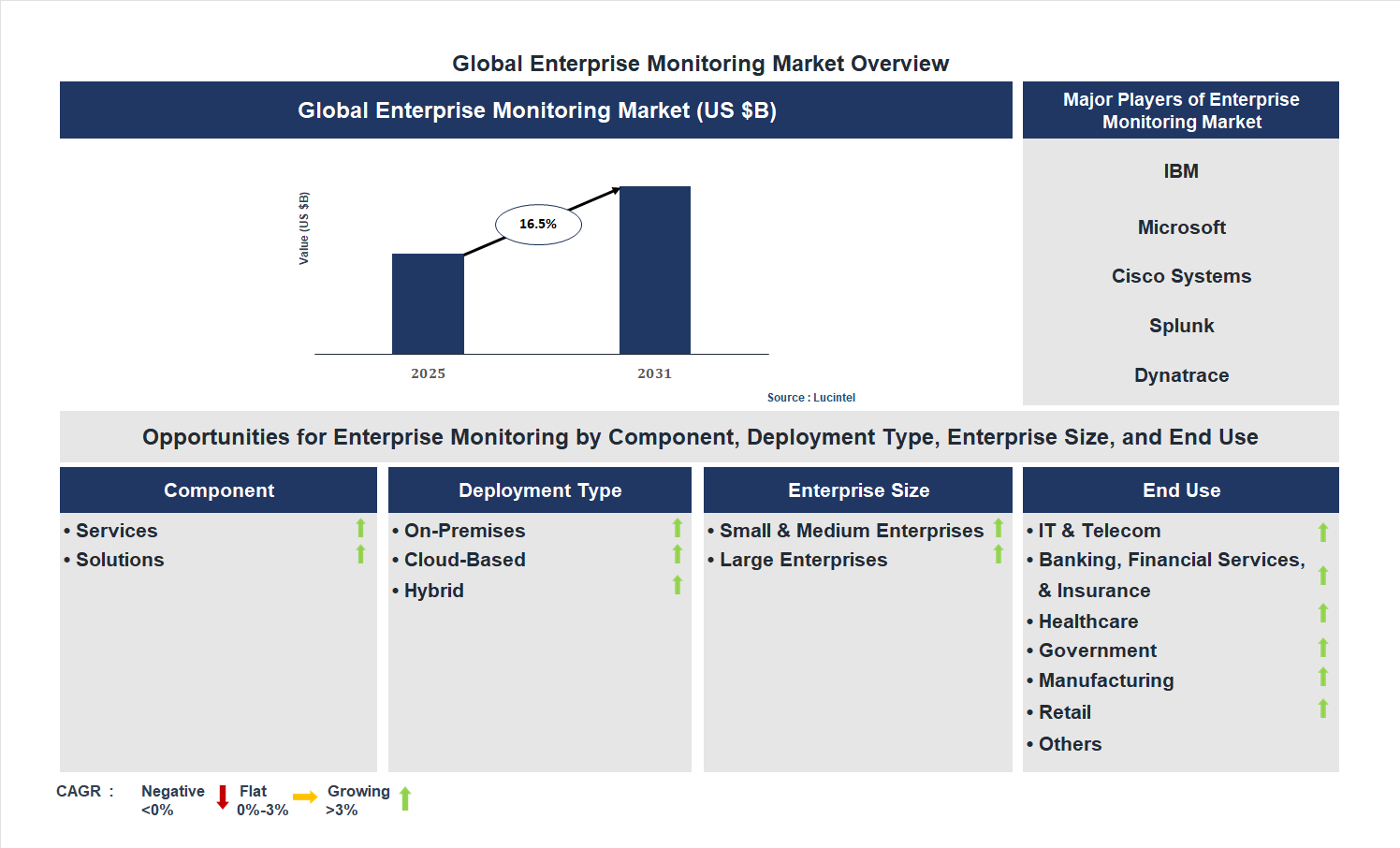
The future of the global enterprise monitoring market looks promising with opportunities in the IT & telecom, banking, financial services, & insurance, healthcare, government, manufacturing, and retail markets. The global enterprise monitoring market is expected to grow with a CAGR of 16.5% from 2025 to 2031. The major drivers for this market are the increasing demand for real time system visibility, the rising adoption of cloud based monitoring tools, and the growing focus on enhancing service performance.• Lucintel forecasts that, within the component category, service is expected to witness higher growth over the forecast period.
• Within the end use category, healthcare is expected to witness the highest growth.
• In terms of region, APAC is expected to witness the highest growth over the forecast period. Gain valuable insights for your business decisions with our comprehensive 150+ page report. Sample figures with some insights are shown below.
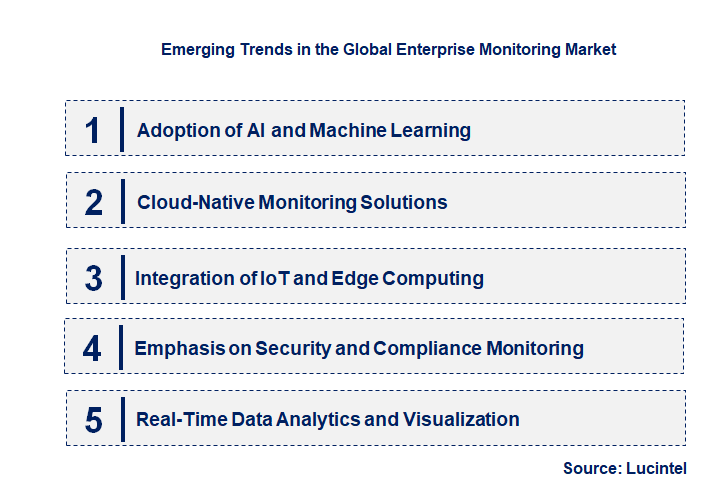
Emerging Trends in the Enterprise Monitoring Market
The enterprise monitoring market is experiencing rapid evolution driven by technological advancements, increasing digital transformation, and the need for real-time insights. Organizations are prioritizing proactive monitoring to enhance operational efficiency, security, and customer experience. As businesses adopt cloud computing, IoT, and AI, the market is witnessing innovative solutions that cater to complex, dynamic environments. These trends are reshaping how enterprises manage their IT infrastructure, ensuring resilience and agility in a competitive landscape. The following key trends highlight the major developments shaping the future of enterprise monitoring.• Adoption of AI and Machine Learning: AI and ML are transforming enterprise monitoring by enabling predictive analytics and automated anomaly detection. These technologies help identify potential issues before they impact operations, reducing downtime and improving response times. AI-driven insights facilitate smarter decision-making and optimize resource allocation. As AI integration deepens, monitoring tools become more intelligent, providing proactive alerts and recommendations. This trend enhances operational efficiency, reduces manual intervention, and supports scalable, adaptive monitoring solutions aligned with complex enterprise environments.
• Cloud-Native Monitoring Solutions: With the shift to cloud infrastructure, enterprises are increasingly adopting cloud-native monitoring tools designed specifically for dynamic, distributed environments. These solutions offer scalability, flexibility, and seamless integration with cloud platforms like AWS, Azure, and Google Cloud. Cloud-native monitoring enables real-time visibility across hybrid and multi-cloud setups, ensuring consistent performance and security. It also simplifies management by leveraging containerization and microservices architectures. This trend is crucial for organizations seeking agility and cost-efficiency in their digital transformation journeys, making monitoring more accessible and effective in cloud-centric ecosystems.
• Integration of IoT and Edge Computing: The proliferation of IoT devices and edge computing is expanding the scope of enterprise monitoring. Organizations need to monitor vast networks of connected devices and edge nodes to ensure security, performance, and compliance. This trend drives the development of specialized monitoring tools capable of handling high volumes of data generated at the edge. It enables real-time insights into operational conditions, facilitating faster decision-making and predictive maintenance. As IoT adoption grows, monitoring solutions are evolving to address the unique challenges of decentralized, data-intensive environments, enhancing overall operational resilience.
• Emphasis on Security and Compliance Monitoring: As cyber threats increase and regulatory requirements tighten, security and compliance monitoring are becoming central to enterprise strategies. Monitoring tools now incorporate advanced security analytics, threat detection, and compliance reporting features. This trend ensures continuous monitoring of vulnerabilities, unauthorized access, and data breaches, helping organizations meet standards like GDPR, HIPAA, and PCI DSS. Enhanced security monitoring reduces risk exposure and supports proactive threat mitigation. The integration of security into core monitoring processes reflects a shift towards comprehensive, risk-aware enterprise management, vital for safeguarding digital assets and maintaining trust.
• Real-Time Data Analytics and Visualization: The demand for instant insights has propelled the adoption of real-time data analytics and visualization tools. These solutions provide dynamic dashboards and customizable reports, enabling IT teams to monitor system health, user activity, and performance metrics continuously. Real-time analytics facilitate rapid troubleshooting, capacity planning, and strategic decision-making. Visualization tools help translate complex data into understandable formats, improving communication across teams. This trend enhances operational agility, allowing enterprises to respond swiftly to issues and optimize performance proactively, ultimately driving better business outcomes in a fast-paced digital environment. In summary, these emerging trends are fundamentally transforming the enterprise monitoring market by making solutions more intelligent, scalable, secure, and aligned with modern digital infrastructures. They enable organizations to achieve higher operational resilience, agility, and security, positioning them for sustained growth in an increasingly complex technological landscape.
Recent Development in the Enterprise Monitoring Market
The enterprise monitoring market has experienced significant evolution driven by technological advancements, increasing cybersecurity threats, and the growing complexity of IT infrastructures. Organizations are prioritizing real-time insights, automation, and integrated solutions to ensure optimal performance, security, and compliance. Recent developments reflect a shift towards more sophisticated, scalable, and user-friendly monitoring tools that cater to diverse enterprise needs. These innovations are transforming how businesses manage their IT environments, enabling proactive decision-making and minimizing downtime. As the market continues to evolve, understanding these key developments is essential for stakeholders aiming to leverage the latest capabilities and maintain competitive advantage.• Adoption of AI and Machine Learning: Integration of AI and ML algorithms enhances anomaly detection, predictive analytics, and automation, leading to faster incident resolution and improved system reliability. This development reduces manual effort and increases accuracy, enabling enterprises to proactively address issues before they impact operations.
• Cloud-Native Monitoring Solutions: The shift towards cloud computing has driven the adoption of cloud-native monitoring tools that offer scalability, flexibility, and seamless integration with cloud platforms. These solutions support hybrid and multi-cloud environments, providing comprehensive visibility and control over distributed infrastructures.
• Increased Focus on Security Monitoring: With rising cybersecurity threats, enterprises are investing more in security-focused monitoring solutions. These tools enable real-time threat detection, vulnerability assessment, and compliance management, strengthening overall security posture and reducing risk exposure.
• Integration of IoT Monitoring: The proliferation of IoT devices has prompted the development of specialized monitoring solutions to manage and analyze data from connected devices. This integration supports operational efficiency, predictive maintenance, and enhanced decision-making across various industries.
• Enhanced User Experience and Automation: Modern monitoring tools emphasize intuitive interfaces, customizable dashboards, and automation features. These improvements facilitate easier adoption, faster insights, and reduced operational overhead, empowering IT teams to focus on strategic initiatives. In summary, these developments are significantly transforming the enterprise monitoring market by enabling more intelligent, scalable, and secure solutions. They improve operational efficiency, reduce downtime, and enhance security, positioning enterprises to better navigate the complexities of modern IT environments. As a result, the market is witnessing accelerated growth and increased adoption of innovative monitoring technologies.
Strategic Growth Opportunities in the Enterprise Monitoring Market
The enterprise monitoring market is experiencing rapid evolution driven by digital transformation, increasing complexity of IT environments, and the need for real-time insights. Organizations are prioritizing proactive monitoring to enhance operational efficiency, security, and customer experience. As technology advances, new applications emerge, creating significant growth opportunities across various sectors. These developments are reshaping how enterprises manage their infrastructure, applications, and security, fostering innovation and competitive advantage. The following key growth opportunities highlight the most promising areas within the market, each poised to influence future trends and investment strategies.• Cloud Infrastructure Monitoring: This opportunity involves tracking cloud-based resources and services, enabling organizations to optimize performance and reduce downtime. As cloud adoption accelerates, monitoring tools that provide real-time insights into cloud environments are crucial for maintaining service levels and ensuring security compliance. This growth enhances agility and cost-efficiency, making cloud infrastructure monitoring a vital component of enterprise strategies.
• Application Performance Monitoring (APM): APM focuses on tracking the performance of software applications to identify bottlenecks and improve user experience. With the increasing complexity of applications, especially those utilizing microservices and APIs, APM tools help organizations ensure seamless functionality. This growth opportunity directly impacts customer satisfaction and operational efficiency, making it essential for digital transformation initiatives.
• Security and Threat Monitoring: As cyber threats become more sophisticated, enterprises require advanced security monitoring solutions to detect and respond to threats in real time. This includes monitoring network traffic, user activities, and system vulnerabilities. The expansion of security monitoring enhances enterprise resilience, compliance, and trust, especially in regulated industries, and is critical for safeguarding digital assets.
• IoT and Edge Device Monitoring: The proliferation of IoT devices and edge computing creates a need for specialized monitoring solutions that manage distributed and often resource-constrained devices. This opportunity supports real-time data collection, device health, and security management at the edge, enabling industries like manufacturing, healthcare, and transportation to optimize operations and innovate with IoT applications.
• Business Analytics and Insights: Monitoring tools that integrate with analytics platforms provide actionable insights into enterprise operations. This growth area involves aggregating data from various sources to support decision-making, predictive maintenance, and process optimization. The ability to leverage data-driven insights enhances competitive advantage and operational agility across industries. In summary, these growth opportunities are significantly transforming the enterprise monitoring market by enabling organizations to achieve higher efficiency, security, and innovation. As enterprises increasingly adopt advanced monitoring solutions across cloud, applications, security, IoT, and analytics, the market is poised for sustained expansion and technological advancement.
Enterprise Monitoring Market Driver and Challenges
The enterprise monitoring market is influenced by a variety of technological, economic, and regulatory factors that shape its growth and development. Rapid advancements in cloud computing, artificial intelligence, and big data analytics are driving the need for sophisticated monitoring solutions. Economic factors such as increasing IT budgets and digital transformation initiatives are further fueling market expansion. Simultaneously, evolving regulatory requirements around data security and compliance are compelling organizations to adopt comprehensive monitoring tools. However, the market also faces challenges including high implementation costs, data privacy concerns, and the complexity of integrating new systems with existing infrastructure. These drivers and challenges collectively determine the trajectory of the enterprise monitoring landscape. The factors responsible for driving the enterprise monitoring market include:• Technological Advancements: Rapid innovations in cloud computing, AI, and machine learning are enabling more proactive and predictive monitoring solutions. These technologies facilitate real-time insights, automation, and improved system reliability, which are critical for modern enterprises. As organizations increasingly adopt cloud-based infrastructure, the demand for scalable and intelligent monitoring tools grows, pushing the market forward. The integration of AI-driven analytics helps in early detection of issues, reducing downtime and operational costs, thus making enterprise monitoring more efficient and essential.
• Growing Adoption of Cloud Computing: The shift towards cloud infrastructure is a significant driver, as enterprises seek flexible, scalable, and cost-effective solutions. Cloud environments require continuous monitoring to ensure security, performance, and compliance. This trend has expanded the market beyond traditional on-premises systems to include cloud-native monitoring tools. As cloud adoption accelerates across industries, the demand for specialized monitoring solutions that can handle hybrid and multi-cloud environments increases, fueling market growth.
• Increasing Focus on Cybersecurity and Compliance: With rising cyber threats and stringent regulatory standards such as GDPR and HIPAA, organizations are prioritizing security and compliance monitoring. Enterprise monitoring solutions now incorporate advanced security features to detect vulnerabilities and prevent breaches. This focus not only enhances data protection but also helps organizations avoid hefty fines and reputational damage. The need for comprehensive, real-time compliance reporting is a key factor driving the adoption of advanced monitoring tools across sectors.
• Digital Transformation Initiatives: Enterprises are undergoing digital transformation to improve operational efficiency and customer experience. Monitoring plays a vital role in this process by providing visibility into complex IT environments, ensuring seamless service delivery, and supporting innovation. As digital initiatives expand, the demand for integrated monitoring solutions that can manage diverse applications and infrastructure increases, propelling market growth. The challenges facing this Market include:
• High Implementation and Maintenance Costs: Deploying enterprise monitoring solutions often involves significant investment in hardware, software, and skilled personnel. The complexity of integrating new monitoring tools with existing legacy systems can lead to increased costs and resource allocation. Ongoing maintenance and updates further add to the financial burden, especially for small and medium-sized enterprises. These costs can hinder widespread adoption, particularly in cost-sensitive markets, and slow down overall market growth.
• Data Privacy and Security Concerns: As monitoring solutions collect vast amounts of sensitive data, organizations face risks related to data breaches and privacy violations. Ensuring data security within monitoring systems is complex, especially when dealing with cloud environments and third-party vendors. Regulatory compliance adds another layer of complexity, requiring robust security measures. These concerns can lead to reluctance in adopting comprehensive monitoring solutions, thereby limiting market expansion.
• Complexity of System Integration: Integrating new monitoring tools with existing IT infrastructure can be challenging due to diverse systems, platforms, and legacy applications. Compatibility issues, lack of standardized protocols, and the need for customization can delay deployment and increase costs. This complexity often requires specialized expertise, which may not be readily available, creating barriers for organizations to fully leverage advanced monitoring solutions and potentially stunting market growth. In summary, the enterprise monitoring market is driven by technological innovations, cloud adoption, security and compliance needs, and digital transformation efforts. However, high costs, data privacy issues, and integration challenges pose significant hurdles. These factors collectively influence the pace and direction of market development, with ongoing innovation and strategic solutions needed to overcome barriers. Overall, the markets future will depend on balancing technological progress with effective management of these challenges to deliver scalable, secure, and cost-efficient monitoring solutions.
List of Enterprise Monitoring Companies
Companies in the market compete on the basis of product quality offered. Major players in this market focus on expanding their manufacturing facilities, R&D investments, infrastructural development, and leverage integration opportunities across the value chain. With these strategies enterprise monitoring companies cater increasing demand, ensure competitive effectiveness, develop innovative products & technologies, reduce production costs, and expand their customer base. Some of the enterprise monitoring companies profiled in this report include-• IBM
• Microsoft
• Cisco Systems
• Splunk
• Dynatrace
• SolarWinds
• Nagios Enterprises
• New Relic
• Datadog
• AppDynamics
Enterprise Monitoring Market by Segment
The study includes a forecast for the global enterprise monitoring market by component, deployment type, enterprise size, end use, and region.Enterprise Monitoring Market by Component [Value from 2019 to 2031]:
• Services
• Solutions
Enterprise Monitoring Market by Deployment Type [Value from 2019 to 2031]:
• On-Premises
• Cloud-Based
• Hybrid
Enterprise Monitoring Market by Enterprise Size [Value from 2019 to 2031]:
• Small & Medium Enterprises
• Large Enterprises
Enterprise Monitoring Market by End Use [Value from 2019 to 2031]:
• IT & Telecom
• Banking, Financial Services, & Insurance
• Healthcare
• Government
• Manufacturing
• Retail
• Others
Enterprise Monitoring Market by Region [Value from 2019 to 2031]:
• North America
• Europe
• Asia Pacific
• The Rest of the World
Country Wise Outlook for the Enterprise Monitoring Market
The enterprise monitoring market has experienced rapid growth driven by digital transformation, increased cybersecurity concerns, and the need for real-time data insights. As organizations worldwide adopt advanced technologies, the demand for comprehensive monitoring solutions has surged, leading to innovations and strategic shifts across major economies. These developments reflect the evolving landscape of enterprise management, emphasizing automation, AI integration, and enhanced security features. Each country’s market dynamics are influenced by local technological advancements, regulatory frameworks, and industry-specific needs, shaping the global trajectory of enterprise monitoring solutions.• United States: The US market has seen significant advancements with increased adoption of AI-powered monitoring tools and cloud-based solutions. Major players are investing in automation and predictive analytics to enhance operational efficiency. Regulatory compliance, especially around data privacy, remains a key focus, prompting innovations in security features. The rise of remote work has accelerated demand for comprehensive enterprise monitoring to ensure security and productivity. Additionally, startups and tech giants are collaborating to develop integrated platforms that offer real-time insights and automation capabilities, solidifying the US’s leadership in this sector.
• China: China’s enterprise monitoring market is rapidly expanding, driven by government initiatives to boost digital infrastructure and smart city projects. Local companies are focusing on AI and big data integration to improve real-time monitoring and predictive maintenance. The government’s emphasis on cybersecurity and data sovereignty influences product development, with a focus on localized solutions. E-commerce and manufacturing sectors are key adopters, leveraging monitoring tools to optimize supply chains and operational efficiency. The market is also characterized by a surge in domestic innovation, with several startups gaining prominence through tailored, cost-effective solutions.
• Germany: Germany’s market emphasizes industrial automation and manufacturing sector integration, aligning with its Industry 4.0 initiatives. There is a strong focus on cybersecurity and data protection, complying with strict EU regulations like GDPR. Companies are adopting hybrid cloud and edge computing solutions to enhance real-time monitoring and reduce latency. The automotive and machinery industries are significant users, utilizing advanced monitoring for predictive maintenance and quality control. Innovation in AI and IoT integration is prominent, with a growing trend toward sustainable and energy-efficient monitoring systems that support Germany’s environmental goals.
• India: The Indian enterprise monitoring market is witnessing rapid growth fueled by digital transformation across sectors such as IT, manufacturing, and telecom. Local providers are developing affordable, scalable solutions tailored to the needs of small and medium enterprises. Cloud adoption is increasing, with a focus on remote monitoring and cybersecurity. Government initiatives like Digital India are promoting digital infrastructure, boosting demand for monitoring tools. Startups are innovating in AI and IoT to offer predictive analytics and automation. The market’s expansion is also driven by increasing cybersecurity threats and the need for robust monitoring solutions to safeguard digital assets.
• Japan: Japan’s market is characterized by a focus on industrial automation, robotics, and IoT integration, supporting its advanced manufacturing sector. There is a strong emphasis on cybersecurity and data privacy, aligned with national policies. Companies are adopting AI-driven monitoring systems to optimize production processes and maintenance schedules. The integration of IoT devices enhances real-time data collection and analysis, improving operational efficiency. Japan is also investing in sustainable monitoring solutions that align with its environmental commitments. The market is driven by both domestic demand and collaborations with global technology firms to develop innovative, secure, and efficient enterprise monitoring solutions.

Features of the Global Enterprise Monitoring Market
Market Size Estimates: Enterprise monitoring market size estimation in terms of value ($B). Trend and Forecast Analysis: Market trends (2019 to 2024) and forecast (2025 to 2031) by various segments and regions. Segmentation Analysis: Enterprise monitoring market size by various segments, such as by component, deployment type, enterprise size, end use, and region in terms of value ($B). Regional Analysis: Enterprise monitoring market breakdown by North America, Europe, Asia Pacific, and Rest of the World. Growth Opportunities: Analysis of growth opportunities in different components, deployment types, enterprise sizes, end uses, and regions for the enterprise monitoring market. Strategic Analysis: This includes M&A, new product development, and competitive landscape of the enterprise monitoring market. Analysis of competitive intensity of the industry based on Porter’s Five Forces model.
FAQ
Q1. What is the growth forecast for enterprise monitoring market? Answer: The global enterprise monitoring market is expected to grow with a CAGR of 16.5% from 2025 to 2031. Q2. What are the major drivers influencing the growth of the enterprise monitoring market? Answer: The major drivers for this market are the increasing demand for real time system visibility, the rising adoption of cloud based monitoring tools, and the growing focus on enhancing service performance. Q3. What are the major segments for enterprise monitoring market? Answer: The future of the enterprise monitoring market looks promising with opportunities in the IT & telecom, banking, financial services, & insurance, healthcare, government, manufacturing, and retail markets. Q4. Who are the key enterprise monitoring market companies? Answer: Some of the key enterprise monitoring companies are as follows:• IBM
• Microsoft
• Cisco Systems
• Splunk
• Dynatrace
• SolarWinds
• Nagios Enterprises
• New Relic
• Datadog
• AppDynamics Q5. Which enterprise monitoring market segment will be the largest in future? Answer: Lucintel forecasts that, within the component category, service is expected to witness higher growth over the forecast period. Q6. In enterprise monitoring market, which region is expected to be the largest in next 5 years? Answer: In terms of region, APAC is expected to witness the highest growth over the forecast period. Q7. Do we receive customization in this report? Answer: Yes, Lucintel provides 10% customization without any additional cost.
Table of Contents
List of Figures
List of Tables
Methodology
- In-depth interviews of the major players in this market
- Detailed secondary research from competitors’ financial statements and published data
- Extensive searches of published works, market, and database information pertaining to industry news, company press releases, and customer intentions
- A compilation of the experiences, judgments, and insights of Lucintel’s professionals, who have analyzed and tracked this market over the years.


Buy Now
Choose a license that fits your team. Instant PDF delivery.
Prices exclude taxes. Instant delivery. Custom licensing available on request.
Key Questions
- • What are some of the most promising, high-growth opportunities for the enterprise monitoring market by component (services and solutions), deployment type (on-premises, cloud-based, and hybrid), enterprise size (small & medium enterprises and large enterprises), end use (IT & telecom, banking, financial services, & insurance, healthcare, government, manufacturing, retail, and others), and region (North America, Europe, Asia Pacific, and the Rest of the World)?
- • Which segments will grow at a faster pace and why?
- • Which region will grow at a faster pace and why?
- • What are the key factors affecting market dynamics? What are the key challenges and business risks in this market?
- • What are the business risks and competitive threats in this market?
- • What are the emerging trends in this market and the reasons behind them?
- • What are some of the changing demands of customers in the market?
- • What are the new developments in the market? Which companies are leading these developments?
- • Who are the major players in this market? What strategic initiatives are key players pursuing for business growth?
- • What are some of the competing products in this market and how big of a threat do they pose for loss of market share by material or product substitution?
- • What M&A activity has occurred in the last 5 years and what has its impact been on the industry? For any questions related to Enterprise Monitoring Market, Enterprise Monitoring Market Size, Enterprise Monitoring Market Growth, Enterprise Monitoring Market Analysis, Enterprise Monitoring Market Report, Enterprise Monitoring Market Share, Enterprise Monitoring Market Trends, Enterprise Monitoring Market Forecast, Enterprise Monitoring Companies, write Lucintel analyst at email: helpdesk@lucintel.com. We will be glad to get back to you soon.


