
Report Feature
Engine Driven Welder Market Trends and Forecast
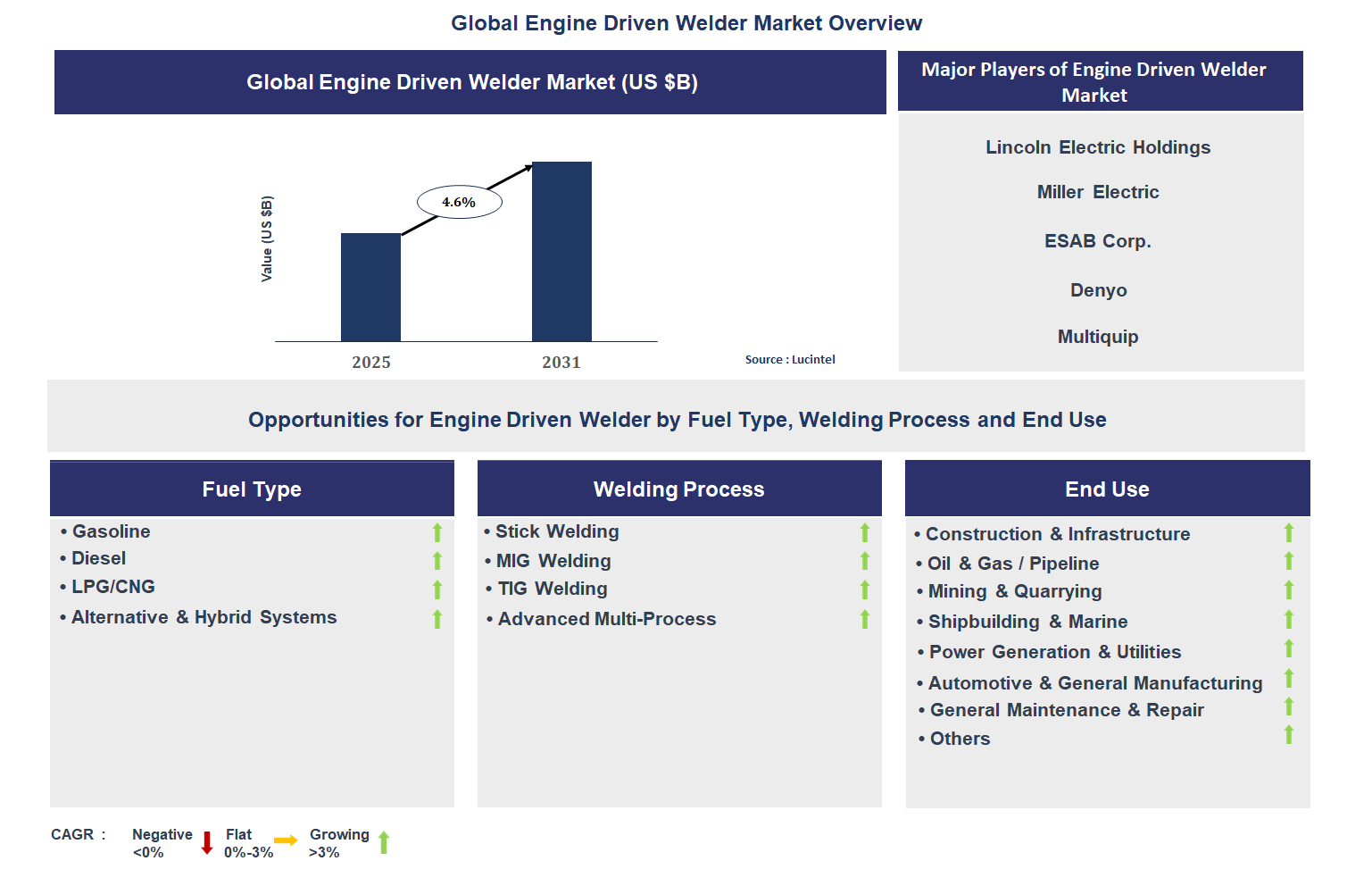
The future of the global engine driven welder market looks promising with opportunities in the construction & infrastructure, oil & gas / pipeline, mining & quarrying, shipbuilding & marine, power generation & utility, automotive & general manufacturing, and general maintenance & repair markets. The global engine driven welder market is expected to grow with a CAGR of 4.6% from 2025 to 2031. The major drivers for this market are the increasing demand for portable welding solutions, the rising adoption of welding in construction projects, and the growing need for off-grid power generation systems.• Lucintel forecasts that, within the fuel type category, gasoline, diesel, LPG/CNG, and alternative & hybrid system is expected to witness the highest growth over the forecast period.
• Within the end use category, construction & infrastructure is expected to witness the highest growth.
• In terms of region, APAC is expected to witness the highest growth over the forecast period. Gain valuable insights for your business decisions with our comprehensive 150+ page report. Sample figures with some insights are shown below.
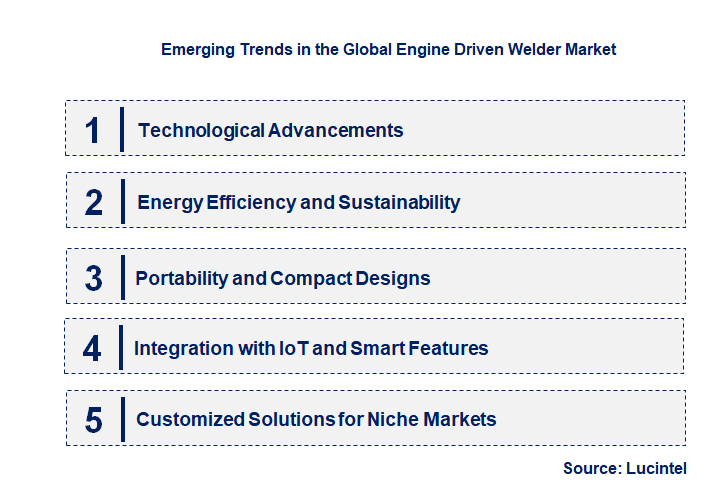
Emerging Trends in the Engine Driven Welder Market
The engine driven welder market is influenced by emerging technological, economic, and environmental trends. These trends are shaping product development, user preferences, and manufacturing strategies, enabling the market to evolve to meet modern industrial demands. The following five trends are at the forefront of this transformation.• Technological Advancements: Welding machines are integrating more sophisticated technologies like inverter-based systems and digital controls. These developments offer better energy efficiency, precise welding output, and reduced maintenance requirements. The shift towards automated and smart welders is allowing operators to monitor and adjust processes in real-time, increasing productivity and reducing error rates.
• Energy Efficiency and Sustainability: As industries focus on reducing their carbon footprints, engine driven welders are being designed with improved fuel efficiency and lower emissions. These eco-friendly models are gaining popularity, particularly in regions with strict environmental regulations. Manufacturers are exploring hybrid or electric-driven options as alternatives to traditional gasoline-powered models.
• Portability and Compact Designs: Portability is increasingly becoming a priority in the engine driven welder market. Compact, lightweight, and easy-to-transport models are especially in demand for remote worksites in construction, agriculture, and disaster recovery. These designs allow for more flexibility in operations, minimizing downtime and improving efficiency on the job.
• Integration with IoT and Smart Features: The rise of the Internet of Things (IoT) is transforming engine driven welders by adding smart capabilities. Welders are now integrated with sensors and monitoring systems that provide real-time diagnostics, predictive maintenance alerts, and remote management. This technology enhances machine uptime and ensures more reliable welding results, particularly in high-demand industries.
• Customized Solutions for Niche Markets: As industries such as aerospace, automotive, and oil & gas evolve, there’s increasing demand for highly specialized welding solutions. Manufacturers are responding by offering customized welder configurations, tailored to specific industry needs. This trend is reshaping the market, as companies focus on delivering solutions that address unique challenges like heavy-duty welding or extreme temperature conditions. These emerging trends reflect the dynamic nature of the engine driven welder market, with technological innovations, sustainability efforts, and tailored solutions reshaping how welders are designed and used. Manufacturers are adapting quickly to meet growing industrial demand for efficiency, mobility, and precision, ensuring the sector’s continued evolution.
Recent Development in the Engine Driven Welder Market
The engine driven welder market is experiencing transformative changes driven by technological advancements, regulatory shifts, and evolving industrial needs. The following key developments highlight the major forces reshaping the industry and their broad implications for global markets.• Increased Fuel Efficiency and Reduced Emissions: A significant development in engine driven welders is the improvement in fuel efficiency and a reduction in harmful emissions. Manufacturers are focusing on creating more energy-efficient engines that use less fuel and produce fewer emissions, catering to the growing demand for environmentally friendly industrial solutions.
• Integration of Digital Control Systems: Digitalization is transforming the welding industry, and engine driven welders are no exception. The integration of advanced control systems allows operators to fine-tune welding parameters and achieve greater precision and consistency. These features also enable better machine diagnostics, helping to improve performance and reduce downtime during operations.
• Rise of Hybrid Power Systems: Hybrid power systems, combining traditional fuel engines with battery power, are gaining popularity in the market. These systems offer greater flexibility and can reduce operational costs by utilizing battery power for lighter tasks, while the engine provides backup power for more intense welding needs. This development is highly regarded for its efficiency and versatility.
• Portable and Lightweight Models: With an increasing emphasis on mobility, manufacturers are producing more portable and lightweight engine driven welders. These machines are ideal for fieldwork and remote jobsites, where ease of transport and quick setup are essential. This trend is expanding the market’s reach into industries like construction, automotive repair, and emergency services.
• Adoption of IoT-Enabled Welders: The integration of IoT technology into engine driven welders is another critical development. Smart welders equipped with sensors and IoT capabilities allow for remote monitoring, predictive maintenance, and real-time adjustments. These smart features increase the overall efficiency, reliability, and lifespan of the equipment, catering to industries that demand high uptime and precision. These developments illustrate the rapid evolution of the engine driven welder market, where technological advancements, fuel efficiency, and enhanced portability are significantly improving the performance and appeal of welding machines. These innovations are shaping the market to meet the growing demands for flexibility, sustainability, and precision across industries.
Strategic Growth Opportunities in the Engine Driven Welder Market
The engine driven welder market offers several promising growth opportunities, fueled by evolving industrial applications and emerging market needs. Manufacturers are focusing on creating tailored solutions that address specific challenges across different industries, opening up new avenues for market expansion.• Construction Industry Expansion: The construction sector remains a dominant driver of demand for engine driven welders. With rapid urbanization and infrastructure projects worldwide, there is a growing need for reliable, portable welding machines. Manufacturers are capitalizing on this demand by offering more robust, high-performance, and portable welders suited for construction sites, boosting the market’s growth.
• Energy Sector and Oil & Gas: In the energy sector, particularly in oil & gas extraction, there is an increasing need for heavy-duty welders that can withstand harsh environments. Engine-driven welders are critical in these industries for pipeline construction and repairs. Tailoring these machines to meet the energy sector’s requirements presents significant growth potential for manufacturers.
• Shipbuilding and Marine Industries: The shipbuilding industry requires precise, reliable, and high-performance welding equipment, driving demand for engine driven welders that can handle large-scale projects. The need for mobile solutions, particularly in remote shipyards, is fueling the adoption of portable and powerful welding machines, offering growth opportunities in this niche market.
• Agriculture and Field Operations: In agriculture, where mobility and versatility are essential, engine driven welders are increasingly used for field maintenance and machinery repairs. Lightweight, durable models that can handle outdoor conditions are gaining traction, especially as farmers and agricultural workers require efficient, on-site solutions.
• Adoption of Green Technologies: As industries move toward sustainable practices, there is growing interest in eco-friendly welding machines. Manufacturers are exploring hybrid and electric-powered welders as alternatives to traditional models, capitalizing on the demand for green technologies. This trend offers growth potential in markets where environmental regulations are stringent. These growth opportunities illustrate the expanding versatility and application of engine driven welders across multiple industries. By tapping into specific sectors such as construction, energy, and agriculture, manufacturers can drive market expansion while catering to the demand for sustainable and portable solutions.
Engine Driven Welder Market Driver and Challenges
The engine driven welder market is influenced by various drivers and challenges that shape its growth and development. Technological innovations, regulatory changes, and economic factors all play significant roles in determining the market’s trajectory. However, companies must also navigate challenges that could impact product demand and market competition. The factors responsible for driving the engine driven welder market include: 1. Technological Advancements: Ongoing innovations in digital control systems, inverter technology, and fuel efficiency are boosting the demand for modern engine driven welders. These technologies offer more precise welding, longer machine life, and greater operational efficiency, making them highly attractive to industries that require high-performance equipment. 2. Increased Industrial Automation: The rise of automation in industries like automotive manufacturing and construction has led to greater demand for engine driven welders that can integrate seamlessly with robotic systems. Automated welding processes require precise, reliable equipment, and as robotics adoption increases, so does the demand for advanced welding solutions. 3. Growing Infrastructure Investments: Global investments in infrastructure development are a major driver of the engine driven welder market. With large-scale construction and energy projects underway, there is an increasing need for portable, durable, and efficient welding equipment capable of withstanding challenging work environments. 4. Rising Demand for Mobility: With a growing emphasis on field-based work, industries such as construction and agriculture are demanding portable and compact welding solutions. This trend towards mobility is fueling the development of smaller, lighter engine driven welders that can be easily transported to remote worksites. 5. Government Regulations and Emission Standards: Stricter environmental regulations and emission standards are pushing manufacturers to develop more energy-efficient, low-emission welders. Compliance with these regulations is a major driver in the market, especially in regions with stringent environmental laws. Challenges in the engine driven welder market are: 1. High Initial Cost: The high upfront cost of advanced engine driven welders, especially those with digital control systems or hybrid power sources, can deter small and medium-sized enterprises from investing in these solutions. Price sensitivity in certain regions may limit market penetration. 2. Availability of Skilled Labor: The demand for skilled welders and technicians to operate advanced machinery poses a challenge for the industry. Training and certification requirements for new technologies can lead to a shortage of qualified personnel, hindering the adoption of new welder models. 3. Fuel Price Fluctuations: Volatility in fuel prices, especially for gasoline or diesel-powered welders, can impact the overall operating cost for end-users. This may lead to uncertainty for companies that rely heavily on these machines for field operations, affecting long-term equipment purchasing decisions. The engine driven welder market is shaped by both significant drivers and challenges. While technological innovation, industrial growth, and regulatory standards fuel demand, issues like high costs, skilled labor shortages, and fuel price fluctuations can create hurdles. Navigating these factors will be crucial for companies looking to succeed in this competitive market.List of Engine Driven Welder Companies
Companies in the market compete on the basis of product quality offered. Major players in this market focus on expanding their manufacturing facilities, R&D investments, infrastructural development, and leverage integration opportunities across the value chain. With these strategies engine driven welder companies cater increasing demand, ensure competitive effectiveness, develop innovative products & technologies, reduce production costs, and expand their customer base. Some of the engine driven welder companies profiled in this report include-• Lincoln Electric Holdings
• Miller Electric
• ESAB Corp.
• Denyo
• Multiquip
• Vanair Manufacturing
• Hobart Brothers
• MOSA
• Shindaiwa
• Atlas Copco
Engine Driven Welder Market by Segment
The study includes a forecast for the global engine driven welder market by fuel type, welding process, end use, and region.Engine Driven Welder Market by Fuel Type [Value from 2019 to 2031]:
• Gasoline
• Diesel
• LPG/CNG
• Alternative & Hybrid Systems
Engine Driven Welder Market by Welding Process [Value from 2019 to 2031]:
• Stick Welding
• MIG Welding
• TIG Welding
• Advanced Multi-Process
Engine Driven Welder Market by End Use [Value from 2019 to 2031]:
• Construction & Infrastructure
• Oil & Gas / Pipeline
• Mining & Quarrying
• Shipbuilding & Marine
• Power Generation & Utilities
• Automotive & General Manufacturing
• General Maintenance & Repair
• Others
Engine Driven Welder Market by Region [Value from 2019 to 2031]:
• North America
• Europe
• Asia Pacific
• The Rest of the World
Country Wise Outlook for the Engine Driven Welder Market
The engine driven welder market is undergoing significant shifts globally, driven by advancements in technology, shifting demand, and evolving industrial needs. Different countries are focusing on innovation, sustainability, and expanding applications for these welding solutions. This market is expected to experience considerable growth, especially as demand for heavy-duty, mobile, and energy-efficient welding solutions continues to rise.• United States: Recent trends in the U.S. welding market show a shift towards advanced features like improved fuel efficiency, compact designs, and integration of digital technologies. American manufacturers are focusing on expanding portable engine driven welders to meet the needs of construction, automotive, and oil & gas industries. Sustainable welding solutions and emission-reducing technology are also gaining traction.
• China: China’s engine driven welder market is growing rapidly, fueled by industrial expansion, particularly in construction and infrastructure. Chinese companies are prioritizing innovation to produce affordable, high-performance welders, with a focus on improving welding efficiency and durability. Government support for industrial upgrades and environmental regulations is encouraging manufacturers to develop greener, more energy-efficient welding equipment.
• Germany: Germany is witnessing growth in high-tech engine driven welders, with a strong focus on precision and automation. The German market is increasingly adopting advanced welding technologies like inverter-based systems and digital controls, catering to industries such as automotive, aerospace, and energy. As a leader in industrial machinery, Germany continues to emphasize quality, efficiency, and environmental standards.
• India: In India, the engine driven welder market is evolving with increased demand from the construction, manufacturing, and infrastructure sectors. Local manufacturers are focusing on delivering cost-effective, durable welders, while international brands are expanding their presence. The adoption of cleaner, energy-efficient models is also growing due to rising awareness about environmental sustainability in industrial practices.
• Japan: Japan’s engine driven welder market is marked by high demand for precision equipment in industries like automotive, shipbuilding, and construction. Japanese manufacturers focus on advanced technological integration, such as wireless monitoring systems and fuel-efficient models. As Japan continues to invest in automation and robotics, the welding market sees the development of more sophisticated and environmentally conscious products.

Features of the Global Engine Driven Welder Market
Market Size Estimates: Engine driven welder market size estimation in terms of value ($B). Trend and Forecast Analysis: Market trends (2019 to 2024) and forecast (2025 to 2031) by various segments and regions. Segmentation Analysis: Engine driven welder market size by fuel type, welding process, end use, and region in terms of value ($B). Regional Analysis: Engine driven welder market breakdown by North America, Europe, Asia Pacific, and Rest of the World. Growth Opportunities: Analysis of growth opportunities in different fuel type, welding process, end use, and regions for the engine driven welder market. Strategic Analysis: This includes M&A, new product development, and competitive landscape of the engine driven welder market. Analysis of competitive intensity of the industry based on Porter’s Five Forces model.
FAQ
Q1. What is the growth forecast for engine driven welder market? Answer: The global engine driven welder market is expected to grow with a CAGR of 4.6% from 2025 to 2031. Q2. What are the major drivers influencing the growth of the engine driven welder market? Answer: The major drivers for this market are the increasing demand for portable welding solutions, the rising adoption of welding in construction projects, and the growing need for off-grid power generation systems. Q3. What are the major segments for engine driven welder market? Answer: The future of the engine driven welder market looks promising with opportunities in the construction & infrastructure, oil & gas / pipeline, mining & quarrying, shipbuilding & marine, power generation & utility, automotive & general manufacturing, and general maintenance & repair markets. Q4. Who are the key engine driven welder market companies? Answer: Some of the key engine driven welder companies are as follows:• Lincoln Electric Holdings
• Miller Electric
• ESAB Corp.
• Denyo
• Multiquip
• Vanair Manufacturing
• Hobart Brothers
• MOSA
• Shindaiwa
• Atlas Copco Q5. Which engine driven welder market segment will be the largest in future? Answer: Lucintel forecasts that, within the fuel type category, gasoline, diesel, LPG/CNG, and alternative & hybrid system is expected to witness the highest growth over the forecast period. Q6. In engine driven welder market, which region is expected to be the largest in next 5 years? Answer: In terms of region, APAC is expected to witness the highest growth over the forecast period. Q7. Do we receive customization in this report? Answer: Yes, Lucintel provides 10% customization without any additional cost.
Table of Contents
List of Figures
List of Tables
Methodology
- In-depth interviews of the major players in this market
- Detailed secondary research from competitors’ financial statements and published data
- Extensive searches of published works, market, and database information pertaining to industry news, company press releases, and customer intentions
- A compilation of the experiences, judgments, and insights of Lucintel’s professionals, who have analyzed and tracked this market over the years.


Buy Now
Choose a license that fits your team. Instant PDF delivery.
Prices exclude taxes. Instant delivery. Custom licensing available on request.
Key Questions
- • What are some of the most promising, high-growth opportunities for the engine driven welder market by fuel type (gasoline, diesel, LPG/CNG, and alternative & hybrid systems), welding process (stick welding, MIG welding, TIG welding, and advanced multi-process), end use (construction & infrastructure, oil & gas / pipeline, mining & quarrying, shipbuilding & marine, power generation & utilities, automotive & general manufacturing, general maintenance & repair, and others), and region (North America, Europe, Asia Pacific, and the Rest of the World)?
- • Which segments will grow at a faster pace and why?
- • Which region will grow at a faster pace and why?
- • What are the key factors affecting market dynamics? What are the key challenges and business risks in this market?
- • What are the business risks and competitive threats in this market?
- • What are the emerging trends in this market and the reasons behind them?
- • What are some of the changing demands of customers in the market?
- • What are the new developments in the market? Which companies are leading these developments?
- • Who are the major players in this market? What strategic initiatives are key players pursuing for business growth?
- • What are some of the competing products in this market and how big of a threat do they pose for loss of market share by material or product substitution?
- • What M&A activity has occurred in the last 5 years and what has its impact been on the industry? For any questions related to Engine Driven Welder Market, Engine Driven Welder Market Size, Engine Driven Welder Market Growth, Engine Driven Welder Market Analysis, Engine Driven Welder Market Report, Engine Driven Welder Market Share, Engine Driven Welder Market Trends, Engine Driven Welder Market Forecast, Engine Driven Welder Companies, write Lucintel analyst at email: helpdesk@lucintel.com. We will be glad to get back to you soon.


