
Report Feature
Energy Algotrading Platform Market Trends and Forecast
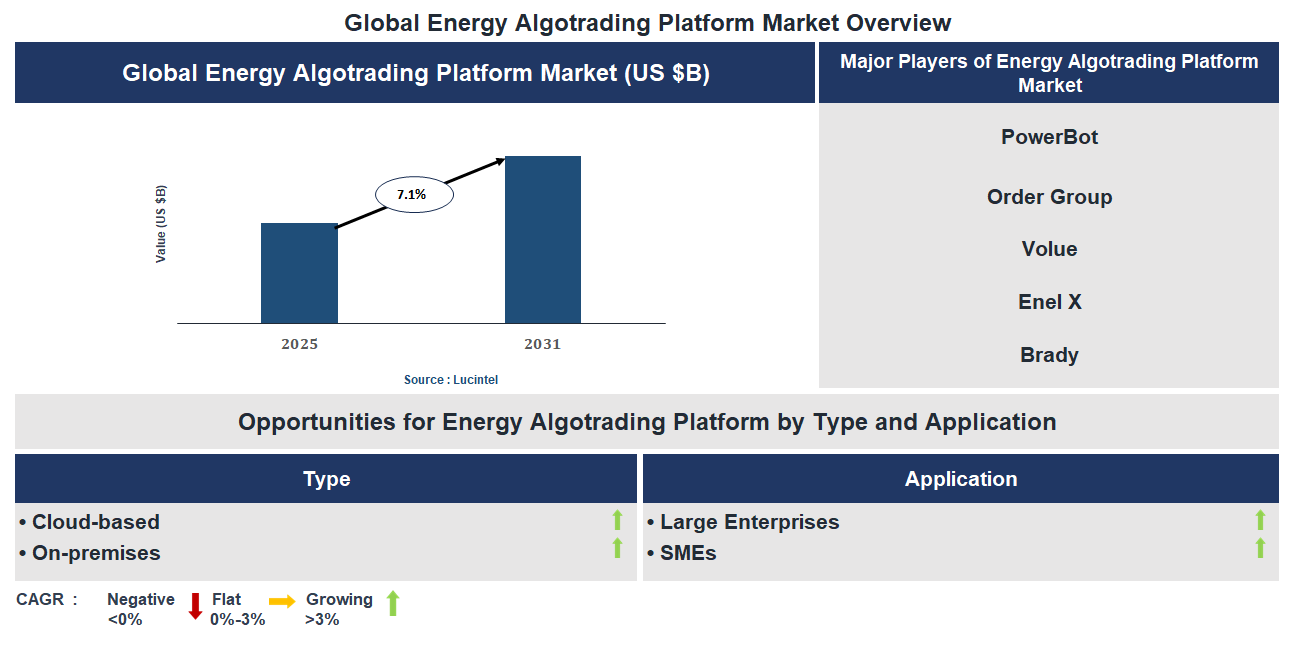
The future of the global energy algotrading platform market looks promising with opportunities in the large enterprise and SME markets. The global energy algotrading platform market is expected to grow with a CAGR of 7.1% from 2025 to 2031. The major drivers for this market are the increasing demand for automated energy trading, the rising adoption of AI-based trading solutions, and the growing need for real-time market analytics.• Lucintel forecasts that, within the type category, cloud-based is expected to witness higher growth over the forecast period.
• Within the application category, large enterprise is expected to witness higher growth.
• In terms of region, APAC is expected to witness the highest growth over the forecast period. Gain valuable insights for your business decisions with our comprehensive 150+ page report. Sample figures with some insights are shown below.
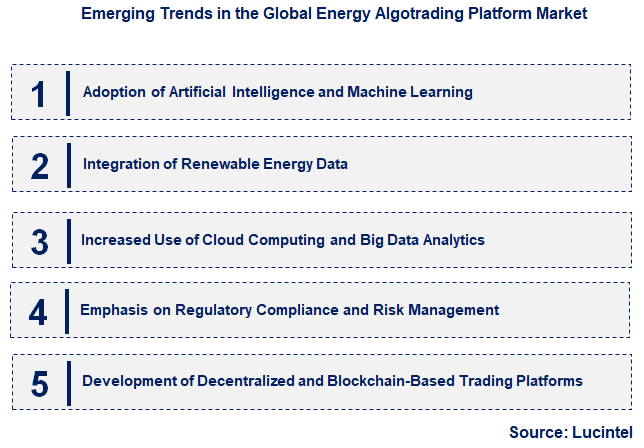
Emerging Trends in the Energy Algotrading Platform Market
The energy algotrading platform market is experiencing rapid evolution driven by technological advancements, increasing demand for renewable energy integration, and the need for more efficient trading strategies. As energy markets become more complex and data-driven, platforms are adopting innovative features to optimize trading performance and manage risks effectively. These developments are reshaping how energy commodities are traded, influencing market dynamics, and creating new opportunities for stakeholders. The following key trends highlight the major shifts shaping this market, reflecting a move towards smarter, more sustainable, and automated energy trading solutions.• Adoption of Artificial Intelligence and Machine Learning: These technologies are revolutionizing energy trading by enabling platforms to analyze vast datasets, predict market trends, and optimize trading strategies in real-time. AI-driven algorithms improve decision-making accuracy, reduce human error, and enhance profitability. Machine learning models continuously learn from new data, adapting to market fluctuations and providing traders with a competitive edge. This trend is making energy algotrading more intelligent, efficient, and responsive to market changes, ultimately leading to more dynamic and profitable trading environments.
• Integration of Renewable Energy Data: As renewable energy sources like solar and wind become more prevalent, platforms are increasingly incorporating real-time renewable generation data. This integration helps traders better forecast supply and demand, manage variability, and optimize trading strategies accordingly. It also facilitates better grid management and supports the transition to sustainable energy systems. The ability to analyze renewable energy patterns enhances market transparency and allows traders to capitalize on renewable energy fluctuations, fostering a more resilient and eco-friendly energy market.
• Increased Use of Cloud Computing and Big Data Analytics: Cloud technology enables scalable, flexible, and cost-effective data processing capabilities essential for energy algotrading. Big data analytics allow platforms to process enormous volumes of market, weather, and operational data swiftly. This combination enhances predictive accuracy and decision-making speed, providing traders with timely insights. Cloud-based platforms also facilitate collaboration across geographies and improve system reliability. Overall, this trend is making energy trading more agile, data-driven, and accessible, supporting complex algorithmic strategies and real-time market responses.
• Emphasis on Regulatory Compliance and Risk Management: As energy markets are heavily regulated, platforms are integrating advanced compliance tools and risk management features. These include automated reporting, audit trails, and real-time monitoring of trading activities to ensure adherence to legal standards. Enhanced risk management modules help traders identify potential market risks, price volatility, and operational hazards, enabling proactive mitigation. This focus on compliance and risk control is vital for maintaining market integrity, avoiding penalties, and building trader confidence in automated trading systems amid evolving regulatory landscapes.
• Development of Decentralized and Blockchain-Based Trading Platforms: Blockchain technology is gaining traction in energy algotrading by providing transparent, secure, and tamper-proof transaction records. Decentralized platforms reduce reliance on centralized intermediaries, lowering transaction costs and increasing efficiency. Smart contracts automate trade execution and settlement, reducing delays and errors. This trend promotes greater transparency, trust, and security in energy trading, especially for peer-to-peer energy transactions and renewable energy certificates. As blockchain adoption grows, it is poised to transform traditional trading models, making them more decentralized, efficient, and resilient. In summary, these emerging trends are fundamentally transforming the energy algotrading platform market by making trading smarter, more sustainable, and more secure. The integration of advanced technologies like AI, big data, and blockchain is driving efficiency, transparency, and adaptability. As the market continues to evolve, these developments will enable stakeholders to better navigate complexities, capitalize on new opportunities, and support the global shift towards renewable energy and digital transformation.
Recent Development in the Energy Algotrading Platform Market
The energy algotrading platform market has experienced rapid growth driven by technological advancements, increasing renewable energy integration, and the need for optimized energy management. As energy markets become more complex and data-driven, platforms that leverage algorithms for trading decisions are gaining prominence. Recent developments reflect a shift towards more sophisticated, efficient, and sustainable trading solutions. These innovations are transforming how energy is bought, sold, and managed, impacting stakeholders from utilities to independent traders. The following key developments highlight the current trajectory of this dynamic market and its future potential.• Adoption of Artificial Intelligence and Machine Learning: Integration of AI and ML algorithms has enhanced predictive analytics and decision-making accuracy, leading to more profitable trading strategies and reduced risks for market participants.
• Expansion of Renewable Energy Integration: Platforms now support the trading of renewable energy certificates and facilitate the management of variable renewable sources, promoting sustainability and enabling better grid balancing.
• Increased Use of Blockchain Technology: Blockchain has been incorporated to improve transparency, security, and real-time settlement processes, reducing transaction costs and fraud risks in energy trading.
• Development of Real-Time Data Analytics: Advanced data analytics tools enable traders to access real-time market data, weather forecasts, and grid conditions, allowing for more responsive and optimized trading decisions.
• Regulatory and Market Framework Enhancements: Evolving policies and standards have prompted platform updates to ensure compliance, facilitate cross-border trading, and support market liberalization efforts. These developments are collectively transforming the energy algotrading platform market by making trading more efficient, transparent, and sustainable. They are enabling market participants to better manage risks, capitalize on emerging opportunities, and support the transition to cleaner energy sources, ultimately fostering a more resilient and innovative energy ecosystem.
Strategic Growth Opportunities in the Energy Algotrading Platform Market
The energy algotrading platform market is experiencing rapid growth driven by the increasing adoption of automation and data-driven decision-making in energy trading. As the industry shifts towards more efficient and sustainable practices, advanced algorithms and AI technologies are becoming essential. Key applications such as renewable energy management, power generation, and grid optimization are fueling this expansion. Market players are focusing on innovative solutions to capitalize on emerging opportunities, ensuring competitive advantage and improved profitability. The following five growth opportunities across key applications highlight the transformative potential of algotrading platforms in shaping the future of energy markets.• Renewable Energy Management: Enhanced algorithms optimize the integration and dispatch of renewable sources, increasing efficiency and reducing costs. This leads to better forecasting, balancing supply and demand, and supporting the transition to sustainable energy. The impact is a more resilient and flexible energy grid, encouraging investments in renewables.
• Power Generation Optimization: Advanced algotrading platforms enable power plants to maximize output and minimize operational costs through real-time data analysis. This improves profitability and operational efficiency, especially in fluctuating market conditions. The result is a more competitive power generation sector with reduced carbon footprints.
• Grid Balancing and Stability: Algotrading solutions facilitate real-time grid balancing by predicting demand fluctuations and adjusting supply accordingly. This enhances grid stability, reduces outages, and supports the integration of variable energy sources. The impact is a more reliable and resilient energy infrastructure.
• Energy Storage Management: Algorithms optimize the charging and discharging cycles of energy storage systems, ensuring maximum efficiency and lifespan. This supports grid stability and enables better utilization of intermittent renewable sources. The outcome is increased energy storage adoption and improved energy security.
• Market Trading and Risk Management: Sophisticated algotrading platforms provide traders with predictive analytics and automated trading capabilities, reducing risks and increasing profitability. This fosters a more dynamic and competitive energy market, attracting new participants and investments. In summary, these growth opportunities are significantly transforming the energy algotrading platform market by enhancing efficiency, sustainability, and market competitiveness. They enable stakeholders to better manage resources, reduce costs, and adapt to evolving energy landscapes, ultimately driving industry innovation and growth.
Energy Algotrading Platform Market Driver and Challenges
The energy algotrading platform market is influenced by a complex interplay of technological advancements, economic shifts, and regulatory frameworks. As energy markets become more dynamic and data-driven, the adoption of sophisticated algorithms and platforms is accelerating. Economic factors such as fluctuating energy prices and the push for cost efficiency drive demand for automated trading solutions. Regulatory changes aimed at promoting renewable energy and market transparency also shape the landscape. Additionally, technological innovations like artificial intelligence, machine learning, and big data analytics are transforming how energy trading is conducted. These drivers and challenges collectively determine the growth trajectory and competitiveness of the market. The factors responsible for driving the energy algotrading platform market include:• Technological Innovation: The rapid development of AI, machine learning, and big data analytics enhances trading algorithms' accuracy and efficiency. These technologies enable real-time data processing, predictive analytics, and automated decision-making, which are crucial for optimizing energy trading strategies. As technology continues to evolve, platforms become more sophisticated, reducing risks and increasing profitability for traders. This ongoing innovation attracts new market entrants and encourages existing players to upgrade their systems, fostering overall market growth.
• Increasing Market Volatility: Fluctuations in energy prices driven by geopolitical tensions, supply-demand imbalances, and renewable energy integration create a volatile trading environment. Automated algotrading platforms are essential for navigating this volatility efficiently, executing trades at optimal moments, and managing risks. The ability to respond swiftly to market changes provides traders with a competitive edge, thereby boosting demand for advanced trading platforms. As volatility persists, the reliance on algorithmic trading is expected to grow, further expanding the market.
• Regulatory Support and Policy Frameworks: Governments and regulatory bodies worldwide are implementing policies to promote renewable energy and market transparency. These regulations often require real-time data reporting and compliance mechanisms, which algotrading platforms can facilitate. Additionally, market reforms aimed at increasing competition and reducing market manipulation encourage the adoption of automated trading systems. Regulatory support not only ensures market integrity but also creates a conducive environment for technological adoption, thereby driving market expansion.
• Growing Adoption of Renewable Energy Sources: The global shift towards renewable energy sources like solar and wind introduces new complexities and opportunities in energy trading. Algotrading platforms are instrumental in managing the intermittent nature of renewables, optimizing energy dispatch, and balancing supply and demand. As renewable capacity expands, the need for sophisticated trading solutions increases to handle the variability and ensure grid stability. This trend significantly propels the market forward, as traders seek advanced platforms to capitalize on renewable energy trading opportunities.
• Digital Transformation in the Energy Sector: The energy industry is undergoing a digital transformation, integrating IoT, smart meters, and cloud computing into operations. This digital shift provides vast amounts of data that can be leveraged by algotrading platforms for better decision-making. Enhanced connectivity and data availability enable more accurate forecasting and risk assessment. As the sector becomes more digitized, the demand for robust, scalable, and intelligent trading platforms grows, fueling market growth and innovation. The challenges facing this energy algotrading platform market include:
• Data Security and Privacy Concerns: As algotrading platforms rely heavily on vast amounts of data, ensuring data security and privacy becomes critical. Cybersecurity threats, data breaches, and unauthorized access can compromise sensitive information, disrupt trading operations, and lead to financial losses. Regulatory requirements for data protection are becoming more stringent, necessitating significant investments in security infrastructure. Overcoming these challenges is essential for maintaining trust and stability in the market, but it also poses ongoing technical and financial hurdles for market participants.
• Regulatory Uncertainty and Compliance: While regulations support market growth, frequent changes and ambiguities can hinder progress. Navigating complex compliance requirements across different jurisdictions demands significant resources and expertise. Non-compliance risks, penalties, and reputational damage, discouraging some players from fully adopting algotrading solutions. Additionally, regulatory delays or restrictions on algorithmic trading can limit market innovation and expansion, creating an environment of uncertainty that hampers long-term planning.
• Market Fragmentation and Integration Challenges: The energy market is highly fragmented, with various regional markets operating under different rules and standards. Integrating algotrading platforms across these diverse environments is complex and costly. Compatibility issues, data standardization, and interoperability challenges can impede seamless trading operations. This fragmentation limits the scalability of solutions and slows down the adoption rate, especially in emerging markets. Overcoming these barriers requires concerted efforts towards harmonization and technological standardization. In summary, the energy algotrading platform market is driven by technological innovation, market volatility, regulatory support, renewable energy adoption, and digital transformation. However, it faces challenges related to data security, regulatory uncertainty, and market fragmentation. These drivers propel the market forward by enabling more efficient, responsive, and sustainable energy trading. Conversely, the challenges necessitate strategic investments and regulatory clarity to ensure stable growth. Overall, the market's future depends on balancing technological progress with effective risk management and regulatory compliance, shaping a resilient and innovative energy trading ecosystem.
List of Energy Algotrading Platform Companies
Companies in the market compete on the basis of product quality offered. Major players in this market focus on expanding their manufacturing facilities, R&D investments, infrastructural development, and leverage integration opportunities across the value chain. With these strategies energy algotrading platform companies cater increasing demand, ensure competitive effectiveness, develop innovative products & technologies, reduce production costs, and expand their customer base. Some of the energy algotrading platform companies profiled in this report include-• PowerBot
• Order Group
• Volue
• Enel X
• Brady
• Enmacc GmbH
• ETPA
• Allegro
• Energy One
• Navitasoft
Energy Algotrading Platform Market by Segment
The study includes a forecast for the global energy algotrading platform market by type, application, and region.Energy Algotrading Platform Market by Type [Value from 2019 to 2031]:
• Cloud-based
• On-premises
Energy Algotrading Platform Market by Application [Value from 2019 to 2031]:
• Large Enterprises
• SMEs
Energy Algotrading Platform Market by Region [Value from 2019 to 2031]:
• North America
• Europe
• Asia Pacific
• The Rest of the World
Country Wise Outlook for the Energy Algotrading Platform Market
The energy algotrading platform market has experienced significant growth driven by technological advancements, increasing renewable energy integration, and the need for efficient energy management. Countries are adopting innovative algorithms and AI-driven solutions to optimize energy production, distribution, and consumption. Regulatory policies and market dynamics are also shaping the landscape, encouraging investments and technological innovation. As the market evolves, key players are focusing on scalability, security, and real-time analytics to stay competitive. The following summaries highlight recent developments in the United States, China, Germany, India, and Japan, reflecting their unique approaches and advancements in this sector.• United States: The US market has seen rapid adoption of AI-powered algotrading platforms, driven by major energy companies and tech firms investing in renewable integration and grid optimization. Regulatory support for clean energy has spurred innovation, with increased focus on real-time data analytics and blockchain for transparency. Several startups are emerging, offering advanced algorithms for market forecasting and risk management, contributing to a more resilient and efficient energy market.
• China: China has accelerated its deployment of energy algotrading platforms to manage its vast renewable energy resources, especially solar and wind. The government’s emphasis on smart grid development and digital transformation has fostered a conducive environment for platform innovation. Major state-owned enterprises are adopting AI-driven solutions to optimize energy dispatch and reduce costs, aligning with national goals for energy security and sustainability.
• Germany: Germany’s focus on renewable energy transition (Energiewende) has led to increased use of algotrading platforms for grid balancing and market participation. The country emphasizes integrating wind and solar power into its energy mix, utilizing advanced algorithms for predictive analytics and demand response. Regulatory frameworks support digital innovation, and collaborations between tech firms and energy providers are strengthening the market.
• India: India is rapidly expanding its energy algotrading capabilities to manage its growing renewable energy sector and address grid stability challenges. The government’s push for solar and wind projects has increased demand for sophisticated trading platforms. Local startups and international firms are developing AI-based solutions for market forecasting, risk mitigation, and efficient energy dispatch, supporting India’s goal of sustainable growth.
• Japan: Japan’s energy market is increasingly adopting algotrading platforms to enhance grid stability and incorporate renewable sources post-Fukushima. The country focuses on integrating smart grid technologies and AI-driven analytics for efficient energy management. Regulatory reforms and government incentives are encouraging innovation, with a focus on reducing reliance on fossil fuels and increasing renewable energy share through advanced trading solutions.

Features of the Global Energy Algotrading Platform Market
Market Size Estimates: Energy algotrading platform market size estimation in terms of value ($B). Trend and Forecast Analysis: Market trends (2019 to 2024) and forecast (2025 to 2031) by various segments and regions. Segmentation Analysis: Energy algotrading platform market size by type, application, and region in terms of value ($B). Regional Analysis: Energy algotrading platform market breakdown by North America, Europe, Asia Pacific, and Rest of the World. Growth Opportunities: Analysis of growth opportunities in different types, applications, and regions for the energy algotrading platform market. Strategic Analysis: This includes M&A, new product development, and competitive landscape of the energy algotrading platform market. Analysis of competitive intensity of the industry based on Porter’s Five Forces model.
FAQ
Q1. What is the growth forecast for energy algotrading platform market? Answer: The global energy algotrading platform market is expected to grow with a CAGR of 7.1% from 2025 to 2031. Q2. What are the major drivers influencing the growth of the energy algotrading platform market? Answer: The major drivers for this market are the increasing demand for automated energy trading, the rising adoption of ai-based trading solutions, and the growing need for real-time market analytics. Q3. What are the major segments for energy algotrading platform market? Answer: The future of the energy algotrading platform market looks promising with opportunities in the large enterprise and SME markets. Q4. Who are the key energy algotrading platform market companies? Answer: Some of the key energy algotrading platform companies are as follows:• PowerBot
• Order Group
• Volue
• Enel X
• Brady
• Enmacc GmbH
• ETPA
• Allegro
• Energy One
• Navitasoft Q5. Which energy algotrading platform market segment will be the largest in future? Answer: Lucintel forecasts that, within the type category, cloud-based is expected to witness higher growth over the forecast period. Q6. In energy algotrading platform market, which region is expected to be the largest in next 5 years? Answer: In terms of region, APAC is expected to witness the highest growth over the forecast period. Q7. Do we receive customization in this report? Answer: Yes, Lucintel provides 10% customization without any additional cost.
Table of Contents
List of Figures
List of Tables
Methodology
- In-depth interviews of the major players in this market
- Detailed secondary research from competitors’ financial statements and published data
- Extensive searches of published works, market, and database information pertaining to industry news, company press releases, and customer intentions
- A compilation of the experiences, judgments, and insights of Lucintel’s professionals, who have analyzed and tracked this market over the years.


Buy Now
Choose a license that fits your team. Instant PDF delivery.
Prices exclude taxes. Instant delivery. Custom licensing available on request.
Key Questions
- • What are some of the most promising, high-growth opportunities for the energy algotrading platform market by type (cloud-based and on-premises), application (large enterprises and SMEs), and region (North America, Europe, Asia Pacific, and the Rest of the World)?
- • Which segments will grow at a faster pace and why?
- • Which region will grow at a faster pace and why?
- • What are the key factors affecting market dynamics? What are the key challenges and business risks in this market?
- • What are the business risks and competitive threats in this market?
- • What are the emerging trends in this market and the reasons behind them?
- • What are some of the changing demands of customers in the market?
- • What are the new developments in the market? Which companies are leading these developments?
- • Who are the major players in this market? What strategic initiatives are key players pursuing for business growth?
- • What are some of the competing products in this market and how big of a threat do they pose for loss of market share by material or product substitution?
- • What M&A activity has occurred in the last 6 years and what has its impact been on the industry? For any questions related to Energy Algotrading Platform Market, Energy Algotrading Platform Market Size, Energy Algotrading Platform Market Growth, Energy Algotrading Platform Market Analysis, Energy Algotrading Platform Market Report, Energy Algotrading Platform Market Share, Energy Algotrading Platform Market Trends, Energy Algotrading Platform Market Forecast, Energy Algotrading Platform Companies, write Lucintel analyst at email: helpdesk@lucintel.com. We will be glad to get back to you soon.


