
Report Feature
Endpoint Adjudication Service Market Trends and Forecast
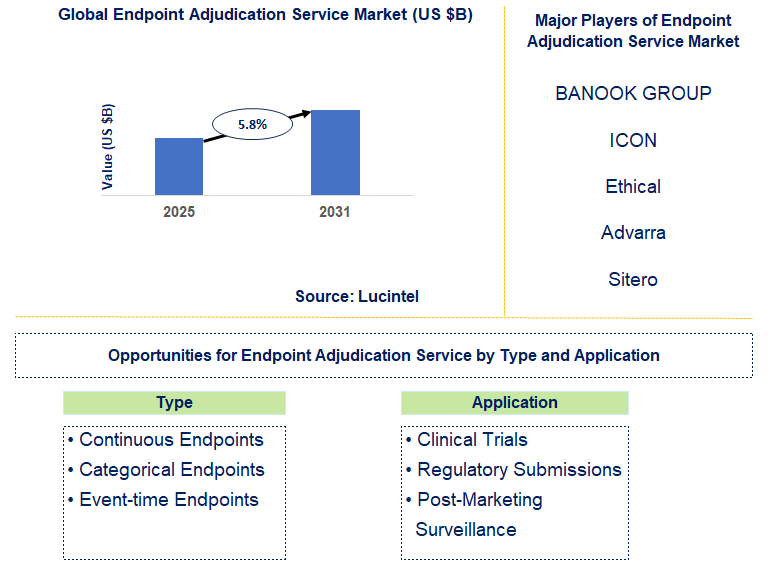
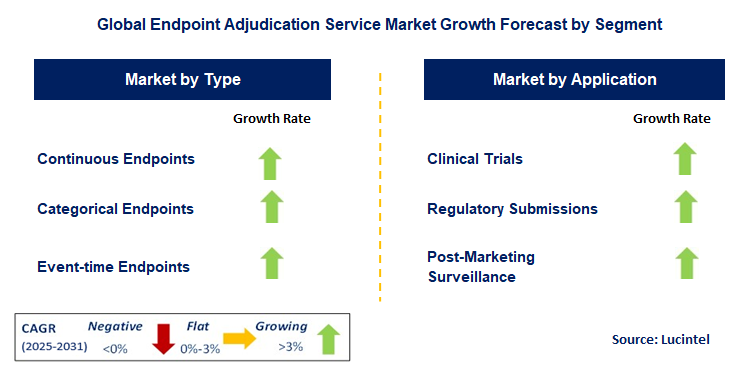
The future of the global endpoint adjudication service market looks promising with opportunities in the clinical trial, regulatory submission, and post-marketing surveillance markets. The global endpoint adjudication service market is expected to grow with a CAGR of 5.8% from 2025 to 2031. The major drivers for this market are the increasing demand for clinical trials, the rising need for data accuracy, and the growing focus on regulatory compliance.• Lucintel forecasts that, within the type category, continuous endpoint is expected to witness the highest growth over the forecast period.
• Within the application category, clinical trial is expected to witness the highest growth.
• In terms of region, APAC is expected to witness the highest growth over the forecast period. Gain valuable insights for your business decisions with our comprehensive 150+ page report. Sample figures with some insights are shown below.
Emerging Trends in the Endpoint Adjudication Service Market
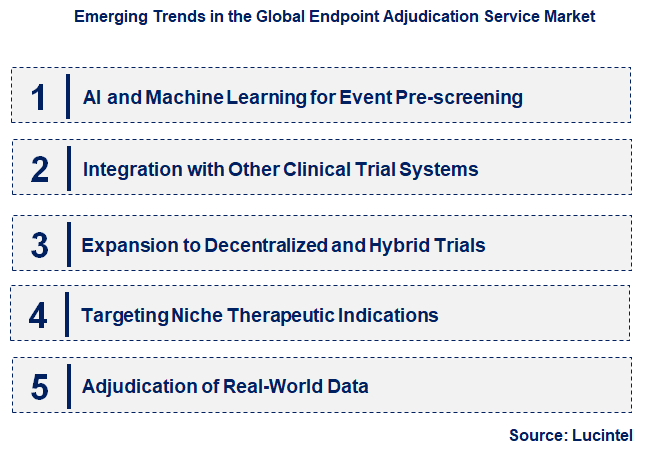
The endpoint adjudication service market is being reshaped at its core by the growing sophistication of clinical trials coupled with a greater emphasis on data integrity. These trends are taking the industry from a paper-based, manual process to one that is highly automated and integrated digitally. The new emphasis is on making adjudication more efficient, accurate, and transparent and on extending its use to new therapeutic classes and study designs. This transition is important to guarantee the consistency of clinical trial data and hasten the approval of new medicines and medical devices.• AI and Machine Learning for Event Pre-screening: Artificial intelligence (AI) and machine learning (ML) are a new trend for pre-screening clinical trial events. These technologies can process big data to identify possible events, allowing prioritization of cases for the adjudication committee. This strategy greatly minimizes the workload, speeds up the adjudication process, and enhances the overall efficiency of clinical trials. The effect is an enhanced workflow and increased speed to market of new therapies.
• Integration with Other Clinical Trial Systems: Increasingly, endpoint adjudication systems are being integrated with other clinical trial technologies, including electronic data capture (EDC) and clinical trial management systems (CTMS). This integration offers a smooth exchange of data, minimizing the risk of errors and data replication. It also offers a single platform for the management of all trial activities, enhancing transparency and collaboration among all stakeholders. This trend is important to enhance data integrity and operational efficiency.
• Expansion to Decentralized and Hybrid Trials: The move towards decentralized and hybrid clinical trials, which enable patients to take part remotely, is setting a new trend in endpoint adjudication. Adjudication services are responding by creating platforms that have the ability to process a more varied list of data sources, such as data from wearable devices and electronic health records (EHRs). This expansion is critical for maintaining the consistency and integrity of data gathered from heterogeneous sources and multiple environments.
• Targeting Niche Therapeutic Indications: Endpoint adjudication is now moving beyond the conventional therapeutic indication to target more niche and complex indications like oncology, rare diseases, and cardiovascular trials. These conditions have more subjective endpoints that need expert, impartial review. The increase in such indications points to the increasing need for specialized adjudication services able to offer the right medical and scientific input to ensure trial outcomes are accurate.
• Adjudication of Real-World Data: As policy makers continue to push for the utilization of real-world evidence (RWE) to inform drug approval, a trend is evolving: adjudication of real-world data. Adjudication services are increasingly being utilized to impose a rigorous, unbiased review process on data from electronic health records and patient registries, thus ensuring the integrity of RWE and increasing its utility in regulatory filing and post-market monitoring. All these new trends are, in essence, transforming the endpoint adjudication service market. The combination of AI and machine learning is accelerating the process and making it more efficient, whereas integration with other clinical trial systems is enhancing data integrity. The extension into decentralized trials and specialized therapeutic spaces is expanding the scope and applicability of the market. Lastly, the real-world adjudication of real-world data is placing the market at the center of the emerging clinical research landscape. All these trends together are shifting the market into a technologically driven and highly specialized market that is pivotal in the future of drug development.
Recent Development in the Endpoint Adjudication Service Market
The endpoint adjudication service market is currently undergoing accelerated development due to the demand for higher accuracy, efficiency, and transparency in clinical trials. These trends are aimed at harnessing technology to overcome the historical barriers posed by manual, paper-based adjudication. Some of the key advancements include developing specialized software platforms, the inclusion of automation, and increased focus on regulatory compliance. These developments are crucial to the assurance of clinical trial data integrity, a requirement for approval by regulatory agencies and successful commercialization of new medicines.• Introduction of Dedicated Electronic Adjudication Systems: One of the key advances is the introduction of dedicated electronic adjudication systems (EAS). These are centralized, secure, and auditable systems for handling the entire adjudication process. They carry out a number of the manual tasks, including document gathering and communication with committee members. This has a powerful effect in reducing dramatically the time and effort involved in adjudication, as well as enhancing data quality and transparency.
• AI-Enabled Dossier Management: One of the important developments is the utilization of artificial intelligence in dossier management. AI is being utilized to redact personal health information (PHI) automatically from documents and to structure complicated patient records. This process automates the dossier creation process, which is an important initial step in adjudication. This development enhances efficiency and increases data privacy, which is a significant issue in clinical research.
• Creation of International Expert Networks: A new trend is the creation of international networks of expert adjudicators. Providers are creating large networks of therapeutic experts globally to be able to put together the right adjudication committee for any kind of trial, irrespective of its geographical location or therapeutic field. This is important to deal with the complexity of multinational clinical trials and to guarantee the required medical expertise.
• Improved Interoperability with EDC Systems: One of the developments is the improved interoperability between electronic adjudication systems and electronic data capture (EDC) systems. New platforms are built to integrate directly with multiple EDC systems, transferring data automatically and minimizing manual data entry. Improved integration enhances data accuracy, improves workflow, and offers a more comprehensive view of the clinical trial data.
• Adoption of a Risk-Based Monitoring Strategy: It is increasingly becoming a trend to embrace a risk-based monitoring strategy in endpoint adjudication. This entails prioritizing adjudication processes in the most important and risky endpoints instead of adjudicating all events. This evolution enables a more effective resource allocation and accelerates the process of adjudication without endangering the integrity of data. It is especially effective for very large and complex trials with numerous events. These five major developments are having a deep impact on the endpoint adjudication service market by making it more efficient, technologically savvy, and specialized. The use of purpose-built electronic systems and AI-powered dossier management is consolidating workflows and enhancing data quality. The creation of global expert networks and increased interoperability with EDC systems are imperative to deal with the complexity of contemporary clinical trials. Lastly, the implementation of a risk-based approach is streamlining the process.
Strategic Growth Opportunities in the Endpoint Adjudication Service Market
The endpoint adjudication service market provides exciting strategic development opportunities in different key applications. The reasons are rising complexity in clinical trials, data integrity demand, and a move towards novel study designs. By targeting these particular applications, service providers can differentiate themselves and build a more robust, sustainable business model. The below growth opportunities indicate the manner in which innovation and specialization in various applications are defining the future of the market, setting it up for further expansion and profitability.• Complex Oncology and Rare Disease Trials: There is a vast opportunity for growth in adjudication services for complex oncology and rare disease trials. These trials tend to have subjective, highly specialized endpoints that necessitate a panel of experts. Building customized services with access to an international network of specialist adjudicators will be key to addressing this high-value segment. This opportunity influences the market by propelling the demand for advanced therapeutic expertise and cutting-edge technological platforms.
• Decentralized and Hybrid Clinical Trials: The move to decentralized and hybrid clinical trials offers a significant opportunity for growth. These trials are creating data from diverse sources, such as wearables and home monitoring devices, which need a special adjudication process. Creating platforms that can manage this varied data and maintain its consistency and integrity is crucial for this use. This opportunity is growing the market by embracing new models of clinical research.
• Medical Device Trials: The medical device industry is an increasing use case for endpoint adjudication. These trials usually have subjective endpoints concerning device function and patient outcomes that necessitate a free, independent review. Providing customized adjudication services for medical devices, with emphasis on regulatory needs such as those of the FDA, will be one of the growth drivers. This use case influences the market by expanding its presence outside the drug development sphere.
• Post-Marketing Surveillance: Post-marketing surveillance represents a major growth area. With regulatory bodies demanding greater real-world evidence and post-approval safety monitoring, adjudication services can be employed to review and classify events independently. The use case broadens the adjudication service's life cycle beyond the clinical trial environment into a new and recurring revenue source for providers.
• Pharmacovigilance and Drug Safety: The area of pharmacovigilance, where drug safety is monitored, presents a significant growth prospect. Endpoint adjudication services are utilized to centrally review and categorize adverse events and safety signals. This use maintains the rigor and consistency of drug safety information, which is essential to satisfy regulatory needs as well as for making informed decisions on continued medication. All of these strategic growth opportunities are significantly affecting the endpoint adjudication service market by propelling specialization and innovation. With an emphasis on complicated trials, decentralized designs, medical devices, and post-marketing surveillance, the market is evolving toward a more advanced and clinically crucial function. The focus on drug safety and pharmacovigilance is also broadening the market's penetration into new segments of the drug development life cycle. This strategic emphasis keeps the market relevant and necessary, supplying the essential expertise and technology to maintain the integrity of clinical trial data.
Endpoint Adjudication Service Market Driver and Challenges
The endpoint adjudication service market is shaped by a mix of some major drivers that propel its growth and some important challenges that limit its growth. The market is largely driven by growing complexity in clinical trials and the increasing emphasis on data integrity. Nevertheless, it is also limited by issues such as the expense of services and the requirement for specialized skill. Understanding these dynamics is important for stakeholders to craft effective strategies, reduce risks, and leverage the opportunities in this niche medical space. The factors responsible for driving the endpoint adjudication service market include: 1. Growing Complexity of Clinical Trials: The increasing complexity of clinical trial designs, featuring more composite and subjective endpoints, is a key driver. Complex trials demand an independent, expert opinion review for ensuring that endpoints are categorized consistently and correctly. This driver guarantees a consistent and increasing demand for adjudication services to uphold the integrity of trial data. 2. Increased Regulatory Oversight: Regulators, including the FDA and EMA, are emphasizing more rigorously data quality and integrity. They increasingly suggest or mandate independent endpoint adjudication in pivotal clinical trials, particularly in those with subjective endpoints. Regulatory scrutiny is a driving force behind the use of adjudication services, as it is viewed as a means to reduce risk and enhance the prospect of a successful regulatory submission. 3. Globalization of Clinical Trials: With increasing globalization of clinical trials, multiple sites within various countries are involved with their own local medical practice and standards. Independent adjudication by a committee ensures that endpoints are measured uniformly for all sites, thus minimizing inter-site variability. This driver is critical in ensuring the integrity of data from multinational studies. 4. Growth in Specialized Therapeutic Areas: The expansion in clinical trials for specialized therapeutic areas, including rare diseases, oncology, and gene therapies, is a principal driver. Such therapeutic areas tend to comprise specialized endpoints that call for a committee with extensive therapeutic experience. Such need for extensively specialized knowledge and experience is the primary driver for market expansion. 5. Emphasis on Data Integrity and Minimization of Bias: A strong emphasis on data integrity and minimization of bias is a major impetus for endpoint adjudication. Blind adjudication by an independent panel of experts offers unbiased evaluation of the data, essential for scientific validity and regulatory approval of trial findings. Challenges in the endpoint adjudication service market are: 1. Exorbitant Cost of Services: High on the list of challenges is an exorbitant cost of endpoint adjudication services. The procedure involves a panel of highly trained specialists, an experienced project management team, and an advanced technological platform. These expenses can prove to be a hindrance, especially for small biotechnology firms or research institutions with low budgets. 2. Need for Specialized Expertise: Recruitment and retaining enough highly qualified and specialized adjudicators is another major challenge. With increasing complexity in clinical trials and entry into niche therapeutic areas, the demand for a rich pool of experts becomes more indispensable. This lack of specialized talent may cause project timelines to slip and costs to rise. 3. Integration and Interoperability Challenges: While integration is a direction of increasing trend, a major challenge lies in the interoperability among various clinical trial systems. Intelligently integrating the adjudication platform with EDC, CTMS, and other data sources may be technologically challenging and take some time, leaving room for errors during data transfer and workflow inefficiencies. The collective effect of these drivers and challenges is forging a dynamic but complicated endpoint adjudication services market. The drivers, namely the trial complexity and regulatory requirements, are driving the market toward a specialized, high-tech model. Yet the dominant challenges of cost and specialized expertise are compelling a market consolidation and emphasis on delivering value-added end-to-end solutions. The net effect is a consolidating market that is looking more towards offering technologically sophisticated and highly specialized services for the most complex and critical clinical trials.List of Endpoint Adjudication Service Companies
Companies in the market compete on the basis of product quality offered. Major players in this market focus on expanding their manufacturing facilities, R&D investments, infrastructural development, and leverage integration opportunities across the value chain. With these strategies endpoint adjudication service companies cater increasing demand, ensure competitive effectiveness, develop innovative products & technologies, reduce production costs, and expand their customer base. Some of the endpoint adjudication service companies profiled in this report include-• BANOOK GROUP
• ICON
• Ethical
• Advarra
• Sitero
• George Clinical
• Medidata Solutions
• WCG
• Judi for Adjumination
• Clario
Endpoint Adjudication Service Market by Segment
The study includes a forecast for the global endpoint adjudication service market by type, application, and region.Endpoint Adjudication Service Market by Type [Value from 2019 to 2031]:
• Continuous Endpoints
• Categorical Endpoints
• Event-time Endpoints
Endpoint Adjudication Service Market by Application [Value from 2019 to 2031]:
• Clinical Trials
• Regulatory Submissions
• Post-Marketing Surveillance
Endpoint Adjudication Service Market by Region [Value from 2019 to 2031]:
• North America
• Europe
• Asia Pacific
• The Rest of the World
Country Wise Outlook for the Endpoint Adjudication Service Market
The endpoint adjudication service market is witnessing an intense transformation, fueled by the growing complexity of clinical trials and the demand for strict, impartial data. Endpoint adjudication, a key process wherein an independent panel of experts examines and approves clinical trial results, is increasingly becoming a must-have to ensure the integrity of data and compliance with regulatory requirements. Advances in recent times are aimed at taking advantage of technology in order to automate workflows, improve data management, and the efficiency and accuracy of the adjudication process. This innovation is gearing the market to be able to facilitate the increasing number of complex and international clinical trials, with the assurance that new treatments are brought to market effectively.• United States: The US marketplace is a powerhouse, spearheaded by a strong pharmaceutical and biotechnology sector. Current trends are focused on the consolidation of cutting-edge technologies such as AI and machine learning to pre-screen clinical trial events automatically. A high focus is being placed on regulatory affairs and the adoption of advanced, paperless systems that provide data transparency and security. The market is also witnessing increased collaborations between technology vendors and contract research organizations (CROs) to provide end-to-end, integrated solutions.
• China: The market in China is marked by high growth and a rise in the number of clinical trials, most notably in oncology and orphan diseases. Developments in recent times are centered around establishing local expertise and embracing cutting-edge technological platforms. Pressure from the government for stricter regulatory control is fueling the need for dependable endpoint adjudication services. The market is witnessing an increase in local service providers that are coming up with their own electronic adjudication systems to meet the particular requirements of domestic trials.
• Germany: Germany's market is characterized by high levels of quality standards and an emphasis on evidence-based medicine. Recent trends involve the slow rollout of electronic adjudication systems to enhance efficiency while upholding rigorous data privacy guidelines. There is a preference for well-known, reliable service providers with a proven history. The market is also witnessing growth in adjudication for trials within specialized therapeutic categories, e.g., cardiovascular and neurological diseases.
• India: The Indian market is a fast-growing destination for clinical research because it has a huge population of patients and offers inexpensive services. Recent growth is aimed at expanding services to accommodate more trials. There is increased demand for cost-effective and technologically sound solutions. The market is witnessing more local CRO-global service provider collaborations to provide a vast array of endpoint adjudication services to domestic as well as international sponsors.
• Japan: Japan's market has a robust focus on accuracy and technology-driven innovation. Recent trends are targeting the regulation streamlining to drive faster drug development. Increasing acceptance of sophisticated electronic adjudication platforms capable of processing large and complex data sets such as medical imaging and genetic data is being witnessed in the marketplace. Increasing demand for trial adjudication services in fields such as regenerative medicine and rare disease, where very specialized expertise is needed, is also being experienced in the marketplace.

Features of the Global Endpoint Adjudication Service Market
Market Size Estimates: Endpoint adjudication service market size estimation in terms of value ($B). Trend and Forecast Analysis: Market trends (2019 to 2024) and forecast (2025 to 2031) by various segments and regions. Segmentation Analysis: Endpoint adjudication service market size by type, application, and region in terms of value ($B). Regional Analysis: Endpoint adjudication service market breakdown by North America, Europe, Asia Pacific, and Rest of the World. Growth Opportunities: Analysis of growth opportunities in different types, applications, and regions for the endpoint adjudication service market. Strategic Analysis: This includes M&A, new product development, and competitive landscape of the endpoint adjudication service market. Analysis of competitive intensity of the industry based on Porter’s Five Forces model.
FAQ
Q1. What is the growth forecast for endpoint adjudication service market? Answer: The global endpoint adjudication service market is expected to grow with a CAGR of 5.8% from 2025 to 2031. Q2. What are the major drivers influencing the growth of the endpoint adjudication service market? Answer: The major drivers for this market are the increasing demand for clinical trials, the rising need for data accuracy, and the growing focus on regulatory compliance. Q3. What are the major segments for endpoint adjudication service market? Answer: The future of the endpoint adjudication service market looks promising with opportunities in the clinical trial, regulatory submission, and post-marketing surveillance markets. Q4. Who are the key endpoint adjudication service market companies? Answer: Some of the key endpoint adjudication service companies are as follows:• BANOOK GROUP
• ICON
• Ethical
• Advarra
• Sitero
• George Clinical
• Medidata Solutions
• WCG
• Judi for Adjumination
• Clario Q5. Which endpoint adjudication service market segment will be the largest in future? Answer: Lucintel forecasts that, within the type category, continuous endpoint is expected to witness the highest growth over the forecast period. Q6. In endpoint adjudication service market, which region is expected to be the largest in next 5 years? Answer: In terms of region, APAC is expected to witness the highest growth over the forecast period. Q7. Do we receive customization in this report? Answer: Yes, Lucintel provides 10% customization without any additional cost.
Table of Contents
Methodology
- In-depth interviews of the major players in this market
- Detailed secondary research from competitors’ financial statements and published data
- Extensive searches of published works, market, and database information pertaining to industry news, company press releases, and customer intentions
- A compilation of the experiences, judgments, and insights of Lucintel’s professionals, who have analyzed and tracked this market over the years.


Buy Now
Choose a license that fits your team. Instant PDF delivery.
Prices exclude taxes. Instant delivery. Custom licensing available on request.
Key Questions
- • What are some of the most promising, high-growth opportunities for the endpoint adjudication service market by type (continuous endpoints, categorical endpoints, and event-time endpoints), application (clinical trials, regulatory submissions, and post-marketing surveillance), and region (North America, Europe, Asia Pacific, and the Rest of the World)?
- • Which segments will grow at a faster pace and why?
- • Which region will grow at a faster pace and why?
- • What are the key factors affecting market dynamics? What are the key challenges and business risks in this market?
- • What are the business risks and competitive threats in this market?
- • What are the emerging trends in this market and the reasons behind them?
- • What are some of the changing demands of customers in the market?
- • What are the new developments in the market? Which companies are leading these developments?
- • Who are the major players in this market? What strategic initiatives are key players pursuing for business growth?
- • What are some of the competing products in this market and how big of a threat do they pose for loss of market share by material or product substitution?
- • What M&A activity has occurred in the last 5 years and what has its impact been on the industry? For any questions related to Endpoint Adjudication Service Market, Endpoint Adjudication Service Market Size, Endpoint Adjudication Service Market Growth, Endpoint Adjudication Service Market Analysis, Endpoint Adjudication Service Market Report, Endpoint Adjudication Service Market Share, Endpoint Adjudication Service Market Trends, Endpoint Adjudication Service Market Forecast, Endpoint Adjudication Service Companies, write Lucintel analyst at email: helpdesk@lucintel.com. We will be glad to get back to you soon.


