
Market Report · July 29, 2026

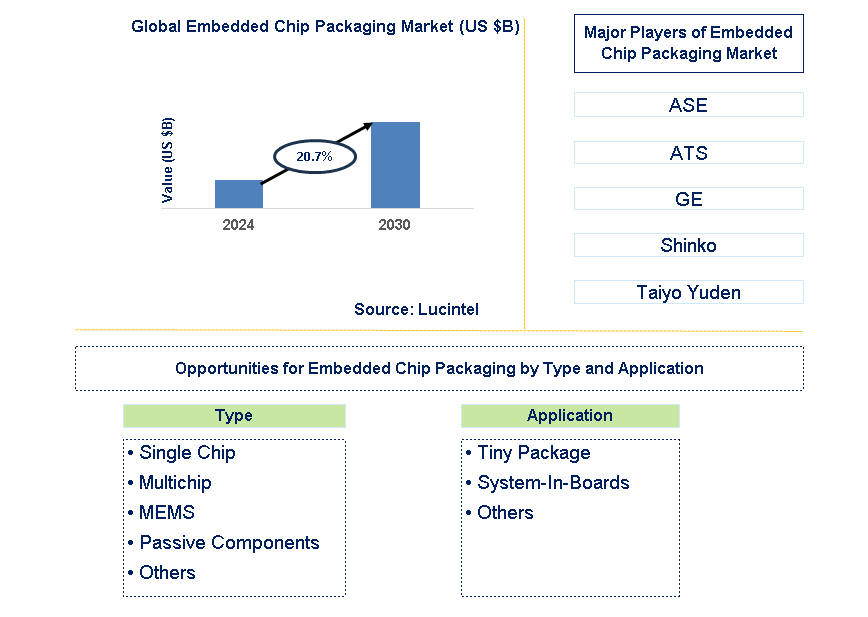
Key data points: The growth forecast = 20.7% annually for the next 6 years. Scroll below to get more insights. This market report covers trends, opportunities, and forecasts in the global embedded chip packaging market to 2030 by type (single chip, multichip, mems, passive components, and others), application (tiny package, system-in-boards, and others), and region (North America, Europe, Asia Pacific, and the Rest of the World)
We'll send your sample report shortly.
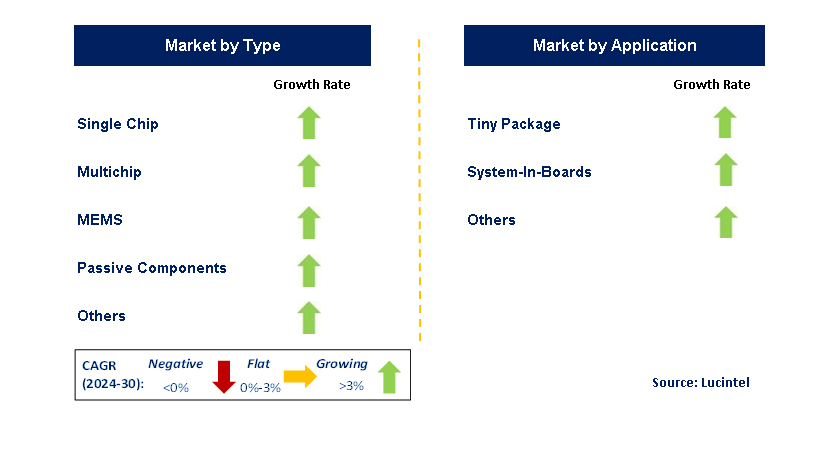
• Lucintel forecasts that, within the type category, single chip is expected to witness highest growth over the forecast period because the packages offer a simpler and more economical solution compared to multi-chip or other complex configurations.
• In terms of regions, APAC is expected to witness highest growth over the forecast period because the major manufacturers of electronics, like Apple, Samsung, and Huawei, have substantial production bases in the region, especially in China, owing to strong need for cutting-edge packaging options like integrated chips. Gain valuable insights for your business decisions with our comprehensive 150+ page report.
• Advanced Packaging Technologies: The embedded systems packaging market is being revolutionized by the growing trend in advanced packaging technologies, particularly towards 3D packaging and system-in-package (SiP). Such technologies allow for achieving higher integration densities, greater performance benefits, and less packaging waste. Manufacturers are resorting to stacking chip layers or integrating various chips into a single package to achieve more utilization and efficiency. This trend addresses the increased needs for small, high-performance electronic gadgets.
• Fan-Out Wafer-Level Packaging: Fan-Out Wafer-Level Packaging (FOWLP) has gained popularity among practitioners as the need to enhance I/O density and reduce the form factor increases. In FOWLP, a chip is mounted on a wafer, and then chips are covered with a reconstituted wafer package. This method improves packaging performance and reduces costs. This trend is especially applicable to electronic devices that require very high performance in a miniature space, such as mobile applications and automotive electronics.
• Integration of Sophisticated Thermal Management: As embedded chips become denser in power, better thermal management technologies are rapidly becoming essential. More heat spreaders, heat sink devices, and thermal interface materials have been incorporated into the packaging, eliminating heat-related restrictions during device operation. Effective thermal management guarantees the correct operation of high-performance chips and increases the performance and lifetime of electronic equipment.
• Initiatives Aimed at Eco-Friendly Packaging Designs: The need for eco-friendliness is positively influencing the creation of eco-friendly packaging designs. Manufacturing processes aimed at lowering negative impacts on the environment include the use of biodegradable capsules and recyclable packing materials. This trend responds to the requirements of international regulations for the protection of the atmosphere and the preferences of consumers who care about greener products, leading to the industry’s transition to sustainable practices.
• Growing Emphasis on Customization and Integration: Customization, especially in packaging and integration, is gaining attention due to the desire to satisfy specific application settings. There is also a considerable upsurge in demand for packaging solutions that can be engineered to combine performance parameters, dimensions, and unique functions. This trend captures flexible and universal packaging design concepts that satisfy changing market needs and help create specialized electronic systems. The emerging trends in the embedded chip packaging market show an inclination toward smarter and more innovative packaging. Innovations such as 3D packaging and FOWLP are enhancing performance and facilitating miniaturization. There is an emphasis on thermal management and environmental solutions, which are critical issues and objectives, respectively. Today’s customization and integration also address various market needs, dictating how the industry will evolve. These trends will improve the features and overall marketability of embedded chip packaging solutions.
• Advancements in 3D Packaging Technologies: The development of 3D packaging and other related technologies is changing the embedded chip packaging market. In 3D packaging, chip layers are added above one another to maximize integration density and system performance. This advancement meets the high-performance electronic device market requirements by creating smaller and more efficient designs. It also addresses concerns related to space and power levels, underscoring its importance in the industry.
• Adoption of Fan-Out Wafer-Level Packaging: There is increasing adoption of Fan-Out Wafer-Level Packaging (FOWLP) as it enhances input and output density while reducing associated costs. FOWLP is suitable for mobile and consumer electronics, as it provides better chip integration along with greater miniaturization. With this packaging, overall performance is improved while the total form factor is minimized, reflecting market demand for more efficient packaging solutions.
• Development of Advanced Heat Dissipation Systems: Heat dissipation issues in high-power devices are being addressed through the inclusion of advanced thermal management solutions in chip packaging. Advanced heat spreaders and thermal interface materials are among the heat management technologies being integrated into chips. This development affects the reliability and performance of high-density electronic devices.
• Emergence of Eco-Friendly Packaging Materials: The advent of eco-friendly packaging materials is an important trend in the embedded chip packaging market. Manufacturers are seeking to utilize biodegradable and recyclable materials with minimal environmental impact. This development aligns with global supply management strategies and regulatory requirements in the industry.
• Expansion of Manufacturing Capabilities: As many countries expand, so do manufacturing capabilities, particularly in emerging markets, reshaping the embedded chip packaging industry. This has led to the establishment of new production facilities and enhanced local manufacturing capabilities, increasing availability and reducing the cost of advanced packaging solutions. This development meets global demand and strengthens manufacturers’ positions in specialized markets. Recent developments in the embedded chip packaging market are fostering creativity and efficiency. The wireless and embedded chip market is witnessing the growing dominance of 3D packaging, while FOWLP enhances miniaturization. The increase in production capabilities and the shift towards sustainable materials align with sustainability objectives and market demands. These developments constructively facilitate growth and evolution in embedded chip packaging.
• Automotive Electronics: There is significant growth potential in embedded chip packaging technology targeting the automotive electronics segment. As advanced driver-assistance systems (ADAS) and infotainment solutions become increasingly incorporated into vehicles, the demand for highly reliable, high-performance packaging solutions rises. Manufacturers can take advantage of this opportunity by implementing packaging technologies for stringent automotive applications.
• Consumer Electronics: Consumer electronics, such as mobile phones, tablets, and wearable devices, represent one of the most rapidly expanding segments. The development of miniaturized, powerful, and energy-efficient devices creates the need for further advancements in chip packaging technologies. Companies in the new market can pursue this opportunity by introducing effective packaging technologies that enhance device performance and allow for acceptable device downsizing.
• Industrial Automation: The industrial automation sector is on an expansion path, offering opportunities for embedded chip packaging solutions in control and automation systems. There is a need for advanced packaging technologies that are robust, reliable, and integrated for industrial applications. This growth opportunity involves designing and developing packaging solutions that can withstand the harsh conditions of the industrial environment and improve automation levels.
• Telecommunications Industry: There are growth opportunities in embedded chip packaging for the expansion of the telecommunications industry, particularly in 5G technology. The rise in demand for high-speed data transmission and network facilities necessitates the use of advanced packaging solutions that support high-frequency and high-performance components. Manufacturers can redirect their efforts into developing packaging technologies tailored to the needs of the telecommunications industry, including high-speed and non-high-density interconnects.
• Healthcare Devices: The growing adoption of electronic devices for diagnostics, monitoring, and treatment in healthcare creates a scope for embedded chip packaging. Packaging solutions that offer precision, reliability, and biocompatibility are in high demand. Firms have the opportunity to capitalize on this gap by developing packaging technologies that enhance the performance and safety of electronic devices used in healthcare. The embedded chip packaging market offers a variety of strategic growth opportunities across automotive electronics, consumer electronics, industrial automation, telecommunications, and medical devices. As a result, manufacturers can leverage market developments and foster innovation by focusing on these application areas and creating specific packaging solutions. These growth opportunities continue to drive the industry’s development and meet the changing requirements of advanced electronic applications.
• Technological Advancements: Developments in chip packaging, such as 3D packaging and new thermal management techniques, present significant market benefits. These improvements offer enhanced performance, greater miniaturization, and more efficient electronic devices. Upgrading packaging technologies enables companies to satisfy the ever-changing needs of high-performing applications and supports the growth of advanced electronic applications.
• Global Demand for Electronics Encouraging Novel Packaging Technologies: The emergence of next-generation smartphones, more sophisticated automotive systems, and increased industrial automation drives the quest for superior packaging technologies. As devices and their operations become more complex, the need for efficient and safe packaging solutions grows. This driver demonstrates the trend toward higher performance in electronic devices and contributes to market expansion.
• Miniaturization of Products: This attribute of the embedded chip packaging market growth is linked to the miniaturization of electronic devices. Concerns about portability lead to the design of smaller devices, but to market them effectively, higher performance packaging techniques must be employed. This driver aligns with the development of packaging systems that meet the increased demand for smaller and more efficient gadgets.
• Rise of Manufacturing in New Economies: Emerging economies like India and China are also fueling increased demand for embedded chip packaging in large-scale production of microelectronics. The expansion of production capacities and efforts to build local production facilities enhance market supply. This driver points out opportunities for manufacturers to penetrate new and emerging markets, assisting in satisfying rising demand.
• Government Regulations and Competition Driving Sustainability: The growing emphasis on environmental considerations is a key reason behind the development of “green” packaging solutions and techniques. Industries are embracing sustainable technologies and materials to mitigate adverse environmental effects and enhance regulatory compliance. This driver embodies a shift in practice within the industry, aligning with global environmental objectives. Challenges in the embedded chip packaging market include:
• High Costs of Production: Developing advanced packaging technologies for high-end products constrains market growth due to high production costs. Most newly developed packaging systems incorporate techniques that require significant investment in materials and processes. Such costs can affect many industries, although large-scale participants may have more leeway in terms of generated revenues compared to incurred costs.
• Stringent Climate-Related Policies: The embedded chip packaging market faces challenges from stringent environmental regulations. Efforts to comply with material, waste management, and emission laws can impose operational burdens and additional costs. Manufacturers must conform to these regulations and adopt eco-friendly measures to remain competitive.
• Supply Chain Instabilities: Political instability and logistical issues can impact the supply and pricing of packaging materials for chips. Effective supply chain risk management and maintaining a supply of high-quality materials are beneficial to the market and enhance the ability to meet production needs. The embedded chip packaging market is influenced by numerous drivers and constraints. Growing technologies, increasing demand for miniaturization of high-performance electronics, expansion of emerging markets, and sustainability emphasis are the primary drivers affecting the market. Conversely, high production costs, regulatory compliance, and political risks pose significant challenges. Harmonizing these factors is crucial to understanding the evolving landscape of the embedded chip packaging industry and enabling its further development and innovation.
• ASE
• ATS
• GE
• Shinko
• Taiyo Yuden
• TDK
• Würth Elektronik
• Texas Instruments
• Siemens
• Infineon
• Single Chip
• Multichip
• MEMS
• Passive Components
• Others
• Tiny Package
• System-In-Boards
• Others
• In terms of regions, North America
• In terms of regions, Europe
• Asia Pacific
• The Rest of the World
• United States: The U.S. embedded chip packaging market has witnessed extraordinary changes regarding advanced packaging technologies. Large technology firms are currently investing in chip-on-board (COB) and system-in-package (SiP) solutions to improve performance and reduce sizes. There is an increasing focus on building up high-density interconnect (HDI) technologies and 3D packaging to meet the requirements for high-performance computing and consumer equipment. Moreover, there is a growing concern regarding the need for complex thermal management techniques, such as heat pipes, which are essential due to the challenges of high-density packaging.
• China: China's embedded chip packaging market is witnessing rapid growth due to the flourishing electronics manufacturing service industry. In the last decade, significant developments have included the incorporation of flip-chip and fan-out wafer-level packaging (FOWLP) technologies. Companies in China are enthusiastic about enhancing output more quickly and cost-effectively by harnessing automation and technology in production methods. The localization of R&D and production activities is also allowing China to upgrade its packaging technologies to meet the needs of the growing consumer electronics and automotive markets.
• Germany: The embedded chip packaging market in Germany is currently characterized by a focus on accurately and reliably enclosing chips. German companies are recognized as leaders in developing effective advanced packaging techniques, such as HTCC and embedded die. This sector concentrates on finding solutions to the challenges of enclosing electronic components for automotive and industrial applications. The growth of the packaging market, which requires increasingly advanced engineering and reliability attributes, is supported by German engineering ingenuity and a growing tendency toward innovation.
• India: Significant developments in manufacturing capacities and technology are emerging in the embedded chip packaging market in India. Recent advancements include the establishment of new production plants and partnerships with foreign companies to enhance local packaging capabilities. Indian manufacturers are developing and commercializing low-cost packaging solutions to capitalize on the rising demand for consumer electronics and telecommunications. New trends, including the adoption of advanced packaging, are emerging to help maintain competitiveness in the market.
• Japan: The embedded chip packaging market in Japan has maintained its dominance through increased implementation of advanced packaging technologies, including 3D packaging and high-density interconnects. Japanese manufacturers are exploring wafer-level packages (WLP) and system-in-package (SiP) designs for optimal electronic devices and automotive applications. There are also numerous developments in materials and processes aimed at enhancing packaging efficiency and performance. Japan remains committed to keeping pace with advancements in packaging technology through research, thereby maintaining its competitiveness in the global market.


• ASE
• ATS
• GE
• Shinko
• Taiyo Yuden
• TDK
• Würth Elektronik
• Texas Instruments
• Siemens
• Infineon Q5. Which embedded chip packaging market segment will be the largest in future? Answer: Lucintel forecasts that, within the xyz category, within the type category, single chip is expected to witness highest growth over the forecast period because the packages offer a simpler and more economical solution compared to multi-chip or other complex configurations. Q6. In embedded chip packaging market, which region is expected to be the largest in next 5 years? Answer: In terms of regions, APAC is expected to witness highest growth over the forecast period because the major manufacturers of electronics, like Apple, Samsung, and Huawei, have substantial production bases in the region, especially in China, owing to strong need for cutting-edge packaging options like integrated chips. Q7. Do we receive customization in this report? Answer: Yes, Lucintel provides 10% customization without any additional cost.


Choose a license that fits your team. Instant PDF delivery.
Prices exclude taxes. Instant delivery. Custom licensing available on request.
Market Report · July 29, 2026
Market Report · July 20, 2026
Market Report · July 20, 2026
Trusted partner for strategic intelligence and business growth


Receive a complimentary market analysis tailored to your industry. Our analysts will identify key growth opportunities and competitive dynamics specific to your business.

Market size, growth rate, and key trend analysis for your specific sector.

Top competitor positioning and market share analysis.

Strategic recommendations backed by data-driven insights.
Get curated market intelligence and competitive moves straight to your inbox.
By subscribing, you agree to receive our monthly insights. Unsubscribe anytime.
Receive a complimentary market analysis tailored to your industry. Our analysts will identify key growth opportunities and competitive dynamics specific to your business.
Market size, growth rate, and key trend analysis for your specific sector.
Top competitor positioning and market share analysis.
Strategic recommendations backed by data-driven insights.
Get curated market intelligence, emerging trends, and competitive moves straight to your inbox each month.
By subscribing, you agree to receive our monthly insights. Unsubscribe anytime.
We'll send your sample report shortly.