
Market Report · July 16, 2026

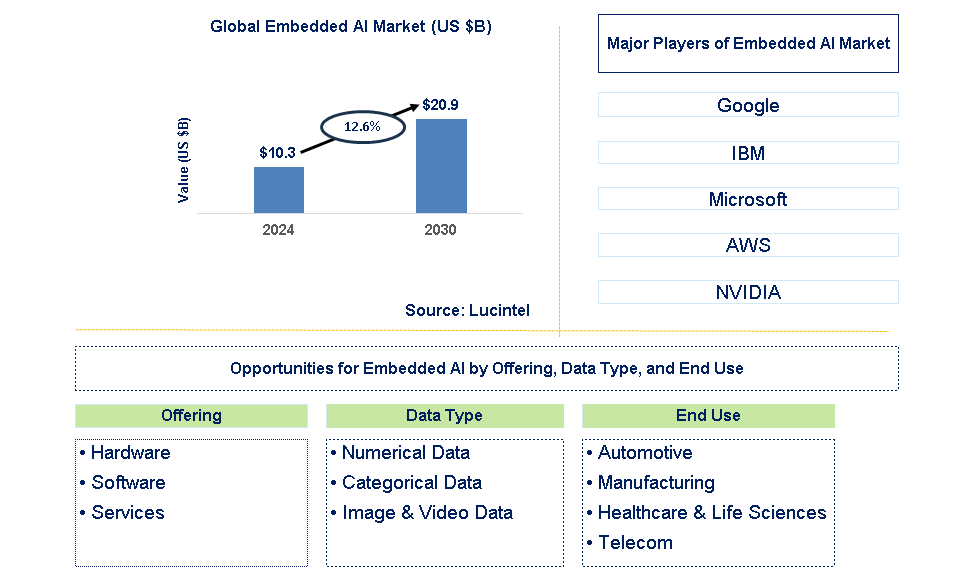
Key data points: The market size in 2030 = $20.9 billion, growth forecast = 12.6% annually next 6 years. Scroll below to get more insights. This market report covers trends, opportunities, and forecast in the global embedded ai market to 2030 by offering (hardware, software, and services), data type (numerical data, categorical data, and image & video data), end use (automotive, manufacturing, healthcare & life sciences, and telecom), and region (North America, Europe, Asia Pacific, and the Rest of the World)
We'll send your sample report shortly.
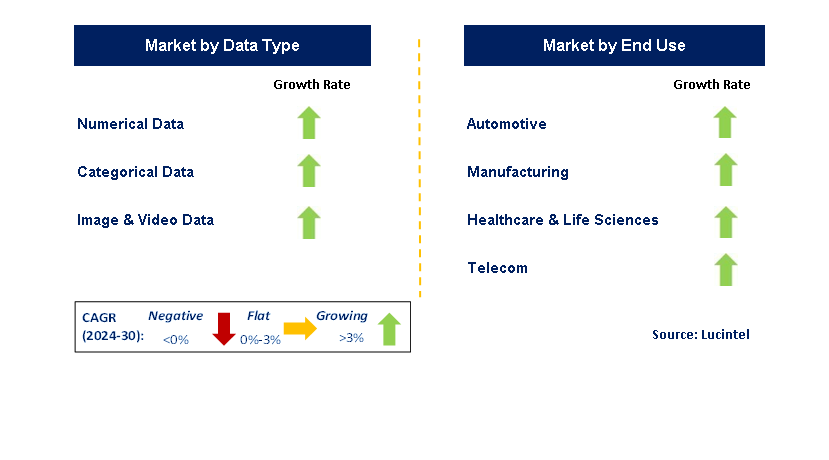
• Lucintel forecasts that numeric data is expected to witness highest growth over the forecast period as it is easy to store and process and it can be used in a wide range of embedded AI applications.
• Within this market, manufacturing will remain the largest segment.
• North America will remain the largest region over the forecast period due to the strong presence of technology companies, availability of funding and increasing adoption of intelligent edge devices in the region. A more than 150-page report is developed to help in your business decisions.
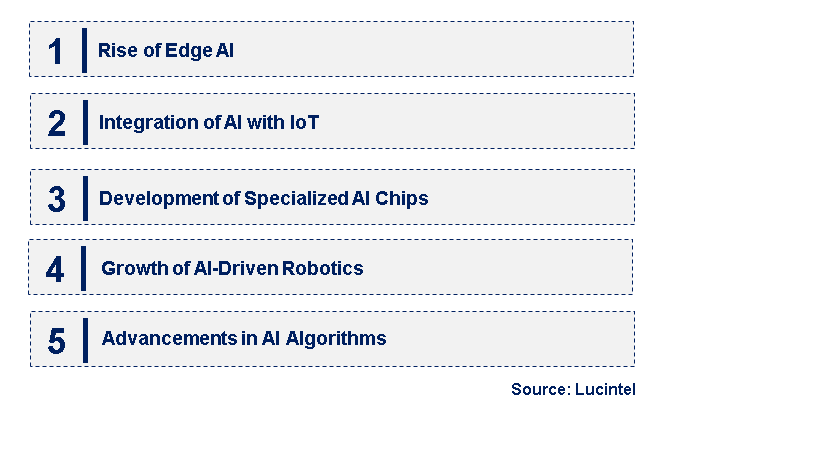
• Rise of Edge AI: Edge AI is gaining prominence as more processing is done locally on devices rather than in the cloud. This trend reduces latency, enhances data privacy, and improves real-time decision-making capabilities. Edge AI is particularly important for applications requiring immediate responses, such as autonomous vehicles and industrial automation.
• Integration of AI with IoT: The integration of AI with the Internet of Things (IoT) is transforming smart devices and systems. AI algorithms enable IoT devices to analyze data locally, improving functionality and efficiency. This trend is driving innovations in smart homes, cities, and industrial IoT applications by providing more intelligent and responsive systems.
• Development of Specialized AI Chips: The development of specialized AI chips is optimizing performance for embedded systems. These chips are designed to handle specific AI tasks more efficiently than general-purpose processors, offering enhanced power efficiency and speed. Specialized AI chips are crucial for applications in consumer electronics, automotive systems, and industrial machinery.
• Growth of AI-Driven Robotics: AI-driven robotics are becoming more sophisticated, with advancements in machine learning enabling robots to perform complex tasks autonomously. This trend is expanding the use of robotics in manufacturing, healthcare, and service industries, enhancing automation and operational efficiency.
• Advancements in AI Algorithms: Continuous advancements in AI algorithms are improving the capabilities of embedded systems. Enhanced algorithms enable better data analysis, pattern recognition, and decision-making, leading to more intelligent and adaptive embedded AI solutions. This trend is crucial for applications in various sectors, including finance, healthcare, and transportation. Trends such as edge AI, IoT integration, specialized AI chips, AI-driven robotics, and advanced algorithms are reshaping the embedded AI market. These developments are driving innovation, improving performance, and expanding the applications of embedded AI technologies across different industries.
• Enhanced AI Chips and Processors: The introduction of advanced AI chips and processors is revolutionizing embedded systems by providing higher performance and energy efficiency. These chips are optimized for AI tasks, improving processing speed and reducing latency in applications such as autonomous vehicles and smart devices.
• Growth in Edge AI Solutions: Edge AI solutions are becoming more prevalent, enabling data processing to occur directly on devices rather than in the cloud. This development enhances real-time decision-making and reduces latency, benefiting applications in industrial automation, smart homes, and healthcare.
• Expansion of AI in Robotics: AI integration in robotics is driving significant advancements, with robots becoming more capable of performing complex tasks autonomously. This development is enhancing automation in manufacturing, healthcare, and service industries, leading to improved efficiency and productivity.
• Advancements in IoT and AI Integration: The integration of AI with IoT devices is creating smarter and more responsive systems. AI algorithms enable IoT devices to analyze data locally, improving functionality and decision-making in applications such as smart cities, industrial IoT, and consumer electronics.
• Increased Focus on AI Algorithms: Continued advancements in AI algorithms are enhancing the capabilities of embedded systems. Improved algorithms enable better data analysis, pattern recognition, and decision-making, driving innovations in various sectors, including finance, transportation, and healthcare. Developments in AI chips, edge solutions, robotics, IoT integration, and algorithms are significantly impacting the embedded AI market. These advancements are enhancing performance, expanding applications, and driving growth across multiple industries.
• Smart Home Devices: The integration of AI in smart home devices offers opportunities for enhanced automation and personalized experiences. AI-powered devices can learn user preferences, optimize energy usage, and improve home security, driving growth in the smart home market.
• Automotive Industry: Embedded AI solutions in the automotive industry present significant growth potential, particularly in autonomous driving and advanced driver assistance systems (ADAS). AI can improve vehicle safety, navigation, and efficiency, contributing to the development of next-generation transportation technologies.
• Industrial Automation: AI-driven industrial automation offers opportunities for increased efficiency and reduced operational costs. AI can enhance predictive maintenance, optimize production processes, and improve quality control, driving growth in the industrial sector.
• Healthcare Applications: The application of AI in healthcare, such as in medical imaging and patient monitoring, provides opportunities for improved diagnostics and personalized treatment. AI can enhance the accuracy of medical devices and streamline healthcare workflows, expanding its use in the healthcare market.
• Consumer Electronics: The incorporation of AI into consumer electronics, including wearable devices and smart appliances, presents opportunities for innovation and market growth. AI can enhance the functionality and user experience of these devices, driving demand in the consumer electronics sector. Growth opportunities in smart home devices, automotive applications, industrial automation, healthcare, and consumer electronics are shaping the embedded AI market. Leveraging these opportunities can drive innovation, improve performance, and expand market reach across various sectors.
• Technological Advancements: Rapid advancements in AI technology and edge computing are driving the growth of the embedded AI market. Innovations in AI chips, algorithms, and integration with IoT are enhancing the capabilities and applications of embedded systems, fueling market expansion.
• Increasing Demand for Smart Devices: The growing demand for smart devices and IoT applications is a significant driver for embedded AI. AI enables smarter, more responsive devices, leading to increased adoption in consumer electronics, automotive, and industrial sectors.
• Focus on Real-Time Processing: The need for real-time data processing and decision-making is driving the adoption of edge AI solutions. Embedded AI systems that process data locally reduce latency and improve performance, addressing the demands of applications requiring immediate responses.
• Investment in AI Research and Development: Increased investment in AI research and development is advancing the capabilities of embedded systems. Funding and innovation in AI technologies contribute to the development of more powerful and efficient embedded AI solutions.
• Expansion of Healthcare and Industrial Applications: The expansion of AI applications in healthcare and industrial automation is driving market growth. AI enhances diagnostics, patient monitoring, and industrial processes, creating new opportunities and demand for embedded AI technologies. Challenges in the embedded AI market include:
• High Development Costs: The high costs associated with developing and deploying advanced embedded AI solutions can limit market access and adoption. Addressing cost challenges is crucial for ensuring affordability and widespread implementation.
• Integration with Existing Systems: Integrating new AI technologies with existing systems and infrastructure can be complex and challenging. Ensuring compatibility and seamless integration is important for successful deployment and operation.
• Data Privacy and Security Concerns: Data privacy and security issues are critical challenges for embedded AI systems. Ensuring robust protection and compliance with regulations is essential for maintaining trust and safeguarding sensitive information. Drivers such as technological advancements, demand for smart devices, real-time processing needs, investment in R&D, and expansion in healthcare and industrial applications are shaping the embedded AI market. Challenges related to development costs, integration, and data security need to be addressed to facilitate market growth and innovation.
• IBM
• Microsoft
• AWS
• NVIDIA
• Intel
• Qualcomm
• ARM
• AMD
• MediaTek
• Hardware
• Software
• Services
• Numerical Data
• Categorical Data
• Image & Video Data
• Automotive
• Manufacturing
• Healthcare & Life Sciences
• Telecom
• North America
• Europe
• Asia Pacific
• The Rest of the World
• United States: In the United States, recent developments in the embedded AI market include significant investments in edge AI infrastructure and the integration of AI chips in consumer electronics and industrial applications. Major tech companies are advancing AI algorithms to optimize performance and energy efficiency in embedded systems. Additionally, there is a focus on developing AI-powered solutions for autonomous vehicles and smart home devices, reflecting the country's leadership in AI research and innovation.
• China: China is advancing rapidly in the embedded AI market with a strong focus on AI chip development and smart manufacturing. The country is investing heavily in AI research to enhance its embedded systems for applications in surveillance, smart cities, and industrial automation. Chinese technology firms are deploying AI solutions across various sectors, leveraging high-performance computing to boost efficiency and intelligence in embedded devices.
• Germany: Germany is leading advancements in embedded AI through its emphasis on Industry 4.0 and smart manufacturing. German companies are integrating AI with automation technologies to improve industrial processes and machine efficiency. The development of AI-powered industrial robots and predictive maintenance systems is a key focus, enhancing Germany's position in the global embedded AI market with its robust engineering and manufacturing capabilities.
• India: In India, recent developments in the embedded AI market are centered around expanding AI research and development capabilities, particularly in affordable AI solutions for diverse applications. The focus is on integrating AI into healthcare, agriculture, and smart city projects to drive innovation. Indian startups are also contributing to advancements in AI algorithms and embedded systems, aiming to create cost-effective and scalable solutions for local and global markets.
• Japan: Japan is making strides in the embedded AI market by incorporating AI into robotics and consumer electronics. Japanese companies are developing advanced AI-driven robotics for manufacturing and healthcare, enhancing automation and efficiency. Additionally, there is a push towards integrating AI with IoT devices to create smarter consumer products and improve operational efficiency in various industries, reflecting Japan's technological prowess in embedded systems.


• IBM
• Microsoft
• AWS
• NVIDIA
• Intel
• Qualcomm
• ARM
• AMD
• MediaTek Q6. Which embedded AI market segment will be the largest in future? Answer: Lucintel forecasts that numeric data is expected to witness highest growth over the forecast period as it is easy to store and process and it can be used in a wide range of embedded AI applications. Q7. In embedded AI market, which region is expected to be the largest in next 5 years? Answer: North America will remain the largest region over the forecast period due to the strong presence of technology companies, availability of funding and increasing adoption of intelligent edge devices in the region. Q.8 Do we receive customization in this report? Answer: Yes, Lucintel provides 10% customization without any additional cost.


Choose a license that fits your team. Instant PDF delivery.
Prices exclude taxes. Instant delivery. Custom licensing available on request.
Market Report · July 16, 2026
Market Report · July 15, 2026
Market Report · July 15, 2026
Trusted partner for strategic intelligence and business growth


Receive a complimentary market analysis tailored to your industry. Our analysts will identify key growth opportunities and competitive dynamics specific to your business.

Market size, growth rate, and key trend analysis for your specific sector.

Top competitor positioning and market share analysis.

Strategic recommendations backed by data-driven insights.
Get curated market intelligence and competitive moves straight to your inbox.
By subscribing, you agree to receive our monthly insights. Unsubscribe anytime.
Receive a complimentary market analysis tailored to your industry. Our analysts will identify key growth opportunities and competitive dynamics specific to your business.
Market size, growth rate, and key trend analysis for your specific sector.
Top competitor positioning and market share analysis.
Strategic recommendations backed by data-driven insights.
Get curated market intelligence, emerging trends, and competitive moves straight to your inbox each month.
By subscribing, you agree to receive our monthly insights. Unsubscribe anytime.
We'll send your sample report shortly.