
Report Feature
Electronic Deadbolt Lock Market Trends and Forecast
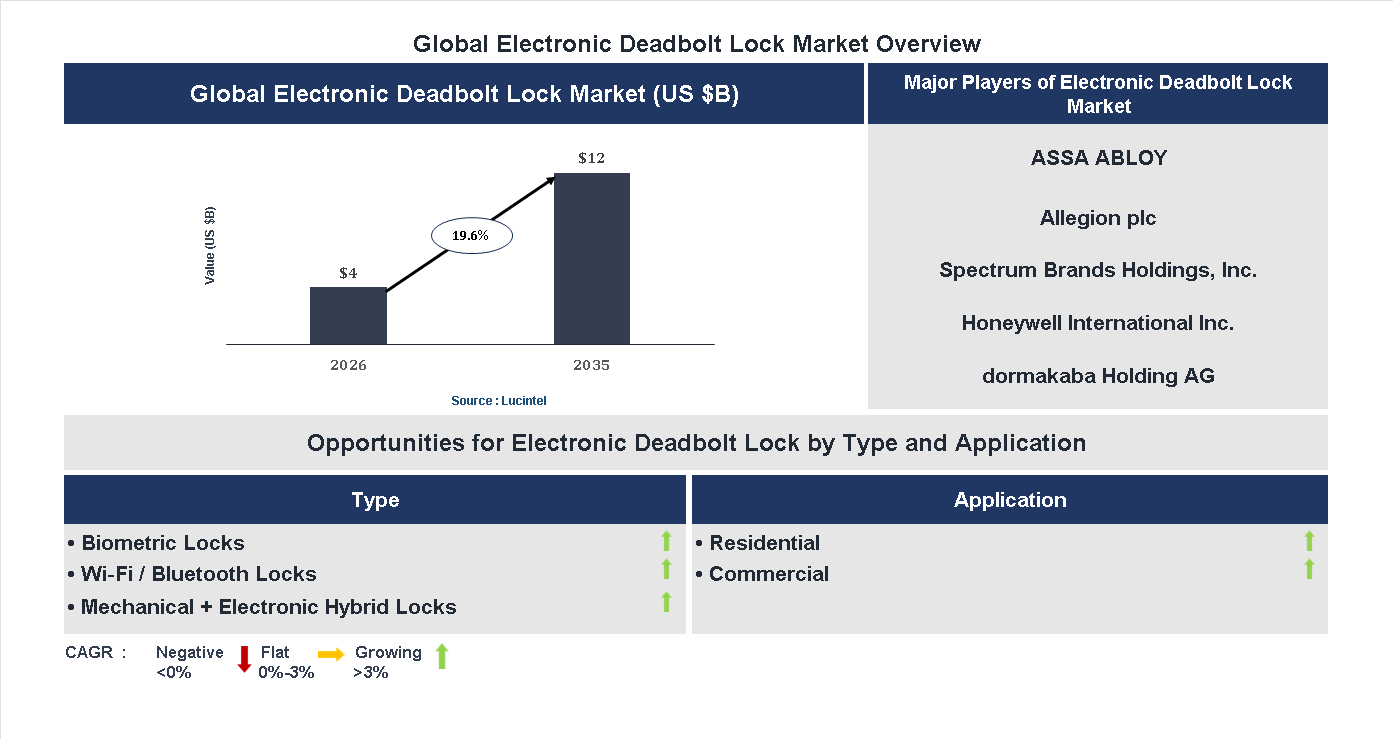
The future of the global electronic deadbolt lock market looks promising with opportunities in the residential and commercial markets. The global electronic deadbolt lock market is expected to reach an estimated $12 billion by 2035 with a CAGR of 19.6% from 2026 to 2035. The major drivers for this market are the increasing demand for smart home security solutions, the rising adoption of connected home automation systems, and the growing concerns regarding residential property safety.• Lucintel forecasts that, within the type category, biometric lock is expected to witness the highest growth over the forecast period.
• Within the application category, commercial is expected to witness higher growth.
• In terms of region, APAC is expected to witness the highest growth over the forecast period. Gain valuable insights for your business decisions with our comprehensive 150+ page report. Sample figures with some insights are shown below.
Emerging Trends in the Electronic Deadbolt Lock Market
The electronic deadbolt lock market is experiencing rapid growth driven by technological advancements, increasing security concerns, and the integration of smart home systems. Consumers are seeking more convenient, reliable, and high-tech security solutions for residential and commercial properties. As the market evolves, several key trends are emerging that are shaping its future landscape. These trends reflect innovations in product features, user experience, and market strategies, ultimately transforming how security is perceived and implemented in various settings. Understanding these developments is crucial for stakeholders aiming to capitalize on the market's potential and meet evolving customer demands.• Integration of Smart Home Technology: The market is witnessing a significant shift towards smart home integration, allowing electronic deadbolts to connect seamlessly with home automation systems. This trend enhances user convenience through remote access, voice control, and automation features. Consumers increasingly prefer locks that can be managed via smartphones or voice assistants like Alexa or Google Assistant. This integration not only improves security but also offers real-time monitoring and alerts, making home security more proactive and user-friendly. Manufacturers are focusing on compatibility with popular smart home ecosystems to attract tech-savvy customers.
• Biometric and Multi-Function Authentication: Advanced biometric features such as fingerprint recognition, facial recognition, and even voice authentication are becoming standard in electronic deadbolts. These features provide higher security levels compared to traditional keys or PIN codes. Multi-function authentication options, combining biometrics with PINs or smartphone access, are gaining popularity for added security layers. This trend caters to security-conscious consumers and businesses seeking reliable, tamper-proof access control. The adoption of biometric technology is also driven by decreasing costs and increasing accuracy, making it accessible for a broader market segment.
• Enhanced Security Features and Encryption: As cyber threats evolve, manufacturers are prioritizing robust security protocols and encryption standards in electronic deadbolts. End-to-end encryption, secure cloud storage, and regular firmware updates are now common to prevent hacking and unauthorized access. These enhancements ensure data privacy and protect user credentials, building consumer trust. The market is also witnessing the development of anti-tampering features and alarm systems integrated into locks, providing immediate alerts in case of forced entry or tampering attempts. This focus on security is critical for gaining consumer confidence and complying with regulatory standards.
• Rise of Subscription and Service-Based Models: The market is shifting towards subscription-based services, including remote monitoring, maintenance, and software updates. Companies are offering value-added services such as 24/7 security monitoring, access logs, and emergency response integrations through cloud platforms. This model provides recurring revenue streams for manufacturers and ongoing value for consumers. It also enables continuous product improvement and feature upgrades without requiring hardware replacement. Service-based models are particularly appealing to commercial clients and property managers seeking scalable, managed security solutions.
• Growing Adoption in Commercial and Multi-Unit Residential Sectors: While residential use remains dominant, there is a notable increase in electronic deadbolt adoption within commercial buildings, hotels, and multi-unit residential complexes. These sectors benefit from centralized access control, audit trails, and remote management capabilities. The demand is driven by the need for enhanced security, operational efficiency, and contactless access solutions, especially in the post-pandemic era. This trend is expanding market opportunities for manufacturers and integrators, encouraging the development of scalable, customizable solutions tailored to large-scale property management. These emerging trends are fundamentally reshaping the Electronic Deadbolt Lock Market by integrating advanced technology, enhancing security, and expanding application areas. The focus on smart integration, biometric authentication, security protocols, service models, and commercial adoption is driving innovation and growth. As these trends continue to evolve, they will lead to more secure, convenient, and intelligent access control solutions, ultimately transforming the landscape of property security and management.

Recent Development in the Electronic Deadbolt Lock Market
The electronic deadbolt lock market is experiencing rapid growth driven by increasing security concerns, technological advancements, and smart home integration. Consumers and businesses are seeking more reliable, convenient, and connected locking solutions. Innovations in IoT, biometric access, and mobile control are transforming the landscape. Market players are focusing on product development, strategic partnerships, and expanding distribution channels to capitalize on these opportunities. This evolving environment presents significant potential for growth, competition, and technological innovation in the electronic deadbolt lock industry.• Growing Demand for Smart Security Solutions: The rising need for enhanced security in residential and commercial spaces is fueling the adoption of electronic deadbolt locks. Consumers prefer smart locks that offer remote access, real-time monitoring, and integration with home automation systems. This trend is driven by increasing crime rates and a desire for convenience. Manufacturers are developing advanced features like biometric access and app control, which are attracting a broader customer base. The market is expected to expand significantly as smart security becomes a standard feature in modern properties.
• Technological Innovations in Locking Mechanisms: Advances in IoT, biometrics, and wireless technology are revolutionizing electronic deadbolt locks. These innovations enable seamless integration with smartphones, voice assistants, and security systems. Enhanced features such as fingerprint recognition, keypad entry, and auto-lock functions improve user experience and security. Companies investing in R&D are launching smarter, more durable products that cater to tech-savvy consumers. These technological developments are creating new market segments and increasing the overall adoption rate of electronic deadbolt locks.
• Increasing Adoption in Commercial and Hospitality Sectors: The commercial and hospitality industries are increasingly adopting electronic deadbolt locks for their security and operational efficiency. Hotels, offices, and retail outlets benefit from keyless entry, audit trails, and remote management. These locks reduce the need for physical keys, enhance security, and streamline access control. As these sectors prioritize safety and convenience, demand for sophisticated locking solutions is rising. This trend is expected to drive market growth, with manufacturers offering tailored solutions for different commercial applications.
• Expansion of Smart Home Integration: The integration of electronic deadbolt locks with smart home ecosystems is a key growth driver. Consumers seek interconnected devices that can be controlled via smartphones, voice commands, or automation routines. Compatibility with platforms like Alexa, Google Assistant, and Apple HomeKit enhances user convenience. This integration allows for features like temporary access sharing and activity logs. As smart home adoption accelerates globally, the demand for compatible electronic deadbolt locks is expected to surge, creating new opportunities for manufacturers and service providers.
• Strategic Partnerships and Market Expansion: Companies are forming strategic alliances to expand their product offerings and market reach. Collaborations with home automation providers, security firms, and retail channels facilitate wider distribution and technological integration. Market expansion into emerging economies is driven by urbanization and rising disposable incomes. These partnerships enable innovation, improve supply chains, and enhance brand visibility. As a result, the market is becoming more competitive, with increased product diversity and accessibility, ultimately accelerating growth and adoption of electronic deadbolt locks worldwide. The overall impact of these developments is a dynamic, expanding market characterized by technological innovation, increased adoption across sectors, and greater consumer convenience. These opportunities are driving market growth, fostering competition, and encouraging continuous product evolution, positioning the electronic deadbolt lock industry for sustained success in the coming years.
Strategic Growth Opportunities in the Electronic Deadbolt Lock Market
The electronic deadbolt lock market is experiencing rapid growth driven by increasing security concerns, technological advancements, and the demand for smart home integration. Consumers and businesses seek reliable, convenient, and high-tech locking solutions, fueling innovation and expansion across various applications. Market players are focusing on product development, strategic partnerships, and geographic expansion to capitalize on emerging opportunities. This dynamic environment presents significant potential for growth, driven by evolving consumer preferences and the need for enhanced security measures worldwide.• Increasing Adoption of Smart Home Technology: The rising integration of electronic deadbolt locks into smart home systems offers significant growth opportunities. Consumers are seeking seamless, remote access control, and automation features, which enhance convenience and security. Manufacturers are developing compatible, user-friendly products with IoT connectivity, expanding their market reach. The trend toward connected homes and the proliferation of smart devices are expected to drive demand, especially in residential sectors, creating a lucrative landscape for innovative lock solutions.
• Growing Security Concerns and Need for Enhanced Protection: As security threats escalate globally, there is a heightened demand for reliable locking systems. Electronic deadbolt locks provide advanced features such as keyless entry, biometric access, and real-time monitoring, addressing these concerns effectively. Commercial and residential sectors are increasingly adopting these solutions to prevent unauthorized access and theft. The focus on safety and security is expected to propel market growth, encouraging manufacturers to develop more sophisticated, tamper-proof, and integrated locking systems.
• Expansion in Commercial and Institutional Applications: The commercial sector, including offices, hotels, and healthcare facilities, is adopting electronic deadbolt locks for improved security and operational efficiency. These locks facilitate access management, audit trails, and remote control, reducing the need for physical keys. The increasing need for secure access control in sensitive environments is driving market expansion. Additionally, government regulations and standards are encouraging the adoption of electronic locking solutions, further boosting growth prospects in institutional applications.
• Technological Innovations and Product Development: Continuous advancements in electronics, wireless communication, and biometric technologies are fueling product innovation in the market. Companies are introducing features like fingerprint recognition, mobile app control, and integration with security systems. These innovations improve user experience, security, and convenience, making electronic deadbolt locks more attractive. Investment in R&D is expected to lead to smarter, more durable, and cost-effective products, expanding their application scope and market penetration.
• Strategic Partnerships and Geographic Expansion: Market players are forming alliances with technology providers, security firms, and distributors to enhance product offerings and reach new markets. Geographic expansion into emerging economies presents substantial growth opportunities due to rising urbanization and security awareness. Companies are tailoring products to meet regional needs and regulatory standards, facilitating market entry. Strategic collaborations and expansion efforts are expected to accelerate adoption rates, diversify revenue streams, and strengthen competitive positioning globally. The overall impact of these opportunities is set to significantly accelerate market growth, foster innovation, and expand the adoption of electronic deadbolt locks across various sectors. As technological integration and security needs evolve, the market is poised for sustained development, offering lucrative prospects for industry stakeholders worldwide.
Electronic Deadbolt Lock Market Driver and Challenges
The electronic deadbolt lock market is influenced by a variety of technological, economic, and regulatory factors that shape its growth and development. Advances in smart home technology and increasing consumer demand for enhanced security are primary drivers. Economic factors such as rising disposable incomes and urbanization contribute to market expansion. Regulatory standards related to safety and security also impact product development and adoption. However, the market faces challenges including high costs, cybersecurity concerns, and regulatory complexities that could hinder growth. Understanding these drivers and challenges is essential for stakeholders to navigate the evolving landscape effectively and capitalize on emerging opportunities. The factors responsible for driving the electronic deadbolt lock market include:• Technological Innovation: The rapid development of smart home devices and IoT integration has significantly boosted the market. Consumers seek convenient, remote access to their locks, prompting manufacturers to develop advanced electronic deadbolts with features like biometric access, app control, and voice commands. These innovations improve security and user experience, making electronic deadbolts more attractive. As technology continues to evolve, the market is expected to see increased adoption, especially among residential and commercial sectors. The integration with home automation systems further enhances their appeal, driving market growth.
• Increasing Security Concerns: Rising awareness about security threats and break-ins has led consumers and businesses to seek more reliable locking solutions. Electronic deadbolts offer enhanced security features such as keyless entry, audit trails, and tamper alerts, which traditional locks cannot provide. This shift is driven by urbanization, rising crime rates, and the need for better access control. As security remains a top priority, the demand for electronic deadbolts is expected to grow, especially in high-value residential and commercial properties. This trend supports the market’s expansion as consumers prioritize safety.
• Growing Adoption of Smart Home Technology: The proliferation of smart home ecosystems has created a favorable environment for electronic deadbolt locks. Integration with home automation systems allows users to control locks remotely, monitor access, and receive alerts, enhancing convenience and security. The increasing affordability of smart devices and rising consumer awareness further accelerate adoption. Real estate developers and property managers are also incorporating smart locks to add value to their offerings. This trend is expected to continue, fueling market growth as smart home adoption becomes mainstream.
• Economic Growth and Urbanization: Economic development in emerging markets has increased disposable incomes, enabling consumers to invest in advanced security solutions like electronic deadbolts. Urbanization drives the need for secure, convenient access control in densely populated areas. Commercial establishments, hotels, and residential complexes are increasingly adopting electronic deadbolts to meet security standards and improve operational efficiency. The expansion of infrastructure and real estate development in these regions provides significant growth opportunities, making economic factors a key driver for market expansion.
• Regulatory and Safety Standards: Governments and regulatory bodies are implementing stricter safety and security standards for residential and commercial properties. These regulations often mandate the use of advanced locking systems to prevent unauthorized access and enhance safety. Compliance with such standards encourages manufacturers to innovate and develop compliant products, boosting market growth. Additionally, certifications and standards related to cybersecurity are becoming more prominent, influencing product design and features. Regulatory support and standards thus play a crucial role in shaping the market landscape. The challenges facing the electronic deadbolt lock market include:
• High Costs and Price Sensitivity: Despite technological advancements, electronic deadbolt locks tend to be more expensive than traditional locks, which can deter price-sensitive consumers. The initial investment, installation costs, and ongoing maintenance can be barriers, especially in emerging markets. This limits widespread adoption among budget-conscious segments. Manufacturers need to balance advanced features with affordability to expand their customer base. Cost considerations also impact the adoption in large-scale commercial projects, where budget constraints are significant. Overcoming price barriers is essential for broader market penetration.
• Cybersecurity Risks: As electronic deadbolts rely on digital connectivity, they are vulnerable to hacking, malware, and other cyber threats. Security breaches can compromise user data and access control, leading to privacy concerns and loss of trust. Ensuring robust cybersecurity measures is critical but can increase product complexity and costs. Manufacturers must invest in secure encryption protocols and regular updates to mitigate risks. Failure to address cybersecurity issues could result in legal liabilities and damage to brand reputation, hindering market growth.
• Regulatory and Standardization Challenges: The lack of uniform standards and regulations across regions can create barriers for manufacturers and consumers. Differing safety, security, and cybersecurity standards complicate product development and compliance processes. Navigating these regulatory landscapes can delay product launches and increase costs. Additionally, evolving standards require continuous updates and testing, adding to operational challenges. Harmonization of standards is necessary to facilitate international trade and adoption, but the current fragmented regulatory environment poses significant hurdles for market expansion. The electronic deadbolt lock market is driven by technological innovation, security concerns, smart home integration, economic growth, and regulatory support. However, high costs, cybersecurity vulnerabilities, and regulatory complexities present notable challenges. These factors collectively influence market dynamics, requiring stakeholders to innovate, adapt, and address barriers to sustain growth. The market’s future will depend on balancing technological advancements with affordability and security, ensuring widespread adoption and trust in electronic locking solutions.
List of Electronic Deadbolt Lock Companies
Companies in the market compete on the basis of product quality offered. Major players in this market focus on expanding their manufacturing facilities, R&D investments, infrastructural development, and leverage integration opportunities across the value chain. With these strategies electronic deadbolt lock companies cater increasing demand, ensure competitive effectiveness, develop innovative products & technologies, reduce production costs, and expand their customer base. Some of the electronic deadbolt lock companies profiled in this report include-• ASSA ABLOY
• Allegion plc
• Spectrum Brands Holdings, Inc.
• Honeywell International Inc.
• dormakaba Holding AG
• Samsung Electronics Co., Ltd.
• Xiaomi Corporation
• ZKTeco Co., Ltd.
• U-tec Group, Inc.
• Aqara
Electronic Deadbolt Lock Market by Segment
The study includes a forecast for the global electronic deadbolt lock market by type, application, and region.Electronic Deadbolt Lock Market by Type [Value from 2019 to 2035]:
• Biometric Locks
• Wi‑Fi / Bluetooth Locks
• Mechanical + Electronic Hybrid Locks
Electronic Deadbolt Lock Market by Application [Value from 2019 to 2035]:
• Residential
• Commercial
Electronic Deadbolt Lock Market by Region [Value from 2019 to 2035]:
• North America
• Europe
• Asia Pacific
• The Rest of the World
Country Wise Outlook for the Electronic Deadbolt Lock Market
The electronic deadbolt lock market has experienced significant growth driven by increasing security concerns, technological advancements, and smart home integration. As consumers seek more convenient and secure locking solutions, countries are adopting innovative products tailored to their unique needs. The market's evolution is marked by the integration of IoT, biometric access, and remote control features, making locks more intelligent and user-friendly. Regulatory standards and consumer preferences vary across regions, influencing product development and adoption rates. This dynamic landscape reflects a global shift towards enhanced security solutions that combine convenience, technology, and connectivity.• United States: The US market has seen rapid adoption of smart electronic deadbolt locks, driven by rising security awareness and smart home trends. Major players are focusing on integrating voice control and mobile app access, with increased demand from residential and commercial sectors. Innovations include biometric and multi-factor authentication options, enhancing security features. The market is also influenced by regulatory standards promoting smart security devices, and the growth of home automation systems further accelerates adoption. Consumer preferences favor convenience, durability, and advanced security features, making the US a leader in market innovation and expansion.
• China: China's electronic deadbolt lock market is expanding quickly due to urbanization, rising disposable incomes, and a growing middle class seeking enhanced security. Local manufacturers are focusing on affordable yet technologically advanced products, often integrating IoT and remote access features. The government’s emphasis on smart city initiatives and security infrastructure boosts market growth. E-commerce platforms facilitate widespread distribution, and consumer demand for stylish, easy-to-install locks is increasing. Additionally, biometric technology adoption is rising, with a focus on fingerprint and facial recognition systems, making China a key emerging market for innovative security solutions.
• Germany: The German market emphasizes high-quality, reliable, and secure electronic deadbolt locks, driven by strict safety standards and consumer preference for durable products. There is a strong focus on integrating energy-efficient and eco-friendly features, aligning with sustainability goals. The adoption of smart locks is growing in residential and commercial buildings, with an emphasis on seamless integration with existing security systems. German consumers prioritize privacy and data security, influencing product design and features. The market also benefits from technological collaborations within the European Union, fostering innovation and adherence to rigorous safety and quality standards.
• India: The Indian electronic deadbolt lock market is witnessing rapid growth due to increasing urbanization, rising middle-class income, and a growing awareness of security concerns. Affordable yet feature-rich products are in high demand, with local manufacturers offering competitive options. The adoption of biometric access, especially fingerprint recognition, is expanding, driven by government initiatives promoting digital security. The market is also influenced by the expansion of smart city projects and increasing penetration of IoT devices in homes and businesses. Consumer preferences are shifting towards easy-to-install, low-maintenance, and cost-effective security solutions, making India a promising emerging market.
• Japan: Japan's market for electronic deadbolt locks is characterized by a focus on advanced technology, reliability, and integration with smart home systems. Consumers prioritize security, convenience, and energy efficiency, leading to the adoption of features like remote access and biometric authentication. The market benefits from high standards for safety and quality, with a preference for products that comply with strict regulatory requirements. Innovations include integration with home automation and security networks, as well as emphasis on privacy protection. The aging population also drives demand for user-friendly, accessible security solutions, positioning Japan as a mature and technologically sophisticated market.

Features of the Global Electronic Deadbolt Lock Market
Market Size Estimates: Electronic deadbolt lock market size estimation in terms of value ($B). Trend and Forecast Analysis: Market trends (2019 to 2025) and forecast (2026 to 2035) by various segments and regions. Segmentation Analysis: Electronic deadbolt lock market size by type, application, and region in terms of value ($B). Regional Analysis: Electronic deadbolt lock market breakdown by North America, Europe, Asia Pacific, and Rest of the World. Growth Opportunities: Analysis of growth opportunities in different types, applications, and regions for the electronic deadbolt lock market. Strategic Analysis: This includes M&A, new product development, and competitive landscape of the electronic deadbolt lock market. Analysis of competitive intensity of the industry based on Porter’s Five Forces model.
FAQ
Q1. What is the electronic deadbolt lock market size? Answer: The global electronic deadbolt lock market is expected to reach an estimated $12 billion by 2035. Q2. What is the growth forecast for electronic deadbolt lock market? Answer: The global electronic deadbolt lock market is expected to grow with a CAGR of 19.6% from 2026 to 2035. Q3. What are the major drivers influencing the growth of the electronic deadbolt lock market? Answer: The major drivers for this market are the increasing demand for smart home security solutions, the rising adoption of connected home automation systems, and the growing concerns regarding residential property safety. Q4. What are the major segments for electronic deadbolt lock market? Answer: The future of the electronic deadbolt lock market looks promising with opportunities in the residential and commercial markets. Q5. Who are the key electronic deadbolt lock market companies? Answer: Some of the key electronic deadbolt lock companies are as follows:• ASSA ABLOY
• Allegion plc
• Spectrum Brands Holdings, Inc.
• Honeywell International Inc.
• dormakaba Holding AG
• Samsung Electronics Co., Ltd.
• Xiaomi Corporation
• ZKTeco Co., Ltd.
• U-tec Group, Inc.
• Aqara Q6. Which electronic deadbolt lock market segment will be the largest in future? Answer: Lucintel forecasts that, within the type category, biometric lock is expected to witness the highest growth over the forecast period. Q7. In electronic deadbolt lock market, which region is expected to be the largest in next 5 years? Answer: In terms of region, APAC is expected to witness the highest growth over the forecast period. Q8. Do we receive customization in this report? Answer: Yes, Lucintel provides 10% customization without any additional cost.
Table of Contents
List of Figures
List of Tables
Methodology
- In-depth interviews of the major players in this market
- Detailed secondary research from competitors’ financial statements and published data
- Extensive searches of published works, market, and database information pertaining to industry news, company press releases, and customer intentions
- A compilation of the experiences, judgments, and insights of Lucintel’s professionals, who have analyzed and tracked this market over the years.


Buy Now
Choose a license that fits your team. Instant PDF delivery.
Prices exclude taxes. Instant delivery. Custom licensing available on request.
Key Questions
- • What are some of the most promising, high-growth opportunities for the electronic deadbolt lock market by type (biometric locks, Wi‑Fi / bluetooth locks, and mechanical + electronic hybrid locks), application (residential and commercial), and region (North America, Europe, Asia Pacific, and the Rest of the World)?
- • Which segments will grow at a faster pace and why?
- • Which region will grow at a faster pace and why?
- • What are the key factors affecting market dynamics? What are the key challenges and business risks in this market?
- • What are the business risks and competitive threats in this market?
- • What are the emerging trends in this market and the reasons behind them?
- • What are some of the changing demands of customers in the market?
- • What are the new developments in the market? Which companies are leading these developments?
- • Who are the major players in this market? What strategic initiatives are key players pursuing for business growth?
- • What are some of the competing products in this market and how big of a threat do they pose for loss of market share by material or product substitution?
- • What M&A activity has occurred in the last 7 years and what has its impact been on the industry? For any questions related to Electronic Deadbolt Lock Market, Electronic Deadbolt Lock Market Size, Electronic Deadbolt Lock Market Growth, Electronic Deadbolt Lock Market Analysis, Electronic Deadbolt Lock Market Report, Electronic Deadbolt Lock Market Share, Electronic Deadbolt Lock Market Trends, Electronic Deadbolt Lock Market Forecast, Electronic Deadbolt Lock Companies, write Lucintel analyst at email: helpdesk@lucintel.com. We will be glad to get back to you soon.


