
Report Feature
Electronic Consumer Device Motor Market Trends and Forecast
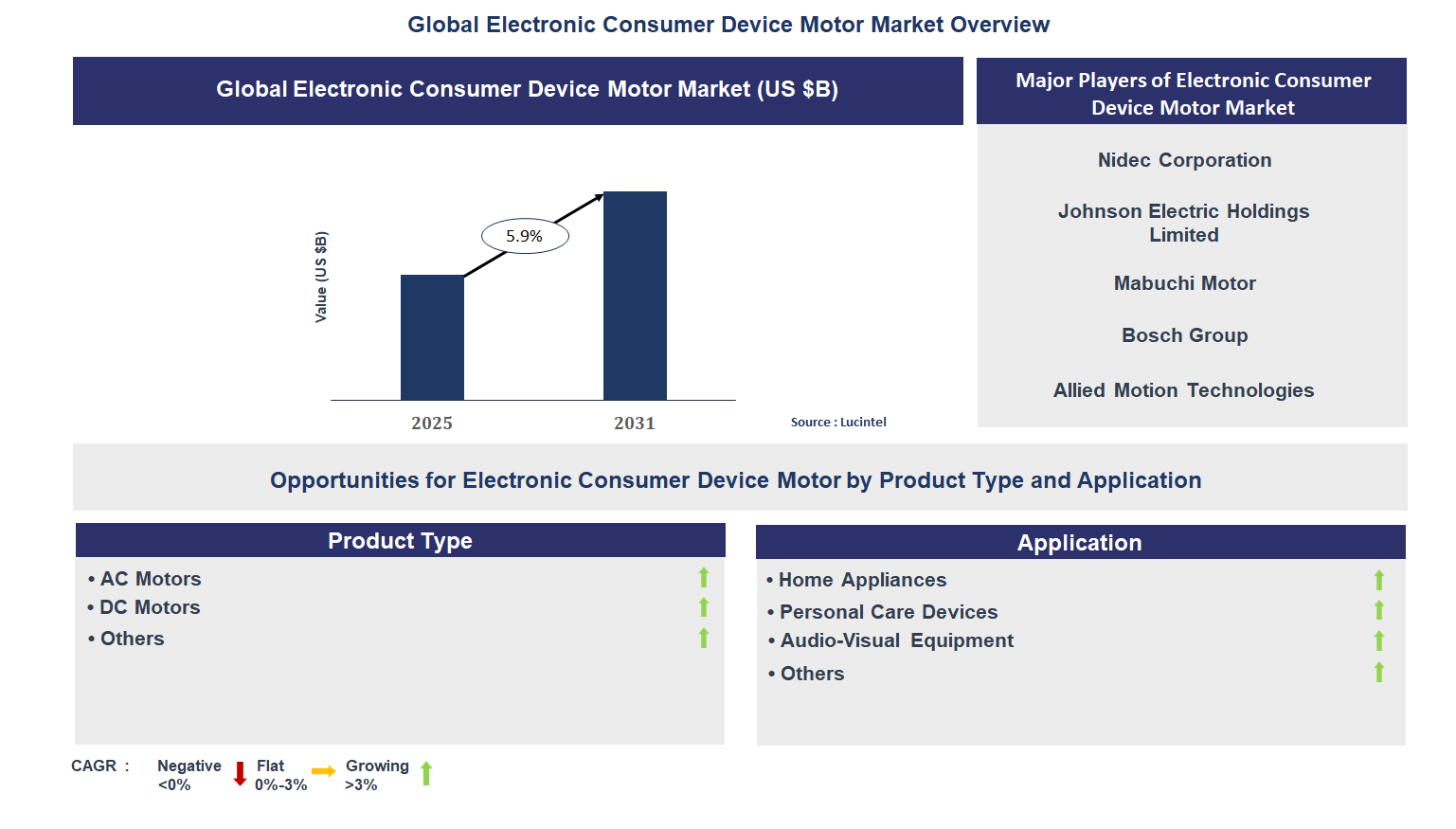
The future of the global electronic consumer device motor market looks promising with opportunities in the home appliance, personal care device, and audio-visual equipment markets. The global electronic consumer device motor market is expected to grow with a CAGR of 5.9% from 2025 to 2031. The major drivers for this market are the increasing demand for smart consumer electronic devices, the rising adoption of automated home appliances, and the growing need for energy-efficient motor technologies.• Lucintel forecasts that, within the product type category, AC motor is expected to witness higher growth over the forecast period.
• Within the application category, home appliance is expected to witness the highest growth.
• In terms of region, APAC is expected to witness the highest growth over the forecast period. Gain valuable insights for your business decisions with our comprehensive 150+ page report. Sample figures with some insights are shown below.
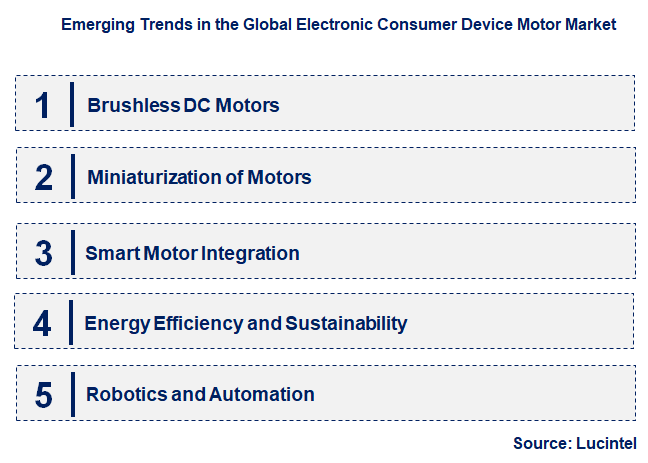
Emerging Trends in the Electronic Consumer Device Motor Market
The electronic consumer device motor market is witnessing several key trends that are reshaping the way devices are designed and function. These trends focus on energy efficiency, compactness, smart motor integration, and technological innovations that improve performance, user experience, and sustainability.• Brushless DC Motors: The shift towards BLDC motors is a major trend, as they are quieter, more efficient, and longer-lasting compared to traditional motors. BLDC motors are ideal for use in energy-sensitive applications like drones, vacuum cleaners, and wearables. Their increasing use is driving market growth, especially in high-performance consumer electronics.
• Miniaturization of Motors: As consumer devices become smaller and more integrated, the demand for compact motors that can deliver high power and efficiency is growing. This trend is particularly visible in the wearable tech and mobile device markets, where space is limited, and the motor size must be minimized without sacrificing performance.
• Smart Motor Integration: The integration of smart features, such as IoT connectivity and AI-powered performance optimization, is becoming more common. These smart motors can automatically adjust their operation based on real-time data, improving efficiency and extending the devices life. Smart motors are becoming increasingly popular in smart home appliances and robotics.
• Energy Efficiency and Sustainability: Energy-efficient motors are a growing demand, driven by increasing environmental awareness and regulations around energy consumption. The focus on low-power solutions, particularly in home appliances and automotive applications, is reshaping the industry. Manufacturers are investing in designing motors that meet sustainability goals without compromising on performance.
• Robotics and Automation: With the increasing adoption of robotics and automation, there is a rising need for precision motors that can handle complex tasks. Motors for applications in drones, robotic vacuum cleaners, and industrial automation are in demand, pushing manufacturers to innovate and design motors capable of high precision and reliability. These emerging trends—focused on energy efficiency, miniaturization, smart technology, and robotics—are transforming the electronic consumer device motor market. Manufacturers are adapting to these trends to meet consumer demand for smarter, more sustainable, and efficient devices, which are shaping the future of motor design and usage.
Recent Development in the Electronic Consumer Device Motor Market
The electronic consumer device motor market is undergoing significant developments, driven by technological advancements, increased consumer demand for smarter devices, and a shift toward energy-efficient solutions. Manufacturers are investing in the latest motor technologies to meet these demands and gain a competitive edge.• Shift to Brushless DC Motors: A major development in the motor market is the transition from traditional motors to BLDC motors, which offer better performance, longer life, and higher efficiency. These motors are particularly popular in consumer electronics like drones, home appliances, and wearables, where reduced noise and higher efficiency are critical.
• Integration of IoT and AI: The integration of IoT and AI into motors is an important development. Motors equipped with sensors and connected to the internet enable remote monitoring and predictive maintenance. This trend is growing, especially in smart home devices, where automation and real-time adjustments are becoming key features for enhanced user experiences.
• Advancements in Motor Materials: Manufacturers are investing in new materials for motors to improve performance, reduce weight, and increase durability. The use of advanced materials such as rare-earth magnets and composites allows motors to be smaller, more efficient, and more robust, making them ideal for high-performance applications like robotics and wearables.
• Focus on Energy Efficiency: Energy efficiency is a major driving force in the development of motors for consumer devices. Advances in motor design, such as the use of high-efficiency windings and optimized control systems, have led to the creation of motors that consume less power, meet eco-friendly standards, and reduce the overall energy footprint of consumer electronics.
• Miniaturization and Compact Design: The push for smaller, more compact devices has led to significant advancements in motor miniaturization. Manufacturers are developing ultra-small, high-performance motors for use in wearables, mobile devices, and small appliances. This trend is vital for industries where space is at a premium, and energy efficiency must not be sacrificed. These key developments in the electronic consumer device motor market—such as the adoption of BLDC motors, the integration of smart technologies, the focus on energy efficiency, and the miniaturization of components—are setting the stage for next-generation consumer electronics. These innovations are enhancing the performance, sustainability, and functionality of modern devices.
Strategic Growth Opportunities in the Electronic Consumer Device Motor Market
The electronic consumer device motor market presents numerous growth opportunities driven by advancements in technology, increasing consumer demand for smarter products, and the need for more energy-efficient solutions. These opportunities span across multiple applications, including wearables, robotics, home automation, and electric vehicles.• Wearable Technology: The rapid growth of the wearable tech market presents a major opportunity for the motor industry. Miniaturized motors that can provide haptic feedback, vibration, and motion sensing are essential for devices like smartwatches, fitness trackers, and health monitoring gadgets. Manufacturers that focus on small, efficient motors will benefit from this trend.
• Electric Vehicles: As the adoption of electric vehicles rises, the demand for advanced motors capable of powering EVs efficiently is growing. Manufacturers can seize this opportunity by providing high-performance electric drivetrains, in-wheel motors, and other components for the EV market, which is projected to see significant growth in the coming years.
• Smart Home Appliances: The increasing popularity of smart home products, such as robotic vacuum cleaners, smart air purifiers, and automated window blinds, offers significant growth opportunities for motors. Manufacturers who can provide energy-efficient, compact, and reliable motors for these devices will tap into the expanding smart home market.
• Robotics and Automation: Robotics is a fast-growing sector that requires motors capable of high precision and performance. Motors for robots used in both consumer and industrial applications are in demand. This presents an opportunity for manufacturers to create highly specialized, durable, and precise motors to meet the needs of the robotics market.
• Sustainability and Eco-Friendly Motors: With rising environmental concerns, there is a growing opportunity to develop energy-efficient motors that meet sustainability standards. Manufacturers can focus on creating green motors that consume less power and are built using environmentally friendly materials. This trend is gaining traction in regions with strict environmental regulations. The strategic growth opportunities in the electronic consumer device motor market are abundant, with key applications in wearables, electric vehicles, smart homes, robotics, and sustainable technologies. Manufacturers that focus on innovation and meet consumer demands for efficiency, miniaturization, and smart functionality will be well-positioned for growth in the future.
Electronic Consumer Device Motor Market Driver and Challenges
The electronic consumer device motor market is influenced by several key drivers and challenges. Technological advancements, consumer demand for energy-efficient and smart devices, and regulatory pressures are driving growth. However, the industry also faces challenges such as cost constraints, competition, and the complexities of integrating new technologies into existing systems. The factors responsible for driving the electronic consumer device motor market include: 1. Technological Advancements: The continuous development of advanced motor technologies, such as BLDC motors, miniaturization, and smart integration, is a major driver. These innovations improve the performance, efficiency, and functionality of electronic devices, enabling manufacturers to meet the growing demand for high-performance products. 2. Increasing Demand for Energy Efficiency: Rising awareness about environmental sustainability is pushing the demand for energy-efficient motors. With regulations becoming stricter on energy consumption, manufacturers are developing motors that use less power and generate less heat, thus helping consumers reduce their energy consumption and carbon footprints. 3. Consumer Demand for Smart Devices: As consumers increasingly adopt smart devices, there is a rising demand for motors integrated with IoT and AI. These smart motors provide enhanced control, automation, and energy optimization, making them essential for smart home devices, wearables, and robotics. 4. Growth of Electric Vehicles: The growing electric vehicle market is driving demand for advanced motors that can provide higher efficiency and reliability. Electric vehicles require specialized motors for propulsion, making this sector a significant growth driver for the motor industry, with manufacturers focusing on electric drivetrains and in-wheel motors. 5. Miniaturization and Compactness: As consumer devices become smaller and more compact, the need for smaller motors that maintain high performance is increasing. The trend towards miniaturization is particularly strong in mobile devices, wearables, and portable electronics, where space constraints drive innovation in motor design. Challenges in the electronic consumer device motor market are: 1. Cost Pressures: The increasing demand for high-performance motors, especially in sectors like wearables and EVs, presents cost challenges. Manufacturers must balance performance with cost efficiency, especially in consumer electronics where price sensitivity is a major factor. 2. Complexity of Integration: Integrating advanced technologies like IoT, AI, and smart features into motors can be complex and costly. The need for seamless integration between motor systems and other electronic components often requires significant investment in R&D, which can be a barrier for some manufacturers. 3. Competition and Market Saturation: The electronic motor market is highly competitive, with many players vying for market share. This intense competition puts pressure on manufacturers to continuously innovate and differentiate their products, which can be challenging in a saturated market. The electronic consumer device motor market is shaped by key drivers such as technological advancements, energy efficiency, and consumer demand for smart devices. However, manufacturers face challenges including cost pressures, integration complexity, and fierce competition. Navigating these drivers and challenges will be crucial for companies looking to succeed in this evolving market.List of Electronic Consumer Device Motor Companies
Companies in the market compete on the basis of product quality offered. Major players in this market focus on expanding their manufacturing facilities, R&D investments, infrastructural development, and leverage integration opportunities across the value chain. With these strategies electronic consumer device motor companies cater increasing demand, ensure competitive effectiveness, develop innovative products & technologies, reduce production costs, and expand their customer base. Some of the electronic consumer device motor companies profiled in this report include-• Nidec Corporation
• Johnson Electric Holdings Limited
• Mabuchi Motor
• Bosch Group
• Allied Motion Technologies
Electronic Consumer Device Motor Market by Segment
The study includes a forecast for the global electronic consumer device motor market by product type, application, and region.Electronic Consumer Device Motor Market by Product Type [Value from 2019 to 2031]:
• AC Motors
• DC Motors
• Others
Electronic Consumer Device Motor Market by Application [Value from 2019 to 2031]:
• Home Appliances
• Personal Care Devices
• Audio-Visual Equipment
• Others
Electronic Consumer Device Motor Market by Region [Value from 2019 to 2031]:
• North America
• Europe
• Asia Pacific
• The Rest of the World
Country Wise Outlook for the Electronic Consumer Device Motor Market
The electronic consumer device motor market is evolving rapidly due to advancements in energy-efficient designs, the miniaturization of components, and increasing consumer demand for smarter and more compact devices. Key markets like the United States, China, Germany, India, and Japan are playing pivotal roles in driving innovation and shaping global trends in the motor sector for electronic devices.• United States: The U.S. market is seeing increased demand for high-performance, energy-efficient motors in applications like smart home devices, wearables, and electric vehicles. Manufacturers are focusing on the development of brushless DC (BLDC) motors due to their superior efficiency and durability. There’s also a strong push for the integration of artificial intelligence (AI) to enhance motor functionality in consumer electronics.
• China: China continues to dominate the production and consumption of electronic consumer device motors, particularly in low-cost, mass-produced devices like smartphones, drones, and home appliances. The country’s manufacturers are increasingly focusing on the development of smart motors that can optimize energy usage and reduce waste. Chinas government’s push for sustainability is also influencing these innovations.
• Germany: In Germany, precision engineering and technological expertise are driving the development of advanced motors used in high-end consumer electronics and automotive applications. BLDC motors and advanced materials are becoming more common in the production of highly efficient and durable motors. The integration of smart sensors and IoT connectivity is also emerging as a major trend in German motor designs.
• India: India’s electronic consumer device motor market is rapidly expanding with increasing disposable income and the adoption of modern home appliances. The demand for efficient motors is particularly high in sectors like air conditioning, refrigeration, and home automation. Indian manufacturers are increasingly turning to energy-efficient motors to cater to the growing demand for eco-friendly and cost-effective solutions.
• Japan: Japan is at the forefront of developing highly efficient, compact motors, especially for applications in robotics, consumer electronics, and automotive sectors. Japanese manufacturers are integrating advanced motor technologies with AI, ensuring motors can adapt to changing conditions. Additionally, the demand for high-precision motors in industries like robotics is pushing the development of more sophisticated motor designs.

Features of the Global Electronic Consumer Device Motor Market
Market Size Estimates: Electronic consumer device motor market size estimation in terms of value ($B). Trend and Forecast Analysis: Market trends (2019 to 2024) and forecast (2025 to 2031) by various segments and regions. Segmentation Analysis: Electronic consumer device motor market size by product type, application, and region in terms of value ($B). Regional Analysis: Electronic consumer device motor market breakdown by North America, Europe, Asia Pacific, and Rest of the World. Growth Opportunities: Analysis of growth opportunities in different product types, applications, and regions for the electronic consumer device motor market. Strategic Analysis: This includes M&A, new product development, and competitive landscape of the electronic consumer device motor market. Analysis of competitive intensity of the industry based on Porter’s Five Forces model.
FAQ
Q1. What is the growth forecast for electronic consumer device motor market? Answer: The global electronic consumer device motor market is expected to grow with a CAGR of 5.9% from 2025 to 2031. Q2. What are the major drivers influencing the growth of the electronic consumer device motor market? Answer: The major drivers for this market are the increasing demand for smart consumer electronic devices, the rising adoption of automated home appliances, and the growing need for energy-efficient motor technologies. Q3. What are the major segments for electronic consumer device motor market? Answer: The future of the electronic consumer device motor market looks promising with opportunities in the home appliance, personal care device, and audio-visual equipment markets. Q4. Who are the key electronic consumer device motor market companies? Answer: Some of the key electronic consumer device motor companies are as follows:• Nidec Corporation
• Johnson Electric Holdings Limited
• Mabuchi Motor
• Bosch Group
• Allied Motion Technologies Q5. Which electronic consumer device motor market segment will be the largest in future? Answer: Lucintel forecasts that, within the product type category, AC motor is expected to witness higher growth over the forecast period. Q6. In electronic consumer device motor market, which region is expected to be the largest in next 5 years? Answer: In terms of region, APAC is expected to witness the highest growth over the forecast period. Q7. Do we receive customization in this report? Answer: Yes, Lucintel provides 10% customization without any additional cost.
Table of Contents
List of Figures
List of Tables
Methodology
- In-depth interviews of the major players in this market
- Detailed secondary research from competitors’ financial statements and published data
- Extensive searches of published works, market, and database information pertaining to industry news, company press releases, and customer intentions
- A compilation of the experiences, judgments, and insights of Lucintel’s professionals, who have analyzed and tracked this market over the years.


Buy Now
Choose a license that fits your team. Instant PDF delivery.
Prices exclude taxes. Instant delivery. Custom licensing available on request.
Key Questions
- • What are some of the most promising, high-growth opportunities for the electronic consumer device motor market by product type (AC motors, DC motors, and others), application (home appliances, personal care devices, audio-visual equipment, and others), and region (North America, Europe, Asia Pacific, and the Rest of the World)?
- • Which segments will grow at a faster pace and why?
- • Which region will grow at a faster pace and why?
- • What are the key factors affecting market dynamics? What are the key challenges and business risks in this market?
- • What are the business risks and competitive threats in this market?
- • What are the emerging trends in this market and the reasons behind them?
- • What are some of the changing demands of customers in the market?
- • What are the new developments in the market? Which companies are leading these developments?
- • Who are the major players in this market? What strategic initiatives are key players pursuing for business growth?
- • What are some of the competing products in this market and how big of a threat do they pose for loss of market share by material or product substitution?
- • What M&A activity has occurred in the last 5 years and what has its impact been on the industry? For any questions related to Electronic Consumer Device Motor Market, Electronic Consumer Device Motor Market Size, Electronic Consumer Device Motor Market Growth, Electronic Consumer Device Motor Market Analysis, Electronic Consumer Device Motor Market Report, Electronic Consumer Device Motor Market Share, Electronic Consumer Device Motor Market Trends, Electronic Consumer Device Motor Market Forecast, Electronic Consumer Device Motor Companies, write Lucintel analyst at email: helpdesk@lucintel.com. We will be glad to get back to you soon.


