
Market Report · July 24, 2026

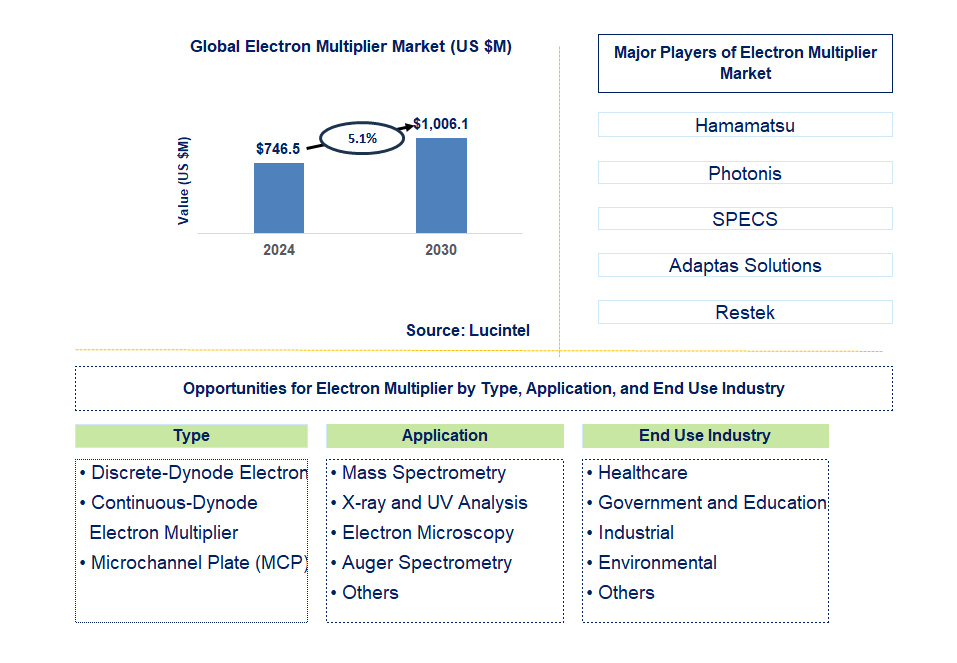
Key data points: The market size in 2030 = $1,006.1 million, growth forecasts = 5.1% annually for the next 6 years. Scroll below to get more insights. This market report covers trends, opportunities, and forecasts in the global electron multiplier market to 2030 by type (discrete-dynode electron multiplier, continuous-dynode electron multiplier, and microchannel plate (MCP), application (mass spectrometry, x-ray and uv analysis, electron microscopy, auger spectrometry, and others (night vision, leak detection, etc.), end use industry (healthcare, government and education, industrial, environmental, others (semiconductor, astronomy, etc.), and region (North America, Europe, Asia Pacific, and the Rest of the World)
We'll send your sample report shortly.
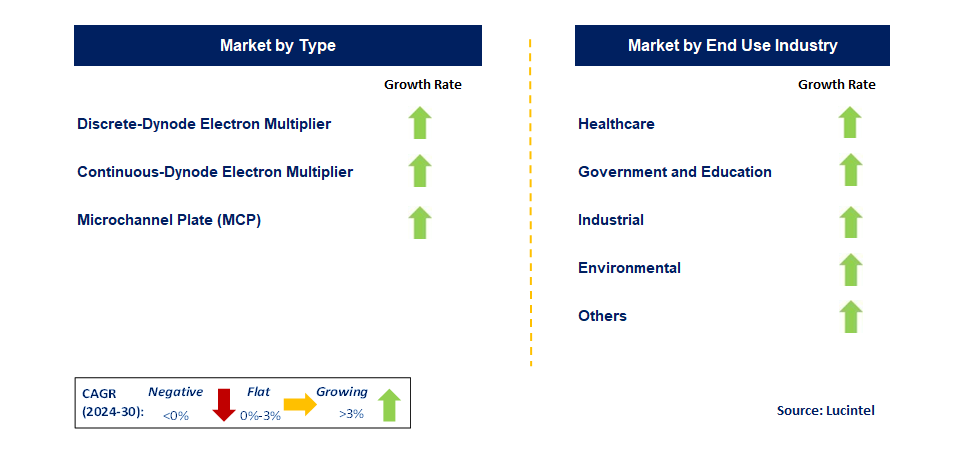
• Lucintel forecast that, within the type category, continuous-dynode electron multiplieris expected to witness highest growth over the forecast period
• Within the end use category, healthcare will remain the largest segment
• In terms of region, North America is expected to witness highest growth over the forecast period Gain Valuable insights for your business decisions with our comprehensive 150+ page report.
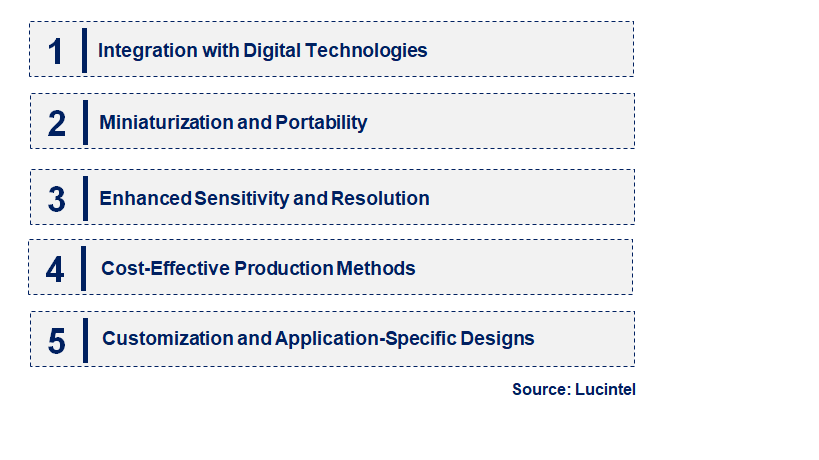
• Integration with Digital Technologies: The integration of electron multipliers with digital technologies is enhancing data acquisition and analysis. This trend involves incorporating advanced digital signal processing and data management capabilities into electron multipliers, improving their overall performance and ease of use. Digital integration allows for more precise control and real-time data analysis, which is crucial for applications requiring high accuracy. This trend is driving innovation and efficiency in analytical instruments, leading to better research outcomes and more effective industrial applications.
• Miniaturization and Portability: Miniaturization is a significant trend, with advancements aimed at creating smaller, more portable electron multipliers without compromising performance. This trend is driven by the need for compact analytical equipment in field applications and space-constrained environments. Miniaturized multipliers are being designed to offer the same level of sensitivity and accuracy as larger models while being more convenient for mobile and on-site analyses. This development is expanding the use of electron multipliers in diverse settings, including environmental monitoring and portable diagnostic tools.
• Enhanced Sensitivity and Resolution: There is a continuous push towards improving the sensitivity and resolution of electron multipliers. Manufacturers are developing new materials and technologies to enhance the detection capabilities of these devices, allowing for more accurate measurements and better resolution in mass spectrometry and other analytical techniques. Enhanced sensitivity enables the detection of lower concentrations of analytes, which is crucial for high-precision research and analysis. This trend is driving advancements in scientific research and industrial applications that require high-performance analytical instruments.
• Cost-Effective Production Methods: Cost-effective production methods are becoming increasingly important as manufacturers seek to make electron multipliers more affordable without sacrificing quality. Advances in manufacturing technologies and materials are helping reduce production costs, making high-performance electron multipliers more accessible to a broader range of users. This trend is particularly significant in emerging markets where cost constraints impact the adoption of advanced analytical technologies. By lowering costs, manufacturers can expand their market reach and support the growth of various industries and research sectors.
• Customization and Application-Specific Designs: Customization is becoming a key trend in the electron multiplier market, with manufacturers offering tailored solutions to meet specific application requirements. This includes designing multipliers with unique configurations, materials, and performance characteristics to suit particular industries or research needs. Customization allows for greater flexibility and optimization of electron multipliers, enhancing their effectiveness in diverse applications. This trend is supporting the development of specialized analytical instruments and fostering innovation across different sectors. These emerging trends are reshaping the electron multiplier market by driving technological advancements, improving performance, and expanding application areas. Integration with digital technologies, miniaturization, and enhanced sensitivity are pushing the boundaries of what electron multipliers can achieve, while cost-effective production and customization are making these devices more accessible and versatile. Collectively, these trends are enhancing the functionality and utility of electron multipliers, influencing their adoption in various fields and contributing to the ongoing evolution of the analytical instruments markete
• Advanced Material Innovations: Recent advancements in materials science have led to the development of more durable and efficient electron multipliers. Innovations such as improved phosphor coatings and advanced metal alloys are enhancing the performance and longevity of these devices. These material improvements contribute to better signal amplification, increased sensitivity, and longer operational lifespans, making electron multipliers more reliable for high-precision applications. The use of advanced materials is also enabling the creation of multipliers with reduced noise and improved resolution, further advancing analytical capabilities.
• Integration with Analytical Instruments: Electron multipliers are increasingly being integrated with advanced analytical instruments, such as mass spectrometers and chromatography systems. This integration allows for seamless data acquisition and enhanced performance in complex analyses. The development of multipliers that are specifically designed to complement and enhance the functionality of these instruments is driving innovation in the field. This trend is improving the overall efficiency and accuracy of analytical processes, making it easier for researchers and industries to obtain reliable data.
• Enhanced Digital Interfaces: The incorporation of enhanced digital interfaces into electron multipliers is revolutionizing their operation and data management. Modern multipliers now feature advanced digital controls and interfaces that facilitate real-time monitoring and data analysis. These digital enhancements are improving the ease of use, precision, and data processing capabilities of electron multipliers. Researchers and technicians can now achieve more accurate and timely results, contributing to more effective and efficient analytical workflows.
• Expansion into Emerging Markets: The expansion of electron multiplier technology into emerging markets is opening up new opportunities and applications. Manufacturers are focusing on adapting their products to meet the needs of growing economies with increasing research and industrial activities. This expansion involves developing cost-effective solutions and providing support for local industries. By entering emerging markets, companies are broadening their customer base and driving the adoption of advanced analytical technologies in regions with rising demand.
• Focus on Environmental and Health Applications: There is a growing focus on adapting electron multipliers for environmental and health applications. Recent developments include designing multipliers for use in monitoring environmental pollutants and analyzing biological samples. These specialized multipliers are tailored to meet the specific requirements of these fields, such as sensitivity to low-level contaminants or compatibility with biological matrices. This focus is expanding the utility of electron multipliers and supporting critical applications in environmental protection and healthcare. The recent developments in the electron multiplier market are driving significant advancements in technology, application versatility, and market expansion. Innovations in materials, digital interfaces, and integration with analytical instruments are enhancing the performance and usability of electron multipliers. The focus on emerging markets and specialized applications is broadening the scope of their use and supporting growth in various sectors. These developments are collectively reshaping the market and contributing to the evolution of analytical technology
• Advancements in Mass Spectrometry: Mass spectrometry is integral in chemical analysis and drug development. Recent advancements have increased the demand for more sensitive and reliable detection systems. Electron multipliers are crucial for enhancing the sensitivity and resolution of mass spectrometers, enabling the detection of trace elements and compounds with greater accuracy. This growth opportunity stems from the need for precise measurements in research and quality control, boosting demand for high-performance electron multipliers.
• Expansion in Medical Diagnostics: The medical diagnostics sector increasingly relies on advanced imaging and analytical technologies. Electron multipliers are essential in detecting low levels of radiation and enhancing imaging techniques. As diagnostic tools become more sophisticated, the need for electron multipliers in applications like PET scans and other imaging systems is growing. This trend is driven by the demand for earlier and more accurate disease detection, which is spurring innovation and market expansion.
• Growth in Environmental Monitoring: Environmental monitoring requires highly sensitive equipment to detect and analyze pollutants and radioactive substances. Electron multipliers play a critical role in these systems, improving the accuracy of environmental assessments. As regulatory requirements tighten and public awareness of environmental issues increases, the demand for advanced electron multipliers to ensure accurate monitoring and compliance is rising, creating substantial growth opportunities in this sector.
• Developments in Space Exploration: Space exploration missions rely on precise instruments to analyze extraterrestrial materials and monitor cosmic radiation. Electron multipliers are used in spaceborne instruments to detect and measure low-intensity signals from space. As space missions become more ambitious, including those to other planets and deep space, the need for robust and high-performance electron multipliers is increasing, offering significant growth potential in the aerospace sector.
• Emergence of Advanced Research Facilities: Modern research facilities, including those focused on particle physics and materials science, require advanced detection systems to handle complex experiments. Electron multipliers are vital for detecting and analyzing particles in high-energy environments. With the establishment of new research centers and the upgrading of existing facilities, there is a growing demand for state-of-the-art electron multipliers, presenting a promising growth opportunity for manufacturers in the scientific research domain. The electron multiplier market is influenced by a range of drivers and challenges stemming from technological advancements, economic factors, and regulatory environments. Understanding these factors is crucial for stakeholders aiming to navigate the market effectively and leverage emerging opportunities. The market dynamics are shaped by ongoing innovations, shifts in demand across applications, and the need to address various operational and regulatory hurdles.
• Technological Advancements: Technological progress is a primary driver of market growth. Innovations in electron multiplier design and materials enhance performance, such as improved sensitivity and durability. Advancements like miniaturization and integration with digital technologies contribute to more efficient and versatile detection systems. These developments enable new applications and expand the use of electron multipliers in emerging fields, driving market expansion and attracting investment.
• Increased Demand in Healthcare: The healthcare sector's growing need for precise diagnostic tools and imaging technologies fuels demand for electron multipliers. Enhanced diagnostic capabilities, such as those used in PET scans and MRI systems, require high-performance electron multipliers for accurate signal detection. The focus on early disease detection and personalized medicine further accelerates this demand, leading to increased market growth and innovation in medical applications.
• Expansion of Scientific Research: Scientific research, particularly in fields like particle physics and materials science, drives the need for advanced detection instruments. Electron multipliers are critical for high-energy experiments and particle detection. As research facilities upgrade their equipment and new centers emerge, the demand for cutting-edge electron multipliers grows. This expansion supports technological advancement and boosts market opportunities for suppliers.
• Regulatory Compliance: Stringent environmental and safety regulations increase the demand for accurate monitoring and detection systems. Electron multipliers are essential for meeting regulatory requirements in environmental monitoring and industrial applications. Compliance with evolving standards drives the adoption of advanced multipliers, stimulating market growth and encouraging innovations that enhance regulatory compliance.
• Growth in Aerospace and Defense: The aerospace and defense sectors' increasing focus on advanced detection and measurement systems for space missions and defense applications fuels demand for electron multipliers. These sectors require robust and sensitive instruments to analyze space samples and monitor radiation. As space exploration and defense technology advance, the need for high-performance electron multipliers continues to rise, contributing to market growth. Challenges in the electron multiplier market are:
• High Cost of Advanced Systems: The cost of developing and manufacturing advanced electron multipliers can be significant, particularly for cutting-edge technologies. High production costs may limit accessibility for smaller research facilities and emerging markets. This challenge can restrict market growth and affect the affordability of high-performance systems, necessitating strategies to reduce costs and improve cost-efficiency.
• Complexity of Integration: Integrating electron multipliers with existing systems and technologies can be complex and technically challenging. Compatibility issues and the need for specialized expertise can hinder the adoption of new multipliers in various applications. Overcoming these integration challenges requires ongoing research and development to ensure seamless compatibility and ease of use.
• Regulatory and Compliance: Issues Navigating regulatory requirements and compliance standards can be challenging for electron multiplier manufacturers. Changes in regulations or differing standards across regions may affect market entry and operational practices. Staying abreast of regulatory developments and ensuring compliance is crucial for maintaining market presence and avoiding potential legal and financial repercussions. The electron multiplier market is shaped by significant drivers, including technological advancements, growing demand in healthcare and scientific research, regulatory compliance needs, and expansion in aerospace and defense. These factors collectively propel market growth and innovation. However, challenges such as high costs, integration complexities, and regulatory hurdles must be addressed to ensure sustainable development. Balancing these drivers and challenges will be crucial for stakeholders aiming to capitalize on market opportunities while navigating the evolving landscape of the electron multiplier industry.
• Hamamatsu
• Photonis
• SPECS
• Adaptas Solutions
• Restek
• Thermo Fisher Scientific
• Penlink
• Agilent
• McPherson
• Detector Technology
• Discrete-Dynode Electron Multiplier
• Continuous-Dynode Electron Multiplier
• Microchannel Plate (MCP)
• Mass Spectrometry
• X-ray and UV Analysis
• Electron Microscopy
• Auger Spectrometry
• Others
• Healthcare
• Government and Education
• Industrial
• Environmental
• Others
• North America
• Europe
• Asia Pacific
• The Rest of the World
• United States: In the United States, advancements in electron multiplier technology have focused on improving sensitivity and operational lifespan. Companies have introduced new models with enhanced performance metrics and reliability. Innovations in material science have led to the development of more durable and efficient electron multiplier tubes, which are crucial for high-precision analytical instruments used in research and industry. The U.S. market is also witnessing increased integration of electron multipliers with digital technologies, facilitating better data processing and analysis.
• China: China has emerged as a significant player in the electron multiplier market, driven by its rapid technological growth and increasing research investments. Chinese manufacturers are advancing electron multiplier technology through cost-effective production methods and enhanced performance capabilities. The focus is on developing high-performance multipliers for applications in environmental monitoring and industrial analysis. Additionally, China is investing in research and development to achieve breakthroughs in miniaturization and integration with emerging analytical platforms.
• Germany: Germany continues to be a leader in precision engineering and has recently made strides in enhancing the efficiency of electron multipliers. German companies are focusing on developing multipliers with improved resolution and reduced noise, catering to the stringent requirements of scientific research and industrial applications. Innovations in vacuum technology and materials are also contributing to the advancements in German electron multipliers. Moreover, Germany strong emphasis on quality and reliability is driving the production of high-end multipliers with longer lifespans and greater stability.
• India: In India, the electron multiplier market is experiencing growth due to increasing investments in scientific research and industrial applications. Recent developments include the introduction of more affordable electron multiplier models, making advanced analytical technology more accessible. Indian manufacturers are focusing on improving the performance and reliability of electron multipliers to meet the growing demand in research laboratories and environmental analysis. Additionally, collaborations with international companies are helping to enhance local technological capabilities and innovation.
• Japan: Japan remains a key player in the electron multiplier market with ongoing advancements in technology and innovation. Japanese companies are leading the development of high-resolution electron multipliers that cater to sophisticated applications in spectroscopy and mass spectrometry. There is a strong focus on integrating multipliers with advanced analytical instruments and improving their performance in terms of speed and accuracy. Japan's emphasis on research and development, coupled with its expertise in electronics, continues to drive significant progress in the electron multiplier sector.


• Hamamatsu
• Photonis
• SPECS
• Adaptas Solutions
• Restek
• Thermo Fisher Scientific
• Penlink
• Agilent
• McPherson
• Detector Technology Q6. Which electron multiplier market segment will be the largest in future? Answer: Lucintel forecast that continuous-dynode electron multiplieris expected to witness highest growth over the forecast period Q7. In electron multiplier market, which region is expected to be the largest in next 5 years? Answer: North America is expected to witness highest growth over the forecast period Q.8 Do we receive customization in this report? Answer: Yes, Lucintel provides 10% customization without any additional cost.


Choose a license that fits your team. Instant PDF delivery.
Prices exclude taxes. Instant delivery. Custom licensing available on request.
Market Report · July 24, 2026
Market Report · July 20, 2026
Market Report · July 20, 2026
Trusted partner for strategic intelligence and business growth


Receive a complimentary market analysis tailored to your industry. Our analysts will identify key growth opportunities and competitive dynamics specific to your business.

Market size, growth rate, and key trend analysis for your specific sector.

Top competitor positioning and market share analysis.

Strategic recommendations backed by data-driven insights.
Get curated market intelligence and competitive moves straight to your inbox.
By subscribing, you agree to receive our monthly insights. Unsubscribe anytime.
Receive a complimentary market analysis tailored to your industry. Our analysts will identify key growth opportunities and competitive dynamics specific to your business.
Market size, growth rate, and key trend analysis for your specific sector.
Top competitor positioning and market share analysis.
Strategic recommendations backed by data-driven insights.
Get curated market intelligence, emerging trends, and competitive moves straight to your inbox each month.
By subscribing, you agree to receive our monthly insights. Unsubscribe anytime.
We'll send your sample report shortly.