
Close Lucintel Chat
Didn't Find What You're Looking for?
Call us at +1972 636 5056 or write at helpdesk@Lucintel.com
Ask an Expert Provide Custom Requirements Download Sample Report Search Available Reports
  • helpdesk@Lucintel.com
  • |
  • Call Lucintel +1 972 636 5056
  • |
  • Login
  • |
  • Register
  • |
  • Search
  • |
'
...

The Impact of COVID-19 is included in Electrodynamic Shaker System Market Report. Buy it today to get an advantage.

Request the impact of COVID-19 on your product or industry


Electrodynamic Shaker System Market Trends and Forecast

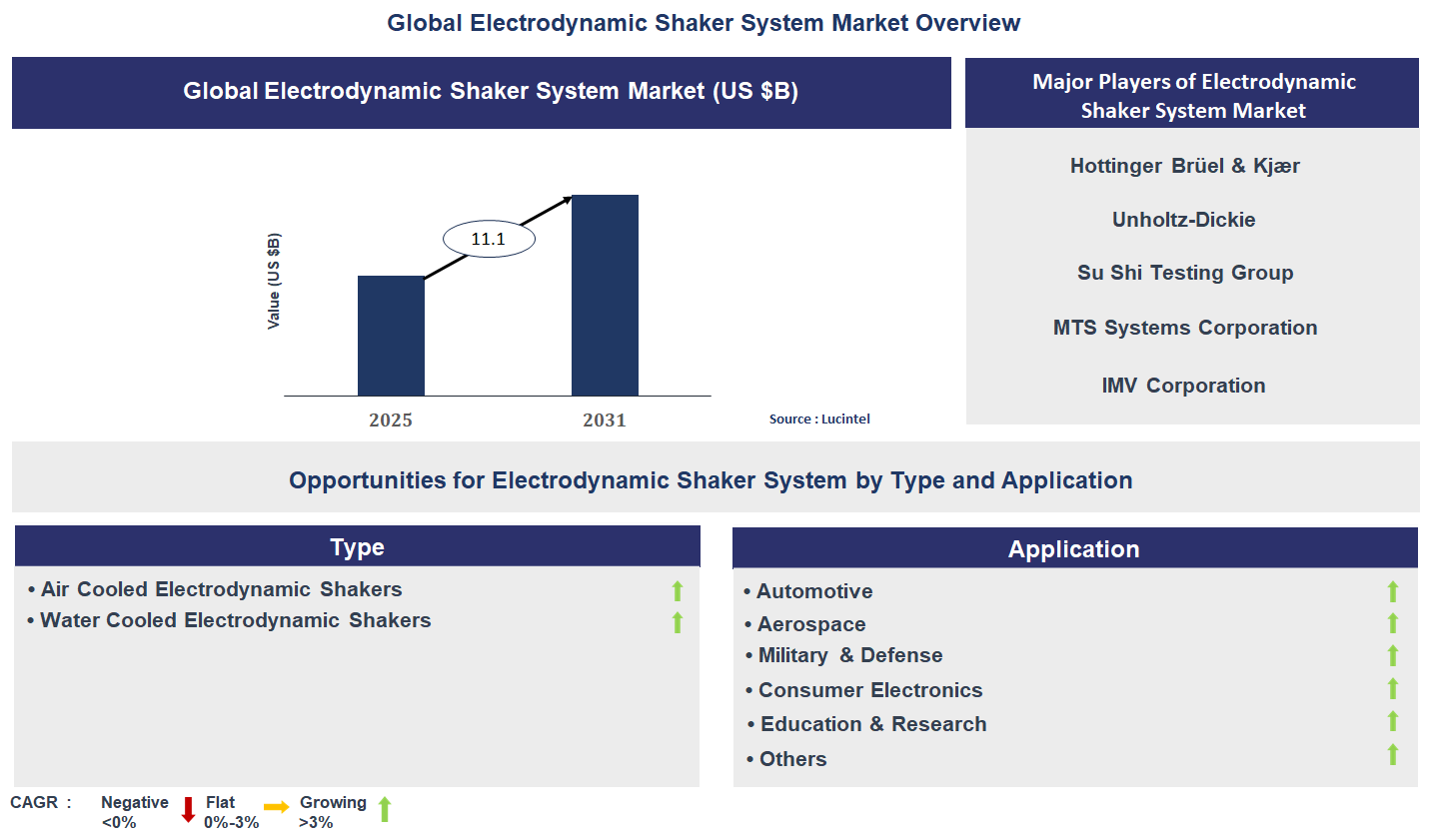
The future of the global electrodynamic shaker system market looks promising with opportunities in the automotive, aerospace, military & defense, consumer electronic, and education & research markets. The global electrodynamic shaker system market is expected to grow with a CAGR of 11.1% from 2025 to 2031. The major drivers for this market are the increasing demand from aerospace industries, the rising adoption of automated testing systems, and the growing focus on product quality standards.

• Lucintel forecasts that, within the type category, air cooled electrodynamic shaker is expected to witness higher growth over the forecast period.
• Within the application category, aerospace is expected to witness the highest growth.
• In terms of region, APAC is expected to witness the highest growth over the forecast period.
Gain valuable insights for your business decisions with our comprehensive 150+ page report. Sample figures with some insights are shown below.
Electrodynamic Shaker System Market Trends and Forecast

Emerging Trends in the Electrodynamic Shaker System Market

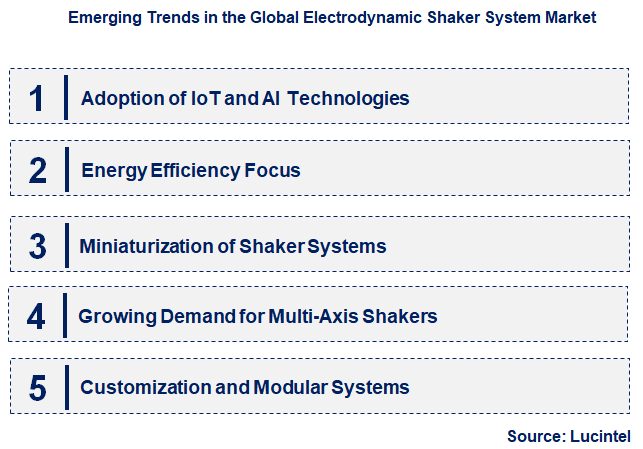
The market for the electrodynamic shaker system is experiencing revolutionary changes because of technological advancements and the requirements for more reliable, accurate, and efficient test systems. The following five trends are dominating the market.
• Adoption of IoT and AI Technologies: The combination of IoT and AI with Electrodynamic Shaker Systems is transforming the practice of vibration testing. These technologies allow for real-time acquisition and analysis of data, making it possible to have smarter, more efficient systems that can forecast maintenance requirements, optimize test processes, and enhance overall system performance. AI algorithms enable shaker systems to adjust testing parameters automatically depending on real-time conditions, enhancing testing accuracy while minimizing human error.
• Energy Efficiency Focus: As companies seek to cut operating expenses and their footprint on the environment, energy-efficient shaker systems are becoming increasingly popular. Companies are creating systems that use less energy with the same or improved testing capability. Advances in motor technology and power management are helping to make shaker systems more energy efficient, not only enabling companies to save on carbon emissions but also on the cost of operations in the long run.
• Miniaturization of Shaker Systems: There is increased focus on the miniaturization of Electrodynamic Shaker Systems, which are becoming more versatile and accessible. Smaller systems are applied to a range of applications, such as laboratory testing and portable on-site testing systems. Miniaturization permits the integration of the system in smaller test environments with greater flexibility while preserving the capability of the system for high-precision vibration testing. Such a trend is highly suited for automotive, aerospace, and electronics industries.
• Growing Demand for Multi-Axis Shakers: The use of multi-axis Electrodynamic Shaker Systems is on the rise as industries are aiming to recreate more complex real-world conditions. Multi-axis shakers provide more realistic vibration testing by exposing products to forces in more than one direction at a time. It is an important technology for industries such as aerospace and automotive, where parts need to be exposed to vibrations from different angles. Multi-axis systems provide greater understanding of product durability and performance under complex operating conditions.
• Customization and Modular Systems: Customization is emerging as a key trend in the Electrodynamic Shaker System industry, with companies producing modular systems that can be customized to meet specific test needs. Modular systems provide greater flexibility and expandability in vibration testing, enabling businesses to adjust the shaker system to accommodate various product sizes and test parameters. This trend is most applicable in industries where test demands greatly differ based on the product being tested.
These new trends are transforming the electrodynamic shaker system market by making it more accurate, efficient, and versatile in meeting varied industrial requirements. The confluence of IoT and AI, the requirement for energy-saving systems, miniaturization, multi-axis shakers, and customization are all going to lead to a market that is increasingly sophisticated and flexible. These new developments not only improve the testing process but also reduce costs, raise operational efficiency, and enhance product development cycles.
Emerging Trends in the Electrodynamic Shaker System Market

Recent Development in the Electrodynamic Shaker System Market

The electrodynamic shaker system market is developing at a fast pace, with new trends focusing on meeting the growing need for efficient, reliable, and adaptable vibration test systems. The trends are fueled by technological improvements, the necessity for more precise testing, and the ongoing expansion of industries such as aerospace, automotive, and electronics.
• Control and Software Improvements in Shaker Systems: Advanced developments in control technology and shaker system software have greatly enhanced the precision and accuracy of vibration testing. Advanced software capabilities enable more sophisticated testing procedures, making it possible to simulate more types of real-world conditions. This has enabled shaker systems to be more versatile and able to test a wider range of products, including those of highly specialized markets such as aerospace and automotive.
• High-Force Shaker Development: In order to address the requirements of industries like aerospace and defense, manufacturers have been concentrating on producing high-force electrodynamic shaker systems. These systems provide the capability to mimic harsh vibration conditions and are manufactured for testing larger, bulkier components. These developments enable more thorough testing, which makes sure that products are safe and long-lasting even under the harshest conditions.
• Development of Cooling Systems: Electrodynamic Shaker Systems produce considerable heat levels during testing that might compromise their performance and lifespan. Advances in cooling technologies within the recent past have enabled the retention of system efficiency while reducing heat accumulation. The enhanced cooling systems enable longer and more stable tests with less heating, important for industries that need to conduct prolonged testing, for instance, automotive and electronics.
• Improved System Durability and Reliability: In a bid to enhance the reliability and lifespan of shaker systems, companies are using more robust materials and components in their production. The systems are now designed with the capacity to perform under hard environmental conditions while requiring less maintenance, which means they will be able to function over time. Greater durability means fewer downtimes and lower operational costs, making these systems cost-saving in the long run.
• Move Toward Digital and Remote Monitoring: The transition towards digital and remote monitoring has revolutionized the operation and maintenance of electrodynamic shaker systems. Users are now able to monitor the systems performance in real-time with cloud-based monitoring software, which facilitates quicker diagnostics and minimizes the frequency of on-site interventions. This innovation improves operational efficiency and enables efficient predictive maintenance that can prevent businesses from spending a lot on downtime and repair.
The electrodynamic shaker system market is fast evolving with advancements in control software, high-force capacity, cooling systems, durability, and remote monitoring. These advances improve system performance, lower the cost of operation, and offer higher flexibility to vibration-testing-dependent industries. With the market still evolving, such innovations are enabling companies to satisfy increasing demands for accurate, reliable, and efficient shaker systems.

Strategic Growth Opportunities in the Electrodynamic Shaker System Market

The electrodynamic shaker system market is growing extensively in major sectors due to the rising need for accurate vibration testing and durability evaluation of products. The systems play a crucial role in applications ranging from aerospace to automotive, electronics, and industrial testing. With technological advancements, changing market needs, and requirements of increased testing precision, there are various strategic possibilities for producers to leverage. Emphasis on core applications and nascent trends provides enormous expansion opportunities for firms in this industry, allowing them to drive broader market presence and system capability.
• Increasing Testing Needs: The aerospace sector poses an expanding market for electrodynamic shaker systems, as vibration testing with high accuracy and thoroughness is required to keep pace with the evolution of sophisticated aircraft and space exploration technology. Simulating environmental conditions to test equipment like engines, fuselages, and avionics is required to help maintain reliability and safety. With increasing demands for next-generation airplanes and advanced aerospace technology, high-performance shaker systems that can replicate severe vibrations and acceleration forces are in greater demand.
• Evolution of Vehicle Testing: The automotive sector is increasingly depending on electrodynamic shaker systems for durability and safety testing of components like suspension systems, tires, and electronic systems. With growing electric vehicle (EV) and autonomous driving technology, the manufacturers require advanced vibration testing solutions that simulate real-world conditions, including high-frequency vibrations, which are especially applicable to electric vehicle systems and components. Since the auto industry is improving in terms of innovation, there is a great potential for shaker system manufacturers to increase their customer base by providing more specialized solutions for new auto technologies.
• Miniaturization and Precision Testing: With consumer electronics improving to smaller, more compact devices, the demand for precision vibration testing has grown. Shaker systems are used to test the reliability of small electronic components, including sensors, chips, and circuit boards. As IoT, wearables, and portable electronics advance, there is increasing demand for shaker systems that can simulate the stress and environmental exposure these devices will encounter in actual use.
• Renewable and Nuclear Energy Testing: The energy industry, with the renewable and nuclear energy sectors in the lead, provides considerable opportunities for electrodynamic shaker systems. Wind turbines, solar panels, and components of nuclear power plants need to be tested stringently to withstand the harsh vibrations. With the increasing worldwide emphasis on renewable power, shaker systems to replicate vibration and stress in wind turbine blades, solar inverters, and other equipment for the production of energy will be in great demand. Nuclear facilities also need serious vibration testing to ensure safety and operational dependability. This is an untapped market for manufacturers of shaker systems to offer customized high-force vibration testing solutions.
• Improved Durability Testing: The defense and military industry is a profitable market for electrodynamic shaker system producers. Testing defense equipment, vehicles, and weapons systems for their resistance to vibration conditions is essential for maintaining product operational reliability in harsh environments. As defense technology is increasingly invested in, such as unmanned systems, armored vehicles, and aerospace, there is a rising need for shaker systems that can replicate battlefield conditions and maintain equipment robustness. Organizations that specialize in the design and development of shaker systems for military use can get an upper hand in the extremely niche market.
These strategic growth prospects demonstrate the wide range of applications of electrodynamic shaker systems in industries such as aerospace, automotive, electronics, energy, and defense. Companies that specialize in providing customized, high-end solutions specific to the needs of these industries will stand to gain from the expanding demand for vibration testing. By keeping up with technology advancements and new market trends, businesses are able to increase their presence and register sustained growth in an increasingly competitive market.

Electrodynamic Shaker System Market Driver and Challenges

The electrodynamic shaker system market is influenced by various technological, economic, and regulatory forces. These drivers and challenges are key in driving the pattern of market growth and new system development. As businesses need more precise and effective testing systems, corporations have to navigate challenges such as exorbitant costs, regulatory requirements, and innovation in order to remain competitive. Identifying these important drivers and challenges will be important to stakeholders who are trying to make sound choices and make the most out of available market opportunities.
The factors responsible for driving the electrodynamic shaker system market include:
1. Innovation in Shaker Systems: Ongoing technological improvements in electrodynamic shaker systems, such as advancements in control software, sensor integration, and automation, are primary forces driving market expansion. Simulating increasingly advanced vibration profiles and enhancing the accuracy of testing enable manufacturers to deliver ever-tighter industry requirements. Improvements in AI and IoT are also facilitating smarter, real-time monitoring and predictive maintenance, enhancing system efficiency and reliability. These technologies not only enhance testing results but also lower operational expenses and increase customer satisfaction.
2. Greater Demand for High-Precision Testing: With industries like aerospace, automotive, and electronics increasingly concerned about product longevity and safety, demand for high-precision vibration testing has grown significantly. This is most obvious in fields where the failure of a single part could have disastrous repercussions, like aerospace and automotive use. The demand for more accurate and consistent testing solutions is fueling the growth of Electrodynamic Shaker Systems, especially those with the ability to mimic a greater variety of vibration frequency and forces.
3. Growth of Emerging Markets: Industrialization in emerging economies, especially Asia and Latin America, is a major stimulator for the electrodynamic shaker system market. With growing manufacturing and technology industries in these countries, there is a greater need for sophisticated testing systems. In India and China, there is fast industrial growth in sectors like automobiles, electronics, and aerospace driving the demand for more efficient and trusted vibration testing systems. Businesses that have an expanded presence in these countries can benefit from a large and emerging customer base.
4. Government Regulations and Industry Standards: Tough regulatory standards and industry guidelines for product safety, durability, and performance with respect to the environment are propelling the use of electrodynamic shaker systems. For example, the aerospace and automobile industries need components to be subjected to severe vibration tests in order to achieve safety certifications. As governments increasingly impose tougher testing laws, manufacturers will depend on shaker systems to make sure they meet these standards. This regulatory atmosphere provides a sound demand for sophisticated shaker systems in various industries.
5. Increased Emphasis on Sustainability: Sustainability is increasingly becoming a priority for industries globally, and the electrodynamic shaker system market is no different. Industries are now more likely to embrace vibration testing solutions that not only ensure performance but also help them reduce their ecological footprint. Shaker systems that are energy-efficient and consume less power while generating less waste are sought after as industries try to address sustainability objectives. The increased relevance of green technologies and eco-friendly practices is driving manufacturers to develop in accordance with these demands.
Challenges in the electrodynamic shaker system market are:
1. Premium Initial Cost of Shaker Systems: High initial equipment and installation cost are one of the primary challenges that the electrodynamic shaker system market is currently experiencing. Due to the high technology levels necessary for accurate vibration testing, these systems are quite costly, especially for small and mid-sized enterprises. Although the eventual cost savings from minimized operation expenses and enhanced testing accuracy can be afforded, high initial investment is still a major entry barrier for most prospective customers, especially in developing economies.
2. Complex Installation and Maintenance: Electrodynamic shaker systems tend to involve elaborate installation and calibration, contributing to overall cost of ownership. Also, regular maintenance and system calibration are imperative in order to provide the best performance, although expertise and time, as well as costs, may also be involved. The requirement for highly skilled personnel in order to use and support these systems also adds to overall operational complexity, complicating things for companies lacking the required expertise or means.
3. Standardization and Compliance with Regulation: Keeping up with changing industry standards and regulations is a major challenge for manufacturers and customers alike. Shaker system manufacturers have to regularly revise their products to conform to changing certification standards and global norms. Differing or non-uniform regulations in areas like different regions also make the task even more challenging, and companies find it hard to keep up with compliance in more than one market.
The electrodynamic shaker system market is influenced by major drivers like technological innovation, rising demand for high accuracy testing, and regulatory requirements. Concomitantly, drivers like high upfront costs, intricacy of maintenance, and regulation compliance continue to be hurdles to global adoption. In the face of these challenges, however, there remains ongoing expansion in the emerging markets, the emphasis on sustainability, and the demand for more accurate testing solutions pushing the market forward, creating opportunities for manufacturers that can effectively solve these challenges.

List of Electrodynamic Shaker System Companies

Companies in the market compete on the basis of product quality offered. Major players in this market focus on expanding their manufacturing facilities, R&D investments, infrastructural development, and leverage integration opportunities across the value chain. With these strategies electrodynamic shaker system companies cater increasing demand, ensure competitive effectiveness, develop innovative products & technologies, reduce production costs, and expand their customer base. Some of the electrodynamic shaker system companies profiled in this report include-
• Hottinger Brüel & Kjær
• Unholtz-Dickie
• Su Shi Testing Group
• MTS Systems Corporation
• IMV Corporation
• Data Physics Corporation
• EMIC corporation
• Thermotron Industries
• Sentek Dynamics
• TIRA

Electrodynamic Shaker System Market by Segment

The study includes a forecast for the global electrodynamic shaker system market by type, application, and region.

Electrodynamic Shaker System Market by Type [Value from 2019 to 2031]:


• Air Cooled Electrodynamic Shakers
• Water Cooled Electrodynamic Shakers

Electrodynamic Shaker System Market by Application [Value from 2019 to 2031]:


• Automotive
• Aerospace
• Military & Defense
• Consumer Electronics
• Education & Research
• Others

Electrodynamic Shaker System Market by Region [Value from 2019 to 2031]:


• North America
• Europe
• Asia Pacific
• The Rest of the World

Country Wise Outlook for the Electrodynamic Shaker System Market

The electrodynamic shaker system market is experiencing heightened growth as aerospace, automotive, and electronics industries keep calling for advanced vibration simulation and testing solutions. The market is fueled by the requirement for accurate vibration testing in product development and quality assurance procedures. Some of the countries like the United States, China, Germany, India, and Japan have experienced country-specific innovation in their shaker system technology propelled by industrial expansion, technological advancements, and increased regulatory requirements.
• United States: In the United States, the market for Electrodynamic Shaker System is dominated by the aerospace and defense industries, which depend on accurate vibration testing to certify products. Some of the recent developments involve incorporating AI and IoT functionalities into shaker systems so that real-time data can be analyzed and predictive maintenance improved. Increasing demand for environmental testing, particularly in automobile and electronics industries, is driving producers to develop systems with higher frequency ranges and precise control systems.
• China: China is experiencing rapid development of the Electrodynamic Shaker System market, driven by its growing manufacturing industries in aerospace, electronics, and automobile. The governments emphasis on technological innovation and automation has created increasing demand for high-performance shaker systems for product testing. Chinese suppliers are investing in highly sophisticated vibration testing equipment with increased durability and accuracy to compete at the international level.
• Germany: Germanys Electrodynamic Shaker System market is fueled by the countrys strong automotive, aerospace, and manufacturing industries. German firms are implementing shaker systems with increased frequency and force capabilities to support the aggressive testing specifications necessary in these fields. R&D of shaker technology is concentrated on raising energy efficiency, lowering operating noise levels, and enhancing system accuracy. Germanys firm dedication to sustainability has also established a focus on creating shaker systems that consume less energy while offering higher-precision vibration simulation.
• India: In India, the demand for Electrodynamic Shaker Systems is on the rise, especially in the automotive, defense, and electronics industries. With the expansion of these sectors, the need for reliable testing equipment to guarantee product ruggedness and safety is increasing. The producers are investing in cheaper shaker systems, making the systems affordable for a broader range of industries. Indias expanding infrastructure and manufacturing capabilities are fueling the increase in domestic production and innovation of shaker systems with emphasis on low-cost, efficient solutions to vibration testing.
• Japan: Japans market for Electrodynamic Shaker Systems is driven by Japans leadership in technology and electronics production. Japanese shaker systems are being incorporated into sophisticated test laboratories, with emphasis on high-precision vibration simulation for the automobile and electronics industries. Japanese industry is aiming at miniaturizing and lightening shaker systems and making them more performance-driven. Japans emphasis on sustainability is also leading to more energy-efficient shaker systems to suit the environmental requirements of domestic and foreign markets.

Lucintel Analytics Dashboard

Features of the Global Electrodynamic Shaker System Market

Market Size Estimates: Electrodynamic shaker system market size estimation in terms of value ($B).
Trend and Forecast Analysis: Market trends (2019 to 2024) and forecast (2025 to 2031) by various segments and regions.
Segmentation Analysis: Electrodynamic shaker system market size by type, application, and region in terms of value ($B).
Regional Analysis: Electrodynamic shaker system market breakdown by North America, Europe, Asia Pacific, and Rest of the World.
Growth Opportunities: Analysis of growth opportunities in different type, application, and regions for the electrodynamic shaker system market.
Strategic Analysis: This includes M&A, new product development, and competitive landscape of the electrodynamic shaker system market.
Analysis of competitive intensity of the industry based on Porter’s Five Forces model.

Lucintel Consulting Services

FAQ

Q1. What is the growth forecast for electrodynamic shaker system market?
Answer: The global electrodynamic shaker system market is expected to grow with a CAGR of 11.1% from 2025 to 2031.
Q2. What are the major drivers influencing the growth of the electrodynamic shaker system market?
Answer: The major drivers for this market are the increasing demand from aerospace industries, the rising adoption of automated testing systems, and the growing focus on product quality standards.
Q3. What are the major segments for electrodynamic shaker system market?
Answer: The future of the electrodynamic shaker system market looks promising with opportunities in the automotive, aerospace, military & defense, consumer electronic, and education & research markets.
Q4. Who are the key electrodynamic shaker system market companies?
Answer: Some of the key electrodynamic shaker system companies are as follows:
• Hottinger Brüel & Kjær
• Unholtz-Dickie
• Su Shi Testing Group
• MTS Systems Corporation
• IMV Corporation
• Data Physics Corporation
• EMIC corporation
• Thermotron Industries
• Sentek Dynamics
• TIRA
Q5. Which electrodynamic shaker system market segment will be the largest in future?
Answer: Lucintel forecasts that, within the type category, air cooled electrodynamic shaker is expected to witness higher growth over the forecast period.
Q6. In electrodynamic shaker system market, which region is expected to be the largest in next 5 years?
Answer: In terms of region, APAC is expected to witness the highest growth over the forecast period.
Q7. Do we receive customization in this report?
Answer: Yes, Lucintel provides 10% customization without any additional cost.

This report answers following 11 key questions:

Q.1. What are some of the most promising, high-growth opportunities for the electrodynamic shaker system market by type (air cooled electrodynamic shakers and water cooled electrodynamic shakers), application (automotive, aerospace, military & defense, consumer electronics, education & research, and others), and region (North America, Europe, Asia Pacific, and the Rest of the World)?
Q.2. Which segments will grow at a faster pace and why?
Q.3. Which region will grow at a faster pace and why?
Q.4. What are the key factors affecting market dynamics? What are the key challenges and business risks in this market?
Q.5. What are the business risks and competitive threats in this market?
Q.6. What are the emerging trends in this market and the reasons behind them?
Q.7. What are some of the changing demands of customers in the market?
Q.8. What are the new developments in the market? Which companies are leading these developments?
Q.9. Who are the major players in this market? What strategic initiatives are key players pursuing for business growth?
Q.10. What are some of the competing products in this market and how big of a threat do they pose for loss of market share by material or product substitution?
Q.11. What M&A activity has occurred in the last 5 years and what has its impact been on the industry?

For any questions related to Electrodynamic Shaker System Market, Electrodynamic Shaker System Market Size, Electrodynamic Shaker System Market Growth, Electrodynamic Shaker System Market Analysis, Electrodynamic Shaker System Market Report, Electrodynamic Shaker System Market Share, Electrodynamic Shaker System Market Trends, Electrodynamic Shaker System Market Forecast, Electrodynamic Shaker System Companies, write Lucintel analyst at email: helpdesk@lucintel.com. We will be glad to get back to you soon.
                                           Table of Contents

            1. Executive Summary

            2. Market Overview

                        2.1 Background and Classifications
                        2.2 Supply Chain

            3. Market Trends & Forecast Analysis

                        3.1 Macroeconomic Trends and Forecasts
                        3.2 Industry Drivers and Challenges
                        3.3 PESTLE Analysis
                        3.4 Patent Analysis
                        3.5 Regulatory Environment
                        3.6 Global Electrodynamic Shaker System Market Trends and Forecast

            4. Global Electrodynamic Shaker System Market by Type

                        4.1 Overview
                        4.2 Attractiveness Analysis by Type
                        4.3 Air Cooled Electrodynamic Shakers : Trends and Forecast 2025 to 2031
                        4.4 Water Cooled Electrodynamic Shakers : Trends and Forecast 2025 to 2031

            5. Global Electrodynamic Shaker System Market by Application

                        5.1 Overview
                        5.2 Attractiveness Analysis by Application
                        5.3 Automotive : Trends and Forecast 2025 to 2031
                        5.4 Aerospace : Trends and Forecast 2025 to 2031
                        5.5 Military & Defense : Trends and Forecast 2025 to 2031
                        5.6 Consumer Electronics : Trends and Forecast 2025 to 2031
                        5.7 Education & Research : Trends and Forecast 2025 to 2031
                        5.8 Others : Trends and Forecast 2025 to 2031

            6. Regional Analysis

                        6.1 Overview
                        6.2 Global Electrodynamic Shaker System Market by Region

            7. North American Electrodynamic Shaker System Market

                        7.1 Overview
                        7.2 North American Electrodynamic Shaker System Market by Type
                        7.3 North American Electrodynamic Shaker System Market by Application
                        7.4 The United States Electrodynamic Shaker System Market
                        7.5 Canadian Electrodynamic Shaker System Market
                        7.6 Mexican Electrodynamic Shaker System Market

            8. European Electrodynamic Shaker System Market

                        8.1 Overview
                        8.2 European Electrodynamic Shaker System Market by Type
                        8.3 European Electrodynamic Shaker System Market by Application
                        8.4 German Electrodynamic Shaker System Market
                        8.5 French Electrodynamic Shaker System Market
                        8.6 Italian Electrodynamic Shaker System Market
                        8.7 Spanish Electrodynamic Shaker System Market
                        8.8 The United Kingdom Electrodynamic Shaker System Market

            9. APAC Electrodynamic Shaker System Market

                        9.1 Overview
                        9.2 APAC Electrodynamic Shaker System Market by Type
                        9.3 APAC Electrodynamic Shaker System Market by Application
                        9.4 Chinese Electrodynamic Shaker System Market
                        9.5 Indian Electrodynamic Shaker System Market
                        9.6 Japanese Electrodynamic Shaker System Market
                        9.7 South Korean Electrodynamic Shaker System Market
                        9.8 Indonesian Electrodynamic Shaker System Market

            10. ROW Electrodynamic Shaker System Market

                        10.1 Overview
                        10.2 ROW Electrodynamic Shaker System Market by Type
                        10.3 ROW Electrodynamic Shaker System Market by Application
                        10.4 Middle Eastern Electrodynamic Shaker System Market
                        10.5 South American Electrodynamic Shaker System Market
                        10.6 African Electrodynamic Shaker System Market

            11. Competitor Analysis

                        11.1 Product Portfolio Analysis
                        11.2 Operational Integration
                        11.3 Porter’s Five Forces Analysis
                                    • Competitive Rivalry
                                    • Bargaining Power of Buyers
                                    • Bargaining Power of Suppliers
                                    • Threat of Substitutes
                                    • Threat of New Entrants
                        11.4 Market Share Analysis

            12. Opportunities & Strategic Analysis

                        12.1 Value Chain Analysis
                        12.2 Growth Opportunity Analysis
                                    12.2.1 Growth Opportunity by Type
                                    12.2.2 Growth Opportunity by Application
                        12.3 Emerging Trends in the Global Electrodynamic Shaker System Market
                        12.4 Strategic Analysis
                                    12.4.1 New Product Development
                                    12.4.2 Certification and Licensing
                                    12.4.3 Mergers, Acquisitions, Agreements, Collaborations, and Joint Ventures

            13. Company Profiles of the Leading Players Across the Value Chain

                        13.1 Competitive Analysis Overview
                        13.2 Hottinger Brüel & Kjær
                                    • Company Overview
                                    • Electrodynamic Shaker System Market Business Overview
                                    • New Product Development
                                    • Merger, Acquisition, and Collaboration
                                    • Certification and Licensing
                        13.3 Unholtz-Dickie
                                    • Company Overview
                                    • Electrodynamic Shaker System Market Business Overview
                                    • New Product Development
                                    • Merger, Acquisition, and Collaboration
                                    • Certification and Licensing
                        13.4 Su Shi Testing Group
                                    • Company Overview
                                    • Electrodynamic Shaker System Market Business Overview
                                    • New Product Development
                                    • Merger, Acquisition, and Collaboration
                                    • Certification and Licensing
                        13.5 MTS Systems Corporation
                                    • Company Overview
                                    • Electrodynamic Shaker System Market Business Overview
                                    • New Product Development
                                    • Merger, Acquisition, and Collaboration
                                    • Certification and Licensing
                        13.6 IMV Corporation
                                    • Company Overview
                                    • Electrodynamic Shaker System Market Business Overview
                                    • New Product Development
                                    • Merger, Acquisition, and Collaboration
                                    • Certification and Licensing
                        13.7 Data Physics Corporation
                                    • Company Overview
                                    • Electrodynamic Shaker System Market Business Overview
                                    • New Product Development
                                    • Merger, Acquisition, and Collaboration
                                    • Certification and Licensing
                        13.8 EMIC corporation
                                    • Company Overview
                                    • Electrodynamic Shaker System Market Business Overview
                                    • New Product Development
                                    • Merger, Acquisition, and Collaboration
                                    • Certification and Licensing
                        13.9 Thermotron Industries
                                    • Company Overview
                                    • Electrodynamic Shaker System Market Business Overview
                                    • New Product Development
                                    • Merger, Acquisition, and Collaboration
                                    • Certification and Licensing
                        13.10 Sentek Dynamics
                                    • Company Overview
                                    • Electrodynamic Shaker System Market Business Overview
                                    • New Product Development
                                    • Merger, Acquisition, and Collaboration
                                    • Certification and Licensing
                        13.11 TIRA
                                    • Company Overview
                                    • Electrodynamic Shaker System Market Business Overview
                                    • New Product Development
                                    • Merger, Acquisition, and Collaboration
                                    • Certification and Licensing

            14. Appendix

                        14.1 List of Figures
                        14.2 List of Tables
                        14.3 Research Methodology
                        14.4 Disclaimer
                        14.5 Copyright
                        14.6 Abbreviations and Technical Units
                        14.7 About Us
                        14.8 Contact Us

                                               List of Figures


            Chapter 1

                        Figure 1.1: Trends and Forecast for the Global Electrodynamic Shaker System Market

            Chapter 2

                        Figure 2.1: Usage of Electrodynamic Shaker System Market
                        Figure 2.2: Classification of the Global Electrodynamic Shaker System Market
                        Figure 2.3: Supply Chain of the Global Electrodynamic Shaker System Market

            Chapter 3

                        Figure 3.1: Trends of the Global GDP Growth Rate
                        Figure 3.2: Trends of the Global Population Growth Rate
                        Figure 3.3: Trends of the Global Inflation Rate
                        Figure 3.4: Trends of the Global Unemployment Rate
                        Figure 3.5: Trends of the Regional GDP Growth Rate
                        Figure 3.6: Trends of the Regional Population Growth Rate
                        Figure 3.7: Trends of the Regional Inflation Rate
                        Figure 3.8: Trends of the Regional Unemployment Rate
                        Figure 3.9: Trends of Regional Per Capita Income
                        Figure 3.10: Forecast for the Global GDP Growth Rate
                        Figure 3.11: Forecast for the Global Population Growth Rate
                        Figure 3.12: Forecast for the Global Inflation Rate
                        Figure 3.13: Forecast for the Global Unemployment Rate
                        Figure 3.14: Forecast for the Regional GDP Growth Rate
                        Figure 3.15: Forecast for the Regional Population Growth Rate
                        Figure 3.16: Forecast for the Regional Inflation Rate
                        Figure 3.17: Forecast for the Regional Unemployment Rate
                        Figure 3.18: Forecast for Regional Per Capita Income
                        Figure 3.19: Driver and Challenges of the Electrodynamic Shaker System Market

            Chapter 4

                        Figure 4.1: Global Electrodynamic Shaker System Market by Type in 2019, 2024, and 2031
                        Figure 4.2: Trends of the Global Electrodynamic Shaker System Market ($B) by Type
                        Figure 4.3: Forecast for the Global Electrodynamic Shaker System Market ($B) by Type
                        Figure 4.4: Trends and Forecast for Air Cooled Electrodynamic Shakers in the Global Electrodynamic Shaker System Market (2019-2031)
                        Figure 4.5: Trends and Forecast for Water Cooled Electrodynamic Shakers in the Global Electrodynamic Shaker System Market (2019-2031)

            Chapter 5

                        Figure 5.1: Global Electrodynamic Shaker System Market by Application in 2019, 2024, and 2031
                        Figure 5.2: Trends of the Global Electrodynamic Shaker System Market ($B) by Application
                        Figure 5.3: Forecast for the Global Electrodynamic Shaker System Market ($B) by Application
                        Figure 5.4: Trends and Forecast for Automotive in the Global Electrodynamic Shaker System Market (2019-2031)
                        Figure 5.5: Trends and Forecast for Aerospace in the Global Electrodynamic Shaker System Market (2019-2031)
                        Figure 5.6: Trends and Forecast for Military & Defense in the Global Electrodynamic Shaker System Market (2019-2031)
                        Figure 5.7: Trends and Forecast for Consumer Electronics in the Global Electrodynamic Shaker System Market (2019-2031)
                        Figure 5.8: Trends and Forecast for Education & Research in the Global Electrodynamic Shaker System Market (2019-2031)
                        Figure 5.9: Trends and Forecast for Others in the Global Electrodynamic Shaker System Market (2019-2031)

            Chapter 6

                        Figure 6.1: Trends of the Global Electrodynamic Shaker System Market ($B) by Region (2019-2024)
                        Figure 6.2: Forecast for the Global Electrodynamic Shaker System Market ($B) by Region (2025-2031)

            Chapter 7

                        Figure 7.1: Trends and Forecast for the North American Electrodynamic Shaker System Market (2019-2031)
                        Figure 7.2: North American Electrodynamic Shaker System Market by Type in 2019, 2024, and 2031
                        Figure 7.3: Trends of the North American Electrodynamic Shaker System Market ($B) by Type (2019-2024)
                        Figure 7.4: Forecast for the North American Electrodynamic Shaker System Market ($B) by Type (2025-2031)
                        Figure 7.5: North American Electrodynamic Shaker System Market by Application in 2019, 2024, and 2031
                        Figure 7.6: Trends of the North American Electrodynamic Shaker System Market ($B) by Application (2019-2024)
                        Figure 7.7: Forecast for the North American Electrodynamic Shaker System Market ($B) by Application (2025-2031)
                        Figure 7.8: Trends and Forecast for the United States Electrodynamic Shaker System Market ($B) (2019-2031)
                        Figure 7.9: Trends and Forecast for the Mexican Electrodynamic Shaker System Market ($B) (2019-2031)
                        Figure 7.10: Trends and Forecast for the Canadian Electrodynamic Shaker System Market ($B) (2019-2031)

            Chapter 8

                        Figure 8.1: Trends and Forecast for the European Electrodynamic Shaker System Market (2019-2031)
                        Figure 8.2: European Electrodynamic Shaker System Market by Type in 2019, 2024, and 2031
                        Figure 8.3: Trends of the European Electrodynamic Shaker System Market ($B) by Type (2019-2024)
                        Figure 8.4: Forecast for the European Electrodynamic Shaker System Market ($B) by Type (2025-2031)
                        Figure 8.5: European Electrodynamic Shaker System Market by Application in 2019, 2024, and 2031
                        Figure 8.6: Trends of the European Electrodynamic Shaker System Market ($B) by Application (2019-2024)
                        Figure 8.7: Forecast for the European Electrodynamic Shaker System Market ($B) by Application (2025-2031)
                        Figure 8.8: Trends and Forecast for the German Electrodynamic Shaker System Market ($B) (2019-2031)
                        Figure 8.9: Trends and Forecast for the French Electrodynamic Shaker System Market ($B) (2019-2031)
                        Figure 8.10: Trends and Forecast for the Spanish Electrodynamic Shaker System Market ($B) (2019-2031)
                        Figure 8.11: Trends and Forecast for the Italian Electrodynamic Shaker System Market ($B) (2019-2031)
                        Figure 8.12: Trends and Forecast for the United Kingdom Electrodynamic Shaker System Market ($B) (2019-2031)

            Chapter 9

                        Figure 9.1: Trends and Forecast for the APAC Electrodynamic Shaker System Market (2019-2031)
                        Figure 9.2: APAC Electrodynamic Shaker System Market by Type in 2019, 2024, and 2031
                        Figure 9.3: Trends of the APAC Electrodynamic Shaker System Market ($B) by Type (2019-2024)
                        Figure 9.4: Forecast for the APAC Electrodynamic Shaker System Market ($B) by Type (2025-2031)
                        Figure 9.5: APAC Electrodynamic Shaker System Market by Application in 2019, 2024, and 2031
                        Figure 9.6: Trends of the APAC Electrodynamic Shaker System Market ($B) by Application (2019-2024)
                        Figure 9.7: Forecast for the APAC Electrodynamic Shaker System Market ($B) by Application (2025-2031)
                        Figure 9.8: Trends and Forecast for the Japanese Electrodynamic Shaker System Market ($B) (2019-2031)
                        Figure 9.9: Trends and Forecast for the Indian Electrodynamic Shaker System Market ($B) (2019-2031)
                        Figure 9.10: Trends and Forecast for the Chinese Electrodynamic Shaker System Market ($B) (2019-2031)
                        Figure 9.11: Trends and Forecast for the South Korean Electrodynamic Shaker System Market ($B) (2019-2031)
                        Figure 9.12: Trends and Forecast for the Indonesian Electrodynamic Shaker System Market ($B) (2019-2031)

            Chapter 10

                        Figure 10.1: Trends and Forecast for the ROW Electrodynamic Shaker System Market (2019-2031)
                        Figure 10.2: ROW Electrodynamic Shaker System Market by Type in 2019, 2024, and 2031
                        Figure 10.3: Trends of the ROW Electrodynamic Shaker System Market ($B) by Type (2019-2024)
                        Figure 10.4: Forecast for the ROW Electrodynamic Shaker System Market ($B) by Type (2025-2031)
                        Figure 10.5: ROW Electrodynamic Shaker System Market by Application in 2019, 2024, and 2031
                        Figure 10.6: Trends of the ROW Electrodynamic Shaker System Market ($B) by Application (2019-2024)
                        Figure 10.7: Forecast for the ROW Electrodynamic Shaker System Market ($B) by Application (2025-2031)
                        Figure 10.8: Trends and Forecast for the Middle Eastern Electrodynamic Shaker System Market ($B) (2019-2031)
                        Figure 10.9: Trends and Forecast for the South American Electrodynamic Shaker System Market ($B) (2019-2031)
                        Figure 10.10: Trends and Forecast for the African Electrodynamic Shaker System Market ($B) (2019-2031)

            Chapter 11

                        Figure 11.1: Porter’s Five Forces Analysis of the Global Electrodynamic Shaker System Market
                        Figure 11.2: Market Share (%) of Top Players in the Global Electrodynamic Shaker System Market (2024)

            Chapter 12

                        Figure 12.1: Growth Opportunities for the Global Electrodynamic Shaker System Market by Type
                        Figure 12.2: Growth Opportunities for the Global Electrodynamic Shaker System Market by Application
                        Figure 12.3: Growth Opportunities for the Global Electrodynamic Shaker System Market by Region
                        Figure 12.4: Emerging Trends in the Global Electrodynamic Shaker System Market

                                               List of Tables


            Chapter 1

                        Table 1.1: Growth Rate (%, 2023-2024) and CAGR (%, 2025-2031) of the Electrodynamic Shaker System Market by Type and Application
                        Table 1.2: Attractiveness Analysis for the Electrodynamic Shaker System Market by Region
                        Table 1.3: Global Electrodynamic Shaker System Market Parameters and Attributes

            Chapter 3

                        Table 3.1: Trends of the Global Electrodynamic Shaker System Market (2019-2024)
                        Table 3.2: Forecast for the Global Electrodynamic Shaker System Market (2025-2031)

            Chapter 4

                        Table 4.1: Attractiveness Analysis for the Global Electrodynamic Shaker System Market by Type
                        Table 4.2: Market Size and CAGR of Various Type in the Global Electrodynamic Shaker System Market (2019-2024)
                        Table 4.3: Market Size and CAGR of Various Type in the Global Electrodynamic Shaker System Market (2025-2031)
                        Table 4.4: Trends of Air Cooled Electrodynamic Shakers in the Global Electrodynamic Shaker System Market (2019-2024)
                        Table 4.5: Forecast for Air Cooled Electrodynamic Shakers in the Global Electrodynamic Shaker System Market (2025-2031)
                        Table 4.6: Trends of Water Cooled Electrodynamic Shakers in the Global Electrodynamic Shaker System Market (2019-2024)
                        Table 4.7: Forecast for Water Cooled Electrodynamic Shakers in the Global Electrodynamic Shaker System Market (2025-2031)

            Chapter 5

                        Table 5.1: Attractiveness Analysis for the Global Electrodynamic Shaker System Market by Application
                        Table 5.2: Market Size and CAGR of Various Application in the Global Electrodynamic Shaker System Market (2019-2024)
                        Table 5.3: Market Size and CAGR of Various Application in the Global Electrodynamic Shaker System Market (2025-2031)
                        Table 5.4: Trends of Automotive in the Global Electrodynamic Shaker System Market (2019-2024)
                        Table 5.5: Forecast for Automotive in the Global Electrodynamic Shaker System Market (2025-2031)
                        Table 5.6: Trends of Aerospace in the Global Electrodynamic Shaker System Market (2019-2024)
                        Table 5.7: Forecast for Aerospace in the Global Electrodynamic Shaker System Market (2025-2031)
                        Table 5.8: Trends of Military & Defense in the Global Electrodynamic Shaker System Market (2019-2024)
                        Table 5.9: Forecast for Military & Defense in the Global Electrodynamic Shaker System Market (2025-2031)
                        Table 5.10: Trends of Consumer Electronics in the Global Electrodynamic Shaker System Market (2019-2024)
                        Table 5.11: Forecast for Consumer Electronics in the Global Electrodynamic Shaker System Market (2025-2031)
                        Table 5.12: Trends of Education & Research in the Global Electrodynamic Shaker System Market (2019-2024)
                        Table 5.13: Forecast for Education & Research in the Global Electrodynamic Shaker System Market (2025-2031)
                        Table 5.14: Trends of Others in the Global Electrodynamic Shaker System Market (2019-2024)
                        Table 5.15: Forecast for Others in the Global Electrodynamic Shaker System Market (2025-2031)

            Chapter 6

                        Table 6.1: Market Size and CAGR of Various Regions in the Global Electrodynamic Shaker System Market (2019-2024)
                        Table 6.2: Market Size and CAGR of Various Regions in the Global Electrodynamic Shaker System Market (2025-2031)

            Chapter 7

                        Table 7.1: Trends of the North American Electrodynamic Shaker System Market (2019-2024)
                        Table 7.2: Forecast for the North American Electrodynamic Shaker System Market (2025-2031)
                        Table 7.3: Market Size and CAGR of Various Type in the North American Electrodynamic Shaker System Market (2019-2024)
                        Table 7.4: Market Size and CAGR of Various Type in the North American Electrodynamic Shaker System Market (2025-2031)
                        Table 7.5: Market Size and CAGR of Various Application in the North American Electrodynamic Shaker System Market (2019-2024)
                        Table 7.6: Market Size and CAGR of Various Application in the North American Electrodynamic Shaker System Market (2025-2031)
                        Table 7.7: Trends and Forecast for the United States Electrodynamic Shaker System Market (2019-2031)
                        Table 7.8: Trends and Forecast for the Mexican Electrodynamic Shaker System Market (2019-2031)
                        Table 7.9: Trends and Forecast for the Canadian Electrodynamic Shaker System Market (2019-2031)

            Chapter 8

                        Table 8.1: Trends of the European Electrodynamic Shaker System Market (2019-2024)
                        Table 8.2: Forecast for the European Electrodynamic Shaker System Market (2025-2031)
                        Table 8.3: Market Size and CAGR of Various Type in the European Electrodynamic Shaker System Market (2019-2024)
                        Table 8.4: Market Size and CAGR of Various Type in the European Electrodynamic Shaker System Market (2025-2031)
                        Table 8.5: Market Size and CAGR of Various Application in the European Electrodynamic Shaker System Market (2019-2024)
                        Table 8.6: Market Size and CAGR of Various Application in the European Electrodynamic Shaker System Market (2025-2031)
                        Table 8.7: Trends and Forecast for the German Electrodynamic Shaker System Market (2019-2031)
                        Table 8.8: Trends and Forecast for the French Electrodynamic Shaker System Market (2019-2031)
                        Table 8.9: Trends and Forecast for the Spanish Electrodynamic Shaker System Market (2019-2031)
                        Table 8.10: Trends and Forecast for the Italian Electrodynamic Shaker System Market (2019-2031)
                        Table 8.11: Trends and Forecast for the United Kingdom Electrodynamic Shaker System Market (2019-2031)

            Chapter 9

                        Table 9.1: Trends of the APAC Electrodynamic Shaker System Market (2019-2024)
                        Table 9.2: Forecast for the APAC Electrodynamic Shaker System Market (2025-2031)
                        Table 9.3: Market Size and CAGR of Various Type in the APAC Electrodynamic Shaker System Market (2019-2024)
                        Table 9.4: Market Size and CAGR of Various Type in the APAC Electrodynamic Shaker System Market (2025-2031)
                        Table 9.5: Market Size and CAGR of Various Application in the APAC Electrodynamic Shaker System Market (2019-2024)
                        Table 9.6: Market Size and CAGR of Various Application in the APAC Electrodynamic Shaker System Market (2025-2031)
                        Table 9.7: Trends and Forecast for the Japanese Electrodynamic Shaker System Market (2019-2031)
                        Table 9.8: Trends and Forecast for the Indian Electrodynamic Shaker System Market (2019-2031)
                        Table 9.9: Trends and Forecast for the Chinese Electrodynamic Shaker System Market (2019-2031)
                        Table 9.10: Trends and Forecast for the South Korean Electrodynamic Shaker System Market (2019-2031)
                        Table 9.11: Trends and Forecast for the Indonesian Electrodynamic Shaker System Market (2019-2031)

            Chapter 10

                        Table 10.1: Trends of the ROW Electrodynamic Shaker System Market (2019-2024)
                        Table 10.2: Forecast for the ROW Electrodynamic Shaker System Market (2025-2031)
                        Table 10.3: Market Size and CAGR of Various Type in the ROW Electrodynamic Shaker System Market (2019-2024)
                        Table 10.4: Market Size and CAGR of Various Type in the ROW Electrodynamic Shaker System Market (2025-2031)
                        Table 10.5: Market Size and CAGR of Various Application in the ROW Electrodynamic Shaker System Market (2019-2024)
                        Table 10.6: Market Size and CAGR of Various Application in the ROW Electrodynamic Shaker System Market (2025-2031)
                        Table 10.7: Trends and Forecast for the Middle Eastern Electrodynamic Shaker System Market (2019-2031)
                        Table 10.8: Trends and Forecast for the South American Electrodynamic Shaker System Market (2019-2031)
                        Table 10.9: Trends and Forecast for the African Electrodynamic Shaker System Market (2019-2031)

            Chapter 11

                        Table 11.1: Product Mapping of Electrodynamic Shaker System Suppliers Based on Segments
                        Table 11.2: Operational Integration of Electrodynamic Shaker System Manufacturers
                        Table 11.3: Rankings of Suppliers Based on Electrodynamic Shaker System Revenue

            Chapter 12

                        Table 12.1: New Product Launches by Major Electrodynamic Shaker System Producers (2019-2024)
                        Table 12.2: Certification Acquired by Major Competitor in the Global Electrodynamic Shaker System Market

.

Buy full report or by chapter as follows

Limited Time Offer

Price by License Type:
[-] Hide Chapter Details
[Chapter Number] [Chapter Name] [Chapter Number Of Pages] [Chapter Price]
Title/Chapter Name Pages Price
Full Report: Electrodynamic Shaker System Market Report: Trends, Forecast and Competitive Analysis to 2031 Full Report $ 2,990
A 150 Page Report
Lucintel has been in the business of market research and management consulting since 2000 and has published over 1000 market intelligence reports in various markets / applications and served over 1,000 clients worldwide. This study is a culmination of four months of full-time effort performed by Lucintel's analyst team. The analysts used the following sources for the creation and completion of this valuable report:
  • In-depth interviews of the major players in this market
  • Detailed secondary research from competitors’ financial statements and published data 
  • Extensive searches of published works, market, and database information pertaining to industry news, company press releases, and customer intentions
  • A compilation of the experiences, judgments, and insights of Lucintel’s professionals, who have analyzed and tracked this market over the years.
Extensive research and interviews are conducted across the supply chain of this market to estimate market share, market size, trends, drivers, challenges, and forecasts. Below is a brief summary of the primary interviews that were conducted by job function for this report.
 
Thus, Lucintel compiles vast amounts of data from numerous sources, validates the integrity of that data, and performs a comprehensive analysis. Lucintel then organizes the data, its findings, and insights into a concise report designed to support the strategic decision-making process. The figure below is a graphical representation of Lucintel’s research process. 
 

Please sign in below to get report brochure - Electrodynamic Shaker System Market Report.

At Lucintel, we respect your privacy and maintain the confidentiality of information / data provided by you
(Please enter your corporate email. * These fields are mandatory )

Follow us on

