
Market Report · July 31, 2026

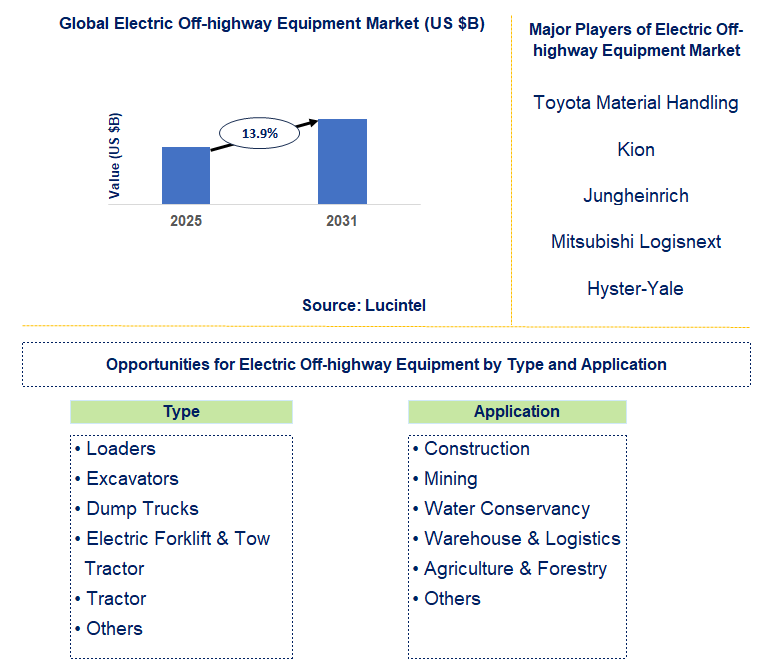
Key data points: The growth forecast = 13.9% annually for the next 7 years. Scroll below to get more insights. This market report covers trends, opportunities and forecasts in electric off-highway equipment market to 2031 by type (loaders, excavators, dump trucks, electric forklift & tow tractor, tractor, and others), application (construction, mining, water conservancy, warehouse & logistics, agriculture & forestry, and others), and region (North America, Europe, Asia Pacific, and the Rest of the World)
We'll send your sample report shortly.
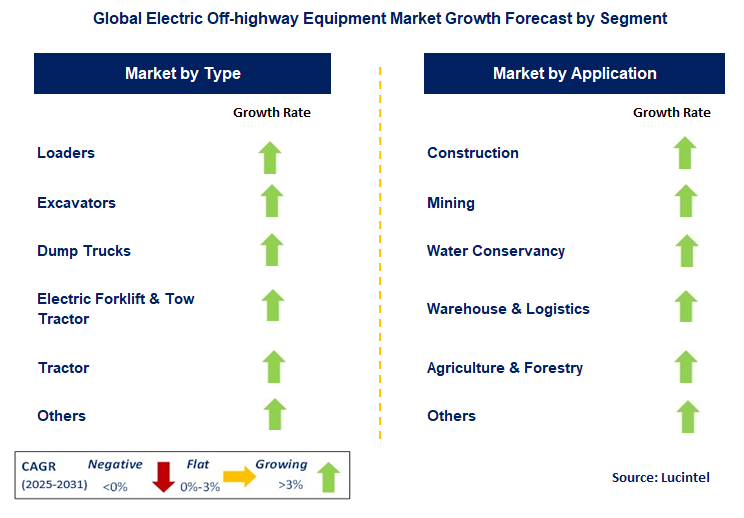
• Lucintel forecasts that, within the type category, excavator is expected to witness higher growth over the forecast period.
• Within the application category, construction is expected to witness the highest growth.
• In terms of region, APAC is expected to witness the highest growth over the forecast period. Gain valuable insights for your business decisions with our comprehensive 150+ page report. Sample figures with some insights are shown below.
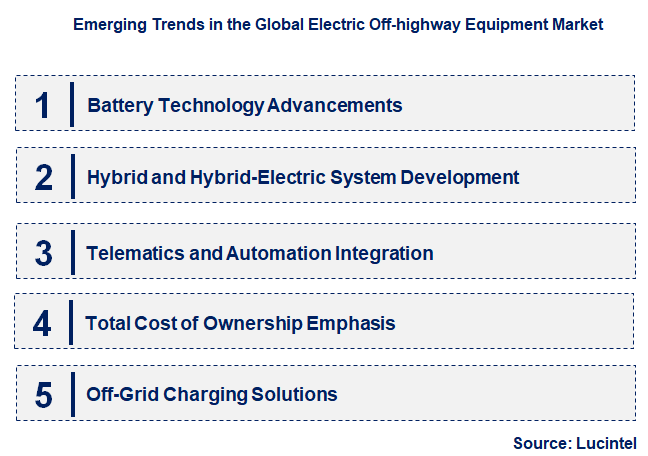
• Battery Technology Advancements: One of the most significant upcoming trends is ongoing development in battery technology. Companies are shifting toward more energy-dense batteries with high-charging speeds and greater durability. This captures one of the biggest pain points of electric off-highway equipment: the requirement for prolonged working hours and rapid recharging to maintain low downtime. The advancement of solid-state batteries and enhanced thermal management systems is a key focus area, which is directly making the electrification of heavier-duty machines possible and enhancing the viability of the market.
• Hybrid and Hybrid-Electric System Development: The advancement of hybrid and hybrid-electric systems is a prominent trend, particularly for heavy-duty applications. These vehicles pair an internal combustion engine with a motor for electric use to enhance fuel economy and lower emissions without being range-constrained by a full electric vehicle. This strategy offers a viable stepping stone for most companies to move toward electric power. It is highly effective in industries such as mining, where the electrical needs are huge and a full electric fleet is not yet practical.
• Telematics and Automation Integration: Telematics and automation integration is a major trend. Electric off-highway machinery is being more and more connected with sensors and connectivity to monitor performance in real-time, remotely diagnose, and conduct predictive maintenance. This enables operators to minimize energy usage and avoid expensive breakdowns. In addition, the creation of autonomous technologies is facilitating hauling and digging tasks to be carried out more accurately and safely, which is especially useful in dangerous conditions.
• Total Cost of Ownership Emphasis: Customers increasingly emphasize the TCO over the initial cost of purchase. Although electric machinery is more expensive initially, it provides substantial savings in the long run with less fuel consumption and lower maintenance needs. With no heavy diesel engines and hydraulic systems, there are fewer moving parts and less maintenance to be done regularly. This trend is a primary enabler for adoption since companies see the cost savings of electrification throughout the equipment's lifespan.
• Off-Grid Charging Solutions: One of the new trends is the creation of off-grid and renewable energy charging solutions. In areas such as mines or construction sites where grid access is not available, battery packs, solar panels, and mobile charging units are being created. These solutions offer the infrastructure that electric equipment needs in isolated locations. This trend is essential for reaching past the boundaries of urban markets and opening up new growth potential in a range of industries. These trends are transforming the electric off-highway equipment market at its very core by making solutions smarter, more efficient, and more accessible. The transition to advanced battery and hybrid technologies is resolving range and power issues, while emphasizing TCO is strengthening the business case for electrification. The use of telematics and automation is changing equipment from a basic machine to a connected, data-driven asset. Generally, these trends are building towards a more mature and dynamic marketplace better positioned to accommodate the needs of today's industries.
• Rollout of Fully Electric Heavy-Duty Models: One major recent innovation is the rollout of fully electric heavy-duty models by key manufacturers. These are electric excavators, haul trucks, and loaders that can deliver functions similar to diesel machines. Firms are now shifting beyond smaller equipment and are electrifying larger machines in order to meet the demands of industries such as mining and heavy construction. This move is a strong indication of the industry adopting electrification and a huge step towards mass adoption.
• Increased Development in Battery Swapping Technology: There has been an increasing trend in the evolution of battery swapping technology for off-highway machinery. This enables operators to rapidly swap a spent battery for a fully charged one, obviating the lengthy waiting period that comes with charging. This innovation is essential for applications that demand constant work and cannot entertain any downtime. By decoupling the power source from the machine, it also keeps the equipment's initial cost down, making electrification more affordable.
• Emergence of Autonomous and Semi-Autonomous Machinery: Autonomous and semi-autonomous electric off-highway machinery is a significant development. With a blend of GPS, AI, and sensors, these machines can execute tasks such as site grading or material hauling without direct human control. This innovation not only enhances productivity but also saves human lives by taking them away from unsafe environments. The electrical drivetrain is the best platform on which to deploy this technology because it offers accurate control and quiet operation.
• Emphasis on Charging Infrastructure Partnerships: One of the developments is creating partnerships among equipment makers and charging infrastructure companies. This is solving the problem of energizing large electric equipment fleets in distant locations. These alliances are driving the creation of purpose-built charging solutions, such as high-power chargers and modular charging hubs deployed on a project-by-project basis. This cooperation is critical to building the required ecosystem to enable the mass adoption of electric equipment.
• Digital Fleet Management System Integration: Integration of electric off-highway equipment with digital fleet management systems is a robust development. These systems offer real-time information on the performance of machines, battery levels, and power consumption to operators and managers. This enables improved planning in operations and resource allocation. The integration digitally allows for over-the-air software updates, enhancing machine performance and introducing new functionality without physical servicing. These innovations are significantly affecting the electric off-highway equipment market through making solutions more connected, integrated, and accessible. Increased electric heavy-duty model adoption and battery swapping technology are resolving perennial power and range issues. Autonomy and digitalization are improving equipment productivity and safety. Charging infrastructure collaboration is creating the required ecosystem for mass adoption. In total, these transitions are pushing the market toward a future in which electric off-highway equipment will be the norm, rather than the exception.
• Electrification of Construction Industry: The construction industry offers a great growth potential. The potential is to offer a complete line of electric machinery, such as excavators, loaders, and dozers, for city and indoor construction where noise and emissions are a significant issue. The advantages of silent operation and no tailpipe emissions are greatly sought after in such environments. The growth comes on the back of a mix of increased urban regulations and a quest for green building strategies.
• Automation of the Mining Industry: The mining industry provides a special opportunity for growth. Electric machinery is well-suited for the underground mining process since it emits no noxious emissions, minimizing the necessity for expensive and complicated air ventilation systems. The opportunity lies in offering electric haul trucks, drills, and loaders that can also be equipped to be integrated with automated systems to provide enhanced safety and efficiency in toxic, far-off locations. This is a high-margin niche with great potential for growth.
• Precision Farming and Agriculture: The agriculture industry is one major growth area, fueled by the necessity for sustainable and efficient farming. Electric tractors and implements provide a silent, emission-free option to diesel-driven equipment. The opportunity lies in offering machinery that can be utilized with precision farming technology to mechanize operations such as plowing, seeding, and harvesting. This market is driven by the desire to reduce operational costs and improve crop yield through better resource management.
• Material Handling and Logistics: The material handling and logistics industry presents a tremendous opportunity for growth, especially in warehouses, ports, and distribution centers. The opportunity lies in offering electric forklifts, pallet trucks, and loaders for indoor and outdoor usage. The zero-emissions advantage and less noise are greatly appreciated in these indoor or semi-indoor applications. The e-commerce and logistics growth are generating a steady level of demand for electric material handling equipment.
• Landscaping and Utility Compact Equipment: Landscaping and the utility industry offer a volume growth opportunity. The opportunity lies in the sale of electric compact excavators, skid steer loaders, and utility vehicles for landscaping, municipal, and small construction work. These end users are extremely noise and emission sensitive, and electric equipment provides a more quiet and clean solution. The reduced operating and maintenance cost makes these products an exciting investment opportunity for small and medium enterprises. These opportunities are influencing the electric off-highway equipment market by increasing its scope and value proposition. The market is transitioning from basic machine sales to offering integrated, intelligent, and application-conscious solutions. Entry into industries such as construction, mining, agriculture, and logistics is opening up the market and generating new revenue streams. These opportunities are fueling innovation, and providers are being motivated to create increasingly higher-level and specialized software that meets the advanced challenges and special needs of contemporary industries.
• Toyota Material Handling
• Kion
• Jungheinrich
• Mitsubishi Logisnext
• Hyster-Yale
• Komatsu
• Crown Equipment Corporation
• Caterpillar
• Anhui Heli
• Hangcha
• Loaders
• Excavators
• Dump Trucks
• Electric Forklift & Tow Tractor
• Tractor
• Others
• Construction
• Mining
• Water Conservancy
• Warehouse & Logistics
• Agriculture & Forestry
• Others
• North America
• Europe
• Asia Pacific
• The Rest of the World
• United States: The US market features a high emphasis on regulatory compliance and fleet electrification. With growing federal and state requirements for emissions reduction, especially in cities and for government orders, demand for zero-emission alternatives is on the upswing. Leading builders are making alliances with battery and technology firms to speed up the creation of all-electric and hybrid versions of heavy equipment for construction, mining, and agriculture. Demand for charging infrastructure specific to large-scale operation is also being strongly driven in the market.
• China: China is a world leader in the manufacture and uptake of electric off-highway machinery. This is the direct consequence of the government's tough environmental policies and a strong domestic battery production industry. The sheer volume of building and infrastructure projects, combined with an emphasis on smart cities, has developed a huge market for electric excavators, loaders, and dump trucks. Chinese producers are concerned with low-cost, high-volume production, with intense technological progress at a fast rate to cater to the local market and for export.
• Germany: The German market is characterized by a keen focus on engineering prowess, industrial automation, and high-performance products. German producers are concentrating on creating high-end electric off-highway machinery that provides higher efficiency, longer durability, and longer life of operation. The market is also experiencing a drive for integration with leading-edge telematics and smart technology to enhance performance and servicing. This emphasis on quality and innovation is making Germany a top player in high-value, specialized electric off-highway solutions.
• India: India's market is experiencing a growth spurt, driven by government policy aimed at infrastructure development and driving cleaner energy. There is an increasing need for electric off-highway machinery, especially in construction and agriculture, to combat pollution issues and save fuel expenses. The "Make in India" campaign is promoting local production and the creation of affordable yet robust solutions that are responsive to the special operating needs of the country. The market is experiencing an influx of startups and entry of well-established players into the electric domain.
• Japan: Japan's market is defined by a concentration on technological accuracy, dependability, and compactness. With a robust robotics and automation sector, Japanese producers are creating electric off-road equipment that is extremely efficient and can operate autonomously. The market is further fueled by the emphasis on safety as well as the requirement for quiet machines to be used in heavily populated cities. Recent features involve the incorporation of sophisticated battery management systems and artificial intelligence for predictive maintenance.


• Toyota Material Handling
• Kion
• Jungheinrich
• Mitsubishi Logisnext
• Hyster-Yale
• Komatsu
• Crown Equipment Corporation
• Caterpillar
• Anhui Heli
• Hangcha Q5. Which electric off-highway equipment market segment will be the largest in future? Answer: Lucintel forecasts that, within the type category, excavator is expected to witness higher growth over the forecast period. Q6. In electric off-highway equipment market, which region is expected to be the largest in next 5 years? Answer: In terms of region, APAC is expected to witness the highest growth over the forecast period. Q7. Do we receive customization in this report? Answer: Yes, Lucintel provides 10% customization without any additional cost.


Choose a license that fits your team. Instant PDF delivery.
Prices exclude taxes. Instant delivery. Custom licensing available on request.
Market Report · July 31, 2026
Market Report · July 17, 2026
Market Report · May 18, 2026
Trusted partner for strategic intelligence and business growth


Receive a complimentary market analysis tailored to your industry. Our analysts will identify key growth opportunities and competitive dynamics specific to your business.

Market size, growth rate, and key trend analysis for your specific sector.

Top competitor positioning and market share analysis.

Strategic recommendations backed by data-driven insights.
Get curated market intelligence and competitive moves straight to your inbox.
By subscribing, you agree to receive our monthly insights. Unsubscribe anytime.
Receive a complimentary market analysis tailored to your industry. Our analysts will identify key growth opportunities and competitive dynamics specific to your business.
Market size, growth rate, and key trend analysis for your specific sector.
Top competitor positioning and market share analysis.
Strategic recommendations backed by data-driven insights.
Get curated market intelligence, emerging trends, and competitive moves straight to your inbox each month.
By subscribing, you agree to receive our monthly insights. Unsubscribe anytime.
We'll send your sample report shortly.