
Close Lucintel Chat
Didn't Find What You're Looking for?
Call us at +1972 636 5056 or write at helpdesk@Lucintel.com
Ask an Expert Provide Custom Requirements Download Sample Report Search Available Reports
  • helpdesk@Lucintel.com
  • |
  • Call Lucintel +1 972 636 5056
  • |
  • Login
  • |
  • Register
  • |
  • Search
  • |
'
...

The Impact of COVID-19 is included in Electric LCV Market Report. Buy it today to get an advantage.

Request the impact of COVID-19 on your product or industry


Electric LCV Market Trends and Forecast

The future of the global electric LCV market looks promising with opportunities in the pick-up truck and van markets. The global electric LCV market is expected to grow with a CAGR of 36.3% from 2025 to 2031. The major drivers for this market are the increasing government incentives for electric commercial vehicles, the rising demand for efficient last mile delivery solutions, and the growing adoption of electric fleets by logistics companies.

• Lucintel forecasts that, within the propulsion type category, battery electric vehicle is expected to witness the highest growth over the forecast period.
• Within the vehicle type category, pick-up truck is expected to witness higher growth.
• In terms of region, APAC is expected to witness the highest growth over the forecast period.
Gain valuable insights for your business decisions with our comprehensive 150+ page report. Sample figures with some insights are shown below.
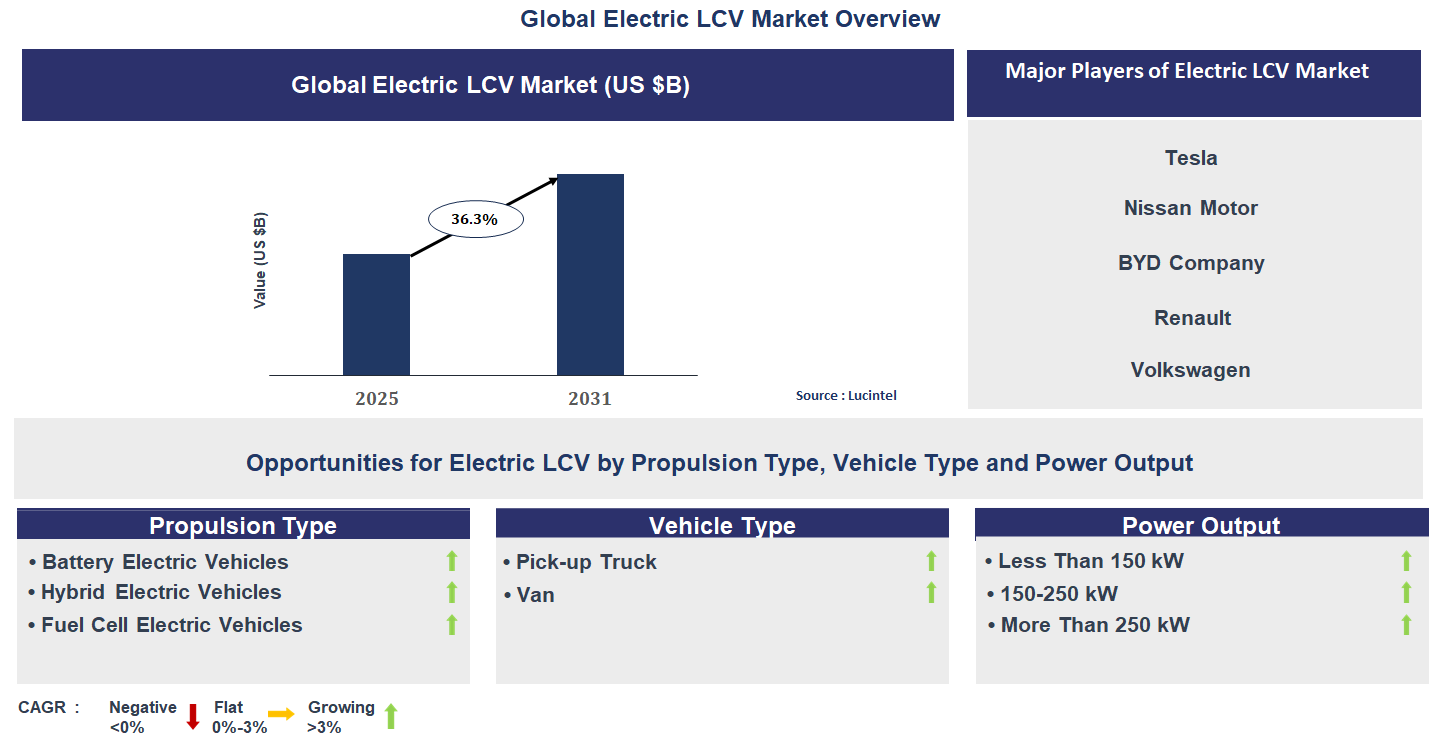
Electric LCV Market Trends and Forecast

Emerging Trends in the Electric LCV Market

Emerging electric LCV market trends in 2025 reflect a shift towards operation resilience and eco-integration, with fleets valuing uptime and regulatory compliance. Advances in batteries allow heavier payloads, and digital twins ensure optimized routes. Policymakers provide incentives for urban deployment, and manufacturers differentiate chemistries for longevity. These are shifts beyond passenger EVs, with commercial requirements such as payload and telematics being adapted.
• Modular Battery Swapping Systems: Fleets utilize swift-swapping frameworks in LCVs, with five-minute replacements at service stations, led by examples such as NIO ET7 cargo models. This concept is suitable for high-turnover logistics, keeping depot standstills to a minimum. Impacts include higher fleet utilizations, cost equivalences with diesel with energy savings, and infrastructural synergies with solar-powered facilities. In the case of countries such as China, it is speeding up rural penetrations, while internationally, it promotes standardization partnerships, simplifying scalability and recycling circuits, eventually simplifying commercial rhythms without range trade-offs.
• Telematics-Driven Predictive Maintenance: LCVs incorporate IoT sensors for instant diagnostics, predicting part failures through cloud analytics, such as in Ford E-Transit Connect. This facilitates anticipatory repairs, eliminating unexpected stops. The effect increases operational reliabilities, reduces warranty claims to operators, and opens up data monetization’s to route planners. For Europe, it supports safety directives, making driver trainings more enhanced. Economically, it keeps smaller fleets through low-cost monitoring, socially benefits workforce safeties, and environmentally optimizes energies, turning vehicles into foresight-enabled assets in dynamic logistics chains.
• Lightweight and Aerodynamic Designs: LCVs are designed by manufacturers using composite panels and aerodynamic cabs, improving ranges by 20% without extra packs, as seen in Mercedes Eitan. This offsets payload penalties in electrics. Effects comprise fuel-equivalent efficiencies on long haul, lower manufacturing footprints, and attractiveness to eco-fleets. In India, it avoids fuel-like costs on highways, triggering exports. The trend fuels material breakthroughs such as recycled carbons, reduces lifecycle emissions, and enhances market accesses, making LCVs lean performers in weight-conscious markets.
• Last-Mile Delivery Specializations: Electric LCVs transform with lockable bins and drone docking, focusing on e-commerce peaks such as Amazon Rivian EDV. Urban agility trumps speed. Effects include smooth parcel handoffs, congestion reductions in cities, and collaborations with gig platforms. China uses it for express networks, whereas the United States reduces delivery emissions. It spurs accessory ecosystems, enables micro-entrepreneurs, and interfaces with pedestrian streets, redirecting urban freights to hyper-local, low-impact models that maximize customer velocities.
• Hybrid Powertrain Hybrids: Plug-in LCVs hybridize batteries with range extenders for transitional dependability, such as Toyota Hilux REVO EVO. This fills infrastructure gaps in off-grid regions. The effect facilitates adoption for conservative operators, retains engine experience during shifts, and conforms to interim regs. Japan is aided by smooth hybrids, allowing progressive electrifications. It affects subsidy designs, informs on dual-fuel ops, and speeds full-EV transitions as chargers multiply, acting as a practical bridge to pure electrics in flexible commercial usages.
These trends transform the electric LCV market by infusing it with intelligence and flexibility, increasing throughput while reducing environmental burdens. They break down boundaries through hybrids and modularity, stimulate innovations in data and materials, and coordinate commerce with urban ecologies, solidifying LCVs as the bedrock of electrified, resilient freight models.
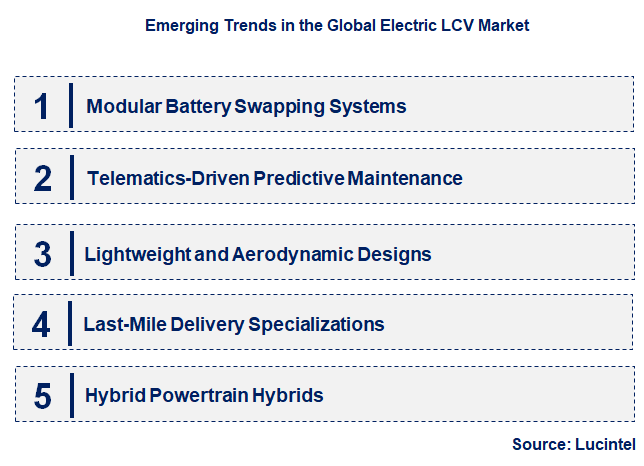
Emerging Trends in the Electric LCV Market

Recent Development in the Electric LCV Market

The latest advancements in the electric LCV market by late 2025 represent fast-forward mainstreaming, with fleets adopting zero-emission requirements and tech injections. Manufacturing spikes match delivery needs, as modular platforms hasten tailors. Supply agreements lock in minerals, and software overlays bring autonomy previews. Incentives are rebalanced to commercial sizes, branching out from cars. Such breakthroughs enhance depot efficiencies, reduce carbon emissions, and spark vocational retraining’s, positioning LCVs as flexible backbones in world trade nets.
• Expansion of Specialist Cargo Models: New electric LCVs proliferate, from micro-vans to panel trucks, for diverse payloads, such as IVECO jolly for urban deliveries. This expands SME options to businesses. The effect permeates niches, makes feature competitions fiercer, and reduces lead times through shared chassis. Market saturations mainstream electrics in trades, trigger booms in accessories, and complement warehouse automations, creating tailored fleets that resonate with operational diversities.
• Higher Energy Densities in Batteries: Cells realize denser packs, delivering 300-mile hauls in compact configurations, through silicon anodes in BYD eT3. This addresses endurance criticisms for inter-city operation. Impacts increase confidences, reduce charging frequencies, and match depot solar connections. It sparks silicon supplies, creates precision employment, and replaces diesels faster, placing LCVs within emission-free corridors that stabilize grids via bidirectional flows.
• Fleet Adoption Incentive Overhauls: EU and US policies offer rebates for bulk buybacks, driving German bonuses to revive registrations. This places the spotlight on local assemblers. The effect boosts vocational uptakes, offsets premiums, and localizes chains. It facilitates inclusive accesses through SME grants, retools factories, and harmonizes trade rules, diffusing tensions while co-developing solutions for sourcing challenges.
• Off-site Production Enlargements: India and China hubs multiply outputs, where Tata Sanand factories for Ace EVs. This avoids interruptions. Affects yield scale economies, spread assemblies, and shift know-hows. Reduced transports reduce scopes, level trades, and tailor to geographies such as monsoons, enabling risers as tech nodes in global diversified.
• Autonomy and Connectivity Integrations: LCVs connect with 5G infrastructures for convoying, such as Volvo FL Electric pilots. This makes cabs command centers. Effects maintain through updates, crowd-sourced safeties, and advise plannings. It joins peripherals, fuels coding, and greens routings, conceiving LCVs as networked intellects for IoT freights in adaptive societies.
These innovations influence the electric LCV space by enhancing stabilities, widening accesses, and adding smarts. They accelerate decarbonizations, spur economies, and claim autonomies, leading to widespread, electric freights that marry utility with environmental imperatives.

Strategic Growth Opportunities in the Electric LCV Market

Strategic opportunity for growth in the electric LCV market in 2025 is focused on application customization, tapping into LCV versatility for logistics, services, and construction. Electrification is suited to duty cycles, opening niches through powertrain adjustments and partnerships. This niches investments in swaps and sensors, leveraging fleets and trades. By aligning with applications, players capture values in risers and premiums, building strong webs that combine gains with green targets.
• Last-Mile Urban Deliveries: Maneuverable LCVs with small chassis and parcel bays opportunity in e-tails, as Bright Drop Zeva for Amazon. V2G smoothing mitigates peaks. This has a bearing on workflows through faster drops, young driver appeal. Municipal zones stimulate shares, app nets for pools, decongesting streets and cleansing airs for livable cities.
• Construction Site Transportations: Hardy LCVs with off-road torques and tool lockers specialize in builds, such as Ford E-Transit Trail. Dust-proof packs are suitable for sites. This expands reaches through site efficiencies, vacation flexes. It influences eco-builds, aftermarkets for guards, communities through supplier nets, reducing site footprints for lasting builds.
• Service and Maintenance Fleets: Multi-use LCVs with interchangeable racks for trades, such as Mercedes editor for plumbers. Inventories are tracked by telematics. This transforms B2Bs through night charges, e-service booms in China. Cost savings on services, scalabilities for gigs, green badges for companies, innovating responses that reduce mile emissions.
• Luxury Logistics Segments: Custom LCVs with climatized cabs for pharma deliveries, such as Rivian EDV luxury. AR builds unique. This elevates presences with event marketings, Japan affluents. Wealth’s to greens maintain crafts, signal ethics, propel silent powers that reshape elite freights.
• Agriculture and Rural Hauls: Long-lasting LCVs with extender ranges for farms, such as Mahindra euro Argo. Solar toppers increase duties. This unlocks tours partnerships. Affects access remotes sans fuels, rural booms, greens explorations, gateways to stewards in fields.
Such opportunities affect the electric LCV market by branching revenues, testing depths in apps from dailies to elites. They foster inclusive, dissolve silos, synchronize novelties with wants, making LCVs strong pillars in charged futures.

Electric LCV Market Driver and Challenges

The principal drivers and issues in the electric LCV industry are technological developments, economics, and regulatory pressures that drive or hinder expansions up to 2025. Drivers include mandates and greening transitions, accelerating takes in LCV cultures. Challenges arise from nets deficits and chain swings, testing scales. These dynamics shape invests, with drivers accelerating novelties and challenges requiring team solutions, determining maturations in a global context of greens.
The factors responsible for driving the electric LCV market include:
1. Stringent Emission Requirements: Governments have stringent quotas in areas, compelling LCV manufacturers to choose electrics. EU legislation and US legislation propel through penalty evasions. This pushes R&Ds on trains, ascending constructions and area fits. Reaching healthier populations, pollution health reductions, edges for fits, alignments that normalize global and accelerate de-carb activities.
2. Battery Cost Reductions: Scales in makes cut prices, tuning LCVs to masses. Solid-states cut weights, increase stores. This influences pricings, entry models compete with gases. Expands middles accesses, used trades, oil to minerals shifts, transitions that provide without drops.
3. Fleet Versatility Demands: Operators crave elevated cabs, loads in electrics, combining practical’s and creds. Emphasizes hauls, adventures. Models evos to interiors, volumes in subs. Normalizes through looks, portfolios, racks for renews, icons in charged nears.
4. Infrastructure Builds: Nets expand, fasts on roads, barriers rise. Binds embed routines. Long confides, fleet takes. Ecosystems seamless, builds ripples, loads smarts, rurales links, regions unifies.
5. Green Firm Promises: Net-zeros target, fleets to LCVs executives. Reports and changes. Contracts bulks, lines deeded. Images enhances, talents greens, charges teams, starts to climates multiplies.
Challenges in the electric LCV market are:
1. Net Charging Shortages: Rural, road gaps remain, trip fans discourage. City jams peak waits. Hampers trusts, slows turns. Funds surges, wireless nova, equity plans, divides stalls.
2. Chain Fragilities: Mineral concentrates reveal swings, costs leaps. Volas timelines. Divers starts, recycles, alts, buffers shocks, steadies scales.
3. Initial Cost Highs: Expenditures peaks gases, budgets surfacing. Finance hesitates. Curbs volumes. Lease nova, subsidy increases, savings reveals, chasms unlocks demands.
Overall, challenges and drivers provide net lifts on electric LCV market, propels such as rules, drops exceed via adapts. Strong paths, equilibrates speeds with polishes to embeds lasting, greens gains, vigor in frames.

List of Electric LCV Companies

Companies in the market compete on the basis of product quality offered. Major players in this market focus on expanding their manufacturing facilities, R&D investments, infrastructural development, and leverage integration opportunities across the value chain. With these strategies electric LCV companies cater increasing demand, ensure competitive effectiveness, develop innovative products & technologies, reduce production costs, and expand their customer base. Some of the electric LCV companies profiled in this report include-
• Tesla
• Nissan Motor
• BYD Company
• Renault
• Volkswagen
• Foton Motor Group
• Tata Motors Limited
• Mahindra and Mahindra
• Rivian Automotive
• Dongfeng Motor Corporation Limited

Electric LCV Market by Segment

The study includes a forecast for the global electric LCV market by propulsion type, vehicle type, power output, and region.

Electric LCV Market by Propulsion Type [Value from 2019 to 2031]:


• Battery Electric Vehicles
• Hybrid Electric Vehicles
• Fuel Cell Electric Vehicles

Electric LCV Market by Vehicle Type [Value from 2019 to 2031]:


• Pick-up Truck
• Van

Electric LCV Market by Power Output [Value from 2019 to 2031]:


• Less Than 150 kW
• 150-250 kW
• More Than 250 kW

Electric LCV Market by Region [Value from 2019 to 2031]:


• North America
• Europe
• Asia Pacific
• The Rest of the World

Country Wise Outlook for the Electric LCV Market

The electric LCV market changes rapidly as of late 2025, driven by requirements for effective urban logistics and emissions cuts. Fleets shift to battery-electric vans and trucks for final-mile delivery, fueled by declining battery prices and increasing charging networks. Governments introduce tougher norms, and manufacturers unveil modular designs for cargo flexibility. Adoption varies by region: the U.S. focuses on e-commerce fleet electrification, China leads in scales of production, Germany aligns with EU sustainability targets, India offers affordable alternatives for varying roads, and Japan combines hybrids with pure electric vehicles.
• United States: The United States electric light commercial vehicle market moves forward with fleet-centered innovations in the midst of e-commerce surges. Ford broadens the E-Transit offerings with increased payload capacities and over-the-air diagnostics, and General Motors Bright Drop Zeva vans win contracts with FedEx for urban deliveries. Rivian launches R1T configurations for commercial applications, with durable constructions for mixed landscapes. Federal funding propels depot charging installations, which combat city traffic congestion. Sales plateau as incentives address small fleets, with hybrid models crossing transition periods.
• China: China leads electric LCV growth through enormous domestic production and policy directives. BYD introduces e6 and T5 models optimized for express freight, adding telematics for route planning. JAC and Foton vehicles swamp markets with small cargo models, aided by zero-emission urban requirements. Exports from coastal plants increase, shaping international standards. Plug-in hybrids supplement pure electrics for highway loads, and smart connections connect cars to warehouse networks. The dominance strengthens lithium and electronics supply chains, reduces logistics expenses across the country, and makes China the hub for low-cost, high-volume electric LCV production.
• Germany: Germany electric LCV market recovers through resumed subsidies and industrial integrations. Mercedes-Benz sprinter tops with modular cargo bays and 250-mile ranges, perfect for parcel services. Volkswagen upgrades ID. Buzz Cargo for DHL fleets, with a focus on aerodynamic efficiency. BMW tests CE 04 electric scooters in parallel to vans for micro-mobility. Highway charging corridors extend under EU funding, supporting cross-border operations. Local assembly in Wolfsburg generates skilled jobs, as per emission caps. This resurgence fortifies vocational training schemes, reduces urban pollution, and enhances German engineering in sustainable logistics in Europe.
• India: India electric LCV space explodes with localized versions for different infrastructures. Mahindra e Verita Cargo leads sales, with heavy suspensions for road potholes and app-tracked payloads. Tata Ace EV versions pick up among small retailers, with quick-swap batteries for least downtime. Euler Motors introduces Hilo ad for e-rickshaw conversions. Subsidies are carried over to Tamil Nadu assembly, supporting rural charging pilots. Mid-tier entrepreneurs lead demand for affordable models with ventilated cabs.
• Japan: Japan electric LCV development combines precision engineering with incremental electrification. Nissan launches e-NV200 refreshes with enhanced regenerative systems for delivery cycles. Toyota uses Proact Electric for city couriers in matters of small footprints. Honda tests light vans at Tokyo hubs, adding hydrogen fuel cell backups. Corporate leasing benefits from tax incentives, but key-car electrics are ideal for small streets. Local battery companies such as Panasonic scale up production for dependability.

Lucintel Analytics Dashboard

Features of the Global Electric LCV Market

Market Size Estimates: Electric LCV market size estimation in terms of value ($B).
Trend and Forecast Analysis: Market trends (2019 to 2024) and forecast (2025 to 2031) by various segments and regions.
Segmentation Analysis: Electric LCV market size by propulsion type, vehicle type, power output, and region in terms of value ($B).
Regional Analysis: Electric LCV market breakdown by North America, Europe, Asia Pacific, and Rest of the World.
Growth Opportunities: Analysis of growth opportunities in different propulsion types, vehicle types, power outputs, and regions for the electric LCV market.
Strategic Analysis: This includes M&A, new product development, and competitive landscape of the electric LCV market.
Analysis of competitive intensity of the industry based on Porter’s Five Forces model.

Lucintel Consulting Services

FAQ

Q1. What is the growth forecast for electric LCV market?
Answer: The global electric LCV market is expected to grow with a CAGR of 36.3% from 2025 to 2031.
Q2. What are the major drivers influencing the growth of the electric LCV market?
Answer: The major drivers for this market are the increasing government incentives for electric commercial vehicles, the rising demand for efficient last mile delivery solutions, and the growing adoption of electric fleets by logistics companies.
Q3. What are the major segments for electric LCV market?
Answer: The future of the electric LCV market looks promising with opportunities in the pick-up truck and van markets.
Q4. Who are the key electric LCV market companies?
Answer: Some of the key electric LCV companies are as follows:
• Tesla
• Nissan Motor
• BYD Company
• Renault
• Volkswagen
• Foton Motor Group
• Tata Motors Limited
• Mahindra and Mahindra
• Rivian Automotive
• Dongfeng Motor Corporation Limited
Q5. Which electric LCV market segment will be the largest in future?
Answer: Lucintel forecasts that, within the propulsion type category, battery electric vehicle is expected to witness the highest growth over the forecast period.
Q6. In electric LCV market, which region is expected to be the largest in next 5 years?
Answer: In terms of region, APAC is expected to witness the highest growth over the forecast period.
Q7. Do we receive customization in this report?
Answer: Yes, Lucintel provides 10% customization without any additional cost.

This report answers following 11 key questions:

Q.1. What are some of the most promising, high-growth opportunities for the electric LCV market by propulsion type (battery electric vehicles, hybrid electric vehicles, and fuel cell electric vehicles), vehicle type (pick-up truck and van), power output (less than 150 kw, 150-250 kw, and more than 250 kw), and region (North America, Europe, Asia Pacific, and the Rest of the World)?
Q.2. Which segments will grow at a faster pace and why?
Q.3. Which region will grow at a faster pace and why?
Q.4. What are the key factors affecting market dynamics? What are the key challenges and business risks in this market?
Q.5. What are the business risks and competitive threats in this market?
Q.6. What are the emerging trends in this market and the reasons behind them?
Q.7. What are some of the changing demands of customers in the market?
Q.8. What are the new developments in the market? Which companies are leading these developments?
Q.9. Who are the major players in this market? What strategic initiatives are key players pursuing for business growth?
Q.10. What are some of the competing products in this market and how big of a threat do they pose for loss of market share by material or product substitution?
Q.11. What M&A activity has occurred in the last 5 years and what has its impact been on the industry?

For any questions related to Electric LCV Market, Electric LCV Market Size, Electric LCV Market Growth, Electric LCV Market Analysis, Electric LCV Market Report, Electric LCV Market Share, Electric LCV Market Trends, Electric LCV Market Forecast, Electric LCV Companies, write Lucintel analyst at email: helpdesk@lucintel.com. We will be glad to get back to you soon.
                                           Table of Contents

            1. Executive Summary

            2. Market Overview

                        2.1 Background and Classifications
                        2.2 Supply Chain

            3. Market Trends & Forecast Analysis

                        3.1 Macroeconomic Trends and Forecasts
                        3.2 Industry Drivers and Challenges
                        3.3 PESTLE Analysis
                        3.4 Patent Analysis
                        3.5 Regulatory Environment
                        3.6 Global Electric LCV Market Trends and Forecast

            4. Global Electric LCV Market by Propulsion Type

                        4.1 Overview
                        4.2 Attractiveness Analysis by Propulsion Type
                        4.3 Battery Electric Vehicles : Trends and Forecast 2025 to 2031
                        4.4 Hybrid Electric Vehicles : Trends and Forecast 2025 to 2031
                        4.5 Fuel Cell Electric Vehicles : Trends and Forecast 2025 to 2031

            5. Global Electric LCV Market by Vehicle Type

                        5.1 Overview
                        5.2 Attractiveness Analysis by Vehicle Type
                        5.3 Pick-up Truck : Trends and Forecast 2025 to 2031
                        5.4 Van : Trends and Forecast 2025 to 2031

            6. Global Electric LCV Market by Power Output

                        6.1 Overview
                        6.2 Attractiveness Analysis by Power Output
                        6.3 Less Than 150 kW : Trends and Forecast 2025 to 2031
                        6.4 150-250 kW : Trends and Forecast 2025 to 2031
                        6.5 More Than 250 kW : Trends and Forecast 2025 to 2031

            7. Regional Analysis

                        7.1 Overview
                        7.2 Global Electric LCV Market by Region

            8. North American Electric LCV Market

                        8.1 Overview
                        8.2 North American Electric LCV Market by Propulsion Type
                        8.3 North American Electric LCV Market by Vehicle Type
                        8.4 The United States Electric LCV Market
                        8.5 Canadian Electric LCV Market
                        8.6 Mexican Electric LCV Market

            9. European Electric LCV Market

                        9.1 Overview
                        9.2 European Electric LCV Market by Propulsion Type
                        9.3 European Electric LCV Market by Vehicle Type
                        9.4 German Electric LCV Market
                        9.5 French Electric LCV Market
                        9.6 Italian Electric LCV Market
                        9.7 Spanish Electric LCV Market
                        9.8 The United Kingdom Electric LCV Market

            10. APAC Electric LCV Market

                        10.1 Overview
                        10.2 APAC Electric LCV Market by Propulsion Type
                        10.3 APAC Electric LCV Market by Vehicle Type
                        10.4 Chinese Electric LCV Market
                        10.5 Indian Electric LCV Market
                        10.6 Japanese Electric LCV Market
                        10.7 South Korean Electric LCV Market
                        10.8 Indonesian Electric LCV Market

            11. ROW Electric LCV Market

                        11.1 Overview
                        11.2 ROW Electric LCV Market by Propulsion Type
                        11.3 ROW Electric LCV Market by Vehicle Type
                        11.4 Middle Eastern Electric LCV Market
                        11.5 South American Electric LCV Market
                        11.6 African Electric LCV Market

            12. Competitor Analysis

                        12.1 Product Portfolio Analysis
                        12.2 Operational Integration
                        12.3 Porter’s Five Forces Analysis
                                    • Competitive Rivalry
                                    • Bargaining Power of Buyers
                                    • Bargaining Power of Suppliers
                                    • Threat of Substitutes
                                    • Threat of New Entrants
                        12.4 Market Share Analysis

            13. Opportunities & Strategic Analysis

                        13.1 Value Chain Analysis
                        13.2 Growth Opportunity Analysis
                                    13.2.1 Growth Opportunity by Propulsion Type
                                    13.2.2 Growth Opportunity by Vehicle Type
                                    13.2.3 Growth Opportunity by Power Output
                        13.3 Emerging Trends in the Global Electric LCV Market
                        13.4 Strategic Analysis
                                    13.4.1 New Product Development
                                    13.4.2 Certification and Licensing
                                    13.4.3 Mergers, Acquisitions, Agreements, Collaborations, and Joint Ventures

            14. Company Profiles of the Leading Players Across the Value Chain

                        14.1 Competitive Analysis Overview
                        14.2 Tesla
                                    • Company Overview
                                    • Electric LCV Market Business Overview
                                    • New Product Development
                                    • Merger, Acquisition, and Collaboration
                                    • Certification and Licensing
                        14.3 Nissan Motor
                                    • Company Overview
                                    • Electric LCV Market Business Overview
                                    • New Product Development
                                    • Merger, Acquisition, and Collaboration
                                    • Certification and Licensing
                        14.4 BYD Company
                                    • Company Overview
                                    • Electric LCV Market Business Overview
                                    • New Product Development
                                    • Merger, Acquisition, and Collaboration
                                    • Certification and Licensing
                        14.5 Renault
                                    • Company Overview
                                    • Electric LCV Market Business Overview
                                    • New Product Development
                                    • Merger, Acquisition, and Collaboration
                                    • Certification and Licensing
                        14.6 Volkswagen
                                    • Company Overview
                                    • Electric LCV Market Business Overview
                                    • New Product Development
                                    • Merger, Acquisition, and Collaboration
                                    • Certification and Licensing
                        14.7 Foton Motor Group
                                    • Company Overview
                                    • Electric LCV Market Business Overview
                                    • New Product Development
                                    • Merger, Acquisition, and Collaboration
                                    • Certification and Licensing
                        14.8 Tata Motors Limited
                                    • Company Overview
                                    • Electric LCV Market Business Overview
                                    • New Product Development
                                    • Merger, Acquisition, and Collaboration
                                    • Certification and Licensing
                        14.9 Mahindra and Mahindra
                                    • Company Overview
                                    • Electric LCV Market Business Overview
                                    • New Product Development
                                    • Merger, Acquisition, and Collaboration
                                    • Certification and Licensing
                        14.10 Rivian Automotive
                                    • Company Overview
                                    • Electric LCV Market Business Overview
                                    • New Product Development
                                    • Merger, Acquisition, and Collaboration
                                    • Certification and Licensing
                        14.11 Dongfeng Motor Corporation Limited
                                    • Company Overview
                                    • Electric LCV Market Business Overview
                                    • New Product Development
                                    • Merger, Acquisition, and Collaboration
                                    • Certification and Licensing

            15. Appendix

                        15.1 List of Figures
                        15.2 List of Tables
                        15.3 Research Methodology
                        15.4 Disclaimer
                        15.5 Copyright
                        15.6 Abbreviations and Technical Units
                        15.7 About Us
                        15.8 Contact Us

                                               List of Figures


            Chapter 1

                        Figure 1.1: Trends and Forecast for the Global Electric LCV Market

            Chapter 2

                        Figure 2.1: Usage of Electric LCV Market
                        Figure 2.2: Classification of the Global Electric LCV Market
                        Figure 2.3: Supply Chain of the Global Electric LCV Market

            Chapter 3

                        Figure 3.1: Trends of the Global GDP Growth Rate
                        Figure 3.2: Trends of the Global Population Growth Rate
                        Figure 3.3: Trends of the Global Inflation Rate
                        Figure 3.4: Trends of the Global Unemployment Rate
                        Figure 3.5: Trends of the Regional GDP Growth Rate
                        Figure 3.6: Trends of the Regional Population Growth Rate
                        Figure 3.7: Trends of the Regional Inflation Rate
                        Figure 3.8: Trends of the Regional Unemployment Rate
                        Figure 3.9: Trends of Regional Per Capita Income
                        Figure 3.10: Forecast for the Global GDP Growth Rate
                        Figure 3.11: Forecast for the Global Population Growth Rate
                        Figure 3.12: Forecast for the Global Inflation Rate
                        Figure 3.13: Forecast for the Global Unemployment Rate
                        Figure 3.14: Forecast for the Regional GDP Growth Rate
                        Figure 3.15: Forecast for the Regional Population Growth Rate
                        Figure 3.16: Forecast for the Regional Inflation Rate
                        Figure 3.17: Forecast for the Regional Unemployment Rate
                        Figure 3.18: Forecast for Regional Per Capita Income
                        Figure 3.19: Driver and Challenges of the Electric LCV Market

            Chapter 4

                        Figure 4.1: Global Electric LCV Market by Propulsion Type in 2019, 2024, and 2031
                        Figure 4.2: Trends of the Global Electric LCV Market ($B) by Propulsion Type
                        Figure 4.3: Forecast for the Global Electric LCV Market ($B) by Propulsion Type
                        Figure 4.4: Trends and Forecast for Battery Electric Vehicles in the Global Electric LCV Market (2019-2031)
                        Figure 4.5: Trends and Forecast for Hybrid Electric Vehicles in the Global Electric LCV Market (2019-2031)
                        Figure 4.6: Trends and Forecast for Fuel Cell Electric Vehicles in the Global Electric LCV Market (2019-2031)

            Chapter 5

                        Figure 5.1: Global Electric LCV Market by Vehicle Type in 2019, 2024, and 2031
                        Figure 5.2: Trends of the Global Electric LCV Market ($B) by Vehicle Type
                        Figure 5.3: Forecast for the Global Electric LCV Market ($B) by Vehicle Type
                        Figure 5.4: Trends and Forecast for Pick-up Truck in the Global Electric LCV Market (2019-2031)
                        Figure 5.5: Trends and Forecast for Van in the Global Electric LCV Market (2019-2031)

            Chapter 6

                        Figure 6.1: Global Electric LCV Market by Power Output in 2019, 2024, and 2031
                        Figure 6.2: Trends of the Global Electric LCV Market ($B) by Power Output
                        Figure 6.3: Forecast for the Global Electric LCV Market ($B) by Power Output
                        Figure 6.4: Trends and Forecast for Less Than 150 kW in the Global Electric LCV Market (2019-2031)
                        Figure 6.5: Trends and Forecast for 150-250 kW in the Global Electric LCV Market (2019-2031)
                        Figure 6.6: Trends and Forecast for More Than 250 kW in the Global Electric LCV Market (2019-2031)

            Chapter 7

                        Figure 7.1: Trends of the Global Electric LCV Market ($B) by Region (2019-2024)
                        Figure 7.2: Forecast for the Global Electric LCV Market ($B) by Region (2025-2031)

            Chapter 8

                        Figure 8.1: Trends and Forecast for the North American Electric LCV Market (2019-2031)
                        Figure 8.2: North American Electric LCV Market by Propulsion Type in 2019, 2024, and 2031
                        Figure 8.3: Trends of the North American Electric LCV Market ($B) by Propulsion Type (2019-2024)
                        Figure 8.4: Forecast for the North American Electric LCV Market ($B) by Propulsion Type (2025-2031)
                        Figure 8.5: North American Electric LCV Market by Vehicle Type in 2019, 2024, and 2031
                        Figure 8.6: Trends of the North American Electric LCV Market ($B) by Vehicle Type (2019-2024)
                        Figure 8.7: Forecast for the North American Electric LCV Market ($B) by Vehicle Type (2025-2031)
                        Figure 8.8: North American Electric LCV Market by Power Output in 2019, 2024, and 2031
                        Figure 8.9: Trends of the North American Electric LCV Market ($B) by Power Output (2019-2024)
                        Figure 8.10: Forecast for the North American Electric LCV Market ($B) by Power Output (2025-2031)
                        Figure 8.11: Trends and Forecast for the United States Electric LCV Market ($B) (2019-2031)
                        Figure 8.12: Trends and Forecast for the Mexican Electric LCV Market ($B) (2019-2031)
                        Figure 8.13: Trends and Forecast for the Canadian Electric LCV Market ($B) (2019-2031)

            Chapter 9

                        Figure 9.1: Trends and Forecast for the European Electric LCV Market (2019-2031)
                        Figure 9.2: European Electric LCV Market by Propulsion Type in 2019, 2024, and 2031
                        Figure 9.3: Trends of the European Electric LCV Market ($B) by Propulsion Type (2019-2024)
                        Figure 9.4: Forecast for the European Electric LCV Market ($B) by Propulsion Type (2025-2031)
                        Figure 9.5: European Electric LCV Market by Vehicle Type in 2019, 2024, and 2031
                        Figure 9.6: Trends of the European Electric LCV Market ($B) by Vehicle Type (2019-2024)
                        Figure 9.7: Forecast for the European Electric LCV Market ($B) by Vehicle Type (2025-2031)
                        Figure 9.8: European Electric LCV Market by Power Output in 2019, 2024, and 2031
                        Figure 9.9: Trends of the European Electric LCV Market ($B) by Power Output (2019-2024)
                        Figure 9.10: Forecast for the European Electric LCV Market ($B) by Power Output (2025-2031)
                        Figure 9.11: Trends and Forecast for the German Electric LCV Market ($B) (2019-2031)
                        Figure 9.12: Trends and Forecast for the French Electric LCV Market ($B) (2019-2031)
                        Figure 9.13: Trends and Forecast for the Spanish Electric LCV Market ($B) (2019-2031)
                        Figure 9.14: Trends and Forecast for the Italian Electric LCV Market ($B) (2019-2031)
                        Figure 9.15: Trends and Forecast for the United Kingdom Electric LCV Market ($B) (2019-2031)

            Chapter 10

                        Figure 10.1: Trends and Forecast for the APAC Electric LCV Market (2019-2031)
                        Figure 10.2: APAC Electric LCV Market by Propulsion Type in 2019, 2024, and 2031
                        Figure 10.3: Trends of the APAC Electric LCV Market ($B) by Propulsion Type (2019-2024)
                        Figure 10.4: Forecast for the APAC Electric LCV Market ($B) by Propulsion Type (2025-2031)
                        Figure 10.5: APAC Electric LCV Market by Vehicle Type in 2019, 2024, and 2031
                        Figure 10.6: Trends of the APAC Electric LCV Market ($B) by Vehicle Type (2019-2024)
                        Figure 10.7: Forecast for the APAC Electric LCV Market ($B) by Vehicle Type (2025-2031)
                        Figure 10.8: APAC Electric LCV Market by Power Output in 2019, 2024, and 2031
                        Figure 10.9: Trends of the APAC Electric LCV Market ($B) by Power Output (2019-2024)
                        Figure 10.10: Forecast for the APAC Electric LCV Market ($B) by Power Output (2025-2031)
                        Figure 10.11: Trends and Forecast for the Japanese Electric LCV Market ($B) (2019-2031)
                        Figure 10.12: Trends and Forecast for the Indian Electric LCV Market ($B) (2019-2031)
                        Figure 10.13: Trends and Forecast for the Chinese Electric LCV Market ($B) (2019-2031)
                        Figure 10.14: Trends and Forecast for the South Korean Electric LCV Market ($B) (2019-2031)
                        Figure 10.15: Trends and Forecast for the Indonesian Electric LCV Market ($B) (2019-2031)

            Chapter 11

                        Figure 11.1: Trends and Forecast for the ROW Electric LCV Market (2019-2031)
                        Figure 11.2: ROW Electric LCV Market by Propulsion Type in 2019, 2024, and 2031
                        Figure 11.3: Trends of the ROW Electric LCV Market ($B) by Propulsion Type (2019-2024)
                        Figure 11.4: Forecast for the ROW Electric LCV Market ($B) by Propulsion Type (2025-2031)
                        Figure 11.5: ROW Electric LCV Market by Vehicle Type in 2019, 2024, and 2031
                        Figure 11.6: Trends of the ROW Electric LCV Market ($B) by Vehicle Type (2019-2024)
                        Figure 11.7: Forecast for the ROW Electric LCV Market ($B) by Vehicle Type (2025-2031)
                        Figure 11.8: ROW Electric LCV Market by Power Output in 2019, 2024, and 2031
                        Figure 11.9: Trends of the ROW Electric LCV Market ($B) by Power Output (2019-2024)
                        Figure 11.10: Forecast for the ROW Electric LCV Market ($B) by Power Output (2025-2031)
                        Figure 11.11: Trends and Forecast for the Middle Eastern Electric LCV Market ($B) (2019-2031)
                        Figure 11.12: Trends and Forecast for the South American Electric LCV Market ($B) (2019-2031)
                        Figure 11.13: Trends and Forecast for the African Electric LCV Market ($B) (2019-2031)

            Chapter 12

                        Figure 12.1: Porter’s Five Forces Analysis of the Global Electric LCV Market
                        Figure 12.2: Market Share (%) of Top Players in the Global Electric LCV Market (2024)

            Chapter 13

                        Figure 13.1: Growth Opportunities for the Global Electric LCV Market by Propulsion Type
                        Figure 13.2: Growth Opportunities for the Global Electric LCV Market by Vehicle Type
                        Figure 13.3: Growth Opportunities for the Global Electric LCV Market by Power Output
                        Figure 13.4: Growth Opportunities for the Global Electric LCV Market by Region
                        Figure 13.5: Emerging Trends in the Global Electric LCV Market

                                               List of Tables


            Chapter 1

                        Table 1.1: Growth Rate (%, 2023-2024) and CAGR (%, 2025-2031) of the Electric LCV Market by Propulsion Type, Vehicle Type, and Power Output
                        Table 1.2: Attractiveness Analysis for the Electric LCV Market by Region
                        Table 1.3: Global Electric LCV Market Parameters and Attributes

            Chapter 3

                        Table 3.1: Trends of the Global Electric LCV Market (2019-2024)
                        Table 3.2: Forecast for the Global Electric LCV Market (2025-2031)

            Chapter 4

                        Table 4.1: Attractiveness Analysis for the Global Electric LCV Market by Propulsion Type
                        Table 4.2: Market Size and CAGR of Various Propulsion Type in the Global Electric LCV Market (2019-2024)
                        Table 4.3: Market Size and CAGR of Various Propulsion Type in the Global Electric LCV Market (2025-2031)
                        Table 4.4: Trends of Battery Electric Vehicles in the Global Electric LCV Market (2019-2024)
                        Table 4.5: Forecast for Battery Electric Vehicles in the Global Electric LCV Market (2025-2031)
                        Table 4.6: Trends of Hybrid Electric Vehicles in the Global Electric LCV Market (2019-2024)
                        Table 4.7: Forecast for Hybrid Electric Vehicles in the Global Electric LCV Market (2025-2031)
                        Table 4.8: Trends of Fuel Cell Electric Vehicles in the Global Electric LCV Market (2019-2024)
                        Table 4.9: Forecast for Fuel Cell Electric Vehicles in the Global Electric LCV Market (2025-2031)

            Chapter 5

                        Table 5.1: Attractiveness Analysis for the Global Electric LCV Market by Vehicle Type
                        Table 5.2: Market Size and CAGR of Various Vehicle Type in the Global Electric LCV Market (2019-2024)
                        Table 5.3: Market Size and CAGR of Various Vehicle Type in the Global Electric LCV Market (2025-2031)
                        Table 5.4: Trends of Pick-up Truck in the Global Electric LCV Market (2019-2024)
                        Table 5.5: Forecast for Pick-up Truck in the Global Electric LCV Market (2025-2031)
                        Table 5.6: Trends of Van in the Global Electric LCV Market (2019-2024)
                        Table 5.7: Forecast for Van in the Global Electric LCV Market (2025-2031)

            Chapter 6

                        Table 6.1: Attractiveness Analysis for the Global Electric LCV Market by Power Output
                        Table 6.2: Market Size and CAGR of Various Power Output in the Global Electric LCV Market (2019-2024)
                        Table 6.3: Market Size and CAGR of Various Power Output in the Global Electric LCV Market (2025-2031)
                        Table 6.4: Trends of Less Than 150 kW in the Global Electric LCV Market (2019-2024)
                        Table 6.5: Forecast for Less Than 150 kW in the Global Electric LCV Market (2025-2031)
                        Table 6.6: Trends of 150-250 kW in the Global Electric LCV Market (2019-2024)
                        Table 6.7: Forecast for 150-250 kW in the Global Electric LCV Market (2025-2031)
                        Table 6.8: Trends of More Than 250 kW in the Global Electric LCV Market (2019-2024)
                        Table 6.9: Forecast for More Than 250 kW in the Global Electric LCV Market (2025-2031)

            Chapter 7

                        Table 7.1: Market Size and CAGR of Various Regions in the Global Electric LCV Market (2019-2024)
                        Table 7.2: Market Size and CAGR of Various Regions in the Global Electric LCV Market (2025-2031)

            Chapter 8

                        Table 8.1: Trends of the North American Electric LCV Market (2019-2024)
                        Table 8.2: Forecast for the North American Electric LCV Market (2025-2031)
                        Table 8.3: Market Size and CAGR of Various Propulsion Type in the North American Electric LCV Market (2019-2024)
                        Table 8.4: Market Size and CAGR of Various Propulsion Type in the North American Electric LCV Market (2025-2031)
                        Table 8.5: Market Size and CAGR of Various Vehicle Type in the North American Electric LCV Market (2019-2024)
                        Table 8.6: Market Size and CAGR of Various Vehicle Type in the North American Electric LCV Market (2025-2031)
                        Table 8.7: Market Size and CAGR of Various Power Output in the North American Electric LCV Market (2019-2024)
                        Table 8.8: Market Size and CAGR of Various Power Output in the North American Electric LCV Market (2025-2031)
                        Table 8.9: Trends and Forecast for the United States Electric LCV Market (2019-2031)
                        Table 8.10: Trends and Forecast for the Mexican Electric LCV Market (2019-2031)
                        Table 8.11: Trends and Forecast for the Canadian Electric LCV Market (2019-2031)

            Chapter 9

                        Table 9.1: Trends of the European Electric LCV Market (2019-2024)
                        Table 9.2: Forecast for the European Electric LCV Market (2025-2031)
                        Table 9.3: Market Size and CAGR of Various Propulsion Type in the European Electric LCV Market (2019-2024)
                        Table 9.4: Market Size and CAGR of Various Propulsion Type in the European Electric LCV Market (2025-2031)
                        Table 9.5: Market Size and CAGR of Various Vehicle Type in the European Electric LCV Market (2019-2024)
                        Table 9.6: Market Size and CAGR of Various Vehicle Type in the European Electric LCV Market (2025-2031)
                        Table 9.7: Market Size and CAGR of Various Power Output in the European Electric LCV Market (2019-2024)
                        Table 9.8: Market Size and CAGR of Various Power Output in the European Electric LCV Market (2025-2031)
                        Table 9.9: Trends and Forecast for the German Electric LCV Market (2019-2031)
                        Table 9.10: Trends and Forecast for the French Electric LCV Market (2019-2031)
                        Table 9.11: Trends and Forecast for the Spanish Electric LCV Market (2019-2031)
                        Table 9.12: Trends and Forecast for the Italian Electric LCV Market (2019-2031)
                        Table 9.13: Trends and Forecast for the United Kingdom Electric LCV Market (2019-2031)

            Chapter 10

                        Table 10.1: Trends of the APAC Electric LCV Market (2019-2024)
                        Table 10.2: Forecast for the APAC Electric LCV Market (2025-2031)
                        Table 10.3: Market Size and CAGR of Various Propulsion Type in the APAC Electric LCV Market (2019-2024)
                        Table 10.4: Market Size and CAGR of Various Propulsion Type in the APAC Electric LCV Market (2025-2031)
                        Table 10.5: Market Size and CAGR of Various Vehicle Type in the APAC Electric LCV Market (2019-2024)
                        Table 10.6: Market Size and CAGR of Various Vehicle Type in the APAC Electric LCV Market (2025-2031)
                        Table 10.7: Market Size and CAGR of Various Power Output in the APAC Electric LCV Market (2019-2024)
                        Table 10.8: Market Size and CAGR of Various Power Output in the APAC Electric LCV Market (2025-2031)
                        Table 10.9: Trends and Forecast for the Japanese Electric LCV Market (2019-2031)
                        Table 10.10: Trends and Forecast for the Indian Electric LCV Market (2019-2031)
                        Table 10.11: Trends and Forecast for the Chinese Electric LCV Market (2019-2031)
                        Table 10.12: Trends and Forecast for the South Korean Electric LCV Market (2019-2031)
                        Table 10.13: Trends and Forecast for the Indonesian Electric LCV Market (2019-2031)

            Chapter 11

                        Table 11.1: Trends of the ROW Electric LCV Market (2019-2024)
                        Table 11.2: Forecast for the ROW Electric LCV Market (2025-2031)
                        Table 11.3: Market Size and CAGR of Various Propulsion Type in the ROW Electric LCV Market (2019-2024)
                        Table 11.4: Market Size and CAGR of Various Propulsion Type in the ROW Electric LCV Market (2025-2031)
                        Table 11.5: Market Size and CAGR of Various Vehicle Type in the ROW Electric LCV Market (2019-2024)
                        Table 11.6: Market Size and CAGR of Various Vehicle Type in the ROW Electric LCV Market (2025-2031)
                        Table 11.7: Market Size and CAGR of Various Power Output in the ROW Electric LCV Market (2019-2024)
                        Table 11.8: Market Size and CAGR of Various Power Output in the ROW Electric LCV Market (2025-2031)
                        Table 11.9: Trends and Forecast for the Middle Eastern Electric LCV Market (2019-2031)
                        Table 11.10: Trends and Forecast for the South American Electric LCV Market (2019-2031)
                        Table 11.11: Trends and Forecast for the African Electric LCV Market (2019-2031)

            Chapter 12

                        Table 12.1: Product Mapping of Electric LCV Suppliers Based on Segments
                        Table 12.2: Operational Integration of Electric LCV Manufacturers
                        Table 12.3: Rankings of Suppliers Based on Electric LCV Revenue

            Chapter 13

                        Table 13.1: New Product Launches by Major Electric LCV Producers (2019-2024)
                        Table 13.2: Certification Acquired by Major Competitor in the Global Electric LCV Market

.

Buy full report or by chapter as follows

Limited Time Offer

Price by License Type:
[-] Hide Chapter Details
[Chapter Number] [Chapter Name] [Chapter Number Of Pages] [Chapter Price]
Title/Chapter Name Pages Price
Full Report: Electric LCV Market Report: Trends, Forecast and Competitive Analysis to 2031 Full Report $ 2,990
A 150 Page Report
Lucintel has been in the business of market research and management consulting since 2000 and has published over 1000 market intelligence reports in various markets / applications and served over 1,000 clients worldwide. This study is a culmination of four months of full-time effort performed by Lucintel's analyst team. The analysts used the following sources for the creation and completion of this valuable report:
  • In-depth interviews of the major players in this market
  • Detailed secondary research from competitors’ financial statements and published data 
  • Extensive searches of published works, market, and database information pertaining to industry news, company press releases, and customer intentions
  • A compilation of the experiences, judgments, and insights of Lucintel’s professionals, who have analyzed and tracked this market over the years.
Extensive research and interviews are conducted across the supply chain of this market to estimate market share, market size, trends, drivers, challenges, and forecasts. Below is a brief summary of the primary interviews that were conducted by job function for this report.
 
Thus, Lucintel compiles vast amounts of data from numerous sources, validates the integrity of that data, and performs a comprehensive analysis. Lucintel then organizes the data, its findings, and insights into a concise report designed to support the strategic decision-making process. The figure below is a graphical representation of Lucintel’s research process. 
 

Please sign in below to get report brochure - Electric LCV Market Report.

At Lucintel, we respect your privacy and maintain the confidentiality of information / data provided by you
(Please enter your corporate email. * These fields are mandatory )

Follow us on