
Report Feature
Elastin Market Trends and Forecast
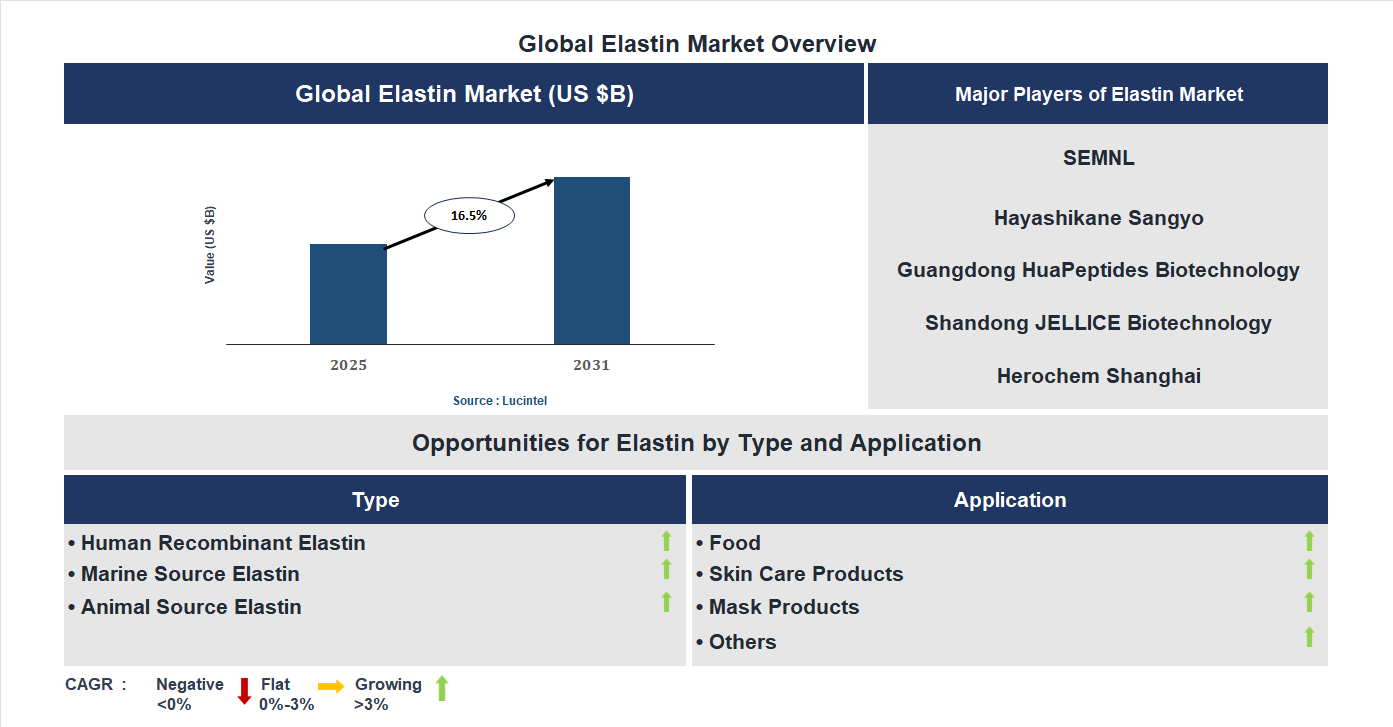
The future of the global elastin market looks promising with opportunities in the food, skin care product, and mask product markets. The global elastin market is expected to grow with a CAGR of 16.5% from 2025 to 2031. The major drivers for this market are the increasing demand for advanced skincare formulations, the rising use in regenerative medical treatments, and the growing adoption across cosmetic ingredient applications.• Lucintel forecasts that, within the type category, human recombinant elastin is expected to witness the highest growth over the forecast period.
• Within the application category, skin care product is expected to witness the highest growth.
• In terms of region, APAC is expected to witness the highest growth over the forecast period. Gain valuable insights for your business decisions with our comprehensive 150+ page report. Sample figures with some insights are shown below.
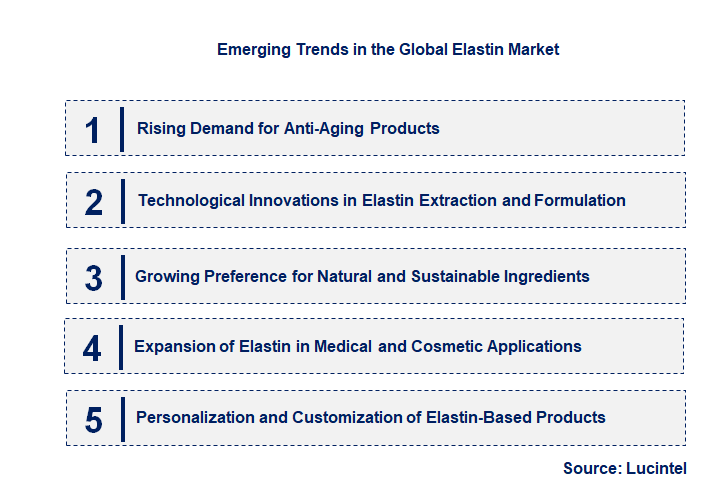
Emerging Trends in the Elastin Market
The elastin market is experiencing significant transformation driven by technological advancements, increasing demand for anti-aging and skin rejuvenation products, and a growing focus on sustainable and natural ingredients. As consumers become more health-conscious and beauty standards evolve, companies are innovating to meet these needs. The market is also witnessing a shift towards personalized skincare solutions and the integration of elastin in medical and cosmetic applications. These developments are not only expanding the market size but also redefining product offerings and marketing strategies. Understanding these emerging trends is crucial for stakeholders aiming to capitalize on the markets growth potential and stay competitive in a dynamic landscape.• Rising Demand for Anti-Aging Products: The increasing aging population and consumer focus on youthful skin are driving demand for elastin-based anti-aging skincare products. Elastins ability to improve skin elasticity and reduce wrinkles makes it a key ingredient. This trend is encouraging companies to develop innovative formulations that deliver visible results, thereby expanding market opportunities. The focus on natural and minimally invasive treatments further boosts the adoption of elastin in cosmetic procedures. As consumers seek effective, non-invasive solutions, elastins role in anti-aging products is expected to grow, significantly impacting market growth.
• Technological Innovations in Elastin Extraction and Formulation: Advances in biotechnology and extraction techniques are enabling the production of higher-quality elastin with enhanced purity and efficacy. Novel formulation methods, such as nanotechnology and encapsulation, improve elastin stability and skin penetration. These innovations allow for more effective delivery systems and longer-lasting results, attracting both cosmetic and medical applications. The ongoing research and development efforts are fostering new product development, increasing elastins versatility, and expanding its application scope across skincare, wound healing, and tissue engineering.
• Growing Preference for Natural and Sustainable Ingredients: Consumers are increasingly seeking natural, organic, and sustainably sourced ingredients in their skincare products. This trend is prompting manufacturers to source elastin from eco-friendly and cruelty-free sources, emphasizing transparency and sustainability. The demand for plant-based or bioengineered elastin is rising, aligning with eco-conscious consumer values. This shift not only enhances brand reputation but also opens new market segments. The focus on sustainability is influencing product development, packaging, and marketing strategies, thereby reshaping the overall market landscape towards more environmentally responsible practices.
• Expansion of Elastin in Medical and Cosmetic Applications: Elastins unique properties are being harnessed beyond traditional skincare, notably in wound healing, tissue regeneration, and reconstructive surgeries. Its biocompatibility and elasticity make it ideal for medical devices and regenerative therapies. The increasing adoption of elastin in minimally invasive procedures and bioengineered tissues is expanding its market reach. This trend is driven by technological progress and a growing healthcare focus on regenerative medicine. As elastin becomes integral to advanced medical solutions, it is opening new revenue streams and transforming the market into a multidisciplinary space.
• Personalization and Customization of Elastin-Based Products: The rise of personalized skincare is influencing the elastin market, with companies developing tailored formulations based on individual skin types, age, and specific concerns. Advanced diagnostics and AI-driven analysis enable precise customization, enhancing product efficacy and consumer satisfaction. This trend fosters innovation in elastin delivery systems and formulations, catering to niche markets. Personalized elastin products are gaining popularity, leading to higher consumer engagement and brand loyalty. The shift towards customization is fundamentally changing product development strategies and market dynamics, making elastin a key component in bespoke skincare solutions. In summary, these emerging trends are collectively reshaping the elastin market by fostering innovation, emphasizing sustainability, and expanding application areas. They are driving growth, enhancing product efficacy, and aligning offerings with consumer preferences, ultimately creating a more dynamic and competitive landscape.
Recent Development in the Elastin Market
The elastin market has experienced significant growth driven by increasing demand in the healthcare, cosmetic, and biomedical sectors. Innovations in extraction and synthesis methods, along with rising awareness of skin aging and tissue regeneration, are fueling market expansion. Additionally, the integration of elastin in advanced medical devices and cosmetic products is creating new opportunities. Market players are focusing on product development, strategic collaborations, and geographic expansion to capitalize on these trends. The evolving regulatory landscape and technological advancements are shaping the future of the elastin industry. These developments collectively influence market dynamics, competitive positioning, and consumer preferences, leading to a more robust and innovative market environment.• Technological Advancements in Elastin Extraction: New extraction techniques, such as enzymatic and recombinant methods, have improved yield and purity, reducing costs and enhancing product quality. This development allows for more efficient production of elastin-based products, meeting increasing demand across industries. It also enables the development of customized elastin formulations for specific applications, boosting innovation and market competitiveness.
• Rising Demand for Cosmetic and Anti-Aging Products: Growing consumer awareness about skin aging and the desire for youthful skin have driven demand for elastin in cosmetic formulations. This trend has led to increased investments by cosmetic companies in elastin-based products, expanding market reach. The impact is a surge in product launches and innovations, which are fueling market growth and attracting new players.
• Expansion in Biomedical and Tissue Engineering Applications: Elastins biocompatibility and elasticity make it ideal for tissue engineering, wound healing, and vascular grafts. Advances in biomedical research have led to new elastin-based medical devices and implants, opening lucrative opportunities. This development enhances the market by diversifying applications and increasing adoption in healthcare sectors.
• Strategic Collaborations and Mergers: Major companies are forming alliances, joint ventures, and mergers to strengthen their R&D capabilities and expand product portfolios. These collaborations facilitate access to new technologies and markets, accelerating innovation. The resulting competitive landscape benefits from increased resource sharing and market penetration.
• Regulatory and Sustainability Focus: Governments and industry bodies are implementing stricter regulations on biocompatibility, safety, and environmental impact. Companies are investing in sustainable extraction methods and eco-friendly products to comply. This focus influences market practices, encourages innovation in sustainable elastin production, and enhances consumer trust. In summary, recent developments in the elastin market—ranging from technological innovations and expanding applications to strategic collaborations and regulatory compliance—are collectively driving growth, fostering innovation, and shaping a competitive, sustainable future for the industry.
Strategic Growth Opportunities in the Elastin Market
The elastin market is experiencing significant growth driven by increasing demand across various industries such as healthcare, cosmetics, and textiles. Innovations in elastin-based products and expanding applications are creating new opportunities for market players. As consumer awareness about skin health and aging accelerates, companies are investing in advanced elastin formulations to meet these needs. Additionally, technological advancements are enabling more sustainable and cost-effective production methods. These developments are shaping the future landscape of the elastin industry, offering substantial growth potential. Understanding key application-driven opportunities is essential for stakeholders aiming to capitalize on this expanding market.• Healthcare Applications: Improving wound healing and tissue regeneration : Elastins biocompatibility and elasticity make it ideal for medical devices, wound dressings, and tissue engineering, leading to enhanced patient outcomes and expanding healthcare markets.
• Cosmetics and Personal Care: Anti-aging and skin rejuvenation products : Elastins ability to restore skin elasticity is driving demand in anti-aging creams, serums, and skincare treatments, boosting the cosmetic industrys growth.
• Textile Industry: Development of elastic textiles and garments : Elastin fibers are increasingly used in sportswear, medical textiles, and fashion, offering superior comfort and durability, thus opening new revenue streams.
• Food Industry: Use in edible films and packaging : Elastin-based edible films provide biodegradable packaging solutions, aligning with sustainability trends and expanding applications in food preservation.
• Automotive and Industrial Applications: Elastin in flexible components and seals : The elasticity and resilience of elastin are utilized in manufacturing flexible automotive parts and industrial seals, enhancing product performance and durability. In summary, these key growth opportunities across diverse applications are significantly impacting the elastin market by broadening its scope and increasing demand. The integration of elastin into new sectors is fostering innovation, driving revenue growth, and positioning the market for sustained expansion in the coming years.
Elastin Market Driver and Challenges
The elastin market is influenced by a variety of technological, economic, and regulatory factors that shape its growth trajectory. Advances in biotechnology and material science have enabled the development of innovative elastin-based products, while economic factors such as increasing healthcare expenditure and demand for anti-aging solutions drive market expansion. Regulatory frameworks governing product safety and approval processes also impact market dynamics, either facilitating or hindering growth. Additionally, consumer awareness and preferences for natural and sustainable products further influence market trends. Navigating these complex drivers and challenges is essential for stakeholders aiming to capitalize on opportunities within the elastin market. The factors responsible for driving the elastin market include:-• Technological Innovations: The development of advanced extraction and synthesis techniques has improved elastin quality and availability. Innovations such as recombinant DNA technology enable large-scale production of elastin proteins, reducing costs and enhancing product consistency. These technological advancements facilitate the creation of novel elastin-based biomaterials for medical, cosmetic, and industrial applications, thereby expanding market potential. As research progresses, the integration of nanotechnology and bioengineering is expected to further revolutionize elastin applications, attracting investments and fostering market growth.
• Rising Demand for Anti-Aging and Skincare Products: Increasing consumer awareness about skincare and aging concerns has led to a surge in demand for elastin-based products. Elastins ability to improve skin elasticity and reduce wrinkles makes it a preferred ingredient in anti-aging creams, serums, and cosmetic procedures. The growing aging population worldwide further amplifies this demand, prompting cosmetic companies to innovate and incorporate elastin into their product lines. This trend is expected to continue, driven by a focus on youthful appearance and wellness, thereby fueling market expansion.
• Growing Healthcare and Regenerative Medicine Applications: Elastins unique properties make it highly suitable for use in tissue engineering, wound healing, and vascular grafts. The increasing prevalence of cardiovascular diseases and injuries necessitates advanced biomaterials, positioning elastin as a critical component in regenerative medicine. Ongoing research and clinical trials are expanding elastins application scope, encouraging healthcare providers and biotech firms to invest in elastin-based solutions. This growing adoption in medical fields is a significant driver, promising substantial market growth in the coming years.
• Increasing Investment and R&D Activities: The elastin sector benefits from heightened investments by pharmaceutical, cosmetic, and biotech companies aiming to develop innovative products. R&D efforts focus on improving elastin extraction, stability, and functionality, which in turn broadens its application spectrum. Government grants and collaborations with research institutions further support innovation. These investments accelerate product development, regulatory approvals, and commercialization, creating a conducive environment for market growth and attracting new entrants seeking to capitalize on emerging opportunities.
• Expansion in Industrial and Textile Applications: Elastins unique elastic properties are increasingly utilized in the textile, sportswear, and industrial sectors. The demand for high-performance fabrics that offer durability, flexibility, and comfort is rising, driving the integration of elastin into various products. Additionally, elastin-based materials are used in manufacturing flexible electronics and biodegradable packaging, reflecting its versatility. Market players are investing in new formulations and applications, which are expected to open up substantial revenue streams and expand the elastin market beyond traditional sectors. The challenges facing this elastin market include:-
• Regulatory and Safety Concerns: Stringent regulatory frameworks governing the approval and safety of elastin-based products pose significant hurdles. Variability in regulations across regions can delay product launches and increase compliance costs. Ensuring biocompatibility, non-toxicity, and environmental safety requires extensive testing and validation, which can be time-consuming and expensive. These regulatory challenges may hinder innovation, limit market entry for new players, and slow down overall market growth, especially in medical and cosmetic applications.
• High Production Costs and Supply Chain Issues: The extraction and synthesis of elastin are complex and costly processes, impacting overall product pricing. Limited raw material availability and the need for specialized manufacturing facilities further exacerbate costs. Supply chain disruptions, especially during global crises, can lead to shortages and delays, affecting product availability and market stability. These factors restrict the ability of companies to scale production efficiently and competitively, thereby constraining market expansion.
• Market Competition and Fragmentation: The elastin market is characterized by intense competition among established players and new entrants, leading to fragmentation. Differentiating products and establishing brand loyalty can be challenging in a crowded marketplace. Price wars and patent disputes may also arise, impacting profitability. Additionally, the lack of standardized quality benchmarks can create inconsistencies, affecting consumer trust and adoption. Navigating this competitive landscape requires strategic innovation and effective marketing, which can be resource-intensive for companies. In summary, the elastin market is driven by technological advancements, increasing demand in cosmetics and healthcare, and expanding industrial applications. However, regulatory hurdles, high production costs, and intense competition pose significant challenges. These factors collectively influence the markets growth potential, requiring stakeholders to innovate, adapt, and collaborate to capitalize on emerging opportunities. Overall, the markets future hinges on balancing these drivers and challenges to foster sustainable development and innovation.
List of Elastin Companies
Companies in the market compete on the basis of product quality offered. Major players in this market focus on expanding their manufacturing facilities, R&D investments, infrastructural development, and leverage integration opportunities across the value chain. With these strategies elastin companies cater increasing demand, ensure competitive effectiveness, develop innovative products & technologies, reduce production costs, and expand their customer base. Some of the elastin companies profiled in this report include-• SEMNL
• Hayashikane Sangyo
• Guangdong HuaPeptides Biotechnology
• Shandong JELLICE Biotechnology
• Herochem Shanghai
• NH Foods
• Copalis
• Wuhu Yingtefei Biological Products
• BIOFAC A/S
• Natide Biotechnology
Elastin Market by Segment
The study includes a forecast for the global elastin market by type, application, and region.Elastin Market by Type [Value from 2019 to 2031]:
• Human Recombinant Elastin
• Marine Source Elastin
• Animal Source Elastin
Elastin Market by Application [Value from 2019 to 2031]:
• Food
• Skin Care Products
• Mask Products
• Others
Elastin Market by Region [Value from 2019 to 2031]:
• North America
• Europe
• Asia Pacific
• The Rest of the World
Country Wise Outlook for the Elastin Market
The elastin market has experienced significant growth driven by increasing demand in healthcare, cosmetics, and biomedical industries worldwide. Innovations in extraction techniques, product formulations, and applications have expanded market opportunities. Countries are investing in research and development to enhance elastin quality and functionality, addressing diverse consumer and industrial needs. Regulatory frameworks and sustainability initiatives are also shaping market dynamics. As the global focus on aging populations and skin health intensifies, the elastin market is poised for continued expansion, with key players focusing on product innovation, strategic partnerships, and market penetration strategies to capitalize on emerging trends.• United States: The U.S. elastin market has seen rapid growth due to rising consumer awareness of anti-aging products and skincare. Major companies are investing in advanced extraction and purification technologies to improve product quality. The healthcare sector is increasingly adopting elastin-based biomaterials for wound healing and tissue engineering applications. Regulatory agencies are emphasizing safety standards, encouraging innovation while ensuring consumer protection. Additionally, the cosmetic industry is expanding its use of elastin in anti-aging creams and serums, boosting market demand. The U.S. market remains highly competitive, with a focus on sustainable and natural elastin sources.
• China: China’s elastin market is experiencing robust growth driven by a booming cosmetics industry and increasing healthcare awareness. Local manufacturers are investing in R&D to develop cost-effective, high-quality elastin products. The government’s support for biotech innovations and cosmetic exports is fostering market expansion. Consumer preferences are shifting towards natural and organic elastin-based products, prompting companies to adopt eco-friendly extraction methods. The rising middle class and urbanization are fueling demand for premium skincare products containing elastin. Additionally, collaborations between domestic and international firms are enhancing technological capabilities and market reach.
• Germany: Germany’s elastin market is characterized by high-quality standards and a focus on sustainable sourcing. The country’s strong pharmaceutical and cosmetic sectors are driving demand for elastin in medical devices and skincare products. Innovations in biodegradable and plant-based elastin are gaining traction, aligning with environmental regulations. German companies are investing in research to improve elastin’s functional properties for medical applications such as tissue regeneration. The emphasis on eco-conscious production processes and strict regulatory compliance is shaping the market landscape. Germany’s position as a leader in biotech research supports ongoing advancements and market stability.
• India: The elastin market in India is expanding rapidly, fueled by increasing disposable incomes and a growing beauty consciousness among consumers. Local manufacturers are focusing on affordable elastin products for skincare and personal care. The rise of e-commerce platforms is facilitating wider distribution and access to elastin-based products. R&D efforts are underway to develop indigenous elastin sources and improve extraction techniques. The cosmetic and healthcare sectors are adopting elastin for anti-aging and wound healing applications. Government initiatives promoting biotech innovation and exports are further supporting market growth. The market is expected to continue its upward trajectory with increasing domestic demand.
• Japan: Japan’s elastin market is driven by advanced skincare technology and a strong emphasis on anti-aging solutions. Japanese companies are pioneering research into elastin’s role in skin elasticity and durability, leading to innovative product formulations. The market benefits from a highly health-conscious consumer base seeking premium, scientifically backed products. Regulatory standards are stringent, ensuring high-quality elastin products. The focus on sustainable and natural elastin sources aligns with Japan’s environmental commitments. Medical applications, including regenerative medicine and wound care, are also expanding. Overall, Japan’s market remains innovative, with a steady growth trajectory supported by technological advancements and consumer preferences for high-performance skincare.

Features of the Global Elastin Market
Market Size Estimates: Elastin market size estimation in terms of value ($B). Trend and Forecast Analysis: Market trends (2019 to 2024) and forecast (2025 to 2031) by various segments and regions. Segmentation Analysis: Elastin market size by type, application, and region in terms of value ($B). Regional Analysis: Elastin market breakdown by North America, Europe, Asia Pacific, and Rest of the World. Growth Opportunities: Analysis of growth opportunities in different types, applications, and regions for the elastin market. Strategic Analysis: This includes M&A, new product development, and competitive landscape of the elastin market. Analysis of competitive intensity of the industry based on Porter’s Five Forces model.
FAQ
Q1. What is the growth forecast for elastin market? Answer: The global elastin market is expected to grow with a CAGR of 16.5% from 2025 to 2031. Q2. What are the major drivers influencing the growth of the elastin market? Answer: The major drivers for this market are the increasing demand for advanced skincare formulations, the rising use in regenerative medical treatments, and the growing adoption across cosmetic ingredient applications. Q3. What are the major segments for elastin market? Answer: The future of the elastin market looks promising with opportunities in the food, skin care product, and mask product markets. Q4. Who are the key elastin market companies? Answer: Some of the key elastin companies are as follows:• SEMNL
• Hayashikane Sangyo
• Guangdong HuaPeptides Biotechnology
• Shandong JELLICE Biotechnology
• Herochem Shanghai
• NH Foods
• Copalis
• Wuhu Yingtefei Biological Products
• BIOFAC A/S
• Natide Biotechnology Q5. Which elastin market segment will be the largest in future? Answer: Lucintel forecasts that, within the type category, human recombinant elastin is expected to witness the highest growth over the forecast period. Q6. In elastin market, which region is expected to be the largest in next 5 years? Answer: In terms of region, APAC is expected to witness the highest growth over the forecast period. Q7. Do we receive customization in this report? Answer: Yes, Lucintel provides 10% customization without any additional cost.
Table of Contents
List of Figures
List of Tables
Methodology
- In-depth interviews of the major players in this market
- Detailed secondary research from competitors’ financial statements and published data
- Extensive searches of published works, market, and database information pertaining to industry news, company press releases, and customer intentions
- A compilation of the experiences, judgments, and insights of Lucintel’s professionals, who have analyzed and tracked this market over the years.


Buy Now
Choose a license that fits your team. Instant PDF delivery.
Prices exclude taxes. Instant delivery. Custom licensing available on request.
Key Questions
- • What are some of the most promising, high-growth opportunities for the elastin market by type (human recombinant elastin, marine source elastin, and animal source elastin), application (food, skin care products, mask products, and others), and region (North America, Europe, Asia Pacific, and the Rest of the World)?
- • Which segments will grow at a faster pace and why?
- • Which region will grow at a faster pace and why?
- • What are the key factors affecting market dynamics? What are the key challenges and business risks in this market?
- • What are the business risks and competitive threats in this market?
- • What are the emerging trends in this market and the reasons behind them?
- • What are some of the changing demands of customers in the market?
- • What are the new developments in the market? Which companies are leading these developments?
- • Who are the major players in this market? What strategic initiatives are key players pursuing for business growth?
- • What are some of the competing products in this market and how big of a threat do they pose for loss of market share by material or product substitution?
- • What M&A activity has occurred in the last 5 years and what has its impact been on the industry? For any questions related to Elastin Market, Elastin Market Size, Elastin Market Growth, Elastin Market Analysis, Elastin Market Report, Elastin Market Share, Elastin Market Trends, Elastin Market Forecast, Elastin Companies, write Lucintel analyst at email: helpdesk@lucintel.com. We will be glad to get back to you soon.


