
Report Feature
Educational Toy Market Trends and Forecast
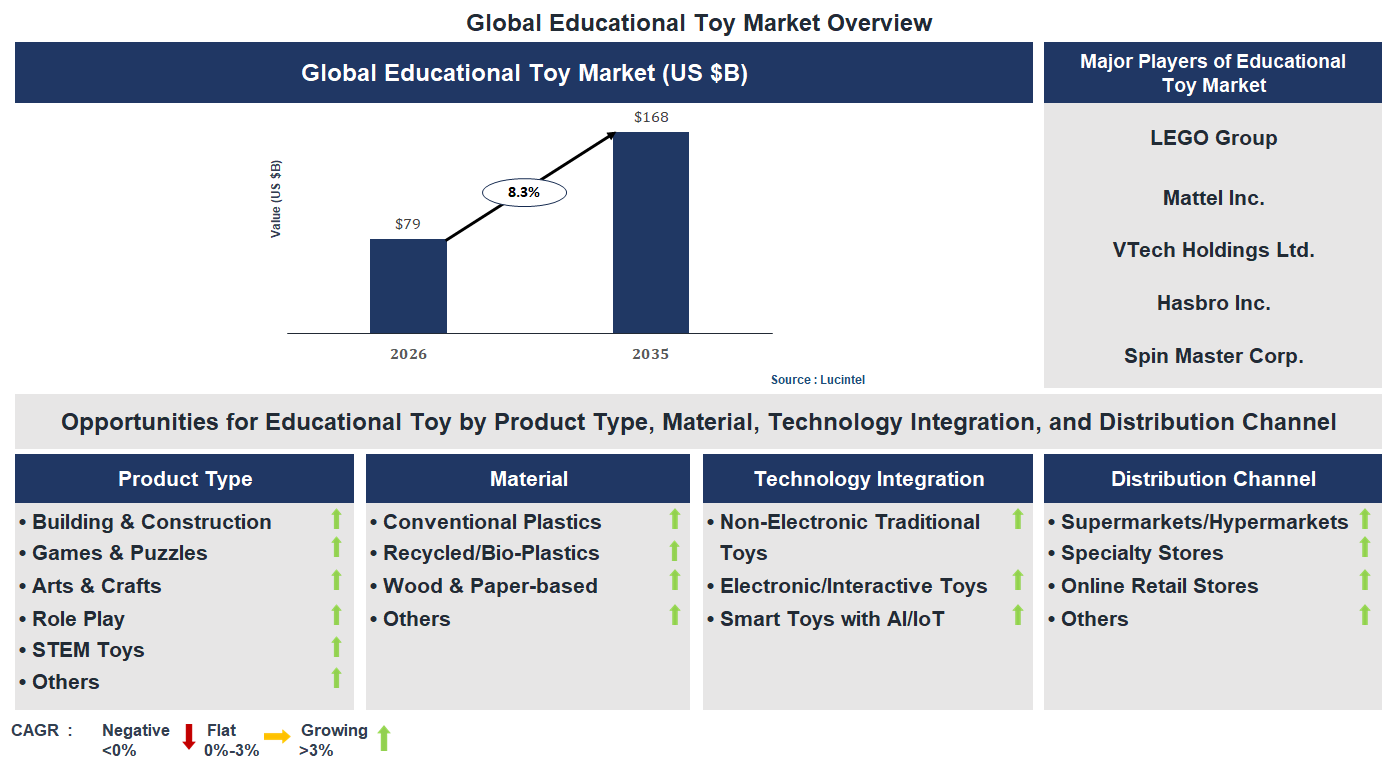
The future of the global educational toy market looks promising with opportunities in the supermarket/hypermarket, specialty store, and online retail store markets. The global educational toy market is expected to reach an estimated $168.0 billion by 2035 with a CAGR of 8.3% from 2026 to 2035. The major drivers for this market are the increasing demand for interactive learning tools, the rising focus on early childhood development, and the growing awareness of educational benefits.• Lucintel forecasts that, within the product type category, game & puzzle is expected to witness the highest growth over the forecast period.
• Within the distribution channel category, supermarket/hypermarket is expected to witness the highest growth.
• In terms of region, Europe is expected to witness the highest growth over the forecast period. Gain valuable insights for your business decisions with our comprehensive 150+ page report. Sample figures with some insights are shown below.
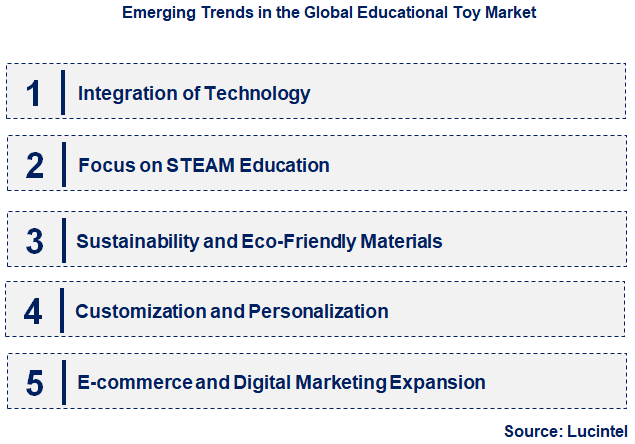
Emerging Trends in the Educational Toy Market
The educational toy market is experiencing rapid evolution driven by technological advancements, changing consumer preferences, and a growing emphasis on developmental benefits for children. As parents and educators seek innovative ways to enhance learning, the market is adapting to incorporate new materials, digital integration, and sustainability. These trends are not only shaping product offerings but also influencing marketing strategies and distribution channels. Understanding these emerging trends is crucial for stakeholders aiming to stay competitive and meet the evolving needs of children and their caregivers in a dynamic educational landscape.• Integration of Technology: The use of digital devices, augmented reality, and interactive apps is transforming traditional educational toys. These innovations provide immersive learning experiences, enhance engagement, and cater to tech-savvy children. The integration allows for personalized learning, immediate feedback, and a broader range of educational content, making toys more effective and appealing. This trend is driving market growth by attracting a new segment of consumers seeking high-tech educational solutions.
• Focus on STEAM Education: There is a rising emphasis on toys that promote Science, Technology, Engineering, Arts, and Mathematics (STEAM). These toys are designed to develop critical thinking, problem-solving, creativity, and technical skills from an early age. The market is witnessing increased demand for STEM/STEAM kits, robotics, and coding toys, reflecting a shift towards preparing children for future careers. This trend is influencing product development and marketing strategies, positioning STEAM-focused toys as essential educational tools.
• Sustainability and Eco-Friendly Materials: Consumers are increasingly concerned about environmental impact, prompting manufacturers to adopt sustainable practices. Eco-friendly educational toys made from biodegradable, recycled, or non-toxic materials are gaining popularity. This trend aligns with broader societal values of environmental responsibility and health safety. It encourages innovation in material sourcing and manufacturing processes, fostering a market that values sustainability alongside educational benefits.
• Customization and Personalization: Personalized toys tailored to a childs interests, learning pace, and developmental stage are becoming more prevalent. Advanced manufacturing techniques and data-driven insights enable the creation of customized educational experiences. This trend enhances engagement, supports individual learning needs, and fosters a stronger emotional connection with the product. It also allows brands to differentiate themselves in a competitive market by offering unique, tailored solutions.
• E-commerce and Digital Marketing Expansion: The shift towards online shopping and digital marketing channels is significantly impacting the educational toy market. E-commerce platforms provide a wider reach, convenience, and access to a diverse product range. Digital marketing strategies, including social media and influencer collaborations, are increasing brand visibility and consumer engagement. This trend enables companies to gather valuable consumer data, optimize offerings, and respond swiftly to market demands, ultimately driving sales and market penetration. These emerging trends are reshaping the educational toy market by fostering innovation, emphasizing sustainability, and leveraging digital platforms. They are creating more engaging, personalized, and environmentally conscious products that meet the evolving expectations of modern consumers. As a result, the market is becoming more dynamic, competitive, and aligned with educational and societal priorities, paving the way for sustained growth and development.
Recent Development in the Educational Toy Market
The educational toy market is experiencing rapid growth driven by increasing awareness of early childhood development, technological integration, and shifting consumer preferences towards sustainable and innovative products. As parents and educators seek engaging, skill-enhancing toys, companies are innovating to meet these demands. The markets expansion is also fueled by rising disposable incomes and government initiatives promoting early education. These developments are reshaping the landscape, creating new opportunities for manufacturers and retailers to capitalize on evolving consumer needs and technological advancements.• Growing Demand for STEM Toys: The increasing focus on science, technology, engineering, and mathematics (STEM) education has driven demand for STEM-focused toys. Parents and educators prioritize these products to enhance critical thinking, problem-solving, and technical skills in children. This trend encourages manufacturers to develop innovative, curriculum-aligned toys that foster learning through play. The market benefits from a broader consumer base seeking educational value, leading to increased sales and product diversification, ultimately supporting early skill development and long-term educational outcomes.
• Integration of Technology in Toys: The incorporation of digital and interactive features into educational toys has revolutionized the market. Smart toys, augmented reality (AR), and app-enabled devices offer immersive learning experiences that captivate children and enhance engagement. This technological integration allows for personalized learning, real-time feedback, and adaptive difficulty levels. As a result, the market sees increased consumer interest, higher product differentiation, and expanded opportunities for brands to innovate. This trend also supports remote learning and skill development outside traditional classroom settings.
• Rising Focus on Sustainability and Eco-Friendly Toys: Consumers are increasingly demanding environmentally sustainable and non-toxic toys. Manufacturers are adopting eco-friendly materials, biodegradable packaging, and ethical sourcing practices to meet this demand. This shift not only appeals to environmentally conscious parents but also aligns with regulatory standards. The focus on sustainability enhances brand reputation, encourages innovation in biodegradable and recycled materials, and opens new market segments. It also promotes responsible consumption, contributing to long-term market growth and environmental preservation.
• Expansion in Emerging Markets: Rapid urbanization, rising disposable incomes, and increased awareness of early childhood education are fueling growth in emerging markets. Companies are expanding distribution channels and customizing products to local preferences, which boosts market penetration. This expansion offers significant growth opportunities, diversifies revenue streams, and reduces dependence on mature markets. It also fosters local employment and educational initiatives, strengthening brand presence and consumer loyalty in these regions, ultimately contributing to global market expansion.
• Increasing Consumer Preference for Customization and Personalization: Consumers now seek personalized educational toys tailored to their childs interests, developmental stage, and learning style. Manufacturers are offering customizable options, modular toys, and digital platforms that allow parents to select specific features. This trend enhances customer satisfaction, builds brand loyalty, and differentiates products in a competitive market. Personalization also enables targeted marketing strategies and data-driven product development, fostering deeper engagement and long-term growth in the educational toy sector. The overall impact of these developments is a dynamic, innovative, and expanding educational toy market. Increased technological integration, sustainability focus, and market diversification are driving growth, creating new opportunities for manufacturers and retailers. These trends are fostering a more engaging, responsible, and accessible learning environment for children worldwide, ensuring sustained market evolution and competitive advantage.
Strategic Growth Opportunities in the Educational Toy Market
The educational toy market is experiencing rapid growth driven by increasing awareness of early childhood development, technological integration, and evolving consumer preferences. Parents and educators seek innovative, engaging, and educational products that foster cognitive, social, and motor skills. Market players are expanding their portfolios to include eco-friendly, STEM-focused, and digitally enhanced toys. Strategic investments, product diversification, and global expansion are key to capturing emerging opportunities, ensuring sustained growth and competitive advantage in this dynamic sector.• Expansion into Digital and STEM Educational Toys: The rising demand for STEM-focused toys and digital learning tools presents significant growth opportunities. Manufacturers are developing interactive, tech-enabled toys that promote problem-solving, coding, and scientific exploration. Integration of augmented reality (AR) and virtual reality (VR) enhances engagement and learning outcomes. This shift caters to tech-savvy children and parents seeking innovative educational experiences, driving market expansion and product diversification.
• Growing Preference for Eco-Friendly and Sustainable Toys: Consumers increasingly prioritize environmentally friendly products, prompting manufacturers to adopt sustainable materials and eco-conscious manufacturing processes. Eco-friendly educational toys appeal to environmentally aware parents and educators, fostering brand loyalty. This trend encourages innovation in biodegradable plastics, recycled materials, and non-toxic components, opening new market segments and reinforcing corporate social responsibility initiatives.
• Rising Adoption of Digital and Online Sales Channels: The proliferation of e-commerce platforms and digital marketing strategies facilitates wider reach and consumer engagement. Online channels enable brands to showcase diverse product ranges, offer personalized recommendations, and provide convenient purchasing options. The COVID-19 pandemic accelerated this shift, making digital sales channels essential for market growth. Enhanced logistics and digital payment solutions further support this trend, expanding access to global markets.
• Increasing Focus on Early Childhood Development and Learning: Growing awareness of the importance of early education drives demand for toys that support developmental milestones. Products designed to enhance motor skills, language acquisition, and social interaction are prioritized. Collaborations with educational institutions and child development experts influence product design. This focus encourages innovation in multi-sensory, age-appropriate toys that foster holistic growth, creating new opportunities for market players.
• Strategic Collaborations and Licensing Agreements: Partnerships with educational institutions, entertainment brands, and technology firms enable the creation of branded, innovative, and engaging toys. Licensing popular characters and themes attracts children and boosts sales. Collaborations facilitate access to new markets, enhance product credibility, and foster innovation through shared expertise. These strategic alliances are vital for differentiation and capturing consumer interest in a competitive landscape. The overall impact of these opportunities is a robust, innovative, and expanding educational toy market. Companies that leverage technological advancements, sustainability, digital channels, developmental insights, and strategic partnerships will be well-positioned for sustained growth. This dynamic environment encourages continuous innovation, catering to evolving consumer preferences and educational needs, ultimately fostering a more engaging and effective learning experience for children worldwide.
Educational Toy Market Driver and Challenges
The educational toy market is influenced by a variety of technological, economic, and regulatory factors that shape its growth and development. Advances in technology have introduced innovative learning tools, while economic conditions affect consumer spending on educational products. Regulatory standards ensure safety and quality, impacting product development and market entry. Additionally, societal trends emphasizing early childhood development and parental involvement drive demand. However, challenges such as market saturation, regulatory compliance costs, and rapid technological changes pose obstacles. Understanding these drivers and challenges is essential for stakeholders to navigate the evolving landscape and capitalize on emerging opportunities effectively. The factors responsible for driving the educational toy market include:-• Technological Innovation: The integration of digital technology and smart toys has revolutionized educational products, offering interactive and personalized learning experiences. These innovations attract tech-savvy parents and educators, expanding market reach. The development of augmented reality, AI, and IoT-enabled toys enhances engagement and learning outcomes, fostering market growth. Companies investing in R&D to create innovative, safe, and educationally effective toys are gaining competitive advantages, thus fueling overall market expansion.
• Rising Awareness of Early Childhood Development: Increasing recognition of the importance of early education has led parents and educators to seek high-quality educational toys. This trend is driven by research emphasizing cognitive and social development in children, prompting demand for toys that promote learning through play. Governments and NGOs also promote early childhood programs, further boosting market growth. As awareness spreads, the market experiences sustained demand for diverse educational products tailored to different age groups.
• Economic Growth and Disposable Income: Improved economic conditions and rising disposable incomes enable parents to invest more in educational toys. Affluent households prioritize quality and innovative learning tools, expanding the customer base. Additionally, the growth of the middle class in emerging economies contributes to increased market penetration. This economic upliftment supports higher spending on educational products, encouraging manufacturers to diversify their offerings and expand distribution channels.
• Regulatory Standards and Safety Certifications: Stringent safety regulations and quality standards ensure that educational toys are safe for children, building consumer trust. Compliance with certifications like ASTM, EN71, and CPSIA influences product design and manufacturing processes. While these regulations may increase production costs, they also create barriers to entry for unqualified competitors. Market players investing in compliance gain credibility, which enhances brand reputation and encourages consumer confidence, ultimately driving market growth.
• E-commerce and Digital Distribution Channels: The proliferation of online retail platforms has expanded access to educational toys globally. E-commerce offers convenience, wider product selection, and competitive pricing, attracting a broader customer base. Digital marketing strategies and direct-to-consumer sales enable brands to build loyalty and gather customer insights. The growth of online marketplaces accelerates market penetration, especially in remote or underserved regions, fostering overall industry expansion. The challenges facing the educational toy market include:-
• Market Saturation and Intense Competition: The proliferation of numerous brands and products has led to a saturated market, making it difficult for new entrants to establish a foothold. Established players benefit from brand recognition and distribution networks, creating high barriers for startups. Differentiating products through innovation and marketing becomes crucial but challenging, often requiring significant investment. This intense competition can lead to price wars, reducing profit margins and slowing overall market growth.
• Regulatory Compliance Costs: Meeting safety and quality standards involves substantial costs related to testing, certification, and compliance processes. Smaller manufacturers may struggle to afford these expenses, limiting their ability to compete. Additionally, evolving regulations require continuous updates to product designs and documentation, increasing operational complexity. These compliance costs can delay product launches and reduce profit margins, posing a significant challenge for market participants aiming to innovate while maintaining regulatory adherence.
• Rapid Technological Changes: The fast pace of technological advancements demands continuous innovation and adaptation from manufacturers. Keeping up with emerging trends like AI, AR, and IoT integration requires significant R&D investment. Failure to innovate or adapt quickly can render existing products obsolete, impacting sales and market share. Moreover, rapid technological shifts can lead to increased costs and complexity in manufacturing, supply chain management, and consumer education, complicating market stability and growth prospects. The educational toy market is driven by technological advancements, increased awareness of early childhood development, economic growth, regulatory standards, and expanding digital channels. However, it faces challenges such as market saturation, high compliance costs, and rapid technological changes. These factors collectively influence the markets trajectory, requiring stakeholders to innovate strategically and adapt swiftly. While growth opportunities are substantial, navigating the competitive landscape and regulatory environment remains critical for sustained success. Overall, the markets future depends on balancing innovation with compliance and leveraging digital platforms to reach a broader audience.
List of Educational Toy Companies
Companies in the market compete on the basis of product quality offered. Major players in this market focus on expanding their manufacturing facilities, R&D investments, infrastructural development, and leverage integration opportunities across the value chain. With these strategies educational toy companies cater increasing demand, ensure competitive effectiveness, develop innovative products & technologies, reduce production costs, and expand their customer base. Some of the educational toy companies profiled in this report include-• LEGO Group
• Mattel Inc.
• VTech Holdings Ltd.
• Hasbro Inc.
• Spin Master Corp.
• Learning Resources Inc.
• Melissa & Doug LLC
• Ravensburger AG
• Gigo Toys Co. Ltd.
• MindWare Holdings
Educational Toy Market by Segment
The study includes a forecast for the global educational toy market by product type, material, technology integration, distribution channel, and region.Educational Toy Market by Product Type [Value from 2019 to 2035]:
• Building & Construction
• Games & Puzzles
• Arts & Crafts
• Role Play
• STEM Toys
• Others
Educational Toy Market by Material [Value from 2019 to 2035]:
• Conventional Plastics
• Recycled/Bio-plastics
• Wood & Paper-based
• Others
Educational Toy Market by Technology Integration [Value from 2019 to 2035]:
• Non-Electronic Traditional Toys
• Electronic/Interactive Toys
• Smart Toys with AI/IoT
Educational Toy Market by Distribution Channel [Value from 2019 to 2035]:
• Supermarkets/Hypermarkets
• Specialty Stores
• Online Retail Stores
• Others
Educational Toy Market by Region [Value from 2019 to 2035]:
• North America
• Europe
• Asia Pacific
• The Rest of the World
Country Wise Outlook for the Educational Toy Market
The educational toy market has experienced significant growth driven by increasing awareness of early childhood development, technological integration, and shifting consumer preferences towards STEM-focused products. The COVID-19 pandemic accelerated digital adoption, prompting innovation in interactive and online learning toys. Governments and the private sector are investing in educational initiatives, further boosting demand. Market players are expanding their product portfolios to include eco-friendly and inclusive toys, catering to diverse needs. As the market evolves, countries are adopting different strategies based on their economic, technological, and cultural contexts, leading to varied developmental trajectories across regions.• United States: The US educational toy market has seen rapid growth with a focus on STEM and coding toys. Major brands are integrating augmented reality (AR) and artificial intelligence (AI) to enhance learning experiences. E-commerce sales surged, and startups are innovating with eco-friendly materials. Government initiatives promoting early childhood education have also supported market expansion. Additionally, there is a rising trend in personalized and subscription-based educational toy services, catering to diverse learning needs.
• China: Chinas market is characterized by a booming demand for digital and smart toys, driven by a large young population and increasing disposable income. Local companies are investing heavily in R&D to develop innovative products with advanced features like voice recognition and robotics. E-commerce platforms dominate sales channels, and collaborations with tech giants are common. The government is promoting quality standards and safety regulations, fostering consumer confidence. The market is also witnessing a rise in bilingual and multilingual toys to cater to Chinas diverse linguistic landscape.
• Germany: The German educational toy market emphasizes sustainability and quality, with a strong preference for eco-friendly and durable products. The country’s focus on environmental consciousness influences product development, with many companies adopting biodegradable materials. There is a significant demand for traditional wooden toys integrated with modern educational concepts. Retail channels include specialty stores and online platforms, with a growing trend towards educational kits that promote critical thinking and creativity. The government’s support for educational initiatives further boosts market growth.
• India: The Indian market is experiencing rapid expansion due to increasing urbanization and rising disposable incomes. There is a strong demand for affordable, locally-made educational toys that promote STEM learning. Startups are innovating with low-cost, culturally relevant products, and e-commerce platforms are expanding their reach. Government schemes supporting skill development and early childhood education are positively impacting the market. Additionally, the popularity of bilingual toys and games that incorporate Indian languages is growing, catering to diverse linguistic demographics.
• Japan: Japan’s educational toy market is driven by technological innovation and a focus on cognitive development. Companies are developing interactive and robotics-based toys aligned with Japan’s technological expertise. The market also emphasizes traditional values, with a resurgence in wooden and handcrafted toys that promote fine motor skills. Digital integration, such as app-connected toys, is prevalent. The aging population’s interest in lifelong learning influences product offerings, and collaborations with educational institutions are common to enhance learning outcomes. Overall, Japan’s market balances innovation with cultural heritage.

Features of the Global Educational Toy Market
Market Size Estimates: Educational toy market size estimation in terms of value ($B). Trend and Forecast Analysis: Market trends (2019 to 2025) and forecast (2026 to 2035) by various segments and regions. Segmentation Analysis: Educational toy market size by various segments, such as by product type, material, technology integration, distribution channel, and region in terms of value ($B). Regional Analysis: Educational toy market breakdown by North America, Europe, Asia Pacific, and Rest of the World. Growth Opportunities: Analysis of growth opportunities in different product types, materials, technology integration, distribution channels, and regions for the educational toy market. Strategic Analysis: This includes M&A, new product development, and competitive landscape of the educational toy market. Analysis of competitive intensity of the industry based on Porter’s Five Forces model.
FAQ
Q1. What is the educational toy market size? Answer: The global educational toy market is expected to reach an estimated $168.0 billion by 2035. Q2. What is the growth forecast for educational toy market? Answer: The global educational toy market is expected to grow with a CAGR of 8.3% from 2026 to 2035. Q3. What are the major drivers influencing the growth of the educational toy market? Answer: The major drivers for this market are the increasing demand for interactive learning tools, the rising focus on early childhood development, and the growing awareness of educational benefits. Q4. What are the major segments for educational toy market? Answer: The future of the educational toy market looks promising with opportunities in the supermarket/hypermarket, specialty store, and online retail store markets. Q5. Who are the key educational toy market companies? Answer: Some of the key educational toy companies are as follows:• LEGO Group
• Mattel Inc.
• VTech Holdings Ltd.
• Hasbro Inc.
• Spin Master Corp.
• Learning Resources Inc.
• Melissa & Doug LLC
• Ravensburger AG
• Gigo Toys Co. Ltd.
• MindWare Holdings Q6. Which educational toy market segment will be the largest in future? Answer: Lucintel forecasts that, within the product type category, game & puzzle is expected to witness the highest growth over the forecast period. Q7. In educational toy market, which region is expected to be the largest in next 5 years? Answer: In terms of region, Europe is expected to witness the highest growth over the forecast period. Q8. Do we receive customization in this report? Answer: Yes, Lucintel provides 10% customization without any additional cost.
Table of Contents
List of Figures
List of Tables
Methodology
- In-depth interviews of the major players in this market
- Detailed secondary research from competitors’ financial statements and published data
- Extensive searches of published works, market, and database information pertaining to industry news, company press releases, and customer intentions
- A compilation of the experiences, judgments, and insights of Lucintel’s professionals, who have analyzed and tracked this market over the years.


Buy Now
Choose a license that fits your team. Instant PDF delivery.
Prices exclude taxes. Instant delivery. Custom licensing available on request.
Key Questions
- • What are some of the most promising, high-growth opportunities for the educational toy market by product type (building & construction, games & puzzles, arts & crafts, role play, STEM toys, and others), material (conventional plastics, recycled/bio-plastics, wood & paper-based, and others), technology integration (non-electronic traditional toys, electronic/interactive toys, and smart toys with AI/IoT), distribution channel (supermarkets/hypermarkets, specialty stores, online retail stores, and others), and region (North America, Europe, Asia Pacific, and the Rest of the World)?
- • Which segments will grow at a faster pace and why?
- • Which region will grow at a faster pace and why?
- • What are the key factors affecting market dynamics? What are the key challenges and business risks in this market?
- • What are the business risks and competitive threats in this market?
- • What are the emerging trends in this market and the reasons behind them?
- • What are some of the changing demands of customers in the market?
- • What are the new developments in the market? Which companies are leading these developments?
- • Who are the major players in this market? What strategic initiatives are key players pursuing for business growth?
- • What are some of the competing products in this market and how big of a threat do they pose for loss of market share by material or product substitution?
- • What M&A activity has occurred in the last 7 years and what has its impact been on the industry? For any questions related to Educational Toy Market, Educational Toy Market Size, Educational Toy Market Growth, Educational Toy Market Analysis, Educational Toy Market Report, Educational Toy Market Share, Educational Toy Market Trends, Educational Toy Market Forecast, Educational Toy Companies, write Lucintel analyst at email: helpdesk@lucintel.com. We will be glad to get back to you soon.


