
Report Feature
Earbud Market Trends and Forecast
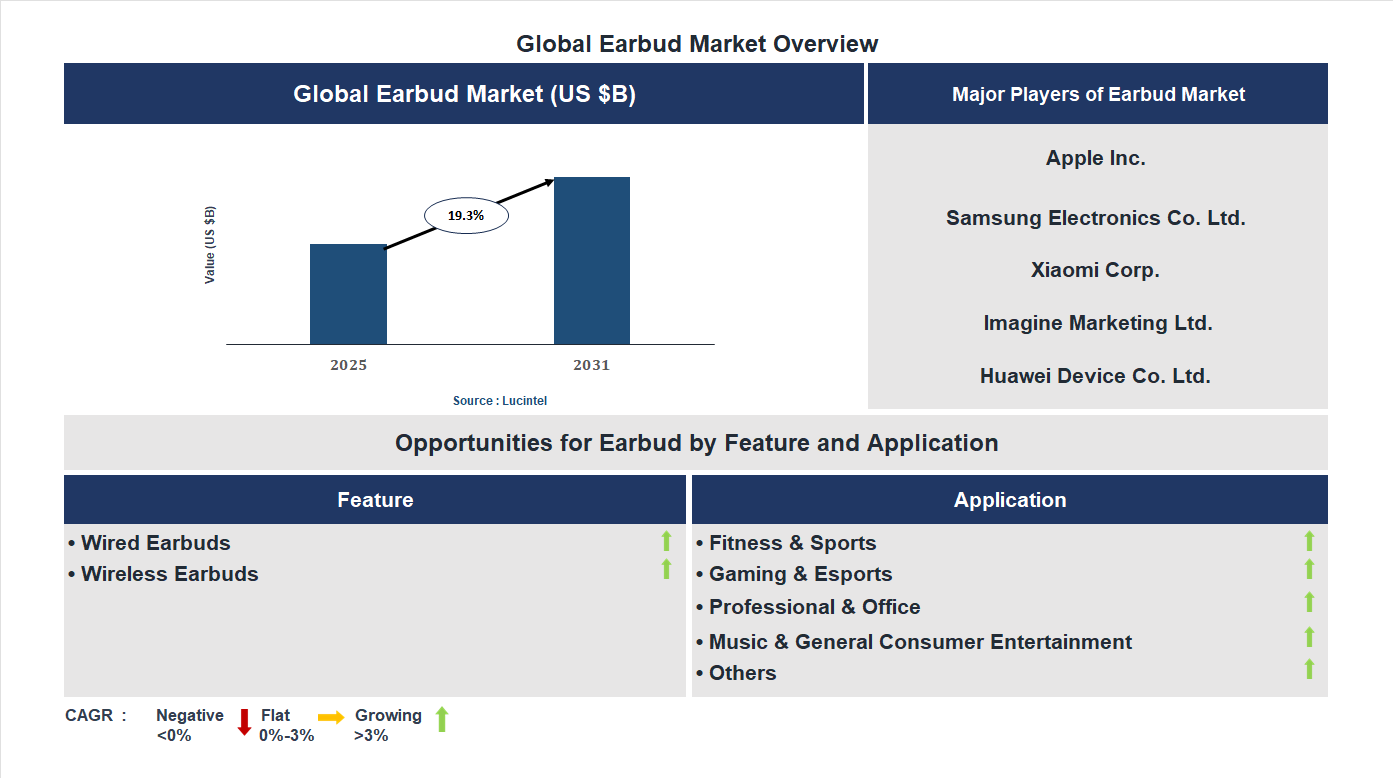
The future of the global earbud market looks promising with opportunities in the fitness & sport, gaming & esport, professional & office, and music & general consumer entertainment markets. The global earbud market is expected to grow with a CAGR of 19.3% from 2025 to 2031. The major drivers for this market are the increasing adoption of wireless audio devices, the rising demand for immersive audio experience, and the growing use with smartphones & wearables.• Lucintel forecasts that, within the feature category, wireless earbud is expected to witness higher growth over the forecast period.
• Within the application category, fitness & sport is expected to witness the highest growth.
• In terms of region, APAC is expected to witness the highest growth over the forecast period. Gain valuable insights for your business decisions with our comprehensive 150+ page report. Sample figures with some insights are shown below.
Emerging Trends in the Earbud Market
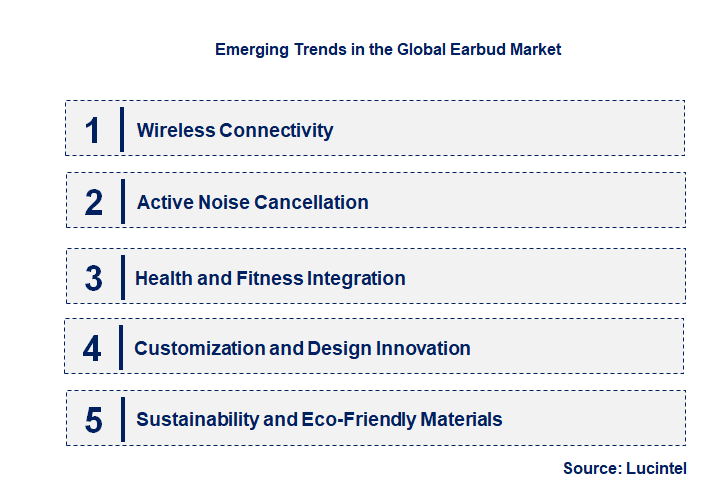
The earbud market is experiencing rapid growth driven by technological advancements, changing consumer preferences, and increasing demand for portable audio solutions. As lifestyles become more mobile and health-conscious, consumers seek convenient, high-quality audio devices that integrate seamlessly with their digital lives. Innovations in design, connectivity, and functionality are shaping the competitive landscape, prompting manufacturers to develop smarter, more versatile earbuds. Additionally, the rise of wireless technology and the integration of health monitoring features are transforming how consumers interact with audio devices. These developments are not only expanding market size but also redefining user expectations and industry standards.• Wireless Connectivity: The shift from wired to wireless earbuds is a dominant trend, driven by advancements in Bluetooth technology. Consumers prefer the convenience of tangle-free, portable devices that offer seamless pairing with smartphones and other gadgets. This trend enhances user experience by providing greater mobility and ease of use, while also encouraging manufacturers to innovate with longer battery life and improved connectivity stability. As wireless technology becomes more affordable and reliable, it is expected to further accelerate market growth and adoption across various demographics.
• Active Noise Cancellation (ANC): The integration of ANC technology is transforming the user experience by providing immersive sound quality and reducing ambient noise. This feature appeals to commuters, travelers, and fitness enthusiasts seeking distraction-free listening. The adoption of ANC in mid-range and premium earbuds is increasing, driving demand for high-performance audio devices. As technology advances, ANC is becoming more effective and energy-efficient, influencing consumer preferences and setting new standards for audio quality. This trend is significantly impacting product differentiation and pricing strategies within the market.
• Health and Fitness Integration: Earbuds are increasingly incorporating health monitoring features such as heart rate tracking, step counting, and fitness coaching. This trend aligns with the growing health-conscious consumer base and the rise of wearable health technology. By combining audio entertainment with health tracking, manufacturers create multifunctional devices that appeal to active users. The integration of sensors and health apps enhances user engagement and provides valuable data insights. This convergence of fitness and audio technology is reshaping product development and expanding the market into new consumer segments.
• Customization and Design Innovation: Consumers are seeking earbuds that reflect personal style and offer customizable features. Manufacturers are responding with a variety of designs, colors, and ergonomic options to enhance comfort and aesthetics. Additionally, modular and customizable earbuds allow users to select features like interchangeable tips or personalized sound profiles. This trend improves user satisfaction and brand loyalty by offering tailored experiences. As design innovation continues, it influences marketing strategies and product differentiation, making earbuds not just functional but also fashionable accessories.
• Sustainability and Eco-Friendly Materials: Environmental concerns are prompting manufacturers to adopt sustainable practices, including the use of eco-friendly materials and recyclable components. Consumers are increasingly valuing brands that demonstrate environmental responsibility, influencing purchasing decisions. This trend encourages innovation in biodegradable plastics, sustainable packaging, and energy-efficient manufacturing processes. The focus on sustainability not only enhances brand image but also aligns with global efforts to reduce carbon footprints. As eco-consciousness grows, sustainability is becoming a key factor in product development and market competitiveness. In summary, these emerging trends are reshaping the earbud market by enhancing user experience, promoting innovation, and aligning with societal values. Wireless connectivity, advanced noise cancellation, health integration, design customization, and sustainability are collectively driving growth and setting new industry standards. These developments are creating a more dynamic, consumer-centric market that emphasizes convenience, personalization, and environmental responsibility, ultimately transforming how consumers select and use earbuds.
Recent Development in the Earbud Market
The earbud market has experienced rapid growth driven by technological advancements, changing consumer preferences, and increasing demand for portable audio devices. As the market evolves, several key developments are shaping its future trajectory. These include innovations in product design, integration of smart features, expansion into new segments, strategic collaborations, and sustainability initiatives. These developments are not only enhancing user experience but also expanding market reach and competitiveness. Understanding these trends is essential for stakeholders aiming to capitalize on emerging opportunities and navigate the competitive landscape effectively.• Technological Innovations: Advanced noise-cancellation and improved battery life are enhancing user experience, leading to increased adoption and higher customer satisfaction.
• Smart Features Integration: Incorporation of voice assistants and touch controls is making earbuds more functional, attracting tech-savvy consumers and expanding use cases.
• Market Segmentation Expansion: Entry into niche markets such as sports, gaming, and professional use is diversifying the customer base and boosting sales.
• Strategic Collaborations: Partnerships between earbud manufacturers and tech giants are driving innovation, brand recognition, and accelerated product development.
• Sustainability Initiatives: Focusing on eco-friendly materials and recycling programs aligns the market with global sustainability goals, appealing to environmentally conscious consumers. These developments are collectively transforming the earbud market by enhancing product capabilities, broadening consumer appeal, and promoting sustainable practices. As a result, the market is experiencing accelerated growth, increased competition, and greater innovation, positioning it for continued expansion in the coming years.
Strategic Growth Opportunities in the Earbud Market
The earbud market is experiencing rapid expansion driven by technological advancements, changing consumer preferences, and increasing demand for portable audio devices. As the market evolves, several key growth opportunities are emerging across various applications. These opportunities are shaping the future landscape of the industry, offering innovative solutions and expanding market reach. Companies that capitalize on these trends can gain competitive advantages and meet the growing needs of consumers worldwide. Understanding these growth areas is essential for stakeholders aiming to leverage market potential and drive sustainable development in the earbud industry.• Consumer Electronics: The increasing adoption of wireless earbuds in consumer electronics is driven by convenience, improved connectivity, and enhanced user experience. Innovations in Bluetooth technology and battery life are making wireless options more attractive, leading to higher sales and market penetration. This growth enhances brand loyalty and opens new revenue streams for manufacturers.
• Healthcare & Wellness: Earbuds are increasingly integrated with health monitoring features such as heart rate tracking and fitness metrics. This application impacts the market by providing consumers with multifunctional devices that support wellness and health management. It also opens opportunities for partnerships with healthcare providers and fitness brands.
• Gaming & Entertainment: The gaming and entertainment sector benefits from earbuds offering high-fidelity sound and noise cancellation. These features improve user immersion and satisfaction, driving demand among gamers and content consumers. This growth fosters innovation in audio technology tailored for entertainment purposes.
• Communication & Business: Earbuds with advanced microphones and noise reduction are transforming communication applications. They enable clearer calls and virtual meetings, impacting remote work trends positively. This opportunity supports the rise of hybrid work environments and professional use cases.
• Sports & Outdoor Activities: The demand for rugged, sweat-resistant earbuds suitable for outdoor activities is rising. These products impact the market by catering to active consumers seeking reliable audio devices during workouts and outdoor adventures. This growth encourages manufacturers to develop specialized, durable designs. In summary, these key growth opportunities across applications are significantly impacting the earbud market by driving innovation, expanding consumer bases, and opening new revenue streams. As these trends continue, the industry is poised for sustained growth and diversification, meeting the evolving needs of a global audience.
Earbud Market Driver and Challenges
The earbud market is influenced by a variety of technological, economic, and regulatory factors that shape its growth trajectory. Rapid advancements in audio technology, increasing consumer demand for wireless and portable devices, and the proliferation of smart devices are key drivers. Additionally, economic factors such as rising disposable incomes and decreasing costs of manufacturing contribute to market expansion. Regulatory aspects, including safety standards and wireless communication regulations, also impact product development and market entry. These combined factors create a dynamic environment that fosters innovation while presenting certain challenges that need to be addressed for sustained growth. The factors responsible for driving the earbud market include:-• Technological Innovation: The continuous development of advanced audio technologies, such as noise cancellation, Bluetooth connectivity, and ergonomic designs, enhances user experience and drives demand. Manufacturers are investing heavily in R&D to introduce features like touch controls, voice assistants, and longer battery life, which appeal to tech-savvy consumers. These innovations make earbuds more functional, stylish, and convenient, encouraging consumers to upgrade and adopt new products. As technology evolves, the market is expected to see increased competition and product differentiation, further fueling growth.
• Rising Consumer Preference for Wireless Devices: The shift from wired to wireless earbuds is driven by consumer desire for convenience, portability, and improved aesthetics. Wireless earbuds offer freedom of movement, ease of use, and compatibility with a range of devices, making them highly attractive. The trend is supported by the proliferation of smartphones without headphone jacks and the growing popularity of fitness and lifestyle activities. As consumers prioritize seamless connectivity and minimalistic design, the demand for wireless earbuds continues to surge, expanding the market significantly.
• Increasing Adoption of Smart Devices and IoT: The integration of earbuds with smartphones, tablets, and smart home devices is boosting market growth. The rise of the Internet of Things (IoT) has led to a connected ecosystem where earbuds serve as essential accessories for communication, entertainment, and health monitoring. Compatibility with voice assistants like Siri, Google Assistant, and Alexa enhances user experience. This interconnected environment encourages consumers to invest in high-quality earbuds that can seamlessly integrate with their digital lifestyles, thereby expanding the market.
• Growing Focus on Health and Fitness: The increasing awareness of health and fitness has driven demand for earbuds equipped with features like sweat resistance, secure fit, and activity tracking. Wireless earbuds are popular among athletes and fitness enthusiasts for their convenience during workouts. Some models now include sensors for heart rate monitoring and other health metrics, adding value for health-conscious consumers. This trend encourages manufacturers to develop specialized products, broadening the market scope and attracting a diverse consumer base. The challenges in the earbud market are:
• Regulatory and Safety Standards: The market faces challenges related to compliance with various safety and wireless communication regulations across different regions. Ensuring product safety, electromagnetic compatibility, and adherence to standards like FCC, CE, and RoHS can increase costs and complicate product development. Non-compliance risks legal penalties and market restrictions, which can hinder market entry for new players. Additionally, evolving regulations around wireless spectrum use and data privacy require continuous adaptation, posing ongoing challenges for manufacturers.
• Intense Market Competition: The rapid growth of the earbud market has led to high competition among established brands and new entrants. Price wars, innovation races, and marketing battles can squeeze profit margins and create barriers for smaller companies. Differentiating products in a crowded marketplace is challenging, requiring significant investment in R&D and branding. This competitive pressure can slow down market expansion for some players and lead to market saturation in certain segments.
• Short Product Lifecycle and Rapid Obsolescence: Technological advancements and changing consumer preferences result in quick product obsolescence. Consumers often seek the latest features, leading to frequent product upgrades and shorter lifecycles. This dynamic creates pressure on manufacturers to innovate constantly and manage inventory efficiently. It also increases the risk of excess stock and reduced profitability, especially for companies unable to keep pace with rapid technological changes or shifting consumer demands. In summary, the earbud market is driven by technological innovation, consumer preferences for wireless and smart devices, and health-focused features, which collectively foster growth. However, regulatory compliance, intense competition, and rapid product obsolescence pose significant challenges. These factors create a complex environment requiring strategic agility from market players. Overall, while expansion opportunities are substantial, addressing these challenges is crucial for sustainable development and long-term success in the market.
List of Earbud Companies
Companies in the market compete on the basis of product quality offered. Major players in this market focus on expanding their manufacturing facilities, R&D investments, infrastructural development, and leverage integration opportunities across the value chain. With these strategies earbud companies cater increasing demand, ensure competitive effectiveness, develop innovative products & technologies, reduce production costs, and expand their customer base. Some of the earbud companies profiled in this report include-• Apple Inc.
• Samsung Electronics Co. Ltd.
• Xiaomi Corp.
• Imagine Marketing Ltd.
• Huawei Device Co. Ltd.
• Sony Group Corp.
• Bose Corp.
• Skullcandy Inc.
• Edifier International Ltd.
• QCY Electronics Co. Ltd.
Earbud Market by Segment
The study includes a forecast for the global earbud market by feature, application, and region.Earbud Market by Feature [Value from 2019 to 2031]:
• Wired Earbuds
• Wireless Earbuds
Earbud Market by Application [Value from 2019 to 2031]:
• Fitness & Sports
• Gaming & Esports
• Professional & Office
• Music & General Consumer Entertainment
• Others
Earbud Market by Region [Value from 2019 to 2031]:
• North America
• Europe
• Asia Pacific
• The Rest of the World
Country Wise Outlook for the Earbud Market
The earbud market has experienced rapid growth driven by technological advancements, increasing consumer demand for wireless audio devices, and the proliferation of smart devices globally. As the market evolves, key players are innovating with features like noise cancellation, longer battery life, and improved comfort. Different countries are adopting these trends at varying paces, influenced by technological infrastructure, consumer preferences, and economic factors. The United States, China, Germany, India, and Japan are notable markets with distinct developments shaping the future of wireless earbuds. These countries are at the forefront of innovation, market expansion, and consumer adoption, contributing significantly to the global earbud industry.• United States: The US market has seen significant growth with a focus on premium wireless earbuds featuring active noise cancellation, voice assistant integration, and health monitoring capabilities. Major brands like Apple, Samsung, and Bose continue to innovate, expanding their product lines. The adoption of true wireless earbuds is widespread, driven by increasing smartphone penetration and consumer demand for convenience. Additionally, the US market is witnessing a rise in fitness-oriented earbuds with health tracking features, and brands are emphasizing sustainability by using eco-friendly materials. The market is also seeing increased competition from emerging startups offering affordable yet feature-rich options.
• China: China remains the largest producer and consumer of earbuds, with rapid technological advancements and a highly competitive landscape. Local brands such as Xiaomi, Huawei, and OnePlus are expanding their market share by offering affordable, feature-rich wireless earbuds. The Chinese market is characterized by rapid innovation in noise cancellation, battery life, and form factor customization. E-commerce platforms like Alibaba and JD.com facilitate swift distribution and adoption. The government’s focus on 5G infrastructure and smart device integration is accelerating the adoption of advanced earbuds. Moreover, Chinese companies are investing heavily in R&D to develop AI-powered features and seamless connectivity.
• Germany: The German market emphasizes high-quality, durable, and eco-friendly earbuds, aligning with the country’s sustainability values. Premium brands like Sennheiser and Beyerdynamic are leading the market with audiophile-grade products that prioritize sound quality and comfort. Germany is also witnessing increased demand for noise-canceling earbuds suitable for professional and leisure use. The market is driven by consumers seeking long-lasting, high-performance devices, with a focus on innovative materials and sustainable manufacturing practices. Additionally, German consumers are increasingly interested in earbuds that integrate seamlessly with smart home and office systems, reflecting a broader trend toward connected devices.
• India: The Indian earbud market is experiencing rapid growth due to increasing smartphone penetration, affordability, and a young, tech-savvy population. Local brands like boAt and Noise are gaining popularity by offering budget-friendly, feature-rich wireless earbuds. The market is driven by the demand for affordable noise-canceling and water-resistant earbuds suitable for outdoor and daily use. E-commerce platforms and regional retail outlets facilitate widespread access. The adoption of 5G and digital payments is further boosting sales. Indian consumers are also showing interest in earbuds with long battery life, stylish designs, and compatibility with regional languages and voice assistants, fueling innovation and competition.
• Japan: Japan’s market is characterized by a focus on high-quality, compact, and technologically advanced earbuds. Leading brands like Sony and Panasonic are innovating with features such as superior sound quality, noise cancellation, and ergonomic designs. The Japanese market values durability, comfort, and integration with other smart devices. There is a growing trend toward earbuds that support high-resolution audio and are compatible with gaming and professional audio applications. Consumers are also interested in eco-friendly products, with brands emphasizing sustainability. The market is driven by a mature consumer base that seeks premium, innovative, and reliable wireless audio solutions, with a strong emphasis on technological excellence.

Features of the Global Earbud Market
Market Size Estimates: Earbud market size estimation in terms of value ($B). Trend and Forecast Analysis: Market trends (2019 to 2024) and forecast (2025 to 2031) by various segments and regions. Segmentation Analysis: Earbud market size by feature, application, and region in terms of value ($B). Regional Analysis: Earbud market breakdown by North America, Europe, Asia Pacific, and Rest of the World. Growth Opportunities: Analysis of growth opportunities in different features, applications, and regions for the earbud market. Strategic Analysis: This includes M&A, new product development, and competitive landscape of the earbud market. Analysis of competitive intensity of the industry based on Porter’s Five Forces model.
FAQ
Q1. What is the growth forecast for earbud market? Answer: The global earbud market is expected to grow with a CAGR of 19.3% from 2025 to 2031. Q2. What are the major drivers influencing the growth of the earbud market? Answer: The major drivers for this market are the increasing adoption of wireless audio devices, the rising demand for immersive audio experience, and the growing use with smartphones & wearables. Q3. What are the major segments for earbud market? Answer: The future of the earbud market looks promising with opportunities in the fitness & sport, gaming & esport, professional & office, and music & general consumer entertainment markets. Q4. Who are the key earbud market companies? Answer: Some of the key earbud companies are as follows:• Apple Inc.
• Samsung Electronics Co. Ltd.
• Xiaomi Corp.
• Imagine Marketing Ltd.
• Huawei Device Co. Ltd.
• Sony Group Corp.
• Bose Corp.
• Skullcandy Inc.
• Edifier International Ltd.
• QCY Electronics Co. Ltd. Q5. Which earbud market segment will be the largest in future? Answer: Lucintel forecasts that, within the feature category, wireless earbud is expected to witness higher growth over the forecast period. Q6. In earbud market, which region is expected to be the largest in next 5 years? Answer: In terms of region, APAC is expected to witness the highest growth over the forecast period. Q7. Do we receive customization in this report? Answer: Yes, Lucintel provides 10% customization without any additional cost.
Table of Contents
List of Figures
List of Tables
Methodology
- In-depth interviews of the major players in this market
- Detailed secondary research from competitors’ financial statements and published data
- Extensive searches of published works, market, and database information pertaining to industry news, company press releases, and customer intentions
- A compilation of the experiences, judgments, and insights of Lucintel’s professionals, who have analyzed and tracked this market over the years.


Buy Now
Choose a license that fits your team. Instant PDF delivery.
Prices exclude taxes. Instant delivery. Custom licensing available on request.
Key Questions
- • What are some of the most promising, high-growth opportunities for the earbud market by feature (wired earbuds and wireless earbuds), application (fitness & sports, gaming & esports, professional & office, music & general consumer entertainment, and others), and region (North America, Europe, Asia Pacific, and the Rest of the World)?
- • Which segments will grow at a faster pace and why?
- • Which region will grow at a faster pace and why?
- • What are the key factors affecting market dynamics? What are the key challenges and business risks in this market?
- • What are the business risks and competitive threats in this market?
- • What are the emerging trends in this market and the reasons behind them?
- • What are some of the changing demands of customers in the market?
- • What are the new developments in the market? Which companies are leading these developments?
- • Who are the major players in this market? What strategic initiatives are key players pursuing for business growth?
- • What are some of the competing products in this market and how big of a threat do they pose for loss of market share by material or product substitution?
- • What M&A activity has occurred in the last 5 years and what has its impact been on the industry? For any questions related to Earbud Market, Earbud Market Size, Earbud Market Growth, Earbud Market Analysis, Earbud Market Report, Earbud Market Share, Earbud Market Trends, Earbud Market Forecast, Earbud Companies, write Lucintel analyst at email: helpdesk@lucintel.com. We will be glad to get back to you soon.


