
Report Feature
E-Nose Market Trends and Forecast
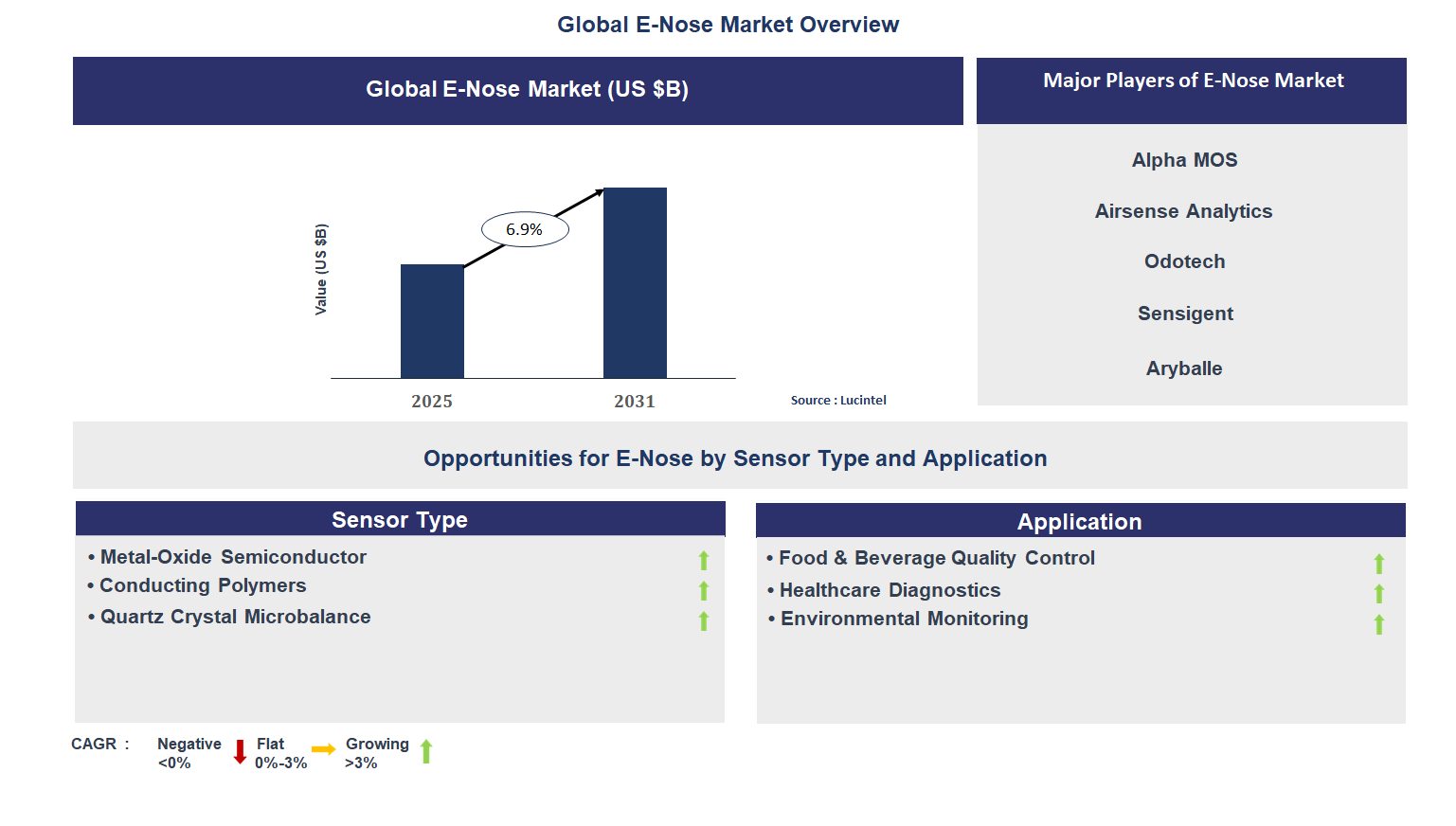
The future of the global E-nose market looks promising with opportunities in the food & beverage quality control, healthcare diagnostic, and environmental monitoring markets. The global E-nose market is expected to grow with a CAGR of 6.9% from 2025 to 2031. The major drivers for this market are the increasing demand for non-invasive detection methods, the rising adoption of smart sensors in industries, and the growing need for food quality monitoring systems.• Lucintel forecasts that, within the sensor type category, metal-oxide semiconductor is expected to witness the highest growth over the forecast period.
• Within the application category, food & beverage quality control is expected to witness the highest growth.
• In terms of region, APAC is expected to witness the highest growth over the forecast period. Gain valuable insights for your business decisions with our comprehensive 150+ page report. Sample figures with some insights are shown below.
Emerging Trends in the E-Nose Market
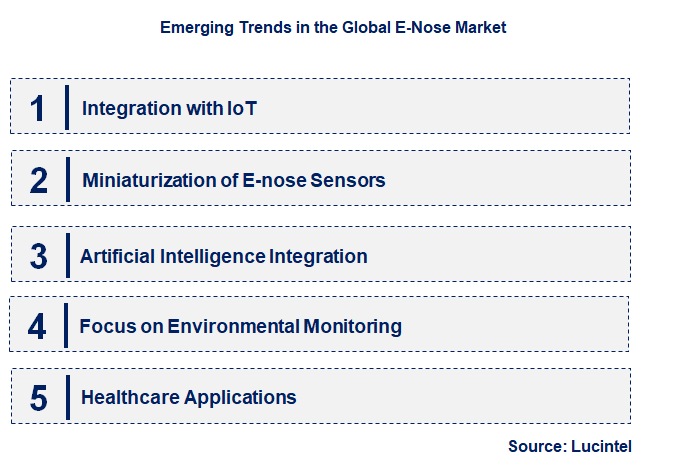
The E-nose market is undergoing significant transformations, driven by technological advancements and the increasing demand for precise, real-time odor detection. The market is witnessing a shift towards integration with smart systems, miniaturization, and improved sensitivity. Below are five key trends shaping the future of the E-nose market.• Integration with IoT: E-nose devices are increasingly being integrated with Internet of Things (IoT) systems. This allows for real-time data collection, remote monitoring, and predictive analytics. The synergy between E-noses and IoT devices enhances automation in industrial applications, enabling smarter decision-making and more efficient operations.
• Miniaturization of E-nose Sensors: Advances in nanotechnology are enabling the miniaturization of E-nose sensors without compromising performance. Smaller sensors make E-noses more portable and easier to integrate into everyday consumer devices like smartphones, wearables, and home appliances, driving the adoption of E-nose technology across various industries.
• Artificial Intelligence Integration: The use of AI in E-nose systems is improving odor classification and pattern recognition. AI algorithms enhance the E-nose’s ability to detect and differentiate complex odors, making them more accurate and effective for applications in healthcare diagnostics, food quality, and environmental monitoring.
• Focus on Environmental Monitoring: With growing concerns about air pollution and climate change, there is a rising demand for E-noses in environmental monitoring. E-noses are now used to detect harmful gases, monitor air quality, and help in environmental compliance. Their ability to provide real-time data is valuable for governments and organizations working toward sustainability goals.
• Healthcare Applications: The healthcare sector is increasingly adopting E-nose technology for non-invasive disease detection, including for conditions like diabetes and lung cancer. E-noses can detect biomarkers in exhaled breath, providing a potential for early diagnosis and continuous monitoring, leading to more personalized healthcare treatments and management. These emerging trends, such as IoT integration, miniaturization, AI adoption, environmental monitoring, and healthcare applications, are reshaping the E-nose market. As technology advances and industries seek more accurate, real-time data, E-nose systems are becoming more ubiquitous and integrated into various sectors, from consumer electronics to environmental and healthcare applications.
Recent Development in the E-Nose Market
Recent developments in the E-nose market are driven by technological innovations, new applications, and increasing adoption across diverse industries. These developments are setting the stage for rapid growth and transformation, addressing the demand for precise odor detection and real-time monitoring. Below are five key developments shaping the market.• Development of Portable E-nose Devices: Portable E-nose devices are being developed for on-the-go applications, particularly in food safety, healthcare, and environmental monitoring. These devices provide real-time odor detection, allowing for quick analysis and decision-making. Their compact form factor makes them suitable for use in remote locations, food inspection sites, and medical diagnostics.
• AI-Powered E-nose Systems: The integration of AI with E-nose technology is a key development. AI algorithms are enhancing the ability of E-nose devices to distinguish complex odors with greater precision. This advancement allows for more accurate detection of specific volatile compounds, which is particularly useful in healthcare diagnostics and environmental monitoring.
• E-nose Technology for Smart Agriculture: E-nose devices are now being used in smart agriculture to detect plant diseases and monitor soil health. This technology allows farmers to detect early signs of pest infestation or plant stress, enabling more proactive crop management. The adoption of E-noses in agriculture is driving sustainable practices by reducing the need for harmful pesticides.
• Expansion of E-nose Use in Healthcare: E-nose technology is increasingly being explored for healthcare applications, such as the detection of disease biomarkers in breath analysis. Recent developments in wearable E-nose devices are enabling continuous health monitoring, providing patients and doctors with real-time data on conditions like diabetes, infections, or lung diseases.
• Partnerships for Market Expansion: Companies in the E-nose sector are forming partnerships to expand their market reach and develop new applications. Collaborations between sensor manufacturers, software developers, and end-users are accelerating innovation and helping bring advanced E-nose products to market faster. These partnerships are essential in pushing the boundaries of what E-nose technology can achieve. The key developments in the E-nose market, including portable devices, AI integration, agricultural applications, healthcare advancements, and strategic partnerships, are propelling the market forward. These innovations are making E-nose technology more accessible, accurate, and versatile across various industries, unlocking new opportunities and driving the markets growth.
Strategic Growth Opportunities in the E-Nose Market
The E-nose market presents several strategic growth opportunities across key applications. As industries continue to seek innovative ways to monitor odors, detect gases, and ensure quality control, the E-nose technologys versatility positions it as a valuable tool in multiple sectors. Below are five key growth opportunities in the market.• Food Quality Control: One of the largest opportunities for E-nose growth is in food quality control, particularly in the food and beverage industry. E-noses can be used to ensure consistency in flavor, detect spoilage, and monitor freshness. As the demand for high-quality and safe food products grows, E-noses will become essential in maintaining industry standards.
• Healthcare Diagnostics: E-nose technology holds significant potential in non-invasive healthcare diagnostics. E-noses can detect volatile organic compounds (VOCs) in breath, providing early warning signs for diseases like lung cancer, diabetes, or infections. The growing demand for personalized and preventive healthcare opens opportunities for E-noses in diagnostic applications, both in clinical and at-home settings.
• Environmental Monitoring: With increasing awareness of air pollution and climate change, E-noses have a growing role in environmental monitoring. These devices can detect harmful gases, pollutants, and allergens in real-time, helping organizations comply with environmental regulations. The expansion of smart cities and environmental monitoring networks is fueling the demand for E-noses in this sector.
• Smart Manufacturing: The integration of E-noses in smart manufacturing processes offers opportunities for quality control, maintenance, and safety. E-noses can detect hazardous gases, measure air quality, and monitor production processes, ensuring workplace safety. As more manufacturers adopt Industry 4.0 technologies, the demand for smart sensors like E-noses will increase.
• Consumer Electronics: The growth of wearable devices, particularly in health tech and smart home applications, presents significant growth potential for E-nose technology. E-noses integrated into smart devices can provide real-time environmental data or health insights, such as detecting body odors or pollutants in indoor environments. This growing trend in consumer electronics offers new avenues for market expansion. Strategic growth opportunities in the E-nose market span various industries, including food quality control, healthcare diagnostics, environmental monitoring, smart manufacturing, and consumer electronics. As the technology advances and more industries seek odor detection solutions, E-nose applications are becoming increasingly diverse, fueling market expansion and creating new avenues for innovation.
E-Nose Market Driver and Challenges
The E-nose market is driven by technological advancements, increasing demand for real-time monitoring, and the need for more efficient systems across various industries. However, the market also faces challenges related to cost, regulation, and technological limitations. Below are the key drivers and challenges influencing the markets growth. The factors responsible for driving the e-nose market include: 1. Technological Advancements: Advances in sensor technology, artificial intelligence, and miniaturization are key drivers for the E-nose market. Improved sensitivity, accuracy, and the ability to detect a wide range of odors are fueling market growth. The integration of AI allows for more intelligent, automated odor detection, further expanding applications in healthcare, food, and environmental sectors. 2. Growing Environmental Concerns: Increasing concerns about air pollution and environmental degradation are driving the demand for E-noses in environmental monitoring. E-noses offer a cost-effective way to monitor air quality, detect pollutants, and ensure compliance with environmental regulations. This trend is leading to widespread adoption in urban planning, smart cities, and industrial emissions monitoring. 3. Rising Demand for Non-Invasive Diagnostics: The demand for non-invasive diagnostic tools in healthcare is accelerating, with E-nose technology being used to detect disease biomarkers in breath samples. E-noses provide a less intrusive, cost-effective method of diagnosing and monitoring conditions like diabetes, lung diseases, and infections, creating new opportunities in the healthcare sector. 4. Increased Focus on Food Safety: The need for food safety and quality control is driving the adoption of E-nose technology in the food and beverage industry. E-noses can detect spoilage, measure freshness, and monitor flavor profiles, ensuring quality and safety throughout the production process. This is leading to increased demand for E-noses in food processing and packaging. 5. Advancements in IoT Integration: The integration of E-nose technology with the Internet of Things (IoT) is transforming its capabilities, enabling real-time monitoring and data collection. This integration enhances operational efficiency and supports smart decision-making in industrial, healthcare, and environmental applications, which is fueling market growth. Challenges in the e-nose market are: 1. High Cost of Implementation: The cost of developing, manufacturing, and implementing E-nose systems remains high, particularly for advanced sensors with AI capabilities. The initial investment required for adoption can be a barrier, especially for smaller companies or industries with limited budgets, affecting widespread market penetration. 2. Limited Standardization: The lack of standardization in E-nose technologies can pose challenges in integrating them into existing systems. This leads to compatibility issues and higher customization costs for industries that require specific configurations. Developing standardized solutions will be crucial to ensure seamless adoption and scalability across various applications. 3. Technological Limitations: Despite advancements, E-nose technology still faces challenges in terms of sensitivity and reliability in complex environments. Environmental factors such as temperature, humidity, and chemical interference can affect the performance of sensors, limiting their effectiveness in certain applications. The major drivers in the E-nose market include technological advancements, growing environmental concerns, and rising demand for non-invasive diagnostics. However, challenges such as high implementation costs, limited standardization, and technological limitations must be addressed to unlock the full potential of E-nose technology. As these challenges are overcome, the market is poised for further growth and diversification across various industries.List of E-Nose Companies
Companies in the market compete on the basis of product quality offered. Major players in this market focus on expanding their manufacturing facilities, R&D investments, infrastructural development, and leverage integration opportunities across the value chain. With these strategies E-nose companies cater increasing demand, ensure competitive effectiveness, develop innovative products & technologies, reduce production costs, and expand their customer base. Some of the E-nose companies profiled in this report include-• Alpha MOS
• Airsense Analytics
• Odotech
• Sensigent
• Aryballe
E-Nose Market by Segment
The study includes a forecast for the global E-nose market by sensor type, application, and region.E-Nose Market by Sensor Type [Value from 2019 to 2031]:
• Metal-Oxide Semiconductor
• Conducting Polymers
• Quartz Crystal Microbalance
E-Nose Market by Application [Value from 2019 to 2031]:
• Food & Beverage Quality Control
• Healthcare Diagnostics
• Environmental Monitoring
E-Nose Market by Region [Value from 2019 to 2031]:
• North America
• Europe
• Asia Pacific
• The Rest of the World
Country Wise Outlook for the E-Nose Market
The E-nose market is growing as industries adopt advanced sensors and technologies to detect, identify, and analyze odors. With applications across food and beverage, healthcare, environmental monitoring, and defense, various countries, including the United States, China, Germany, India, and Japan, are making significant strides in advancing E-nose technology. These developments highlight the increasing demand for real-time, precise olfactory sensors in diverse industries.• United States: The U.S. is at the forefront of E-nose technology, with significant investments in R&D for applications in healthcare, food safety, and environmental monitoring. Companies are developing more advanced sensor arrays that mimic the human olfactory system, enhancing precision in detecting harmful gases and volatile compounds. Regulatory pressure around environmental monitoring is driving growth in this sector.
• China: China has seen rapid development in the E-nose market, with a focus on agricultural applications and air quality monitoring. The government’s push for smart cities and environmental sustainability has led to increased adoption of E-nose technologies for real-time pollution detection and air quality analysis. Chinese manufacturers are also lowering production costs, making E-noses more accessible to various industries.
• Germany: In Germany, E-nose technology is being integrated into the automotive, food, and beverage industries. Companies are developing sensors for quality control in food production, ensuring flavor consistency and safety. Additionally, Germany’s emphasis on precision engineering and sustainability has led to the development of high-accuracy, long-lasting E-nose devices, which are now being used for industrial applications as well.
• India: India is witnessing increasing adoption of E-nose technology in food safety and environmental monitoring, particularly in urban areas. The growing concern over air pollution and the need for real-time quality control in food processing are driving the market. Indian companies are leveraging low-cost sensor technologies to cater to local demands, which is fostering market growth.
• Japan: Japan is focusing on healthcare and consumer electronics applications for E-nose technology. Companies are integrating E-noses into wearable devices for health monitoring, detecting changes in body odor related to diseases like diabetes. Japan’s high-tech infrastructure and emphasis on innovation make it a leader in developing miniaturized, user-friendly E-nose products for everyday applications.

Features of the Global E-Nose Market
Market Size Estimates: E-nose market size estimation in terms of value ($B). Trend and Forecast Analysis: Market trends (2019 to 2024) and forecast (2025 to 2031) by various segments and regions. Segmentation Analysis: E-nose market size by sensor type, application, and region in terms of value ($B). Regional Analysis: E-nose market breakdown by North America, Europe, Asia Pacific, and Rest of the World. Growth Opportunities: Analysis of growth opportunities in different sensor type, application, and regions for the E-nose market. Strategic Analysis: This includes M&A, new product development, and competitive landscape of the E-nose market. Analysis of competitive intensity of the industry based on Porter’s Five Forces model.
FAQ
Q1. What is the growth forecast for E-nose market? Answer: The global E-nose market is expected to grow with a CAGR of 6.9% from 2025 to 2031. Q2. What are the major drivers influencing the growth of the E-nose market? Answer: The major drivers for this market are the increasing demand for non-invasive detection methods, the rising adoption of smart sensors in industries, and the growing need for food quality monitoring systems. Q3. What are the major segments for E-nose market? Answer: The future of the E-nose market looks promising with opportunities in the food & beverage quality control, healthcare diagnostic, and environmental monitoring markets. Q4. Who are the key E-nose market companies? Answer: Some of the key E-nose companies are as follows:• Alpha MOS
• Airsense Analytics
• Odotech
• Sensigent
• Aryballe Q5. Which E-nose market segment will be the largest in future? Answer: Lucintel forecasts that, within the sensor type category, metal-oxide semiconductor is expected to witness the highest growth over the forecast period. Q6. In E-nose market, which region is expected to be the largest in next 5 years? Answer: In terms of region, APAC is expected to witness the highest growth over the forecast period. Q7. Do we receive customization in this report? Answer: Yes, Lucintel provides 10% customization without any additional cost.
Table of Contents
List of Figures
List of Tables
Methodology
- In-depth interviews of the major players in this market
- Detailed secondary research from competitors’ financial statements and published data
- Extensive searches of published works, market, and database information pertaining to industry news, company press releases, and customer intentions
- A compilation of the experiences, judgments, and insights of Lucintel’s professionals, who have analyzed and tracked this market over the years.


Buy Now
Choose a license that fits your team. Instant PDF delivery.
Prices exclude taxes. Instant delivery. Custom licensing available on request.
Key Questions
- • What are some of the most promising, high-growth opportunities for the E-nose market by sensor type (metal-oxide semiconductor, conducting polymers, and quartz crystal microbalance), application (food & beverage quality control, healthcare diagnostics, and environmental monitoring), and region (North America, Europe, Asia Pacific, and the Rest of the World)?
- • Which segments will grow at a faster pace and why?
- • Which region will grow at a faster pace and why?
- • What are the key factors affecting market dynamics? What are the key challenges and business risks in this market?
- • What are the business risks and competitive threats in this market?
- • What are the emerging trends in this market and the reasons behind them?
- • What are some of the changing demands of customers in the market?
- • What are the new developments in the market? Which companies are leading these developments?
- • Who are the major players in this market? What strategic initiatives are key players pursuing for business growth?
- • What are some of the competing products in this market and how big of a threat do they pose for loss of market share by material or product substitution?
- • What M&A activity has occurred in the last 5 years and what has its impact been on the industry? For any questions related to E-Nose Market, E-Nose Market Size, E-Nose Market Growth, E-Nose Market Analysis, E-Nose Market Report, E-Nose Market Share, E-Nose Market Trends, E-Nose Market Forecast, E-Nose Companies, write Lucintel analyst at email: helpdesk@lucintel.com. We will be glad to get back to you soon.


