
Report Feature
E-Liquid Market Trends and Forecast
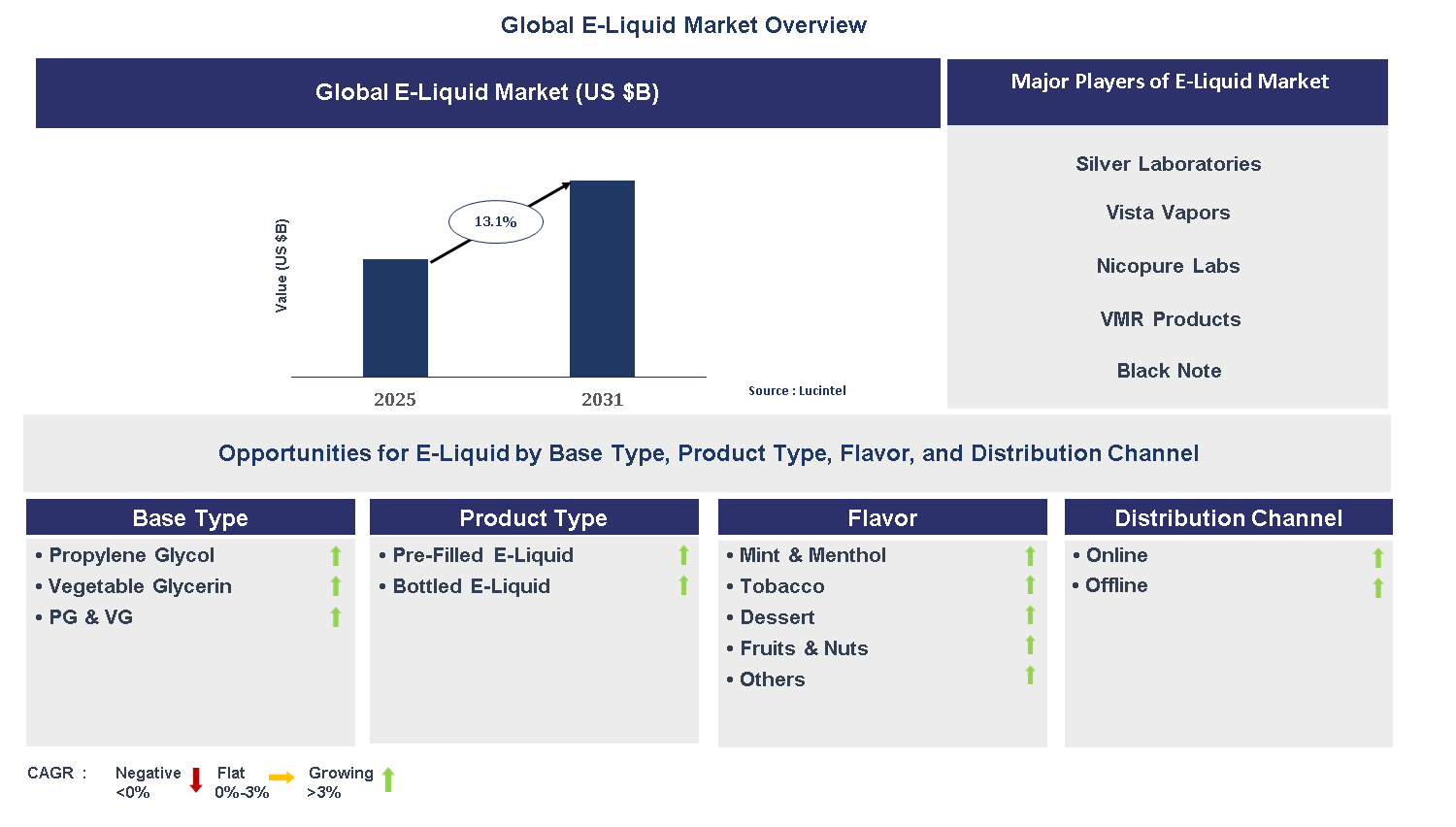
The future of the global E-liquid market looks promising with opportunities in the pre-filled E-liquid and bottled E-liquid markets. The global E-liquid market is expected to grow with a CAGR of 13.1% from 2025 to 2031. The major drivers for this market are the increasing demand for vaping products over smoking, the rising preference for flavored E-liquids among users, and the growing popularity of e-cigarettes across demographics.• Lucintel forecasts that, within the base type category, PG & VG is expected to witness the highest growth over the forecast period.
• Within the product type category, pre-filled E-liquid is expected to witness higher growth.
• In terms of region, APAC is expected to witness the highest growth over the forecast period. Gain valuable insights for your business decisions with our comprehensive 150+ page report. Sample figures with some insights are shown below.
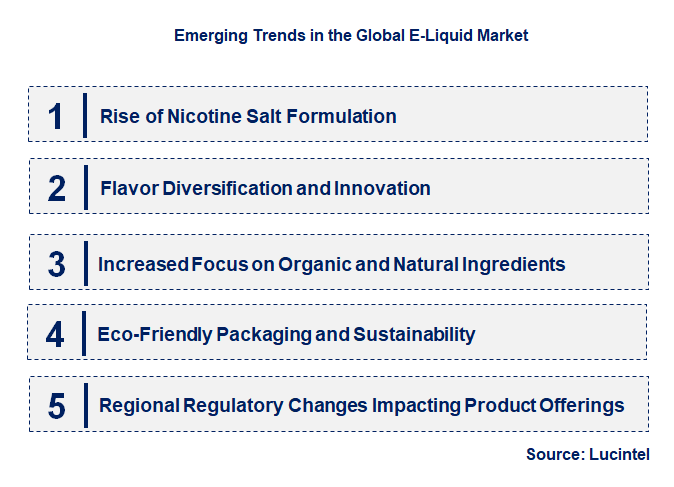
Emerging Trends in the E-Liquid Market
The E-liquid market is undergoing various transformations, influenced by both consumer trends and regulatory changes. As the demand for healthier and more sustainable alternatives to smoking grows, manufacturers are responding with innovations in product formulations, flavor variety, and packaging. Here are the emerging trends reshaping the E-liquid market.• Rise of Nicotine Salt Formulation: Nicotine salt-based E-liquids are gaining popularity, especially in the U.S. and European markets. They allow for higher nicotine concentrations without the harshness typically associated with regular freebase nicotine. This trend appeals to smokers looking to transition to vaping with a smoother experience. The rise of these products signals a shift toward more consumer-friendly formulations.
• Flavor Diversification and Innovation: Flavored E-liquids are becoming more diverse, with manufacturers experimenting with unique combinations like dessert, tropical fruit, and even savory flavors. In countries like China and the U.S., flavored E-liquids are becoming a dominant segment. However, regulatory restrictions in certain markets are beginning to limit this trend, particularly with bans on flavored products.
• Increased Focus on Organic and Natural Ingredients: Consumers are increasingly gravitating towards E-liquids made from organic and natural ingredients. This trend is being seen across markets such as Germany and the U.S., where consumers are more health-conscious. Organic E-liquids are marketed as cleaner alternatives, free from synthetic chemicals, which appeals to those looking for safer options.
• Eco-Friendly Packaging and Sustainability: There is a noticeable shift towards eco-friendly packaging in the E-liquid industry, driven by both consumer demand and environmental concerns. Brands are opting for recyclable or biodegradable packaging materials, especially in markets like the U.S. and Europe. This trend reflects the broader movement towards sustainability in consumer products.
• Regional Regulatory Changes Impacting Product Offerings: As governments around the world implement stricter regulations on vaping products, the E-liquid market is being reshaped. For example, in India and China, there are increased restrictions on nicotine content and flavored products. Manufacturers are adapting by formulating E-liquids that comply with local regulations, ensuring access to key markets despite tightening controls. Emerging trends in the E-liquid market reflect consumer preferences for smoother, safer, and more sustainable products. The rise of nicotine salts, innovative flavors, organic ingredients, and eco-friendly packaging is reshaping the market landscape. However, regulatory challenges, especially regarding flavor restrictions and product safety, are influencing how companies innovate and position their products.
Recent Development in the E-Liquid Market
Recent developments in the E-liquid market are driven by innovations in product formulations, regulatory challenges, and changing consumer preferences. Companies are responding with new product offerings, focusing on quality and sustainability, while navigating an increasingly complex regulatory environment. These developments reflect the ongoing evolution of the market as it adapts to the needs of a diverse global consumer base.• Growth in Nicotine Salt Products: Nicotine salt E-liquids have gained traction due to their smoother throat hit at higher nicotine concentrations. This is particularly evident in the U.S. market, where these products cater to former smokers looking for an experience closer to traditional cigarettes. This shift is reshaping the market, attracting new users and offering an alternative to standard E-liquids.
• Regulations and Flavor Bans: The E-liquid market has been significantly impacted by the introduction of flavor bans in key markets like the U.S. and China. These bans, aimed at reducing the appeal of vaping to younger consumers, have forced manufacturers to adjust their product offerings. As a result, many companies are focusing on non-flavored, tobacco-based E-liquids or complying with local regulatory requirements.
• Premium and Organic E-liquids on the Rise: The demand for premium and organic E-liquids is growing in mature markets like Germany and the U.S. Consumers are becoming more discerning, preferring products made with organic, natural ingredients. This trend has prompted brands to invest in transparency and high-quality formulations, offering products that appeal to health-conscious individuals.
• Increased Focus on International Markets: Manufacturers are increasingly looking to expand into international markets such as India and Japan, where there is a rising interest in vaping as an alternative to smoking. However, each region has its own regulatory landscape, requiring companies to adapt their product offerings. The Asian market presents significant growth potential, especially as vaping awareness rises.
• Adoption of Eco-Friendly Packaging: The push towards sustainability in the E-liquid industry is leading to more eco-friendly packaging solutions. Brands are shifting to recyclable and biodegradable materials to appeal to environmentally conscious consumers. This trend is especially strong in Europe and the U.S., where sustainability is becoming an integral part of consumer purchasing decisions. Recent developments in the E-liquid market highlight a growing focus on product innovation, regulatory compliance, and sustainability. The rise of nicotine salt products, premium offerings, and eco-friendly packaging is reshaping consumer expectations. However, regulatory hurdles, especially around flavored E-liquids, are pushing manufacturers to innovate while navigating increasingly complex market dynamics.
Strategic Growth Opportunities in the E-Liquid Market
The E-liquid market offers a variety of growth opportunities, driven by changing consumer demands, regulatory adjustments, and technological innovations. Companies can leverage these opportunities by tapping into emerging markets, focusing on sustainability, and adapting to shifting consumer preferences. The evolving landscape presents several avenues for expansion in both established and developing markets.• Focus on Emerging Markets: Emerging markets, especially in Asia, present significant growth opportunities for the E-liquid industry. As countries like India and China see increasing awareness of vaping as a healthier alternative to smoking, demand for E-liquids is expected to rise. Manufacturers can capitalize on this by offering affordable, region-specific products that cater to local tastes and preferences.
• Innovation in Nicotine Salt Products: Nicotine salt-based E-liquids offer smoother experiences at higher nicotine concentrations, making them an appealing option for former smokers. The U.S. and European markets are particularly ripe for growth in this segment, with a growing demand for products that mimic traditional cigarettes. Companies focusing on nicotine salt innovation can capture this emerging consumer base.
• Expansion of Premium and Organic E-liquids: There is growing consumer interest in premium and organic E-liquids, particularly in developed markets. Consumers are willing to pay a premium for products made with natural, high-quality ingredients. Brands that position themselves as providers of luxury, high-end, and organic E-liquids can capitalize on this trend, expanding their market share.
• Sustainability and Eco-Friendly Products: With increasing consumer demand for sustainability, there is a strong growth opportunity in offering eco-friendly E-liquids and packaging. Brands that adopt recyclable, biodegradable packaging and prioritize environmental sustainability can stand out in the competitive market. Companies can align with eco-conscious consumers and benefit from this emerging trend in markets like Europe and North America.
• Diversification into Flavored E-liquids: Despite regulatory challenges in some markets, the demand for flavored E-liquids continues to grow in areas with fewer restrictions. Manufacturers can diversify their product offerings by introducing innovative and unique flavors to capture consumer interest. Developing flavors that cater to specific cultural tastes or preferences can help brands establish a competitive advantage in international markets. Strategic growth opportunities in the E-liquid market are abundant, with potential for expansion in emerging markets, innovation in nicotine salt products, and a focus on premium and sustainable offerings. By aligning with consumer trends and navigating regulatory challenges, companies can position themselves for success in this dynamic and evolving market.
E-Liquid Market Driver and Challenges
The E-liquid market is influenced by a variety of drivers, including consumer preferences for alternative nicotine products and increasing regulatory oversight. Technological innovations and the focus on sustainability also play key roles. However, the market faces significant challenges from changing regulations, safety concerns, and competition. Understanding these drivers and challenges is crucial for market participants to remain competitive and compliant. The factors responsible for driving the E-liquid market include: 1. Health-Conscious Consumer Preferences: As smokers transition to vaping as a less harmful alternative, health-conscious consumers are driving demand for E-liquids. This shift is particularly evident in markets like the U.S. and Europe, where the focus on reduced harm products continues to grow. The increasing awareness of vaping’s potential benefits over smoking is a major driver for market expansion. 2. Technological Advancements in Vaping: Advancements in vaping devices and E-liquid formulations are enhancing the user experience. Innovations in nicotine salts, flavor delivery systems, and vaporization technology contribute to the growing popularity of vaping. These technological improvements help brands differentiate themselves in the competitive market, offering smoother and more customizable experiences for consumers. 3. Growing Acceptance of Vaping: Vaping is becoming more widely accepted as a smoking cessation tool, with governments and public health organizations acknowledging its potential benefits. This acceptance, combined with rising consumer awareness, is fueling the demand for E-liquids globally. Countries like the U.S. and Japan are experiencing growing vaping populations, providing a fertile market for E-liquid manufacturers. 4. Premium Product Demand: As consumers seek higher-quality, safer, and more enjoyable experiences, the demand for premium E-liquids is on the rise. Organic, natural ingredients and transparent production processes are increasingly sought after. This trend is especially evident in developed markets where consumers are willing to pay a premium for high-end products. 5. Regulatory Developments in Key Markets: Government regulations regarding vaping products, including quality controls and nicotine concentration limits, are driving innovation and ensuring product safety. This has created a more regulated market in countries like Germany and the U.S., where manufacturers are adapting to meet stringent guidelines, which is increasing consumer confidence in E-liquids. Challenges in the E-liquid market are: 1. Regulatory Uncertainty: Uncertainty surrounding vaping regulations, especially around flavor bans and nicotine limits, poses a significant challenge for manufacturers. In markets like the U.S., India, and China, changing laws create difficulties in product planning and long-term strategy. Companies must navigate this regulatory landscape to ensure compliance while maintaining competitive products. 2. Market Saturation and Competition: The E-liquid market is highly competitive, with a large number of brands offering similar products at varying price points. Differentiating products in such a crowded market is a challenge for manufacturers. Brands must innovate continually to stay relevant, leading to constant pressure on pricing, branding, and product differentiation. 3. Health and Safety Concerns: Despite the growing popularity of vaping, health and safety concerns surrounding E-liquids remain. Issues such as the safety of ingredients, the long-term effects of vaping, and potential risks associated with counterfeit products have raised alarm in several markets. These concerns may deter some potential consumers from entering the market and require manufacturers to improve quality assurance. The E-liquid market is driven by health-conscious consumer preferences, technological innovation, and growing acceptance of vaping. However, manufacturers face challenges from regulatory uncertainty, market saturation, and safety concerns. Navigating these drivers and challenges will be critical for companies aiming to capture opportunities in this rapidly evolving market.List of E-Liquid Companies
Companies in the market compete on the basis of product quality offered. Major players in this market focus on expanding their manufacturing facilities, R&D investments, infrastructural development, and leverage integration opportunities across the value chain. With these strategies E-liquid companies cater increasing demand, ensure competitive effectiveness, develop innovative products & technologies, reduce production costs, and expand their customer base. Some of the E-liquid companies profiled in this report include-• Silver Laboratories
• Vista Vapors
• Nicopure Labs
• VMR Products
• Black Note
• Mt Baker Vapor
• Savage Enterprises
• Mig Vapor
• Fuggin Vapor
• USA Vape Labe
E-Liquid Market by Segment
The study includes a forecast for the global E-liquid market by base type, product type, flavor, distribution channel, and region.E-Liquid Market by Base Type [Value from 2019 to 2031]:
• Propylene Glycol
• Vegetable Glycerin
• PG & VG
E-Liquid Market by Product Type [Value from 2019 to 2031]:
• Pre-Filled E-Liquid
• Bottled E-Liquid
E-Liquid Market by Flavor [Value from 2019 to 2031]:
• Mint & Menthol
• Tobacco
• Dessert
• Fruits & Nuts
• Others
E-Liquid Market by Distribution Channel [Value from 2019 to 2031]:
• Online
• Offline
E-Liquid Market by Region [Value from 2019 to 2031]:
• North America
• Europe
• Asia Pacific
• The Rest of the World
Country Wise Outlook for the E-Liquid Market
The global E-liquid market has experienced significant shifts due to changing consumer preferences, health concerns, and evolving regulatory frameworks. In regions like the United States, China, Germany, India, and Japan, the market is adapting to new trends such as the rise of nicotine salts, flavors, and eco-friendly packaging. These developments highlight the dynamic nature of the market as it responds to diverse consumer demands and governmental regulations.• United States: In the U.S., the E-liquid market has been heavily impacted by government regulations, particularly the FDA’s oversight of vaping products. A trend toward nicotine salts has become more prominent, offering smoother hits at higher nicotine concentrations. Additionally, there’s a growing demand for organic and eco-friendly E-liquid brands, as consumers become more health-conscious and environmentally aware.
• China: China, being the largest producer and consumer of E-liquids, has seen an expansion in local vape brands and a rise in premium products. The market is evolving to meet consumer demand for innovative flavors and higher nicotine concentrations. Regulatory pressures are beginning to tighten, particularly in regard to the sale of flavored products, which is reshaping the market dynamics.
• Germany: In Germany, the E-liquid market is regulated under the European Union’s Tobacco Products Directive (TPD). This has led to the widespread adoption of regulated E-liquid products, ensuring quality control and safety. There is a notable increase in demand for premium and organic E-liquids, with more consumers seeking high-quality ingredients and transparency regarding production methods.
• India: India’s E-liquid market remains relatively small but is growing due to increasing awareness of vaping as a less harmful alternative to smoking. However, the market faces challenges from ongoing government bans on vaping products in several states. Despite regulatory challenges, there is still a demand for E-liquids, particularly from the younger, urban population.
• Japan: In Japan, the E-liquid market is expanding, driven by the increasing popularity of vaping among smokers looking for alternatives. There is a strong preference for tobacco and menthol flavors, as well as nicotine salts. The Japanese government is cautious with regulations but has begun to implement measures that allow vaping products, including E-liquids, to be sold under strict controls.

Features of the Global E-Liquid Market
Market Size Estimates: E-liquid market size estimation in terms of value ($B). Trend and Forecast Analysis: Market trends (2019 to 2024) and forecast (2025 to 2031) by various segments and regions. Segmentation Analysis: E-liquid market size by various segments, such as by base type, product type, flavor, distribution channel, and region in terms of value ($B). Regional Analysis: E-liquid market breakdown by North America, Europe, Asia Pacific, and Rest of the World. Growth Opportunities: Analysis of growth opportunities in different base types, product types, flavors, distribution channels, and regions for the E-liquid market. Strategic Analysis: This includes M&A, new product development, and competitive landscape of the E-liquid market. Analysis of competitive intensity of the industry based on Porter’s Five Forces model.
FAQ
Q1. What is the growth forecast for E-liquid market? Answer: The global E-liquid market is expected to grow with a CAGR of 13.1% from 2025 to 2031. Q2. What are the major drivers influencing the growth of the E-liquid market? Answer: The major drivers for this market are the increasing demand for vaping products over smoking, the rising preference for flavored E-liquids among users, and the growing popularity of e-cigarettes across demographics. Q3. What are the major segments for E-liquid market? Answer: The future of the E-liquid market looks promising with opportunities in the pre-filled E-liquid and bottled E-liquid markets. Q4. Who are the key E-liquid market companies? Answer: Some of the key E-liquid companies are as follows:• Silver Laboratories
• Vista Vapors
• Nicopure Labs
• VMR Products
• Black Note
• Mt Baker Vapor
• Savage Enterprises
• Mig Vapor
• Fuggin Vapor
• USA Vape Labe Q5. Which E-liquid market segment will be the largest in future? Answer: Lucintel forecasts that, within the base type category, PG & VG is expected to witness the highest growth over the forecast period. Q6. In E-liquid market, which region is expected to be the largest in next 5 years? Answer: In terms of region, APAC is expected to witness the highest growth over the forecast period. Q7. Do we receive customization in this report? Answer: Yes, Lucintel provides 10% customization without any additional cost.
Table of Contents
List of Figures
List of Tables
Methodology
- In-depth interviews of the major players in this market
- Detailed secondary research from competitors’ financial statements and published data
- Extensive searches of published works, market, and database information pertaining to industry news, company press releases, and customer intentions
- A compilation of the experiences, judgments, and insights of Lucintel’s professionals, who have analyzed and tracked this market over the years.


Buy Now
Choose a license that fits your team. Instant PDF delivery.
Prices exclude taxes. Instant delivery. Custom licensing available on request.
Key Questions
- • What are some of the most promising, high-growth opportunities for the E-liquid market by base type (propylene glycol, vegetable glycerin, and PG & VG), product type (pre-filled E-liquid and bottled E-liquid), flavor (mint & menthol, tobacco, dessert, fruits & nuts, and others), distribution channel (online and offline), and region (North America, Europe, Asia Pacific, and the Rest of the World)?
- • Which segments will grow at a faster pace and why?
- • Which region will grow at a faster pace and why?
- • What are the key factors affecting market dynamics? What are the key challenges and business risks in this market?
- • What are the business risks and competitive threats in this market?
- • What are the emerging trends in this market and the reasons behind them?
- • What are some of the changing demands of customers in the market?
- • What are the new developments in the market? Which companies are leading these developments?
- • Who are the major players in this market? What strategic initiatives are key players pursuing for business growth?
- • What are some of the competing products in this market and how big of a threat do they pose for loss of market share by material or product substitution?
- • What M&A activity has occurred in the last 5 years and what has its impact been on the industry? For any questions related to E-Liquid Market, E-Liquid Market Size, E-Liquid Market Growth, E-Liquid Market Analysis, E-Liquid Market Report, E-Liquid Market Share, E-Liquid Market Trends, E-Liquid Market Forecast, E-Liquid Companies, write Lucintel analyst at email: helpdesk@lucintel.com. We will be glad to get back to you soon.


