
Report Feature
Drone Warfare Market Trends and Forecast
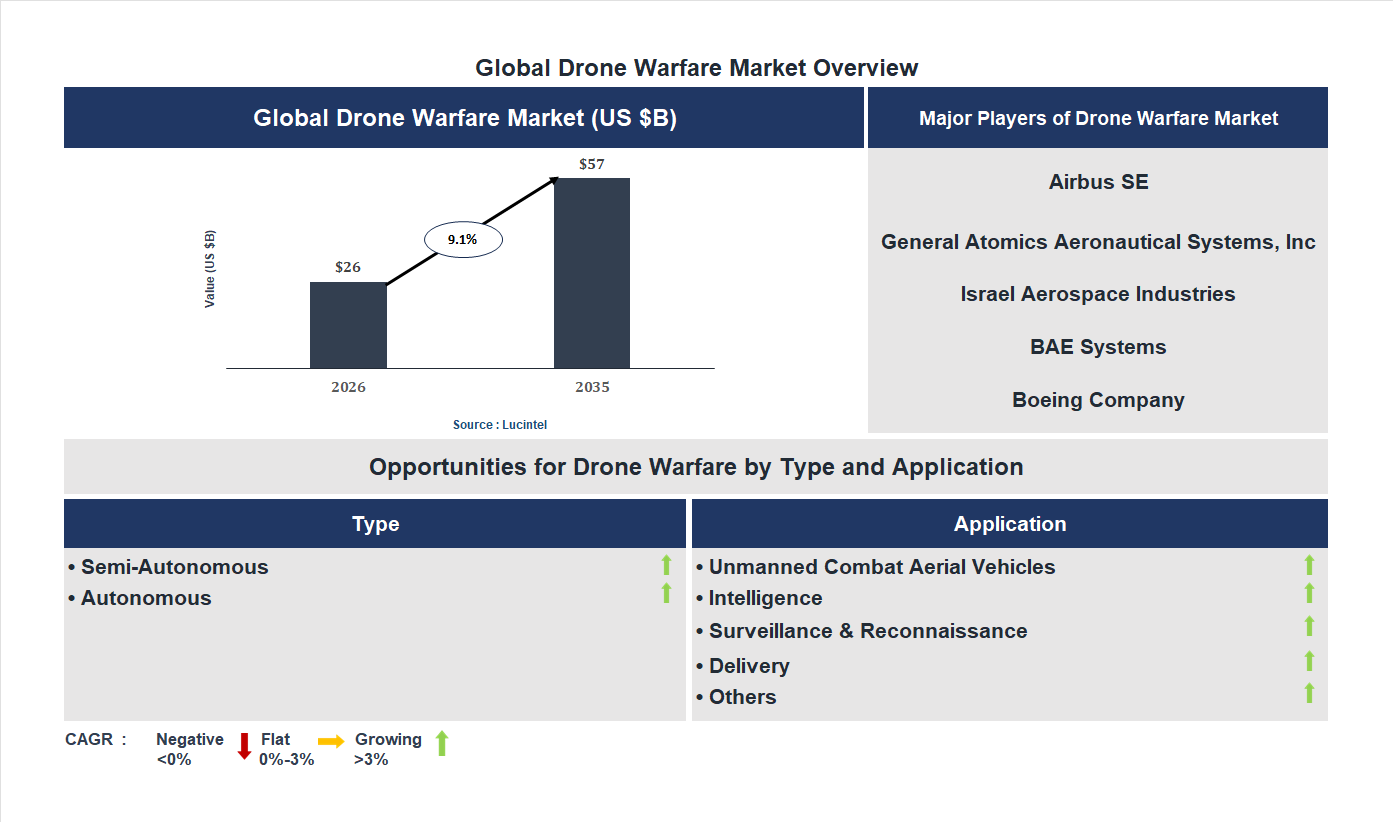
The future of the global drone warfare market looks promising with opportunities in the unmanned combat aerial vehicle, intelligence, surveillance & reconnaissance, and delivery markets. The global drone warfare market is expected to reach an estimated $57 billion by 2035 with a CAGR of 9.1% from 2026 to 2035. The major drivers for this market are the increasing demand for advanced unmanned combat systems, the rising investments in military drone technologies, and the growing adoption of autonomous surveillance solutions.• Lucintel forecasts that, within the type category, autonomous is expected to witness higher growth over the forecast period.
• Within the application category, surveillance & reconnaissance is expected to witness the highest growth.
• In terms of region, APAC is expected to witness the highest growth over the forecast period. Gain valuable insights for your business decisions with our comprehensive 150+ page report. Sample figures with some insights are shown below.
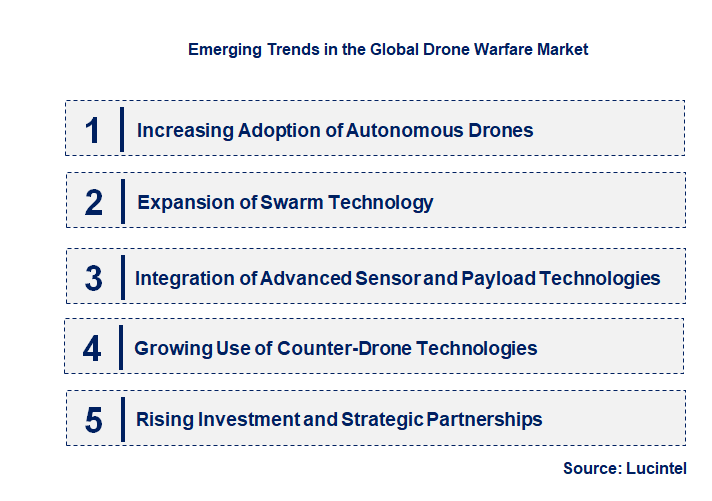
Emerging Trends in the Drone Warfare Market
The drone warfare market is experiencing rapid evolution driven by technological advancements, shifting geopolitical dynamics, and increasing demand for enhanced security measures. As nations seek more efficient, cost-effective, and precise military solutions, the industry is witnessing significant innovations and strategic shifts. These developments are not only transforming traditional defense paradigms but also expanding the scope of drone applications beyond combat to surveillance, reconnaissance, and logistics. The following key trends highlight the major forces shaping the future of drone warfare, reflecting a landscape that is becoming more sophisticated, integrated, and responsive to emerging security challenges.• Increasing Adoption of Autonomous Drones: The integration of artificial intelligence (AI) and machine learning into drone systems is enabling higher levels of autonomy. These drones can perform complex missions without human intervention, improving operational efficiency and reducing risks to personnel. Autonomous capabilities allow for real-time decision-making, adaptive flight paths, and enhanced target recognition, making them invaluable in combat and surveillance scenarios. This trend is driven by advancements in sensor technology, computing power, and data analytics, leading to smarter, more reliable drone systems that can operate in contested environments with minimal oversight.
• Expansion of Swarm Technology: Drone swarms, consisting of large numbers of small, coordinated drones, are emerging as a game-changing trend. These swarms can execute complex, synchronized operations such as overwhelming enemy defenses, conducting large-scale reconnaissance, or disrupting communication networks. The use of swarm technology enhances battlefield resilience, scalability, and flexibility, providing a tactical advantage. Developments in communication protocols, decentralized control algorithms, and miniaturization are facilitating the deployment of drone swarms, which are expected to become a core component of future military strategies across various defense budgets.
• Integration of Advanced Sensor and Payload Technologies: Modern drone warfare relies heavily on sophisticated sensors and payloads, including high-resolution cameras, radar systems, electronic warfare equipment, and even lethal payloads. These enhancements improve target identification, situational awareness, and engagement precision. The ability to carry diverse payloads allows drones to perform multiple roles, from intelligence gathering to direct strikes. Continuous innovation in sensor miniaturization and data processing is expanding the operational capabilities of drones, making them more versatile and effective in complex combat environments, thereby increasing their strategic value.
• Growing Use of Counter-Drone Technologies: As drone usage proliferates, so does the need to counter hostile or unauthorized drones. The market is witnessing a surge in counter-drone solutions such as jamming systems, drone interceptors, and cyber warfare tools. These technologies aim to detect, track, and neutralize threats posed by enemy drones, safeguarding critical infrastructure and military assets. The development of effective counter-drone measures is crucial for maintaining operational security and dominance in contested environments. This trend underscores the importance of integrated defense systems that can seamlessly address both offensive and defensive drone operations.
• Rising Investment and Strategic Partnerships: Governments and defense contractors are increasing investments in drone warfare technology, driven by the need to modernize armed forces and maintain strategic superiority. Public-private partnerships, joint ventures, and international collaborations are accelerating innovation and deployment. Funding is directed toward research and development of next-generation drones, enhanced autonomy, and integrated command systems. These investments are also fostering a competitive landscape, encouraging rapid technological advancements and commercialization of military drone solutions, which are shaping the future trajectory of the drone warfare market. These trends are fundamentally reshaping the drone warfare market by making systems more autonomous, scalable, versatile, and resilient. They are enabling militaries to conduct more precise, efficient, and adaptive operations while also addressing emerging threats through counter-drone technologies. As these developments continue, the market will see increased innovation, strategic collaborations, and a broader scope of applications, ultimately transforming modern warfare and defense strategies.
Recent Development in the Drone Warfare Market
The drone warfare market is experiencing rapid growth driven by technological advancements, increasing defense budgets, and evolving security threats worldwide. Governments and private sectors are investing heavily in drone technology to enhance surveillance, combat capabilities, and strategic dominance. This dynamic environment presents significant opportunities for innovation, market expansion, and competitive positioning. As nations modernize their military arsenals, the drone warfare sector is poised for substantial development, influencing global security paradigms and defense strategies.• Technological Innovations in Drone Capabilities: The integration of AI, machine learning, and autonomous systems is revolutionizing drone operations. These advancements enable longer flight times, improved targeting accuracy, and enhanced data collection. Such innovations are expanding the scope of drone applications in surveillance, reconnaissance, and combat missions. The market benefits from increased demand for smarter, more efficient drones, fostering growth in R&D investments and new product launches, ultimately transforming modern warfare strategies.
• Rising Defense Budgets and Military Spending: Governments worldwide are increasing defense budgets to modernize their military forces, with a focus on drone technology. Countries like the U.S., China, and Russia are allocating substantial funds to develop advanced drone systems. This surge in military spending accelerates market growth, encourages public-private partnerships, and drives procurement of next-generation drones. The increased financial commitment ensures sustained innovation, competitive market dynamics, and expanded deployment of drone warfare solutions across various defense sectors.
• Strategic Use of Drones in Asymmetric Warfare: Drones are increasingly employed in asymmetric conflicts, providing smaller nations and non-state actors with cost-effective, versatile tools for surveillance and targeted strikes. This trend shifts traditional warfare paradigms, emphasizing the importance of drone technology in counterinsurgency and border security. The market responds to this demand by developing lightweight, portable, and easy-to-operate drone systems. Such applications broaden market reach, stimulate new product segments, and influence global security strategies.
• Regulatory Frameworks and International Policies: Evolving regulations and international treaties are shaping the drone warfare landscape. Governments are establishing guidelines for drone usage, export controls, and airspace security to mitigate risks. These policies impact market growth by creating compliance requirements and influencing international trade. Companies investing in drone technology must navigate complex legal environments, which can both challenge and stimulate innovation. Clear regulations foster safer deployment, encouraging broader adoption and market stability.
• Emerging Sub-segments and Market Diversification: The drone warfare market is diversifying into specialized sub-segments such as underwater drones, swarm technology, and counter-drone systems. These niches address specific operational needs, like anti-drone defenses and covert underwater surveillance. The expansion into these areas opens new revenue streams and enhances overall market resilience. As demand for tailored solutions grows, companies are investing in niche innovations, leading to a more robust, competitive, and technologically advanced drone warfare ecosystem. The overall impact of these developments is a rapidly evolving market characterized by technological innovation, increased military investment, and expanding application areas. These factors are driving global adoption, fostering competitive advancements, and shaping future defense strategies. The markets growth prospects remain strong, with ongoing innovations promising to redefine modern warfare and security paradigms worldwide.
Strategic Growth Opportunities in the Drone Warfare Market
The drone warfare market is experiencing rapid expansion driven by technological advancements, increasing defense budgets, and evolving security threats. Governments and private sectors are investing heavily in unmanned systems to enhance surveillance, combat capabilities, and strategic dominance. As geopolitical tensions rise, the demand for sophisticated drone solutions is expected to grow across various regions and applications, creating significant opportunities for innovation, partnerships, and market penetration in both military and commercial sectors.• Enhanced Surveillance and Reconnaissance Capabilities: The increasing need for real-time intelligence and border security is driving demand for advanced surveillance drones equipped with high-resolution cameras, thermal imaging, and AI-powered analytics. These systems enable military and law enforcement agencies to monitor large areas efficiently, improve situational awareness, and respond swiftly to threats. Sub-segments like tactical drones and long-endurance systems are gaining prominence, offering extended operational capabilities in complex environments.
• Development of Autonomous and AI-Driven Drones: The integration of artificial intelligence and autonomous navigation systems is transforming drone warfare. These innovations allow for reduced human intervention, improved target accuracy, and enhanced operational safety. Autonomous drones can perform complex missions such as target tracking, swarm operations, and logistics delivery, making them invaluable for modern military strategies. The focus on AI-driven systems is expected to accelerate, fostering new capabilities and operational efficiencies.
• Increasing Adoption of Combat Drones in Modern Warfare: The deployment of armed drones for offensive operations is expanding rapidly, driven by their precision, reduced risk to personnel, and cost-effectiveness. Countries are investing in combat drone platforms capable of carrying missiles, bombs, and other munitions. Sub-segments like tactical attack drones and loitering munitions are gaining traction, enabling targeted strikes with minimal collateral damage, thus reshaping battlefield tactics and strategic planning.
• Rising Demand for Counter-Drone Technologies: As drone usage proliferates, so does the threat of hostile or rogue drones. This has led to a surge in demand for counter-drone systems such as jamming, interception, and drone-destroying technologies. These solutions are critical for protecting military bases, critical infrastructure, and crowded events from drone-based threats. The development of integrated defense systems is a key focus area, ensuring comprehensive security against evolving aerial threats.
• Expansion of Commercial and Civil Drone Applications in Defense: Beyond military use, commercial drones are increasingly employed for defense-related applications such as border patrol, disaster management, and infrastructure inspection. The integration of commercial drone technology into defense strategies offers cost-effective, scalable solutions for various operational needs. Sub-segments like cargo delivery, mapping, and environmental monitoring are expanding, providing new revenue streams and enhancing overall market growth. The overall market is poised for substantial growth as these opportunities foster innovation, improve operational efficiency, and address emerging security challenges, ultimately shaping the future landscape of drone warfare.
Drone Warfare Market Driver and Challenges
The drone warfare market is influenced by a complex interplay of technological advancements, economic considerations, and regulatory frameworks. Rapid innovations in drone technology, including increased autonomy and payload capacity, are expanding operational capabilities. Economic factors such as defense budgets and geopolitical tensions drive demand for advanced drone systems. Regulatory environments, both national and international, shape deployment and usage policies, impacting market growth. Additionally, concerns over security, privacy, and ethical issues pose challenges that need to be addressed. These drivers and challenges collectively determine the trajectory of the drone warfare industry, influencing innovation, adoption rates, and market expansion across global defense sectors. The factors responsible for driving the drone warfare market include:• Technological Innovation: The rapid development of autonomous systems, AI integration, and enhanced payload capabilities significantly boost drone effectiveness in warfare. These technological advancements enable longer flight times, better targeting accuracy, and increased operational versatility, making drones indispensable for modern military strategies. As technology continues to evolve, defense agencies are increasingly investing in next-generation drone systems, which further accelerates market growth and innovation.
• Geopolitical Tensions and Defense Spending: Rising geopolitical conflicts and regional tensions compel nations to bolster their defense capabilities, including drone warfare. Countries are allocating substantial budgets toward acquiring and developing advanced drone systems to maintain strategic superiority. This increased defense expenditure directly fuels market demand, encouraging innovation and expanding the global drone warfare ecosystem.
• Regulatory and Policy Frameworks: Evolving regulations and policies governing drone usage influence market dynamics. Governments are establishing standards for drone deployment, airspace integration, and operational safety, which can either facilitate or hinder market growth. Clear regulatory guidelines promote confidence among defense contractors and military agencies, enabling smoother adoption and deployment of drone technologies.
• Strategic Military Modernization: Modernization initiatives within armed forces emphasize the integration of drone systems into existing military operations. The shift towards network-centric warfare and the need for persistent surveillance and targeted strikes drive the adoption of drone technology. This strategic focus ensures continuous market expansion as militaries seek to enhance their operational capabilities with cutting-edge drone solutions.
• Commercial and Dual-Use Technologies: The crossover of commercial drone innovations into military applications accelerates technological progress and reduces costs. Dual-use technologies enable defense agencies to leverage commercial advancements, fostering innovation and expanding the market. This synergy enhances the capabilities of military drones while also promoting cost-effective solutions, further propelling market growth. The challenges facing the drone warfare market include:
• Regulatory and Legal Barriers: The lack of comprehensive international regulations and varying national policies create uncertainties in drone deployment. Concerns over airspace security, privacy, and misuse hinder widespread adoption. Navigating complex legal frameworks can delay procurement processes and restrict operational flexibility, posing significant hurdles for market expansion.
• Ethical and Security Concerns: The use of autonomous drones raises ethical questions regarding accountability, civilian safety, and the potential for misuse. These concerns lead to public and governmental apprehensions, which can result in restrictions or bans on certain drone operations. Addressing these issues is crucial for sustainable market growth and acceptance.
• Technological and Operational Limitations: Despite advancements, drones face challenges such as limited flight endurance, susceptibility to electronic warfare, and vulnerability to hacking. These limitations impact operational reliability and safety, especially in contested environments. Overcoming these technological hurdles is essential for ensuring the effectiveness and trustworthiness of drone warfare systems. The drone warfare market is shaped by rapid technological innovations, geopolitical factors, and evolving regulatory landscapes. While these drivers propel growth and modernization, challenges related to legal frameworks, ethical considerations, and technological limitations pose significant hurdles. The overall impact is a dynamic and rapidly evolving industry that requires careful navigation of technological, regulatory, and ethical domains. Successful market expansion will depend on balancing innovation with responsible deployment, fostering international cooperation, and addressing security concerns to ensure sustainable growth in drone warfare capabilities.
List of Drone Warfare Companies
Companies in the market compete on the basis of product quality offered. Major players in this market focus on expanding their manufacturing facilities, R&D investments, infrastructural development, and leverage integration opportunities across the value chain. With these strategies drone warfare companies cater increasing demand, ensure competitive effectiveness, develop innovative products & technologies, reduce production costs, and expand their customer base. Some of the drone warfare companies profiled in this report include-• Airbus SE
• General Atomics Aeronautical Systems, Inc
• Israel Aerospace Industries
• BAE Systems
• Boeing Company
• Elbit Systems Ltd
• General Dynamics Corporation
• FLIR Systems, Inc
• Kratos Defense & Security Solutions, Inc
• Lockheed Martin Corporation
Drone Warfare Market by Segment
The study includes a forecast for the global drone warfare market by type, application, and region.Drone Warfare Market by Type [Value from 2019 to 2035]:
• Semi-Autonomous
• Autonomous
Drone Warfare Market by Application [Value from 2019 to 2035]:
• Unmanned Combat Aerial Vehicles
• Intelligence
• Surveillance & Reconnaissance
• Delivery
• Others
Drone Warfare Market by Region [Value from 2019 to 2035]:
• North America
• Europe
• Asia Pacific
• The Rest of the World
Country Wise Outlook for the Drone Warfare Market
The drone warfare market has experienced rapid growth driven by technological advancements, increasing military budgets, and evolving strategic needs worldwide. Countries are investing heavily in developing autonomous systems, enhancing surveillance capabilities, and integrating drones into their defense strategies. This global shift reflects a focus on reducing human casualties, increasing operational efficiency, and gaining tactical advantages. As nations compete for technological superiority, regulatory frameworks and ethical considerations are also evolving. The following summaries highlight recent developments in the drone warfare market across the United States, China, Germany, India, and Japan, illustrating their respective advancements and strategic priorities.• United States: The US has expanded its drone fleet with advanced models like the MQ-9 Reaper and MQ-Next, emphasizing AI integration for autonomous operations. The military is investing in counter-drone technologies and developing offensive capabilities to neutralize enemy drones. Recent policy shifts aim to streamline drone deployment in various theaters, including cyber and electronic warfare domains. The US also collaborates with private industry to accelerate innovation and maintain technological dominance in drone warfare.
• China: China has made significant strides in drone technology, focusing on both surveillance and combat drones such as the Wing Loong and CH-4 series. The country is enhancing its indigenous capabilities and exporting drones to allied nations. Recent developments include the integration of AI for autonomous targeting and improved endurance for long-range missions. China’s military modernization efforts aim to establish regional dominance through advanced drone systems that complement its broader strategic objectives.
• Germany: Germany is advancing its drone capabilities primarily for surveillance and reconnaissance, with a focus on integrating these systems into NATO operations. Recent developments include the deployment of the Euro drone project, a joint effort with France and Spain, aimed at producing a European medium-altitude, long-endurance drone. Germany emphasizes ethical use and regulatory compliance, investing in secure communication links and autonomous flight safety features to ensure operational reliability within European frameworks.
• India: India has accelerated its drone development program, emphasizing both surveillance and combat applications. Recent initiatives include the indigenous development of armed drones like the Nishant and the integration of AI for autonomous navigation. The government has relaxed regulations to promote domestic manufacturing and procurement of drones for military and border security purposes. India’s focus is on enhancing its border surveillance capabilities and counter-insurgency operations with advanced drone technology.
• Japan: Japan is primarily focusing on surveillance, reconnaissance, and disaster management drones, with recent advancements in autonomous flight and sensor technology. The country is exploring dual-use drone applications for civilian and military purposes, emphasizing security and disaster response. Japan is also investing in international collaborations to develop next-generation drone systems, aligning with its strategic goal of maintaining regional security and technological innovation in unmanned systems.

Features of the Global Drone Warfare Market
Market Size Estimates: Drone warfare market size estimation in terms of value ($B). Trend and Forecast Analysis: Market trends (2019 to 2025) and forecast (2026 to 2035) by various segments and regions. Segmentation Analysis: Drone warfare market size by type, application, and region in terms of value ($B). Regional Analysis: Drone warfare market breakdown by North America, Europe, Asia Pacific, and Rest of the World. Growth Opportunities: Analysis of growth opportunities in different types, applications, and regions for the drone warfare market. Strategic Analysis: This includes M&A, new product development, and competitive landscape of the drone warfare market. Analysis of competitive intensity of the industry based on Porter’s Five Forces model.
FAQ
Q1. What is the drone warfare market size? Answer: The global drone warfare market is expected to reach an estimated $57 billion by 2035. Q2. What is the growth forecast for drone warfare market? Answer: The global drone warfare market is expected to grow with a CAGR of 9.1% from 2026 to 2035. Q3. What are the major drivers influencing the growth of the drone warfare market? Answer: The major drivers for this market are the increasing demand for advanced unmanned combat systems, the rising investments in military drone technologies, and the growing adoption of autonomous surveillance solutions. Q4. What are the major segments for drone warfare market? Answer: The future of the drone warfare market looks promising with opportunities in the unmanned combat aerial vehicle, intelligence, surveillance & reconnaissance, and delivery markets. Q5. Who are the key drone warfare market companies? Answer: Some of the key drone warfare companies are as follows:• Airbus SE
• General Atomics Aeronautical Systems, Inc
• Israel Aerospace Industries
• BAE Systems
• Boeing Company
• Elbit Systems Ltd
• General Dynamics Corporation
• FLIR Systems, Inc
• Kratos Defense & Security Solutions, Inc
• Lockheed Martin Corporation Q6. Which drone warfare market segment will be the largest in future? Answer: Lucintel forecasts that, within the type category, autonomous is expected to witness higher growth over the forecast period. Q7. In drone warfare market, which region is expected to be the largest in next 8 years? Answer: In terms of region, APAC is expected to witness the highest growth over the forecast period. Q8. Do we receive customization in this report? Answer: Yes, Lucintel provides 10% customization without any additional cost.
Table of Contents
List of Figures
List of Tables
Methodology
- In-depth interviews of the major players in this market
- Detailed secondary research from competitors’ financial statements and published data
- Extensive searches of published works, market, and database information pertaining to industry news, company press releases, and customer intentions
- A compilation of the experiences, judgments, and insights of Lucintel’s professionals, who have analyzed and tracked this market over the years.


Buy Now
Choose a license that fits your team. Instant PDF delivery.
Prices exclude taxes. Instant delivery. Custom licensing available on request.
Key Questions
- • What are some of the most promising, high-growth opportunities for the drone warfare market by type (semi-autonomous and autonomous), application (unmanned combat aerial vehicles, intelligence, surveillance & reconnaissance, delivery, and others), and region (North America, Europe, Asia Pacific, and the Rest of the World)?
- • Which segments will grow at a faster pace and why?
- • Which region will grow at a faster pace and why?
- • What are the key factors affecting market dynamics? What are the key challenges and business risks in this market?
- • What are the business risks and competitive threats in this market?
- • What are the emerging trends in this market and the reasons behind them?
- • What are some of the changing demands of customers in the market?
- • What are the new developments in the market? Which companies are leading these developments?
- • Who are the major players in this market? What strategic initiatives are key players pursuing for business growth?
- • What are some of the competing products in this market and how big of a threat do they pose for loss of market share by material or product substitution?
- • What M&A activity has occurred in the last 5 years and what has its impact been on the industry? For any questions related to Drone Warfare Market, Drone Warfare Market Size, Drone Warfare Market Growth, Drone Warfare Market Analysis, Drone Warfare Market Report, Drone Warfare Market Share, Drone Warfare Market Trends, Drone Warfare Market Forecast, Drone Warfare Companies, write Lucintel analyst at email: helpdesk@lucintel.com. We will be glad to get back to you soon.


