
Report Feature
Drone Inspection Software Market Trends and Forecast
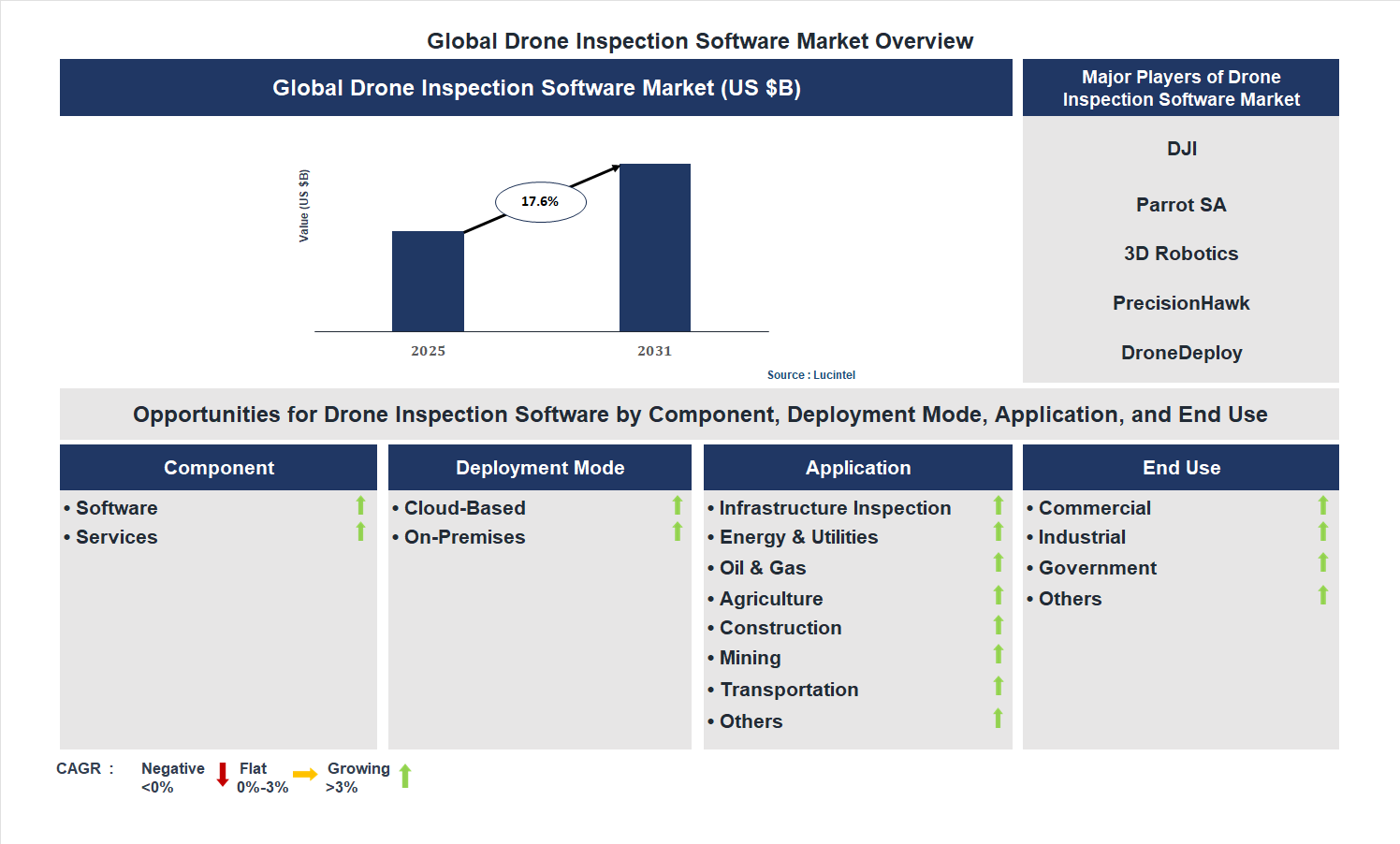
The future of the global drone inspection software market looks promising with opportunities in the commercial, industrial, and government markets. The global drone inspection software market is expected to grow with a CAGR of 17.6% from 2025 to 2031. The major drivers for this market are the increasing adoption of automated inspection solutions, the rising use of drones in infrastructure monitoring, and the growing demand for real time data analysis.• Lucintel forecasts that, within the component category, software is expected to witness higher growth over the forecast period.
• Within the end use category, commercial is expected to witness the highest growth.
• In terms of region, APAC is expected to witness the highest growth over the forecast period. Gain valuable insights for your business decisions with our comprehensive 150+ page report. Sample figures with some insights are shown below.
Emerging Trends in the Drone Inspection Software Market
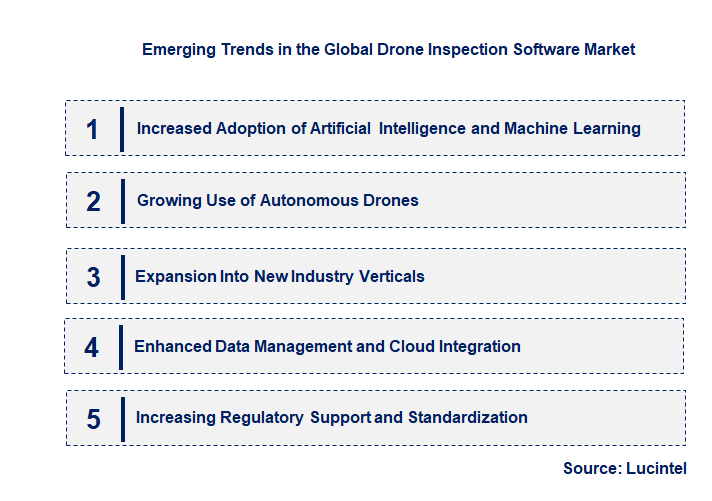
The drone inspection software market is experiencing rapid growth driven by technological advancements, increasing adoption across various industries, and a rising need for efficient, accurate, and cost-effective inspection solutions. As industries such as construction, energy, agriculture, and infrastructure seek innovative ways to monitor and maintain assets, drone inspection software is becoming indispensable. The markets evolution is also influenced by regulatory changes, advancements in drone hardware, and the integration of artificial intelligence. These developments are not only expanding the markets scope but also transforming traditional inspection methods, leading to more streamlined, safer, and data-driven decision-making processes.• Increased Adoption of Artificial Intelligence and Machine Learning: The integration of AI and ML into drone inspection software enhances data analysis capabilities, enabling automated defect detection, predictive maintenance, and real-time insights. This trend improves accuracy, reduces human error, and accelerates decision-making processes, making inspections more efficient and reliable. Industries benefit from predictive analytics that help prevent failures and optimize asset management, ultimately reducing costs and downtime.
• Growing Use of Autonomous Drones: The development of autonomous drone technology allows for longer flight times, precise navigation, and reduced human intervention. This trend increases operational efficiency, especially in hard-to-reach or hazardous areas, and minimizes safety risks. Autonomous drones can perform continuous inspections, gather high-resolution data, and operate in complex environments, significantly enhancing the scope and frequency of inspections.
• Expansion into New Industry Verticals: Originally popular in energy and infrastructure, drone inspection software is now penetrating sectors like agriculture, telecommunications, and environmental monitoring. This diversification broadens market opportunities and drives innovation tailored to specific industry needs. For example, in agriculture, drones assist in crop health assessment, while in telecommunications, they facilitate tower inspections, leading to more comprehensive market coverage.
• Enhanced Data Management and Cloud Integration: The shift towards cloud-based platforms allows for seamless data storage, sharing, and analysis. This trend improves collaboration among teams, ensures data security, and enables remote access to inspection reports. Cloud integration also facilitates large-scale data processing and integration with other enterprise systems, making inspection data more actionable and accessible.
• Increasing Regulatory Support and Standardization: Governments and regulatory bodies are establishing clearer guidelines and standards for drone operations, which fosters market growth. Compliance with safety and privacy regulations encourages wider adoption and integration of drone inspection solutions. Standardization efforts also promote interoperability and the development of industry best practices, ensuring sustainable growth and increased trust among users. In summary, these emerging trends are fundamentally reshaping the drone inspection software market by enhancing technological capabilities, expanding industry applications, and improving operational efficiency. As AI, autonomy, and data management evolve, the market is poised for continued growth, transforming traditional inspection paradigms into more intelligent, safe, and scalable solutions.
Recent Development in the Drone Inspection Software Market
The drone inspection software market is experiencing rapid growth driven by technological advancements and increasing demand across various industries. As businesses seek efficient, cost-effective solutions for infrastructure assessment, safety inspections, and asset management, the market is expanding globally. Innovations in AI, data analytics, and automation are transforming drone capabilities, creating new opportunities for service providers and software developers. This dynamic environment presents significant potential for market players to capitalize on emerging needs and improve operational efficiencies.• Growing Adoption of AI and Machine Learning: Enhancing Inspection Accuracy and Efficiency: AI integration allows drones to analyze data in real-time, identify defects, and predict maintenance needs. This reduces manual effort, minimizes errors, and accelerates decision-making processes. As industries prioritize safety and reliability, AI-powered inspection software becomes essential, boosting market growth. Companies investing in AI-driven solutions are gaining competitive advantages by offering smarter, faster, and more reliable inspection services, thus expanding their market share.
• Increasing Use of Drones in Infrastructure Inspection: Improving Safety and Cost Savings: Drones are increasingly used for inspecting bridges, power lines, and pipelines, replacing risky manual inspections. This shift enhances safety by reducing human exposure to hazardous environments. Additionally, drone inspections are faster and more cost-effective, enabling frequent assessments and early detection of issues. Governments and private firms are adopting these technologies to maintain infrastructure integrity, driving demand for specialized inspection software tailored to various assets.
• Advancements in Data Analytics and Visualization Tools: Facilitating Better Decision-Making: Modern drone inspection software now incorporates advanced data analytics and visualization features. These tools enable users to interpret complex data sets through 3D models, heat maps, and detailed reports. Improved visualization helps stakeholders quickly understand asset conditions, prioritize repairs, and plan maintenance activities. As data-driven decision-making becomes a standard practice, the market for sophisticated analytics tools integrated with drone software is expanding rapidly.
• Growing Market in Agriculture and Environmental Monitoring: Expanding Application Scope: Drones equipped with inspection software are increasingly used in agriculture for crop health assessment, irrigation management, and pest detection. Environmental agencies utilize these tools for monitoring ecosystems, wildlife, and pollution levels. The ability to gather high-resolution data efficiently broadens the market beyond traditional infrastructure inspection. This diversification opens new revenue streams for software providers and encourages innovation tailored to specific industry needs.
• Rising Demand for Regulatory Compliance and Safety Standards: Ensuring Industry Standards and Certification: As drone operations become more regulated, inspection software must comply with safety and certification standards. This drives the development of features like automated flight logs, compliance reporting, and secure data management. Companies offering compliant solutions gain trust and access to new markets, especially in highly regulated sectors like energy and transportation. The emphasis on safety and standards accelerates software innovation and market expansion. These developments are significantly transforming the drone inspection software market by enhancing operational efficiency, safety, and data management. The integration of AI, advanced analytics, and expanding application areas is broadening market scope and attracting diverse industry players. Regulatory compliance and technological innovations are fostering trust and driving adoption. Overall, these opportunities are propelling the market toward greater growth, increased competitiveness, and more comprehensive inspection solutions across multiple sectors.
Strategic Growth Opportunities in the Drone Inspection Software Market
The drone inspection software market is experiencing rapid expansion driven by technological advancements, increasing safety regulations, and the need for efficient asset management across various industries. As organizations seek cost-effective and accurate inspection solutions, the market presents significant growth opportunities. Innovations in AI, data analytics, and automation are further enhancing the capabilities of drone inspection software, making it a vital tool for industries such as energy, construction, and infrastructure. Strategic investments and partnerships are expected to accelerate market penetration and adoption worldwide.• Integration of Artificial Intelligence for Enhanced Data Analysis: Incorporating AI into drone inspection software enables automated image recognition, anomaly detection, and predictive maintenance. This integration improves inspection accuracy, reduces manual effort, and accelerates decision-making processes. AI-driven insights help identify potential issues early, minimizing downtime and operational costs. As AI technology advances, its application in drone inspection software will become more sophisticated, offering real-time analytics and improved predictive capabilities, thus expanding market adoption across diverse sectors.
• Expansion into Renewable Energy and Infrastructure Sectors: The increasing focus on renewable energy projects like wind farms and solar plants creates a demand for specialized inspection solutions. Drone software tailored for these sectors can efficiently monitor large-scale assets, assess structural integrity, and detect faults. Additionally, infrastructure inspections for bridges, railways, and pipelines benefit from drone technology, reducing risks and costs associated with manual inspections. This expansion opens new revenue streams and accelerates market growth in these environmentally critical sectors.
• Development of Industry-Specific Drone Inspection Solutions: Customizing drone software for specific industries enhances usability and effectiveness. For example, oil and gas, construction, and telecommunications require tailored features such as specialized sensors, data formats, and compliance standards. Industry-specific solutions improve operational efficiency, safety, and regulatory adherence. As demand for specialized tools grows, vendors focusing on niche markets will gain competitive advantages, fostering innovation and increasing overall market share.
• Adoption of Cloud-Based Platforms for Data Management and Collaboration: Cloud integration allows seamless storage, sharing, and analysis of inspection data collected by drones. This facilitates real-time collaboration among teams, remote monitoring, and centralized data management. Cloud platforms also enable scalable solutions, cost reduction, and enhanced security. As organizations seek more flexible and accessible data solutions, cloud-based drone inspection software will become a key driver of market growth, supporting remote operations and data-driven decision-making.
• Increasing Use of Autonomous Drones for Continuous Monitoring: Autonomous drone technology enables continuous, unattended inspections, reducing labor costs and increasing inspection frequency. These drones can operate in hazardous or hard-to-reach areas, providing consistent data collection without human intervention. The development of reliable autonomous systems enhances safety and operational efficiency. As technology matures, the market will see broader adoption of autonomous drones for routine inspections, leading to more comprehensive asset management and significant growth opportunities. The overall market growth will be significantly influenced by these opportunities, fostering innovation, expanding application areas, and improving operational efficiencies. As industries adopt advanced drone inspection software solutions, the market is poised for sustained expansion, driven by technological progress and increasing demand for safer, faster, and more accurate inspection methods.
Drone Inspection Software Market Driver and Challenges
The drone inspection software market is influenced by a variety of technological, economic, and regulatory factors that shape its growth trajectory. Advances in drone technology, increasing demand for efficient inspection solutions across industries, and evolving regulatory frameworks are key drivers. Simultaneously, challenges such as regulatory restrictions, high implementation costs, and data security concerns pose significant hurdles. Understanding these drivers and challenges is essential for stakeholders to navigate the market effectively and capitalize on emerging opportunities while mitigating risks. The factors responsible for driving the drone inspection software market include:-• Technological Advancements: The rapid development of drone hardware and software has significantly enhanced inspection capabilities. Improved sensors, AI integration, and automation enable more accurate, faster, and cost-effective inspections across sectors like energy, infrastructure, and agriculture. These innovations reduce manual labor, increase safety, and expand application scope, fueling market growth. As technology continues to evolve, the efficiency and reliability of drone inspection solutions are expected to improve further, attracting more industry adoption and investment.
• Increasing Industry Adoption: Industries such as oil and gas, power generation, construction, and telecommunications are increasingly adopting drone inspection software to monitor assets, conduct surveys, and ensure safety compliance. The need for real-time data, reduced downtime, and cost savings drives this adoption. As organizations recognize the benefits of drone-based inspections over traditional methods, demand accelerates, creating a robust market environment. This trend is supported by rising infrastructure projects and the need for regular maintenance and monitoring.
• Regulatory Developments: Governments and regulatory bodies are establishing frameworks to govern drone operations, which influence market growth. Clear regulations facilitate safer and more widespread drone use, encouraging companies to invest in inspection software. Conversely, stringent restrictions can limit operational scope and increase compliance costs. Evolving policies around airspace management, privacy, and safety standards are critical factors that can either propel or hinder market expansion, depending on their implementation and industry adaptation.
• Cost Efficiency and ROI: The ability of drone inspection software to reduce operational costs and improve return on investment is a major driver. Traditional inspection methods are often labor-intensive, time-consuming, and risky. Drones offer a faster, safer, and more economical alternative, especially for hard-to-reach areas. As organizations recognize these benefits, they are more inclined to adopt drone solutions, leading to increased market demand. The long-term cost savings and efficiency gains are compelling factors that support sustained growth in this market. The challenges facing this drone inspection software market include:-
• Regulatory Restrictions: Despite progress, regulatory hurdles remain a significant challenge. Many regions have strict rules regarding drone flight permissions, altitude limits, and operational zones, which can delay or restrict deployment. Compliance costs and bureaucratic procedures can also hinder rapid adoption. These restrictions vary widely across jurisdictions, creating complexity for companies operating internationally. Navigating these regulations requires significant effort and resources, potentially limiting market expansion and innovation.
• High Implementation Costs: Although drones can reduce operational expenses over time, the initial investment in drone hardware, software, training, and maintenance can be substantial. Small and medium-sized enterprises may find these costs prohibitive, limiting their ability to adopt drone inspection solutions. Additionally, ongoing expenses related to regulatory compliance and data management further add to the financial burden, posing a barrier to widespread adoption, especially in cost-sensitive markets.
• Data Security and Privacy Concerns: The use of drone inspection software involves collecting and transmitting large volumes of sensitive data. Concerns over data breaches, unauthorized access, and privacy violations can impede market growth. Organizations may hesitate to adopt drone solutions without robust security measures, fearing potential legal and reputational risks. Ensuring data integrity and compliance with privacy laws is essential but challenging, requiring significant investment in cybersecurity infrastructure. In summary, the drone inspection software market is driven by technological innovations, increasing industry adoption, regulatory developments, and cost efficiency benefits. However, regulatory restrictions, high initial costs, and data security concerns pose notable challenges. These factors collectively influence the market’s growth potential, requiring stakeholders to navigate complex regulatory landscapes, invest strategically, and prioritize data security. Overall, the market’s future hinges on balancing these drivers and challenges to foster sustainable expansion and technological advancement.
List of Drone Inspection Software Companies
Companies in the market compete on the basis of product quality offered. Major players in this market focus on expanding their manufacturing facilities, R&D investments, infrastructural development, and leverage integration opportunities across the value chain. With these strategies drone inspection software companies cater increasing demand, ensure competitive effectiveness, develop innovative products & technologies, reduce production costs, and expand their customer base. Some of the drone inspection software companies profiled in this report include-• DJI
• Parrot SA
• 3D Robotics
• PrecisionHawk
• DroneDeploy
• Delair
• Kespry
• Pix4D
• Airware
• Cyberhawk Innovations
Drone Inspection Software Market by Segment
The study includes a forecast for the global drone inspection software market by component, deployment mode, application, end use, and region.Drone Inspection Software Market by Component [Value from 2019 to 2031]:
• Software
• Services
Drone Inspection Software Market by Deployment Mode [Value from 2019 to 2031]:
• Cloud-Based
• On-Premises
Drone Inspection Software Market by Application [Value from 2019 to 2031]:
• Infrastructure Inspection
• Energy & Utilities
• Oil & Gas
• Agriculture
• Construction
• Mining
• Transportation
• Others
Drone Inspection Software Market by End Use [Value from 2019 to 2031]:
• Commercial
• Industrial
• Government
• Others
Drone Inspection Software Market by Region [Value from 2019 to 2031]:
• North America
• Europe
• Asia Pacific
• The Rest of the World
Country Wise Outlook for the Drone Inspection Software Market
The drone inspection software market has experienced rapid growth driven by technological advancements, increasing adoption across various industries, and the need for efficient, cost-effective inspection solutions. As countries seek to modernize infrastructure, enhance safety, and improve operational efficiency, the market dynamics are evolving uniquely in each region. The United States leads with innovation and regulatory support, China emphasizes manufacturing and integration, Germany focuses on industrial applications, India is expanding its infrastructure and agricultural use, and Japan emphasizes precision and robotics integration. These developments reflect each countrys strategic priorities and technological capabilities, shaping the future landscape of drone inspection solutions globally.• United States: The US market has seen significant advancements with increased adoption in energy, construction, and infrastructure sectors. Regulatory frameworks have become more supportive, enabling broader commercial use. Major tech companies are investing in AI-driven inspection tools, enhancing drone capabilities. The integration of 5G networks has improved real-time data transmission, boosting operational efficiency. Additionally, government agencies are funding research to develop autonomous drone systems, further expanding market potential. The US remains a leader in innovation, with startups and established firms pushing the boundaries of drone inspection technology.
• China: China is rapidly expanding its drone inspection market, driven by government initiatives to modernize infrastructure and promote smart city projects. The country emphasizes manufacturing and integration of drones with AI and big data analytics for industrial inspections. Domestic companies are developing cost-effective, high-performance drones tailored for large-scale infrastructure monitoring. The government’s supportive policies and investments in drone R&D have accelerated market growth. China also focuses on export opportunities, aiming to become a global leader in drone inspection solutions. The integration of drones into manufacturing and logistics sectors is a key trend.
• Germany: Germany’s market is characterized by a focus on industrial applications, especially in manufacturing, energy, and transportation. The country emphasizes precision, safety, and compliance with strict regulations. German companies are adopting advanced sensor technologies and AI for detailed inspections of critical infrastructure. The push towards Industry 4.0 has facilitated the integration of drone inspection software into automated industrial processes. Additionally, collaborations between research institutions and industry players are fostering innovation. Germany’s emphasis on sustainability and safety standards ensures that drone inspection solutions are reliable and environmentally friendly, positioning it as a leader in industrial drone applications.
• India: India is witnessing rapid growth in drone inspection software, driven by infrastructure development, agriculture, and renewable energy sectors. The government’s liberalized drone policies have facilitated market entry and innovation. Companies are deploying drones for infrastructure monitoring, crop health assessment, and power line inspections. The focus on rural connectivity and smart city projects is expanding drone applications. Investment in drone startups and technology hubs is increasing, fostering local innovation. The integration of AI and machine learning is improving inspection accuracy and efficiency. India’s large-scale infrastructure projects and agricultural modernization are key drivers of this market’s expansion.
• Japan: Japan’s market emphasizes precision, robotics, and integration with existing industrial systems. The country leverages its advanced technological ecosystem to develop sophisticated drone inspection solutions for the nuclear, manufacturing, and transportation sectors. Japan’s focus on safety standards and regulatory compliance ensures high-quality deployment. The integration of AI, sensors, and autonomous navigation enhances inspection accuracy and reduces operational risks. Japan is also investing in research to develop drones capable of operating in challenging environments, such as disaster zones. The country’s emphasis on innovation and safety positions it as a key player in high-end industrial drone inspection markets.

Features of the Global Drone Inspection Software Market
Market Size Estimates: Drone inspection software market size estimation in terms of value ($B). Trend and Forecast Analysis: Market trends (2019 to 2024) and forecast (2025 to 2031) by various segments and regions. Segmentation Analysis: Drone inspection software market size by various segments, such as by component, deployment mode, application, end use, and region in terms of value ($B). Regional Analysis: Drone inspection software market breakdown by North America, Europe, Asia Pacific, and Rest of the World. Growth Opportunities: Analysis of growth opportunities in different components, deployment modes, applications, end uses, and regions for the drone inspection software market. Strategic Analysis: This includes M&A, new product development, and competitive landscape of the drone inspection software market. Analysis of competitive intensity of the industry based on Porter’s Five Forces model.
FAQ
Q1. What is the growth forecast for drone inspection software market? Answer: The global drone inspection software market is expected to grow with a CAGR of 17.6% from 2025 to 2031. Q2. What are the major drivers influencing the growth of the drone inspection software market? Answer: The major drivers for this market are the increasing adoption of automated inspection solutions, the rising use of drones in infrastructure monitoring, and the growing demand for real time data analysis. Q3. What are the major segments for drone inspection software market? Answer: The future of the drone inspection software market looks promising with opportunities in the commercial, industrial, and government markets. Q4. Who are the key drone inspection software market companies? Answer: Some of the key drone inspection software companies are as follows:• DJI
• Parrot SA
• 3D Robotics
• PrecisionHawk
• DroneDeploy
• Delair
• Kespry
• Pix4D
• Airware
• Cyberhawk Innovations Q5. Which drone inspection software market segment will be the largest in future? Answer: Lucintel forecasts that, within the component category, software is expected to witness higher growth over the forecast period. Q6. In drone inspection software market, which region is expected to be the largest in next 5 years? Answer: In terms of region, APAC is expected to witness the highest growth over the forecast period. Q7. Do we receive customization in this report? Answer: Yes, Lucintel provides 10% customization without any additional cost.
Table of Contents
List of Figures
List of Tables
Methodology
- In-depth interviews of the major players in this market
- Detailed secondary research from competitors’ financial statements and published data
- Extensive searches of published works, market, and database information pertaining to industry news, company press releases, and customer intentions
- A compilation of the experiences, judgments, and insights of Lucintel’s professionals, who have analyzed and tracked this market over the years.


Buy Now
Choose a license that fits your team. Instant PDF delivery.
Prices exclude taxes. Instant delivery. Custom licensing available on request.
Key Questions
- • What are some of the most promising, high-growth opportunities for the drone inspection software market by component (software and services), deployment mode (cloud-based and on-premises), application (infrastructure inspection, energy & utilities, oil & gas, agriculture, construction, mining, transportation, and others), end use (commercial, industrial, government, and others), and region (North America, Europe, Asia Pacific, and the Rest of the World)?
- • Which segments will grow at a faster pace and why?
- • Which region will grow at a faster pace and why?
- • What are the key factors affecting market dynamics? What are the key challenges and business risks in this market?
- • What are the business risks and competitive threats in this market?
- • What are the emerging trends in this market and the reasons behind them?
- • What are some of the changing demands of customers in the market?
- • What are the new developments in the market? Which companies are leading these developments?
- • Who are the major players in this market? What strategic initiatives are key players pursuing for business growth?
- • What are some of the competing products in this market and how big of a threat do they pose for loss of market share by material or product substitution?
- • What M&A activity has occurred in the last 6 years and what has its impact been on the industry? For any questions related to Drone Inspection Software Market, Drone Inspection Software Market Size, Drone Inspection Software Market Growth, Drone Inspection Software Market Analysis, Drone Inspection Software Market Report, Drone Inspection Software Market Share, Drone Inspection Software Market Trends, Drone Inspection Software Market Forecast, Drone Inspection Software Companies, write Lucintel analyst at email: helpdesk@lucintel.com. We will be glad to get back to you soon.


