
Market Report · July 29, 2026

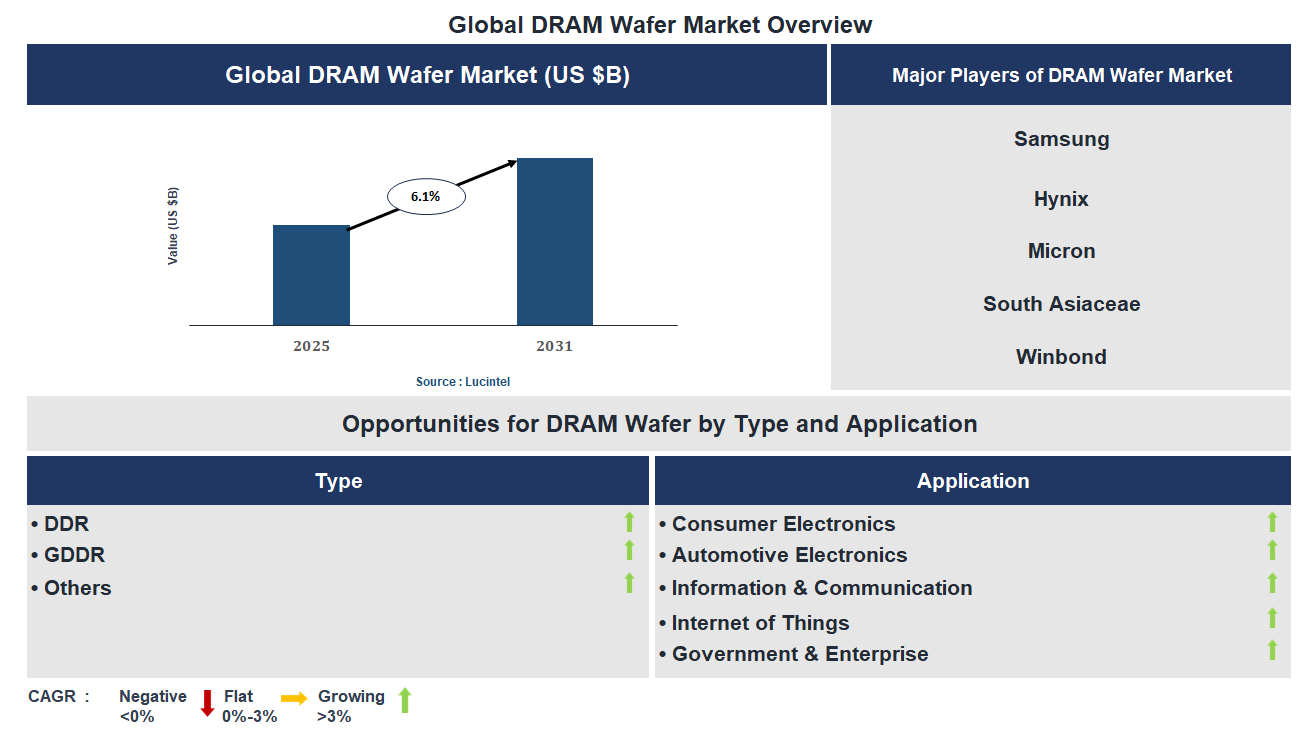
Key data points: The growth forecast = 6.1% annually for the next 7 years. Scroll below to get more insights. This market report covers trends, opportunities and forecasts in DRAM wafer market to 2031 by type (DDR, GDDR, and others), application (consumer electronics, automotive electronics, information & communication, internet of things, and government & enterprise), and region (North America, Europe, Asia Pacific, and the Rest of the World)
We'll send your sample report shortly.
• Lucintel forecasts that, within the type category, GDDR is expected to witness higher growth over the forecast period.
• Within the application category, consumer electronics is expected to witness the highest growth.
• In terms of region, APAC is expected to witness the highest growth over the forecast period. Gain valuable insights for your business decisions with our comprehensive 150+ page report. Sample figures with some insights are shown below.
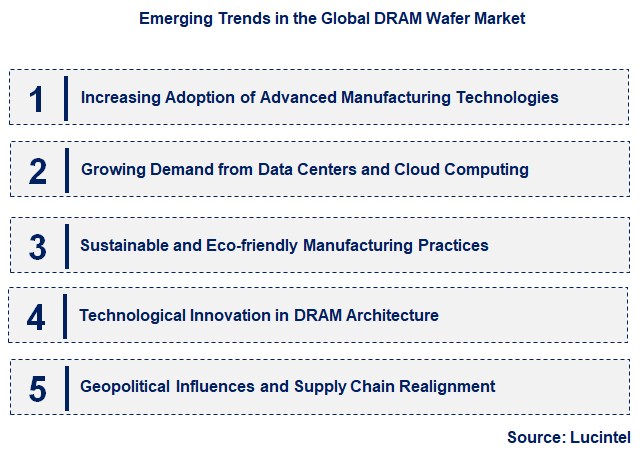
• Increasing Adoption of Advanced Manufacturing Technologies: The integration of EUV lithography and automation is enhancing wafer production precision and efficiency. This trend reduces defect rates and improves yield, enabling manufacturers to produce higher-capacity DRAM wafers at lower costs. As a result, the market benefits from increased scalability and the ability to meet rising demand for high-density memory modules. The adoption of these technologies also supports the development of smaller, more powerful devices, fueling innovation across consumer electronics and data centers.
• Growing Demand from Data Centers and Cloud Computing: The surge in data center infrastructure and cloud services is driving significant demand for high-capacity DRAM wafers. These applications require large volumes of fast, reliable memory to handle big data, AI workloads, and real-time processing. This trend pushes manufacturers to increase wafer production capacity and develop specialized DRAM products optimized for data-intensive tasks. Consequently, the market experiences rapid growth, with companies investing heavily in expanding manufacturing capabilities to meet this expanding need.
• Sustainable and Eco-friendly Manufacturing Practices: Environmental concerns and regulatory pressures are prompting industry players to adopt greener production methods. This includes reducing energy consumption, minimizing waste, and utilizing sustainable materials. Such initiatives not only help companies comply with regulations but also appeal to environmentally conscious consumers and clients. The shift towards sustainability is reshaping supply chain strategies and encouraging innovation in eco-friendly wafer fabrication processes, ultimately leading to a more sustainable market landscape.
• Technological Innovation in DRAM Architecture: Advances in DRAM design, such as 1znm and 1αnm process nodes, are enabling higher performance and lower power consumption. These innovations are critical for supporting next-generation devices like 5G smartphones, AI hardware, and high-performance computing systems. The development of new architectures also allows for increased memory density and improved reliability. This trend is fostering a competitive edge among manufacturers, driving continuous R&D investments, and accelerating the deployment of cutting-edge memory solutions across various sectors.
• Geopolitical Influences and Supply Chain Realignment: Trade tensions and geopolitical factors are prompting companies to diversify manufacturing locations and establish regional supply chains. This trend aims to reduce dependency on specific countries and mitigate risks associated with political instability or tariffs. As a result, the market is witnessing increased investments in manufacturing facilities in regions like Southeast Asia and North America. This realignment enhances supply chain resilience, influences pricing strategies, and fosters regional market growth, ultimately reshaping the global DRAM wafer landscape. In summary, these emerging trends are collectively transforming the DRAM wafer market by enhancing technological capabilities, expanding application scope, promoting sustainability, and reshaping global supply chains. These developments are fostering innovation, increasing competitiveness, and creating new opportunities for growth in a rapidly evolving industry.
• Technological Innovation: Introduction of advanced fabrication processes such as EUV lithography has improved DRAM performance and density, enabling higher capacity modules and faster speeds. This innovation enhances product competitiveness and meets increasing consumer and enterprise demands for efficient memory solutions.
• Supply Chain Resilience: Companies are diversifying manufacturing locations and increasing inventory buffers to mitigate risks from geopolitical tensions and pandemic-related disruptions. This strategy improves supply stability, reduces lead times, and ensures consistent market availability.
• Capacity Expansion: Major players are investing heavily in new fabrication plants (fabs) to boost production capacity. This expansion aims to meet surging demand from cloud computing, AI, and 5G applications, ultimately increasing overall market supply and reducing prices.
• Market Consolidation: Mergers and acquisitions are intensifying as key firms seek to strengthen their technological capabilities and market share. This consolidation leads to increased competition, innovation, and potentially more integrated supply chains within the industry.
• Sustainability Initiatives: Companies are adopting eco-friendly manufacturing practices, including reducing water and energy consumption and recycling materials. These efforts align with global sustainability goals and appeal to environmentally conscious consumers and investors. The recent developments in the DRAM wafer market are collectively driving increased capacity, technological advancements, and supply chain resilience. These changes are fostering a more competitive, innovative, and sustainable industry, ultimately benefiting end-users through improved product offerings and more reliable supply.
• Expansion into Data Center Applications: The rising demand for cloud computing and data storage drives the need for high-capacity DRAM wafers, enabling data centers to improve performance and energy efficiency. This growth enhances market revenue and positions DRAM manufacturers as critical suppliers for cloud infrastructure.
• Adoption in Consumer Electronics: Increasing adoption of smartphones, tablets, and gaming devices fuels the demand for compact, high-speed DRAM wafers. This opportunity allows manufacturers to innovate in miniaturization and power efficiency, expanding their consumer electronics portfolio.
• Growth in AI and Machine Learning: The surge in AI applications requires advanced DRAM wafers with higher bandwidth and lower latency. This creates a niche for specialized DRAM solutions, boosting R&D investments and market differentiation.
• Development of Next-Generation Memory Technologies: Innovations such as DDR5 and LPDDR5 are opening new markets for faster, more efficient DRAM wafers. Early adoption of these technologies provides a competitive edge and accelerates market growth.
• Geographical Expansion into Emerging Markets: Increasing digital infrastructure investments in regions like Asia-Pacific and Africa present new opportunities for DRAM wafer manufacturers. Expanding production and distribution channels in these areas can significantly increase market share. In summary, these growth opportunities are transforming the DRAM wafer market by driving technological innovation, expanding application scope, and opening new regional markets. This dynamic environment fosters increased competition, higher revenues, and accelerated industry development, positioning the market for sustained growth in the coming years.
• Technological Innovation: The continuous evolution of DRAM technology, including the development of DDR5 and LPDDR5, enhances performance, energy efficiency, and capacity. These innovations meet the rising demands of data centers, consumer electronics, and AI applications. As manufacturers invest heavily in R&D, the market benefits from improved product offerings, enabling higher speeds and lower power consumption. This technological progress sustains competitive advantage and stimulates market expansion, attracting new customers and applications.
• Growing Data Center and Cloud Computing Demand: The surge in data generation from cloud services, IoT, and AI applications drives the need for high-capacity, reliable memory solutions. Data centers require large volumes of DRAM wafers to support their infrastructure, leading to increased procurement. This demand is further amplified by the digital transformation across industries, prompting investments in scalable memory solutions. As organizations prioritize data management and processing, the market experiences consistent growth fueled by this digital shift.
• Expansion of Consumer Electronics Market: The proliferation of smartphones, tablets, gaming consoles, and smart devices significantly boosts DRAM wafer demand. Consumers seek devices with higher processing power and better multitasking capabilities, which require advanced DRAM modules. Manufacturers are continuously upgrading their product lines to incorporate the latest DRAM technologies, thus expanding the market. The rise in consumer electronics sales globally, especially in emerging markets, sustains a steady demand for DRAM wafers.
• Economic Growth and Investment in Semiconductor Industry: Favorable economic conditions and increased investments in semiconductor manufacturing facilities bolster the DRAM wafer market. Governments and private entities are funding R&D and manufacturing expansion to meet global demand. This financial support facilitates technological advancements and capacity building, ensuring supply meets demand. As the industry scales up, economies of scale reduce costs, making DRAM wafers more accessible and fostering further market growth.
• Strategic Partnerships and Mergers: Collaborations between key players and mergers facilitate technology sharing, cost reduction, and market penetration. These strategic alliances enable companies to innovate faster and expand their customer base. Joint ventures often lead to the development of next-generation DRAM wafers, strengthening market position. Such partnerships also help navigate supply chain complexities and regulatory challenges, ensuring sustained growth and competitiveness in the global market. The challenges facing this DRAM wafer market include:-
• Supply Chain Disruptions: The DRAM wafer industry faces significant supply chain issues, including shortages of raw materials like silicon and chemicals, logistical delays, and geopolitical tensions. These disruptions hinder production schedules, increase costs, and lead to supply shortages, impacting end-user industries. The COVID-19 pandemic highlighted vulnerabilities in global supply chains, prompting companies to seek diversification strategies. Overcoming these challenges requires resilient supply networks and strategic inventory management to ensure consistent market supply and avoid price volatility.
• Geopolitical Tensions and Trade Restrictions: Trade disputes, tariffs, and export controls between major economies such as the US and China create uncertainties in the DRAM wafer market. These tensions can restrict access to critical technologies and markets, disrupt supply chains, and increase costs. Companies must navigate complex regulatory environments and adapt their strategies accordingly. Such geopolitical risks threaten to slow down market growth, limit investment, and reduce global trade flows, impacting overall industry stability.
• Environmental Regulations and Sustainability Concerns: Increasing environmental regulations aimed at reducing carbon footprints and managing e-waste pose challenges for DRAM wafer manufacturers. The industry must invest in sustainable manufacturing processes, which can be costly and technologically demanding. Compliance with stricter standards may lead to increased operational costs and delays in product development. Balancing environmental responsibilities with market demands requires innovation and strategic planning to ensure long-term sustainability without compromising growth. In summary, the DRAM wafer market is driven by rapid technological advancements, expanding data center and consumer electronics demand, economic growth, and strategic industry collaborations. However, it faces challenges such as supply chain disruptions, geopolitical tensions, and environmental regulations. These factors collectively influence market stability and growth prospects. While opportunities for innovation and expansion are significant, addressing supply chain vulnerabilities and regulatory hurdles is crucial for sustained success. Overall, the markets future hinges on strategic adaptation to these dynamic drivers and challenges, shaping a resilient and innovative memory industry landscape.
• Samsung
• Hynix
• Micron
• South Asiaceae
• Winbond
• Power Semiconductor
• Changxin Storage
• DDR
• GDDR
• Others
• Consumer Electronics
• Automotive Electronics
• Information & Communication
• Internet of Things
• Government & Enterprise
• North America
• Europe
• Asia Pacific
• The Rest of the World
• United States: The US has increased investments in domestic semiconductor manufacturing, with companies like Micron expanding capacity and R&D efforts focused on advanced DRAM technologies. Government initiatives aim to bolster supply chain resilience and reduce reliance on imports, fostering innovation hubs and public-private partnerships.
• China: China continues to accelerate its semiconductor self-sufficiency goals, investing heavily in local DRAM production facilities. Major firms like ChangXin Memory Technologies are advancing process technology, aiming to reduce dependence on foreign suppliers amid ongoing trade restrictions and export controls.
• Germany: Germany remains a key player in the European semiconductor ecosystem, focusing on high-precision manufacturing and research collaborations. Recent developments include investments in advanced wafer fabrication facilities and partnerships with global tech firms to enhance DRAM production capabilities.
• India: India is emerging as a strategic hub for semiconductor assembly and testing, with government incentives encouraging local manufacturing. While still developing its DRAM wafer production capacity, India is focusing on building a skilled workforce and attracting foreign direct investment to support future growth.
• Japan: Japan maintains a strong position in semiconductor materials and equipment, supporting DRAM wafer manufacturing through advanced process technology and innovation. Companies are investing in next-generation fabrication tools and collaborating with global firms to stay competitive in the evolving market.


• Samsung
• Hynix
• Micron
• South Asiaceae
• Winbond
• Power Semiconductor
• Changxin Storage Q5. Which DRAM wafer market segment will be the largest in future? Answer: Lucintel forecasts that, within the type category, GDDR is expected to witness higher growth over the forecast period. Q6. In DRAM wafer market, which region is expected to be the largest in next 5 years? Answer: In terms of region, APAC is expected to witness the highest growth over the forecast period. Q7. Do we receive customization in this report? Answer: Yes, Lucintel provides 10% customization without any additional cost.


Choose a license that fits your team. Instant PDF delivery.
Prices exclude taxes. Instant delivery. Custom licensing available on request.
Market Report · July 29, 2026
Market Report · July 20, 2026
Market Report · July 20, 2026
Trusted partner for strategic intelligence and business growth


Receive a complimentary market analysis tailored to your industry. Our analysts will identify key growth opportunities and competitive dynamics specific to your business.

Market size, growth rate, and key trend analysis for your specific sector.

Top competitor positioning and market share analysis.

Strategic recommendations backed by data-driven insights.
Get curated market intelligence and competitive moves straight to your inbox.
By subscribing, you agree to receive our monthly insights. Unsubscribe anytime.
Receive a complimentary market analysis tailored to your industry. Our analysts will identify key growth opportunities and competitive dynamics specific to your business.
Market size, growth rate, and key trend analysis for your specific sector.
Top competitor positioning and market share analysis.
Strategic recommendations backed by data-driven insights.
Get curated market intelligence, emerging trends, and competitive moves straight to your inbox each month.
By subscribing, you agree to receive our monthly insights. Unsubscribe anytime.
We'll send your sample report shortly.