
Report Feature
DPM Barcode Market Trends and Forecast
The technologies in the DPM barcode market have undergone significant changes in recent years, with a shift from laser-based imaging and CMOS sensor technologies to optical character recognition (OCR) and multi-directional scanning. Laser-based systems were traditionally used for barcode reading, but advancements in CMOS sensors offer more versatile, faster scanning capabilities in low-light or harsh environments. OCR technology is gaining traction as it enables the reading of damaged or poorly printed barcodes, improving reliability in complex industrial settings. The rise of multi-directional scanning allows for more efficient scanning with greater ease, eliminating the need for precise barcode alignment, which was previously a limitation with laser scanners. These technological shifts are making DPM barcode solutions more robust, adaptable, and efficient across various applications.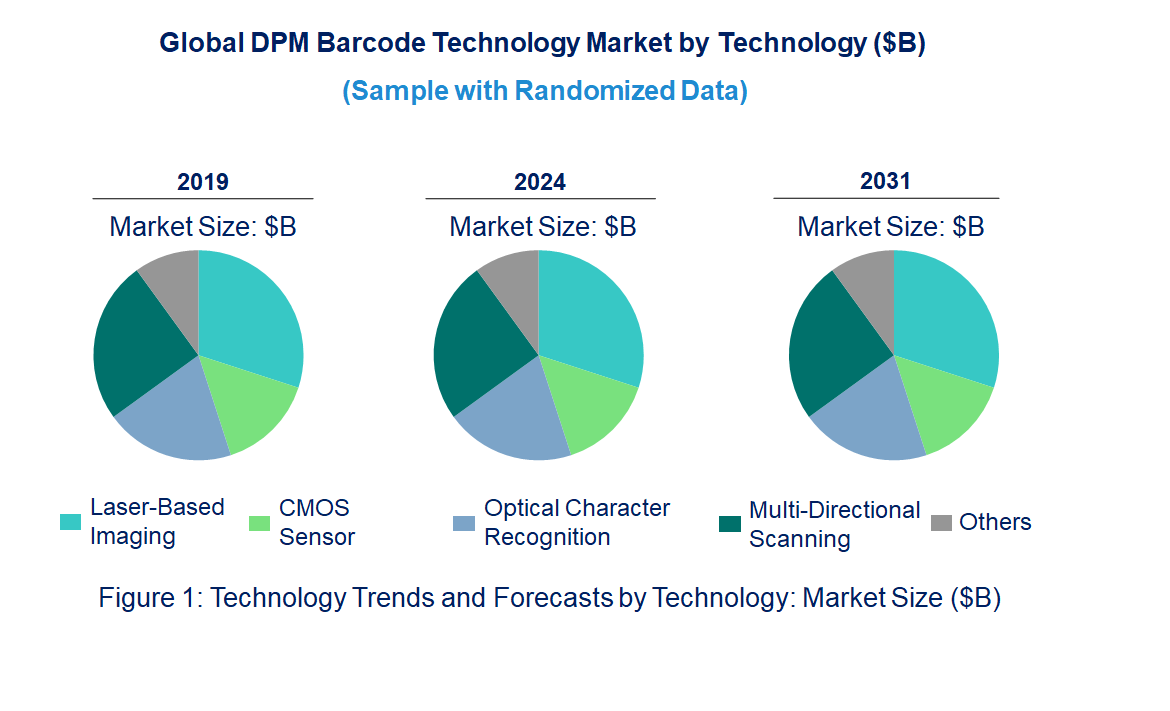
Emerging Trends in the DPM Barcode Market
The DPM (Direct Part Marking) barcode market is rapidly evolving, driven by advancements in technology and increasing demand for enhanced automation across various industries. As companies seek to improve operational efficiency, traceability, and data accuracy, several emerging trends are shaping the DPM barcode market. These trends are fueled by the adoption of more advanced scanning technologies, evolving customer needs, and broader industry shifts towards digitalization and automation. Here are five key trends emerging in the DPM barcode market:• Increased Use of Optical Character Recognition (OCR): OCR technology is gaining traction in the DPM barcode market, enabling the reading of damaged, worn, or poorly printed barcodes that were previously difficult or impossible to scan. This advancement is especially valuable in industries like manufacturing and logistics, where barcodes may degrade over time or during high-usage cycles.
• Integration with IoT for Real-Time Tracking: The growing demand for real-time inventory tracking and asset management is pushing the integration of DPM barcode systems with the Internet of Things (IoT). IoT-enabled DPM barcodes provide businesses with real-time data, improving supply chain visibility, operational efficiency, and decision-making capabilities.
• Shift Toward Multi-Directional Scanning: Multi-directional scanning technology is rapidly being adopted for DPM barcode systems, reducing the need for precise barcode alignment and enhancing scanning speed. This trend is improving productivity in environments like retail, warehouses, and manufacturing, where time-sensitive operations demand faster and more efficient barcode reading.
• Adoption of 2D Barcode Technology: The use of 2D barcodes, such as QR codes and Data Matrix codes, is on the rise. These codes can store more data in a smaller space, providing significant advantages for industries requiring higher data capacity and better traceability, such as medical devices and automotive manufacturing.
• Cloud-Based Data Management: Cloud-based data storage and analytics solutions are increasingly integrated with DPM barcode systems. Cloud solutions allow businesses to store and manage vast amounts of data collected through barcode scanners, enabling better inventory control, maintenance scheduling, and seamless integration across global supply chains. These emerging trends are reshaping the DPM barcode market by enhancing the capabilities of barcode systems to offer faster, more accurate, and versatile solutions. From OCR advancements that address damaged barcodes to the integration of IoT for real-time tracking, these developments are increasing the efficiency, accuracy, and scalability of DPM barcode systems across various applications, ultimately transforming industries like retail, logistics, manufacturing, and healthcare.
DPM Barcode Market : Industry Potential, Technological Development, and Compliance Considerations
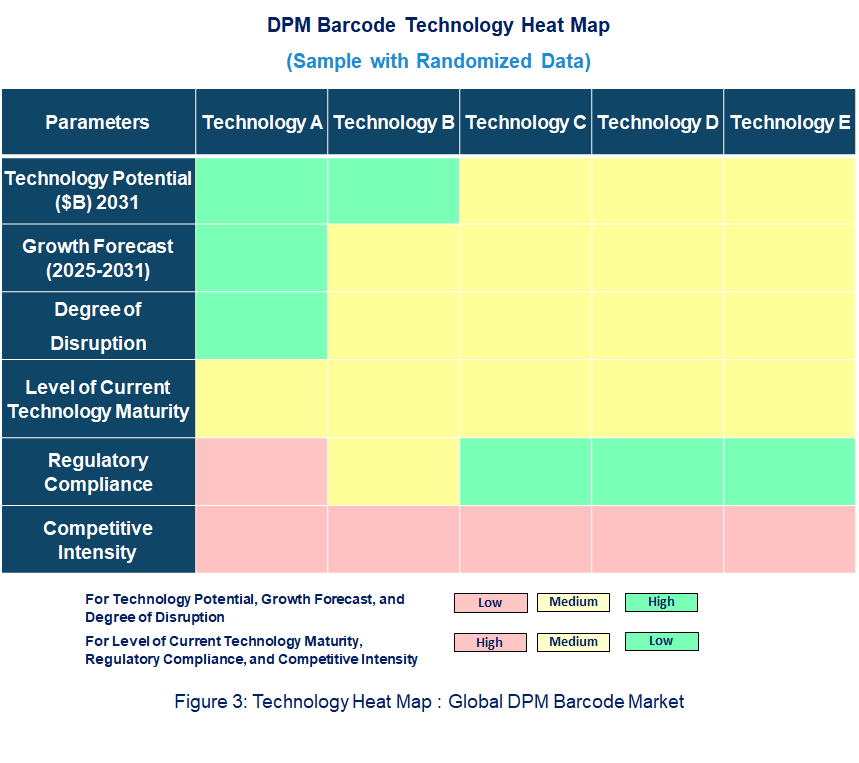
The direct part marking (DPM) barcode market is evolving rapidly, driven by advancements in scanning technologies like laser-based imaging, CMOS sensors, optical character recognition (OCR), and multi-directional scanning. These innovations have significantly improved barcode readability and durability, particularly in challenging environments where traditional labels may not be suitable. The potential for DPM technology is immense, as industries demand more robust, precise, and automated solutions for tracking products, assets, and inventory.• Technology Potential: The DPM barcode market holds substantial potential for industries such as manufacturing, logistics, healthcare, and retail. The ability to mark barcodes directly onto parts or products, ensuring long-term durability and traceability, makes DPM technology a game-changer in areas requiring high accuracy and reliability. Emerging technologies, such as IoT integration and machine learning, further enhance the value of DPM barcodes by enabling real-time data capture and analysis.
• Degree of Disruption: DPM barcode technology is disruptive because it offers unparalleled benefits in terms of accuracy, durability, and efficiency, especially in harsh environments. The shift from traditional printed labels to direct part markings enables businesses to streamline operations, reduce errors, and improve asset tracking and supply chain management.
• Technology Maturity: DPM technology has reached a mature stage, with reliable solutions being widely adopted. However, challenges such as high implementation costs and compliance with strict regulatory standards (particularly in industries like pharmaceuticals and aerospace) persist. As regulations around product traceability become stricter, DPM technology’s role will continue to grow, with regulatory frameworks adapting to ensure consistency in durability and readability.
• Regulatory Compliance: The DPM barcode market continues to evolve with cutting-edge technologies that offer significant potential to disrupt various sectors. While the technology is mature and has widespread applications, ongoing advancements, coupled with regulatory compliance, will drive further adoption and refinement in the coming years.
Recent Technological development in DPM Barcode Market by Key Players
The DPM (Direct Part Marking) barcode market is evolving with continuous technological advancements and increasing adoption across various industries, including retail, logistics, healthcare, and manufacturing. Key players such as Cognex, Datalogic, Microscan, Zebex, Honeywell, Symbol, and Casio have been actively driving innovations to meet the growing demand for high-performance barcode solutions. These developments are shaping the market by improving barcode scanning capabilities, durability, and integration with emerging technologies like IoT and cloud computing.• Cognex: Cognex, a leading player in the DPM barcode market, has introduced advanced machine vision technology that enhances the ability to read damaged or degraded barcodes. Their solutions integrate high-resolution cameras and powerful software algorithms to ensure reliable scanning in challenging environments, such as in manufacturing or automotive industries. Cognex’s focus on image processing and barcode recognition has made their systems a top choice for precision applications.
• Datalogic: Datalogic has been focusing on enhancing its handheld scanners and fixed-mount readers with multi-directional scanning capabilities. Their advancements allow for faster barcode reading, even in rugged industrial environments where part markings may be worn or damaged. Datalogic’s solutions are increasingly used in supply chain, manufacturing, and logistics applications, driving productivity improvements across sectors.
• Microscan: Microscan has been enhancing its barcode reading solutions with increased focus on 2D barcodes and integration with automated systems. Their new solutions provide real-time data capture and enable seamless integration with cloud platforms. Microscan’s barcode readers are now more compact, making them suitable for high-speed applications in pharmaceutical and medical device manufacturing.
• Zebex: Zebex has been focusing on developing user-friendly, durable barcode scanners for industries like retail and healthcare. Their latest models are designed with multi-scanning features that allow them to capture DPM barcodes in any orientation. Zebex has also integrated advanced OCR technology into its barcode readers, improving its accuracy in challenging environments.
• Honeywell: Honeywell has been introducing innovative barcode scanners designed to work in hazardous environments. Their advanced scanning technologies support 1D, 2D, and DPM barcodes with enhanced reading capabilities, particularly for industries like oil and gas and pharmaceuticals, where safety and reliability are crucial. Honeywell’s scanners are also known for their ergonomic design, improving operator comfort.
• Symbol: Symbol, a part of Zebra Technologies, has introduced rugged handheld barcode scanners for the manufacturing and logistics industries. These scanners are capable of reading DPM barcodes under extreme conditions, such as high temperatures, vibration, and exposure to dust and moisture. Their products integrate with enterprise-level software, streamlining inventory and asset management.
• Casio: Casio has focused on developing compact, cost-effective barcode scanners for retail and inventory management. Their DPM barcode readers are equipped with high-speed scanning technology, ensuring reliable performance in environments where barcodes are printed directly on products or parts. Casio’s integration of OCR functionality also improves their systems’ ability to decode damaged barcodes. Key players in the DPM barcode market continue to innovate and enhance their offerings by incorporating new technologies such as multi-directional scanning, OCR, and cloud integration. These developments are helping industries improve operational efficiency, reduce errors, and increase traceability, thereby making DPM barcode solutions indispensable in sectors like retail, manufacturing, and healthcare.
DPM Barcode Market Driver and Challenges
The DPM barcode market is being influenced by several drivers and challenges that are shaping its growth and evolution. These drivers are linked to advancements in technology, increased automation, and evolving consumer demands, while challenges include regulatory constraints, high implementation costs, and technical limitations in reading degraded barcodes. The factors responsible for driving the global DPM barcode market are:• Technological Advancements: Continued improvements in scanning technologies such as multi-directional scanning, OCR, and image processing are enhancing DPM barcode accuracy and reliability. This shift allows for improved performance in tough environments, accelerating market adoption across manufacturing, retail, and logistics sectors.
• Increase in Automation: The rise of automation in supply chains and warehouses is driving the demand for DPM barcode systems. Automation requires fast and reliable data capture, and DPM barcodes provide a solution to accurately track inventory, assets, and shipments, reducing human errors and improving operational efficiency.
• Integration with IoT: IoT-enabled DPM barcode systems offer real-time data tracking and analytics, providing companies with valuable insights into their operations. This integration enhances inventory management, predictive maintenance, and operational monitoring, which are crucial for industries such as automotive, manufacturing, and pharmaceuticals.
• Demand for Traceability: Industries, particularly in pharmaceuticals, automotive, and aerospace, are increasingly prioritizing traceability and compliance. DPM barcodes offer an effective solution for meeting these needs, providing a durable and reliable means of marking and tracking parts and products. Challenges facing the global DPM barcode market are::
• High Implementation Costs: DPM barcode systems can be expensive to implement, especially for small and medium-sized businesses. This may hinder the adoption of advanced barcode technologies, limiting their widespread use in certain sectors.
• Technical Limitations in Degraded Barcodes: While DPM barcodes are designed for harsh environments, they can still be difficult to read if the barcode markings are too degraded. This technical challenge continues to be a limitation, particularly in industries with high-volume, wear-prone environments.
• Regulatory Constraints: In sectors such as healthcare, automotive, and aerospace, DPM barcodes must meet strict regulatory standards for durability and accuracy. This requirement may add complexity and additional cost to implementation, slowing down market growth. While the DPM barcode market presents significant growth opportunities due to technological advancements and the increasing need for traceability and automation, challenges related to cost, technical limitations, and regulatory compliance still need to be addressed. Companies that can overcome these hurdles will be well-positioned to capitalize on the growing demand for robust and efficient barcode solutions.
List of DPM Barcode Companies
Companies in the market compete on the basis of product quality offered. Major players in this market focus on expanding their manufacturing facilities, R&D investments, infrastructural development, and leverage integration opportunities across the value chain. With these strategies dpm barcode companies cater increasing demand, ensure competitive effectiveness, develop innovative products & technologies, reduce production costs, and expand their customer base. Some of the dpm barcode companies profiled in this report includes.• Cognex
• Datalogic
• Microscan
• Zebex
• Honeywell
• Symbol
DPM Barcode Market by Technology
• Technology Readiness by Technology Type for the DPM Barcode Market: Laser-based imaging is highly mature, widely used in the automotive and aerospace industries for precise barcode reading. CMOS sensors, though newer, are gaining ground in fast-paced industries like logistics and manufacturing. OCR is ready for specialized, regulated industries such as healthcare. Multi-directional scanning is nearly fully deployed in retail and logistics for efficient operations. Other technologies, like RFID, are emerging and complementing DPM barcodes, but are still in the early stages of adoption. As these technologies mature, they are reshaping the DPM barcode market.
• Competitive Intensity and Regulatory Compliance for the DPM Barcode Market: Competition in the DPM barcode market is driven by advancements in laser-based imaging, CMOS sensors, OCR, and multi-directional scanning, with companies striving for faster and more reliable solutions. Technologies must comply with stringent industry regulations, particularly in sectors like healthcare and pharmaceuticals. Laser-based imaging and CMOS sensors are highly mature, while OCR is more specialized for regulated industries. Multi-Directional Scanning is growing rapidly in retail and logistics. Companies must innovate while adhering to safety and traceability standards, intensifying market competition.
• Disruption Potential of Different Technologies for the DPM Barcode Market: The DPM barcode market is witnessing disruption due to advancements in laser-based imaging, CMOS sensors, OCR, and multi-directional scanning. Laser-based imaging is essential for industries like aerospace and automotive, offering high precision in harsh conditions. CMOS sensors, with their high resolution and speed, are gaining popularity in manufacturing and logistics for real-time data capture. OCR is revolutionizing healthcare and pharmaceuticals by enabling automated alphanumeric character reading for enhanced traceability. Multi-directional scanning is transforming retail and logistics by enabling barcode scanning from any angle, improving operational efficiency. Emerging technologies like RFID and AI integrations are further enhancing DPM barcodes, improving flexibility, security, and data processing. These shifts are making DPM barcodes more efficient, secure, and versatile across industries.
DPM Barcode Market Trend and Forecast by Technology [Value from 2019 to 2031]:
• Laser-Based Imaging
• CMOS Sensor
• Optical Character Recognition (OCR)
• Multi-Directional Scanning
• Others
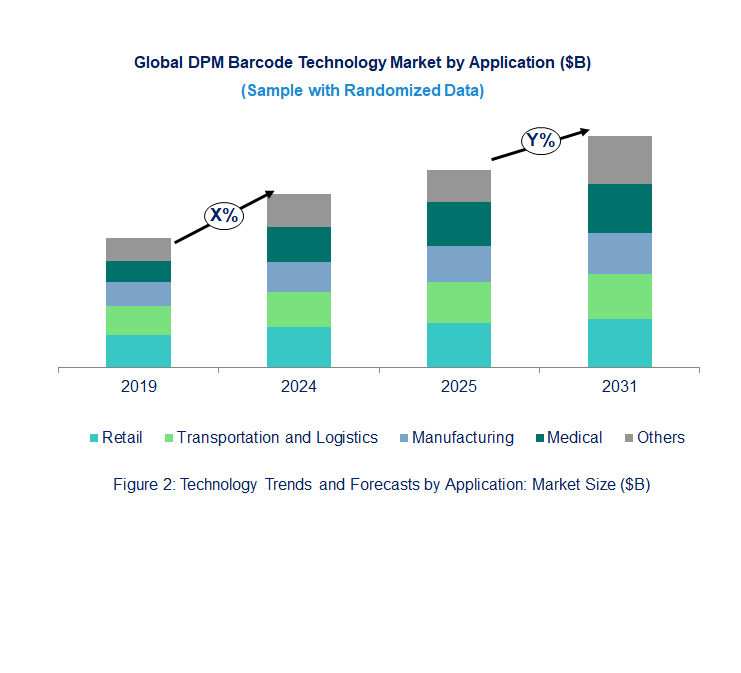
DPM Barcode Market Trend and Forecast by Application [Value from 2019 to 2031]:
• Retail
• Transportation and Logistics
• Manufacturing
• Medical
• Others
DPM Barcode Market by Region [Value from 2019 to 2031]:
• North America
• Europe
• Asia Pacific
• The Rest of the World
• Latest Developments and Innovations in the DPM Barcode Technologies
• Companies / Ecosystems
• Strategic Opportunities by Technology Type
Features of the Global DPM Barcode Market
Market Size Estimates: Dpm barcode market size estimation in terms of ($B). Trend and Forecast Analysis: Market trends (2019 to 2024) and forecast (2025 to 2031) by various segments and regions. Segmentation Analysis: Technology trends in the global dpm barcode market size by various segments, such as application and technology in terms of value and volume shipments. Regional Analysis: Technology trends in the global dpm barcode market breakdown by North America, Europe, Asia Pacific, and the Rest of the World. Growth Opportunities: Analysis of growth opportunities in different end use industries, technologies, and regions for technology trends in the global dpm barcode market. Strategic Analysis: This includes M&A, new product development, and competitive landscape for technology trends in the global dpm barcode market. Analysis of competitive intensity of the industry based on Porter’s Five Forces model.Table of Contents
Methodology
- In-depth interviews of the major players in this market
- Detailed secondary research from competitors’ financial statements and published data
- Extensive searches of published works, market, and database information pertaining to industry news, company press releases, and customer intentions
- A compilation of the experiences, judgments, and insights of Lucintel’s professionals, who have analyzed and tracked this market over the years.


Buy Now
Choose a license that fits your team. Instant PDF delivery.
Prices exclude taxes. Instant delivery. Custom licensing available on request.
Key Questions
- • What are some of the most promising potential, high-growth opportunities for the technology trends in the global dpm barcode market by technology (laser-based imaging, cmos sensor, optical character recognition (ocr), multi-directional scanning, and others), application (retail, transportation and logistics, manufacturing, medical, and others), and region (North America, Europe, Asia Pacific, and the Rest of the World)?
- • Which technology segments will grow at a faster pace and why?
- • Which regions will grow at a faster pace and why?
- • What are the key factors affecting dynamics of different technology? What are the drivers and challenges of these technologies in the global dpm barcode market?
- • What are the business risks and threats to the technology trends in the global dpm barcode market?
- • What are the emerging trends in these material technologies in the global dpm barcode market and the reasons behind them?
- • Which technologies have potential of disruption in this market?
- • What are the new developments in the technology trends in the global dpm barcode market? Which companies are leading these developments?
- • Who are the major players in technology trends in the global dpm barcode market? What strategic initiatives are being implemented by key players for business growth?
- • What are strategic growth opportunities in this dpm barcode technology space?
- • What M & A activities did take place in the last five years in technology trends in the global dpm barcode market?


