
Report Feature
Domestic Tourism Market Trends and Forecast
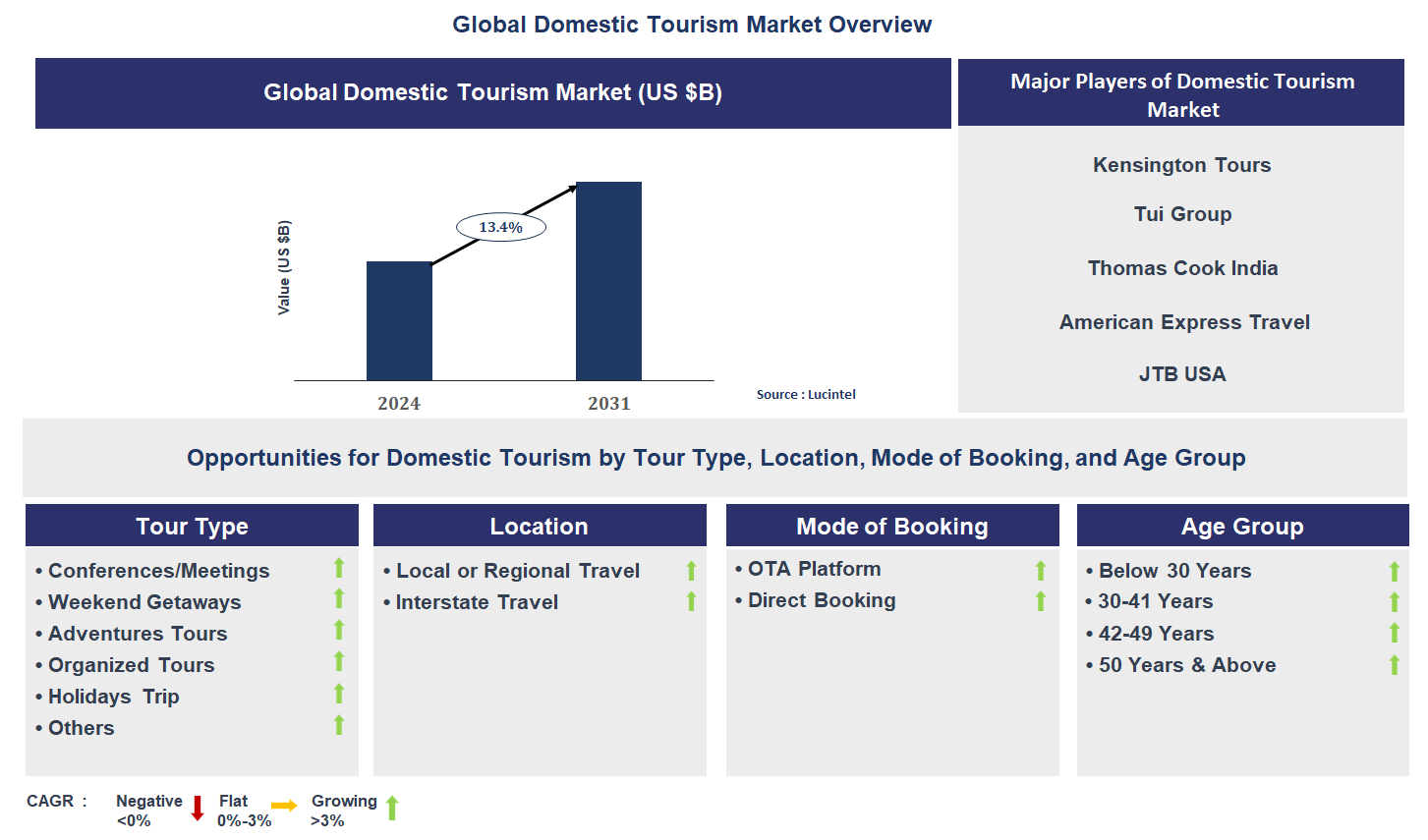
The future of the global domestic tourism market looks promising with opportunities in the OTA platform and direct booking markets. The global domestic tourism market is expected to grow with a CAGR of 13.4% from 2025 to 2031. The major drivers for this market are the increasing preference for local travel experiences, the rising demand for affordable travel options, and the growing interest in cultural heritage exploration.• Lucintel forecasts that, within the mode of booking category, ota platform is expected to witness higher growth over the forecast period.
• Within the tour type category, OTA platform is expected to witness the highest growth.
• In terms of region, APAC will remain the largest region over the forecast period. Gain valuable insights for your business decisions with our comprehensive 150+ page report. Sample figures with some insights are shown below.
Emerging Trends in the Domestic Tourism Market
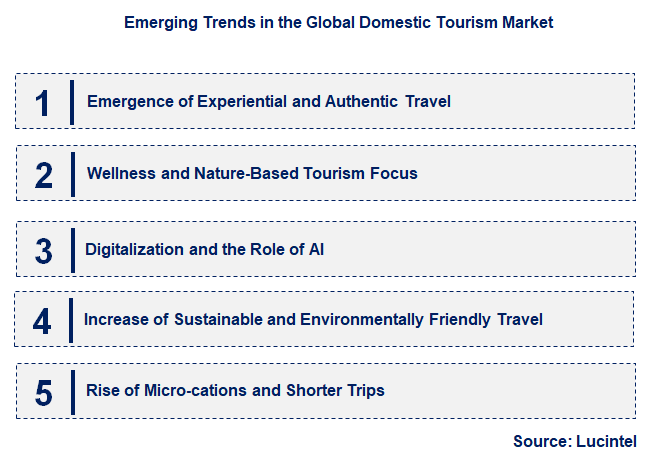
The domestic tourism market is going through a dramatic revolution with a number of new trends that are reshaping the manner in which travel happens across one’s home nation. The trends are fueled by a combination of changing tastes of consumers, new technologies, and increasing awareness about health, sustainability, and individual wellness. The market is shifting from a single-size-fits-all paradigm to a more diversified and notified environment where there are numerous experiences available for different types of travelers.• Emergence of Experiential and Authentic Travel: One of the primary trends is the transition from passive sightseeing to active, authentic, and experiential travel. Tourists no longer wish to merely see sites; they want to experience local cultures, acquire traditional skills, and live like locals. This trend is fueled by the need for a higher level of interaction with a destination. Its influence is transforming the market by generating interest in sustainability-driven, distinctive experiences like culinary tours, homestays, and artisan workshops that challenge tourism providers to provide more than accommodation.
• Wellness and Nature-Based Tourism Focus: There is considerable emerging movement toward wellness and nature-based tourism. Travelers are looking for places and activities that foster physical and mental health, like hiking trails, yoga retreats, and spa resorts. The reason for this trend is directly related to an increasing global emphasis on health and self-care. The result is a new market niche for destinations with natural environments and a strong wellness sector. It is also stimulating tourism boards to advertise outdoor recreation and sustainable tourism practices.
• Digitalization and the Role of AI: The domestic tourism market is increasingly digitalized. Travelers are using online travel agencies, mobile apps, and social media platforms for every stage of their journey, from planning to booking and sharing their experiences. Artificial intelligence is also being used to create personalized travel itineraries and recommendations. The impact is a more seamless and convenient booking process for consumers. It is also compelling conventional tourism enterprises to embrace digital solutions in order to remain competitive and achieve greater reach.
• Increase of Sustainable and Environmentally Friendly Travel: The most notable trend is the increased desire for sustainable travel choices. Customers are becoming increasingly environmentally and socially conscious about their journeys and are actively looking for eco-friendly lodging and activities. They like brands that are open with their efforts at sustainability. The effect is a new competitive edge for environmentally friendly tourism enterprises. The trend is forcing the whole industry to be more responsible and to encourage conservation practices.
• Rise of Micro-cations and Shorter Trips: The market is observing more popularity of "micro-cations," that are short, regular vacations. This trend is fueled by a more flexible labor culture and the need to break more often. It is in response to travelers who lack the funds or time to take an extended holiday. The result is an increase in weekend breaks and short-haul travel demand. This is prompting destinations to innovate products and packages that appeal to shorter breaks. These trends combined are all transforming the domestic tourist economy towards a more individualized, sustainable, and technologically enabled model. The emphasis on real experiences, well-being, and sustainability is mirroring the values of contemporary travelers. Meanwhile, the market digitalization and the popularity of short breaks are responding to a need for convenience and flexibility. In the end, these trends are making the domestic tourism sector more resistant, creative, and in line with the changing needs of its consumers.
Recent Development in the Domestic Tourism Market
The domestic tourism market is today being shaped by some very significant recent developments that are radically altering its direction and competitive dynamics. These developments are not discrete phenomena but rather are intertwined, indicative of an underlying change in consumer behavior and in the approaches of tourism suppliers. The market is becoming increasingly sophisticated as a consequence of a new focus on quality, accessibility, and novelty.• Revitalization of Rural and Regional Destinations: One of the major developments is the revitalization of rural and regional destinations. After a time when people were concentrating on big cities, people are now visiting small towns and off-the-beaten-path destinations. The driving force for this development is to escape crowds and to discover original experiences. The effect is an increasingly dispersed and economically more balanced tourism sector. This has opened up new avenues for local businesses and has resulted in increased investment in tourism promotion and infrastructure in these regions.
• Expanded Use of AI-Based and Digital Platforms: Another big change is the common use of digital and AI-based platforms. Travelers are utilizing apps and websites with AI to discover personalized suggestions, reserve hotels, and plan their entire trip. The effect is a smoother and more individualized experience for visitors. The innovation is compelling tourism enterprises, ranging from tiny hotels to large tour companies, to invest in their online presence in order to compete and reach more customers.
• Government-Facilitated Promotional Campaigns: Governments worldwide are actively encouraging domestic tourism by means of specially designed marketing campaigns and incentives. This is a direct reaction to the recent economic changes and serves to promote the local economies. The effect is a rise in national border travel. These campaigns tend to emphasize the distinct cultural and natural heritage of various regions, inspiring a sense of pride and interest among residents towards their own nation.
• Incorporation of Sustainable Practices in the Industry: One recent trend is the increased incorporation of sustainable practices throughout the domestic tourism industry. From environmentally friendly hotels to low-carbon travel, firms are now actively promoting their environmental commitment. This trend is fueled by heightened consumer awareness and demand for ethical holidays. The spillover is a more sustainable and responsible market that is hosting a new generation of tourists who place high value on sustainability in their buying choices.
• Development of Adventure and Outdoor Tourism: The market is witnessing a significant rise in the development of adventure and outdoor tourism. Outdoorsy activities such as hiking, camping, and cycling are becoming more popular. This growth is motivated by an emphasis on health and a desire to be near nature. The result is a new, high-growth niche in the market. It is inspiring destinations to invest in and market their natural scenery and to create specialized holiday packages tailored to adventure tourists. These recent trends are all combining to influence the domestic tourism industry toward a more diversified, tech-friendly, and consumer-driven model. Regional destinations and outdoor activities are creating new opportunities for local economies, while digital platforms are streamlining the entire traveler’s journey. The inclusion of sustainable practices is also making sure that the growth in the market is responsible and in line with the values of contemporary travelers.
Strategic Growth Opportunities in the Domestic Tourism Market
The domestic tourism market offers a number of strategic expansion opportunities through its major applications. With changing preferences among travelers and emphasis being placed on more authentic and customized experiences, businesses and travel destinations can use these opportunities to increase their market share and establish new sources of revenue. These opportunities go beyond the conventional travel products and cover innovation in technology, destination management, and niche market development.• Potential in Experiential and Cultural Tourism: There is also vast growth potential in cultivating and marketing experiential and cultural tourism. Businesses can design and sell immersive experiences that extend beyond sightseeing, including cooking classes, craft workshops that are local, or member-led tours. This tactic capitalizes on the consumer’s need for authenticity and personal touch. This tactic can create a more loyal customer group and word-of-mouth marketing. It also creates a point of differentiation in a saturated market.
• Wellness and Health Tourism Opportunity: The other prominent growth opportunity is in the wellness and health tourism market. Firms can create packages that integrate travel with physical and mental health-based activities, for instance, yoga retreats, spa vacations, or outdoor-based mindfulness exercises. This approach caters to increasing consumer needs for relaxation and self-care. It provides destinations with a high-spending traveler segment and can help drive a year-round tourism product that is independent of seasonal events.
• Technology Integration and Personalization Opportunity: The market provides a significant opportunity for technology integration and personalization. Through data analytics and artificial intelligence, businesses can design highly customized itineraries and travel recommendations for travelers. This may include an app that recommends activities based on a traveler’s historical interests or a booking website that provides tailored packages. This strategy improves the customer experience and establishes a solid, long-term relationship with the consumer, resulting in increased repeat business and loyalty.
• Business and Leisure Segment Opportunity: There is a strategic opportunity to address the increasing "leisure" market. Businesses can develop packages and accommodations to appeal to business travelers who wish to extend their stay for leisure. This may involve providing special weekend prices, local excursions, or distinct experiences that are readily incorporated into a business trip. Such an initiative enables tour operators and hotels to fill their rooms in their slower periods and to tap a high-spending consumer niche.
• Potential in Sustainable and Green Travel: Increasing demand for sustainable travel offers a huge opportunity for growth. Businesses can distinguish themselves by making their operations sustainable and by openly promoting their efforts at sustainability. This might mean providing carbon-neutral travel alternatives, sourcing sustainable materials for hotels, or collaborating with local conservation initiatives. Such an approach not only captures a rising market but also creates a good brand reputation and illustrates a commitment to future-long responsible business behavior. These strategic opportunities for growth are going to propel the domestic tourism industry ahead. Through emphasis on experience, health-based, and customized products, businesses can establish more valuable and consumer-oriented products. The evolution of sustainable and leisure-specific services also resonates with contemporary values of travelers. Overall, these opportunities suggest a world where not just the size of the market is greater, but it is also more inventive, niche, and attuned to the changing demands of its diverse set of consumers.
Domestic Tourism Market Driver and Challenges
The domestic tourism market is driven by a complex mix of drivers and challenges that are determining its path. The drivers are mainly focused on shifting consumer behavior, economics, and technology. Nevertheless, there are considerable challenges that the market is facing, such as price sensitivity, infrastructural constraints, and the constant fear of external threats such as public health issues. It is critical for any business or destination seeking to thrive in this changing market to understand these drivers and challenges. The factors responsible for driving the domestic tourism market include: 1. Enhanced Awareness and Value of Local Attractions: A chief driver is the added value and appreciation of local and domestic destinations. After a spell of curtailed international travel, residents have reawakened to the splendor and distinct attractions within their own nations. This is an influential driver of market expansion since it inspires tourists to visit proximal sites, which results in a more balanced tourist flow and economic benefits across various regions. 2. Increasing Disposable Income in Emerging Economies: One of the key drivers is increasing disposable income, especially in emerging economies such as China and India. More individuals in the middle class, their capacity and inclination to incur expenses on holidays and leisure activities also increase. This economic phenomenon is building up a vast and increasing consumer market for domestic tourism, enabling growth in tourism infrastructure as well as the development of new products and services. 3. Technological Advances and Digitalization: The industry is fueled by ongoing technological innovations. Expansion in the use of internet-based travel agencies, mobile phone applications for booking, and social media has simplified trip planning and booking a local vacation more than ever. This driver has reduced travel barriers, facilitated more effective marketing, and opened up space for tourists to share experiences, thus motivating others to travel. 4. Government Support and Promotional Campaigns: Most governments are actively promoting and supporting domestic tourism with focused campaigns, subsidies, and infrastructure development. This driver is an outcome of increasing awareness of the economic and social dividends that a vibrant domestic tourism industry can deliver. These efforts are making an environment for tourism enterprises more conducive and are stimulating nationals to travel within their own countries. 5. Need for Shorter and More Flexible Trips: The driver is fueled by a change in lifestyle and the need for more frequent, shorter, and flexible trips. A more flexible work ethic has allowed individuals to experience "micro-cations" or weekend breaks. This driver is developing a consistent demand for short-haul travel. It is motivating destinations to create products and services that appeal to travelers who seek to have a quick, convenient, and enriching experience. Challenges in the domestic tourism market are: 1. Infrastructure Shortages and Connectivity Gaps: One of the major challenges is the paucity of infrastructure and connectivity in certain areas. While tourist cities might enjoy good roads and accommodation facilities, rural and regional places often lack infrastructure to handle a significant number of travelers. This challenge can discourage visitors and restrict the market’s overall growth. It demands large-scale investment in highways, public transport, and accommodations to be addressed. 2. Price Consciousness and Concerns over Value for Money: Domestic travel is a costlier or less exotic experience than international travel for most of the population. This price consciousness is one of the major hindrances to the market. The value proposition of domestic travel, including the richness of culture and ease, must be effectively communicated to break this barrier. Competitive pricing and attractive packages need to be provided by them to capture price-sensitive consumers. 3. Seasonal Dependence and Overtourism: Seasonal dependence and overtourism are issues that the market is struggling with. Several destinations have peak periods when they are full of tourists, causing congestion as well as environmental impacts. This can be detrimental to the traveler experience and the community. The issue necessitates destinations to adopt mechanisms to control visitor flows, encourage off-season travel, and diversify their tourism product to create a more sustainable and year-round business model. The local tourism market is at a crossroads, fueled by robust drivers such as growing domestic appreciation and economic growth. These are establishing a positive environment for growth and innovation. Yet, the development of the market is being disrupted by infrastructure constraints, price sensitivity, and the intricacies of seasonal demand. Future success will depend on companies and governments being able to capitalize on the drivers by developing high-value, digitally-enabled, and accessible journeys while creatively overcoming the challenges through focused investment, sustainable operations, and smart marketing.List of Domestic Tourism Companies
Companies in the market compete on the basis of product quality offered. Major players in this market focus on expanding their manufacturing facilities, R&D investments, infrastructural development, and leverage integration opportunities across the value chain. With these strategies domestic tourism companies cater increasing demand, ensure competitive effectiveness, develop innovative products & technologies, reduce production costs, and expand their customer base. Some of the domestic tourism companies profiled in this report include-• Kensington Tours
• Tui Group
• Thomas Cook India
• American Express Travel
• JTB USA
• Scott Dunn
• Tauck
• Carlson Wagonlit Travel
• TRAVCOA Corporation
• Abercrombie & Kent USA
Domestic Tourism Market by Segment
The study includes a forecast for the global domestic tourism market by tour type, location, mode of booking, age group, and region.Domestic Tourism Market by Tour Type [Value from 2019 to 2031]:
• Conferences/Meetings
• Weekend Getaways
• Adventures Tours
• Organized Tours
• Holidays Trip
• Others
Domestic Tourism Market by Location [Value from 2019 to 2031]:
• Local or Regional Travel
• Interstate Travel
Domestic Tourism Market by Mode of Booking [Value from 2019 to 2031]:
• OTA Platform
• Direct Booking
Domestic Tourism Market by Age Group [Value from 2019 to 2031]:
• Below 30 Years
• 30-41 Years
• 42-49 Years
• 50 Years & Above
Domestic Tourism Market by Region [Value from 2019 to 2031]:
• North America
• Europe
• Asia Pacific
• The Rest of the World
Country Wise Outlook for the Domestic Tourism Market
The domestic travel market worldwide is going through a transformation period, fueled by a new enthusiasm for local and regional trips. After decades of international travel restrictions, citizens of most countries have come to appreciate the historical, cultural, and natural attractions within their own borders anew. This change is not short-term but rather indicates a fundamental shift in consumer tastes, with the traveler now looking for more genuine, sustainable, and elastic experiences. The market is being driven by technological innovation and increased focus on individualized and specialized travel.• United States: Domestic tourism in the United States is booming, with a significant rise in "staycations" and non-tourist trail travel. Americans are going out to national parks, small towns, and the countryside in greater numbers, away from congested cities. Wellness-oriented and environmentally sustainable travel options are in high demand. Technology is key, with digital platforms used widely for planning and booking trips. The market is witnessing an upsurge in "leisure" travel, where business travel gets extended for leisure, representing a more flexible and hybrid work-life style.
• China: China’s internal tourism sector is a behemoth, witnessing the growth of rapid proportions driven by a huge population and rising disposable income. The latest trends involve the strong affinity for "red tourism," or visiting sites of the Communist Revolution, and a surging trend for experiential, immersive travel. The Chinese tourist, especially the youth, is seeking authentic, culturally enriching experiences. The market is highly digitalized and dominated by social media and live-streaming sites, which significantly impact travel planning and travel destination selection.
• Germany: The domestic German tourist market is mature and stable, with recent trends concentrating on sustainability and premium experiences. The German tourists are demanding and prefer destinations that provide cultural authenticity and environmental concerns. There is a strong trend towards "micro-adventures" and day trips, with many Germans discovering nearby scenic landscapes and historic towns. The market is also witnessing an increase in cycling and hiking tourism, facilitated by well-developed infrastructure accommodating these forms of tourism.
• India: India’s domestic tourism industry is on the rise, driven by a growing middle class and enhanced connectivity. One major development has been the development of spiritual and pilgrimage tourism, with a high number of domestic tourists visiting religious destinations. Demand for adventure tourism and off-beat destinations is also on the rise. Efforts from the government to enhance infrastructure and support local tourism are also contributing immensely. Online travel agencies and e-commerce websites are allowing more people to organize and book their vacations easily.
• Japan: Japan’s domestic tourism sector is well advanced, and recent trends are geared towards high-value and tailored experiences. Japanese tourists are more inclined towards genuine cultural immersion, overnight stays at traditional inns, and venturing into native cuisine. There is also a big shift to "workations" and quick, frequent breaks, usually to a ryokan or onsen in order to unwind and recharge. The government is also encouraging less popular regions in an effort to stave off overtourism in major places. The market is fueled by a profound love of the country’s rich culture and natural landscapes.

Features of the Global Domestic Tourism Market
Market Size Estimates: Domestic tourism market size estimation in terms of value ($B). Trend and Forecast Analysis: Market trends (2019 to 2024) and forecast (2025 to 2031) by various segments and regions. Segmentation Analysis: Domestic tourism market size by various segments, such as by tour type, location, mode of booking, age group, and region in terms of value ($B). Regional Analysis: Domestic tourism market breakdown by North America, Europe, Asia Pacific, and Rest of the World. Growth Opportunities: Analysis of growth opportunities in different tour types, locations, modes of booking, age groups, and regions for the domestic tourism market. Strategic Analysis: This includes M&A, new product development, and competitive landscape of the domestic tourism market. Analysis of competitive intensity of the industry based on Porter’s Five Forces model.
FAQ
Q1. What is the growth forecast for domestic tourism market? Answer: The global domestic tourism market is expected to grow with a CAGR of 13.4% from 2025 to 2031. Q2. What are the major drivers influencing the growth of the domestic tourism market? Answer: The major drivers for this market are the increasing preference for local travel experiences, the rising demand for affordable travel options, and the growing interest in cultural heritage exploration. Q3. What are the major segments for domestic tourism market? Answer: The future of the domestic tourism market looks promising with opportunities in the OTA platform and direct booking markets. Q4. Who are the key domestic tourism market companies? Answer: Some of the key domestic tourism companies are as follows:• Kensington Tours
• Tui Group
• Thomas Cook India
• American Express Travel
• JTB USA
• Scott Dunn
• Tauck
• Carlson Wagonlit Travel
• TRAVCOA Corporation
• Abercrombie & Kent USA Q5. Which domestic tourism market segment will be the largest in future? Answer: Lucintel forecasts that, within the mode of booking category, ota platform is expected to witness higher growth over the forecast period. Q6. In domestic tourism market, which region is expected to be the largest in next 5 years? Answer: In terms of region, APAC will remain the largest region over the forecast period. Q7. Do we receive customization in this report? Answer: Yes, Lucintel provides 10% customization without any additional cost.
Table of Contents
List of Figures
List of Tables
Methodology
- In-depth interviews of the major players in this market
- Detailed secondary research from competitors’ financial statements and published data
- Extensive searches of published works, market, and database information pertaining to industry news, company press releases, and customer intentions
- A compilation of the experiences, judgments, and insights of Lucintel’s professionals, who have analyzed and tracked this market over the years.


Buy Now
Choose a license that fits your team. Instant PDF delivery.
Prices exclude taxes. Instant delivery. Custom licensing available on request.
Key Questions
- • What are some of the most promising, high-growth opportunities for the domestic tourism market by tour type (conferences/meetings, weekend getaways, adventures tours, organized tours, holidays trip, and others), location (local or regional travel and interstate travel), mode of booking (OTA platform and direct booking), age group (below 30 years, 30-41 years, 42-49 years, and 50 years & above), and region (North America, Europe, Asia Pacific, and the Rest of the World)?
- • Which segments will grow at a faster pace and why?
- • Which region will grow at a faster pace and why?
- • What are the key factors affecting market dynamics? What are the key challenges and business risks in this market?
- • What are the business risks and competitive threats in this market?
- • What are the emerging trends in this market and the reasons behind them?
- • What are some of the changing demands of customers in the market?
- • What are the new developments in the market? Which companies are leading these developments?
- • Who are the major players in this market? What strategic initiatives are key players pursuing for business growth?
- • What are some of the competing products in this market and how big of a threat do they pose for loss of market share by material or product substitution?
- • What M&A activity has occurred in the last 5 years and what has its impact been on the industry? For any questions related to Domestic Tourism Market, Domestic Tourism Market Size, Domestic Tourism Market Growth, Domestic Tourism Market Analysis, Domestic Tourism Market Report, Domestic Tourism Market Share, Domestic Tourism Market Trends, Domestic Tourism Market Forecast, Domestic Tourism Companies, write Lucintel analyst at email: helpdesk@lucintel.com. We will be glad to get back to you soon.


