
Close Lucintel Chat
Didn't Find What You're Looking for?
Call us at +1972 636 5056 or write at helpdesk@Lucintel.com
Ask an Expert Provide Custom Requirements Download Sample Report Search Available Reports
  • helpdesk@Lucintel.com
  • |
  • Call Lucintel +1 972 636 5056
  • |
  • Login
  • |
  • Register
  • |
  • Search
  • |
'
...

The Impact of COVID-19 is included in Diving Equipment Market Report. Buy it today to get an advantage.

Request the impact of COVID-19 on your product or industry


Diving Equipment Market Trends and Forecast

The future of the global diving equipment market looks promising with opportunities in the amateur diving and professional diving markets. The global diving equipment market is expected to grow with a CAGR of 2.3% from 2025 to 2031. The major drivers for this market are the increasing popularity of underwater tourism, the rising interest in adventure sports, and the growing demand for safer equipment.

• Lucintel forecasts that, within the type category, closed respiratory system is expected to witness higher growth over the forecast period.
• Within the application category, amateur diving is expected to witness higher growth.
• In terms of region, APAC is expected to witness the highest growth over the forecast period.
Gain valuable insights for your business decisions with our comprehensive 150+ page report. Sample figures with some insights are shown below.
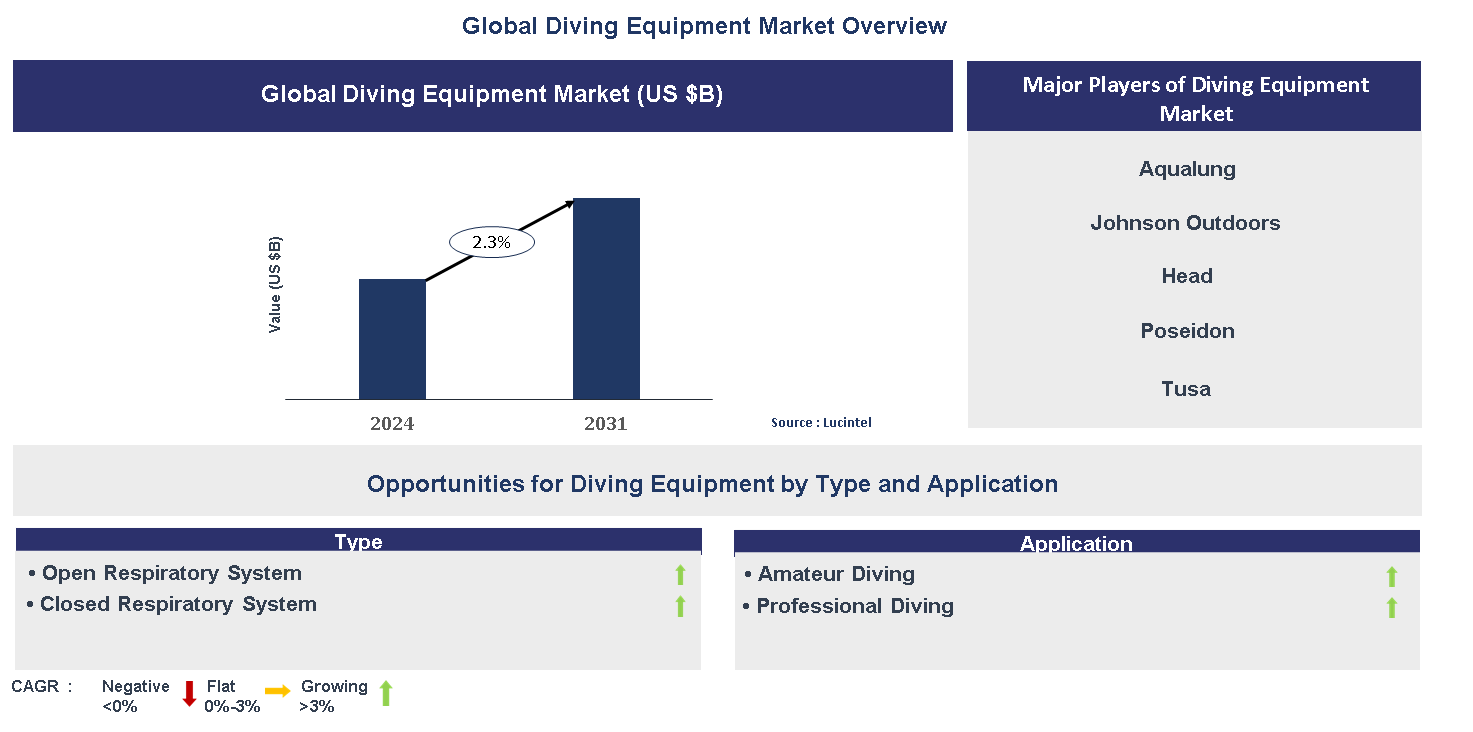
Diving Equipment Market Trends and Forecast

Emerging Trends in the Diving Equipment Market

The market for diving equipment is undergoing a change, with several important trends defining its future. These trends are a representation of a shift in overall consumer behavior and technological advancements. The market is shifting toward increased integration of technology, more focus on sustainability, and a higher level of personalized user interaction. The increased popularity of underwater activities, ranging from recreational diving to underwater photography, is the key driver of these trends.
• Technological Integration and Intelligent Gear: A top trend is integrating high technology into diving gear. This involves smart dive computers that monitor and interpret a diver’s biometric data, air usage, and position in real-time. The effect is a large increase in diver safety and performance. Pieces of equipment such as heads-up displays within masks and wireless communication devices are increasingly prevalent, giving divers vital data without user action.
• Sustainability and Eco-Friendly Materials: The love affair of the diving community with marine conservation is driving a trend towards sustainable and eco-friendly gear. Recycled plastics, lead-free weights, and biodegradable materials are being utilized by manufacturers to minimize their carbon footprint. The effect is an emerging market segment for sustainable products, which attracts more and more environmentally friendly divers.
• Rising Demand for Specialized and High-End Equipment: With growing popularity of diving and increasing experience among divers, there is also a higher demand for specialized and high-end equipment. This includes rebreathers, dry suits for cold water diving, and technical diving equipment for deep or cave exploration. The effect is the establishment of a premium segment with greater profit margins.
• Expansion of Online Retailing and Direct-to-Consumer Channels: The internet has revolutionized the retail channel for diving equipment. Customers can now compare products easily, read other customers’ reviews, and buy equipment directly from producers or online stores. The effect is a more transparent and competitive marketplace. This trend is also making possible smaller, niche brands to become globally accessible without the necessity of a conventional brick-and-mortar location.
• Trend towards Underwater Photography and Videography: The availability of high-quality underwater cameras and drones has become a leading trend around underwater photography and videography. Divers are paying more and more to invest in equipment such as waterproof camera housings, lighting, and color correction filters. The result is a huge growth opportunity for manufacturers of such accessories. This is driven by the need to film underwater experiences and post them on social media, serving as an extremely effective marketing tool for the diving sector as a whole.
All these trends are contributing towards reshaping the market for diving gear in making it more accessible, cutting-edge, and eco-friendly. The incorporation of smart technology is driving safety and user experience, and the emphasis on sustainability is positioning the industry in alignment with its consumers’ values. The popularity of online shopping and the request for specialty equipment are democratizing the marketplace and creating profitable, new segments. Overall, these trends are transforming the market from a niche pastime to a contemporary, evolving industry.
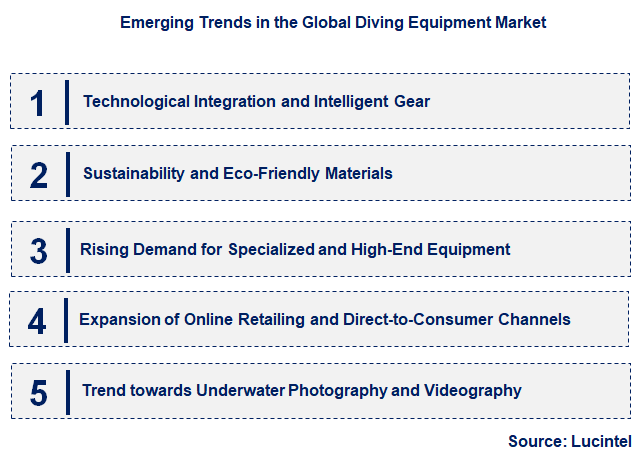
Emerging Trends in the Diving Equipment Market

Recent Development in the Diving Equipment Market

The diving equipment industry has seen several major developments that are practically transforming its operational and strategic environment. These developments are a result of the intersection of technological innovation, changes in consumer trends, and increasing focus on safety and environmental stewardship. The industry is reacting to the demand for improved methods of production, innovative uses for gear, and a larger, more inclusive community.
• Widespread Adoption of Computerized Dive Consoles: A significant development is the widespread adoption of computerized dive consoles and wrist-mounted dive computers. These devices are replacing traditional analog gauges for depth, pressure, and time. This advancement is impacting the market by significantly increasing diver safety and comfort. Computers automatically calculate no-decompression limits, ascent rates, and other critical data, which reduces the risk of human error.
• Lightweight and Travel-Friendly Equipment Development: As adventure tourism grows, one of the main developments is the emphasis on developing lightweight and travel-friendly diving gear. Companies are utilizing cutting-edge materials such as carbon fiber and lighter plastics for the production of tanks, buoyancy control devices (BCDs), and regulators so that they weigh less. The effect is a greatly enhanced convenience for divers who venture to far-flung locations.
• Advancement of Underwater Communications Technology: The creation of underwater communication systems is a fundamental breakthrough that is transforming both commercial and recreational diving. These systems enable divers to communicate with one another and with the surface, which was formerly done only through hand signals. The effect is a dramatic increase in safety, coordination, and cooperation.
• Concentration on Sustainable Production and Materials: There is increased trend in the marketplace towards sustainable production processes and materials. Firms are making use of recycled neoprene and nylon for wetsuits, designing lead-free weights, and implementing more efficient energy-based production processes. This trend is affecting the marketplace by realigning it with a new generation of eco-friendly consumers’ values.
• Growth of Specialty Diving Gear for Niche Segments: The industry is experiencing growth in specialty gear made for niche diving activities like cave diving, technical diving, and underwater hunting. This trend is affecting the industry by opening up new areas of revenue generation and areas of innovation. Although recreational diving is still the largest market, these specialty segments serve veteran divers who are willing to pay for high-performance equipment.
These advancements are cumulatively affecting the diving gear market by creating a more innovative, secure, and consumer-focused industry. They are not only enhancing the quality of the products but also opening up the sport of diving to a broader population by making the activity itself more accessible and desirable. By advancing with these developments, the market is guaranteeing its continued growth and viability in a world environment that stresses technology, eco-friendliness, and individual experience.

Strategic Growth Opportunities in the Diving Equipment Market

The diving equipment market offers several strategic growth opportunities in key applications that are fueled by a mix of changing consumer tastes, advances in technology, and growth in adventure tourism. These opportunities are allowing market participants to broaden their product lines, reach new consumer groups, and establish themselves firmly in a competitive marketplace. By targeting these areas of high growth, businesses can tap into the intrinsic value of diving as a recreational, professional, and educational pursuit. The following strategic opportunities demonstrate how the market is shifting to satisfy the needs of a contemporary consumer base.
• Growth in the Adventure Tourism Segment: One of the growth opportunities is in riding the world’s increased focus on adventure and eco-tourism. The plan is to partner with resorts, tour operators, and cruise lines to provide diving equipment rental, sale, and instruction packages. The result is a direct connection to an expanding consumer market looking for special, experience-centered vacations. By providing travel-friendly gear and on-site assistance, manufacturers can take a big share of this market and establish brand loyalty from new divers.
• Expansion in the Professional and Commercial Diving Segment: Though there is a dominance by recreational diving, there is a huge growth opportunity for the professional and commercial diving segment. This involves equipment for underwater construction, search and rescue, and marine research. The approach is to create specialized, high-performance, highly durable equipment that meets high safety standards. The result is a stable, high-value business segment with a very high barrier to entry.
• Taking Advantage of the Underwater Photography and Videography Market: Social media popularity and underwater media popularity are generating a profitable growth market. The plan is to create and market equipment especially for underwater photographers and videographers, such as camera housings, lighting equipment, and specialized accessories. The influence is a profitable niche segment fueled by professionals and enthusiasts who are eager to spend money on good-quality equipment.
• Building a Strong E-commerce and Direct-to-Consumer Channel: The move towards online selling offers a significant growth potential. The plan is to create a powerful e-commerce site with a high level of products, comprehensive product information, and a hassle-free buying experience. The result is a more streamlined distribution system that minimizes overhead and opens up the possibility for direct customer contact.
• Emphasis on Safety and Training Gear: With an increasing diving population, there is an ongoing need for good-quality safety and training gear. The opportunity lies in collaborating with diving certification agencies and training facilities to become their go-to supplier for regulators, BCDs, and other must-have gear. The result is a stable revenue source from novice divers who must buy or rent certified gear.
These strategic growth prospects are combining to transform the diving equipment market into a more dynamic, diversified, and customer-driven market. They are allowing firms to break free from conventional retailing and to capitalize on new, fast-growing applications, including adventure travel and commercial diving. By targeting these opportunities, market players are not only ensuring the long-term sustainability of their businesses but also positioning themselves as industry leaders in an evolving global environment. Digitalization.

Diving Equipment Market Driver and Challenges

The diving equipment market is shaped by a multicentric combination of drivers that boost its development and challenges that can hinder its path. The main drivers are basically linked to an increased global demand for leisure and adventure pursuits, an increased emphasis on safety, and ongoing technological advancements. On the other hand, the primary challenges are usually in terms of the material expense being too high, the natural risks associated with the activity, and concerns about the environment.
The factors responsible for driving the diving equipment market include:
1. Rise of Adventure and Eco-Tourism: The increasing popularity of eco-tourism and adventure is a significant boost to the diving equipment market. Holidaymakers are increasingly looking for innovative, experience-oriented activities, and scuba diving is an integral part of this phenomenon. The effect is a rise in demand for rental and personal gear, particularly in coastal areas and island resorts.
2. Equipment Technological Advances: Ongoing advances in technology are a compelling force. New dive computers, regulators, and other equipment are safer, more dependable, and easier to use than ever. These advances apply to wireless integration, sensor technology, and ergonomic design. The effect is a decrease in the entry barrier for new divers and a compelling reason for certified divers to replace their equipment, which drives continued growth and innovation in the business.
3. Disposable Income Growth: Expansion of the middle class globally, especially in emerging markets, is growing disposable income and expenditure on leisure activities. This economic impetus is making it possible for more individuals to purchase diving certification and gear. The effect is a considerable market growth into new markets, providing a broader consumer base and broadening the geographic distribution of demand.
4. Increased Emphasis on Safety of Divers: Safety is a top priority when it comes to diving, and the driving force for the industry is the ongoing enhancement of safety standards and equipment. Manufacturers and certification bodies are collaborating to create equipment with improved safety features, including better buoyancy control devices and more dependable pressure gauges. The effect is increased consumer confidence, which promotes more individuals to adopt the activity and invest in good-quality, certified gear.
5. Social Media and Underwater Media Influence: The growth of social media sites and the ease with which high-quality underwater images and videos can be shared are a key impetus. Influencers and content producers are motivating new segments of people to adopt diving. The effect is a strong selling point that generates interest in the appeal of the underwater world and the excitement of scuba diving.
Challenges in the diving equipment market are:
1. High Equipment Cost: The upfront cost of a complete set of diving gear may pose a major obstacle to numerous prospective members. Top-of-the-line gear, particularly specialized gear such as rebreathers, may be costly. This is a hindrance that restricts market penetration to a particular income group and discourages newcomers from taking up the sport. It also encourages rental businesses, which can curtail sales growth of the equipment.
2. Safety Risks and Concerns: Even with all the technology, diving remains fraught with inherent dangers, and these serve as a deterrent for others. Decompression sickness, equipment malfunction, and the risks posed by environmental factors can restrict the flow of new entrants. To overcome this issue, constant investment in safety features, education, and certification is required in order to reassure consumers and curb risk.
3. Regulatory and Environmental Pressure: The diving business is increasingly under pressure with regards to its environmental footprint within oceanic ecosystems. Anchor damage, coral bleaching caused by sunscreen, and the treatment of equipment waste can spur tightened regulations and public disapproval. This issue calls for operators and manufacturers to incorporate more eco-friendly practices, which can elevate costs of production and call for a change in business models.
The net effect of these drivers and issues is a market in dynamic balance. The drivers, particularly technology and growth in adventure tourism, are forcing the market to become more innovative and consumer base wider. Yet the issues, notably high expenses and safety, mandate that the industry be strategic and ethical. The industry is segmenting more and more into a high-end market that emphasizes technology and safety and an affordable rental and entry-level segment.

List of Diving Equipment Companies

Companies in the market compete on the basis of product quality offered. Major players in this market focus on expanding their manufacturing facilities, R&D investments, infrastructural development, and leverage integration opportunities across the value chain. With these strategies diving equipment companies cater increasing demand, ensure competitive effectiveness, develop innovative products & technologies, reduce production costs, and expand their customer base. Some of the diving equipment companies profiled in this report include-
• Aqualung
• Johnson Outdoors
• Head
• Poseidon
• Tusa
• American Underwater Products
• Saekodive
• Cressi
• Sherwood Scuba
• Beuchat International

Diving Equipment Market by Segment

The study includes a forecast for the global diving equipment market by type, application, and region.

Diving Equipment Market by Type [Value from 2019 to 2031]:


• Open Respiratory System
• Closed Respiratory System

Diving Equipment Market by Application [Value from 2019 to 2031]:


• Amateur Diving
• Professional Diving

Diving Equipment Market by Region [Value from 2019 to 2031]:


• North America
• Europe
• Asia Pacific
• The Rest of the World

Country Wise Outlook for the Diving Equipment Market

The diving equipment market is in a state of transformation, driven by the convergence of technological advances, increased recreational diving activity, and heightened concern over sustainability. No longer a specialized niche catering to a small group of experts and amateurs, the market is now expanding to reach a wider consumer base, fueled by adventure travel and growth in underwater pursuits. Current trends indicate a movement toward more sophisticated, user-friendly, and eco-friendly equipment, in line with a market that is increasing in size as well as sophistication.
• United States: The United States has a mature and leading position in the diving equipment market, with a large recreational and professional diver community. Latest trends are focused on advances in technology, especially in rebreathers and dive computers, that are becoming simpler to use, more laden with features, and interconnected with other gear. In addition, there is a very strong trend towards green products, with suppliers making more use of sustainable materials and processes to attract a new generation of environmentally aware consumers.
• China: China’s market for diving gear is growing fast, driven by high disposable incomes and a growing desire to pursue leisure and adventure travel. Recent trends involve a robust government initiative to conserve the sea and expand coastal tourism, as well as directly stimulating demand for diving equipment and activities. Chinese companies are also shifting from bulk production to more high-quality, high-tech equipment. The market is emerging as a center of consumerism and production, with local businesses broadening their product lines and international market share, underpinned by an increasing number of diving clubs and training facilities.
• Germany: In Germany, the diving gear industry is characterized by attention to precision engineering, safety, and quality. Recent innovations are stimulated by a high demand for high-performance, long-lasting equipment, especially for cold-water and technical diving. German brands are leading the way in technologies like dry suits, regulators, and dive computers, which are very much in demand for their reliability. Demand is also increasing for customized and custom-fit gear.
• India: India’s diving gear market is in its early phase but has a high potential for growth. Current trends are led mainly by the development of coastal and maritime tourism in areas like the Andaman and Nicobar Islands. Adventure tourism is also being encouraged by the government, which is drawing tourists both domestically and internationally. The market is experiencing an increasing number of operators and dive centers, building a support system for sales and rentals of equipment.
• Japan: The diving equipment market in Japan is highlighted by a high mix of tradition and advanced high-tech features. Current innovations are geared towards producing light, portable, and functional equipment that is adapted to local diving conditions and preferences. Japanese companies are world leaders in products such as fins, masks, and regulators, whose design is admired as graceful and whose performance is unmatched. There is also a trend of strategic alliances between local distributors and foreign companies, with a view to increasing brand recognition and product availability.

Lucintel Analytics Dashboard

Features of the Global Diving Equipment Market

Market Size Estimates: Diving equipment market size estimation in terms of value ($B).
Trend and Forecast Analysis: Market trends (2019 to 2024) and forecast (2025 to 2031) by various segments and regions.
Segmentation Analysis: Diving equipment market size by type, application, and region in terms of value ($B).
Regional Analysis: Diving equipment market breakdown by North America, Europe, Asia Pacific, and Rest of the World.
Growth Opportunities: Analysis of growth opportunities in different types, applications, and regions for the diving equipment market.
Strategic Analysis: This includes M&A, new product development, and competitive landscape of the diving equipment market.
Analysis of competitive intensity of the industry based on Porter’s Five Forces model.

Lucintel Consulting Services

FAQ

Q1. What is the growth forecast for diving equipment market?
Answer: The global diving equipment market is expected to grow with a CAGR of 2.3% from 2025 to 2031.
Q2. What are the major drivers influencing the growth of the diving equipment market?
Answer: The major drivers for this market are the increasing popularity of underwater tourism, the rising interest in adventure sports, and the growing demand for safer equipment.
Q3. What are the major segments for diving equipment market?
Answer: The future of the diving equipment market looks promising with opportunities in the amateur diving and professional diving markets.
Q4. Who are the key diving equipment market companies?
Answer: Some of the key diving equipment companies are as follows:
• Aqualung
• Johnson Outdoors
• Head
• Poseidon
• Tusa
• American Underwater Products
• Saekodive
• Cressi
• Sherwood Scuba
• Beuchat International
Q5. Which diving equipment market segment will be the largest in future?
Answer: Lucintel forecasts that, within the type category, closed respiratory system is expected to witness higher growth over the forecast period.
Q6. In diving equipment market, which region is expected to be the largest in next 5 years?
Answer: In terms of region, APAC is expected to witness the highest growth over the forecast period.
Q7. Do we receive customization in this report?
Answer: Yes, Lucintel provides 10% customization without any additional cost.

This report answers following 11 key questions:

Q.1. What are some of the most promising, high-growth opportunities for the diving equipment market by type (open respiratory system and closed respiratory system), application (amateur diving and professional diving), and region (North America, Europe, Asia Pacific, and the Rest of the World)?
Q.2. Which segments will grow at a faster pace and why?
Q.3. Which region will grow at a faster pace and why?
Q.4. What are the key factors affecting market dynamics? What are the key challenges and business risks in this market?
Q.5. What are the business risks and competitive threats in this market?
Q.6. What are the emerging trends in this market and the reasons behind them?
Q.7. What are some of the changing demands of customers in the market?
Q.8. What are the new developments in the market? Which companies are leading these developments?
Q.9. Who are the major players in this market? What strategic initiatives are key players pursuing for business growth?
Q.10. What are some of the competing products in this market and how big of a threat do they pose for loss of market share by material or product substitution?
Q.11. What M&A activity has occurred in the last 5 years and what has its impact been on the industry?

For any questions related to Diving Equipment Market, Diving Equipment Market Size, Diving Equipment Market Growth, Diving Equipment Market Analysis, Diving Equipment Market Report, Diving Equipment Market Share, Diving Equipment Market Trends, Diving Equipment Market Forecast, Diving Equipment Companies, write Lucintel analyst at email: helpdesk@lucintel.com. We will be glad to get back to you soon.
                                           Table of Contents

            1. Executive Summary

            2. Market Overview

                        2.1 Background and Classifications
                        2.2 Supply Chain

            3. Market Trends & Forecast Analysis

                        3.1 Macroeconomic Trends and Forecasts
                        3.2 Industry Drivers and Challenges
                        3.3 PESTLE Analysis
                        3.4 Patent Analysis
                        3.5 Regulatory Environment
                        3.6 Global Diving Equipment Market Trends and Forecast

            4. Global Diving Equipment Market by Type

                        4.1 Overview
                        4.2 Attractiveness Analysis by Type
                        4.3 Open Respiratory System : Trends and Forecast 2025 to 2031
                        4.4 Closed Respiratory System : Trends and Forecast 2025 to 2031

            5. Global Diving Equipment Market by Application

                        5.1 Overview
                        5.2 Attractiveness Analysis by Application
                        5.3 Amateur Diving : Trends and Forecast 2025 to 2031
                        5.4 Professional Diving : Trends and Forecast 2025 to 2031

            6. Regional Analysis

                        6.1 Overview
                        6.2 Global Diving Equipment Market by Region

            7. North American Diving Equipment Market

                        7.1 Overview
                        7.2 North American Diving Equipment Market by Type
                        7.3 North American Diving Equipment Market by Application
                        7.4 The United States Diving Equipment Market
                        7.5 Canadian Diving Equipment Market
                        7.6 Mexican Diving Equipment Market

            8. European Diving Equipment Market

                        8.1 Overview
                        8.2 European Diving Equipment Market by Type
                        8.3 European Diving Equipment Market by Application
                        8.4 German Diving Equipment Market
                        8.5 French Diving Equipment Market
                        8.6 Italian Diving Equipment Market
                        8.7 Spanish Diving Equipment Market
                        8.8 The United Kingdom Diving Equipment Market

            9. APAC Diving Equipment Market

                        9.1 Overview
                        9.2 APAC Diving Equipment Market by Type
                        9.3 APAC Diving Equipment Market by Application
                        9.4 Chinese Diving Equipment Market
                        9.5 Indian Diving Equipment Market
                        9.6 Japanese Diving Equipment Market
                        9.7 South Korean Diving Equipment Market
                        9.8 Indonesian Diving Equipment Market

            10. ROW Diving Equipment Market

                        10.1 Overview
                        10.2 ROW Diving Equipment Market by Type
                        10.3 ROW Diving Equipment Market by Application
                        10.4 Middle Eastern Diving Equipment Market
                        10.5 South American Diving Equipment Market
                        10.6 African Diving Equipment Market

            11. Competitor Analysis

                        11.1 Product Portfolio Analysis
                        11.2 Operational Integration
                        11.3 Porter’s Five Forces Analysis
                                    • Competitive Rivalry
                                    • Bargaining Power of Buyers
                                    • Bargaining Power of Suppliers
                                    • Threat of Substitutes
                                    • Threat of New Entrants
                        11.4 Market Share Analysis

            12. Opportunities & Strategic Analysis

                        12.1 Value Chain Analysis
                        12.2 Growth Opportunity Analysis
                                    12.2.1 Growth Opportunity by Type
                                    12.2.2 Growth Opportunity by Application
                        12.3 Emerging Trends in the Global Diving Equipment Market
                        12.4 Strategic Analysis
                                    12.4.1 New Product Development
                                    12.4.2 Certification and Licensing
                                    12.4.3 Mergers, Acquisitions, Agreements, Collaborations, and Joint Ventures

            13. Company Profiles of the Leading Players Across the Value Chain

                        13.1 Competitive Analysis
                        13.2 Aqualung
                                    • Company Overview
                                    • Diving Equipment Market Business Overview
                                    • New Product Development
                                    • Merger, Acquisition, and Collaboration
                                    • Certification and Licensing
                        13.3 Johnson Outdoors
                                    • Company Overview
                                    • Diving Equipment Market Business Overview
                                    • New Product Development
                                    • Merger, Acquisition, and Collaboration
                                    • Certification and Licensing
                        13.4 Head
                                    • Company Overview
                                    • Diving Equipment Market Business Overview
                                    • New Product Development
                                    • Merger, Acquisition, and Collaboration
                                    • Certification and Licensing
                        13.5 Poseidon
                                    • Company Overview
                                    • Diving Equipment Market Business Overview
                                    • New Product Development
                                    • Merger, Acquisition, and Collaboration
                                    • Certification and Licensing
                        13.6 Tusa
                                    • Company Overview
                                    • Diving Equipment Market Business Overview
                                    • New Product Development
                                    • Merger, Acquisition, and Collaboration
                                    • Certification and Licensing
                        13.7 American Underwater Products
                                    • Company Overview
                                    • Diving Equipment Market Business Overview
                                    • New Product Development
                                    • Merger, Acquisition, and Collaboration
                                    • Certification and Licensing
                        13.8 Saekodive
                                    • Company Overview
                                    • Diving Equipment Market Business Overview
                                    • New Product Development
                                    • Merger, Acquisition, and Collaboration
                                    • Certification and Licensing
                        13.9 Cressi
                                    • Company Overview
                                    • Diving Equipment Market Business Overview
                                    • New Product Development
                                    • Merger, Acquisition, and Collaboration
                                    • Certification and Licensing
                        13.10 Sherwood Scuba
                                    • Company Overview
                                    • Diving Equipment Market Business Overview
                                    • New Product Development
                                    • Merger, Acquisition, and Collaboration
                                    • Certification and Licensing
                        13.11 Beuchat International
                                    • Company Overview
                                    • Diving Equipment Market Business Overview
                                    • New Product Development
                                    • Merger, Acquisition, and Collaboration
                                    • Certification and Licensing

            14. Appendix

                        14.1 List of Figures
                        14.2 List of Tables
                        14.3 Research Methodology
                        14.4 Disclaimer
                        14.5 Copyright
                        14.6 Abbreviations and Technical Units
                        14.7 About Us
                        14.8 Contact Us

                                               List of Figures


            Chapter 1

                        Figure 1.1: Trends and Forecast for the Global Diving Equipment Market

            Chapter 2

                        Figure 2.1: Usage of Diving Equipment Market
                        Figure 2.2: Classification of the Global Diving Equipment Market
                        Figure 2.3: Supply Chain of the Global Diving Equipment Market

            Chapter 3

                        Figure 3.1: Trends of the Global GDP Growth Rate
                        Figure 3.2: Trends of the Global Population Growth Rate
                        Figure 3.3: Trends of the Global Inflation Rate
                        Figure 3.4: Trends of the Global Unemployment Rate
                        Figure 3.5: Trends of the Regional GDP Growth Rate
                        Figure 3.6: Trends of the Regional Population Growth Rate
                        Figure 3.7: Trends of the Regional Inflation Rate
                        Figure 3.8: Trends of the Regional Unemployment Rate
                        Figure 3.9: Trends of Regional Per Capita Income
                        Figure 3.10: Forecast for the Global GDP Growth Rate
                        Figure 3.11: Forecast for the Global Population Growth Rate
                        Figure 3.12: Forecast for the Global Inflation Rate
                        Figure 3.13: Forecast for the Global Unemployment Rate
                        Figure 3.14: Forecast for the Regional GDP Growth Rate
                        Figure 3.15: Forecast for the Regional Population Growth Rate
                        Figure 3.16: Forecast for the Regional Inflation Rate
                        Figure 3.17: Forecast for the Regional Unemployment Rate
                        Figure 3.18: Forecast for Regional Per Capita Income
                        Figure 3.19: Driver and Challenges of the Diving Equipment Market

            Chapter 4

                        Figure 4.1: Global Diving Equipment Market by Type in 2019, 2024, and 2031
                        Figure 4.2: Trends of the Global Diving Equipment Market ($B) by Type
                        Figure 4.3: Forecast for the Global Diving Equipment Market ($B) by Type
                        Figure 4.4: Trends and Forecast for Open Respiratory System in the Global Diving Equipment Market (2019-2031)
                        Figure 4.5: Trends and Forecast for Closed Respiratory System in the Global Diving Equipment Market (2019-2031)

            Chapter 5

                        Figure 5.1: Global Diving Equipment Market by Application in 2019, 2024, and 2031
                        Figure 5.2: Trends of the Global Diving Equipment Market ($B) by Application
                        Figure 5.3: Forecast for the Global Diving Equipment Market ($B) by Application
                        Figure 5.4: Trends and Forecast for Amateur Diving in the Global Diving Equipment Market (2019-2031)
                        Figure 5.5: Trends and Forecast for Professional Diving in the Global Diving Equipment Market (2019-2031)

            Chapter 6

                        Figure 6.1: Trends of the Global Diving Equipment Market ($B) by Region (2019-2024)
                        Figure 6.2: Forecast for the Global Diving Equipment Market ($B) by Region (2025-2031)

            Chapter 7

                        Figure 7.1: Trends and Forecast for the North American Diving Equipment Market (2019-2031)
                        Figure 7.2: North American Diving Equipment Market by Type in 2019, 2024, and 2031
                        Figure 7.3: Trends of the North American Diving Equipment Market ($B) by Type (2019-2024)
                        Figure 7.4: Forecast for the North American Diving Equipment Market ($B) by Type (2025-2031)
                        Figure 7.5: North American Diving Equipment Market by Application in 2019, 2024, and 2031
                        Figure 7.6: Trends of the North American Diving Equipment Market ($B) by Application (2019-2024)
                        Figure 7.7: Forecast for the North American Diving Equipment Market ($B) by Application (2025-2031)
                        Figure 7.8: Trends and Forecast for the United States Diving Equipment Market ($B) (2019-2031)
                        Figure 7.9: Trends and Forecast for the Mexican Diving Equipment Market ($B) (2019-2031)
                        Figure 7.10: Trends and Forecast for the Canadian Diving Equipment Market ($B) (2019-2031)

            Chapter 8

                        Figure 8.1: Trends and Forecast for the European Diving Equipment Market (2019-2031)
                        Figure 8.2: European Diving Equipment Market by Type in 2019, 2024, and 2031
                        Figure 8.3: Trends of the European Diving Equipment Market ($B) by Type (2019-2024)
                        Figure 8.4: Forecast for the European Diving Equipment Market ($B) by Type (2025-2031)
                        Figure 8.5: European Diving Equipment Market by Application in 2019, 2024, and 2031
                        Figure 8.6: Trends of the European Diving Equipment Market ($B) by Application (2019-2024)
                        Figure 8.7: Forecast for the European Diving Equipment Market ($B) by Application (2025-2031)
                        Figure 8.8: Trends and Forecast for the German Diving Equipment Market ($B) (2019-2031)
                        Figure 8.9: Trends and Forecast for the French Diving Equipment Market ($B) (2019-2031)
                        Figure 8.10: Trends and Forecast for the Spanish Diving Equipment Market ($B) (2019-2031)
                        Figure 8.11: Trends and Forecast for the Italian Diving Equipment Market ($B) (2019-2031)
                        Figure 8.12: Trends and Forecast for the United Kingdom Diving Equipment Market ($B) (2019-2031)

            Chapter 9

                        Figure 9.1: Trends and Forecast for the APAC Diving Equipment Market (2019-2031)
                        Figure 9.2: APAC Diving Equipment Market by Type in 2019, 2024, and 2031
                        Figure 9.3: Trends of the APAC Diving Equipment Market ($B) by Type (2019-2024)
                        Figure 9.4: Forecast for the APAC Diving Equipment Market ($B) by Type (2025-2031)
                        Figure 9.5: APAC Diving Equipment Market by Application in 2019, 2024, and 2031
                        Figure 9.6: Trends of the APAC Diving Equipment Market ($B) by Application (2019-2024)
                        Figure 9.7: Forecast for the APAC Diving Equipment Market ($B) by Application (2025-2031)
                        Figure 9.8: Trends and Forecast for the Japanese Diving Equipment Market ($B) (2019-2031)
                        Figure 9.9: Trends and Forecast for the Indian Diving Equipment Market ($B) (2019-2031)
                        Figure 9.10: Trends and Forecast for the Chinese Diving Equipment Market ($B) (2019-2031)
                        Figure 9.11: Trends and Forecast for the South Korean Diving Equipment Market ($B) (2019-2031)
                        Figure 9.12: Trends and Forecast for the Indonesian Diving Equipment Market ($B) (2019-2031)

            Chapter 10

                        Figure 10.1: Trends and Forecast for the ROW Diving Equipment Market (2019-2031)
                        Figure 10.2: ROW Diving Equipment Market by Type in 2019, 2024, and 2031
                        Figure 10.3: Trends of the ROW Diving Equipment Market ($B) by Type (2019-2024)
                        Figure 10.4: Forecast for the ROW Diving Equipment Market ($B) by Type (2025-2031)
                        Figure 10.5: ROW Diving Equipment Market by Application in 2019, 2024, and 2031
                        Figure 10.6: Trends of the ROW Diving Equipment Market ($B) by Application (2019-2024)
                        Figure 10.7: Forecast for the ROW Diving Equipment Market ($B) by Application (2025-2031)
                        Figure 10.8: Trends and Forecast for the Middle Eastern Diving Equipment Market ($B) (2019-2031)
                        Figure 10.9: Trends and Forecast for the South American Diving Equipment Market ($B) (2019-2031)
                        Figure 10.10: Trends and Forecast for the African Diving Equipment Market ($B) (2019-2031)

            Chapter 11

                        Figure 11.1: Porter’s Five Forces Analysis of the Global Diving Equipment Market
                        Figure 11.2: Market Share (%) of Top Players in the Global Diving Equipment Market (2024)

            Chapter 12

                        Figure 12.1: Growth Opportunities for the Global Diving Equipment Market by Type
                        Figure 12.2: Growth Opportunities for the Global Diving Equipment Market by Application
                        Figure 12.3: Growth Opportunities for the Global Diving Equipment Market by Region
                        Figure 12.4: Emerging Trends in the Global Diving Equipment Market

                                               List of Tables


            Chapter 1

                        Table 1.1: Growth Rate (%, 2023-2024) and CAGR (%, 2025-2031) of the Diving Equipment Market by Type and Application
                        Table 1.2: Attractiveness Analysis for the Diving Equipment Market by Region
                        Table 1.3: Global Diving Equipment Market Parameters and Attributes

            Chapter 3

                        Table 3.1: Trends of the Global Diving Equipment Market (2019-2024)
                        Table 3.2: Forecast for the Global Diving Equipment Market (2025-2031)

            Chapter 4

                        Table 4.1: Attractiveness Analysis for the Global Diving Equipment Market by Type
                        Table 4.2: Market Size and CAGR of Various Type in the Global Diving Equipment Market (2019-2024)
                        Table 4.3: Market Size and CAGR of Various Type in the Global Diving Equipment Market (2025-2031)
                        Table 4.4: Trends of Open Respiratory System in the Global Diving Equipment Market (2019-2024)
                        Table 4.5: Forecast for Open Respiratory System in the Global Diving Equipment Market (2025-2031)
                        Table 4.6: Trends of Closed Respiratory System in the Global Diving Equipment Market (2019-2024)
                        Table 4.7: Forecast for Closed Respiratory System in the Global Diving Equipment Market (2025-2031)

            Chapter 5

                        Table 5.1: Attractiveness Analysis for the Global Diving Equipment Market by Application
                        Table 5.2: Market Size and CAGR of Various Application in the Global Diving Equipment Market (2019-2024)
                        Table 5.3: Market Size and CAGR of Various Application in the Global Diving Equipment Market (2025-2031)
                        Table 5.4: Trends of Amateur Diving in the Global Diving Equipment Market (2019-2024)
                        Table 5.5: Forecast for Amateur Diving in the Global Diving Equipment Market (2025-2031)
                        Table 5.6: Trends of Professional Diving in the Global Diving Equipment Market (2019-2024)
                        Table 5.7: Forecast for Professional Diving in the Global Diving Equipment Market (2025-2031)

            Chapter 6

                        Table 6.1: Market Size and CAGR of Various Regions in the Global Diving Equipment Market (2019-2024)
                        Table 6.2: Market Size and CAGR of Various Regions in the Global Diving Equipment Market (2025-2031)

            Chapter 7

                        Table 7.1: Trends of the North American Diving Equipment Market (2019-2024)
                        Table 7.2: Forecast for the North American Diving Equipment Market (2025-2031)
                        Table 7.3: Market Size and CAGR of Various Type in the North American Diving Equipment Market (2019-2024)
                        Table 7.4: Market Size and CAGR of Various Type in the North American Diving Equipment Market (2025-2031)
                        Table 7.5: Market Size and CAGR of Various Application in the North American Diving Equipment Market (2019-2024)
                        Table 7.6: Market Size and CAGR of Various Application in the North American Diving Equipment Market (2025-2031)
                        Table 7.7: Trends and Forecast for the United States Diving Equipment Market (2019-2031)
                        Table 7.8: Trends and Forecast for the Mexican Diving Equipment Market (2019-2031)
                        Table 7.9: Trends and Forecast for the Canadian Diving Equipment Market (2019-2031)

            Chapter 8

                        Table 8.1: Trends of the European Diving Equipment Market (2019-2024)
                        Table 8.2: Forecast for the European Diving Equipment Market (2025-2031)
                        Table 8.3: Market Size and CAGR of Various Type in the European Diving Equipment Market (2019-2024)
                        Table 8.4: Market Size and CAGR of Various Type in the European Diving Equipment Market (2025-2031)
                        Table 8.5: Market Size and CAGR of Various Application in the European Diving Equipment Market (2019-2024)
                        Table 8.6: Market Size and CAGR of Various Application in the European Diving Equipment Market (2025-2031)
                        Table 8.7: Trends and Forecast for the German Diving Equipment Market (2019-2031)
                        Table 8.8: Trends and Forecast for the French Diving Equipment Market (2019-2031)
                        Table 8.9: Trends and Forecast for the Spanish Diving Equipment Market (2019-2031)
                        Table 8.10: Trends and Forecast for the Italian Diving Equipment Market (2019-2031)
                        Table 8.11: Trends and Forecast for the United Kingdom Diving Equipment Market (2019-2031)

            Chapter 9

                        Table 9.1: Trends of the APAC Diving Equipment Market (2019-2024)
                        Table 9.2: Forecast for the APAC Diving Equipment Market (2025-2031)
                        Table 9.3: Market Size and CAGR of Various Type in the APAC Diving Equipment Market (2019-2024)
                        Table 9.4: Market Size and CAGR of Various Type in the APAC Diving Equipment Market (2025-2031)
                        Table 9.5: Market Size and CAGR of Various Application in the APAC Diving Equipment Market (2019-2024)
                        Table 9.6: Market Size and CAGR of Various Application in the APAC Diving Equipment Market (2025-2031)
                        Table 9.7: Trends and Forecast for the Japanese Diving Equipment Market (2019-2031)
                        Table 9.8: Trends and Forecast for the Indian Diving Equipment Market (2019-2031)
                        Table 9.9: Trends and Forecast for the Chinese Diving Equipment Market (2019-2031)
                        Table 9.10: Trends and Forecast for the South Korean Diving Equipment Market (2019-2031)
                        Table 9.11: Trends and Forecast for the Indonesian Diving Equipment Market (2019-2031)

            Chapter 10

                        Table 10.1: Trends of the ROW Diving Equipment Market (2019-2024)
                        Table 10.2: Forecast for the ROW Diving Equipment Market (2025-2031)
                        Table 10.3: Market Size and CAGR of Various Type in the ROW Diving Equipment Market (2019-2024)
                        Table 10.4: Market Size and CAGR of Various Type in the ROW Diving Equipment Market (2025-2031)
                        Table 10.5: Market Size and CAGR of Various Application in the ROW Diving Equipment Market (2019-2024)
                        Table 10.6: Market Size and CAGR of Various Application in the ROW Diving Equipment Market (2025-2031)
                        Table 10.7: Trends and Forecast for the Middle Eastern Diving Equipment Market (2019-2031)
                        Table 10.8: Trends and Forecast for the South American Diving Equipment Market (2019-2031)
                        Table 10.9: Trends and Forecast for the African Diving Equipment Market (2019-2031)

            Chapter 11

                        Table 11.1: Product Mapping of Diving Equipment Suppliers Based on Segments
                        Table 11.2: Operational Integration of Diving Equipment Manufacturers
                        Table 11.3: Rankings of Suppliers Based on Diving Equipment Revenue

            Chapter 12

                        Table 12.1: New Product Launches by Major Diving Equipment Producers (2019-2024)
                        Table 12.2: Certification Acquired by Major Competitor in the Global Diving Equipment Market

.

Buy full report or by chapter as follows

Limited Time Offer

Price by License Type:
[-] Hide Chapter Details
[Chapter Number] [Chapter Name] [Chapter Number Of Pages] [Chapter Price]
Title/Chapter Name Pages Price
Full Report: Diving Equipment Market Report: Trends, Forecast and Competitive Analysis to 2031 Full Report $ 2,990
A 150 Page Report
Lucintel has been in the business of market research and management consulting since 2000 and has published over 1000 market intelligence reports in various markets / applications and served over 1,000 clients worldwide. This study is a culmination of four months of full-time effort performed by Lucintel's analyst team. The analysts used the following sources for the creation and completion of this valuable report:
  • In-depth interviews of the major players in this market
  • Detailed secondary research from competitors’ financial statements and published data 
  • Extensive searches of published works, market, and database information pertaining to industry news, company press releases, and customer intentions
  • A compilation of the experiences, judgments, and insights of Lucintel’s professionals, who have analyzed and tracked this market over the years.
Extensive research and interviews are conducted across the supply chain of this market to estimate market share, market size, trends, drivers, challenges, and forecasts. Below is a brief summary of the primary interviews that were conducted by job function for this report.
 
Thus, Lucintel compiles vast amounts of data from numerous sources, validates the integrity of that data, and performs a comprehensive analysis. Lucintel then organizes the data, its findings, and insights into a concise report designed to support the strategic decision-making process. The figure below is a graphical representation of Lucintel’s research process. 
 

Please sign in below to get report brochure - Diving Equipment Market Report.

At Lucintel, we respect your privacy and maintain the confidentiality of information / data provided by you
(Please enter your corporate email. * These fields are mandatory )

Follow us on