
Market Report · July 20, 2026

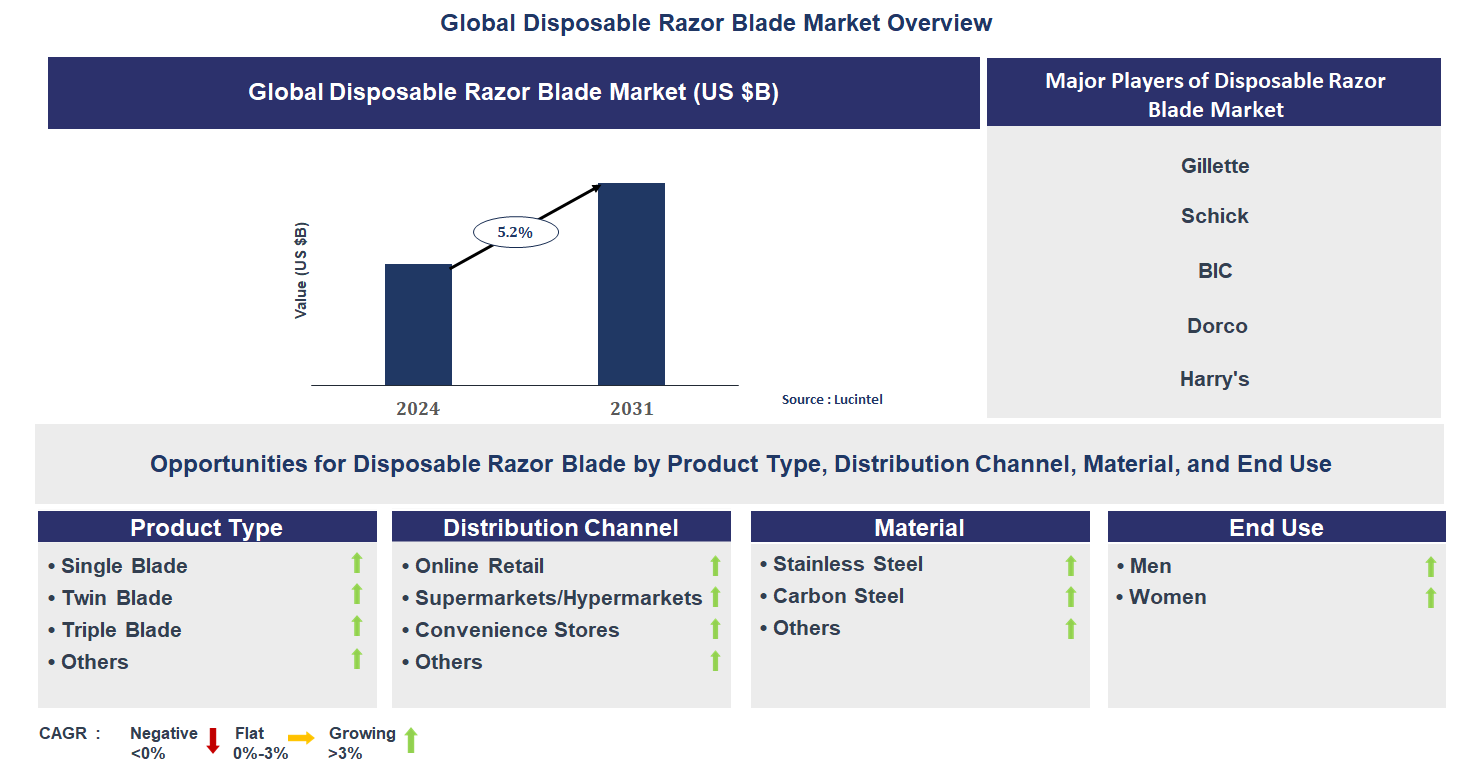
Key data points: The growth forecast = 5.2% annually for the next 7 years. Scroll below to get more insights. This market report covers trends, opportunities and forecasts in disposable razor blade market to 2031 by product type (single blade, twin blade, triple blade, and others), distribution channel (online retail, supermarkets/hypermarkets, convenience stores, and others), material (stainless steel, carbon steel, and others), end use (men and women), and region (North America, Europe, Asia Pacific, and the Rest of the World)
We'll send your sample report shortly.
• Lucintel forecasts that, within the product type category, single blade is expected to witness the highest growth over the forecast period.
• Within the material category, stainless steel is expected to witness higher growth.
• In terms of region, North America is expected to witness the highest growth over the forecast period. Gain valuable insights for your business decisions with our comprehensive 150+ page report. Sample figures with some insights are shown below.
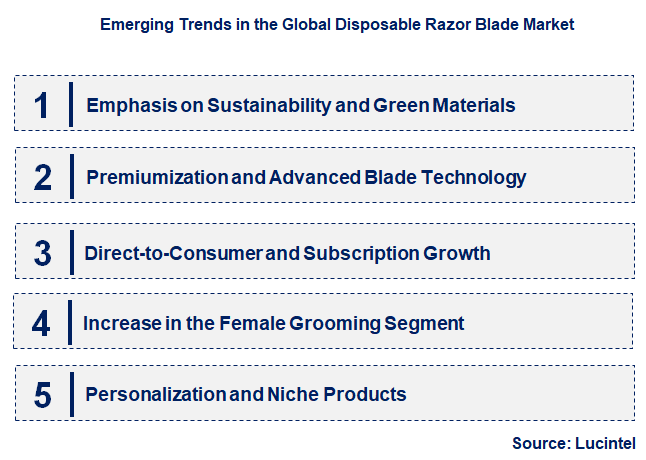
• Emphasis on Sustainability and Green Materials: One of the key trends is the general shift towards sustainability. Consumers are more and more concerned about environmental effects of plastic pollution, such as disposable razors. This has created a demand for items with recycled plastic, bamboo, or other biodegradable material handles. Manufacturers also are cutting down on plastic packaging. This trend is forcing brands to re-engineer their products and supply chains to accommodate an environmentally aware consumer base.
• Premiumization and Advanced Blade Technology: There is a trend toward premiumization in the market. Convenience is still a dominant factor, but customers are also looking for a superior shaving experience. This has led to the creation of multi-blade systems—three, four, or even five blades—that provide a closer, smoother shave with less irritation. Companies are adding high-tech features such as lubrication strips with skin-conditioning ingredients and flex pivoting heads. This trend enables companies to be able to charge more and differentiate their product from low-cost, basic offerings.
• Direct-to-Consumer and Subscription Growth: A growth trend that is increasing at a rapid pace is the expansion of direct-to-consumer and subscription models. Business models that avoid traditional retail and deliver razors to consumers’ doorsteps on a regular basis are offered by these models. The company receives a guaranteed revenue stream with this model and can have a direct relation with customers. It also facilitates easy entry of new brands into the market and pose a challenge to established giants.
• Increase in the Female Grooming Segment: The industry is experiencing a very strong growth in the female grooming segment. With body hair removal becoming a regular practice and socially accepted, there is an increasing need for razors specifically for females. These products commonly include ergonomic handles, moisturizing strips, and an optimal design for shaving legs, underarms, and bikini lines. Companies are placing bets on targeted advertising and product development to appeal to this high-growth and increasingly influential population.
• Personalization and Niche Products: Personalization and niche products are an emerging trend. Brands are currently marketing razors which suit the particular needs of consumers, like products for sensitive skin, for particular body areas, or even for travel. This movement away from one size fits all is in favor of brands being able to serve a wide variety of customers. It is also a way to establish brand loyalty and can promote a better shaving experience for the consumer. These new trends are collectively transforming the disposable razor blade market to be more sensitive to consumer needs and values. Premiumization and personalization are improving the user experience, while sustainability is meeting a significant environmental issue. New business models are introducing increased opportunities for market growth and revenue increase, as well as growth in the female grooming segment. The industry’s future will be determined by how well it can innovate and respond to these strong trends.
• Launch of Sustainable and Recyclable Products: One major advancement is the launch of disposable razors that are made from sustainable materials. Manufacturers are shifting to recycled plastic, bamboo, or other bio-based materials for the handles of razors due to worldwide environmental issues and bans on plastics. Some manufacturers are also cutting down their plastic packaging. This trend not only meets consumer expectations for sustainable products but also assists companies in meeting environmental regulations and enhancing their corporate reputation.
• Blade and Cartridge Technology Advancements: The industry has witnessed a significant evolution of blade and cartridge technology. Companies continue to research ways to get closer and shave more comfortably. This has involved creating multi-blade technology—with six blades—reduce the number of strokes. Innovative features such as flexible pivoting heads that follow the shape of the face and improved lubrication strips with skin conditioners are also becoming the norm. This evolution is setting higher performance expectations among consumers, even for throwaway razors.
• Expansion of the Subscription Box Model: One of the most significant developments is the emergence and mass popularization of the subscription box model. This business model provides consumers with a seamless method to obtain razor blades and other personal care products at regular intervals. Dollar Shave Club and other firms have shaken up the market by providing an economical, direct-to-consumer product that eliminates brick-and-mortar distribution channels.
• Female-Specific Product Line Expansion: There is considerable growth in the market through the extension of products specifically targeted for females. A niche within the market, women’s disposable razors are now a key growth sector. Such products have ergonomic grips, bright colors, and moisturizing strips with formulas specific to women’s skin. This evolution is a sign of increasing attention to the grooming needs of women and has opened up a new and lucrative market segment.
• Greater Emphasis on Skincare Integration: Another significant trend is the inclusion of skincare benefits within disposable razors. Companies are incorporating lubrication strips containing aloe vera, vitamin E, or shea butter to aid in soothing and moisturizing the skin while shaving as well as after shaving. This trend places the disposable razor not only as an apparatus for hair elimination but also as part of a complete skincare regimen. All these recent trends are affecting the market for disposable razor blades collectively by nudging it towards a sustainable and consumer-centric future. The transition to more eco-friendly material is altering the manufacturing process, whereas technology is enhancing the user experience. The emergence of new business models and emphasis on niche categories such as women’s grooming and skincare are opening up new avenues for market growth and revenue increase.
• Targeting the Female Grooming Market: The female grooming market presents a significant growth opportunity. Although there are already disposable razors for women available, there is large space for innovation and increase. Companies can create more offerings of products for specific parts of the body, for example, the bikini region or armpits. Comfort-oriented, skin health-focused strategic marketing that is hassle-free can engage and retain female consumers and build a strong market share within this high-growth segment.
• Establishing a Sustainable and Green Line: There is tremendous growth potential in creating a sustainable line of products. With rising environmental awareness, customers are increasingly seeking alternatives to reduce plastic waste. Brands can launch disposable razors with bio-based or recycled-material handles such as bamboo. Such a move not only satisfies the environmentally aware consumer but also enables a brand to create a positive and responsible image, which can serve as a strong differentiator in a commoditized market.
• Growth into Niche and Specialized Applications: One growth area is to innovate for niche and specialized applications. This involves formulating products for sensitive skin, travelers, or for particular body hair removal purposes. For instance, designing a small, portable disposable razor for travel or a razor with specialized blades to handle thick hair can target individual consumer niches.
• E-commerce and Subscription Services: The subscription model and e-commerce offer a significant growth potential. Through a direct-to-consumer business, brands can cut the costs of distribution and establish a direct link with the consumer. A subscription service provides a repeat and guaranteed revenue stream. Enterprises can also leverage information from online sales to gain insights into consumer behavior and choices, which can be used to guide future product offerings and marketing campaigns.
• Penetrating Emerging Markets: There is strategic growth potential in entering emerging markets. Increasing disposable incomes in the Asia-Pacific and Latin America regions are converting more consumers from using traditional methods of shaving to contemporary, disposable razors. Penetrating such markets with a portfolio of products at varied price points, ranging from mass-market solutions to high-end multi-blade razors, enables brands to establish a long-term growth trend. Product localizing and marketing to meet cultural tastes is also a success formula. These strategic growth drivers are collectively shaping the disposable razor blade market towards a more niche and consumer-centric future. Focusing on specialized demographics such as women and specific applications is widening the markets scope. The focus on sustainability and new business models is forming new segments of premium, value-based products. The strategic extension of new markets also ensures that the industry will keep developing and adapting to consumers’ needs worldwide.
• Gillette
• Schick
• BIC
• Dorco
• Harry’s
• Feather
• Super-Max
• Kai Group
• Wilkinson Sword
• Personna
• Single Blade
• Twin Blade
• Triple Blade
• Others
• Online Retail
• Supermarkets/Hypermarkets
• Convenience Stores
• Others
• Stainless Steel
• Carbon Steel
• Others
• Men
• Women
• North America
• Europe
• Asia Pacific
• The Rest of the World
• United States: In the United States, the disposable razor blade market is highly driven by the growth of direct-to-consumer and subscription-based services. Companies such as Dollar Shave Club and Harrys have shaken off conventional retail channels by providing quality, easy, and sometimes cheaper products to customers directly. There is also increasing consumer interest in environment-friendly products, with companies introducing razors whose handles are recyclable or of bio-based origin.
• China: Chinas market for disposable razor blades is growing fast, fueled by a growing middle class and urbanization. With improving personal grooming habits, consumers are abandoning old shaving practices for easy, new-age solutions. The market is seeing a robust demand for premium and multi-blade razors, which are seen as providing a better shave. E-commerce sites, such as social commerce and live streaming, are increasingly being utilized for marketing and selling, rendering products available to a widespread consumer market throughout the country.
• Germany: The disposable razor blade market in Germany is defined by high consumer concern for quality and environmental sustainability. German consumers are demanding and very sensitive to efforts at being green. This has resulted in a greater use of razors with environmentally friendly recycled handles and minimal plastic packaging. The market may be mature but with steady demand for high-performance and high-design products. In Germany, innovation is focused on developing efficient, long-lasting blades and reducing the environmental impact of the products.
• India: The market for disposable razor blades is growing at a very fast pace in India, driven by increasing disposable incomes and increased levels of awareness about personal hygiene, especially among youth. The market remains highly price-sensitive with high demand for low-cost products. The urban markets, however, are registering a significant shift towards premium, multi-blade razors. The extensive availability of goods through conventional retailing and a rapidly expanding e-commerce market is a primary growth driver.
• Japan: The Japanese disposable razor blade market is developed and characterized by a strong emphasis on cutting-edge technology and precision. Japanese consumers expect products not only to be effective but also kind to the skin. To meet this expectation, razors with ultra-thin blades, better lubrication strips, and ergonomic handles have been developed. The industry is at the forefront of recycling programs, with some of them having programs to recycle razor parts. While the birth rate is low, the market is supported by a strong emphasis on quality and ongoing innovation in male and female grooming products.


• Gillette
• Schick
• BIC
• Dorco
• Harry’s
• Feather
• Super-Max
• Kai Group
• Wilkinson Sword
• Personna Q5. Which disposable razor blade market segment will be the largest in future? Answer: Lucintel forecasts that, within the product type category, single blade is expected to witness the highest growth over the forecast period. Q6. In disposable razor blade market, which region is expected to be the largest in next 5 years? Answer: In terms of region, North America is expected to witness the highest growth over the forecast period. Q7. Do we receive customization in this report? Answer: Yes, Lucintel provides 10% customization without any additional cost.


Choose a license that fits your team. Instant PDF delivery.
Prices exclude taxes. Instant delivery. Custom licensing available on request.
Market Report · July 20, 2026
Market Report · July 15, 2026
Market Report · July 15, 2026
Trusted partner for strategic intelligence and business growth


Receive a complimentary market analysis tailored to your industry. Our analysts will identify key growth opportunities and competitive dynamics specific to your business.

Market size, growth rate, and key trend analysis for your specific sector.

Top competitor positioning and market share analysis.

Strategic recommendations backed by data-driven insights.
Get curated market intelligence and competitive moves straight to your inbox.
By subscribing, you agree to receive our monthly insights. Unsubscribe anytime.
Receive a complimentary market analysis tailored to your industry. Our analysts will identify key growth opportunities and competitive dynamics specific to your business.
Market size, growth rate, and key trend analysis for your specific sector.
Top competitor positioning and market share analysis.
Strategic recommendations backed by data-driven insights.
Get curated market intelligence, emerging trends, and competitive moves straight to your inbox each month.
By subscribing, you agree to receive our monthly insights. Unsubscribe anytime.
We'll send your sample report shortly.