
Market Report · July 15, 2026

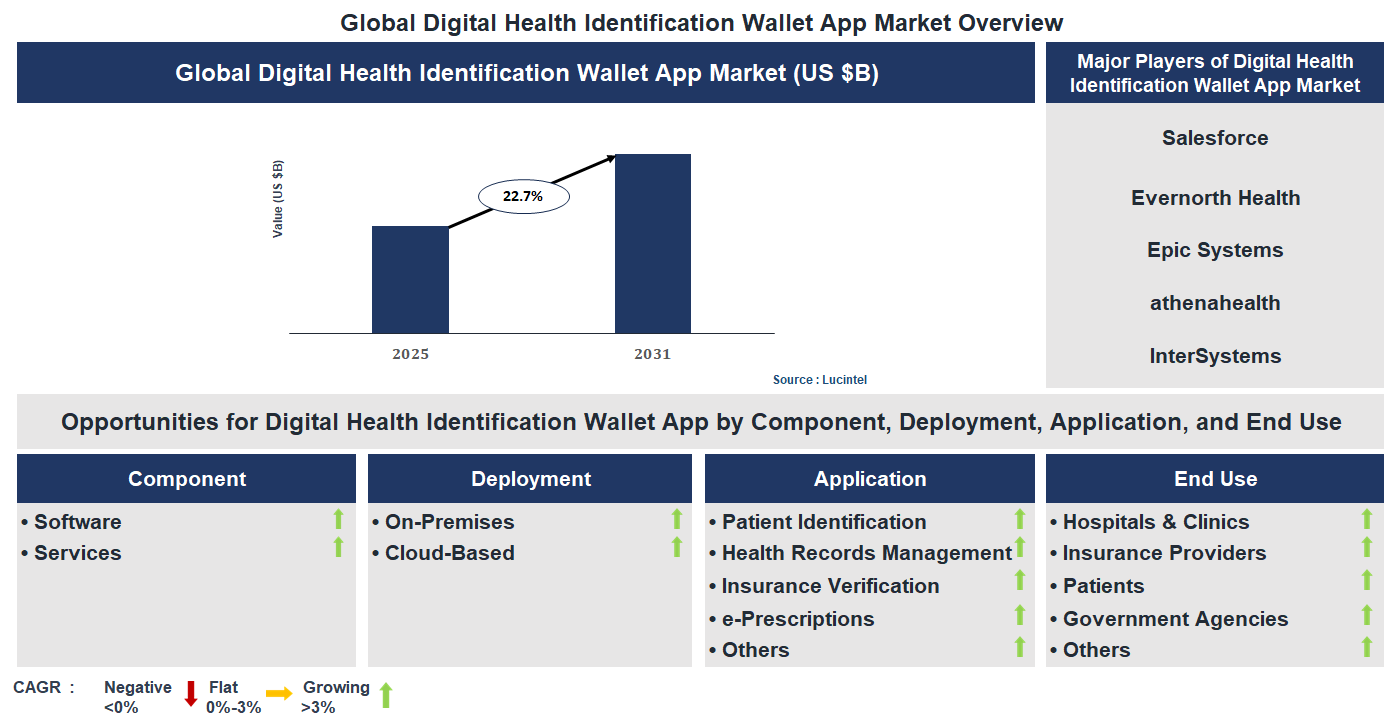
Key data points: The growth forecast = 22.7% annually for the next 7 years. Scroll below to get more insights. This market report covers trends, opportunities and forecasts in digital health identification wallet app market to 2031 by component (software and services), deployment (on-premises and cloud-based), application (patient identification, health records management, insurance verification, e-prescriptions, and others), end use (hospitals & clinics, insurance providers, patients, government agencies, and others), and region (North America, Europe, Asia Pacific, and the Rest of the World)
We'll send your sample report shortly.
• Lucintel forecasts that, within the component category, software is expected to witness higher growth over the forecast period.
• Within the end use category, hospital & clinic is expected to witness the highest growth.
• In terms of region, North America is expected to witness the highest growth over the forecast period. Gain valuable insights for your business decisions with our comprehensive 150+ page report. Sample figures with some insights are shown below.
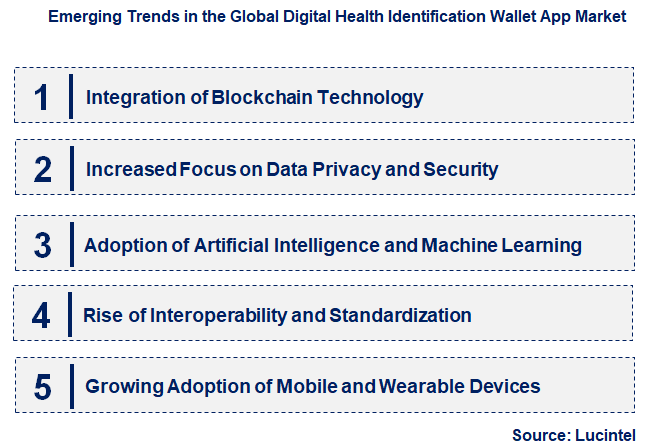
• Integration of Blockchain Technology: Blockchain enhances data security and transparency by providing a decentralized ledger for health records. This trend reduces fraud, ensures data integrity, and facilitates secure sharing among authorized parties. Blockchains immutable nature builds trust among users and healthcare providers, enabling real-time updates and audit trails. Its adoption is expected to streamline identity verification processes and improve interoperability across different health systems, ultimately leading to more secure and efficient digital health wallets.
• Increased Focus on Data Privacy and Security: With rising cyber threats and stringent regulations like GDPR and HIPAA, data privacy has become paramount. Market players are investing in advanced encryption, multi-factor authentication, and biometric verification to protect sensitive health information. Enhanced security measures foster user confidence and compliance with legal standards. This trend also involves developing privacy-preserving technologies that allow data sharing without compromising individual rights, ensuring the market remains trustworthy and resilient against cyberattacks.
• Adoption of Artificial Intelligence and Machine Learning: AI and ML are transforming digital health wallets by enabling personalized health insights, predictive analytics, and automated data management. These technologies improve user experience through intelligent interfaces and proactive health alerts. They also facilitate efficient data categorization and anomaly detection, reducing manual efforts. As AI-driven features become more sophisticated, they will support better decision-making, enhance patient engagement, and enable proactive healthcare management within digital wallets.
• Rise of Interoperability and Standardization: The push for seamless data exchange across different healthcare systems is driving the development of universal standards and APIs. Interoperability ensures that health data can be securely shared and accessed regardless of the platform or provider, improving care coordination. This trend reduces data silos, enhances patient experiences, and supports integrated healthcare delivery. Standardization efforts are crucial for scaling digital health wallets globally and ensuring consistent, reliable data management.
• Growing Adoption of Mobile and Wearable Devices: The proliferation of smartphones, tablets, and wearable health devices is expanding the reach of digital health wallets. These devices enable real-time health monitoring, data collection, and instant access to health records. Their integration with digital wallets enhances user convenience and promotes proactive health management. This trend also supports remote patient monitoring and telehealth services, making healthcare more accessible and personalized. As device adoption increases, digital health wallets will become central to everyday health management. In summary, these emerging trends are fundamentally reshaping the digital health identification wallet app market by enhancing security, interoperability, personalization, and user engagement. They are driving innovation, improving healthcare delivery, and fostering a more connected, efficient, and secure digital health ecosystem.
• Integration of Blockchain Technology: Blockchain is being incorporated to enhance data security and integrity, ensuring tamper-proof health records. This development boosts user trust and compliance with data privacy regulations, facilitating secure data sharing among authorized parties. It also reduces fraud and unauthorized access, making health data management more reliable and transparent.
• Adoption of AI and Machine Learning: AI-driven features are enabling personalized health insights, predictive analytics, and automated data verification within wallet apps. This improves user engagement and provides proactive health management. Healthcare providers benefit from better data analysis, leading to more accurate diagnoses and treatment plans.
• Enhanced Interoperability Standards: New standards and protocols are being developed to ensure seamless data exchange across different health systems and apps. This interoperability reduces data silos, improves care coordination, and allows users to access comprehensive health information from multiple sources within a single wallet app.
• Focus on User Privacy and Consent Management: Advanced privacy controls and consent management features are being integrated to give users greater control over their health data. This development addresses increasing privacy concerns, complies with regulations like GDPR, and fosters user trust and adoption of digital health wallets.
• Expansion of Multi-Functional Platforms: Wallet apps are evolving into comprehensive health management tools, integrating features like appointment scheduling, medication reminders, and telehealth access. This holistic approach enhances user convenience, promotes continuous engagement, and supports broader health management goals within a single platform. In summary, these developments are significantly transforming the digital health identification wallet app market by improving security, interoperability, user control, and functionality. They are driving increased adoption among consumers and healthcare providers, leading to more efficient, secure, and user-friendly health data management solutions. This evolution is poised to enhance healthcare delivery, patient engagement, and data security on a global scale.
• Remote Patient Monitoring: Enhances real-time health data collection and management, leading to improved patient outcomes and reduced hospital visits. This application supports chronic disease management and post-discharge care, driving demand for integrated digital health wallets that securely store and transmit health data.
• Personal Health Records (PHR): Empowers individuals with control over their health information, facilitating seamless data sharing among providers. The growth of PHR applications boosts patient engagement, improves care coordination, and supports personalized treatment plans, expanding the market’s reach.
• Medication Management: Streamlines prescription tracking, adherence, and refill processes through secure digital wallets. This reduces medication errors, enhances compliance, and minimizes healthcare costs, making it a critical application for both providers and patients.
• Health Insurance Verification: Simplifies insurance claims and verification processes via digital wallets, reducing administrative burdens and fraud. This application accelerates claim processing, improves transparency, and enhances user experience, fostering trust in digital health solutions.
• Immunization and Vaccination Records: Provides secure, portable access to immunization data, supporting public health initiatives and travel requirements. The ability to verify vaccination status digitally enhances compliance and facilitates global health management efforts. In summary, these key applications are significantly impacting the digital health identification wallet app market by driving innovation, improving healthcare efficiency, and enhancing patient engagement. As these opportunities expand, they are fostering a more integrated, secure, and patient-centric healthcare ecosystem, ultimately fueling market growth and technological advancement.
• Technological Innovation: The continuous evolution of mobile technology, blockchain, and biometric authentication has significantly enhanced the security, usability, and functionality of health identification apps. These innovations enable seamless, real-time access to health records, improving patient care and operational efficiency. As technology becomes more sophisticated and affordable, adoption rates increase among healthcare providers and consumers, fostering market growth. Additionally, integration with wearable devices and IoT enhances data collection and management, further expanding the apps capabilities and appeal.
• Increasing Healthcare Digitization: Governments and healthcare organizations worldwide are prioritizing digital transformation to improve healthcare delivery. The shift towards electronic health records (EHRs) and telemedicine necessitates secure digital identification solutions. Digital health wallets streamline patient verification, reduce administrative burdens, and facilitate remote consultations. This trend accelerates the adoption of health identification apps, especially in regions with expanding healthcare infrastructure, ultimately driving market expansion and innovation.
• Rising Focus on Data Security and Privacy: As health data becomes more digitized, concerns over data breaches and unauthorized access intensify. Regulatory bodies enforce strict data privacy laws, such as HIPAA and GDPR, compelling market players to develop secure, compliant solutions. The demand for robust encryption, multi-factor authentication, and secure data storage drives innovation in app security features. Ensuring user trust and regulatory compliance is crucial for market growth, making data security a key driver in the development of digital health wallets.
• Growing Investment and Strategic Partnerships: Increased funding from venture capitalists, government grants, and private investors fuels innovation and market expansion. Strategic collaborations between technology firms, healthcare providers, and regulatory agencies facilitate the development of interoperable and scalable solutions. These partnerships accelerate product deployment, enhance features, and expand market reach, creating a competitive environment that benefits consumers and providers alike.
• Adoption of Digital Health Policies and Incentives: Governments worldwide are implementing policies and incentives to promote digital health adoption. Initiatives such as subsidies, grants, and regulatory support encourage healthcare providers and patients to adopt digital health wallets. These policies reduce barriers to entry, foster innovation, and accelerate market penetration, especially in emerging economies. Supportive regulatory environments also facilitate standardization and interoperability, further boosting market growth. The challenges facing digital health identification wallet app market include:
• Data Security and Privacy Concerns: Despite technological advancements, safeguarding sensitive health data remains a significant challenge. Cybersecurity threats, hacking, and data breaches pose risks to user trust and compliance. Ensuring end-to-end security requires continuous investment in advanced encryption, secure authentication methods, and regular security audits. Failure to adequately protect data can lead to legal penalties, loss of reputation, and decreased user adoption, hindering market growth.
• Regulatory Compliance and Standardization: Navigating complex regulatory landscapes across different regions complicates product development and deployment. Variations in data privacy laws, certification requirements, and interoperability standards create barriers for market players. Achieving compliance demands significant resources and expertise, potentially delaying product launches and increasing costs. Lack of standardized protocols also hampers seamless data exchange, affecting user experience and trust.
• User Adoption and Trust Issues: Convincing users to adopt digital health wallets involves overcoming resistance to change, concerns over data security, and digital literacy gaps. Older populations or less tech-savvy individuals may hesitate to use these apps, limiting market penetration. Building user trust through transparent data handling practices, user-friendly interfaces, and effective education is essential. Without widespread acceptance, market growth remains constrained despite technological availability. In summary, the digital health identification wallet app market is driven by technological innovation, healthcare digitization, data security emphasis, strategic investments, and supportive policies. However, challenges such as data security risks, regulatory complexities, and user adoption barriers pose significant hurdles. These factors collectively shape the markets trajectory, requiring stakeholders to balance innovation with compliance and user engagement. Addressing these challenges effectively will be crucial for sustainable growth and widespread adoption, ultimately transforming healthcare delivery and patient management globally.
• Salesforce
• Evernorth Health
• Epic Systems
• athenahealth
• InterSystems
• eClinicalWorks
• NextGen Healthcare Information Systems
• Veradigm
• PointClickCare
• 1upHealth
• Software
• Services
• On-Premises
• Cloud-Based
• Patient Identification
• Health Records Management
• Insurance Verification
• e-Prescriptions
• Others
• Hospitals & Clinics
• Insurance Providers
• Patients
• Government Agencies
• Others
• North America
• Europe
• Asia Pacific
• The Rest of the World
• United States: The US market has seen significant advancements with major tech companies developing comprehensive digital health wallets that integrate with electronic health records (EHRs). Regulatory bodies like the FDA are working on guidelines to ensure security and privacy. The government’s push for nationwide interoperability and initiatives like the Digital Identity Program have accelerated adoption. Additionally, private insurers are increasingly offering digital health wallets to improve patient engagement and streamline claims processing. The market is also witnessing collaborations between healthcare providers and tech firms to enhance app functionalities, including telehealth integration and biometric authentication.
• China: China’s digital health wallet market is rapidly expanding, driven by government initiatives to digitize healthcare and improve access in rural areas. The government’s Healthy China 2030 plan emphasizes digital health infrastructure, leading to widespread adoption of health apps. Major tech firms like Alibaba and Tencent have launched integrated health wallets that store vaccination records, health certificates, and insurance details. The focus is on creating a unified platform for health data management, supported by AI and big data analytics. The market also benefits from increased investment in health tech startups, fostering innovation in secure data sharing and personalized health services.
• Germany: Germany’s market is characterized by strict data privacy regulations under GDPR, which influence app development and deployment. Recent developments include the rollout of the Digital Health Applications (DiGA) framework, allowing approved apps to be reimbursed by health insurers. Several digital health wallets now support secure storage of health data, medication records, and vaccination status. The government is promoting interoperability between different healthcare providers and digital tools to enhance patient-centered care. Additionally, collaborations between pharmaceutical companies and tech firms are advancing the integration of digital health wallets into routine clinical practice, emphasizing data security and user trust.
• India: India’s digital health wallet market is gaining momentum amid government initiatives like Ayushman Bharat and the National Digital Health Mission (NDHM). The focus is on creating a unified health interface that consolidates health records, insurance details, and teleconsultation services. Several startups and tech giants are developing affordable, user-friendly apps to cater to the large rural population. The government’s emphasis on digital literacy and infrastructure development is facilitating wider adoption. Recent developments include the integration of biometric authentication and AI-driven health insights, aiming to improve healthcare access, reduce fraud, and enable seamless data sharing across providers.
• Japan: Japan’s market is evolving with a focus on aging population needs and digital health security. Recent developments include the deployment of digital health wallets that store health data, medication history, and vaccination records, supporting elderly care. The government is promoting interoperability standards and secure data exchange between healthcare providers. Innovations in wearable technology and AI are integrated into digital health wallets to monitor chronic conditions and support remote healthcare. Regulatory updates aim to enhance data privacy and security, encouraging wider adoption among healthcare institutions and consumers. The market is also seeing increased collaboration between tech firms and healthcare providers to develop tailored solutions for Japan’s demographic challenges.


• Salesforce
• Evernorth Health
• Epic Systems
• athenahealth
• InterSystems
• eClinicalWorks
• NextGen Healthcare Information Systems
• Veradigm
• PointClickCare
• 1upHealth Q5. Which digital health identification wallet app market segment will be the largest in future? Answer: Lucintel forecasts that, within the component category, software is expected to witness higher growth over the forecast period. Q6. In digital health identification wallet app market, which region is expected to be the largest in next 5 years? Answer: In terms of region, North America is expected to witness the highest growth over the forecast period. Q7. Do we receive customization in this report? Answer: Yes, Lucintel provides 10% customization without any additional cost.


Choose a license that fits your team. Instant PDF delivery.
Prices exclude taxes. Instant delivery. Custom licensing available on request.
Market Report · July 15, 2026
Market Report · June 26, 2026
Market Report · June 24, 2026
Trusted partner for strategic intelligence and business growth


Receive a complimentary market analysis tailored to your industry. Our analysts will identify key growth opportunities and competitive dynamics specific to your business.

Market size, growth rate, and key trend analysis for your specific sector.

Top competitor positioning and market share analysis.

Strategic recommendations backed by data-driven insights.
Get curated market intelligence and competitive moves straight to your inbox.
By subscribing, you agree to receive our monthly insights. Unsubscribe anytime.
Receive a complimentary market analysis tailored to your industry. Our analysts will identify key growth opportunities and competitive dynamics specific to your business.
Market size, growth rate, and key trend analysis for your specific sector.
Top competitor positioning and market share analysis.
Strategic recommendations backed by data-driven insights.
Get curated market intelligence, emerging trends, and competitive moves straight to your inbox each month.
By subscribing, you agree to receive our monthly insights. Unsubscribe anytime.
We'll send your sample report shortly.