
Digital Fitness Market Trends and Forecast
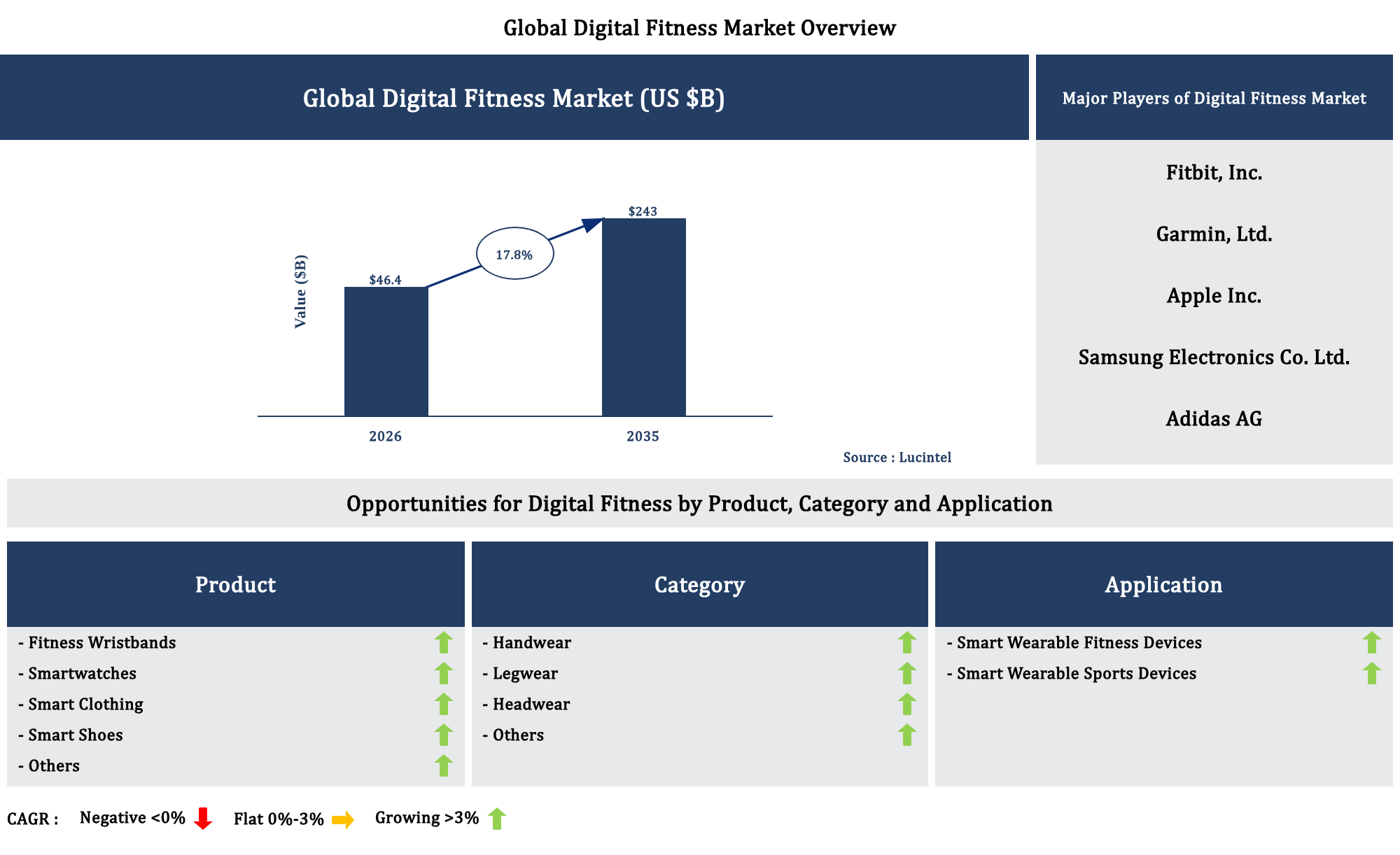
The future of the global digital fitness market looks promising with opportunities in the smart wearable fitness device and smart wearable sport device markets. The global digital fitness market is expected to reach an estimated $243,084 million by 2035 with a CAGR of 17.8% from 2026 to 2035. The major drivers for this market are the growing demand for home workouts boosting app usage, the increasing adoption of ai-based personalized fitness programs, and the rising demand for popularity of subscription-based fitness apps.
• Lucintel forecasts that, within the product category, smartwatch is expected to witness the highest growth over the forecast period.
• Within the application category, smart wearable fitness device is expected to witness the highest growth.
• In terms of region, APAC is expected to witness the highest growth over the forecast period.
Gain valuable insights for your business decisions with our comprehensive 150+ page report. Sample figures with some insights are shown below.
Emerging Trends in the Digital Fitness Market
The digital fitness market is undergoing rapid transformation driven by advancements in artificial intelligence, wearable technology, and mobile health ecosystems. Consumers are increasingly shifting toward personalized, data-driven fitness solutions that can be accessed anytime and anywhere. The integration of cloud computing, IoT devices, and virtual coaching platforms is reshaping how fitness services are delivered and consumed. Rising health awareness, urban lifestyles, and demand for convenience are further accelerating adoption. In addition, social connectivity and gamification are playing a major role in user engagement. These emerging trends are collectively redefining the global fitness landscape and expanding opportunities for technology-enabled wellness solutions across diverse populations.
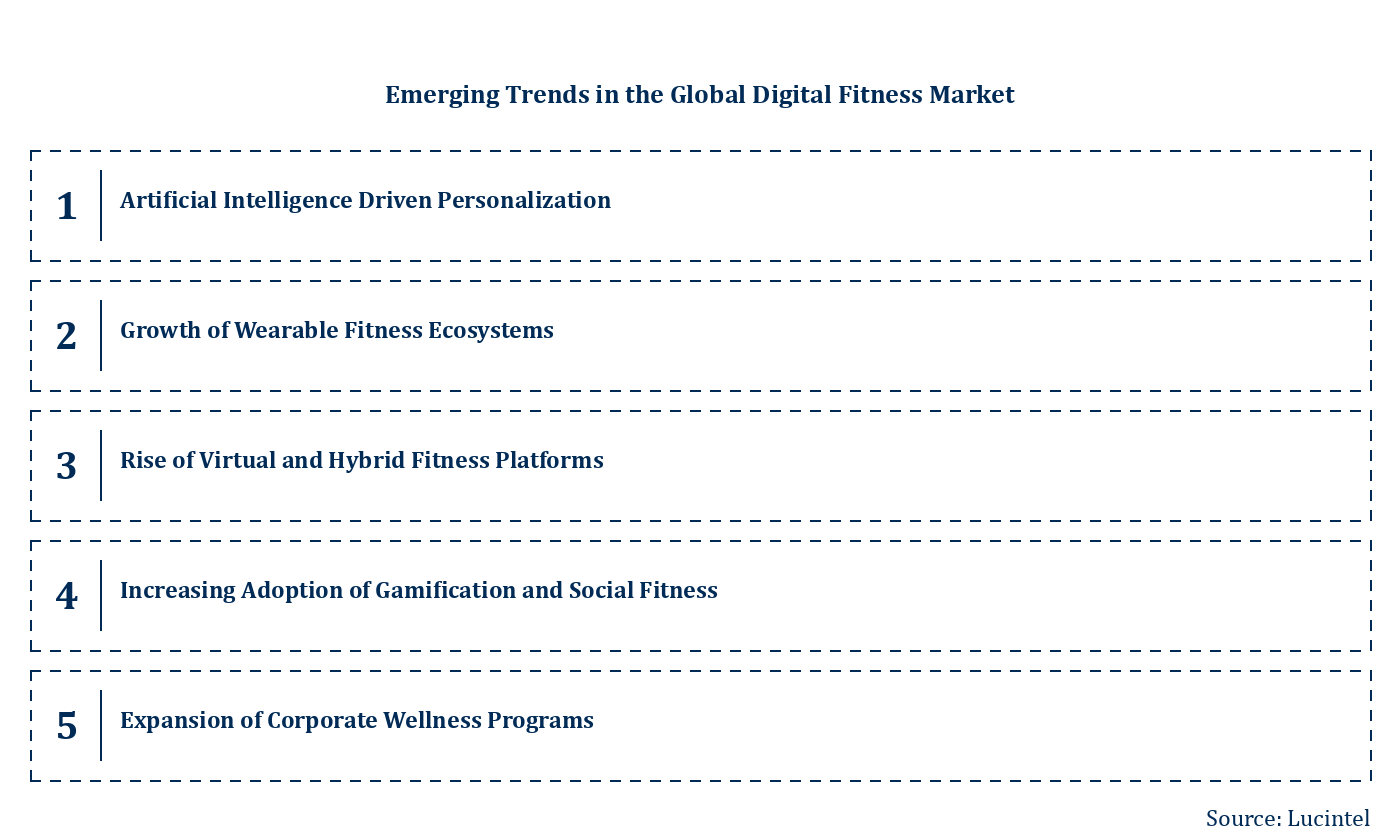
• Artificial Intelligence Driven Personalization: Artificial intelligence is becoming a core trend in the digital fitness market by enabling highly personalized workout plans, nutrition guidance, and real-time health feedback. AI-powered platforms analyze user data such as heart rate, activity levels, sleep patterns, and fitness goals to create customized fitness routines. This improves user engagement and effectiveness of workouts. Companies are integrating machine learning algorithms to continuously adapt fitness recommendations based on user progress. AI also supports virtual coaching and predictive health insights, helping users prevent injuries and optimize performance. This trend is significantly enhancing the value proposition of digital fitness solutions globally.
• Growth of Wearable Fitness Ecosystems: Wearable devices such as smartwatches, fitness bands, and smart clothing are evolving into integrated fitness ecosystems. These devices continuously track health metrics like calories burned, oxygen levels, heart rate, and physical activity. The data is synced with mobile apps and cloud platforms, providing users with real-time insights and long-term health tracking. Manufacturers are focusing on improving sensor accuracy, battery life, and connectivity features. Wearables are also being integrated with healthcare systems and insurance programs. This growing ecosystem is making fitness tracking more seamless, data-rich, and essential for preventive healthcare and lifestyle management.
• Rise of Virtual and Hybrid Fitness Platforms: Virtual fitness platforms and hybrid workout models are gaining strong popularity as users seek flexible and convenient exercise options. Live-streamed classes, on-demand workout videos, and virtual personal training sessions allow users to exercise from home or anywhere. Many fitness centers are combining physical and digital offerings to create hybrid experiences. This trend has been accelerated by lifestyle changes and demand for time-efficient fitness solutions. Social interaction features such as live classes and group challenges further enhance engagement. Virtual fitness platforms are becoming a core component of modern fitness ecosystems worldwide.
• Increasing Adoption of Gamification and Social Fitness: Gamification is transforming fitness engagement by introducing rewards, challenges, leaderboards, and achievement tracking. Social fitness platforms allow users to compete with friends, join communities, and share progress on social media. This enhances motivation and consistency in fitness routines. Fitness apps are increasingly integrating game-like elements to improve user retention and engagement. Social connectivity also helps build supportive communities that encourage healthier lifestyles. This trend is particularly strong among younger demographics who prefer interactive and engaging fitness experiences. It is making digital fitness more enjoyable, competitive, and socially connected.
• Expansion of Corporate Wellness Programs: Corporate wellness programs are increasingly adopting digital fitness solutions to improve employee health, productivity, and engagement. Companies are providing fitness app subscriptions, wearable devices, and virtual wellness challenges as part of employee benefit programs. These initiatives help reduce healthcare costs and improve workplace morale. Digital platforms enable employers to track participation and measure wellness outcomes effectively. Remote and hybrid working models have further increased demand for virtual wellness programs. This trend is driving strong adoption of scalable and data-driven fitness solutions in the corporate sector, making workplace wellness a key growth driver for the digital fitness market.
These emerging trends are fundamentally reshaping the digital fitness market by making it more personalized, connected, and technology-driven. Artificial intelligence and wearable ecosystems are improving accuracy and user engagement, while virtual and hybrid fitness models are increasing accessibility and convenience. Gamification and social fitness features are enhancing motivation and long-term user retention. At the same time, corporate wellness programs are expanding the market beyond individual consumers into enterprise ecosystems. Together, these developments are creating a more integrated and data-centric fitness environment. The market is evolving toward a holistic digital health ecosystem that combines fitness, wellness, and preventive healthcare solutions globally.
Recent Developments in the Digital Fitness Market
The digital fitness market is experiencing significant transformation due to rapid technological advancements, increasing health awareness, and growing adoption of connected devices. Consumers are shifting toward personalized, data-driven, and on-demand fitness solutions that integrate seamlessly with daily lifestyles. Innovations in artificial intelligence, wearable technology, and virtual training platforms are reshaping user engagement and service delivery. Companies are investing heavily in smart ecosystems that combine fitness tracking, coaching, and wellness management. These developments are accelerating market expansion across developed and emerging economies while improving accessibility, convenience, and overall fitness outcomes for diverse user groups globally.
• Expansion of Artificial Intelligence Based Fitness Platforms: Artificial intelligence is being widely integrated into digital fitness platforms to deliver highly personalized workout routines and health recommendations. Recent developments include advanced machine learning models that analyze real-time biometric data from wearables to adjust fitness plans dynamically. Companies are launching AI powered virtual trainers capable of providing feedback on posture, intensity, and performance. This improves user engagement and reduces reliance on human trainers. AI is also being used for predictive health insights and injury prevention. These innovations are enhancing efficiency, scalability, and personalization in digital fitness services across global markets significantly.
• Growth in Advanced Wearable Fitness Technology: Wearable technology has seen major advancements with improved sensors, longer battery life, and multi parameter health tracking capabilities. Recent developments include smartwatches and fitness bands capable of monitoring heart rate variability, oxygen saturation, sleep quality, and stress levels with higher accuracy. Companies are also introducing smart clothing embedded with biometric sensors for real time performance tracking. Integration with mobile applications and cloud platforms allows seamless data synchronization and long term health monitoring. These innovations are making wearables central to digital fitness ecosystems and strengthening their role in preventive healthcare and lifestyle management globally.
• Rise of Hybrid and Virtual Fitness Ecosystems: The digital fitness industry is rapidly evolving with hybrid models that combine physical gym services and virtual fitness platforms. Recent developments include live streaming workout classes, on demand training libraries, and interactive virtual coaching sessions. Fitness centers are increasingly adopting digital platforms to extend their reach beyond physical locations. Users can now access global trainers and specialized fitness programs from home. Integration of augmented reality and virtual reality is further enhancing immersive workout experiences. This trend is significantly increasing accessibility, convenience, and engagement, making fitness services more flexible and user friendly worldwide.
• Increasing Integration of Health and Fitness Data Systems: A major development in the digital fitness market is the integration of fitness platforms with healthcare and wellness systems. Recent innovations allow fitness data from wearables and apps to be shared with healthcare providers for better monitoring and preventive care. Insurance companies are also adopting fitness based incentive programs using real time activity data. This integration enables early detection of health risks and supports personalized wellness plans. Improved interoperability between devices and healthcare systems is strengthening the ecosystem. This development is bridging the gap between fitness tracking and medical health management globally.
• Expansion of Gamification and Social Engagement Features: Gamification has become a key development in digital fitness platforms, enhancing user motivation and engagement. Recent updates include fitness challenges, reward systems, progress tracking, and competitive leaderboards integrated into mobile applications. Social features allow users to share achievements, join communities, and participate in group workouts. Companies are using behavioral psychology to improve user retention and consistency in fitness routines. Integration with social media platforms is further amplifying user interaction. This development is making fitness more interactive, enjoyable, and community driven, significantly improving long term user participation in digital fitness ecosystems.
These developments are significantly transforming the digital fitness market by enhancing personalization, connectivity, and user engagement. The integration of artificial intelligence, advanced wearables, and hybrid fitness ecosystems is improving accessibility and efficiency. Growing interoperability with healthcare systems is strengthening preventive care, while gamification is increasing motivation and long term user retention. Together, these advancements are creating a more intelligent, interactive, and data driven fitness environment. The market is evolving into a holistic digital wellness ecosystem that supports healthier lifestyles and continuous innovation across global regions.
Strategic Growth Opportunities in the Digital Fitness Market
The digital fitness market is witnessing strong expansion driven by increasing consumer focus on health, rising adoption of connected devices, and rapid digital transformation in the wellness industry. Applications such as personal fitness tracking, virtual coaching, corporate wellness, and remote health monitoring are creating new revenue opportunities. Integration of artificial intelligence, wearable technologies, and cloud based platforms is enhancing user engagement and service personalization. Growing demand for flexible, on demand fitness solutions is further accelerating market adoption across both developed and emerging regions, creating significant long term growth potential.
• Personal Fitness Tracking Applications are Expanding Rapidly Across Global Markets: Personal fitness tracking applications are becoming a major growth opportunity as consumers increasingly rely on smartphones and wearable devices to monitor daily activity, calories, sleep, and heart rate. These applications offer real time insights and personalized recommendations, improving user engagement and health outcomes. Companies are integrating AI driven analytics to enhance accuracy and customization. Subscription based models and freemium services are increasing revenue potential. Rising health awareness and preventive healthcare trends are further supporting adoption, making personal fitness tracking one of the most widely used and scalable applications in the digital fitness ecosystem.
• Virtual Coaching and Online Training Platforms are Driving Strong Market Expansion: Virtual coaching applications are gaining traction as users seek convenient, flexible, and cost effective fitness solutions. These platforms connect users with certified trainers through video sessions, live classes, and interactive workout programs. Advanced features such as AI based posture correction and performance tracking are enhancing training effectiveness. Integration with wearable devices allows real time monitoring and feedback. This application is particularly growing among urban populations and remote workers. Increasing demand for home based fitness solutions and digital subscription models is making virtual coaching a key revenue generating segment in the digital fitness market globally.
• Corporate Wellness Programs are Emerging as a High Value Enterprise Application: Corporate wellness applications are expanding as organizations increasingly invest in employee health and productivity. These programs include fitness challenges, wearable device integration, mental wellness tracking, and personalized health dashboards. Companies are using digital platforms to reduce healthcare costs and improve workforce efficiency. Data analytics enables employers to track participation and measure wellness outcomes effectively. Hybrid work environments are further accelerating adoption of virtual wellness solutions. Growing emphasis on preventive healthcare and employee engagement is making corporate wellness one of the fastest growing and most strategic applications in the digital fitness market.
• Remote Health Monitoring and Preventive Care Applications are Gaining Importance: Remote health monitoring applications are becoming a critical growth area as healthcare systems integrate fitness data into preventive care models. Wearables and fitness apps are used to track vital signs such as heart rate, oxygen levels, and physical activity, enabling early detection of health risks. These systems support continuous patient monitoring outside clinical settings. Healthcare providers and insurers are increasingly adopting these solutions to improve outcomes and reduce costs. Rising chronic disease prevalence and aging populations are further driving demand, making remote monitoring a key application in the digital fitness ecosystem.
• Gamified Fitness and Social Engagement Applications are Boosting User Retention: Gamified fitness applications are gaining strong momentum by integrating rewards, challenges, leaderboards, and social sharing features into fitness platforms. These applications enhance user motivation and long term engagement by making workouts more interactive and enjoyable. Social communities and competitive elements encourage consistent participation and lifestyle improvement. Integration with social media platforms further increases visibility and engagement. Developers are using behavioral science techniques to improve user retention rates. Rising demand from younger demographics is driving this application’s growth, making gamified fitness a key contributor to sustained market expansion.
These strategic growth opportunities are significantly shaping the future of the digital fitness market by expanding its application scope and user base. Personal fitness tracking, virtual coaching, corporate wellness, remote health monitoring, and gamified fitness are collectively enhancing accessibility, engagement, and personalization. Integration of advanced technologies such as artificial intelligence, wearable devices, and cloud platforms is improving efficiency and user experience. Together, these applications are driving strong market expansion and transforming digital fitness into a comprehensive, data driven, and highly interactive global wellness ecosystem.
Digital Fitness Market Driver and Challenges
The Digital Fitness Market is expanding rapidly due to a combination of technological advancements, economic shifts, and evolving regulatory frameworks across global regions. Increasing adoption of smartphones, wearable devices, and artificial intelligence based fitness platforms is transforming how consumers approach health and wellness. At the same time, rising healthcare costs and growing awareness of preventive care are encouraging individuals and organizations to invest in digital fitness solutions. However, the market also faces challenges related to data privacy, high subscription costs, and regulatory compliance. Together, these factors are shaping a highly dynamic ecosystem that continues to evolve across both developed and emerging economies worldwide.
The factors responsible for driving the Digital Fitness Market include:-
• Increasing Adoption of Wearable Fitness and Smart Devices: The growing use of wearable devices such as smartwatches, fitness bands, and smart clothing is a major driver of the digital fitness market. These devices provide real time tracking of physical activity, heart rate, sleep patterns, and calorie consumption, enabling users to monitor their health continuously. Integration with mobile applications and cloud platforms enhances data accessibility and personalization. Companies are continuously innovating with improved sensors and longer battery life, increasing consumer trust. Rising demand for preventive healthcare and fitness awareness is further accelerating adoption, making wearables a central component of the digital fitness ecosystem globally.
• Rising Demand for Personalized Fitness Solutions: Consumers are increasingly seeking personalized fitness experiences tailored to their individual health goals, body conditions, and lifestyle preferences. Artificial intelligence and machine learning technologies are enabling platforms to deliver customized workout plans, nutrition guidance, and real time feedback. This personalization improves user engagement and fitness outcomes. Digital platforms analyze large volumes of user data collected from wearables and apps to continuously refine recommendations. Growing health consciousness and demand for efficient fitness routines are driving this trend. As a result, personalized fitness solutions are becoming a key growth driver in the global digital fitness market.
• Expanding Penetration of Smartphones and Internet Connectivity: The widespread availability of smartphones and affordable internet connectivity is significantly driving the growth of the digital fitness market. Mobile based fitness applications allow users to access workouts, coaching, and health tracking services anytime and anywhere. Increasing 4G and 5G adoption is improving streaming quality for virtual fitness classes and real time interactions. Emerging economies are witnessing rapid digital adoption, further expanding the user base. This connectivity enables seamless integration of fitness platforms with wearable devices and cloud systems, making digital fitness solutions more accessible, scalable, and convenient for a wide range of consumers.
• Growth of Corporate Wellness and Preventive Healthcare Programs: Organizations are increasingly adopting digital fitness solutions as part of corporate wellness initiatives to improve employee health and productivity. These programs include fitness tracking, mental wellness monitoring, and incentive based health challenges. Companies benefit from reduced healthcare costs and improved workforce efficiency. Insurance providers are also integrating fitness data into premium discount programs, encouraging healthier lifestyles. The shift toward preventive healthcare is further strengthening demand for digital fitness solutions. This trend is expanding the market beyond individual users into enterprise ecosystems, making corporate wellness a strong and sustainable growth driver globally.
The challenges in the Digital Fitness Market are:
• Data Privacy and Cybersecurity Concerns: One of the major challenges in the digital fitness market is the protection of sensitive user health data collected through wearables and mobile applications. These platforms store biometric information such as heart rate, location, and activity patterns, making them vulnerable to cyber threats. Increasing regulatory requirements around data protection add complexity for companies operating across multiple regions. Users are becoming more cautious about sharing personal health information, which can limit adoption. Ensuring strong encryption, secure cloud storage, and compliance with global privacy laws is essential but costly, posing significant challenges for market players.
• High Cost of Advanced Fitness Technologies and Subscriptions: The adoption of advanced digital fitness solutions is often limited by high costs associated with premium wearables, AI based platforms, and subscription services. While basic apps are widely accessible, advanced features such as personalized coaching and real time analytics require paid subscriptions. This creates affordability barriers, especially in developing regions. Additionally, frequent upgrades in wearable technology increase consumer expenses. High pricing limits mass adoption and restricts market penetration among price sensitive users. Companies face the challenge of balancing innovation with affordability to expand their customer base globally.
• Regulatory Compliance and Interoperability Issues: The digital fitness market faces challenges related to varying regulatory frameworks across countries and lack of standardization in health data systems. Compliance with healthcare regulations, data protection laws, and device certification requirements can be complex and costly for companies. Additionally, interoperability between different devices, platforms, and healthcare systems remains limited, restricting seamless data exchange. This fragmentation affects user experience and limits integration with broader healthcare ecosystems. Companies must invest in compliance infrastructure and standardized technologies to overcome these barriers and ensure smooth global operations in the evolving digital fitness landscape.
The digital fitness market is shaped by strong growth drivers such as wearable technology adoption, personalization, connectivity expansion, and corporate wellness initiatives, all of which are accelerating global demand. At the same time, challenges including data privacy concerns, high costs, and regulatory complexities are limiting full-scale adoption. Despite these barriers, continuous technological innovation and increasing health awareness are expected to sustain market growth. The balance between innovation and regulation will define future success, ultimately transforming the digital fitness industry into a more secure, accessible, and integrated global wellness ecosystem.
List of Digital Fitness Companies
Companies in the market compete on the basis of product quality offered. Major players in this market focus on expanding their manufacturing facilities, R&D investments, infrastructural development, and leverage integration opportunities across the value chain. With these strategies digital fitness companies cater increasing demand, ensure competitive effectiveness, develop innovative products & technologies, reduce production costs, and expand their customer base. Some of the digital fitness companies profiled in this report include-
• Fitbit, Inc.
• Garmin, Ltd.
• Apple Inc.
• Samsung Electronics Co. Ltd.
• Adidas AG
Digital Fitness Market by Segment
The study includes a forecast for the global digital fitness market by product, category, application, and region.
Digital Fitness Market by Product [Value from 2019 to 2035]:
• Fitness Wristbands
• Smartwatches
• Smart Clothing
• Smart Shoes
• Others
Digital Fitness Market by Category [Value from 2019 to 2035]:
• Handwear
• Legwear
• Headwear
• Others
Digital Fitness Market by Application [Value from 2019 to 2035]:
• Smart Wearable Fitness Devices
• Smart Wearable Sports Devices
Digital Fitness Market by Region [Value from 2019 to 2035]:
• North America
• Europe
• Asia Pacific
• The Rest of the World
Country Wise Outlook for the Digital Fitness Market
The digital fitness market is evolving rapidly across major economies, driven by increasing adoption of wearable devices, AI-powered fitness platforms, and virtual workout ecosystems. Technological innovation, rising health awareness, and expanding smartphone penetration are reshaping how consumers engage with fitness globally. Governments and private companies are also promoting preventive healthcare and corporate wellness programs, accelerating digital fitness adoption. Each region is witnessing unique advancements based on infrastructure, consumer behavior, and technological readiness. From smart wearables in the United States and China to preventive health-focused solutions in Japan and Germany, and mobile-first growth in India, the market is experiencing strong transformation and continuous innovation.
• United States: The United States digital fitness market is witnessing strong growth due to high adoption of wearable devices, AI-driven fitness apps, and subscription-based workout platforms. Companies are focusing on personalized coaching, real-time health tracking, and integration with healthcare and insurance systems. Corporate wellness programs are widely using digital fitness platforms to improve employee health and productivity. The country also sees rapid innovation in smart fitness ecosystems combining data analytics and cloud-based health monitoring. Increasing consumer demand for convenience and hybrid fitness solutions is further driving expansion, making the United States a mature yet highly innovative market for digital fitness solutions.
• China: China is experiencing rapid digital fitness expansion supported by strong smartphone penetration, large urban population, and advanced mobile ecosystems. The market is driven by gamified fitness apps, AI-integrated wearables, and social fitness platforms that encourage user engagement and community-based workouts. Domestic technology companies are heavily investing in smart fitness hardware and software innovation. Integration of fitness platforms with social media and e-commerce ecosystems further enhances user participation. China also benefits from strong wearable adoption and VR-based fitness solutions, making it one of the fastest-growing digital fitness markets globally with strong focus on connectivity and digital engagement.
• Germany: Germany’s digital fitness market is growing steadily, driven by increasing health awareness, corporate wellness initiatives, and adoption of smart wearable technologies. Consumers are focusing on preventive healthcare and structured fitness routines supported by digital platforms. Fitness apps integrated with medical and wellness systems are gaining popularity. The country also emphasizes data privacy and secure health tracking, influencing platform development. Smart fitness devices such as wearables and connected training equipment are widely used in both home and gym environments. Germany’s strong healthcare infrastructure and technology adoption are supporting continuous growth in personalized and data-driven fitness solutions.
• India: India is emerging as a fast-growing digital fitness market driven by increasing smartphone usage, affordable fitness apps, and rising health awareness among younger populations. Mobile-first fitness platforms offering yoga, home workouts, and guided training are gaining strong popularity. The expansion of low-cost wearable devices is further supporting adoption. Corporate wellness programs and fitness startups are also contributing to market growth. Internet penetration and digital payment systems are enabling subscription-based fitness services. The country’s large population base and growing interest in preventive health are making India a high-potential market for scalable and cost-effective digital fitness solutions.
• Japan: Japan’s digital fitness market is characterized by advanced wearable adoption, precision health tracking, and strong integration with preventive healthcare systems. The aging population is a key driver, increasing demand for health monitoring, posture tracking, and rehabilitation-focused fitness solutions. Consumers prefer structured and low-impact workouts supported by digital platforms. Corporate wellness programs also encourage digital fitness usage among employees. High technological adoption, including IoT-based wearables and AI-driven fitness insights, supports continuous innovation. Japan’s focus on accuracy, health optimization, and quality-driven fitness experiences makes it a highly specialized and technology-oriented digital fitness market.
Features of the Global Digital Fitness Market
Market Size Estimates: Digital fitness market size estimation in terms of value ($M).
Trend and Forecast Analysis: Market trends (2019 to 2025) and forecast (2026 to 2035) by various segments and regions.
Segmentation Analysis: Digital fitness market size by product, category, application, and region in terms of value ($M).
Regional Analysis: Digital fitness market breakdown by North America, Europe, Asia Pacific, and Rest of the World.
Growth Opportunities: Analysis of growth opportunities in different product, category, application, and regions for the digital fitness market.
Strategic Analysis: This includes M&A, new product development, and competitive landscape of the digital fitness market.
Analysis of competitive intensity of the industry based on Porter’s Five Forces model.
FAQ
Q1. What is the digital fitness market size?
Answer: The global digital fitness market is expected to reach an estimated $243,084 million by 2035.
Q2. What is the growth forecast for digital fitness market?
Answer: The global digital fitness market is expected to grow with a CAGR of 17.8% from 2026 to 2035.
Q3. What are the major drivers influencing the growth of the digital fitness market?
Answer: The major drivers for this market are the growing demand for home workouts boosting app usage, the increasing adoption of ai-based personalized fitness programs, and the rising demand for popularity of subscription-based fitness apps.
Q4. What are the major segments for digital fitness market?
Answer: The future of the digital fitness market looks promising with opportunities in the smart wearable fitness device and smart wearable sport device markets.
Q5. Who are the key digital fitness market companies?
Answer: Some of the key digital fitness companies are as follows:
• Fitbit, Inc.
• Garmin, Ltd.
• Apple Inc.
• Samsung Electronics Co. Ltd.
• Adidas AG
Q6. Which digital fitness market segment will be the largest in future?
Answer: Lucintel forecasts that, within the product category, smartwatch is expected to witness the highest growth over the forecast period.
Q7. In digital fitness market, which region is expected to be the largest in next 8 years?
Answer: In terms of region, APAC is expected to witness the highest growth over the forecast period.
Q8. Do we receive customization in this report?
Answer: Yes, Lucintel provides 10% customization without any additional cost.
This report answers following 11 key questions:
Q.1. What are some of the most promising, high-growth opportunities for the digital fitness market by product (fitness wristbands, smartwatches, smart clothing, smart shoes, and others), category (handwear, legwear, headwear, and others), application (smart wearable fitness devices and smart wearable sports devices), and region (North America, Europe, Asia Pacific, and the Rest of the World)?
Q.2. Which segments will grow at a faster pace and why?
Q.3. Which region will grow at a faster pace and why?
Q.4. What are the key factors affecting market dynamics? What are the key challenges and business risks in this market?
Q.5. What are the business risks and competitive threats in this market?
Q.6. What are the emerging trends in this market and the reasons behind them?
Q.7. What are some of the changing demands of customers in the market?
Q.8. What are the new developments in the market? Which companies are leading these developments?
Q.9. Who are the major players in this market? What strategic initiatives are key players pursuing for business growth?
Q.10. What are some of the competing products in this market and how big of a threat do they pose for loss of market share by material or product substitution?
Q.11. What M&A activity has occurred in the last 5 years and what has its impact been on the industry?
For any questions related to Digital Fitness Market, Digital Fitness Market Size, Digital Fitness Market Growth, Digital Fitness Market Analysis, Digital Fitness Market Report, Digital Fitness Market Share, Digital Fitness Market Trends, Digital Fitness Market Forecast, Digital Fitness Companies, write Lucintel analyst at email: helpdesk@lucintel.com. We will be glad to get back to you soon.