
Report Feature
Diaper Market Trends and Forecast
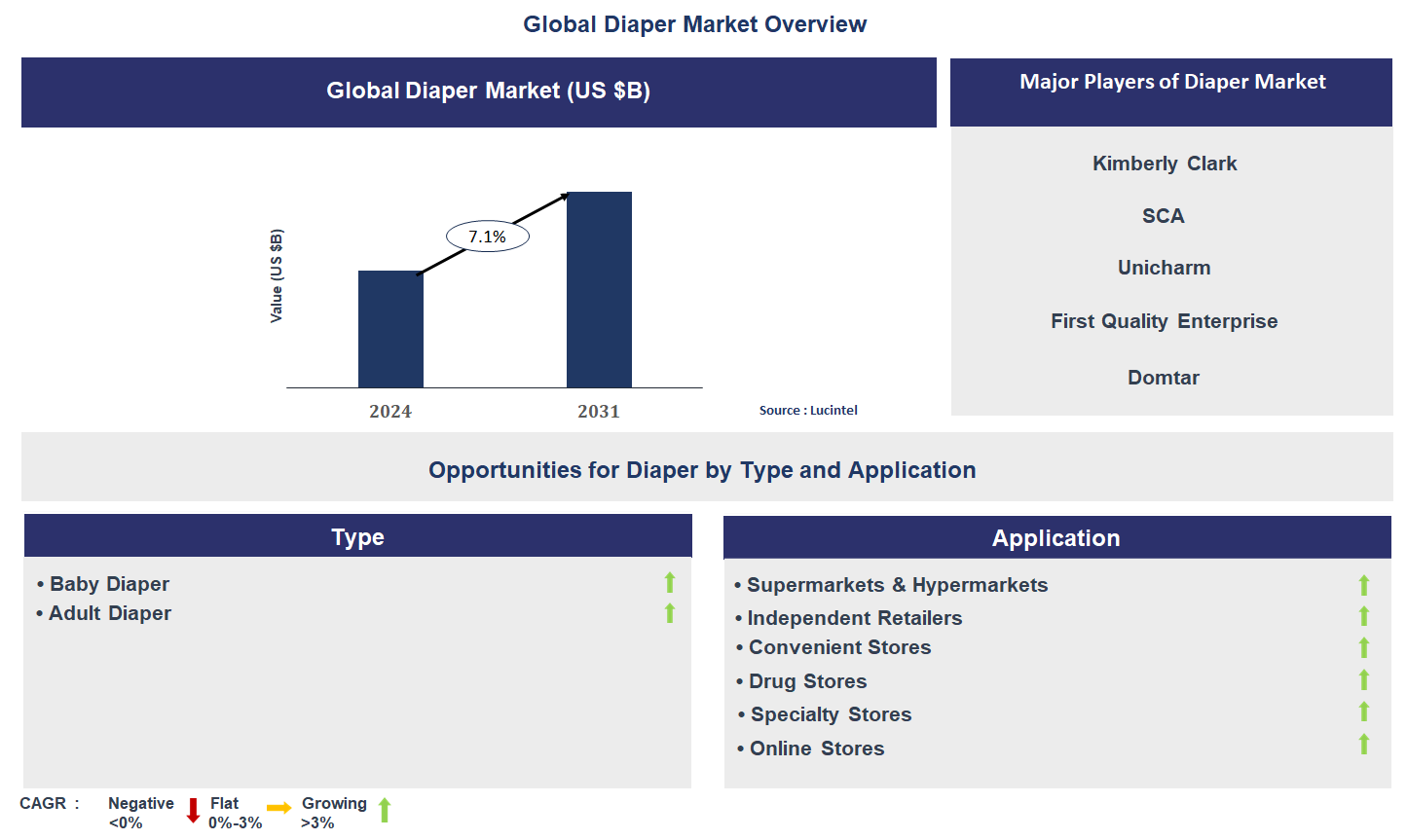
The future of the global diaper market looks promising with opportunities in the supermarket & hypermarket, independent retailer, convenient store, drug store, specialty store, and online store markets. The global diaper market is expected to grow with a CAGR of 7.1% from 2025 to 2031. The major drivers for this market are the increasing awareness of infant health, the rising demand for eco-friendly diapers, and the growing preference for convenient products.• Lucintel forecasts that, within the type category, adult diaper is expected to witness higher growth over the forecast period.
• Within the application category, online store is expected to witness the highest growth.
• In terms of region, APAC is expected to witness the highest growth over the forecast period. Gain valuable insights for your business decisions with our comprehensive 150+ page report. Sample figures with some insights are shown below.
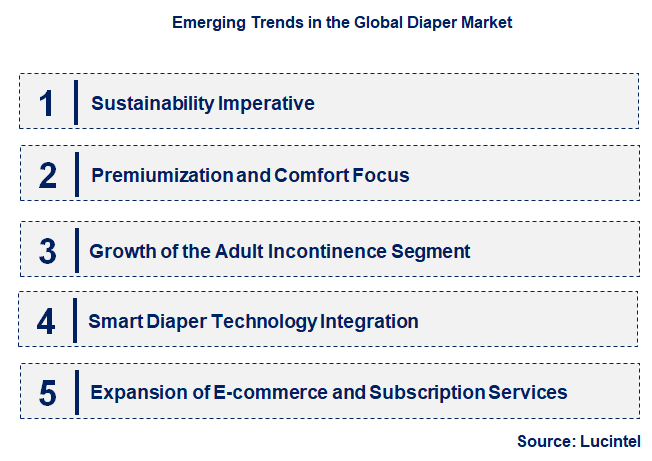
Emerging Trends in the Diaper Market
The diaper market is changing beyond its rudimentary absorbency and convenience, spurred by a new generation of emerging trends that echo wider societal changes. They are taking the industry towards a more sustainable, innovative, and consumer-oriented model. They are transforming everything from the materials that products are made of to how brands engage with their consumers. It is important that companies considering competing in a rapidly evolving market have a clear understanding of these advancements.• Sustainability Imperative: One of the leading trends is the broad movement toward eco-friendly and sustainable diapers. Consumers are increasingly worried about the environmental consequences of conventional disposable diapers, which take centuries to biodegrade in landfills. This has prompted a heightened demand for products produced from bio-based materials such as bamboo and polymers derived from plants.
• Premiumization and Comfort Focus: There is a significant trend toward premiumization in the market. Parents are prepared to pay extra for high-end diapers that have improved features to ensure their baby’s comfort and well-being. These include diapers with better absorbency, breathability, and hypoallergenic linings. Companies are also selling fragrance-free, lotion-free, and other possible allergen chemicals-free products that target a customer base that cares more about skin health and comfort.
• Growth of the Adult Incontinence Segment: A fast-rising trend is the burgeoning growth of the adult diaper market. It is fueled by the aging world population and an increase in awareness of and free conversation about urinary and fecal incontinence. The market is experiencing new product innovations that are more discreet, comfortable, and super absorbent, specifically made for adults.
• Smart Diaper Technology Integration: The market is witnessing a rising trend in smart diaper technology. The diapers come with sensors that can monitor moisture levels and transmit signals wirelessly to inform caregivers through an app. Some of the newer models can even track a baby’s temperature and sleep cycles. It is something that is of interest to high-tech parents who would like real-time data and information to guarantee their babies health and wellness. It is a major leap in baby care going digital.
• Expansion of E-commerce and Subscription Services: The direct-to-consumer and e-commerce model is a fast-growing trend that is revolutionizing the way diapers are being sold. Subscription services provide parents with the benefit of having diapers shipped directly to them on a continuous basis, so they will never be out of them. Busy, working parents are big fans of this trend. It also enables small, niche brands to match traditional players by establishing a direct connection with their consumers and delivering a hassle-free shopping experience. All these new trends are together transforming the diaper market by nudging it toward a more sustainable, tech-savvy, and consumer-driven future. The shift toward biodegradable materials and top-notch comfort is altering product design and manufacturing processes. The expansion of the adult and intelligent diaper segments is opening up completely new markets and revenue streams. Meanwhile, increasing e-commerce and subscription is transforming retail. The future of the market will be shaped by its capacity to innovate and keep up with those changing consumer needs.
Recent Development in the Diaper Market
The diaper industry is witnessing a sequence of important trends, which are driven by a mix of technological innovation, demographic trends, and increased emphasis on ecological sustainability. These trends are not only altering the products themselves but are also transforming business models, marketing approaches, and consumer attitudes. The points below describe five major trends that are shaping the market.• Large-scale Use of Biodegradable Materials: Another major trend is the large-scale use of biodegradable materials for the manufacture of diapers. Due to increasing environmental issues and laws in most parts of the globe, firms are aggressively shifting away from conventional plastic-based products. This has resulted in the use of such materials as plant-based plastics, bamboo, and wood pulp.
• Integration of Advanced Absorption Technologies: There has been a significant evolution in advanced absorption technologies in the market. Companies are developing new channel designs and new super absorbent polymers that have higher moisture-holding capacity and distribution. This technology results in a more comfortable and thinner diaper with fewer leaks and drier skin. This innovation meets a fundamental consumer requirement of enhanced performance and comfort, enabling diapers to perform better and with greater reliability for infants as well as adults.
• Smart Diaper Development: One of the key developments is the creation of smart diapers with the incorporation of a moisture sensor. This innovation is revolutionary in the context of baby care because it informs parents through a mobile application when a diaper is wet. This assists in avoiding diaper rash by providing timely diaper changes. Certain of these intelligent systems also determine urine for possible health problems. This innovation is attractive to technology-oriented parents and makes diapers a means of baby health monitoring.
• Growth of Adult Diaper Market: The adult diaper market is undergoing huge development driven by the world’s aging population and rising life expectancy. The incidence of conditions such as urinary incontinence among older individuals and individuals with mobility disabilities has resulted in a large and expanding market. Companies are reacting by creating more discreet, comfortable, and specialized products for adults, and this is a major driver of market growth and innovation.
• Transition to Direct-to-Consumer and Subscription Models: Another significant trend is the transition towards direct-to-consumer and subscription-based sales models. Here, brands can avoid intermediaries and establish a direct relationship with their customers. For consumers, it provides convenience along with the guarantee of a steady supply of diapers at home. This evolution is also empowering smaller, niche brands to make their entry into the market and compete with larger players. All these recent changes together are collectively affecting the diaper industry to make it more sustainable, technologically advanced, and consumer-centric. The emphasis on biodegradable products is revamping the product itself, while strong absorption technology is enhancing its fundamental function. Expansion of the adult and intelligent diaper segments is opening up new business opportunities, and the move to e-commerce is altering the distribution pattern. These shifts demonstrate a dynamic market that is constantly evolving to address new consumer demands and global issues.
Strategic Growth Opportunities in the Diaper Market
The diaper market provides numerous strategic growth opportunities based on demographic changes, sustainability focus, and technological advancement. To take advantage of these opportunities, businesses need to go beyond one-size-fits-all and invest in new distribution channels and product categories. By recognizing and fulfilling the unique needs of various consumer groups, brands are able to generate new revenues and gain a solid competitive edge.• Leveraging the Adult Incontinence Segment: The greatest opportunity for growth is through the adult incontinence segment. The world’s population is aging, and demand for dignity, comfort, and protection through products continues to rise. Companies can strategically create and market discreet, comfortable, and nurturing high-quality adult diapers and pants. This goes beyond traditional sales into medical facilities and direct-to-consumer subscription services, which can offer a steady and profitable revenue stream.
• Creating a Premium, Eco-Friendly Product Line: There is a huge growth potential in creating a premium, eco-friendly product line. With more consumers going green, they are willing to pay a premium price for diapers produced using sustainable, plant-based, and biodegradable materials. Brands can establish a strong ethical reputation through the use of organic cotton or bamboo and recyclable packaging.
• Smart Diaper Technology Innovation: One of the growth opportunities is innovating with smart diaper technology. By incorporating sensors into diapers that detect wetness and offer real-time reminders to a smartphone app, brands are able to reach the tech-conscious parent audience. Not only does this provide convenience but also positions the product as an infant care health and wellness tool.
• Attacking the Niche Swim Diaper and Training Pants Market: Though smaller in scope, there is a strategic opportunity for growth in the niche swim diaper and training pants markets. Swim diapers are a necessary item for water activity and cannot be substituted with regular diapers. Training pants are an important instrument for parents to use while potty-training. By providing specialty, high-performance products within these categories, brands are able to achieve a loyal consumer base and cross-sell their remaining baby care products.
• Growth in Emerging Markets: There is significant growth potential in moving into emerging markets in Asia-Pacific and Latin America. These countries boast high birth rates and an increasing middle class with growing disposable incomes. As parents in these nations shift from using traditional cloth diapers to disposable ones, there is a huge market penetration opportunity. Brands have the opportunity to enter the markets strategically by targeting a wide range of consumers across multiple price points. All these growth opportunities strategically are collectively transforming the diaper market by driving it towards higher specialization and consumer targeting. By concentrating on niche populations such as adults and specific uses such as swim and training, businesses are broadening the range of the market. The focus on sustainability and technology is not a passing fad but a core change that is building new segments of premium, value-focused products. The strategic conquest of new markets further guarantees that the industry will keep changing and responding to world consumer needs.
Diaper Market Driver and Challenges
The diaper market is a dynamic market influenced by several technological, economic, and social forces. Its development is fueled by strong drivers that are transforming consumer habits and industry trends. Nevertheless, this growth comes with substantial challenges that need to be tackled in order for there to be lasting expansion. Proper comprehension of drivers and challenges is necessary for any company playing in this dynamic and competitive market. The factors responsible for driving the diaper market include: 1. Increase in a Global Population of Infants and Aged: One of the major drivers of the market is the increase in a global population of infants and, more notably, the aged. Although birthrates are declining in some developed countries, the number of babies is still large in most developing economies. At the same time, the global aging population is a significant demographic driver of the adult incontinence market. 2. Growing Awareness of Hygiene and Health: Growing awareness of hygiene and health, especially among parents in developing nations, is a major force. Parents are becoming more aware of the need to keep babies dry to avoid skin problems such as diaper rash. This is translating into a move away from conventional cloth diapers toward disposables, which are seen as more convenient and hygienic. 3. Product Innovation and Technological Advances: Ongoing technological advancement is a key contributor to market growth. This involves the creation of new high-performance materials, such as thinner and more absorptive polymers. It also involves the incorporation of smart technology, which can sense moisture and notify parents, and the design of specialty products for various needs, including swim pants and training diapers. These developments improve product functionality and attractiveness. 4. Development of E-commerce and Online Retail: The increase in e-commerce and online retail sites is a major factor. Shopping online offers a convenient, low-profile method for customers to buy diapers, especially in adult incontinence. Subscription capabilities provide a steady flow and are attractive to time-strapped parents. This shift has not only increased the reach of the market but also enabled niche, direct-to-consumer companies to challenge the larger companies. 5. Increased Lifestyle and Increased Working Parents: The growth in working parents is the largest economic and social force. Active lifestyles and time pressures have increased dependence on products that are convenient and time-saving. Disposable diapers are easier to use than the washing and drying for cloth diapers. This trend is especially prevalent in urbanization and is fueling increased demand for disposable diapers. Challenges in the diaper market are: 1. Environmental Issues and Waste Management: One of the major challenges is the increased environmental issue of disposing of non-biodegradable diapers. Each year, millions of tons of diapers are disposed of in landfills where they take centuries to disintegrate. This has compelled consumers and governments to push for plastic waste reduction. The challenge for brands is to meet this challenge by investing in eco-friendly materials and coming up with new methods of disposal or recycling. 2. Volatile Raw Material Prices: The raw material economy of the diaper industry is heavily reliant on products such as wood pulp, super absorbent polymers, and non-woven fabric. The prices of these raw materials can be volatile, which, in turn, influences the cost of production and margin levels. Companies have to manage this menace by expanding their supply chain and adopting cost-efficient technologies for manufacturing. This volatility can also hit consumer prices and market stability levels. 3. High Competition and Market Saturation: The market for diapers is very competitive, with a small group of global players and a host of regional and local players. This creates stiff price competition and high marketing expenses, making it challenging to penetrate the market for new brands and for established brands to retain market share. Market saturation, especially in developed economies, also poses a challenge to discovering new means of growth. The combined effect of these drivers and challenges is a market in a constant state of evolution. The drivers, as fronted by demographic shifts and high consumer interest in health and convenience, are propelling the business towards diversification and innovation. The market is increasingly segmented, with prospects existing in the adult and premium environmentally friendly segments. But the challenges, and especially environmental issues and harsh competition, are compelling businesses to be more responsible and strategic.List of Diaper Companies
Companies in the market compete on the basis of product quality offered. Major players in this market focus on expanding their manufacturing facilities, R&D investments, infrastructural development, and leverage integration opportunities across the value chain. With these strategies diaper companies cater increasing demand, ensure competitive effectiveness, develop innovative products & technologies, reduce production costs, and expand their customer base. Some of the diaper companies profiled in this report include-• Kimberly Clark
• SCA
• Unicharm
• First Quality Enterprise
• Domtar
• Medtronic
• PBE
• Medline
• Hengan
• Coco
Diaper Market by Segment
The study includes a forecast for the global diaper market by type, application, and region.Diaper Market by Type [Value from 2019 to 2031]:
• Baby Diaper
• Adult Diaper
Diaper Market by Application [Value from 2019 to 2031]:
• Supermarkets & Hypermarkets
• Independent Retailers
• Convenient Stores
• Drug Stores
• Specialty Stores
• Online Stores
Diaper Market by Region [Value from 2019 to 2031]:
• North America
• Europe
• Asia Pacific
• The Rest of the World
Country Wise Outlook for the Diaper Market
The international diaper industry is witnessing great changes fueled by changing consumer values, technological advancement, and heightened concern for the environment. Although convenience and absorbency continue to be the priority for caregivers and parents, a distinct and growing trend toward products being both environmentally friendly, hypoallergenic, and technology-based is being witnessed. These trends are revolutionizing the business on an international platform but with unique regional characteristics.• United States: In the United States, the diaper market is undergoing a significant trend towards plant-based and sustainable diapers. Consumers, and especially millennial parents, are becoming progressively open to paying a premium for products made from organic and bio-based materials with a lower environmental impact. The market for adult diapers is also witnessing robust growth with the growing population of older people and greater awareness among people about incontinence care.
• China: China’s diaper market features a robust trend toward premium and high-performance brands. In spite of a fall in the birth rate, expenditure on each baby for diapers is increasing with parents giving importance to quality, comfort, and improved features such as high absorbency and breathability. Local brands are capturing market share by providing competitively priced brands that cater to local needs.
• Germany: The German market for diapers is very regulated and heavily driven by a strong eco-aware consumer segment. High demand for diapers carrying an organic material certification and environmental label exists. German consumers are wary of overstated marketing, requiring openness and evidence of sustainability. This has resulted in high growth in the availability of biodegradable and compostable diapers.
• India: The diaper market of India is growing at a fast rate, supported by urbanization, increasing disposable incomes, and increasing awareness of personal hygiene. Although the market remains controlled by low-cost, disposable diapers, there is a significant increase in the demand for premium products in urban regions. Online shopping websites are playing an important part in bringing both global and local brands to a larger segment of the population.
• Japan: The Japanese market for diapers is famous for its innovative technology and superior products. With its increasingly aging population, the adult incontinence market is now exceeding that of baby diapers in value. Japanese firms are leaders in innovation, creating super-thin, yet highly absorbent diapers and niche products for specific ages and requirements. The market is also a pioneer in taking care of the environment, with companies aggressively pursuing and executing diaper recycling initiatives to reduce waste management issues.

Features of the Global Diaper Market
Market Size Estimates: Diaper market size estimation in terms of value ($B). Trend and Forecast Analysis: Market trends (2019 to 2024) and forecast (2025 to 2031) by various segments and regions. Segmentation Analysis: Diaper market size by type, application, and region in terms of value ($B). Regional Analysis: Diaper market breakdown by North America, Europe, Asia Pacific, and Rest of the World. Growth Opportunities: Analysis of growth opportunities in different type, application, and regions for the diaper market. Strategic Analysis: This includes M&A, new product development, and competitive landscape of the diaper market. Analysis of competitive intensity of the industry based on Porter’s Five Forces model.
FAQ
Q1. What is the growth forecast for diaper market? Answer: The global diaper market is expected to grow with a CAGR of 7.1% from 2025 to 2031. Q2. What are the major drivers influencing the growth of the diaper market? Answer: The major drivers for this market are the increasing awareness of infant health, the rising demand for eco-friendly diapers, and the growing preference for convenient products. Q3. What are the major segments for diaper market? Answer: The future of the diaper market looks promising with opportunities in the supermarket & hypermarket, independent retailer, convenient store, drug store, specialty store, and online store markets. Q4. Who are the key diaper market companies? Answer: Some of the key diaper companies are as follows:• Kimberly Clark
• SCA
• Unicharm
• First Quality Enterprise
• Domtar
• Medtronic
• PBE
• Medline
• Hengan
• Coco Q5. Which diaper market segment will be the largest in future? Answer: Lucintel forecasts that, within the type category, adult diaper is expected to witness higher growth over the forecast period. Q6. In diaper market, which region is expected to be the largest in next 5 years? Answer: In terms of region, APAC is expected to witness the highest growth over the forecast period. Q7. Do we receive customization in this report? Answer: Yes, Lucintel provides 10% customization without any additional cost.
Table of Contents
List of Figures
List of Tables
Methodology
- In-depth interviews of the major players in this market
- Detailed secondary research from competitors’ financial statements and published data
- Extensive searches of published works, market, and database information pertaining to industry news, company press releases, and customer intentions
- A compilation of the experiences, judgments, and insights of Lucintel’s professionals, who have analyzed and tracked this market over the years.


Buy Now
Choose a license that fits your team. Instant PDF delivery.
Prices exclude taxes. Instant delivery. Custom licensing available on request.
Key Questions
- • What are some of the most promising, high-growth opportunities for the diaper market by type (baby diaper and adult diaper), application (supermarkets & hypermarkets, independent retailers, convenient stores, drug stores, specialty stores, and online stores), and region (North America, Europe, Asia Pacific, and the Rest of the World)?
- • Which segments will grow at a faster pace and why?
- • Which region will grow at a faster pace and why?
- • What are the key factors affecting market dynamics? What are the key challenges and business risks in this market?
- • What are the business risks and competitive threats in this market?
- • What are the emerging trends in this market and the reasons behind them?
- • What are some of the changing demands of customers in the market?
- • What are the new developments in the market? Which companies are leading these developments?
- • Who are the major players in this market? What strategic initiatives are key players pursuing for business growth?
- • What are some of the competing products in this market and how big of a threat do they pose for loss of market share by material or product substitution?
- • What M&A activity has occurred in the last 5 years and what has its impact been on the industry? For any questions related to Diaper Market, Diaper Market Size, Diaper Market Growth, Diaper Market Analysis, Diaper Market Report, Diaper Market Share, Diaper Market Trends, Diaper Market Forecast, Diaper Companies, write Lucintel analyst at email: helpdesk@lucintel.com. We will be glad to get back to you soon.


