
Dental Implant and Prosthetic Market Trends and Forecast
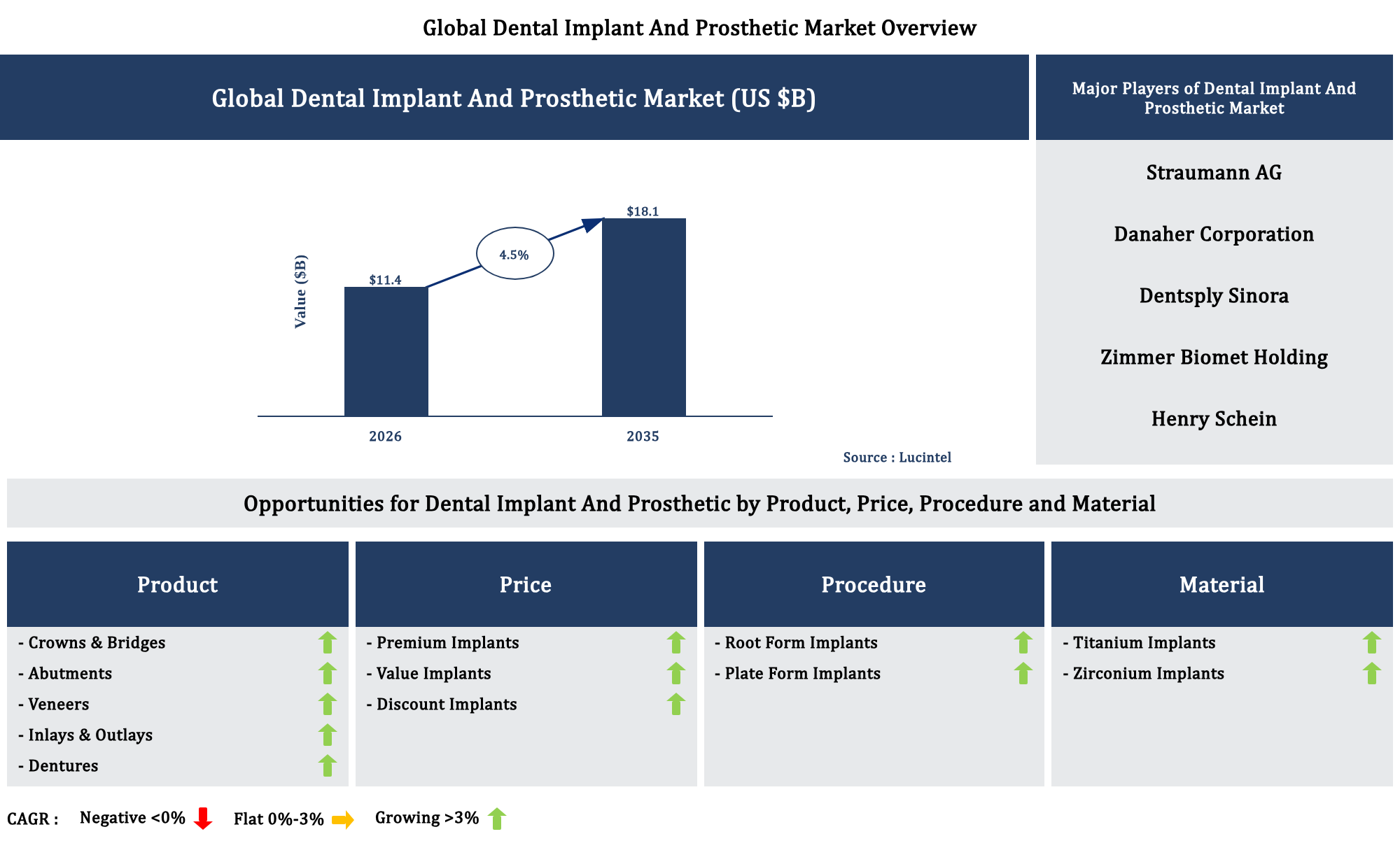
The future of the global dental implant and prosthetic market looks promising with opportunities in the titanium implant and zirconium implant markets. The global dental implant and prosthetic market is expected to reach an estimated $18162 million by 2035 with a CAGR of 4.5% from 2026 to 2035. The major drivers for this market are the increasing adoption of digital dentistry & 3d imaging technologies, the growing demand for cosmetic dentistry & smile enhancement, and the rising awareness about oral health & dental care.
• Lucintel forecasts that, within the product category, crown & bridge is expected to witness higher growth over the forecast period.
• Within the material category, titanium implant is expected to witness the highest growth.
• In terms of region, APAC is expected to witness the highest growth over the forecast period.
Gain valuable insights for your business decisions with our comprehensive 150+ page report. Sample figures with some insights are shown below.
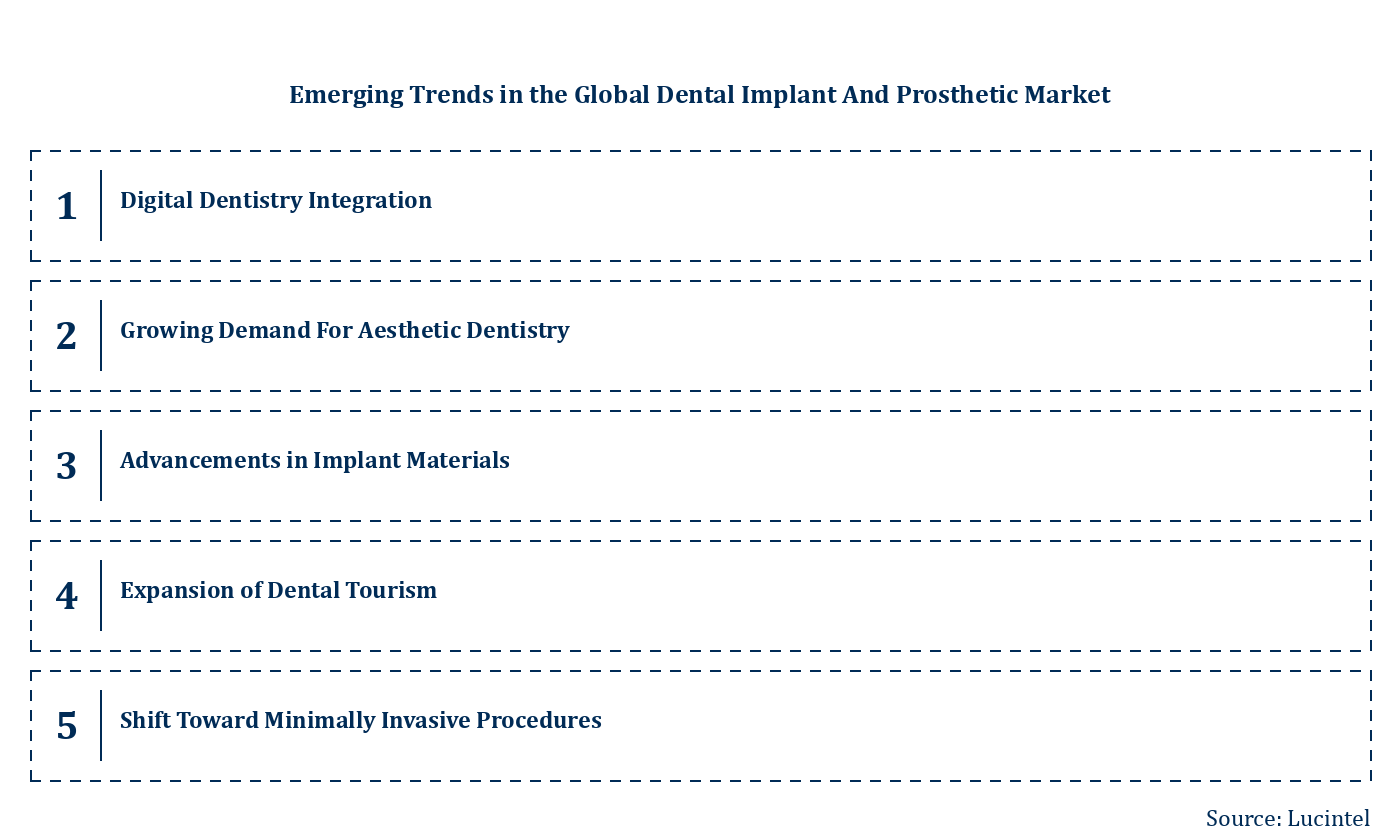
Emerging Trends in the Dental Implant and Prosthetic Market
The dental implant and prosthetic market is undergoing significant transformation due to rapid technological advancements, shifting patient preferences, and evolving healthcare delivery models. Increasing prevalence of dental disorders, rising demand for aesthetic dentistry, and growing awareness of oral health are accelerating market expansion. Innovations such as digital dentistry, advanced implant materials, and minimally invasive procedures are improving treatment outcomes and efficiency. Additionally, emerging economies and dental tourism are reshaping global demand patterns. These developments are not only enhancing accessibility and affordability but also driving competition among key players, leading to continuous innovation and improved patient-centric solutions across the market.
• Digital Dentistry Integration: The increasing adoption of digital dentistry technologies such as CAD or CAM systems, 3D printing, and computer guided implant surgery is a major trend transforming the market. These technologies enable precise planning, customization, and faster production of dental implants and prosthetics. Digital workflows improve accuracy, reduce treatment time, and enhance patient outcomes. Clinics are increasingly investing in intraoral scanners and digital imaging systems to streamline procedures. This trend is also supporting better collaboration between dental laboratories and practitioners, ultimately improving efficiency and consistency in treatment delivery across developed and emerging markets.
• Growing Demand for Aesthetic Dentistry: Rising awareness about appearance and self confidence is driving the demand for cosmetic dental procedures, including implants and prosthetics. Patients are increasingly opting for natural looking and long lasting solutions rather than traditional removable options. This shift is encouraging manufacturers to develop aesthetically superior materials such as zirconia and advanced ceramic prosthetics. Social media influence and increasing disposable income are further accelerating this trend, particularly among younger populations. As a result, dental clinics are expanding their cosmetic dentistry offerings, making aesthetics a key competitive factor in the market.
• Advancements in Implant Materials: Continuous innovation in implant materials, including titanium surface modifications and zirconia implants, is significantly improving durability, biocompatibility, and osseointegration. New surface technologies such as nano textured coatings are enhancing implant stability and reducing healing time. These advancements are particularly beneficial for patients with complex dental conditions. Additionally, research in biomaterials is leading to the development of more corrosion resistant and aesthetically appealing implants. This trend is strengthening clinical outcomes and increasing patient trust, thereby driving broader adoption of dental implant procedures globally.
• Expansion of Dental Tourism: The growth of dental tourism is emerging as a key trend, particularly in countries offering high quality treatments at lower costs. Patients from developed regions are traveling to emerging markets for affordable dental implant procedures without compromising on quality. This trend is supported by improving healthcare infrastructure, skilled professionals, and favorable exchange rates. Dental tourism is also encouraging international collaborations and standardization of treatment protocols. As a result, countries in Asia Pacific and Eastern Europe are witnessing increased patient inflow, contributing significantly to overall market growth.
• Shift Toward Minimally Invasive Procedures: There is a growing preference for minimally invasive dental implant procedures that reduce pain, recovery time, and surgical complications. Techniques such as guided implant surgery and flapless procedures are gaining popularity among both patients and practitioners. These methods improve precision and reduce the risk of errors, leading to higher success rates. Additionally, shorter treatment durations and improved patient comfort are increasing acceptance of implant procedures. This trend is driving innovation in surgical tools and techniques, further enhancing the overall efficiency and attractiveness of dental implant treatments.
The dental implant and prosthetic market is being reshaped by technological innovation, evolving patient expectations, and increasing global accessibility. Trends such as digital dentistry, aesthetic demand, advanced materials, dental tourism, and minimally invasive procedures are collectively enhancing treatment quality and expanding market reach. These developments are fostering competition, encouraging continuous research and development, and improving affordability. As a result, the market is transitioning toward more efficient, patient centric, and technologically advanced solutions, ensuring sustained growth and transformation in the coming years.
Recent Developments in the Dental Implant and Prosthetic Market
The dental implant and prosthetic market is evolving rapidly due to continuous innovation, rising patient expectations, and expanding healthcare infrastructure. Recent developments are centered on improving clinical outcomes, enhancing affordability, and increasing accessibility to advanced dental solutions. Technological advancements, material innovations, and supportive regulatory frameworks are driving these changes across global markets. Additionally, growing awareness of oral health and cosmetic dentistry is encouraging adoption. These developments are reshaping treatment approaches, strengthening competition among manufacturers, and accelerating the transition toward more efficient, precise, and patient focused dental care solutions worldwide.
• Digital Workflow Adoption Across Dental Practices: The increasing integration of digital workflows, including CAD or CAM systems, intraoral scanners, and 3D printing, is transforming dental implant and prosthetic procedures. These technologies improve precision, reduce manual errors, and shorten treatment timelines. Dental professionals are leveraging digital tools for accurate diagnosis and customized implant design, enhancing patient satisfaction. Laboratories and clinics are collaborating more effectively through digital platforms. This development is improving operational efficiency, reducing costs over time, and enabling faster turnaround, thereby supporting wider adoption of advanced dental treatments globally across urban and semi urban regions.
• Advancements in Biocompatible Implant Materials: Continuous innovation in implant materials, particularly titanium and zirconia, is enhancing durability, aesthetics, and patient safety. Surface modifications and nano coatings are improving osseointegration and reducing healing time. These advancements allow implants to perform better even in complex clinical conditions. Manufacturers are focusing on developing corrosion resistant and long lasting materials that improve clinical outcomes. This development is increasing patient trust and expanding treatment eligibility. As a result, dental professionals are more confident in recommending implants, which is driving higher adoption rates and supporting long term market growth.
• Expansion of Affordable Implant Solutions In Emerging Markets: Companies are increasingly focusing on cost effective implant solutions to cater to price sensitive populations in emerging economies. Local manufacturing, simplified procedures, and competitive pricing strategies are making dental implants more accessible. Governments and private players are also supporting infrastructure development and training programs. This development is unlocking a large untreated patient base and increasing procedure volumes. As affordability improves, more patients are opting for permanent dental solutions instead of temporary alternatives, thereby expanding market penetration and contributing significantly to overall revenue growth in developing regions.
• Growth of Minimally Invasive Implant Procedures: The rising preference for minimally invasive procedures is leading to the adoption of advanced surgical techniques such as flapless surgery and guided implant placement. These approaches reduce patient discomfort, shorten recovery time, and minimize surgical risks. Dental practitioners are increasingly adopting these techniques to improve success rates and patient experience. This development is encouraging more patients to undergo implant procedures who were previously hesitant. Additionally, advancements in surgical tools and imaging technologies are supporting precision, making treatments safer and more efficient across various clinical settings globally.
• Strategic Collaborations and Industry Consolidation: The market is witnessing increasing partnerships, mergers, and acquisitions among key players to expand product portfolios and geographic presence. Companies are collaborating with dental clinics, laboratories, and research institutions to drive innovation and improve service delivery. These strategic moves are enabling firms to leverage advanced technologies and strengthen distribution networks. This development is intensifying competition and accelerating product innovation. It also helps companies achieve economies of scale, reduce costs, and enhance customer reach, ultimately contributing to stronger market positioning and sustained long term growth.
Recent developments in the dental implant and prosthetic market are significantly enhancing treatment quality, accessibility, and efficiency. Innovations in digital dentistry, material science, and surgical techniques are improving patient outcomes and expanding adoption. At the same time, affordability initiatives and strategic collaborations are strengthening market reach and competitiveness. These advancements are creating a more dynamic and patient focused environment, encouraging continuous innovation. Overall, such developments are driving sustainable growth, increasing global penetration, and positioning the market for long term expansion across both developed and emerging regions.
Strategic Growth Opportunities in the Dental Implant and Prosthetic Market
The dental implant and prosthetic market is witnessing strong growth driven by increasing dental disorders, rising awareness of oral health, and expanding demand for aesthetic dentistry. Technological advancements and improved healthcare infrastructure are creating new opportunities across various applications. Key growth areas are emerging from cosmetic procedures, restorative treatments, and digital dentistry integration. Additionally, aging populations and growing disposable income are supporting adoption. These factors are encouraging innovation and investment, enabling market players to expand their presence and tap into diverse application segments with high growth potential globally.
• Increasing Demand for Cosmetic Dentistry Applications: The growing emphasis on aesthetics and smile enhancement is creating strong opportunities in cosmetic dentistry applications. Patients are increasingly seeking natural looking dental implants and prosthetics to improve appearance and confidence. This demand is driving innovation in materials such as zirconia and advanced ceramics. Dental clinics are expanding cosmetic service offerings to attract a broader patient base. Rising disposable income and social media influence are further supporting this trend. As a result, cosmetic dentistry applications are becoming a major revenue contributor in the overall dental implant and prosthetic market.
• Expanding Use in Restorative Dental Treatments: Restorative dentistry is a key application area offering significant growth opportunities due to the rising prevalence of tooth loss and dental diseases. Dental implants and prosthetics are increasingly preferred over traditional dentures due to their durability and functionality. Aging populations are particularly driving demand for long term restorative solutions. Dental professionals are recommending implants for improved oral health and quality of life. Continuous advancements in treatment techniques and materials are enhancing outcomes. This is leading to higher adoption of restorative applications across both developed and emerging healthcare markets globally.
• Growing Adoption in Digital Dentistry Applications: The integration of digital technologies in dental practices is opening new growth avenues in digital dentistry applications. Tools such as CAD or CAM systems, 3D imaging, and intraoral scanners are improving diagnosis, treatment planning, and implant design. These technologies enable precise and customized prosthetic solutions, enhancing patient satisfaction. Dental laboratories and clinics are increasingly adopting digital workflows to improve efficiency and reduce turnaround time. This trend is also supporting better collaboration among stakeholders. As digital adoption rises, it is significantly expanding opportunities within implant and prosthetic applications worldwide.
• Rising Opportunities in Dental Tourism Driven Procedures: Dental tourism is emerging as a strong application segment, particularly in cost effective treatment destinations. Patients from developed regions are traveling to countries offering affordable yet high quality dental implant procedures. This is encouraging clinics to upgrade infrastructure and adopt advanced technologies. Governments and private players are promoting medical tourism to attract international patients. The availability of skilled professionals at lower costs is a key advantage. This trend is increasing procedure volumes and creating substantial growth opportunities for implant and prosthetic applications in emerging markets globally.
• Increasing Utilization in Geriatric Dental Care Applications: The rapidly aging population is driving significant opportunities in geriatric dental care applications. Older individuals are more prone to tooth loss and require long lasting restorative solutions such as implants and prosthetics. Healthcare providers are focusing on specialized treatments tailored to elderly patients. Improved awareness about oral health among aging populations is encouraging treatment adoption. Additionally, advancements in minimally invasive procedures are making implants more suitable for older patients. This growing demographic segment is expected to contribute substantially to market demand and drive long term growth across global regions.
Strategic growth opportunities in the dental implant and prosthetic market are expanding across diverse applications, including cosmetic, restorative, digital, tourism driven, and geriatric care segments. These opportunities are driven by technological advancements, demographic shifts, and changing patient preferences. Market players are leveraging these trends to innovate and expand their offerings. As adoption increases across both developed and emerging regions, these application areas are expected to significantly enhance market penetration, improve patient outcomes, and support sustained growth in the global dental implant and prosthetic industry.
Dental Implant and Prosthetic Market Driver and Challenges
The dental implant and prosthetic market is influenced by a combination of technological advancements, economic conditions, and regulatory frameworks that shape its growth trajectory. Increasing awareness of oral health, rising demand for aesthetic dentistry, and innovations in dental materials and procedures are key growth enablers. At the same time, challenges such as high treatment costs, limited reimbursement policies, and stringent regulatory requirements continue to impact market expansion. These factors collectively determine the pace of adoption and investment across regions, influencing both developed and emerging markets and shaping the competitive landscape of the industry.
The Factors Responsible For Driving the dental implant and prosthetic market Include:
• Rising Demand for Cosmetic Dentistry: The increasing focus on physical appearance and self confidence is significantly driving demand for cosmetic dental procedures, including implants and prosthetics. Patients are increasingly opting for permanent and natural looking solutions to replace missing teeth. Social media influence and growing awareness of smile aesthetics are further encouraging individuals to seek advanced dental treatments. Dental clinics are expanding their cosmetic service offerings to cater to this rising demand. Additionally, improvements in materials such as zirconia are enhancing aesthetic outcomes. This driver is creating strong revenue opportunities and encouraging continuous innovation among manufacturers and service providers globally.
• Advancements in Dental Technology and Materials: Technological innovation is a major driver in the market, particularly with the integration of digital dentistry tools such as CAD or CAM systems, 3D printing, and computer guided implant procedures. These advancements improve precision, reduce treatment time, and enhance patient outcomes. In addition, the development of advanced materials such as titanium alloys and zirconia is improving implant durability and biocompatibility. These innovations are enabling dental professionals to offer more reliable and efficient treatments. As a result, patient trust is increasing, and adoption rates are rising across both developed and emerging markets, driving sustained growth in the industry.
• Growing Aging Population and Tooth Loss Cases: The rising global aging population is a key factor driving demand for dental implants and prosthetics. Older individuals are more prone to tooth loss, periodontal diseases, and other dental conditions that require restorative solutions. Dental implants offer long term benefits compared to traditional dentures, making them a preferred choice among elderly patients. Increasing life expectancy and improved awareness of oral health are further supporting treatment adoption. Healthcare providers are focusing on specialized solutions for geriatric patients. This demographic trend is expected to generate consistent demand and create long term growth opportunities in the market.
• Expansion of Dental Tourism and Emerging Markets: The growth of dental tourism and increasing healthcare investments in emerging economies are significantly driving market expansion. Patients from developed regions are traveling to countries offering affordable yet high quality dental treatments. This trend is encouraging clinics in emerging markets to upgrade infrastructure and adopt advanced technologies. Governments are also promoting medical tourism to attract international patients. Additionally, the presence of skilled professionals at competitive costs is enhancing the appeal of these regions. This driver is increasing procedure volumes, expanding market reach, and creating new revenue streams for industry participants globally.
The Challenges In the dental implant and prosthetic market Are:
• High Cost of Dental Implant Procedures: One of the major challenges in the market is the high cost associated with dental implant and prosthetic procedures. Advanced materials, specialized equipment, and skilled professionals contribute to the overall expense, making treatments unaffordable for a large segment of the population. In many regions, limited insurance coverage further increases the financial burden on patients. This cost barrier restricts widespread adoption, particularly in low and middle income countries. As a result, patients often opt for cheaper alternatives such as dentures, which can limit the growth potential of the dental implant market despite increasing demand.
• Stringent Regulatory Requirements and Approval Processes: The dental implant and prosthetic market is subject to strict regulatory standards to ensure patient safety and product efficacy. Obtaining approvals for new products involves extensive clinical testing, documentation, and compliance with regional regulations. These processes can be time consuming and costly for manufacturers, delaying product launches and innovation. Additionally, varying regulatory frameworks across countries create complexities for global market expansion. Companies must invest significant resources in compliance and quality assurance. This challenge can limit the entry of new players and slow down the pace of technological advancements in the market.
• Limited Awareness and Accessibility in Developing Regions: Despite growing awareness, many developing regions still face challenges related to limited access to advanced dental care. A shortage of skilled dental professionals, inadequate infrastructure, and lack of awareness about implant benefits hinder market growth. Patients in rural and underserved areas often rely on traditional treatments due to cost and availability constraints. Educational gaps regarding oral health further reduce adoption rates. Although governments and private players are working to improve healthcare access, progress remains uneven. This challenge restricts market penetration and highlights the need for increased investment in training and infrastructure development.
The dental implant and prosthetic market is shaped by a dynamic interplay of strong growth drivers and persistent challenges. Technological advancements, rising cosmetic demand, aging populations, and expanding dental tourism are fueling market expansion. However, high costs, regulatory complexities, and limited accessibility continue to restrain growth in certain regions. The balance between innovation and affordability will play a critical role in determining future market success. Overall, while challenges remain, ongoing investments and advancements are expected to enhance accessibility and drive sustainable growth across the global dental implant and prosthetic market.
List of Dental Implant and Prosthetic Companies
Companies in the market compete on the basis of product quality offered. Major players in this market focus on expanding their manufacturing facilities, R&D investments, infrastructural development, and leverage integration opportunities across the value chain. With these strategies dental implant and prosthetic companies cater increasing demand, ensure competitive effectiveness, develop innovative products & technologies, reduce production costs, and expand their customer base. Some of the dental implant and prosthetic companies profiled in this report include-
• Straumann AG
• Danaher Corporation
• Dentsply Sinora
• Zimmer Biomet Holding
• Henry Schein
Dental Implant and Prosthetic Market by Segment
The study includes a forecast for the global dental implant and prosthetic market by product, price, procedure, material, and region.
Dental Implant and Prosthetic Market by Product [Value from 2019 to 2035]:
• Crowns & Bridges
• Abutments
• Veneers
• Inlays & Outlays
• Dentures
Dental Implant and Prosthetic Market by Price [Value from 2019 to 2035]:
• Premium Implants
• Value Implants
• Discount Implants
Dental Implant and Prosthetic Market by Procedure [Value from 2019 to 2035]:
• Root Form Implants
• Plate Form Implants
Dental Implant and Prosthetic Market by Material [Value from 2019 to 2035]:
• Titanium Implants
• Zirconium Implants
Dental Implant and Prosthetic Market by Region [Value from 2019 to 2035]:
• North America
• Europe
• Asia Pacific
• The Rest of the World
Country Wise Outlook for the Dental Implant and Prosthetic Market
The dental implant and prosthetic market is experiencing steady growth driven by technological innovation, rising dental disorders, and increasing demand for aesthetic dentistry. Globally, the market is expanding at a strong pace, supported by digital dentistry, improved implant materials, and growing awareness of oral health. Countries such as the United States, China, Germany, India, and Japan are witnessing notable developments shaped by healthcare infrastructure, regulatory policies, and demographic trends. The integration of CAD or CAM systems, 3D printing, and minimally invasive procedures is transforming treatment outcomes. Additionally, aging populations and increasing disposable income are accelerating adoption, making these regions key contributors to market evolution.
• United States: The United States market is characterized by strong adoption of advanced dental technologies and high patient awareness. Recent developments include increasing use of digital dentistry solutions such as CAD or CAM systems and 3D printing for customized implants and prosthetics. The presence of major industry players and continuous product innovation is enhancing treatment efficiency and outcomes. Additionally, the growing popularity of cosmetic dentistry and minimally invasive procedures is driving demand. Insurance coverage improvements and expanding dental service organizations are further supporting market growth, while ongoing research in biomaterials is improving implant durability and success rates.
• China: China is witnessing rapid market expansion due to supportive government policies and rising patient demand. A significant recent development is the implementation of volume based procurement policies, which have reduced implant prices and increased accessibility for patients. This has unlocked a large untreated patient pool and boosted procedure volumes. Domestic manufacturers are gaining strength, while international companies are expanding local production to remain competitive. The increasing middle class population and improving healthcare infrastructure are further accelerating adoption, although pricing pressures continue to influence market dynamics.
• Germany: Germany remains a key European market driven by advanced healthcare infrastructure and strong dental technology innovation. Recent developments include increased adoption of digital workflows, including intraoral scanning and computer guided implant procedures. The country is also witnessing growing demand for premium implant materials such as titanium and zirconia due to their reliability and aesthetics. Collaboration between dental laboratories and clinics is improving treatment precision. Additionally, the aging population is contributing to higher demand for restorative procedures, while regulatory standards ensure high quality and safety in dental treatments.
• India: India is emerging as a high growth market supported by rising dental awareness and expanding dental tourism. Recent developments include increasing investments in dental clinics and the adoption of cost effective implant solutions to cater to price sensitive patients. The growth of private dental chains and skilled professionals is improving accessibility to advanced treatments. Digital dentistry adoption is gradually increasing, especially in urban areas. Additionally, government initiatives to improve healthcare infrastructure and rising disposable income are encouraging patients to opt for dental implants and prosthetic procedures.
• Japan: Japan market is driven by a rapidly aging population and high demand for advanced dental care. Recent developments include increased use of high precision implant systems and digital treatment planning technologies. The country is also focusing on minimally invasive procedures and long lasting prosthetic solutions. Strong emphasis on research and development is leading to innovations in implant materials and surface technologies. Furthermore, integration of robotics and digital imaging is enhancing clinical outcomes. The presence of well established healthcare systems and patient preference for high quality treatments continues to support steady market growth.
Features of the Global Dental Implant and Prosthetic Market
Market Size Estimates: Dental implant and prosthetic market size estimation in terms of value ($M).
Trend and Forecast Analysis: Market trends (2019 to 2025) and forecast (2026 to 2035) by various segments and regions.
Segmentation Analysis: Dental implant and prosthetic market size by various segments, such as by product, price, procedure, material, and region in terms of value ($M).
Regional Analysis: Dental implant and prosthetic market breakdown by North America, Europe, Asia Pacific, and Rest of the World.
Growth Opportunities: Analysis of growth opportunities in different product, price, procedure, material, and regions for the dental implant and prosthetic market.
Strategic Analysis: This includes M&A, new product development, and competitive landscape of the dental implant and prosthetic market.
Analysis of competitive intensity of the industry based on Porter’s Five Forces model.
FAQ
Q1. What is the dental implant and prosthetic market size?
Answer: The global dental implant and prosthetic market is expected to reach an estimated $18162 million by 2035.
Q2. What is the growth forecast for dental implant and prosthetic market?
Answer: The global dental implant and prosthetic market is expected to grow with a CAGR of 4.5% from 2026 to 2035.
Q3. What are the major drivers influencing the growth of the dental implant and prosthetic market?
Answer: The major drivers for this market are the increasing adoption of digital dentistry & 3d imaging technologies, the growing demand for cosmetic dentistry & smile enhancement, and the rising awareness about oral health & dental care.
Q4. What are the major segments for dental implant and prosthetic market?
Answer: The future of the dental implant and prosthetic market looks promising with opportunities in the titanium implant and zirconium implant markets.
Q5. Who are the key dental implant and prosthetic market companies?
Answer: Some of the key dental implant and prosthetic companies are as follows:
• Straumann AG
• Danaher Corporation
• Dentsply Sinora
• Zimmer Biomet Holding
• Henry Schein
Q6. Which dental implant and prosthetic market segment will be the largest in future?
Answer: Lucintel forecasts that, within the product category, crown & bridge is expected to witness higher growth over the forecast period.
Q7. In dental implant and prosthetic market, which region is expected to be the largest in next 8 years?
Answer: In terms of region, APAC is expected to witness the highest growth over the forecast period.
Q8. Do we receive customization in this report?
Answer: Yes, Lucintel provides 10% customization without any additional cost.
This report answers following 11 key questions:
Q.1. What are some of the most promising, high-growth opportunities for the dental implant and prosthetic market by product (crowns & bridges, abutments, veneers, inlays & outlays, and dentures), price (premium implants, value implants, and discount implants), procedure (root form implants and plate form implants), material (titanium implants and zirconium implants), and region (North America, Europe, Asia Pacific, and the Rest of the World)?
Q.2. Which segments will grow at a faster pace and why?
Q.3. Which region will grow at a faster pace and why?
Q.4. What are the key factors affecting market dynamics? What are the key challenges and business risks in this market?
Q.5. What are the business risks and competitive threats in this market?
Q.6. What are the emerging trends in this market and the reasons behind them?
Q.7. What are some of the changing demands of customers in the market?
Q.8. What are the new developments in the market? Which companies are leading these developments?
Q.9. Who are the major players in this market? What strategic initiatives are key players pursuing for business growth?
Q.10. What are some of the competing products in this market and how big of a threat do they pose for loss of market share by material or product substitution?
Q.11. What M&A activity has occurred in the last 5 years and what has its impact been on the industry?
For any questions related to Dental Implant and Prosthetic Market, Dental Implant and Prosthetic Market Size, Dental Implant and Prosthetic Market Growth, Dental Implant and Prosthetic Market Analysis, Dental Implant and Prosthetic Market Report, Dental Implant and Prosthetic Market Share, Dental Implant and Prosthetic Market Trends, Dental Implant and Prosthetic Market Forecast, Dental Implant and Prosthetic Companies, write Lucintel analyst at email: helpdesk@lucintel.com. We will be glad to get back to you soon.