
Report Feature
Dental Additive Manufacturing Market Trends and Forecast
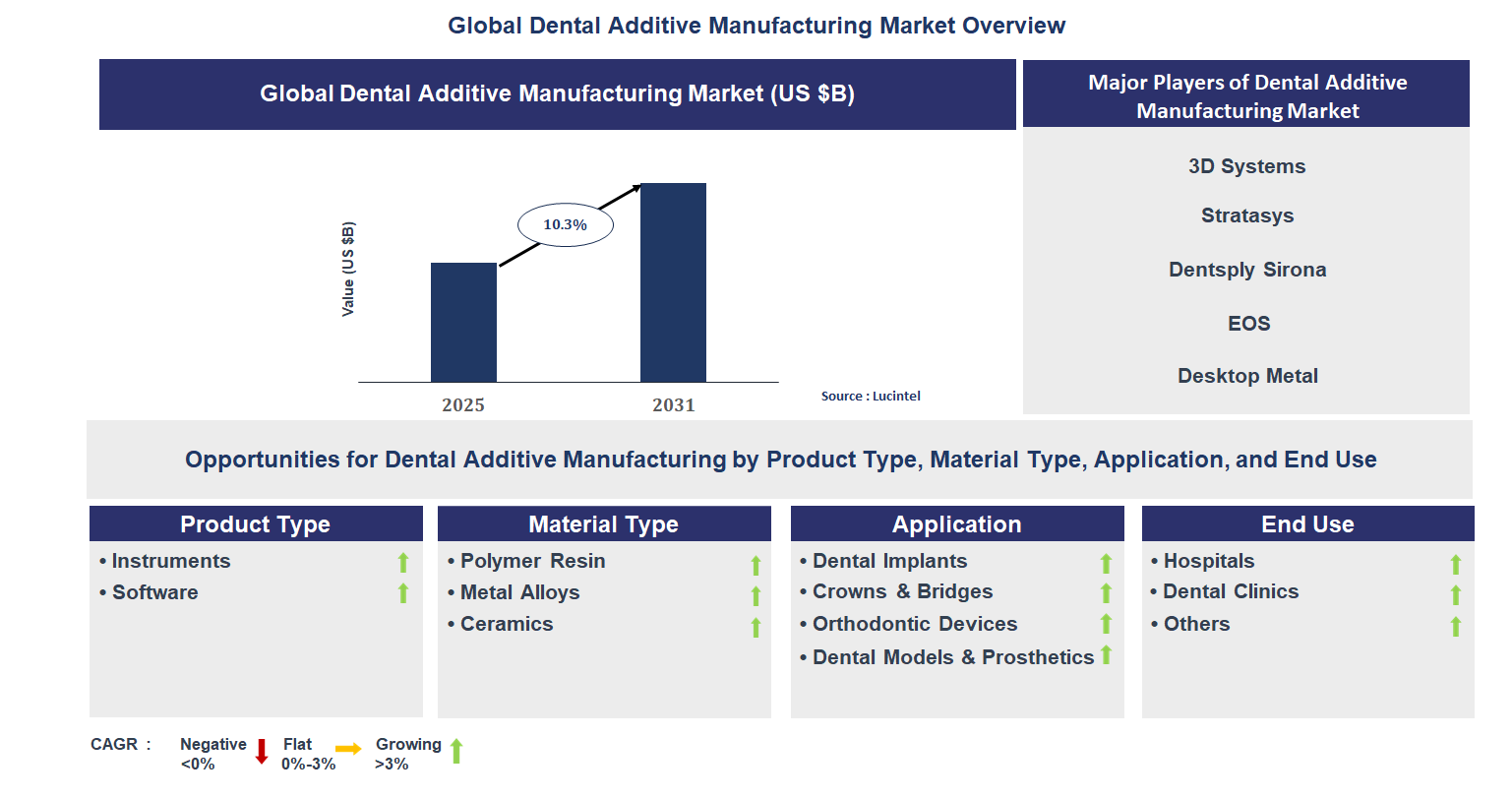
The future of the global dental additive manufacturing market looks promising with opportunities in the hospital and dental clinic markets. The global dental additive manufacturing market is expected to grow with a CAGR of 10.3% from 2025 to 2031. The major drivers for this market are increasing adoption of 3D printing technology, rising demand for customized dental solutions, and growing preference for digital dentistry workflows.• Lucintel forecasts that, within the product type category, instrument is expected to witness higher growth over the forecast period.
• Within the end use category, dental clinic is expected to witness higher growth.
• In terms of region, APAC is expected to witness the highest growth over the forecast period. Gain valuable insights for your business decisions with our comprehensive 150+ page report. Sample figures with some insights are shown below.
Emerging Trends in the Dental Additive Manufacturing Market
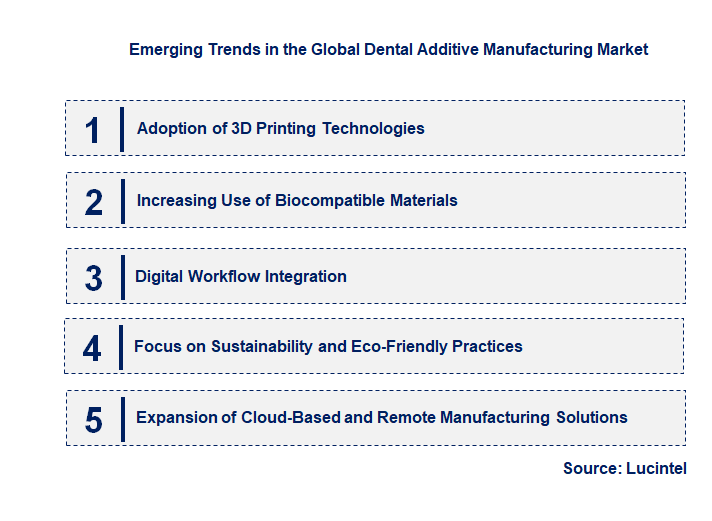
The dental additive manufacturing market is experiencing rapid growth driven by technological advancements, increasing demand for personalized dental solutions, and a shift towards digital dentistry. As dental practices and laboratories adopt innovative manufacturing techniques, the market is evolving to meet the needs for precision, efficiency, and cost-effectiveness. These developments are transforming traditional dental procedures and materials, leading to improved patient outcomes and streamlined workflows. The following key trends highlight the major shifts shaping this dynamic industry, reflecting its move towards more advanced, sustainable, and patient-centric solutions.• Adoption of 3D Printing Technologies: The integration of 3D printing in dental manufacturing is revolutionizing production processes. It allows for rapid prototyping, customization, and on-demand production of dental prosthetics, crowns, and aligners. This technology reduces lead times and costs while increasing precision and fit. As 3D printers become more affordable and versatile, dental labs and clinics are increasingly adopting them, leading to a more efficient and flexible supply chain. The trend enhances patient satisfaction through faster turnaround times and highly personalized dental solutions.
• Increasing Use of Biocompatible Materials: The market is witnessing a surge in the development and utilization of biocompatible materials suitable for additive manufacturing. These materials ensure safety, durability, and aesthetic appeal of dental restorations. Innovations include resins, ceramics, and composites that mimic natural tooth properties. The use of biocompatible materials minimizes allergic reactions and enhances the longevity of dental appliances. This trend supports the creation of more natural-looking and long-lasting dental restorations, expanding the scope of additive manufacturing in complex dental procedures.
• Digital Workflow Integration: The shift towards fully digital workflows is a significant trend in the dental additive manufacturing market. It involves the integration of intraoral scanners, CAD/CAM software, and 3D printing to streamline the entire process from diagnosis to final restoration. Digital workflows improve accuracy, reduce manual errors, and shorten treatment times. They also facilitate better communication between dental practitioners and labs. As this integration becomes more seamless, it is driving efficiency, enhancing patient outcomes, and enabling more complex and customized dental treatments.
• Focus on Sustainability and Eco-Friendly Practices: Sustainability is gaining importance in the dental additive manufacturing industry. Manufacturers are adopting eco-friendly materials, reducing waste through precise additive processes, and implementing energy-efficient production methods. The development of recyclable and biodegradable materials is also a key focus. This trend aligns with global environmental concerns and enhances the market’s appeal to eco-conscious consumers. Sustainable practices not only reduce the environmental footprint but also lower costs and improve brand reputation, making eco-friendly dental solutions more attractive to practitioners and patients alike.
• Expansion of Cloud-Based and Remote Manufacturing Solutions: The rise of cloud computing and remote access technologies is enabling decentralized manufacturing in the dental industry. Cloud-based platforms facilitate collaboration, data sharing, and remote monitoring of 3D printing processes. This trend allows dental labs and clinics to operate more flexibly, reduce inventory costs, and respond quickly to patient needs. It also supports the growth of distributed manufacturing models, where production can occur closer to the point of care. The expansion of these solutions is making dental additive manufacturing more accessible, scalable, and adaptable to various clinical settings. In summary, these trends are collectively reshaping the dental additive manufacturing market by enhancing customization, efficiency, sustainability, and digital integration. They are driving innovation, reducing costs, and improving patient outcomes, ultimately transforming traditional dental practices into more advanced, patient-centric, and environmentally responsible operations.
Recent Development in the Dental Additive Manufacturing Market
The dental additive manufacturing market has experienced rapid growth driven by technological advancements, increasing demand for personalized dental solutions, and the need for cost-effective and efficient production methods. As dental practices and laboratories seek innovative ways to improve patient outcomes, additive manufacturing has emerged as a transformative technology. Recent developments reflect a shift towards more precise, faster, and versatile manufacturing processes, which are reshaping the industry landscape. These innovations are not only enhancing product quality but also expanding the scope of applications within dentistry, from prosthetics to surgical guides. The following key developments highlight the current trajectory of this dynamic market.• Adoption of Multi-Material Printing: This development allows the production of complex dental components with multiple materials in a single print, improving functionality and aesthetics. It enhances customization and reduces production time, leading to better patient outcomes and increased efficiency for dental labs.
• Integration of AI and Machine Learning: AI-driven software now optimizes design and printing processes, reducing errors and material waste. This integration accelerates production cycles and improves precision, making dental additive manufacturing more reliable and accessible.
• Development of Biocompatible and Durable Materials: New materials with enhanced biocompatibility and mechanical properties are being introduced, expanding the range of applications such as permanent restorations and implants. These materials improve patient safety and satisfaction while increasing the longevity of dental products.
• Introduction of Cloud-Based Manufacturing Platforms: Cloud technology enables seamless collaboration between dental practitioners and manufacturers, facilitating real-time design sharing and order tracking. This connectivity streamlines workflows, reduces turnaround times, and enhances customization capabilities.
• Advances in Speed and Resolution: Innovations in printer technology now allow faster production with higher resolution, resulting in more detailed and accurate dental restorations. These improvements reduce wait times for patients and increase the throughput of dental labs. In summary, these recent developments are significantly impacting the dental additive manufacturing market by enhancing product quality, reducing production times, and expanding application possibilities. The integration of advanced materials, AI, and digital platforms is driving greater adoption and transforming traditional dental manufacturing processes, ultimately benefiting practitioners and patients alike.
Strategic Growth Opportunities in the Dental Additive Manufacturing Market
The dental additive manufacturing market is experiencing rapid growth driven by technological advancements, increasing demand for personalized dental solutions, and the need for cost-effective, efficient production methods. As dental practices and laboratories seek innovative ways to improve patient outcomes and streamline operations, additive manufacturing offers significant opportunities across various applications. These developments are transforming the industry by enabling faster, more precise, and customizable dental products. The following are five key growth opportunities across different applications that are shaping the future of this market and driving its expansion.• Digital Dentistry Workflows: Integration of additive manufacturing with digital workflows enhances precision and efficiency in creating dental restorations, prosthetics, and orthodontic devices. This synergy reduces turnaround times and improves patient satisfaction, positioning digital dentistry as a core growth driver.
• Customized Dental Implants: Additive manufacturing allows for the production of patient-specific implants with complex geometries, improving fit and functionality. This customization enhances clinical outcomes and opens new avenues for complex reconstructive procedures, boosting market growth.
• Orthodontic Devices: The ability to rapidly produce customized aligners and brackets using 3D printing accelerates treatment timelines and improves comfort for patients. This application is witnessing increased adoption due to its cost-effectiveness and precision.
• Dental Prosthetics and Crowns: Additive manufacturing enables the production of highly detailed, durable crowns and bridges with reduced material waste. This application improves aesthetic outcomes and reduces manufacturing costs, making it highly attractive to dental labs.
• Educational and Training Models: 3D printed dental models serve as effective tools for training and patient education. The demand for realistic, affordable models is rising, supporting better clinical training and patient understanding. In summary, these growth opportunities are significantly impacting the dental additive manufacturing market by enhancing customization, reducing costs, and improving clinical outcomes. The integration of digital workflows and innovative applications is driving market expansion, making dental solutions more accessible and efficient worldwide.
Dental Additive Manufacturing Market Driver and Challenges
The dental additive manufacturing market is influenced by a variety of technological, economic, and regulatory factors. Advances in 3D printing technology have revolutionized dental procedures, enabling faster, more precise, and cost-effective solutions. Economic factors such as rising healthcare costs and increasing demand for personalized dental care are also significant drivers. Regulatory frameworks ensure safety and quality standards, fostering trust and adoption among practitioners. However, the market faces challenges including high initial investment costs, regulatory hurdles, and technological limitations. These factors collectively shape the growth trajectory of the market, impacting stakeholders from manufacturers to dental practitioners and patients. The factors responsible for driving the dental additive manufacturing market include:-• Technological Advancements: Rapid innovations in 3D printing technology have enhanced the precision, speed, and material diversity of dental manufacturing processes. These advancements enable the production of complex dental restorations, aligners, and surgical guides with high accuracy, reducing turnaround times and costs. As technology continues to evolve, it opens new avenues for customization and on-demand manufacturing, making dental treatments more accessible and efficient. The integration of AI and software improvements further streamlines workflows, boosting overall productivity and adoption rates among dental professionals.
• Increasing Demand for Personalized Dental Solutions: Patients increasingly seek customized dental treatments that offer better fit, comfort, and aesthetics. Additive manufacturing allows for the creation of tailored dental prosthetics, crowns, bridges, and orthodontic devices, meeting individual patient needs precisely. This demand is driven by rising awareness, aesthetic considerations, and the desire for minimally invasive procedures. Dental clinics and labs are adopting 3D printing to enhance patient satisfaction and outcomes, which in turn fuels market growth. The trend toward personalized care is expected to continue, further expanding the market scope.
• Cost Reduction and Efficiency Improvements: Additive manufacturing significantly reduces material waste and production time compared to traditional methods. This cost efficiency benefits dental laboratories and clinics by lowering overall production expenses and enabling affordable treatment options for patients. The ability to produce multiple dental components simultaneously and on-demand minimizes inventory costs and accelerates service delivery. As the technology matures, economies of scale and process optimization will further enhance cost savings, making advanced dental solutions more accessible across various regions.
• Regulatory Support and Industry Standards: Governments and regulatory bodies are establishing clear guidelines and standards for 3D printed dental products, ensuring safety, quality, and efficacy. Such frameworks foster confidence among practitioners and patients, encouraging wider adoption. Regulatory approval processes, although initially challenging, are becoming more streamlined, facilitating faster market entry for innovative products. Industry collaborations and certifications also promote best practices, ensuring consistent product quality and driving market expansion. The challenges in the dental additive manufacturing market are:-
• High Initial Investment and Operational Costs: Implementing additive manufacturing technology requires substantial capital expenditure on equipment, software, and training. Small and medium-sized dental practices may find these costs prohibitive, limiting market penetration. Additionally, ongoing maintenance and material expenses contribute to overall operational costs, which can hinder widespread adoption. The high upfront investment acts as a barrier, especially in emerging markets where budget constraints are prevalent, slowing down the overall growth trajectory.
• Regulatory and Certification Barriers: Despite progress, regulatory approval processes for 3D printed dental devices remain complex and time-consuming. Variability in standards across regions creates uncertainty and delays product launches. Ensuring compliance with safety, biocompatibility, and quality standards demands rigorous testing and documentation, increasing costs and time-to-market. These hurdles can discourage innovation and limit the availability of new products, impacting market growth and technological advancement.
• Technological Limitations and Material Constraints: Although additive manufacturing has advanced, certain limitations persist, such as material strength, durability, and biocompatibility issues. Not all materials suitable for dental applications are compatible with 3D printing processes, restricting design options. Additionally, the resolution and surface finish of printed parts may require post-processing, adding to production time and costs. Overcoming these technical challenges is essential for broader adoption and to meet the stringent demands of dental applications. In summary, the dental additive manufacturing market is driven by technological innovations, increasing demand for personalized solutions, cost efficiencies, and supportive regulatory frameworks. However, high initial costs, regulatory complexities, and technological limitations pose significant challenges. These factors collectively influence the pace and scope of market growth. As technological and regulatory landscapes evolve, the market is poised for substantial expansion, provided stakeholders address the existing barriers effectively. The interplay of drivers and challenges will shape future developments, making ongoing innovation and strategic adaptation crucial for sustained success.
List of Dental Additive Manufacturing Companies
Companies in the market compete on the basis of product quality offered. Major players in this market focus on expanding their manufacturing facilities, R&D investments, infrastructural development, and leverage integration opportunities across the value chain. With these strategies dental additive manufacturing companies cater increasing demand, ensure competitive effectiveness, develop innovative products & technologies, reduce production costs, and expand their customer base. Some of the dental additive manufacturing companies profiled in this report include-• 3D Systems
• Stratasys
• Dentsply Sirona
• EOS
• Desktop Metal
• Formlabs
• Forlinx Embedded Technology
Dental Additive Manufacturing Market by Segment
The study includes a forecast for the global dental additive manufacturing market by product type, material type, application, end use, and region.Dental Additive Manufacturing Market by Product Type [Value from 2019 to 2031]:
• Instruments
• Software
Dental Additive Manufacturing Market by Material Type [Value from 2019 to 2031]:
• Polymer Resin
• Metal Alloys
• Ceramics
Dental Additive Manufacturing Market by Application [Value from 2019 to 2031]:
• Dental Implants
• Crowns & Bridges
• Orthodontic Devices
• Dental Models & Prosthetics
Dental Additive Manufacturing Market by Region [Value from 2019 to 2031]:
• North America
• Europe
• Asia Pacific
• The Rest of the World
Country Wise Outlook for the Dental Additive Manufacturing Market
The dental additive manufacturing market has experienced significant growth driven by technological advancements, increasing demand for personalized dental solutions, and the rising adoption of 3D printing in dental practices worldwide. As healthcare providers seek more efficient, cost-effective, and precise methods for dental restorations and prosthetics, countries are investing in innovative solutions to enhance patient outcomes. The market‘s evolution is also influenced by regulatory developments, material innovations, and expanding applications across various dental procedures. This dynamic landscape reflects a global shift towards digital dentistry, with key players and emerging markets contributing to rapid advancements and increased adoption.• United States: The U.S. market has seen rapid adoption of dental 3D printing technologies, driven by high healthcare expenditure and technological innovation. Leading companies are developing advanced materials and software solutions to improve accuracy and efficiency. The increasing prevalence of dental disorders and cosmetic dentistry trends are fueling demand for customized prosthetics, crowns, and aligners. Regulatory approvals and collaborations between tech firms and dental clinics are further accelerating growth. Additionally, the integration of AI and digital workflows is enhancing treatment planning and patient outcomes, making the U.S. a leader in dental additive manufacturing innovation.
• China: China is experiencing rapid growth in the dental additive manufacturing sector, supported by government initiatives promoting digital healthcare and manufacturing. The country’s expanding dental clinics and rising middle-class income are increasing demand for affordable, high-quality dental restorations. Local manufacturers are investing in R&D to develop cost-effective 3D printing materials and equipment. The adoption of 3D printing for dental implants, crowns, and orthodontics is expanding, with a focus on reducing turnaround times and costs. Strategic partnerships with international firms are also boosting technological capabilities, positioning China as a key emerging market in this sector.
• Germany: Germany‘s market is characterized by its strong emphasis on precision engineering and high-quality materials, making it a significant player in dental additive manufacturing. The country’s focus on research and development has led to innovative solutions for dental prosthetics and surgical guides. German companies are integrating 3D printing with CAD/CAM systems to enhance customization and fit. The adoption of biocompatible materials and sustainable manufacturing practices is also prominent. Regulatory standards in Germany ensure high safety and efficacy, fostering trust among practitioners. The market benefits from collaborations between academia and industry, driving technological advancements and expanding application scope.
• India: India’s dental additive manufacturing market is rapidly expanding due to increasing awareness of digital dentistry and rising healthcare infrastructure. Cost-effective 3D printing solutions are making advanced dental treatments accessible to a broader population. The growing number of dental colleges and clinics adopting 3D printing technology is contributing to market growth. Local manufacturers are focusing on developing affordable materials and printers tailored to Indian needs. The increasing prevalence of dental diseases and cosmetic procedures is further boosting demand. Government initiatives to promote healthcare innovation and the entry of international players are also supporting the market’s growth trajectory.
• Japan: Japan’s market is characterized by its technological sophistication and focus on innovation in dental additive manufacturing. The country’s aging population is driving demand for dental restorations and prosthetics, encouraging the adoption of 3D printing solutions. Japanese companies are investing in advanced materials, such as biocompatible and durable resins, to improve product quality. Integration of digital workflows and robotics in dental clinics is enhancing precision and efficiency. Regulatory frameworks ensure high standards for safety and efficacy, fostering trust among practitioners. Collaborations between industry and academia are leading to cutting-edge developments, positioning Japan as a key player in the global dental additive manufacturing landscape.

Features of the Global Dental Additive Manufacturing Market
Market Size Estimates: Dental additive manufacturing market size estimation in terms of value ($B). Trend and Forecast Analysis: Market trends (2019 to 2024) and forecast (2025 to 2031) by various segments and regions. Segmentation Analysis: Dental additive manufacturing market size by various segments, such as by product type, material type, application, end use, and region in terms of value ($B). Regional Analysis: Dental additive manufacturing market breakdown by North America, Europe, Asia Pacific, and Rest of the World. Growth Opportunities: Analysis of growth opportunities in different product types, material types, applications, end uses, and regions for the dental additive manufacturing market. Strategic Analysis: This includes M&A, new product development, and competitive landscape of the dental additive manufacturing market. Analysis of competitive intensity of the industry based on Porter’s Five Forces model.
FAQ
Q1. What is the growth forecast for dental additive manufacturing market? Answer: The global dental additive manufacturing market is expected to grow with a CAGR of 10.3% from 2025 to 2031. Q2. What are the major drivers influencing the growth of the dental additive manufacturing market? Answer: The major drivers for this market are increasing adoption of 3d printing technology, rising demand for customized dental solutions, and growing preference for digital dentistry workflows. Q3. What are the major segments for dental additive manufacturing market? Answer: The future of the dental additive manufacturing market looks promising with opportunities in the hospital and dental clinic markets. Q4. Who are the key dental additive manufacturing market companies? Answer: Some of the key dental additive manufacturing companies are as follows:• 3D Systems
• Stratasys
• Dentsply Sirona
• EOS
• Desktop Metal
• Formlabs
• Forlinx Embedded Technology Q5. Which dental additive manufacturing market segment will be the largest in future? Answer: Lucintel forecasts that, within the product type category, instrument is expected to witness higher growth over the forecast period. Q6. In dental additive manufacturing market, which region is expected to be the largest in next 5 years? Answer: In terms of region, APAC is expected to witness the highest growth over the forecast period. Q7. Do we receive customization in this report? Answer: Yes, Lucintel provides 10% customization without any additional cost.
Table of Contents
List of Figures
List of Tables
Methodology
- In-depth interviews of the major players in this market
- Detailed secondary research from competitors’ financial statements and published data
- Extensive searches of published works, market, and database information pertaining to industry news, company press releases, and customer intentions
- A compilation of the experiences, judgments, and insights of Lucintel’s professionals, who have analyzed and tracked this market over the years.


Buy Now
Choose a license that fits your team. Instant PDF delivery.
Prices exclude taxes. Instant delivery. Custom licensing available on request.
Key Questions
- • What are some of the most promising, high-growth opportunities for the dental additive manufacturing market by product type (instruments and software), material type (polymer resin, metal alloys, and ceramics), application (dental implants, crowns & bridges, orthodontic devices, and dental models & prosthetics), end use (hospitals, dental clinics, and others), and region (North America, Europe, Asia Pacific, and the Rest of the World)?
- • Which segments will grow at a faster pace and why?
- • Which region will grow at a faster pace and why?
- • What are the key factors affecting market dynamics? What are the key challenges and business risks in this market?
- • What are the business risks and competitive threats in this market?
- • What are the emerging trends in this market and the reasons behind them?
- • What are some of the changing demands of customers in the market?
- • What are the new developments in the market? Which companies are leading these developments?
- • Who are the major players in this market? What strategic initiatives are key players pursuing for business growth?
- • What are some of the competing products in this market and how big of a threat do they pose for loss of market share by material or product substitution?
- • What M&A activity has occurred in the last 5 years and what has its impact been on the industry? For any questions related to Dental Additive Manufacturing Market, Dental Additive Manufacturing Market Size, Dental Additive Manufacturing Market Growth, Dental Additive Manufacturing Market Analysis, Dental Additive Manufacturing Market Report, Dental Additive Manufacturing Market Share, Dental Additive Manufacturing Market Trends, Dental Additive Manufacturing Market Forecast, Dental Additive Manufacturing Companies, write Lucintel analyst at email: helpdesk@lucintel.com. We will be glad to get back to you soon.


