
Market Report · May 18, 2026

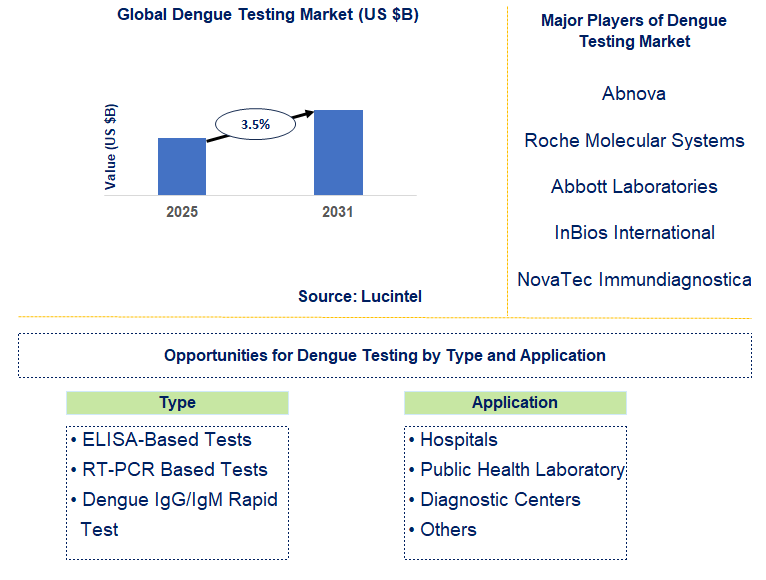
Key data points: The growth forecast = 3.5% annually for the next 7 years. Scroll below to get more insights. This market report covers trends, opportunities and forecasts in dengue testing market to 2031 by type (ELISA-based tests, RT-PCR based tests, and dengue IgG/IgM rapid test), application (hospitals, public health laboratory, diagnostic centers, and others), and region (North America, Europe, Asia Pacific, and the Rest of the World)
We'll send your sample report shortly.
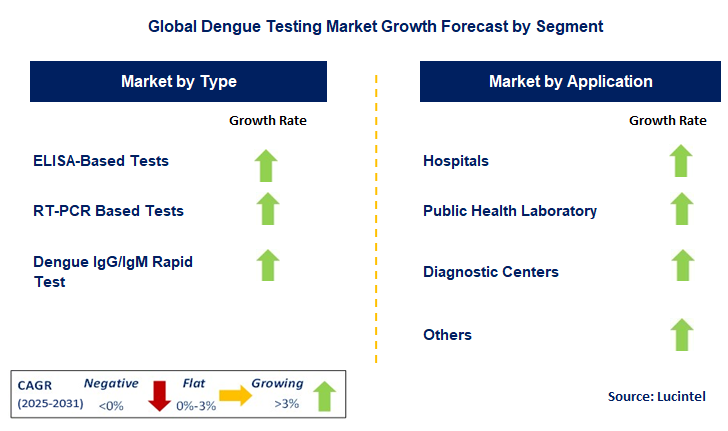
• Lucintel forecasts that, within the type category, dengue IgG/IgM rapid test is expected to witness the highest growth over the forecast period.
• Within the application category, diagnostic center is expected to witness the highest growth.
• In terms of region, APAC is expected to witness the highest growth over the forecast period. Gain valuable insights for your business decisions with our comprehensive 150+ page report. Sample figures with some insights are shown below.
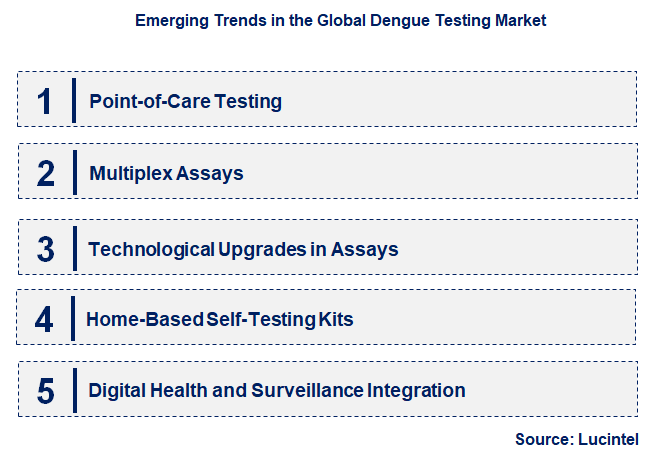
• Point-of-Care Testing: The trend towards point-of-care testing is an important one, transferring the diagnostics from centralized labs to clinics, physicians' offices, and even home care. POCT devices yield quick results, usually in 15-20 minutes, important for making timely clinical decisions and for outbreak control, especially for resource-poor settings. Such a trend decreases dependence on sophisticated lab facilities and skilled technicians, facilitating access to dengue testing. An example of this trend is the introduction of easy-to-handle rapid antigen and antibody kits, allowing quicker screening and enhancing patient care.
• Multiplex Assays: Multiplex assays are becoming an important trend as they enable the detection of several pathogens from one sample at a time. This is especially useful in areas where dengue is co-endemic with other febrile conditions such as chikungunya and Zika. The tests enhance the accuracy of diagnosis by distinguishing between closely symptomatic infections, thereby enabling clinicians to treat more effectively and specifically. Development of multiplex RT-PCR platforms is a significant step forward, improving the capacity for dealing with complicated cases and carrying out broader disease surveillance.
• Technological Upgrades in Assays: Ongoing technological upgrades are resulting in the generation of increasingly sensitive and specific diagnostic assays. Improvements involve the evolution of ELISA-based assays and the development of cutting-edge molecular procedures like CRISPR-based diagnostics. These new technologies enhance the fidelity of test results, particularly during the initial periods of infection when viral loads are potentially low. The emphasis is on designing assays that are not only precise but also more efficient and simpler to conduct, thus speeding up the diagnosis cycle and overall public health response.
• Home-Based Self-Testing Kits: Research and marketing of home-based self-testing kits are a great trend, making dengue diagnosis more democratic and empowering people. Home-based self-testing kits, like self-test kits for detection of NS1 antigen, enable one to carry out an initial test from the convenience of their home, decreasing the load on healthcare establishments. This trend is especially significant in those nations with high dengue incidence and poor access to clinical laboratories. Although they need verification from a doctor, these kits enable early diagnosis and prompt individuals to access medical care in time.
• Digital Health and Surveillance Integration: Digital technology integration with dengue testing is a common practice nowadays. This includes the utilization of digital platforms and mobile applications to read the test results and enable real-time surveillance of diseases. Digital technologies allow health authorities to monitor outbreaks, locate hotspots, and allocate resources more efficiently. Such as mobile-integrated diagnostic devices that can be connected to public health databases, which are assisting in developing stronger epidemiological maps. Data-driven strategies improve the general capacity to monitor and respond to dengue outbreaks, changing the emphasis from reactive to preventive disease control. In summary, all these trends together are transforming the dengue testing market by making diagnostics more rapid, precise, and more widely accessible. The shift towards point-of-care and home-based diagnosis, combined with the accuracy of multiplex and high-tech assays, is decentralizing diagnosis. Inclusion of digital health is further adding to public health surveillance and outbreak response. This transformation is resulting in a more productive and patient-focused market, ultimately enhancing clinical performance and worldwide dengue control measures.
• Introduction of Home-Use Self-Test Kits: Introduction of home-use self-test kits for dengue, like the NS1 antigen kit in India, is a groundbreaking event. It democratizes diagnostics by enabling one to conduct an initial screening test from home, with results within minutes. The effect is intensive as it enables early diagnosis in resource-poor situations and eases the burden on formal health systems.
• Multiplex RT-PCR Platform Advancements: One of the major advances is the improvement of multiplex RT-PCR platforms that can distinguish between dengue and other arboviruses such as Zika and chikungunya using a single sample. This is an important development since these diseases have similar early symptoms, and therefore clinical diagnosis is challenging. The effect of this development is enhanced diagnostic accuracy and efficient clinical management, as clinicians can easily recognize the exact infection and provide appropriate care.
• Introduction of High-Capacity Automated Systems: Introduction of high-capacity automated testing systems is a significant advancement, especially for big-scale dengue surveillance. The automated systems are able to test a large number of samples every day, which is required in the case of large outbreaks. The effect is a significant decrease in the turnaround time for test results, which allows the public health authorities to respond more effectively and quickly. This advancement is especially useful for public health institutes and centralized laboratories requiring surveillance of disease activity in a large population.
• Scaling up Rapid Diagnostic Tests: The ongoing development and enhancement of rapid diagnostic tests (RDTs) for dengue, especially those with increased sensitivity and specificity, is one such advancement. New RDTs are being developed to deliver correct results in less time, and they are perfect for point-of-care use in clinics and emergency departments. This will aid in the rapid triage of patients, enabling quicker treatment decisions. Their ease of use and portability render them precious assets for public health workers in rural settings.
• Greater Emphasis on Digital Integration: One of the most significant developments is the growing emphasis on integrating digital health platforms with dengue testing. This encompasses utilizing mobile apps and cloud-based systems for real-time reporting and analysis of test results. The effect is a more integrated and streamlined disease surveillance network. This technology allows for the rapid identification of new outbreaks, the visualization of disease trends, and the targeted allocation of public health resources. It shifts the paradigm from a reactive to a proactive approach to managing dengue, leveraging data to inform public health strategies. In summary, these recent developments are fundamentally reshaping the dengue testing market. They are taking diagnostics out of the laboratory and into the hands of the people with home-use kits and RDTs, nearer to accuracy with multiplex assays, and at higher volumes with high-capacity automated systems. Digital integration is accelerating surveillance and response. These combined advances are making for a stronger and more responsive market that can better address the dengue fever complexities and the global spread of the disease.
• Expansion of Point-of-Care Diagnostics: One major strategic growth area is the usage of point-of-care (POC) diagnostics. This segment of the market is growing at a fast pace since there is a huge demand for rapid, robust, and convenient testing solutions outside laboratories. Businesses can concentrate on the development and marketing of rapid diagnostic kits for application in clinics, emergency departments, and distant areas. The possibility is important because it fulfills an essential requirement for early diagnosis and therapy, especially in cases of limited healthcare facility. It also facilitates more rapid clinical choices, which will prove to be life-saving in instances of serious dengue.
• Growth in Public Health Laboratories and Surveillance: There is a large opportunity in offering sophisticated testing solutions to public health laboratories for disease surveillance and outbreak control. This entails creating high-throughput automated systems and multiplex assays capable of handling large volumes of samples economically. The strategic emphasis in this area is to collaborate with government institutions and global health organizations to assist their surveillance initiatives. This chance has its significant effects worldwide, with countries able to track disease patterns, detect outbreaks early, and apply specific control measures to prevent epidemic spread.
• Clinical Laboratory and Hospital Opportunities: Use of dengue testing in hospitals and clinical laboratories continues to be a fundamental growth opportunity. The emphasis is on providing complete diagnostic panels consisting of ELISA-based assays, molecular tests, and quick tests to ensure all phases of infection are targeted. Companies can strategically provide bundle-packaged platforms that integrate the whole diagnostic work flow, from sample harvesting to result analysis. This potential is most important for enhancing patient care in established healthcare systems.
• Capitalizing on the Home Healthcare Market: The new home healthcare market represents a distinctive growth prospect. With the growing preference for home care and the availability of user-friendly testing technology, firms can capture this market through direct-to-consumer self-testing products. The plan is to develop products that are easy to use, give clear instructions, and are easy to interpret. The effect is to empower people to become more active in their own health and encourage early detection and decrease the healthcare facility burden.
• Strategic Partnerships and Alliances: One of the greatest opportunities for growth is through strategic partnerships and alliances with distributors within endemic countries, technology companies, and government agencies. This enables companies to bypass logistics challenges and regulatory issues, and their product reaches high-need individuals. The approach is through partnership to create and deliver affordable and accessible testing products customized to regional requirements. All in all, these strategic growth opportunities are reformulating the dengue testing market by broadening its applications beyond conventional settings. The emphasis on point-of-care, public health surveillance, and home-based care is decentralizing diagnostics and making them more accessible. By exploiting these opportunities and collaborating strategically, companies are not only propelling their own development but also contributing directly to the global battle against dengue and leading to a more responsive and resilient public health system.
• Abnova
• Roche Molecular Systems
• Abbott Laboratories
• InBios International
• NovaTec Immundiagnostica
• Sub.PerkinElmer
• Quest Diagnostics
• Certest Biotec
• OriGene Technologies
• Thermo Fisher
• ELISA-Based Tests
• RT-PCR Based Tests
• Dengue IgG/IgM Rapid Test
• Hospitals
• Public Health Laboratory
• Diagnostic Centers
• Others
• North America
• Europe
• Asia Pacific
• The Rest of the World
• United States: In the United States, recent developments are spurred by an increase in travel-related dengue and proactive public health monitoring. The market is witnessing the rising use of sophisticated diagnostic platforms, including multiplex RT-PCR and fast NS1 antigen tests, in clinical laboratories and point-of-care environments. Government funding for tropical disease research and increased insurance coverage for dengue testing are the major drivers. Firms are introducing new products with FDA clearance, like rapid tests for utilization in travel clinics and emergency rooms, to respond to increasing demand for quick diagnosis and patient management.
• China: China's dengue test market is dominated by government-initiated programs and surveillance schemes. The nation is orienting efforts towards building its diagnostic infrastructure in order to control outbreaks. There is a growing need for fast and high-throughput tests to enable large-scale screening and epidemiological surveys. New technologies are being incorporated into public health labs to enhance the speed and sensitivity of dengue detection. Local industries also have their own diagnostic kits being developed and commercialized domestically, usually with government assistance.
• Germany: Germany's dengue testing market is dominated by a rigid focus on technologically sophisticated and high-quality diagnostic products. Although the nation has limited domestic disease burden, the market is compelled by the requirement to diagnose cases related to travel. This has prompted a demand for very sensitive and specific tests, comprising sophisticated ELISA and molecular assays. German firms are leading in research and development, frequently teaming up with foreign partners to develop and ship new diagnostic technologies. The market demands accuracy and reliability, and this affects what types of tests are being adopted.
• India: India is a leading participant in the dengue testing market across the globe because of its heavy disease burden and regular outbreaks. Current trends are directed towards greater accessibility and affordability of testing, particularly in rural and remote settings. The roll-out of home-use self-test kits and rapid diagnostic tests has been a major development, enabling faster initial screening. Demand is also increasing in the marketplace for multiplex assays that can distinguish dengue from other endemic febrile diseases. Government programs and private sector efforts are attempting to raise public consciousness and enhance diagnostic capabilities nationwide.
• Japan: Japan's dengue testing market is technologically advanced and fueled by an emphasis on high-accuracy diagnostic solutions. The country has a strong focus on research and development to screen for imported cases and head off local transmissions. The market is experiencing the deployment of advanced diagnosis technologies, like modern molecular and serological tests, into research and hospital environments. Research organizations and public health authorities are keenly participating in surveillance and research into next-generation diagnostics. The market is dominated by high quality standards and a desire for innovative and accurate testing technologies.


• Abnova
• Roche Molecular Systems
• Abbott Laboratories
• InBios International
• NovaTec Immundiagnostica
• Sub.PerkinElmer
• Quest Diagnostics
• Certest Biotec
• OriGene Technologies
• Thermo Fisher Q5. Which dengue testing market segment will be the largest in future? Answer: Lucintel forecasts that, within the type category, dengue IgG/IgM rapid test is expected to witness the highest growth over the forecast period. Q6. In dengue testing market, which region is expected to be the largest in next 5 years? Answer: In terms of region, APAC is expected to witness the highest growth over the forecast period. Q7. Do we receive customization in this report? Answer: Yes, Lucintel provides 10% customization without any additional cost.


Choose a license that fits your team. Instant PDF delivery.
Prices exclude taxes. Instant delivery. Custom licensing available on request.
Market Report · May 18, 2026
Market Report · May 18, 2026
Market Report · May 18, 2026
Trusted partner for strategic intelligence and business growth


Receive a complimentary market analysis tailored to your industry. Our analysts will identify key growth opportunities and competitive dynamics specific to your business.

Market size, growth rate, and key trend analysis for your specific sector.

Top competitor positioning and market share analysis.

Strategic recommendations backed by data-driven insights.
Get curated market intelligence and competitive moves straight to your inbox.
By subscribing, you agree to receive our monthly insights. Unsubscribe anytime.
Receive a complimentary market analysis tailored to your industry. Our analysts will identify key growth opportunities and competitive dynamics specific to your business.
Market size, growth rate, and key trend analysis for your specific sector.
Top competitor positioning and market share analysis.
Strategic recommendations backed by data-driven insights.
Get curated market intelligence, emerging trends, and competitive moves straight to your inbox each month.
By subscribing, you agree to receive our monthly insights. Unsubscribe anytime.
We'll send your sample report shortly.