
'
...

The Impact of COVID-19 is included in Defense Electronics Obsolescence Market Report. Buy it today to get an advantage.

Request the impact of COVID-19 on your product or industry


Defense Electronics Obsolescence Market Trends and Forecast

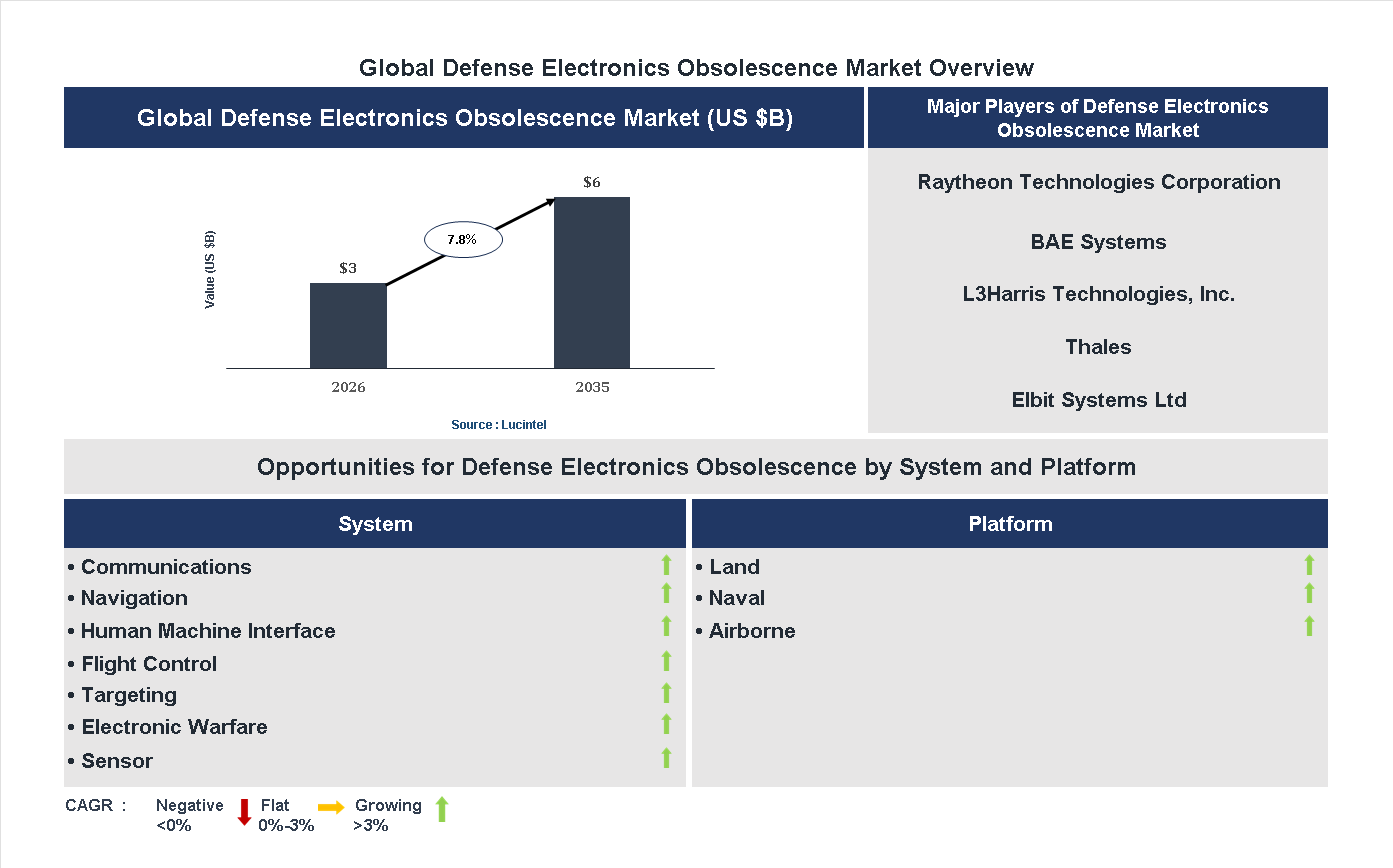
The future of the global defense electronics obsolescence market looks promising with opportunities in the land, naval, and airborne markets. The global defense electronics obsolescence market is expected to reach an estimated $6 billion by 2035 with a CAGR of 7.8% from 2026 to 2035. The major drivers for this market are the increasing demand for lifecycle management solutions, the rising challenges of aging defense electronic systems, and the growing need for component replacement strategies.

• Lucintel forecasts that, within the system category, electronic warfare is expected to witness the highest growth over the forecast period.
• Within the platform category, airborne is expected to witness the highest growth.
• In terms of region, APAC is expected to witness the highest growth over the forecast period.
Gain valuable insights for your business decisions with our comprehensive 150+ page report. Sample figures with some insights are shown below.
Defense Electronics Obsolescence Market Trends and Forecast

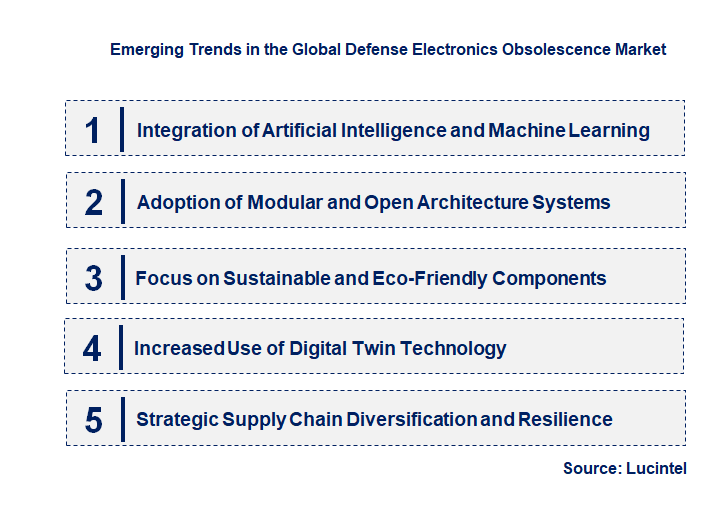
Emerging Trends in the Defense Electronics Obsolescence Market

The defense electronics obsolescence market is experiencing rapid transformation driven by technological advancements, increasing defense budgets, and the need for modernization of military systems. As defense organizations strive to maintain operational superiority, they face challenges related to outdated electronic components that threaten system reliability and security. Emerging trends are shaping the future landscape, emphasizing innovation, sustainability, and strategic procurement. These developments are not only extending the lifespan of defense systems but also reducing costs and enhancing performance. Understanding these key trends is essential for stakeholders aiming to stay ahead in this dynamic market environment.

• Integration of Artificial Intelligence (AI) and Machine Learning (ML): AI and ML are increasingly incorporated into defense electronics to improve system diagnostics, predictive maintenance, and decision-making processes. These technologies enable real-time data analysis, reducing downtime and enhancing operational efficiency. AI-driven obsolescence management tools help predict component failures, allowing proactive replacements and upgrades. This trend is transforming traditional maintenance approaches, making systems more autonomous and resilient. The impact includes increased system longevity, reduced maintenance costs, and improved mission success rates, positioning AI as a critical enabler in modern defense electronics.
• Adoption of Modular and Open Architecture Systems: Modular designs and open architecture are gaining popularity to facilitate easier upgrades and component replacements. These systems allow for flexible integration of new technologies without overhauling entire platforms, thus addressing obsolescence more effectively. Open standards promote interoperability among different systems and vendors, reducing dependency on single suppliers. This approach accelerates innovation cycles and minimizes lifecycle costs. The shift towards modularity is enabling defense agencies to adapt swiftly to emerging threats and technological changes, ensuring sustained operational readiness and cost efficiency.
• Focus on Sustainable and Eco-Friendly Components: Environmental considerations are influencing procurement strategies, with a focus on sustainable electronic components that have lower environmental impact. Manufacturers are developing eco-friendly materials and energy-efficient designs to meet regulatory standards and reduce carbon footprints. This trend supports the global push towards sustainability and aligns with defense agencies commitment to responsible resource management. The adoption of green components not only enhances corporate responsibility but also ensures compliance with evolving environmental regulations, ultimately contributing to a more sustainable defense electronics ecosystem.
• Increased Use of Digital Twin Technology: Digital twin technology creates virtual replicas of physical defense systems, enabling simulation, testing, and predictive maintenance. This approach helps identify obsolescence issues early and tests upgrades in a virtual environment before physical implementation. Digital twins improve system reliability, reduce downtime, and optimize maintenance schedules. They also facilitate better planning for obsolescence management by providing real-time insights into component performance. The integration of digital twin technology is revolutionizing maintenance strategies, leading to more efficient lifecycle management and cost savings across defense electronics systems.
• Strategic Supply Chain Diversification and Resilience: Defense organizations are diversifying their supply chains to mitigate risks associated with component obsolescence and geopolitical tensions. This includes sourcing from multiple vendors, developing local manufacturing capabilities, and establishing strategic stockpiles. Resilient supply chains ensure continuous availability of critical electronic components, reducing system downtime and operational risks. This trend is driven by geopolitical uncertainties and the need for self-reliance in defense procurement. Strengthening supply chain resilience enhances overall system sustainability, supports rapid modernization, and ensures readiness against emerging threats.

These emerging trends are fundamentally reshaping the defense electronics obsolescence market by fostering innovation, enhancing system flexibility, and promoting sustainability. They enable defense agencies to extend the lifespan of critical systems, reduce costs, and improve operational effectiveness. As these trends continue to evolve, they will drive a more resilient, adaptable, and technologically advanced defense electronics landscape, ensuring strategic superiority in an increasingly complex global security environment.
Emerging Trends in the Defense Electronics Obsolescence Market

Recent Development in the Defense Electronics Obsolescence Market

The defense electronics obsolescence market is experiencing rapid evolution driven by technological advancements, increasing defense budgets, and the need for modernization of military systems. As defense organizations seek to upgrade legacy systems, the demand for obsolescence management solutions grows. This market is crucial for maintaining operational readiness, ensuring cybersecurity, and integrating new technologies. Recent developments focus on innovative strategies to address obsolescence challenges, improve lifecycle management, and enhance system interoperability, ultimately supporting national security objectives and defense innovation.

• Growing Demand for Lifecycle Management Solutions: The increasing complexity of defense systems necessitates effective lifecycle management to address obsolescence. Companies are developing advanced tools for real-time monitoring, predictive analytics, and strategic planning to extend system longevity. These solutions help defense agencies reduce costs, minimize downtime, and ensure seamless integration of new components, thereby improving operational efficiency and readiness.
• Integration of Artificial Intelligence in Obsolescence Management: AI-driven solutions are transforming obsolescence management by enabling predictive maintenance and automated decision-making. AI algorithms analyze vast data sets to forecast component failures and recommend timely replacements. This reduces system downtime, enhances reliability, and optimizes inventory management, providing defense organizations with a proactive approach to obsolescence challenges and supporting rapid modernization efforts.
• Development of Modular and Open Architecture Systems: The shift towards modular designs and open architectures allows easier upgrades and component replacements, reducing obsolescence risks. These systems facilitate interoperability among different platforms and enable rapid integration of new technologies. Defense contractors are investing in flexible designs that extend system lifespans, lower costs, and improve adaptability to emerging threats, thus ensuring sustained operational capabilities.
• Focus on Cybersecurity and Obsolescence: As defense electronics become more interconnected, cybersecurity concerns related to obsolescence are rising. Recent developments include integrating cybersecurity measures into obsolescence management strategies to protect against cyber threats. Enhanced encryption, secure firmware updates, and vulnerability assessments are being incorporated, ensuring that modernization efforts do not compromise system security and resilience against evolving cyber-attacks.
• Adoption of Digital Twin Technology for Obsolescence Prediction: Digital twin technology creates virtual replicas of defense systems to simulate performance and predict obsolescence issues. This approach allows for detailed analysis of system components, testing of upgrade scenarios, and proactive planning. Digital twins improve decision-making accuracy, reduce costs associated with unexpected failures, and accelerate modernization timelines, ultimately supporting more resilient and adaptable defense systems.

These recent developments significantly impact the defense electronics obsolescence market by enabling more efficient lifecycle management, enhancing system reliability, and supporting rapid technological integration. They foster innovation, reduce costs, and improve operational readiness, ensuring defense systems remain effective against evolving threats. As these strategies mature, the market will see increased adoption, driving growth and strengthening national security capabilities.

Strategic Growth Opportunities in the Defense Electronics Obsolescence Market

The defense electronics obsolescence market is experiencing rapid growth driven by the increasing need to upgrade aging military systems, technological advancements, and the demand for enhanced operational efficiency. As defense budgets expand and modernization initiatives accelerate, addressing obsolescence becomes critical for maintaining strategic superiority. Market players are focusing on innovative solutions to extend the lifespan of defense electronics, ensuring compatibility with new systems and reducing costs. This evolving landscape presents significant opportunities for companies to develop tailored obsolescence management strategies and innovative replacement components.

• Upgrading Legacy Systems for Enhanced Military Capabilities: The increasing reliance on outdated defense electronics necessitates modernization to improve operational efficiency, safety, and interoperability. Defense agencies seek cost-effective solutions to replace obsolete components without overhauling entire systems, leading to growth in retrofit and upgrade services. This trend supports the development of specialized replacement parts, software updates, and system integration services, ensuring military readiness and compliance with evolving standards.
• Development of Custom Obsolescence Management Solutions: As defense systems become more complex, tailored obsolescence management strategies are in high demand. Companies are offering comprehensive lifecycle management, including component tracking, risk assessment, and strategic planning. These solutions help military organizations minimize downtime, reduce costs, and ensure seamless integration of new technologies, fostering long-term partnerships and expanding market share in defense electronics modernization.
• Integration of Artificial Intelligence for Predictive Obsolescence Planning: AI-driven analytics enable proactive identification of potential obsolescence issues before they impact operations. By analyzing data from various sources, defense contractors can forecast component failures and plan timely replacements. This approach enhances system reliability, reduces maintenance costs, and extends the lifespan of critical defense electronics, creating new opportunities for AI-enabled obsolescence management tools and software solutions.
• Expansion of Remanufacturing and Reuse of Electronic Components: Remanufacturing offers a sustainable and cost-effective alternative to new component procurement. Companies are investing in advanced testing, refurbishment, and re-certification processes to reuse electronic parts, reducing lead times and costs. This approach supports military sustainability goals and ensures supply chain resilience, especially in times of global shortages or disruptions, thereby fueling growth in remanufactured defense electronics.
• Increasing Adoption of Modular and Open Architecture Systems: Modular designs facilitate easier upgrades and replacements, addressing obsolescence more efficiently. Open architecture systems enable interoperability among different platforms and future-proofing against rapid technological changes. Defense organizations are increasingly adopting these systems to extend the lifecycle of existing assets, reduce obsolescence-related costs, and accelerate integration of new technologies, driving innovation and market expansion in defense electronics.

The defense electronics obsolescence market is poised for substantial growth as modernization efforts, technological innovations, and strategic lifecycle management become central to defense operations. Opportunities in system upgrades, AI-driven planning, remanufacturing, and modular architectures will enable defense agencies to maintain technological superiority while optimizing costs. These developments will foster innovation, improve system reliability, and ensure long-term sustainability, significantly shaping the future landscape of defense electronics modernization.

Defense Electronics Obsolescence Market Driver and Challenges

The defense electronics obsolescence market is influenced by a complex interplay of technological advancements, economic factors, and regulatory frameworks. Rapid technological innovation often leads to the quick obsolescence of electronic components, compelling defense agencies to update systems frequently. Economic constraints, including budget limitations and cost pressures, impact procurement and modernization efforts. Additionally, regulatory standards related to security, compliance, and environmental concerns shape market dynamics. These factors collectively drive the need for continuous innovation and strategic planning within the defense sector, while also presenting significant challenges in managing legacy systems and ensuring compliance. Understanding these drivers and challenges is essential for stakeholders aiming to optimize defense electronics lifecycle management.

The factors responsible for driving the defense electronics obsolescence market include:
• Technological Innovation: Rapid advancements in electronics and communication technologies necessitate frequent upgrades of defense systems. As new, more efficient components become available, older systems become obsolete, prompting defense organizations to invest in modernization to maintain operational superiority. This continuous cycle of innovation drives demand for new electronic components and systems, fostering a dynamic market environment. The need to integrate cutting-edge technology for enhanced performance and security further accelerates obsolescence, compelling defense agencies to adopt proactive lifecycle management strategies.
• Budget Constraints and Cost Pressures: Defense budgets are often limited and subject to political and economic fluctuations. The high costs associated with replacing or upgrading electronic systems pose significant challenges, especially for maintaining legacy systems. Cost pressures compel defense organizations to find cost-effective solutions, such as component obsolescence mitigation and strategic sourcing. These financial constraints influence procurement decisions, prioritize maintenance over replacement, and drive innovation in obsolescence management techniques, ultimately shaping the market landscape.
• Regulatory and Compliance Standards: Stringent government regulations related to security, environmental impact, and export controls influence the defense electronics market. Compliance with standards such as ITAR (International Traffic in Arms Regulations) and environmental directives necessitates continuous updates and modifications to electronic components. These regulatory requirements can accelerate obsolescence, as older components may no longer meet current standards, prompting manufacturers and defense agencies to adapt quickly. Navigating complex regulatory environments is crucial for market players to ensure legal compliance and sustain market growth.
• Supply Chain Dynamics: The global supply chain for electronic components is highly complex and susceptible to disruptions, geopolitical tensions, and trade restrictions. Dependence on specific suppliers or regions can lead to shortages and delays, exacerbating obsolescence issues. Supply chain vulnerabilities compel defense organizations to develop resilient sourcing strategies, including component standardization and inventory management. These dynamics influence market stability and drive innovation in supply chain management solutions to mitigate obsolescence risks.
• Lifecycle Management Strategies: The adoption of proactive lifecycle management practices, including obsolescence forecasting, component obsolescence mitigation, and strategic sourcing, is a key driver. These strategies enable defense organizations to extend the lifespan of existing systems, reduce costs, and ensure operational readiness. The increasing emphasis on lifecycle management fosters innovation in obsolescence mitigation technologies and services, creating new market opportunities. Effective lifecycle management is essential for balancing technological obsolescence with budgetary and operational constraints.

The challenges facing the defense electronics obsolescence market include:
• Rapid Technological Obsolescence: The fast pace of technological change makes it difficult for defense organizations to keep systems up-to-date. Legacy systems often become outdated quickly, leading to increased maintenance costs and reduced operational effectiveness. Managing obsolescence requires significant investment in research, development, and procurement of new components, which can strain budgets and delay modernization efforts. Additionally, integrating new technology into existing systems poses compatibility and interoperability challenges, complicating lifecycle management.
• Supply Chain Disruptions: The global supply chain for electronic components is vulnerable to geopolitical tensions, trade restrictions, and natural disasters. These disruptions can cause shortages of critical components, delaying system upgrades and maintenance. Dependence on single-source suppliers or regions increases vulnerability, making it difficult to ensure timely availability of parts. Such disruptions hinder the ability to replace obsolete components promptly, increasing operational risks and costs associated with maintaining aging systems.
• Regulatory and Security Compliance: Evolving regulatory standards and security requirements impose additional burdens on defense electronics. Ensuring compliance with export controls, environmental regulations, and cybersecurity standards can be complex and costly. Non-compliance may lead to legal penalties, export restrictions, or security vulnerabilities. The need to constantly update systems to meet new standards can accelerate obsolescence, forcing organizations to undertake frequent and costly upgrades, which may not always be feasible within budget constraints.

The defense electronics obsolescence market is driven by rapid technological innovation, economic pressures, regulatory standards, supply chain complexities, and strategic lifecycle management. While these drivers foster growth and modernization, challenges such as rapid obsolescence, supply disruptions, and compliance requirements pose significant hurdles. Navigating these factors requires a balanced approach, leveraging innovation and strategic planning to sustain operational readiness and technological superiority in defense systems. The overall market outlook depends on how effectively stakeholders can address these challenges while capitalizing on emerging opportunities.

List of Defense Electronics Obsolescence Companies

Companies in the market compete on the basis of product quality offered. Major players in this market focus on expanding their manufacturing facilities, R&D investments, infrastructural development, and leverage integration opportunities across the value chain. With these strategies defense electronics obsolescence companies cater increasing demand, ensure competitive effectiveness, develop innovative products & technologies, reduce production costs, and expand their customer base. Some of the defense electronics obsolescence companies profiled in this report include-
• Raytheon Technologies Corporation
• BAE Systems
• L3Harris Technologies, Inc.
• Thales
• Elbit Systems Ltd

Defense Electronics Obsolescence Market by Segment

The study includes a forecast for the global defense electronics obsolescence market by system, platform, and region.

Defense Electronics Obsolescence Market by System [Value from 2019 to 2035]:


• Communications
• Navigation
• Human Machine Interface
• Flight Control
• Targeting
• Electronic Warfare
• Sensor

Defense Electronics Obsolescence Market by Platform [Value from 2019 to 2035]:


• Land
• Naval
• Airborne

Defense Electronics Obsolescence Market by Region [Value from 2019 to 2035]:


• North America
• Europe
• Asia Pacific
• The Rest of the World

Country Wise Outlook for the Defense Electronics Obsolescence Market

The defense electronics obsolescence market is experiencing rapid evolution driven by technological advancements, geopolitical shifts, and increasing defense budgets worldwide. Countries are focusing on modernizing their military systems to maintain strategic advantages, which involves addressing obsolescence in electronic components. This market is characterized by innovations in replacement solutions, upgrades, and integrated systems to ensure operational readiness. Governments are investing heavily in research and development to extend the lifespan of existing equipment and incorporate cutting-edge technology. The following summaries highlight recent developments in this sector across the United States, China, Germany, India, and Japan, reflecting their strategic priorities and technological progress.

• United States: The US defense sector is prioritizing the development of advanced electronic warfare systems and cyber defense capabilities. Significant investments are being made in replacing outdated components with modern, secure, and resilient electronics. The Department of Defense is also focusing on integrating artificial intelligence and machine learning to enhance situational awareness and decision-making. Efforts are underway to upgrade legacy platforms like aircraft and naval vessels to ensure compatibility with new electronic systems, reducing obsolescence risks.
• China: China is rapidly advancing its defense electronics to support its growing military ambitions. The country is investing in indigenous technology development to reduce reliance on foreign components, especially in missile systems and naval electronics. Recent initiatives include upgrading radar and communication systems with more sophisticated, longer-lasting electronics. China is also emphasizing the development of electronic countermeasure systems to improve battlefield survivability and electronic warfare capabilities.
• Germany: Germany is focusing on modernizing its defense electronics through collaborative European projects and indigenous innovation. The Bundeswehr is upgrading its armored vehicles, aircraft, and naval vessels with state-of-the-art electronic systems to address obsolescence. Germany is also investing in cybersecurity measures to protect electronic systems from cyber threats. The emphasis is on ensuring interoperability within NATO and enhancing the resilience of defense electronics against evolving threats.
• India: India is actively working to modernize its defense electronics infrastructure amid regional security concerns. The country is developing indigenous electronic warfare and communication systems to reduce dependency on foreign suppliers. Recent developments include upgrading missile defense systems and naval electronics with newer, more reliable components. India is also focusing on establishing a robust supply chain for defense electronics to address obsolescence and ensure timely upgrades.
• Japan: Japan is emphasizing the modernization of its defense electronics to counter regional threats, particularly in the Indo-Pacific region. The country is investing in advanced radar, missile guidance, and communication systems to enhance its defense capabilities. Japan is also collaborating with international partners to develop resilient electronic systems and reduce vulnerabilities. Efforts are underway to upgrade existing platforms with newer electronics that offer longer operational lifespans and improved performance.

Lucintel Analytics Dashboard

Features of the Global Defense Electronics Obsolescence Market

Market Size Estimates: Defense electronics obsolescence market size estimation in terms of value ($B).
Trend and Forecast Analysis: Market trends (2019 to 2025) and forecast (2026 to 2035) by various segments and regions.
Segmentation Analysis: Defense electronics obsolescence market size by system, platform, and region in terms of value ($B).
Regional Analysis: Defense electronics obsolescence market breakdown by North America, Europe, Asia Pacific, and Rest of the World.
Growth Opportunities: Analysis of growth opportunities in different systems, platforms, and regions for the defense electronics obsolescence market.
Strategic Analysis: This includes M&A, new product development, and competitive landscape of the defense electronics obsolescence market.
Analysis of competitive intensity of the industry based on Porter’s Five Forces model.

Lucintel Consulting Services

FAQ

Q1. What is the defense electronics obsolescence market size?
Answer: The global defense electronics obsolescence market is expected to reach an estimated $6 billion by 2035.
Q2. What is the growth forecast for defense electronics obsolescence market?
Answer: The global defense electronics obsolescence market is expected to grow with a CAGR of 7.8% from 2026 to 2035.
Q3. What are the major drivers influencing the growth of the defense electronics obsolescence market?
Answer: The major drivers for this market are the increasing demand for lifecycle management solutions, the rising challenges of aging defense electronic systems, and the growing need for component replacement strategies.
Q4. What are the major segments for defense electronics obsolescence market?
Answer: The future of the defense electronics obsolescence market looks promising with opportunities in the land, naval, and airborne markets.
Q5. Who are the key defense electronics obsolescence market companies?
Answer: Some of the key defense electronics obsolescence companies are as follows:
• Raytheon Technologies Corporation
• BAE Systems
• L3Harris Technologies, Inc.
• Thales
• Elbit Systems Ltd
Q6. Which defense electronics obsolescence market segment will be the largest in future?
Answer: Lucintel forecasts that, within the system category, electronic warfare is expected to witness the highest growth over the forecast period.
Q7. In defense electronics obsolescence market, which region is expected to be the largest in next 8 years?
Answer: In terms of region, APAC is expected to witness the highest growth over the forecast period.
Q8. Do we receive customization in this report?
Answer: Yes, Lucintel provides 10% customization without any additional cost.

This report answers following 11 key questions:

Q.1. What are some of the most promising, high-growth opportunities for the defense electronics obsolescence market by system (communications, navigation, human machine interface, flight control, targeting, electronic warfare, and sensor), platform (land, naval, and airborne), and region (North America, Europe, Asia Pacific, and the Rest of the World)?
Q.2. Which segments will grow at a faster pace and why?
Q.3. Which region will grow at a faster pace and why?
Q.4. What are the key factors affecting market dynamics? What are the key challenges and business risks in this market?
Q.5. What are the business risks and competitive threats in this market?
Q.6. What are the emerging trends in this market and the reasons behind them?
Q.7. What are some of the changing demands of customers in the market?
Q.8. What are the new developments in the market? Which companies are leading these developments?
Q.9. Who are the major players in this market? What strategic initiatives are key players pursuing for business growth?
Q.10. What are some of the competing products in this market and how big of a threat do they pose for loss of market share by material or product substitution?
Q.11. What M&A activity has occurred in the last 5 years and what has its impact been on the industry?

For any questions related to Defense Electronics Obsolescence Market, Defense Electronics Obsolescence Market Size, Defense Electronics Obsolescence Market Growth, Defense Electronics Obsolescence Market Analysis, Defense Electronics Obsolescence Market Report, Defense Electronics Obsolescence Market Share, Defense Electronics Obsolescence Market Trends, Defense Electronics Obsolescence Market Forecast, Defense Electronics Obsolescence Companies, write Lucintel analyst at email: helpdesk@lucintel.com. We will be glad to get back to you soon.
                                           Table of Contents

            1. Executive Summary

            2. Market Overview

                        2.1 Background and Classifications
                        2.2 Supply Chain

            3. Market Trends & Forecast Analysis

                        3.1 Macroeconomic Trends and Forecasts
                        3.2 Industry Drivers and Challenges
                        3.3 PESTLE Analysis
                        3.4 Patent Analysis
                        3.5 Regulatory Environment
                        3.6 Global Defense Electronics Obsolescence Market Trends and Forecast

            4. Global Defense Electronics Obsolescence Market by System

                        4.1 Overview
                        4.2 Attractiveness Analysis by System
                        4.3 Communications : Trends and Forecast (2019 to 2035)
                        4.4 Navigation : Trends and Forecast (2019 to 2035)
                        4.5 Human Machine Interface : Trends and Forecast (2019 to 2035)
                        4.6 Flight Control : Trends and Forecast (2019 to 2035)
                        4.7 Targeting : Trends and Forecast (2019 to 2035)
                        4.8 Electronic Warfare : Trends and Forecast (2019 to 2035)
                        4.9 Sensor : Trends and Forecast (2019 to 2035)

            5. Global Defense Electronics Obsolescence Market by Platform

                        5.1 Overview
                        5.2 Attractiveness Analysis by Platform
                        5.3 Land : Trends and Forecast (2019 to 2035)
                        5.4 Naval : Trends and Forecast (2019 to 2035)
                        5.5 Airborne : Trends and Forecast (2019 to 2035)

            6. Regional Analysis

                        6.1 Overview
                        6.2 Global Defense Electronics Obsolescence Market by Region

            7. North American Defense Electronics Obsolescence Market

                        7.1 Overview
                        7.2 North American Defense Electronics Obsolescence Market by System
                        7.3 North American Defense Electronics Obsolescence Market by Platform
                        7.4 The United States Defense Electronics Obsolescence Market
                        7.5 Canadian Defense Electronics Obsolescence Market
                        7.6 Mexican Defense Electronics Obsolescence Market

            8. European Defense Electronics Obsolescence Market

                        8.1 Overview
                        8.2 European Defense Electronics Obsolescence Market by System
                        8.3 European Defense Electronics Obsolescence Market by Platform
                        8.4 German Defense Electronics Obsolescence Market
                        8.5 French Defense Electronics Obsolescence Market
                        8.6 Italian Defense Electronics Obsolescence Market
                        8.7 Spanish Defense Electronics Obsolescence Market
                        8.8 The United Kingdom Defense Electronics Obsolescence Market

            9. APAC Defense Electronics Obsolescence Market

                        9.1 Overview
                        9.2 APAC Defense Electronics Obsolescence Market by System
                        9.3 APAC Defense Electronics Obsolescence Market by Platform
                        9.4 Chinese Defense Electronics Obsolescence Market
                        9.5 Indian Defense Electronics Obsolescence Market
                        9.6 Japanese Defense Electronics Obsolescence Market
                        9.7 South Korean Defense Electronics Obsolescence Market
                        9.8 Indonesian Defense Electronics Obsolescence Market

            10. ROW Defense Electronics Obsolescence Market

                        10.1 Overview
                        10.2 ROW Defense Electronics Obsolescence Market by System
                        10.3 ROW Defense Electronics Obsolescence Market by Platform
                        10.4 Middle Eastern Defense Electronics Obsolescence Market
                        10.5 South American Defense Electronics Obsolescence Market
                        10.6 African Defense Electronics Obsolescence Market

            11. Competitor Analysis

                        11.1 Product Portfolio Analysis
                        11.2 Operational Integration
                        11.3 Porter’s Five Forces Analysis
                                    • Competitive Rivalry
                                    • Bargaining Power of Buyers
                                    • Bargaining Power of Suppliers
                                    • Threat of Substitutes
                                    • Threat of New Entrants
                        11.4 Market Share Analysis

            12. Opportunities & Strategic Analysis

                        12.1 Value Chain Analysis
                        12.2 Growth Opportunity Analysis
                                    12.2.1 Growth Opportunity by System
                                    12.2.2 Growth Opportunity by Platform
                                    12.2.3 Growth Opportunity by Region
                        12.3 Emerging Trends in the Global Defense Electronics Obsolescence Market
                        12.4 Strategic Analysis
                                    12.4.1 New Product Development
                                    12.4.2 Certification and Licensing
                                    12.4.3 Mergers, Acquisitions, Agreements, Collaborations, and Joint Ventures

            13. Company Profiles of the Leading Players Across the Value Chain

                        13.1 Competitive Analysis Overview
                        13.2 Raytheon Technologies Corporation
                                    • Company Overview
                                    • Defense Electronics Obsolescence Market Business Overview
                                    • New Product Development
                                    • Merger, Acquisition, and Collaboration
                                    • Certification and Licensing
                        13.3 BAE Systems
                                    • Company Overview
                                    • Defense Electronics Obsolescence Market Business Overview
                                    • New Product Development
                                    • Merger, Acquisition, and Collaboration
                                    • Certification and Licensing
                        13.4 L3Harris Technologies, Inc.
                                    • Company Overview
                                    • Defense Electronics Obsolescence Market Business Overview
                                    • New Product Development
                                    • Merger, Acquisition, and Collaboration
                                    • Certification and Licensing
                        13.5 Thales
                                    • Company Overview
                                    • Defense Electronics Obsolescence Market Business Overview
                                    • New Product Development
                                    • Merger, Acquisition, and Collaboration
                                    • Certification and Licensing
                        13.6 Elbit Systems Ltd
                                    • Company Overview
                                    • Defense Electronics Obsolescence Market Business Overview
                                    • New Product Development
                                    • Merger, Acquisition, and Collaboration
                                    • Certification and Licensing

            14. Appendix

                        14.1 List of Figures
                        14.2 List of Tables
                        14.3 Research Methodology
                        14.4 Disclaimer
                        14.5 Copyright
                        14.6 Abbreviations and Technical Units
                        14.7 About Us
                        14.8 Contact Us

                                               List of Figures


            Chapter 1

                        Figure 1.1: Trends and Forecast for the Global Defense Electronics Obsolescence Market

            Chapter 2

                        Figure 2.1: Usage of Defense Electronics Obsolescence Market
                        Figure 2.2: Classification of the Global Defense Electronics Obsolescence Market
                        Figure 2.3: Supply Chain of the Global Defense Electronics Obsolescence Market

            Chapter 3

                        Figure 3.1: Trends of the Global GDP Growth Rate
                        Figure 3.2: Trends of the Global Population Growth Rate
                        Figure 3.3: Trends of the Global Inflation Rate
                        Figure 3.4: Trends of the Global Unemployment Rate
                        Figure 3.5: Trends of the Regional GDP Growth Rate
                        Figure 3.6: Trends of the Regional Population Growth Rate
                        Figure 3.7: Trends of the Regional Inflation Rate
                        Figure 3.8: Trends of the Regional Unemployment Rate
                        Figure 3.9: Trends of Regional Per Capita Income
                        Figure 3.10: Forecast for the Global GDP Growth Rate
                        Figure 3.11: Forecast for the Global Population Growth Rate
                        Figure 3.12: Forecast for the Global Inflation Rate
                        Figure 3.13: Forecast for the Global Unemployment Rate
                        Figure 3.14: Forecast for the Regional GDP Growth Rate
                        Figure 3.15: Forecast for the Regional Population Growth Rate
                        Figure 3.16: Forecast for the Regional Inflation Rate
                        Figure 3.17: Forecast for the Regional Unemployment Rate
                        Figure 3.18: Forecast for Regional Per Capita Income
                        Figure 3.19: Driver and Challenges of the Defense Electronics Obsolescence Market

            Chapter 4

                        Figure 4.1: Global Defense Electronics Obsolescence Market by System in 2019, 2025, and 2035
                        Figure 4.2: Trends of the Global Defense Electronics Obsolescence Market ($B) by System
                        Figure 4.3: Forecast for the Global Defense Electronics Obsolescence Market ($B) by System
                        Figure 4.4: Trends and Forecast for Communications in the Global Defense Electronics Obsolescence Market (2019-2035)
                        Figure 4.5: Trends and Forecast for Navigation in the Global Defense Electronics Obsolescence Market (2019-2035)
                        Figure 4.6: Trends and Forecast for Human Machine Interface in the Global Defense Electronics Obsolescence Market (2019-2035)
                        Figure 4.7: Trends and Forecast for Flight Control in the Global Defense Electronics Obsolescence Market (2019-2035)
                        Figure 4.8: Trends and Forecast for Targeting in the Global Defense Electronics Obsolescence Market (2019-2035)
                        Figure 4.9: Trends and Forecast for Electronic Warfare in the Global Defense Electronics Obsolescence Market (2019-2035)
                        Figure 4.10: Trends and Forecast for Sensor in the Global Defense Electronics Obsolescence Market (2019-2035)

            Chapter 5

                        Figure 5.1: Global Defense Electronics Obsolescence Market by Platform in 2019, 2025, and 2035
                        Figure 5.2: Trends of the Global Defense Electronics Obsolescence Market ($B) by Platform
                        Figure 5.3: Forecast for the Global Defense Electronics Obsolescence Market ($B) by Platform
                        Figure 5.4: Trends and Forecast for Land in the Global Defense Electronics Obsolescence Market (2019-2035)
                        Figure 5.5: Trends and Forecast for Naval in the Global Defense Electronics Obsolescence Market (2019-2035)
                        Figure 5.6: Trends and Forecast for Airborne in the Global Defense Electronics Obsolescence Market (2019-2035)

            Chapter 6

                        Figure 6.1: Trends of the Global Defense Electronics Obsolescence Market ($B) by Region (2019-2025)
                        Figure 6.2: Forecast for the Global Defense Electronics Obsolescence Market ($B) by Region (2026-2035)

            Chapter 7

                        Figure 7.1: Trends and Forecast for the North American Defense Electronics Obsolescence Market (2019-2035)
                        Figure 7.2: North American Defense Electronics Obsolescence Market by System in 2019, 2025, and 2035
                        Figure 7.3: Trends of the North American Defense Electronics Obsolescence Market ($B) by System (2019-2025)
                        Figure 7.4: Forecast for the North American Defense Electronics Obsolescence Market ($B) by System (2026-2035)
                        Figure 7.5: North American Defense Electronics Obsolescence Market by Platform in 2019, 2025, and 2035
                        Figure 7.6: Trends of the North American Defense Electronics Obsolescence Market ($B) by Platform (2019-2025)
                        Figure 7.7: Forecast for the North American Defense Electronics Obsolescence Market ($B) by Platform (2026-2035)
                        Figure 7.8: Trends and Forecast for the United States Defense Electronics Obsolescence Market ($B) (2019-2035)
                        Figure 7.9: Trends and Forecast for the Mexican Defense Electronics Obsolescence Market ($B) (2019-2035)
                        Figure 7.10: Trends and Forecast for the Canadian Defense Electronics Obsolescence Market ($B) (2019-2035)

            Chapter 8

                        Figure 8.1: Trends and Forecast for the European Defense Electronics Obsolescence Market (2019-2035)
                        Figure 8.2: European Defense Electronics Obsolescence Market by System in 2019, 2025, and 2035
                        Figure 8.3: Trends of the European Defense Electronics Obsolescence Market ($B) by System (2019-2025)
                        Figure 8.4: Forecast for the European Defense Electronics Obsolescence Market ($B) by System (2026-2035)
                        Figure 8.5: European Defense Electronics Obsolescence Market by Platform in 2019, 2025, and 2035
                        Figure 8.6: Trends of the European Defense Electronics Obsolescence Market ($B) by Platform (2019-2025)
                        Figure 8.7: Forecast for the European Defense Electronics Obsolescence Market ($B) by Platform (2026-2035)
                        Figure 8.8: Trends and Forecast for the German Defense Electronics Obsolescence Market ($B) (2019-2035)
                        Figure 8.9: Trends and Forecast for the French Defense Electronics Obsolescence Market ($B) (2019-2035)
                        Figure 8.10: Trends and Forecast for the Spanish Defense Electronics Obsolescence Market ($B) (2019-2035)
                        Figure 8.11: Trends and Forecast for the Italian Defense Electronics Obsolescence Market ($B) (2019-2035)
                        Figure 8.12: Trends and Forecast for the United Kingdom Defense Electronics Obsolescence Market ($B) (2019-2035)

            Chapter 9

                        Figure 9.1: Trends and Forecast for the APAC Defense Electronics Obsolescence Market (2019-2035)
                        Figure 9.2: APAC Defense Electronics Obsolescence Market by System in 2019, 2025, and 2035
                        Figure 9.3: Trends of the APAC Defense Electronics Obsolescence Market ($B) by System (2019-2025)
                        Figure 9.4: Forecast for the APAC Defense Electronics Obsolescence Market ($B) by System (2026-2035)
                        Figure 9.5: APAC Defense Electronics Obsolescence Market by Platform in 2019, 2025, and 2035
                        Figure 9.6: Trends of the APAC Defense Electronics Obsolescence Market ($B) by Platform (2019-2025)
                        Figure 9.7: Forecast for the APAC Defense Electronics Obsolescence Market ($B) by Platform (2026-2035)
                        Figure 9.8: Trends and Forecast for the Japanese Defense Electronics Obsolescence Market ($B) (2019-2035)
                        Figure 9.9: Trends and Forecast for the Indian Defense Electronics Obsolescence Market ($B) (2019-2035)
                        Figure 9.10: Trends and Forecast for the Chinese Defense Electronics Obsolescence Market ($B) (2019-2035)
                        Figure 9.11: Trends and Forecast for the South Korean Defense Electronics Obsolescence Market ($B) (2019-2035)
                        Figure 9.12: Trends and Forecast for the Indonesian Defense Electronics Obsolescence Market ($B) (2019-2035)

            Chapter 10

                        Figure 10.1: Trends and Forecast for the ROW Defense Electronics Obsolescence Market (2019-2035)
                        Figure 10.2: ROW Defense Electronics Obsolescence Market by System in 2019, 2025, and 2035
                        Figure 10.3: Trends of the ROW Defense Electronics Obsolescence Market ($B) by System (2019-2025)
                        Figure 10.4: Forecast for the ROW Defense Electronics Obsolescence Market ($B) by System (2026-2035)
                        Figure 10.5: ROW Defense Electronics Obsolescence Market by Platform in 2019, 2025, and 2035
                        Figure 10.6: Trends of the ROW Defense Electronics Obsolescence Market ($B) by Platform (2019-2025)
                        Figure 10.7: Forecast for the ROW Defense Electronics Obsolescence Market ($B) by Platform (2026-2035)
                        Figure 10.8: Trends and Forecast for the Middle Eastern Defense Electronics Obsolescence Market ($B) (2019-2035)
                        Figure 10.9: Trends and Forecast for the South American Defense Electronics Obsolescence Market ($B) (2019-2035)
                        Figure 10.10: Trends and Forecast for the African Defense Electronics Obsolescence Market ($B) (2019-2035)

            Chapter 11

                        Figure 11.1: Porter’s Five Forces Analysis of the Global Defense Electronics Obsolescence Market
                        Figure 11.2: Market Share (%) of Top Players in the Global Defense Electronics Obsolescence Market (2025)

            Chapter 12

                        Figure 12.1: Growth Opportunities for the Global Defense Electronics Obsolescence Market by System
                        Figure 12.2: Growth Opportunities for the Global Defense Electronics Obsolescence Market by Platform
                        Figure 12.3: Growth Opportunities for the Global Defense Electronics Obsolescence Market by Region
                        Figure 12.4: Emerging Trends in the Global Defense Electronics Obsolescence Market

                                               List of Tables


            Chapter 1

                        Table 1.1: Growth Rate (%, 2024-2025) and CAGR (%, 2026-2035) of the Defense Electronics Obsolescence Market by System and Platform
                        Table 1.2: Attractiveness Analysis for the Defense Electronics Obsolescence Market by Region
                        Table 1.3: Global Defense Electronics Obsolescence Market Parameters and Attributes

            Chapter 3

                        Table 3.1: Trends of the Global Defense Electronics Obsolescence Market (2019-2025)
                        Table 3.2: Forecast for the Global Defense Electronics Obsolescence Market (2026-2035)

            Chapter 4

                        Table 4.1: Attractiveness Analysis for the Global Defense Electronics Obsolescence Market by System
                        Table 4.2: Market Size and CAGR of Various System in the Global Defense Electronics Obsolescence Market (2019-2025)
                        Table 4.3: Market Size and CAGR of Various System in the Global Defense Electronics Obsolescence Market (2026-2035)
                        Table 4.4: Trends of Communications in the Global Defense Electronics Obsolescence Market (2019-2025)
                        Table 4.5: Forecast for Communications in the Global Defense Electronics Obsolescence Market (2026-2035)
                        Table 4.6: Trends of Navigation in the Global Defense Electronics Obsolescence Market (2019-2025)
                        Table 4.7: Forecast for Navigation in the Global Defense Electronics Obsolescence Market (2026-2035)
                        Table 4.8: Trends of Human Machine Interface in the Global Defense Electronics Obsolescence Market (2019-2025)
                        Table 4.9: Forecast for Human Machine Interface in the Global Defense Electronics Obsolescence Market (2026-2035)
                        Table 4.10: Trends of Flight Control in the Global Defense Electronics Obsolescence Market (2019-2025)
                        Table 4.11: Forecast for Flight Control in the Global Defense Electronics Obsolescence Market (2026-2035)
                        Table 4.12: Trends of Targeting in the Global Defense Electronics Obsolescence Market (2019-2025)
                        Table 4.13: Forecast for Targeting in the Global Defense Electronics Obsolescence Market (2026-2035)
                        Table 4.14: Trends of Electronic Warfare in the Global Defense Electronics Obsolescence Market (2019-2025)
                        Table 4.15: Forecast for Electronic Warfare in the Global Defense Electronics Obsolescence Market (2026-2035)
                        Table 4.16: Trends of Sensor in the Global Defense Electronics Obsolescence Market (2019-2025)
                        Table 4.17: Forecast for Sensor in the Global Defense Electronics Obsolescence Market (2026-2035)

            Chapter 5

                        Table 5.1: Attractiveness Analysis for the Global Defense Electronics Obsolescence Market by Platform
                        Table 5.2: Market Size and CAGR of Various Platform in the Global Defense Electronics Obsolescence Market (2019-2025)
                        Table 5.3: Market Size and CAGR of Various Platform in the Global Defense Electronics Obsolescence Market (2026-2035)
                        Table 5.4: Trends of Land in the Global Defense Electronics Obsolescence Market (2019-2025)
                        Table 5.5: Forecast for Land in the Global Defense Electronics Obsolescence Market (2026-2035)
                        Table 5.6: Trends of Naval in the Global Defense Electronics Obsolescence Market (2019-2025)
                        Table 5.7: Forecast for Naval in the Global Defense Electronics Obsolescence Market (2026-2035)
                        Table 5.8: Trends of Airborne in the Global Defense Electronics Obsolescence Market (2019-2025)
                        Table 5.9: Forecast for Airborne in the Global Defense Electronics Obsolescence Market (2026-2035)

            Chapter 6

                        Table 6.1: Market Size and CAGR of Various Regions in the Global Defense Electronics Obsolescence Market (2019-2025)
                        Table 6.2: Market Size and CAGR of Various Regions in the Global Defense Electronics Obsolescence Market (2026-2035)

            Chapter 7

                        Table 7.1: Trends of the North American Defense Electronics Obsolescence Market (2019-2025)
                        Table 7.2: Forecast for the North American Defense Electronics Obsolescence Market (2026-2035)
                        Table 7.3: Market Size and CAGR of Various System in the North American Defense Electronics Obsolescence Market (2019-2025)
                        Table 7.4: Market Size and CAGR of Various System in the North American Defense Electronics Obsolescence Market (2026-2035)
                        Table 7.5: Market Size and CAGR of Various Platform in the North American Defense Electronics Obsolescence Market (2019-2025)
                        Table 7.6: Market Size and CAGR of Various Platform in the North American Defense Electronics Obsolescence Market (2026-2035)
                        Table 7.7: Trends and Forecast for the United States Defense Electronics Obsolescence Market (2019-2035)
                        Table 7.8: Trends and Forecast for the Mexican Defense Electronics Obsolescence Market (2019-2035)
                        Table 7.9: Trends and Forecast for the Canadian Defense Electronics Obsolescence Market (2019-2035)

            Chapter 8

                        Table 8.1: Trends of the European Defense Electronics Obsolescence Market (2019-2025)
                        Table 8.2: Forecast for the European Defense Electronics Obsolescence Market (2026-2035)
                        Table 8.3: Market Size and CAGR of Various System in the European Defense Electronics Obsolescence Market (2019-2025)
                        Table 8.4: Market Size and CAGR of Various System in the European Defense Electronics Obsolescence Market (2026-2035)
                        Table 8.5: Market Size and CAGR of Various Platform in the European Defense Electronics Obsolescence Market (2019-2025)
                        Table 8.6: Market Size and CAGR of Various Platform in the European Defense Electronics Obsolescence Market (2026-2035)
                        Table 8.7: Trends and Forecast for the German Defense Electronics Obsolescence Market (2019-2035)
                        Table 8.8: Trends and Forecast for the French Defense Electronics Obsolescence Market (2019-2035)
                        Table 8.9: Trends and Forecast for the Spanish Defense Electronics Obsolescence Market (2019-2035)
                        Table 8.10: Trends and Forecast for the Italian Defense Electronics Obsolescence Market (2019-2035)
                        Table 8.11: Trends and Forecast for the United Kingdom Defense Electronics Obsolescence Market (2019-2035)

            Chapter 9

                        Table 9.1: Trends of the APAC Defense Electronics Obsolescence Market (2019-2025)
                        Table 9.2: Forecast for the APAC Defense Electronics Obsolescence Market (2026-2035)
                        Table 9.3: Market Size and CAGR of Various System in the APAC Defense Electronics Obsolescence Market (2019-2025)
                        Table 9.4: Market Size and CAGR of Various System in the APAC Defense Electronics Obsolescence Market (2026-2035)
                        Table 9.5: Market Size and CAGR of Various Platform in the APAC Defense Electronics Obsolescence Market (2019-2025)
                        Table 9.6: Market Size and CAGR of Various Platform in the APAC Defense Electronics Obsolescence Market (2026-2035)
                        Table 9.7: Trends and Forecast for the Japanese Defense Electronics Obsolescence Market (2019-2035)
                        Table 9.8: Trends and Forecast for the Indian Defense Electronics Obsolescence Market (2019-2035)
                        Table 9.9: Trends and Forecast for the Chinese Defense Electronics Obsolescence Market (2019-2035)
                        Table 9.10: Trends and Forecast for the South Korean Defense Electronics Obsolescence Market (2019-2035)
                        Table 9.11: Trends and Forecast for the Indonesian Defense Electronics Obsolescence Market (2019-2035)

            Chapter 10

                        Table 10.1: Trends of the ROW Defense Electronics Obsolescence Market (2019-2025)
                        Table 10.2: Forecast for the ROW Defense Electronics Obsolescence Market (2026-2035)
                        Table 10.3: Market Size and CAGR of Various System in the ROW Defense Electronics Obsolescence Market (2019-2025)
                        Table 10.4: Market Size and CAGR of Various System in the ROW Defense Electronics Obsolescence Market (2026-2035)
                        Table 10.5: Market Size and CAGR of Various Platform in the ROW Defense Electronics Obsolescence Market (2019-2025)
                        Table 10.6: Market Size and CAGR of Various Platform in the ROW Defense Electronics Obsolescence Market (2026-2035)
                        Table 10.7: Trends and Forecast for the Middle Eastern Defense Electronics Obsolescence Market (2019-2035)
                        Table 10.8: Trends and Forecast for the South American Defense Electronics Obsolescence Market (2019-2035)
                        Table 10.9: Trends and Forecast for the African Defense Electronics Obsolescence Market (2019-2035)

            Chapter 11

                        Table 11.1: Product Mapping of Defense Electronics Obsolescence Suppliers Based on Segments
                        Table 11.2: Operational Integration of Defense Electronics Obsolescence Manufacturers
                        Table 11.3: Rankings of Suppliers Based on Defense Electronics Obsolescence Revenue

            Chapter 12

                        Table 12.1: New Product Launches by Major Defense Electronics Obsolescence Producers (2019-2025)
                        Table 12.2: Certification Acquired by Major Competitor in the Global Defense Electronics Obsolescence Market

.

Buy full report or by chapter as follows

Price by License Type:
[-] Hide Chapter Details
[Chapter Number] [Chapter Name] [Chapter Number Of Pages] [Chapter Price]
Title/Chapter Name Pages Price
Full Report: Defense Electronics Obsolescence Market Report: Trends, Forecast and Competitive Analysis to 2035 Full Report $ 4,850
A 150 Page Report
Lucintel has been in the business of market research and management consulting since 2000 and has published over 1000 market intelligence reports in various markets / applications and served over 1,000 clients worldwide. This study is a culmination of four months of full-time effort performed by Lucintel's analyst team. The analysts used the following sources for the creation and completion of this valuable report:
  • In-depth interviews of the major players in this market
  • Detailed secondary research from competitors’ financial statements and published data 
  • Extensive searches of published works, market, and database information pertaining to industry news, company press releases, and customer intentions
  • A compilation of the experiences, judgments, and insights of Lucintel’s professionals, who have analyzed and tracked this market over the years.
Extensive research and interviews are conducted across the supply chain of this market to estimate market share, market size, trends, drivers, challenges, and forecasts. Below is a brief summary of the primary interviews that were conducted by job function for this report.
 
Thus, Lucintel compiles vast amounts of data from numerous sources, validates the integrity of that data, and performs a comprehensive analysis. Lucintel then organizes the data, its findings, and insights into a concise report designed to support the strategic decision-making process. The figure below is a graphical representation of Lucintel’s research process. 
 

Please sign in below to get report brochure - Defense Electronics Obsolescence Market Report.

At Lucintel, we respect your privacy and maintain the confidentiality of information / data provided by you
(Please enter your corporate email. * These fields are mandatory )

Follow us on