
Market Report · July 29, 2026

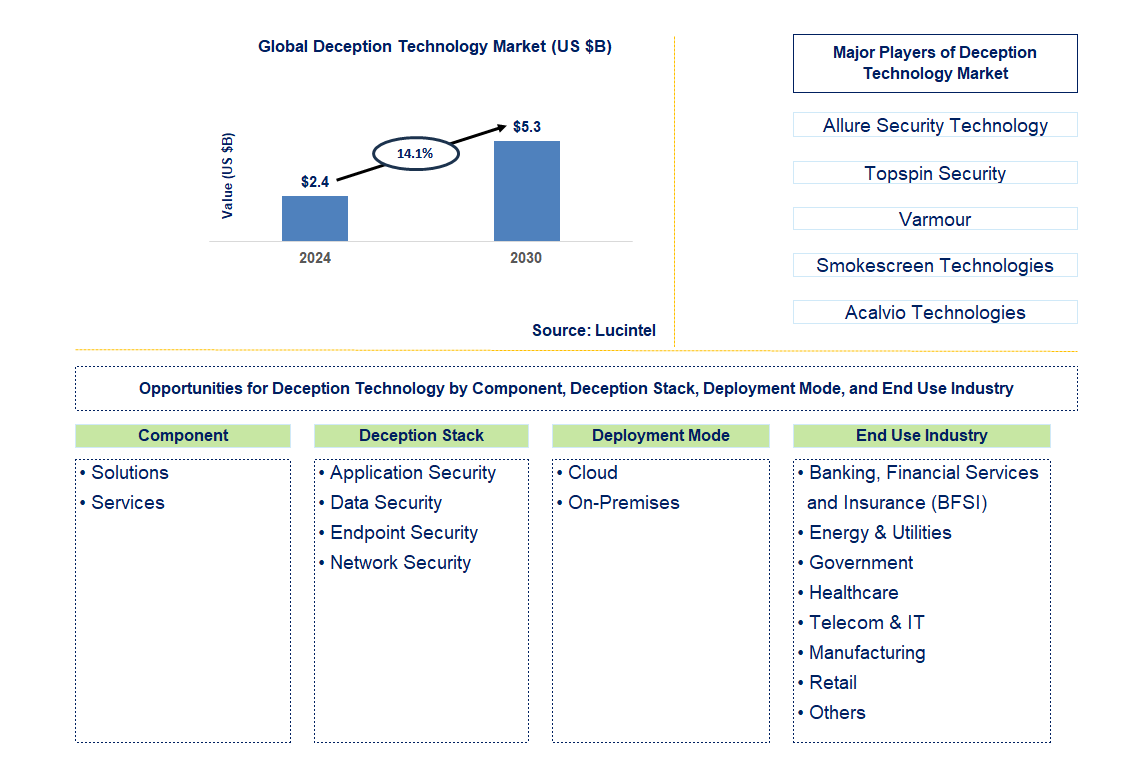
Key data points: The market size in 2030 = $5.3 billion, growth forecast = 14.1% annually for the next 6 years. Scroll below to get more insights. This market report covers trends, opportunities, and forecasts in the global deception technology market to 2030 by component (solutions and services), deception stack (application security, data security, endpoint security, and network security), deployment mode (cloud and on-premises), end use industry (banking, financial services, and insurance (BFSI), energy & utilities, government, healthcare, telecom & it, manufacturing, retail, and others), and region (North America, Europe, Asia Pacific, and the Rest of the World)
We'll send your sample report shortly.
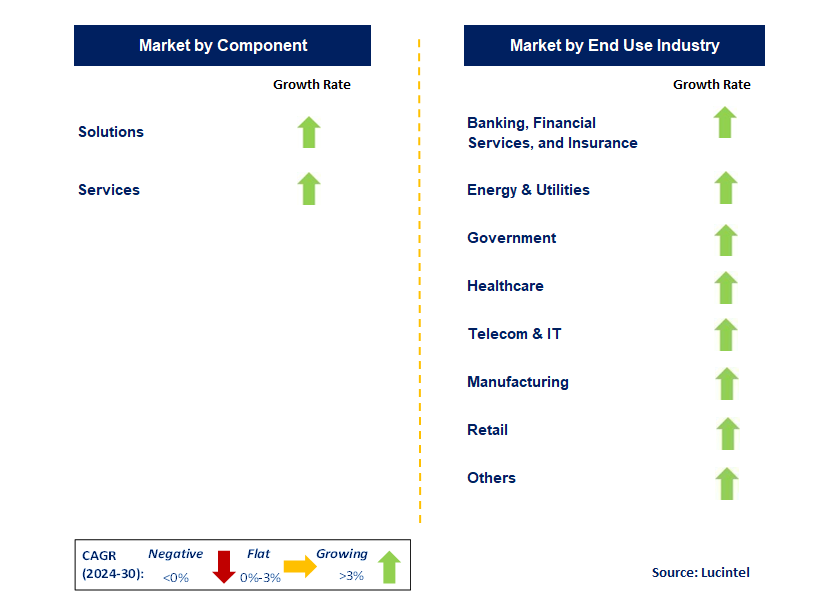
• Lucintel forecast that, within the component category, solution will remain the larger segment over the forecast period due to growing demand for comprehensive and integrated security solutions, as well as increasing need for holistic and customizable cybersecurity offerings to protect critical assets and data.
• Within the end use category, BFSI will remain the largest segment over the forecast period due to rising adoption of deception platforms in financial sector along with growing demand for technological design highly advanced decoys and lures to misdirect attackers and protects real assets from being attacked.
• In terms of regions, APAC will remain the fastest growing region over the forecast period due to growing number of cyber threats and attacks in countries across the region, rising awareness towards the importance of robust security practices coupled with increasing government initiatives promoting cybersecurity. Gain valuable insights for your business decisions with our comprehensive 150+ page report
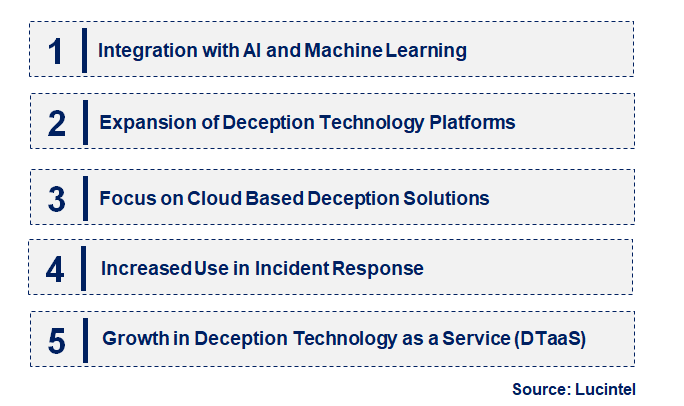
• Integration with AI and Machine Learning: Deception technologies have been incorporating AI and ML for supplementary and autonomous threat detection and response. This incorporation leads to more intelligent and dynamic defense, increasing the efficiency and effectiveness of the threat elimination process.
• Expansion of Deception Technology Platforms: The trend of designing comprehensive deception technology solutions that combine several different deception technologies is also gaining recognition. More complex and varied decoys can be spread throughout the network to offer better protection than systems usually installed in one area.
• Focus on Cloud-Based Deception Solutions: The emergence of cloud computing has created a demand for cloud-based deception solutions. These solutions are able to offer protection for cloud environments in an agile manner, addressing the problems of cloud infrastructure security.
• Increased Use in Incident Response: Deception technology is increasingly being integrated into incident response plans. By using dummy targets or electronic traps, organizations can gather information about the actions of attackers and enhance their capacity to respond to incidents more effectively.
• Growth in Deception Technology as a Service (DTaaS): There has been a surge in the provision of Deception Technology as a Service, enabling organizations to procure sophisticated deception technologies without having to spend much in the initial stage. This development helps increase the penetration and adoption of deceptive technology. The explained trends are transforming the Deception Technology market towards faster penetration of smart technologies, refinement of deployment models, and improvement of the overall cybersecurity apparatus.
• Launch of AI-Enhanced Deception Systems: High-level Deception Systems based on AI methodologies have been developed recently. These include the integration of advanced threat analysis and automatic response systems, improving processes for detecting and responding to cyber-attacks.
• Development of Comprehensive Deception Platforms: There is a trend towards developing integrated deception platforms that employ multiple deception methods. With such platforms, more effective defense is achieved since a more complex and mixed environment is built to trick and detect cyber attackers.
• Cloud-Based Deception Solutions Advances: As cloud-based security solutions have been developed, the security issues related to cloud environments have also been addressed. These solutions are capable and customizable, offering much-needed protection for cloud infrastructure.
• Growth of Deception Technology as a Service (DTaaS): With the increasing trend and popularity of subscription-based access to technologies, DTaaS allows companies to have advanced deception technologies for their operations at a fee.
• Increased Use of Deception Technologies with Incident Response Tools: There is growing integration of deception technologies with incident response tools aimed at enhancing intelligence collection on attackers and refining response methodologies. Such advancements are continuously enhancing the market for Deception Technology through increased capacity, broader usage options, and the incorporation of other technologies for more efficient cybersecurity solutions.
• Increase in Cloud Security: The rapid increase in cloud computing is opening up doors for the use of deception technology to improve cloud security. With the deployment of deception solutions in such environments, harmful threats are eliminated, and cloud-based application security is upheld.
• Adoption in Industrial Control Systems (ICS): Deception technology has gained traction as a measure to secure industrial control systems against breaches. This particular application complements the protection of crucial national and industrial activities from the damage caused by cyber-attacks.
• Integration with Threat Intelligence Platforms: The practice of deception has synergies when integrated with threat intelligence platforms, as it provides useful intelligence regarding attack patterns and behaviors. This extends the range of capabilities in predicting, detecting, and handling advanced cyber threats.
• Growth in Managed Security Service Providers (MSSPs): MSSPs are pushing the frontline as they deploy deception technology to enhance their services and enable clients to detect and respond to threats in advance. This trend encourages wider reach and usage of deception tactics in many industries.
• Focus on Compliance and Regulatory Requirements: Deception technology is also being used to fulfill necessary compliance and regulatory requirements for information security. This undertaking helps organizations meet regulatory requirements and improve their maturity within their respective sectors. These growth opportunities are driving the development and adoption of Deception Technology across various industries and improving cybersecurity technologies.
• Sustained Increase in Cyber Attacks: The growing number of sophisticated cybercriminal attacks is boosting the need for advanced deception technologies. These solutions enhance security through the use of bait and walls to detect and prevent attacks.
• Advancements in AI and Machine Learning: The development of AI and machine learning technologies is enhancing the ability and scope of deception technologies. Such innovations make it better at detecting and responding to threats.
• Growth in Cloud Computing: Growth in cloud computing provides infiltration technology with the means to tackle emerging security issues in the cloud and protect applications and infrastructure in cloud environments.
• Increased Awareness of Cybersecurity: Organizations have become more conscious about cybersecurity, leading to increased investments in deception technology.
• Emergence of Deception Technology as a Service (DTaaS): The accessibility of DTaaS provides easy and economical advanced deception technologies for wider utilization across multiple sectors. Challenges in the deception technology market are:
• Complexity of Integration: The process of merging deception technology with already established security systems can be daunting and complicated. It must be well thought out before being implemented.
• High Cost of Implementation: The cost of using sophisticated deception techniques is usually high and may be a restraining factor for some organizations, especially smaller ones.
• Incorrect Understanding: There is an inherent risk of false positives generated by deception technologies that might affect the utilization of resources in threat detection and response. The factors affecting the Deception Technology market, especially the development of the market, impact technology evolution, adoption, and overall market positioning, which will subsequently affect the development of the industry.
• Allure Security Technology
• Topspin Security
• Varmour
• Smokescreen Technologies
• Acalvio Technologies
• NTT security
• Ridgeback Network Defense
• SEC Technologies
• WatchGuard Technologies
• Attivo Networks
• Solutions
• Services
• Application Security
• Data Security
• Endpoint Security
• Network Security
• Cloud
• On-Premises
• Banking, Financial Services, and Insurance (BFSI)
• Energy & Utilities
• Government
• Healthcare
• Telecom & IT
• Manufacturing
• Retail
• Others
• North America
• Europe
• Asia Pacific
• The Rest of the World
• United States: In the U.S., the use of next-generation deception technologies has recorded very high figures, with heavy budgets allocated to AI threat detection and response. Companies are investing more in the creation of advanced honeypots and decoy systems to improve threat intelligence and fight intrusions.
• China: China is strategic in advancing deception technology and incorporating it into cyber defense. The country is creating large-scale deception architectures to cover critical national infrastructures and boost resistance against cyber-attacks.
• Germany: Germany has adopted deception technology to strengthen the development of its cyber domain. The focus is on improving existing security measures with the incorporation of deception methods for detecting and responding to both new and old threats.
• India: There is growing adoption of deception technology in India, with market growth attributed to increased awareness of cybersecurity threats. Domestic companies are adopting deception systems and strategies to protect business networks more efficiently.
• Japan: Japan, as part of its cybersecurity measures, is integrating advanced deception technologies to increase threat intelligence and improve response to incidents. The nation is adopting these technologies as part of its defense modernization strategies and to protect critical national infrastructure.


• Allure Security Technology
• Topspin Security
• Varmour
• Smokescreen Technologies
• Acalvio Technologies
• NTT security
• Ridgeback Network Defense
• SEC Technologies
• WatchGuard Technologies
• Attivo Networks Q6. Which deception technology market segment will be the largest in future? Answer: Lucintel forecast that solution will remain the larger segment over the forecast period due to growing demand for comprehensive and integrated security solutions, as well as increasing need for holistic and customizable cybersecurity offerings to protect critical assets and data. Q7. In deception technology market, which region is expected to be the largest in next 5 years? Answer: APAC will remain the fastest growing region over the forecast period due to growing number of cyber threats and attacks in countries across the region, rising awareness towards the importance of robust security practices coupled with increasing government initiatives promoting cybersecurity. Q.8 Do we receive customization in this report? Answer: Yes, Lucintel provides 10% customization without any additional cost.


Choose a license that fits your team. Instant PDF delivery.
Prices exclude taxes. Instant delivery. Custom licensing available on request.
Market Report · July 29, 2026
Market Report · July 15, 2026
Market Report · July 13, 2026
Trusted partner for strategic intelligence and business growth


Receive a complimentary market analysis tailored to your industry. Our analysts will identify key growth opportunities and competitive dynamics specific to your business.

Market size, growth rate, and key trend analysis for your specific sector.

Top competitor positioning and market share analysis.

Strategic recommendations backed by data-driven insights.
Get curated market intelligence and competitive moves straight to your inbox.
By subscribing, you agree to receive our monthly insights. Unsubscribe anytime.
Receive a complimentary market analysis tailored to your industry. Our analysts will identify key growth opportunities and competitive dynamics specific to your business.
Market size, growth rate, and key trend analysis for your specific sector.
Top competitor positioning and market share analysis.
Strategic recommendations backed by data-driven insights.
Get curated market intelligence, emerging trends, and competitive moves straight to your inbox each month.
By subscribing, you agree to receive our monthly insights. Unsubscribe anytime.
We'll send your sample report shortly.