
Report Feature
Data Center AI Accelerator Market Trends and Forecast
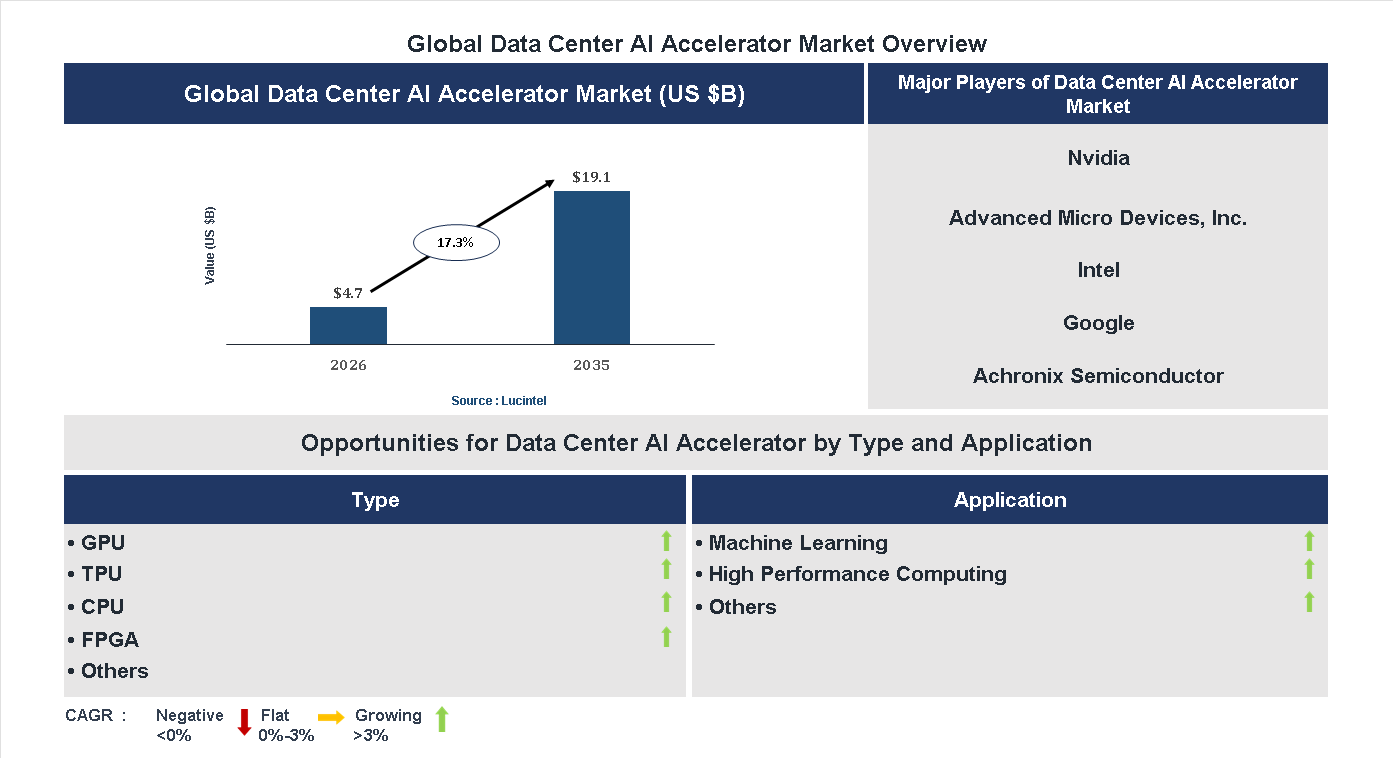
The future of the global data center AI accelerator market looks promising with opportunities in the machine learning and high performance computing markets. The global data center AI accelerator market is expected to reach an estimated $19.1 billion by 2035 with a CAGR of 17.3% from 2026 to 2035. The major drivers for this market are the increasing demand for AI computing, the rising deployment of hyperscale data centers, and the growing focus on accelerated data processing.• Lucintel forecasts that, within the type category, GPU is expected to witness the highest growth over the forecast period.
• Within the application category, machine learning is expected to witness higher growth.
• In terms of region, APAC is expected to witness the highest growth over the forecast period. Gain valuable insights for your business decisions with our comprehensive 150+ page report. Sample figures with some insights are shown below.
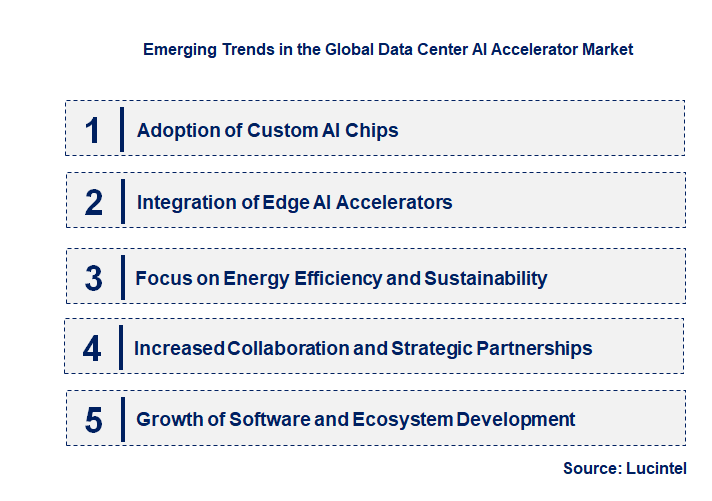
Emerging Trends in the Data Center AI Accelerator Market
The data center AI accelerator market is experiencing rapid growth driven by the increasing demand for high-performance computing, artificial intelligence, and machine learning applications. As organizations seek faster, more efficient processing capabilities, the market is evolving with innovative technologies and strategic investments. These developments are transforming data center infrastructure, enabling more scalable, energy-efficient, and cost-effective solutions. The following key trends highlight the major shifts shaping this dynamic industry, reflecting technological advancements, market strategies, and evolving customer needs that are collectively redefining how AI accelerators are integrated into data centers worldwide.• Adoption of Custom AI Chips: Custom AI chips, such as application-specific integrated circuits (ASICs) and field-programmable gate arrays (FPGAs), are gaining popularity. These chips are designed specifically for AI workloads, offering superior performance and energy efficiency compared to general-purpose processors. Companies are investing heavily in developing tailored hardware to meet the unique demands of AI applications, which results in faster processing times, reduced power consumption, and lower operational costs. This trend is enabling data centers to handle increasingly complex AI models more effectively, thus accelerating innovation and deployment.
• Integration of Edge AI Accelerators: The rise of edge computing is driving the deployment of AI accelerators at the edge of networks. These accelerators enable real-time data processing closer to data sources, reducing latency and bandwidth usage. As IoT devices and sensors proliferate, edge AI accelerators are becoming essential for applications like autonomous vehicles, smart cities, and industrial automation. This trend is decentralizing AI processing, allowing data centers to support a broader range of applications with faster response times and improved data privacy, ultimately expanding the market scope and capabilities.
• Focus on Energy Efficiency and Sustainability: With growing concerns over energy consumption and environmental impact, energy-efficient AI accelerators are a key trend. Manufacturers are developing hardware that consumes less power while maintaining high performance, often incorporating advanced cooling techniques and renewable energy sources. Data centers are increasingly adopting these sustainable solutions to reduce carbon footprints and operational costs. This focus on sustainability is not only driven by regulatory pressures but also by the desire for long-term cost savings, making energy-efficient AI accelerators a strategic priority in the market.
• Increased Collaboration and Strategic Partnerships: Major technology firms, hardware manufacturers, and cloud service providers are forming alliances to develop and deploy AI accelerators more effectively. These collaborations facilitate the sharing of expertise, resources, and technology standards, accelerating innovation and market penetration. Strategic partnerships also help in customizing solutions for specific industry needs, expanding market reach, and reducing time-to-market. This trend is fostering a more integrated ecosystem, promoting interoperability, and driving competitive advantages for participants in the data center AI accelerator market.
• Growth of Software and Ecosystem Development: The market is witnessing a surge in AI software frameworks, development tools, and ecosystem support that optimize hardware utilization. Companies are investing in software solutions that simplify the deployment, management, and scaling of AI workloads on accelerators. This trend enhances the usability and accessibility of AI accelerators, enabling a broader range of organizations to leverage advanced AI capabilities. The development of comprehensive ecosystems also encourages innovation, accelerates adoption, and creates new revenue streams, further fueling market growth. These trends are collectively reshaping the data center AI accelerator market by fostering innovation, improving efficiency, and expanding application scope. The shift towards custom hardware, edge deployment, sustainability, strategic collaborations, and robust software ecosystems is driving a more agile, efficient, and sustainable industry. These developments are not only enhancing performance but also enabling data centers to meet the evolving demands of AI-driven applications, positioning the market for sustained growth and technological leadership.
Recent Development in the Data Center AI Accelerator Market
The data center AI accelerator market is experiencing rapid growth driven by increasing demand for high-performance computing, AI-driven applications, and energy-efficient solutions. Innovations in hardware and software are transforming data centers into smarter, faster, and more sustainable infrastructures. As organizations seek to optimize operations and reduce costs, the market is poised for significant expansion. These developments are shaping the future landscape of AI acceleration, offering new opportunities for vendors and end-users alike.• Growing Adoption of AI Accelerators: Expanding use in data centers to enhance processing speeds and efficiency. This trend is driven by the need for real-time data analysis, machine learning, and deep learning applications. As AI workloads increase, data centers require specialized hardware to meet performance demands, leading to increased investments and technological advancements in AI accelerators. This growth is expected to boost market revenue and innovation.
• Advancements in Hardware Technologies: Development of more powerful, energy-efficient AI chips and architectures. Innovations such as custom ASICs and FPGA-based accelerators are improving processing capabilities while reducing power consumption. These hardware improvements enable data centers to handle larger workloads with lower operational costs. The impact includes enhanced scalability, better performance, and a competitive edge for providers adopting these advanced solutions.
• Integration of AI with Edge Computing: Deployment of AI accelerators at the edge to enable faster data processing closer to the source. This integration reduces latency, improves real-time decision-making, and decreases bandwidth requirements. As IoT devices and smart sensors proliferate, edge AI accelerators become critical for applications like autonomous vehicles and industrial automation. This development broadens market scope and accelerates the deployment of AI-enabled edge solutions.
• Focus on Energy Efficiency and Sustainability: Innovations aimed at reducing the power consumption of AI accelerators. Green data center initiatives are driving the adoption of energy-efficient hardware, including low-power AI chips and cooling solutions. These efforts help data centers meet environmental regulations and reduce operational costs. The impact is a more sustainable market with increased adoption of eco-friendly AI acceleration technologies, aligning with global sustainability goals.
• Strategic Collaborations and Acquisitions: Partnerships between hardware vendors, cloud providers, and AI software firms. These collaborations facilitate integrated solutions, accelerate product development, and expand market reach. Mergers and acquisitions are also consolidating market players, fostering innovation, and driving competitive pricing. Such strategic moves are shaping a dynamic ecosystem that benefits end-users through enhanced offerings and faster deployment of AI accelerators. These developments are significantly transforming the data center AI accelerator market by enhancing performance, energy efficiency, and deployment flexibility. The integration of advanced hardware, edge computing, and sustainability initiatives is expanding market opportunities and driving innovation. Strategic collaborations further accelerate growth, making AI accelerators more accessible and effective. Overall, these trends are positioning the market for sustained expansion, enabling data centers to meet evolving technological demands and maintain competitive advantages in a rapidly evolving digital landscape.
Strategic Growth Opportunities in the Data Center AI Accelerator Market
The data center AI accelerator market is experiencing rapid expansion driven by increasing demand for high-performance computing, AI workloads, and energy-efficient solutions. As data volumes grow exponentially, organizations seek specialized hardware to optimize processing speeds and reduce latency. Innovations in AI accelerators are transforming data center operations, enabling smarter, faster, and more scalable infrastructure. This evolving landscape presents numerous strategic growth opportunities for industry players to capitalize on emerging needs and technological advancements.• Growing Adoption of AI Accelerators for Data Center Optimization: The increasing deployment of AI accelerators in data centers enhances processing capabilities, reduces energy consumption, and improves overall efficiency. As AI workloads become more complex, organizations seek specialized hardware to handle large-scale data processing, machine learning, and deep learning tasks. This trend drives demand for innovative accelerator solutions, fostering market growth and encouraging investments in advanced architectures tailored for data center environments.
• Expansion of Cloud Service Providers Integrating AI Hardware: Major cloud service providers are integrating AI accelerators into their infrastructure to offer enhanced AI and machine learning services. This integration allows clients to access high-performance computing resources without significant capital expenditure. As cloud adoption accelerates globally, the demand for scalable, flexible AI hardware solutions increases, creating opportunities for vendors to supply tailored accelerators that meet the needs of diverse cloud-based applications and services.
• Development of Energy-Efficient and Compact AI Accelerators: The push for energy-efficient and space-saving hardware is critical in data center environments to reduce operational costs and carbon footprint. Innovations in low-power AI accelerators enable data centers to maximize performance while minimizing energy consumption and physical footprint. This opportunity encourages R&D in miniaturized, power-efficient designs, appealing to data centers aiming for sustainable and cost-effective operations, thereby expanding market reach.
• Integration of AI Accelerators with Edge Computing Infrastructure: As edge computing gains prominence, integrating AI accelerators into edge devices and micro data centers offers real-time data processing capabilities. This reduces latency, enhances security, and improves decision-making in applications like IoT, autonomous vehicles, and smart cities. The growth of edge AI accelerators opens new markets, requiring specialized hardware that balances performance with power efficiency, thus broadening the overall market scope.
• Strategic Collaborations and Partnerships for Innovation: Collaborations between hardware manufacturers, cloud providers, and AI software developers foster innovation in AI accelerator technologies. These partnerships accelerate product development, enable customization, and expand application-specific solutions. Such strategic alliances are vital for staying competitive, addressing evolving market demands, and driving adoption across various sectors, ultimately fueling the growth trajectory of the data center AI accelerator market. These growth opportunities are poised to significantly influence the evolution of the data center AI accelerator market by fostering innovation, expanding application domains, and enhancing operational efficiencies. Companies that strategically leverage these opportunities will be well-positioned to capitalize on the increasing demand for high-performance, energy-efficient, and scalable AI hardware solutions in data centers worldwide.
Data Center AI Accelerator Market Driver and Challenges
The data center AI accelerator market is influenced by a complex interplay of technological advancements, economic shifts, and regulatory frameworks. As data demands grow exponentially, the need for faster, more efficient processing solutions becomes critical. Innovations in AI hardware, cloud computing, and edge computing are shaping the landscape, while economic factors such as rising data center investments and global digital transformation initiatives drive growth. Regulatory considerations around data privacy, security, and environmental sustainability also impact market dynamics. Navigating these drivers and challenges is essential for stakeholders aiming to capitalize on emerging opportunities while addressing potential risks in this rapidly evolving sector. The factors responsible for driving the data center AI accelerator market include:• Technological Innovation: The rapid development of AI-specific hardware, such as GPUs, TPUs, and FPGAs, enhances processing power and efficiency. These advancements enable data centers to handle complex AI workloads more effectively, reducing latency and energy consumption. As AI models become more sophisticated, the demand for specialized accelerators increases, fueling market growth. Continuous innovation also fosters integration with emerging technologies like quantum computing and 5G, expanding application scope and competitiveness.
• Growing Data Volumes: The proliferation of IoT devices, digital services, and enterprise applications generates unprecedented data volumes. Data centers require advanced AI accelerators to process, analyze, and derive insights from this data in real-time. This surge in data drives investments in high-performance computing infrastructure, making AI accelerators indispensable for maintaining operational efficiency and competitive advantage across industries.
• Cloud Computing Expansion: The widespread adoption of cloud services by enterprises accelerates demand for scalable AI solutions. Cloud providers integrate AI accelerators into their infrastructure to offer enhanced machine learning and analytics capabilities. This trend democratizes access to powerful AI tools, enabling smaller organizations to leverage advanced data processing without significant capital expenditure, thereby expanding the market.
• Regulatory and Sustainability Pressures: Increasing regulations around data privacy, security, and environmental impact influence market development. Data centers are under pressure to adopt energy-efficient AI accelerators to reduce carbon footprints and comply with standards like GDPR and ISO 14001. These regulatory frameworks encourage innovation in green technologies and sustainable practices, shaping product development and deployment strategies within the market. The challenges facing the data center AI accelerator market include:
• High Capital and Operational Costs: Implementing AI accelerators involves significant investment in hardware, infrastructure, and skilled personnel. The costs associated with deploying and maintaining advanced data center equipment can be prohibitive, especially for smaller organizations. Additionally, operational expenses related to energy consumption and cooling requirements pose ongoing financial challenges, potentially limiting market expansion and adoption rates.
• Rapid Technological Obsolescence: The fast-paced evolution of AI hardware and software creates a risk of rapid obsolescence. Companies investing heavily in current-generation accelerators may face difficulties in upgrading or integrating future technologies, leading to potential sunk costs. This uncertainty hampers long-term planning and can slow down market growth as stakeholders hesitate to commit substantial resources.
• Regulatory and Security Risks: While regulations aim to ensure data privacy and security, they also introduce compliance complexities and potential restrictions on data usage. Cybersecurity threats targeting AI infrastructure can compromise sensitive data and disrupt operations. Navigating diverse regulatory landscapes across regions adds complexity, increasing costs and delaying deployment, which can hinder overall market development. The data center AI accelerator market is driven by technological innovation, increasing data volumes, cloud expansion, and sustainability initiatives. However, high costs, rapid technological changes, and regulatory challenges pose significant hurdles. These factors collectively shape a dynamic environment where strategic investments and adaptive approaches are essential. The markets growth prospects depend on balancing innovation with cost management and regulatory compliance, ultimately influencing the pace and scope of AI-driven data center advancements.
List of Data Center AI Accelerator Companies
Companies in the market compete on the basis of product quality offered. Major players in this market focus on expanding their manufacturing facilities, R&D investments, infrastructural development, and leverage integration opportunities across the value chain. With these strategies data center AI accelerator companies cater increasing demand, ensure competitive effectiveness, develop innovative products & technologies, reduce production costs, and expand their customer base. Some of the data center AI accelerator companies profiled in this report include-• Nvidia
• Advanced Micro Devices, Inc.
• Intel
• Achronix Semiconductor
• Qualcomm
• Analog Devices, Inc.
Data Center AI Accelerator Market by Segment
The study includes a forecast for the global data center AI accelerator market by type, application, and region.Data Center AI Accelerator Market by Type [Value from 2019 to 2035]:
• GPU
• TPU
• CPU
• FPGA
• Others
Data Center AI Accelerator Market by Application [Value from 2019 to 2035]:
• Machine Learning
• High Performance Computing
• Others
Data Center AI Accelerator Market by Region [Value from 2019 to 2035]:
• North America
• Europe
• Asia Pacific
• The Rest of the World
Country Wise Outlook for the Data Center AI Accelerator Market
The data center AI accelerator market is experiencing rapid growth driven by increasing demand for high-performance computing, artificial intelligence, and data processing capabilities. As digital transformation accelerates globally, countries are investing heavily in advanced infrastructure and innovative technologies to stay competitive. This evolution is marked by technological breakthroughs, strategic investments, and policy initiatives aimed at enhancing data center efficiency and AI processing power. The following summaries highlight recent developments in this market across the United States, China, Germany, India, and Japan, reflecting their unique approaches and advancements.• United States: The US leads in AI accelerator innovation with major tech giants like NVIDIA and Intel launching new products. Investments in data center infrastructure are rising, focusing on energy efficiency and scalability. Government initiatives promote AI research, fostering collaborations between academia and industry. Cloud service providers are expanding their AI capabilities, driving market growth. The US also emphasizes sustainable data center practices, integrating renewable energy sources to reduce carbon footprints.
• China: China is rapidly advancing in AI accelerator technology, with government policies supporting domestic innovation. Major companies like Huawei and Alibaba are developing proprietary AI chips to reduce reliance on foreign technology. The country is investing heavily in building large-scale, energy-efficient data centers to support AI and big data applications. Strategic initiatives aim to enhance self-sufficiency in AI hardware, positioning China as a key player in the global market. Collaborations between industry and academia are fostering cutting-edge research.
• Germany: Germany focuses on integrating AI accelerators within its Industry 4.0 framework, emphasizing industrial automation and smart manufacturing. Investments are directed toward energy-efficient data centers and sustainable technology solutions. German companies are adopting AI accelerators to optimize logistics, production, and research processes. The government promotes innovation through funding programs and partnerships with European institutions. There is also a focus on developing secure and resilient data infrastructure to support AI deployment across sectors.
• India: India is witnessing significant growth in data center infrastructure driven by digital transformation and government initiatives like Digital India. The market is adopting AI accelerators to enhance cloud computing and analytics capabilities. Investments from global and domestic players are increasing, with a focus on cost-effective, energy-efficient solutions. The government is encouraging innovation through policies and incentives to develop indigenous AI hardware. The expansion aims to support AI-driven applications in healthcare, finance, and e-governance, positioning India as an emerging hub for AI technology.
• Japan: Japan emphasizes integrating AI accelerators into its robotics, manufacturing, and automotive sectors. The country invests in advanced data center infrastructure to support AI research and development. Japanese firms are developing specialized AI chips to improve processing efficiency and reduce energy consumption. The government promotes collaboration between industry and academia to foster innovation. Japan also prioritizes sustainable data center practices, aligning with its environmental goals. The market is characterized by a focus on high-quality, reliable AI hardware tailored to industrial applications.

Features of the Global Data Center AI Accelerator Market
Market Size Estimates: Data center AI accelerator market size estimation in terms of value ($B). Trend and Forecast Analysis: Market trends (2019 to 2025) and forecast (2026 to 2035) by various segments and regions. Segmentation Analysis: Data center AI accelerator market size by type, application, and region in terms of value ($B). Regional Analysis: Data center AI accelerator market breakdown by North America, Europe, Asia Pacific, and Rest of the World. Growth Opportunities: Analysis of growth opportunities in different types, applications, and regions for the data center AI accelerator market. Strategic Analysis: This includes M&A, new product development, and competitive landscape of the data center AI accelerator market. Analysis of competitive intensity of the industry based on Porter’s Five Forces model.
FAQ
Q1. What is the data center AI accelerator market size? Answer: The global data center AI accelerator market is expected to reach an estimated $19.1 billion by 2035. Q2. What is the growth forecast for data center AI accelerator market? Answer: The global data center AI accelerator market is expected to grow with a CAGR of 17.3% from 2026 to 2035. Q3. What are the major drivers influencing the growth of the data center AI accelerator market? Answer: The major drivers for this market are the increasing demand for AI computing, the rising deployment of hyperscale data centers, and the growing focus on accelerated data processing. Q4. What are the major segments for data center AI accelerator market? Answer: The future of the data center AI accelerator market looks promising with opportunities in the machine learning and high performance computing markets. Q5. Who are the key data center AI accelerator market companies? Answer: Some of the key data center AI accelerator companies are as follows:• Nvidia
• Advanced Micro Devices, Inc.
• Intel
• Achronix Semiconductor
• Qualcomm
• Analog Devices, Inc. Q6. Which data center AI accelerator market segment will be the largest in future? Answer: Lucintel forecasts that, within the type category, GPU is expected to witness the highest growth over the forecast period. Q7. In data center AI accelerator market, which region is expected to be the largest in next 5 years? Answer: In terms of region, APAC is expected to witness the highest growth over the forecast period. Q8. Do we receive customization in this report? Answer: Yes, Lucintel provides 10% customization without any additional cost.
Table of Contents
List of Figures
List of Tables
Methodology
- In-depth interviews of the major players in this market
- Detailed secondary research from competitors’ financial statements and published data
- Extensive searches of published works, market, and database information pertaining to industry news, company press releases, and customer intentions
- A compilation of the experiences, judgments, and insights of Lucintel’s professionals, who have analyzed and tracked this market over the years.


Buy Now
Choose a license that fits your team. Instant PDF delivery.
Prices exclude taxes. Instant delivery. Custom licensing available on request.
Key Questions
- • What are some of the most promising, high-growth opportunities for the data center AI accelerator market by type (GPU, TPU, CPU, FPGA, and others), application (machine learning, high performance computing, and others), and region (North America, Europe, Asia Pacific, and the Rest of the World)?
- • Which segments will grow at a faster pace and why?
- • Which region will grow at a faster pace and why?
- • What are the key factors affecting market dynamics? What are the key challenges and business risks in this market?
- • What are the business risks and competitive threats in this market?
- • What are the emerging trends in this market and the reasons behind them?
- • What are some of the changing demands of customers in the market?
- • What are the new developments in the market? Which companies are leading these developments?
- • Who are the major players in this market? What strategic initiatives are key players pursuing for business growth?
- • What are some of the competing products in this market and how big of a threat do they pose for loss of market share by material or product substitution?
- • What M&A activity has occurred in the last 7 years and what has its impact been on the industry? For any questions related to Data Center AI Accelerator Market, Data Center AI Accelerator Market Size, Data Center AI Accelerator Market Growth, Data Center AI Accelerator Market Analysis, Data Center AI Accelerator Market Report, Data Center AI Accelerator Market Share, Data Center AI Accelerator Market Trends, Data Center AI Accelerator Market Forecast, Data Center AI Accelerator Companies, write Lucintel analyst at email: helpdesk@lucintel.com. We will be glad to get back to you soon.


