
Report Feature
Cybersecurity Insurance Market Trends and Forecast
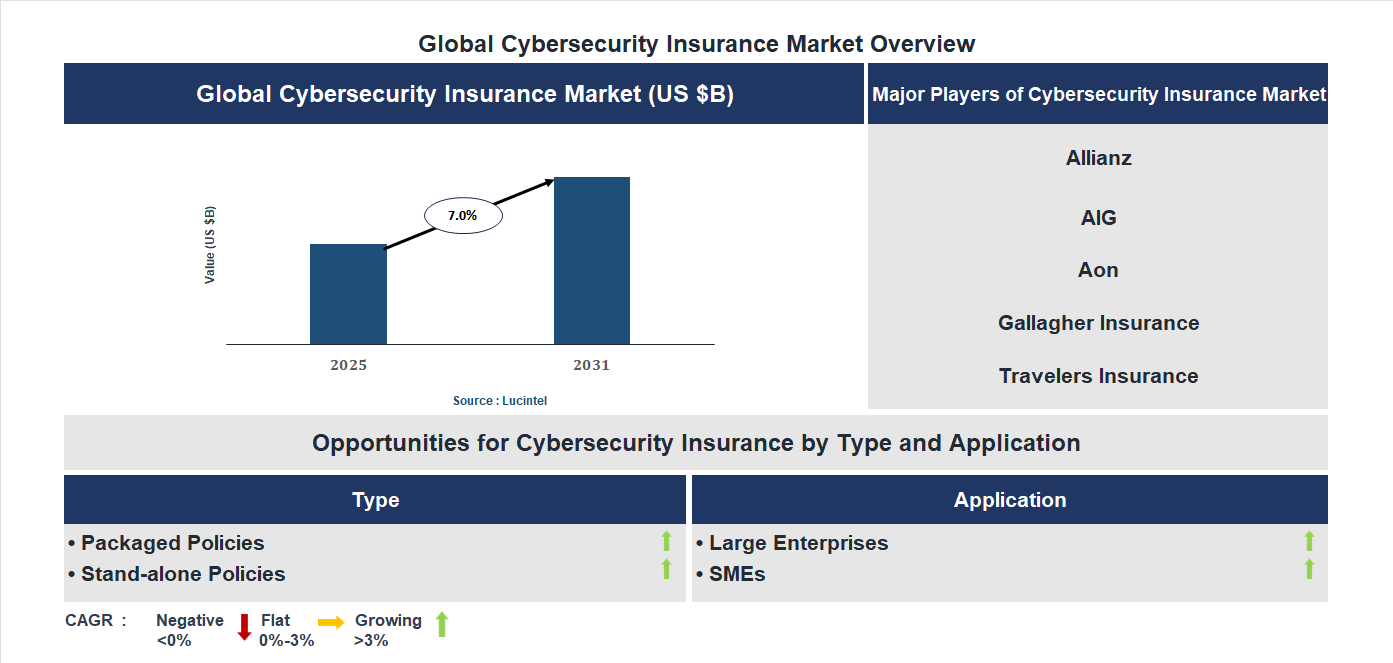
The future of the global cybersecurity insurance market looks promising with opportunities in the large enterprise and SME markets. The global cybersecurity insurance market is expected to grow with a CAGR of 7% from 2025 to 2031. The major drivers for this market are the increasing frequency of large-scale cyber incidents, the rising demand for financial risk protection, and the growing adoption of digital business operations.• Lucintel forecasts that, within the type category, stand-alone policy is expected to witness higher growth over the forecast period.
• Within the application category, SME is expected to witness higher growth.
• In terms of region, APAC is expected to witness the highest growth over the forecast period. Gain valuable insights for your business decisions with our comprehensive 150+ page report. Sample figures with some insights are shown below.
Emerging Trends in the Cybersecurity Insurance Market
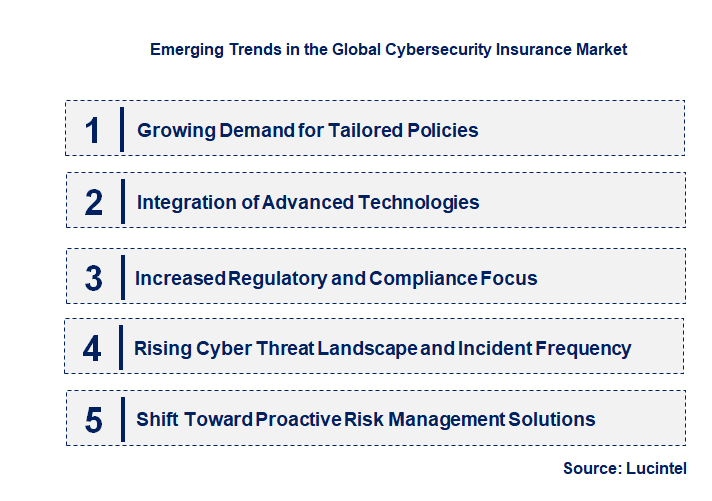
The cybersecurity insurance market is experiencing rapid evolution driven by increasing cyber threats, technological advancements, and changing regulatory landscapes. As organizations seek to mitigate financial and reputational risks associated with cyber incidents, insurers are adapting their offerings to meet new demands. This dynamic environment is characterized by innovative product development, heightened customer awareness, and evolving risk assessment models. These trends are fundamentally reshaping how businesses approach cybersecurity risk management, influencing policy structures, pricing strategies, and coverage options. Understanding these emerging trends is crucial for stakeholders aiming to stay competitive and effectively manage cyber risks in an increasingly digital world.• Growing Demand for Tailored Policies: Customization and flexibility are becoming essential as organizations seek policies that align with their specific risk profiles. Insurers are developing bespoke coverage options to address diverse industry needs, from small businesses to large enterprises. This trend enhances customer satisfaction and ensures more accurate risk mitigation, leading to increased market penetration and competitive advantage for insurers.
• Integration of Advanced Technologies: Insurers are leveraging artificial intelligence, machine learning, and data analytics to improve risk assessment and claims processing. These technologies enable more precise underwriting, early detection of potential threats, and faster claims resolution. The adoption of such innovations enhances operational efficiency and provides clients with more accurate pricing and better risk management tools.
• Increased Regulatory and Compliance Focus: As cyber threats grow, governments and regulatory bodies are implementing stricter data protection laws and reporting requirements. Insurers are adjusting their policies to ensure compliance, which influences coverage terms and premiums. This trend encourages organizations to prioritize cybersecurity measures, fostering a more secure digital environment and reducing overall risk exposure.
• Rising Cyber Threat Landscape and Incident Frequency: The proliferation of ransomware, phishing, and other cyberattacks is driving demand for comprehensive coverage. Insurers are expanding policy limits and coverage options to address the increasing complexity and frequency of incidents. This trend underscores the importance of proactive risk management and continuous policy updates to keep pace with evolving threats.
• Shift Toward Proactive Risk Management Solutions: Insurers are offering more than just coverage; they are providing risk assessment tools, cybersecurity training, and incident response services. This proactive approach helps organizations prevent attacks and minimize damage, fostering stronger client-insurer relationships. It also positions insurers as strategic partners in cybersecurity resilience. In summary, these emerging trends are transforming the cybersecurity insurance market by promoting customization, technological innovation, regulatory compliance, and proactive risk management. These developments are not only expanding market opportunities but also encouraging organizations to adopt more comprehensive cybersecurity strategies, ultimately leading to a more resilient digital ecosystem.
Recent Development in the Cybersecurity Insurance Market
The cybersecurity insurance market has experienced rapid growth driven by increasing cyber threats, evolving regulatory requirements, and the rising cost of data breaches. As organizations seek to mitigate financial and reputational risks associated with cyber incidents, insurers are innovating their offerings to meet these demands. Technological advancements, changing threat landscapes, and regulatory pressures are shaping the market landscape. Companies are increasingly adopting cybersecurity insurance as a critical component of their risk management strategies. This dynamic environment presents both opportunities and challenges for insurers, brokers, and policyholders alike, influencing market growth and product development.• Market Expansion: The cybersecurity insurance market is expanding rapidly due to rising cyber threats and increased awareness among organizations about cyber risks. As data breaches and cyberattacks become more sophisticated, demand for specialized coverage has surged. This growth is also driven by regulatory mandates requiring organizations to have cyber insurance. Insurers are developing tailored policies to address diverse industry needs, leading to broader market penetration across sectors. The expansion signifies a shift towards recognizing cybersecurity as a vital aspect of enterprise risk management, fostering increased investments in cyber insurance products.
• Product Innovation: Insurers are innovating their product offerings to better address evolving cyber threats. New policies now include coverage for ransomware, business interruption, and supply chain disruptions. Some providers are integrating proactive risk management tools, such as cybersecurity assessments and incident response services, into their policies. These innovations help clients mitigate risks more effectively while providing insurers with better risk profiling. The development of modular and customizable policies allows organizations to select coverage aligned with their specific vulnerabilities, enhancing market competitiveness and customer satisfaction.
• Technological Integration: The integration of advanced technologies like AI, machine learning, and big data analytics is transforming the cybersecurity insurance landscape. These tools enable insurers to improve risk assessment accuracy, detect potential threats early, and streamline claims processing. AI-driven underwriting models facilitate more precise pricing and risk segmentation. Additionally, real-time monitoring and predictive analytics help insurers proactively manage risks and prevent cyber incidents. This technological integration enhances operational efficiency and offers clients more dynamic and responsive coverage options, ultimately strengthening market resilience.
• Regulatory and Legal Developments: Increasing regulatory scrutiny and legal frameworks are shaping the cybersecurity insurance market. Governments and industry bodies are implementing stricter data protection laws, requiring organizations to maintain cyber insurance coverage. Regulatory compliance is becoming a key factor influencing policy terms and pricing. Insurers are also adjusting their policies to align with evolving legal standards, which impacts coverage scope and claims processes. These developments promote greater transparency and accountability within the market, encouraging organizations to prioritize cybersecurity investments and insurance as essential risk mitigation tools.
• Market Challenges and Risks: Despite growth, the market faces challenges such as rising claim costs, coverage gaps, and the complexity of cyber risks. The increasing frequency and severity of cyberattacks lead to higher payouts, pressuring insurers' profitability. Coverage gaps, especially around emerging threats like IoT vulnerabilities, pose risks for policyholders and providers. Additionally, the rapidly changing cyber landscape requires continuous product updates and risk assessments. These challenges necessitate ongoing innovation and risk management strategies to sustain market growth and ensure the availability of comprehensive, affordable cyber insurance solutions. In summary, these developments are significantly impacting the cybersecurity insurance market by fostering growth through product innovation, technological advancements, and regulatory compliance. They are also highlighting the need for continuous adaptation to emerging threats and market challenges. As a result, the market is becoming more sophisticated, competitive, and integral to organizational risk management strategies, ensuring better protection against cyber risks in an increasingly digital world.
Strategic Growth Opportunities in the Cybersecurity Insurance Market
The cybersecurity insurance market is experiencing rapid expansion driven by increasing cyber threats, regulatory pressures, and the need for comprehensive risk management solutions. As organizations seek to safeguard their digital assets, insurers are developing innovative products tailored to diverse industry needs. This evolving landscape presents several strategic growth opportunities across key applications, enabling insurers to capture new market segments and enhance their offerings. These opportunities not only address current vulnerabilities but also anticipate future cybersecurity challenges, fostering resilience and trust among clients. The following are five key growth opportunities by application that are shaping the future of the cybersecurity insurance market.• Financial Services: Expansion of tailored policies : Financial institutions face heightened cyber risks, prompting insurers to develop specialized coverage that addresses fraud, data breaches, and operational disruptions. This growth opportunity enhances risk mitigation for banks, insurance companies, and payment processors, fostering greater confidence and stability within the financial sector.
• Healthcare: Coverage for sensitive data and compliance : The healthcare industry’s increasing reliance on digital records and connected devices creates vulnerabilities. Insurers offering targeted policies for data breaches, ransomware, and regulatory compliance help healthcare providers protect patient information and meet legal requirements, reducing financial and reputational damage.
• Retail and E-commerce: Protection against cyberattacks and fraud : As retail and e-commerce platforms grow, so do cyber threats like payment fraud and data theft. Insurance solutions tailored to these sectors enable businesses to mitigate losses from cyberattacks, ensuring continuity and customer trust in a highly competitive environment.
• Manufacturing: Risk management for industrial control systems : The manufacturing sector faces risks from cyberattacks on operational technology and supply chains. Insurers providing coverage for industrial control systems and cyber-physical threats help manufacturers prevent costly disruptions, safeguarding production and revenue streams.
• Public Sector and Critical Infrastructure: Resilience against nation-state threats : Governments and critical infrastructure entities are prime targets for cyber espionage and sabotage. Strategic insurance offerings in this domain bolster national security by covering cyber incidents, facilitating rapid response, and promoting resilience against sophisticated threats. In summary, these growth opportunities are significantly impacting the cybersecurity insurance market by expanding coverage options, addressing sector-specific vulnerabilities, and fostering innovation. They enable insurers to diversify their portfolios, improve risk assessment, and meet the evolving needs of various industries. Consequently, the market is poised for sustained growth, driven by increasing cyber threats and the imperative for comprehensive risk management solutions.
Cybersecurity Insurance Market Driver and Challenges
The cybersecurity insurance market is influenced by a complex interplay of technological advancements, economic shifts, and regulatory developments. As cyber threats become more sophisticated and prevalent, organizations seek insurance solutions to mitigate potential financial losses. Rapid technological innovation drives the need for specialized coverage, while economic factors such as increasing cybercrime costs push demand upward. Regulatory frameworks are evolving to mandate cybersecurity standards, further shaping the market landscape. However, challenges such as rapidly changing threat landscapes, regulatory uncertainties, and underwriting complexities pose significant hurdles. Understanding these drivers and challenges is essential for stakeholders aiming to navigate and capitalize on this dynamic market environment. The factors responsible for driving the cybersecurity insurance market include:-• Increasing Cyber Threats and Data Breaches: The rise in cyberattacks, data breaches, and ransomware incidents has heightened awareness among organizations about the financial and reputational risks involved. As cyber threats become more sophisticated, companies are compelled to seek insurance coverage to protect against potential losses. This growing threat landscape directly correlates with increased demand for cybersecurity insurance, encouraging insurers to develop tailored products. The expanding scope of cyber risks, including IoT vulnerabilities and supply chain attacks, further amplifies the need for comprehensive coverage, making cybersecurity insurance a critical component of corporate risk management strategies.
• Technological Advancements and Digital Transformation: Rapid technological progress, including cloud computing, IoT, and AI, has transformed business operations but also introduced new vulnerabilities. As organizations adopt these innovations, their exposure to cyber risks increases, necessitating specialized insurance solutions. Insurers are developing advanced underwriting models that incorporate emerging technologies to better assess risks. This technological evolution drives market growth by enabling more precise pricing and coverage options. Additionally, the proliferation of digital platforms and remote work arrangements has expanded the attack surface, prompting organizations to seek insurance coverage that addresses these modern vulnerabilities.
• Regulatory and Compliance Pressures: Governments and regulatory bodies worldwide are implementing stricter cybersecurity standards and data protection laws, such as GDPR and CCPA. These regulations compel organizations to enhance their cybersecurity measures and often require them to carry cybersecurity insurance as part of compliance. Insurers are also adjusting their policies to align with evolving legal frameworks, creating a more structured market environment. The increasing regulatory focus on cybersecurity risk management encourages organizations to invest in insurance as a safeguard against potential penalties and liabilities, thereby fueling market growth.
• Growing Awareness and Adoption of Cybersecurity Insurance: As cyber incidents become more visible and impactful, organizations across various sectors are recognizing the importance of cybersecurity insurance. This heightened awareness is driven by high-profile data breaches and cyberattacks that have resulted in significant financial losses. Companies are increasingly integrating cybersecurity insurance into their overall risk management strategies, especially in sectors like finance, healthcare, and retail. The expansion of insurance providers offering specialized products and the development of industry-specific policies further promote adoption, making cybersecurity insurance a standard component of corporate risk mitigation.
• Increasing Investment in Cybersecurity Infrastructure: The escalating costs associated with cybersecurity infrastructure, including threat detection, prevention, and response systems, are influencing the insurance market. Organizations are investing heavily in advanced cybersecurity tools to reduce their risk exposure, which in turn affects the types and levels of coverage they seek. Insurers are tailoring policies to complement these investments, offering coverage that supports cybersecurity infrastructure upgrades and incident response. This synergy between technological investment and insurance coverage accelerates market growth by encouraging organizations to adopt comprehensive cybersecurity measures supported by appropriate insurance solutions. The challenges facing this cybersecurity insurance market include:-
• Rapidly Evolving Cyber Threat Landscape: The dynamic nature of cyber threats makes it difficult for insurers to accurately assess and price risks. Attack techniques evolve quickly, rendering existing risk models less effective and increasing the likelihood of unexpected claims. This uncertainty complicates underwriting processes and can lead to higher premiums, potentially limiting market growth. Insurers must continuously update their risk assessment methodologies and invest in threat intelligence, which increases operational costs. The unpredictable nature of emerging threats, such as zero-day exploits and AI-driven attacks, poses ongoing challenges for maintaining accurate coverage and pricing strategies.
• Regulatory Uncertainty and Variability: The global regulatory environment for cybersecurity is constantly changing, with different jurisdictions implementing diverse standards and compliance requirements. This variability complicates policy development and claims management for insurers operating across borders. Unclear or evolving regulations can lead to legal ambiguities, disputes, and increased compliance costs for insurers and insureds alike. Additionally, the lack of harmonized international standards hampers the development of standardized insurance products, creating barriers to market expansion and increasing the complexity of risk assessment.
• Underwriting and Claims Management Complexities: The unique and complex nature of cyber risks makes underwriting a significant challenge. Insurers often lack sufficient historical data to accurately predict future claims, leading to difficulties in setting appropriate premiums. Moreover, the fast-changing threat environment requires insurers to constantly update their risk models, which can be resource-intensive. Claims management is also complicated by the need for rapid incident response, forensic investigations, and coordination with cybersecurity experts. These complexities can result in higher operational costs and impact profitability, hindering the sustainable growth of the market. In summary, the cybersecurity insurance market is driven by increasing cyber threats, technological innovation, regulatory pressures, rising awareness, and investments in cybersecurity infrastructure. However, it faces challenges from the rapidly evolving threat landscape, regulatory uncertainties, and underwriting complexities. These factors collectively shape a market that is dynamic and rapidly adapting, with significant growth potential balanced by the need for continuous innovation and risk management. Stakeholders must navigate these drivers and challenges carefully to capitalize on emerging opportunities and mitigate potential risks in this evolving landscape.
List of Cybersecurity Insurance Companies
Companies in the market compete on the basis of product quality offered. Major players in this market focus on expanding their manufacturing facilities, R&D investments, infrastructural development, and leverage integration opportunities across the value chain. With these strategies cybersecurity insurance companies cater increasing demand, ensure competitive effectiveness, develop innovative products & technologies, reduce production costs, and expand their customer base. Some of the cybersecurity insurance companies profiled in this report include-• Allianz
• AIG
• Aon
• Gallagher Insurance
• Travelers Insurance
• AXA XL
• AXIS Capital
• Beazley
• Chubb
• CNA Financial
Cybersecurity Insurance Market by Segment
The study includes a forecast for the global cybersecurity insurance market by type, application, and region.Cybersecurity Insurance Market by Type [Value from 2019 to 2031]:
• Packaged Policies
• Stand-alone Policies
Cybersecurity Insurance Market by Application [Value from 2019 to 2031]:
• Large Enterprises
• SMEs
Cybersecurity Insurance Market by Region [Value from 2019 to 2031]:
• North America
• Europe
• Asia Pacific
• The Rest of the World
Country Wise Outlook for the Cybersecurity Insurance Market
The cybersecurity insurance market has experienced rapid growth driven by increasing cyber threats, regulatory changes, and the need for businesses to mitigate financial risks associated with cyberattacks. As digital transformation accelerates globally, organizations are prioritizing cybersecurity measures, including insurance coverage, to protect their assets and reputation. The market's evolution reflects advancements in product offerings, underwriting practices, and regulatory frameworks, with key players expanding their portfolios to address emerging cyber risks. Countries are adopting different strategies based on their technological infrastructure, threat landscape, and regulatory environment, shaping the global landscape of cybersecurity insurance.• United States: The US market has seen significant growth with increased adoption of cybersecurity insurance by large corporations and SMEs. Major insurers are developing tailored policies to cover ransomware, data breaches, and business interruption. Regulatory pressures, such as GDPR and CCPA, have prompted companies to enhance their cybersecurity measures and insurance coverage. Innovation in risk assessment models and the integration of AI for underwriting are notable trends. The US remains a leader in product development, with a focus on comprehensive coverage and rapid claims processing, driven by a high incidence of cyber incidents.
• China: China's cybersecurity insurance market is rapidly expanding, supported by government initiatives to strengthen cybersecurity infrastructure. The government encourages enterprises to adopt insurance solutions to mitigate cyber risks, especially in critical sectors like finance and telecommunications. Local insurers are developing products tailored to the unique threat landscape, including coverage for state-sponsored cyberattacks. Digital payment platforms and e-commerce growth have increased exposure to cyber threats, prompting more businesses to seek insurance. Regulatory frameworks are evolving to standardize offerings and improve market transparency, fostering steady growth.
• Germany: Germany's cybersecurity insurance market is characterized by cautious but steady expansion, driven by strict data protection laws and EU regulations like GDPR. Companies are increasingly recognizing the importance of cyber risk management, leading to higher insurance uptake. Insurers are offering specialized policies covering data breaches, cyber extortion, and supply chain attacks. The market benefits from Germany's strong industrial base, with manufacturing firms seeking tailored coverage. Collaboration between insurers and cybersecurity firms is growing to improve risk assessment and prevention strategies. Overall, the market is maturing with a focus on comprehensive, compliant solutions.
• India: The Indian cybersecurity insurance market is emerging rapidly, fueled by rising cyber threats amid digital adoption and government initiatives like Digital India. Small and medium enterprises are increasingly purchasing insurance to protect against data breaches and cyber fraud. Insurers are developing affordable, customized policies suited to local needs, including coverage for cyber extortion and business interruption. The regulatory environment is evolving to support market growth, with the Reserve Bank of India and other agencies promoting cybersecurity standards. The market is expected to expand further as awareness increases and cyber incidents become more prevalent across sectors.
• Japan: Japan's cybersecurity insurance market is growing steadily, driven by increasing cyberattacks targeting critical infrastructure and financial institutions. Companies are adopting insurance policies to comply with government guidelines and to mitigate financial losses from cyber incidents. Insurers are offering comprehensive coverage, including incident response and recovery services. The market benefits from Japan's advanced technological landscape and proactive cybersecurity policies. Collaboration between insurers and cybersecurity firms is enhancing risk assessment capabilities. As cyber threats become more sophisticated, Japan is expected to see continued growth in tailored insurance solutions to address emerging risks.

Features of the Global Cybersecurity Insurance Market
Market Size Estimates: Cybersecurity insurance market size estimation in terms of value ($B). Trend and Forecast Analysis: Market trends (2019 to 2024) and forecast (2025 to 2031) by various segments and regions. Segmentation Analysis: Cybersecurity insurance market size by type, application, and region in terms of value ($B). Regional Analysis: Cybersecurity insurance market breakdown by North America, Europe, Asia Pacific, and Rest of the World. Growth Opportunities: Analysis of growth opportunities in different types, applications, and regions for the cybersecurity insurance market. Strategic Analysis: This includes M&A, new product development, and competitive landscape of the cybersecurity insurance market. Analysis of competitive intensity of the industry based on Porter’s Five Forces model.
FAQ
Q1. What is the growth forecast for cybersecurity insurance market? Answer: The global cybersecurity insurance market is expected to grow with a CAGR of 7% from 2025 to 2031. Q2. What are the major drivers influencing the growth of the cybersecurity insurance market? Answer: The major drivers for this market are the increasing frequency of large-scale cyber incidents, the rising demand for financial risk protection, and the growing adoption of digital business operations. Q3. What are the major segments for cybersecurity insurance market? Answer: The future of the cybersecurity insurance market looks promising with opportunities in the large enterprise and SME markets. Q4. Who are the key cybersecurity insurance market companies? Answer: Some of the key cybersecurity insurance companies are as follows:• Allianz
• AIG
• Aon
• Gallagher Insurance
• Travelers Insurance
• AXA XL
• AXIS Capital
• Beazley
• Chubb
• CNA Financial Q5. Which cybersecurity insurance market segment will be the largest in future? Answer: Lucintel forecasts that, within the type category, stand-alone policy is expected to witness higher growth over the forecast period. Q6. In cybersecurity insurance market, which region is expected to be the largest in next 5 years? Answer: In terms of region, APAC is expected to witness the highest growth over the forecast period. Q7. Do we receive customization in this report? Answer: Yes, Lucintel provides 10% customization without any additional cost.
Table of Contents
List of Figures
List of Tables
Methodology
- In-depth interviews of the major players in this market
- Detailed secondary research from competitors’ financial statements and published data
- Extensive searches of published works, market, and database information pertaining to industry news, company press releases, and customer intentions
- A compilation of the experiences, judgments, and insights of Lucintel’s professionals, who have analyzed and tracked this market over the years.


Buy Now
Choose a license that fits your team. Instant PDF delivery.
Prices exclude taxes. Instant delivery. Custom licensing available on request.
Key Questions
- • What are some of the most promising, high-growth opportunities for the cybersecurity insurance market by type (packaged policies and stand-alone policies), application (large enterprises and SMEs), and region (North America, Europe, Asia Pacific, and the Rest of the World)?
- • Which segments will grow at a faster pace and why?
- • Which region will grow at a faster pace and why?
- • What are the key factors affecting market dynamics? What are the key challenges and business risks in this market?
- • What are the business risks and competitive threats in this market?
- • What are the emerging trends in this market and the reasons behind them?
- • What are some of the changing demands of customers in the market?
- • What are the new developments in the market? Which companies are leading these developments?
- • Who are the major players in this market? What strategic initiatives are key players pursuing for business growth?
- • What are some of the competing products in this market and how big of a threat do they pose for loss of market share by material or product substitution?
- • What M&A activity has occurred in the last 5 years and what has its impact been on the industry? For any questions related to Cybersecurity Insurance Market, Cybersecurity Insurance Market Size, Cybersecurity Insurance Market Growth, Cybersecurity Insurance Market Analysis, Cybersecurity Insurance Market Report, Cybersecurity Insurance Market Share, Cybersecurity Insurance Market Trends, Cybersecurity Insurance Market Forecast, Cybersecurity Insurance Companies, write Lucintel analyst at email: helpdesk@lucintel.com. We will be glad to get back to you soon.


