
Cyanate Ester Resin Market Trends and Forecast
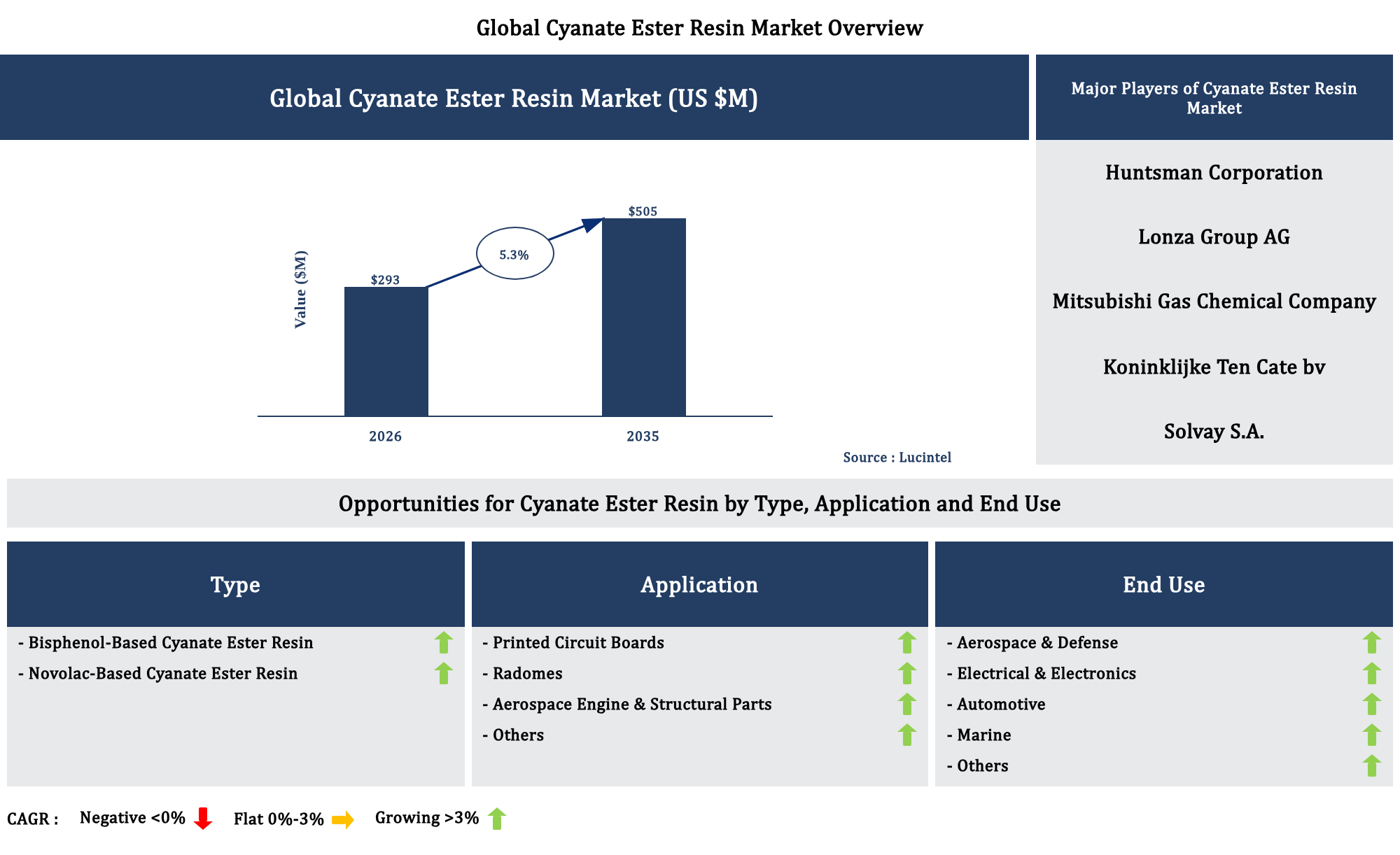
The future of the global cyanate ester resin market looks promising with opportunities in the aerospace & defense, electrical & electronic, automotive, and marine markets. The global cyanate ester resin market is expected to reach an estimated $505 million by 2035 with a CAGR of 5.3% from 2026 to 2035. The major drivers for this market are the increasing adoption in printed circuit boards, the rising demand for high-frequency communication devices, and the growing demand for investments in advanced materials research.
• Lucintel forecasts that, within the type category, bisphenol-based cyanate ester resin is expected to witness higher growth over the forecast period.
• Within the application category, electrical & electronic is expected to witness the highest growth.
• In terms of region, APAC is expected to witness the highest growth over the forecast period.
Gain valuable insights for your business decisions with our comprehensive 150+ page report. Sample figures with some insights are shown below.
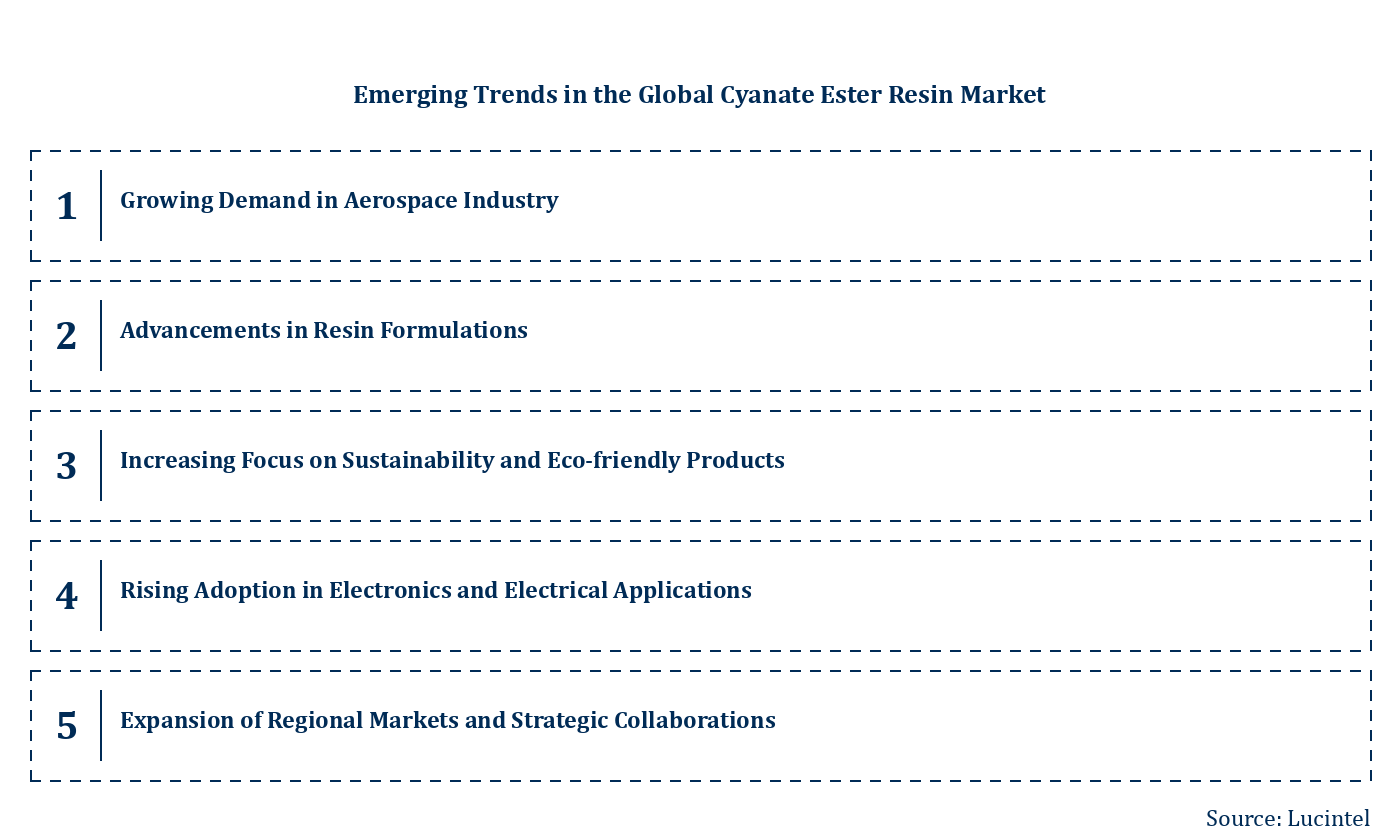
Emerging Trends in the Cyanate Ester Resin Market
The cyanate ester resin market is experiencing rapid evolution driven by technological advancements, increasing demand for high-performance materials, and shifting industry needs. As industries such as aerospace, electronics, and defense seek materials with superior thermal stability, electrical properties, and lightweight characteristics, the market is adapting to meet these demands. Emerging trends are shaping the future landscape, influencing product development, manufacturing processes, and application scopes. These developments are not only expanding market opportunities but also fostering innovation and sustainability. Understanding these key trends is essential for stakeholders aiming to capitalize on the market‘s growth potential and stay competitive in a dynamic environment.
• Growing Demand in Aerospace Industry: The aerospace sector is increasingly adopting cyanate ester resins due to their excellent thermal stability, low dielectric constant, and flame retardancy. These properties are critical for high-performance composites used in aircraft and spacecraft, where safety, weight reduction, and durability are paramount. As aerospace manufacturers seek materials that can withstand extreme conditions, the demand for cyanate ester resins is expected to rise significantly, driving market growth and encouraging further research into specialized formulations.
• Advancements in Resin Formulations: Innovations in resin chemistry are leading to the development of modified cyanate ester resins with enhanced mechanical properties, processability, and environmental resistance. These advancements enable broader application scopes, including in electronics, defense, and automotive sectors. Improved formulations also facilitate easier manufacturing processes, reduce costs, and extend product lifespan. This trend is fostering a competitive edge for manufacturers who can offer tailored solutions that meet specific industry requirements, thereby expanding market penetration.
• Increasing Focus on Sustainability and Eco-Friendly Products: Environmental concerns are prompting manufacturers to develop greener cyanate ester resins with reduced volatile organic compounds (VOCs) and improved recyclability. Efforts include utilizing bio-based raw materials and adopting sustainable production processes. These eco-friendly resins appeal to environmentally conscious clients and comply with stringent regulations, opening new market segments. The shift towards sustainability is also encouraging innovation in raw material sourcing and manufacturing techniques, ultimately influencing the overall market landscape.
• Rising Adoption in Electronics and Electrical Applications: Cyanate ester resins are increasingly used in electronic components due to their excellent electrical insulation, low dielectric constant, and high thermal stability. These properties are vital for advanced electronic devices, including semiconductors, printed circuit boards, and high-frequency communication equipment. As electronic devices become more compact and high-performing, the demand for reliable insulating materials like cyanate ester resins is surging, significantly impacting the market by expanding its application base and encouraging new product development.
• Expansion of Regional Markets and Strategic Collaborations: Emerging economies in Asia-Pacific and other regions are witnessing rapid industrialization, leading to increased demand for high-performance resins. Companies are forming strategic alliances, joint ventures, and investing in local manufacturing facilities to tap into these markets. Such collaborations facilitate technology transfer, cost reduction, and customized solutions for regional needs. This trend is diversifying the market landscape, fostering global competition, and accelerating the adoption of cyanate ester resins across various industries.
These trends are collectively reshaping the cyanate ester resin market by fostering innovation, expanding application areas, and emphasizing sustainability. They are driving market growth, encouraging technological advancements, and enabling companies to meet evolving industry demands. As a result, the market is becoming more dynamic, competitive, and aligned with global sustainability goals, ensuring its continued evolution and relevance in high-performance material applications.
Recent Development in the Cyanate Ester Resin Market
The cyanate ester resin market is experiencing rapid growth driven by advancements in aerospace, electronics, and high-performance materials. Innovations in resin formulations and increasing demand for lightweight, durable composites are fueling market expansion. Key developments include technological improvements, new application sectors, and sustainability initiatives. These trends are shaping the future landscape, offering significant opportunities for manufacturers and stakeholders to capitalize on emerging markets and enhance product performance.
• Growth in Aerospace Industry: The demand for lightweight, high-strength materials is boosting cyanate ester resin use in aerospace composites, improving fuel efficiency and safety standards. This development enhances aircraft performance, reduces weight, and meets stringent safety regulations, leading to increased adoption by aerospace manufacturers. The market benefits from increased investments in aerospace technology, expanding the application scope of cyanate ester resins in aircraft and spacecraft components.
• Advancements in Electronic Materials: The electronics sector is increasingly adopting cyanate ester resins for printed circuit boards and electronic packaging due to their excellent thermal stability and electrical insulation properties. These improvements enable more reliable, miniaturized electronic devices capable of operating under extreme conditions. The growth in consumer electronics, automotive electronics, and telecommunication infrastructure drives demand, positioning cyanate ester resins as critical materials for next-generation electronic components.
• Development of High-Performance Composites: Innovations in composite materials utilizing cyanate ester resins are creating opportunities in defense, sports, and industrial sectors. These composites offer superior thermal resistance, chemical stability, and mechanical strength, making them ideal for demanding environments. The market benefits from increased research and development efforts, leading to customized solutions that meet specific industry needs, thereby expanding the application base and market share.
• Sustainability and Eco-Friendly Initiatives: The industry is focusing on developing environmentally friendly cyanate ester resins with reduced volatile organic compounds (VOCs) and improved recyclability. These initiatives align with global sustainability goals, attracting eco-conscious consumers and regulatory support. The shift towards greener production processes enhances market reputation and opens new avenues for sustainable high-performance materials, fostering long-term growth and compliance with environmental standards.
• Expansion into New Application Sectors: Emerging markets such as renewable energy, medical devices, and advanced transportation are adopting cyanate ester resins for their unique properties. These sectors require materials that withstand extreme conditions and offer longevity, which cyanate ester resins provide. Market players are investing in product innovation and strategic partnerships to penetrate these sectors, broadening the market scope and driving future growth.
The overall impact of these developments is a robust expansion of the cyanate ester resin market, driven by technological innovation, new application opportunities, and sustainability efforts. These factors collectively enhance product performance, open new markets, and strengthen the industry’s competitive position, ensuring sustained growth and increased market share in the coming years.
Strategic Growth Opportunities in the Cyanate Ester Resin Market
The cyanate ester resin market is experiencing significant growth driven by its exceptional thermal stability, electrical properties, and chemical resistance. As industries such as aerospace, electronics, and automotive seek advanced materials for high-performance applications, opportunities for expansion are emerging across various sectors. Innovations in manufacturing processes and increasing demand for lightweight, durable composites are further fueling market development. Companies are exploring new applications and improving resin formulations to meet evolving industry standards, positioning cyanate ester resins as a critical component in next-generation technologies.
• Expansion into Aerospace Composites: Cyanate ester resins are increasingly used in aerospace for lightweight, high-strength composites due to their excellent thermal stability, low dielectric constant, and flame retardancy. The demand for fuel-efficient aircraft and space vehicles drives the need for advanced materials that can withstand extreme conditions. Ongoing research aims to enhance resin properties and processing techniques, opening new opportunities for high-performance aerospace components. This growth is expected to significantly boost market revenue and global adoption.
• Growing Adoption in Electronics and Electrical Insulation: The superior electrical insulation properties and low dielectric constant of cyanate ester resins make them ideal for electronic components, circuit boards, and high-frequency applications. As electronic devices become more compact and require reliable insulation, demand for these resins increases. Additionally, their resistance to moisture and chemicals enhances device longevity. Innovations in resin formulations are expanding their use in advanced electronics, creating substantial growth opportunities in the electronics industry.
• Increasing use in Automotive Lightweight Composites: The automotive industry is shifting towards lightweight materials to improve fuel efficiency and reduce emissions. Cyanate ester resins are gaining traction in manufacturing lightweight composites for structural parts, thanks to their high strength-to-weight ratio and thermal stability. The development of cost-effective processing methods and composite manufacturing techniques is further facilitating adoption. This trend is expected to drive market growth as automakers seek durable, lightweight solutions for next-generation vehicles.
• Advancements in Manufacturing Processes and Resin Formulations: Innovations in synthesis and curing techniques are enhancing the performance and processing efficiency of cyanate ester resins. Researchers are developing new formulations with improved toughness, flexibility, and environmental resistance. These advancements enable easier integration into composite manufacturing and expand application possibilities. As manufacturing becomes more cost-effective and scalable, the market is poised for increased adoption across various high-performance sectors, fostering overall growth.
• Rising Demand for High-Performance Materials in Defense and Space Applications: Cyanate ester resins are critical in defense and space sectors due to their exceptional thermal stability, flame retardancy, and radiation resistance. The need for durable, lightweight materials in military aircraft, satellites, and space exploration drives market expansion. Ongoing government investments and technological innovations are further propelling demand. As these sectors prioritize advanced composites for safety and performance, the market for cyanate ester resins is expected to grow substantially.
These growth opportunities collectively position cyanate ester resins as a vital material in high-performance applications across aerospace, electronics, automotive, and defense sectors. Continuous innovation, expanding application scopes, and increasing industry demand are expected to accelerate market growth, making cyanate ester resins a strategic focus for manufacturers aiming to meet future technological challenges and sustainability goals.
Cyanate Ester Resin Market Driver and Challenges
The cyanate ester resin market is influenced by a variety of technological, economic, and regulatory factors that shape its growth trajectory. Advances in composite materials and aerospace applications drive demand for high-performance resins, while economic fluctuations impact investment levels and manufacturing costs. Regulatory standards concerning environmental safety and material sustainability also play a crucial role in market development. Additionally, innovations in resin formulations and processing techniques contribute to expanding applications across industries. Navigating these drivers and challenges is essential for stakeholders aiming to capitalize on emerging opportunities and address potential barriers within this dynamic market environment.
The factors responsible for driving the cyanate ester resin market include:-
• Technological Advancements: The continuous development of high-performance composite materials and innovative resin formulations enhances the applicability of cyanate ester resins in aerospace, electronics, and defense sectors. These advancements improve thermal stability, mechanical strength, and chemical resistance, making the resins more desirable for critical applications. As industries demand lighter, stronger, and more durable materials, the adoption of advanced cyanate ester resins accelerates, fueling market growth. Moreover, improvements in manufacturing processes, such as resin infusion and curing techniques, reduce production costs and increase efficiency, further boosting demand.
• Growing Aerospace and Defense Industry: The aerospace sector is a significant driver for cyanate ester resins due to their excellent thermal stability, flame retardancy, and low outgassing properties. The increasing production of commercial and military aircraft, along with space exploration initiatives, necessitates advanced composite materials that can withstand extreme conditions. Defense applications, including military vehicles and radar systems, also benefit from these resins‘ superior performance. As governments and private companies invest heavily in aerospace and defense projects, the demand for high-quality cyanate ester resins continues to rise, supporting market expansion.
• Environmental Regulations and Sustainability Initiatives: Stricter environmental standards and sustainability goals influence the market by encouraging the development of eco-friendly resin formulations. Manufacturers are focusing on reducing volatile organic compounds (VOCs) and hazardous emissions during production and curing processes. Regulatory compliance ensures market players adopt safer, more sustainable practices, which can increase R&D investments in green alternatives. These initiatives not only promote environmental responsibility but also open new avenues for market growth by aligning with global sustainability trends, attracting environmentally conscious customers and industries.
• Increasing Adoption in Electronics and Electrical Applications: Cyanate ester resins are increasingly used in electronics due to their excellent dielectric properties, low moisture absorption, and high thermal stability. They are ideal for printed circuit boards, semiconductor packaging, and other electronic components that require reliable insulation and heat resistance. The rapid growth of consumer electronics, telecommunications, and data centers drives demand for advanced materials capable of supporting miniaturization and high-performance requirements. As electronic devices become more sophisticated, the need for durable, high-quality resins like cyanate ester grows, significantly impacting market expansion.
• Rising Investment in R&D and Innovation: Continuous research and development efforts are crucial for enhancing the properties of cyanate ester resins and expanding their application scope. Investment in new formulations, processing techniques, and composite manufacturing methods leads to improved performance and cost-effectiveness. Innovations such as bio-based resins and hybrid materials are opening new markets and applications. Increased R&D activity also helps address existing limitations, such as processing challenges and cost barriers, making cyanate ester resins more accessible and versatile. This ongoing innovation sustains competitive advantage and propels market growth.
The challenges facing this Market include:-
• High Production Costs: The manufacturing of cyanate ester resins involves complex processes, specialized raw materials, and stringent quality controls, resulting in high production costs. These costs can hinder widespread adoption, especially in price-sensitive markets. Additionally, the need for advanced curing equipment and skilled labor further escalates expenses. As a result, manufacturers face pressure to optimize production methods and reduce costs without compromising quality, which can slow market growth and limit penetration into emerging regions or applications.
• Processing Difficulties and Limited Raw Material Availability: Cyanate ester resins require precise processing conditions, such as controlled curing temperatures and times, to achieve desired properties. These processing challenges can lead to defects, longer production cycles, and increased waste. Moreover, the raw materials used in resin synthesis are often limited in supply, which can cause supply chain disruptions and price volatility. Overcoming these technical and supply chain hurdles is essential for scaling production and meeting growing demand, but it remains a significant challenge for industry players.
• Stringent Regulatory and Environmental Standards: Increasing regulations concerning environmental safety, hazardous emissions, and worker safety impose compliance burdens on manufacturers. The need to meet strict standards can lead to increased costs for testing, certification, and process modifications. Non-compliance risks legal penalties and reputational damage, which can deter investment and innovation. Navigating these regulatory landscapes requires significant resources and expertise, potentially slowing down product development and market expansion efforts.
The cyanate ester resin market is driven by technological innovations, expanding aerospace and electronics sectors, and sustainability initiatives, which collectively foster growth opportunities. However, high production costs, processing challenges, and regulatory hurdles pose significant barriers. Balancing these drivers and challenges will determine the market‘s future trajectory, with ongoing R&D and strategic adaptations being key to overcoming obstacles and capitalizing on emerging opportunities. The overall impact suggests a promising yet competitive landscape that requires careful navigation to sustain growth and innovation.
List of Cyanate Ester Resin Companies
Companies in the market compete on the basis of product quality offered. Major players in this market focus on expanding their manufacturing facilities, R&D investments, infrastructural development, and leverage integration opportunities across the value chain. With these strategies cyanate ester resin companies cater increasing demand, ensure competitive effectiveness, develop innovative products & technologies, reduce production costs, and expand their customer base. Some of the cyanate ester resin companies profiled in this report include-
• Huntsman Corporation
• Lonza Group AG
• Mitsubishi Gas Chemical Company
• Koninklijke Ten Cate bv
• Solvay S.A.
Cyanate Ester Resin Market by Segment
The study includes a forecast for the global cyanate ester resin market by type, application, end use, and region.
Cyanate Ester Resin Market by Type [Value from 2019 to 2035]:
• Bisphenol-Based Cyanate Ester Resin
• Novolac-Based Cyanate Ester Resin
Cyanate Ester Resin Market by Application [Value from 2019 to 2035]:
• Printed Circuit Boards
• Radomes
• Aerospace Engine & Structural Parts
• Others
Cyanate Ester Resin Market by End Use [Value from 2019 to 2035]:
• Aerospace & Defense
• Electrical & Electronics
• Automotive
• Marine
• Others
Cyanate Ester Resin Market by Region [Value from 2019 to 2035]:
• North America
• Europe
• Asia Pacific
• The Rest of the World
Country Wise Outlook for the Cyanate Ester Resin Market
The cyanate ester resin market has experienced significant growth driven by increasing demand in aerospace, electronics, and advanced manufacturing sectors worldwide. Innovations in resin formulations, improved processing techniques, and expanding applications have contributed to market expansion. Countries are investing in research and development to enhance resin properties, such as thermal stability, electrical insulation, and environmental resistance. The market‘s evolution reflects a shift towards high-performance materials that meet stringent industry standards. As global industries seek lightweight, durable, and high-temperature resistant materials, the cyanate ester resin market is poised for continued growth and technological advancements across key regions.
• United States: The US market has seen substantial growth driven by aerospace and electronics industries. Leading companies are investing in R&D to develop high-performance, environmentally friendly resins. Adoption of cyanate ester resins in advanced composites for aircraft and space applications has increased, supported by government and private sector initiatives. The US also focuses on improving resin processing techniques to enhance efficiency and reduce costs, fostering innovation and expanding market reach.
• China: China is rapidly expanding its cyanate ester resin market, primarily fueled by its booming electronics and aerospace sectors. The country is investing heavily in research to improve resin properties and develop cost-effective manufacturing processes. Domestic demand for high-performance materials in electronics, automotive, and defense industries is driving market growth. Additionally, government policies supporting advanced manufacturing and technological innovation are further boosting the adoption of cyanate ester resins.
• Germany: Germany‘s market growth is driven by its strong automotive, aerospace, and industrial sectors. The country emphasizes high-quality, durable resins for use in lightweight composites and high-temperature applications. German companies are focusing on sustainable production methods and enhancing resin performance to meet stringent European standards. Collaborations between industry and research institutions are fostering innovation, positioning Germany as a key player in the development of advanced cyanate ester resin technologies.
• India: The Indian cyanate ester resin market is witnessing rapid growth due to expanding aerospace, electronics, and defense industries. Increasing investments in infrastructure and technological development are encouraging the adoption of high-performance materials. Local manufacturers are focusing on cost-effective production and improving resin properties to cater to domestic and export markets. Government initiatives promoting Make in India and self-reliance are further supporting market expansion and technological advancements.
• Japan: Japan‘s market is characterized by its focus on high-end electronics, aerospace, and industrial applications. Japanese companies are investing in R&D to develop innovative cyanate ester resins with enhanced thermal and electrical properties. The country emphasizes sustainable manufacturing practices and the development of eco-friendly resins. Collaboration between industry and academia is driving technological progress, ensuring Japan remains a leader in advanced resin applications and market growth.
Features of the Global Cyanate Ester Resin Market
Market Size Estimates: Cyanate ester resin market size estimation in terms of value ($M).
Trend and Forecast Analysis: Market trends (2019 to 2025) and forecast (2026 to 2035) by various segments and regions.
Segmentation Analysis: Cyanate ester resin market size by type, application, end use, and region in terms of value ($M).
Regional Analysis: Cyanate ester resin market breakdown by North America, Europe, Asia Pacific, and Rest of the World.
Growth Opportunities: Analysis of growth opportunities in different type, application, end use, and regions for the cyanate ester resin market.
Strategic Analysis: This includes M&A, new product development, and competitive landscape of the cyanate ester resin market.
Analysis of competitive intensity of the industry based on Porter’s Five Forces model.
FAQ
Q1. What is the cyanate ester resin market size?
Answer: The global cyanate ester resin market is expected to reach an estimated $505 million by 2035.
Q2. What is the growth forecast for cyanate ester resin market?
Answer: The global cyanate ester resin market is expected to grow with a CAGR of 5.3% from 2026 to 2035.
Q3. What are the major drivers influencing the growth of the cyanate ester resin market?
Answer: The major drivers for this market are the increasing adoption in printed circuit boards, the rising demand for high-frequency communication devices, and the growing demand for investments in advanced materials research.
Q4. What are the major segments for cyanate ester resin market?
Answer: The future of the cyanate ester resin market looks promising with opportunities in the aerospace & defense, electrical & electronic, automotive, and marine markets.
Q5. Who are the key cyanate ester resin market companies?
Answer: Some of the key cyanate ester resin companies are as follows:
• Huntsman Corporation
• Lonza Group AG
• Mitsubishi Gas Chemical Company
• Koninklijke Ten Cate bv
• Solvay S.A.
Q6. Which cyanate ester resin market segment will be the largest in future?
Answer: Lucintel forecasts that, within the type category, bisphenol-based cyanate ester resin is expected to witness higher growth over the forecast period.
Q7. In cyanate ester resin market, which region is expected to be the largest in next 8 years?
Answer: In terms of region, APAC is expected to witness the highest growth over the forecast period.
Q8. Do we receive customization in this report?
Answer: Yes, Lucintel provides 10% customization without any additional cost.
This report answers following 11 key questions:
Q.1. What are some of the most promising, high-growth opportunities for the cyanate ester resin market by type (bisphenol-based cyanate ester resin and novolac-based cyanate ester resin), application (printed circuit boards, radomes, aerospace engine & structural parts, and others), end use (aerospace & defense, electrical & electronics, automotive, marine, and others), and region (North America, Europe, Asia Pacific, and the Rest of the World)?
Q.2. Which segments will grow at a faster pace and why?
Q.3. Which region will grow at a faster pace and why?
Q.4. What are the key factors affecting market dynamics? What are the key challenges and business risks in this market?
Q.5. What are the business risks and competitive threats in this market?
Q.6. What are the emerging trends in this market and the reasons behind them?
Q.7. What are some of the changing demands of customers in the market?
Q.8. What are the new developments in the market? Which companies are leading these developments?
Q.9. Who are the major players in this market? What strategic initiatives are key players pursuing for business growth?
Q.10. What are some of the competing products in this market and how big of a threat do they pose for loss of market share by material or product substitution?
Q.11. What M&A activity has occurred in the last 7 years and what has its impact been on the industry?
For any questions related to Cyanate Ester Resin Market, Cyanate Ester Resin Market Size, Cyanate Ester Resin Market Growth, Cyanate Ester Resin Market Analysis, Cyanate Ester Resin Market Report, Cyanate Ester Resin Market Share, Cyanate Ester Resin Market Trends, Cyanate Ester Resin Market Forecast, Cyanate Ester Resin Companies, write Lucintel analyst at email: helpdesk@lucintel.com. We will be glad to get back to you soon.