
Report Feature
Cryptocurrency Mining Market Trends and Forecast
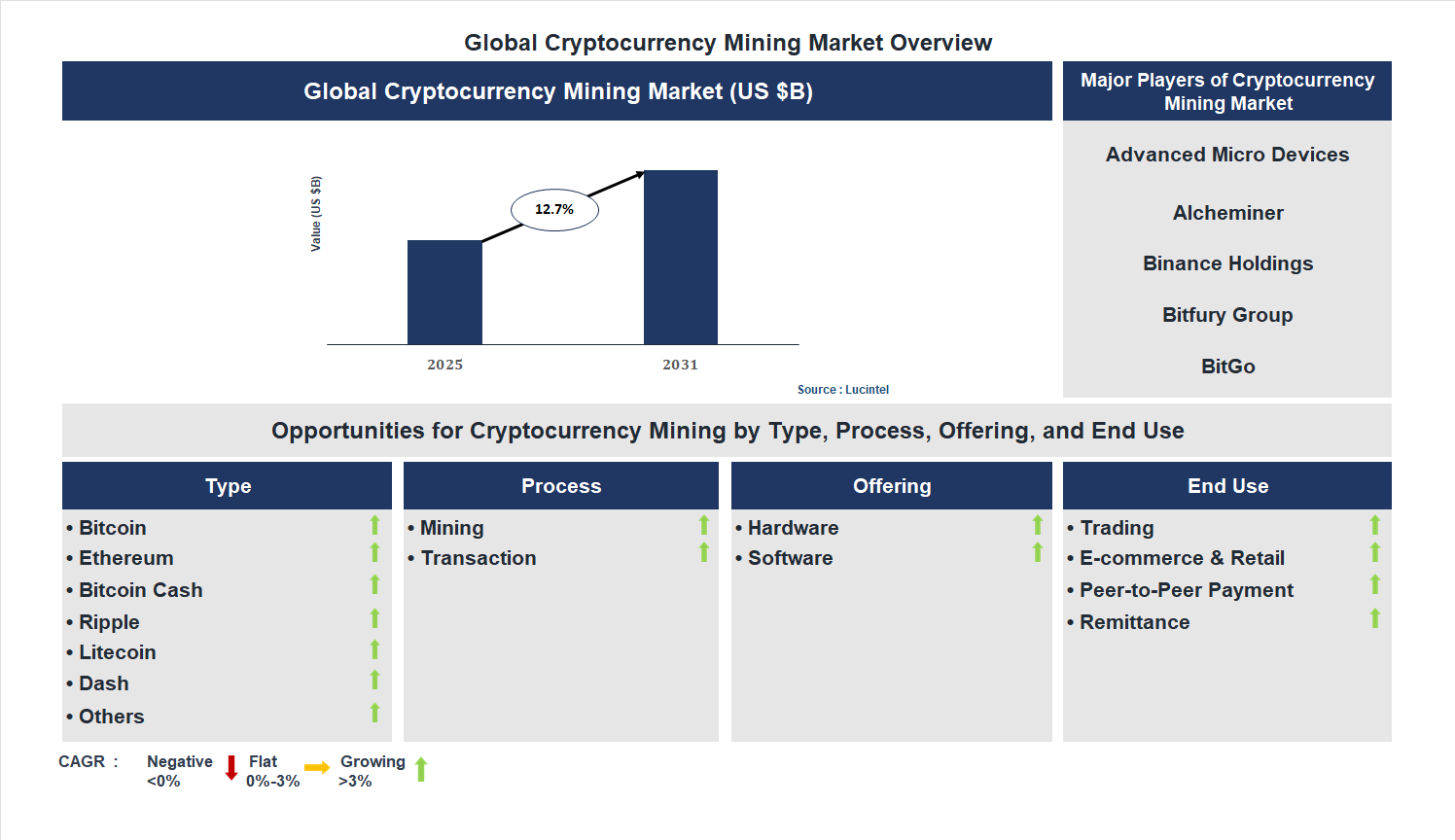
The future of the global cryptocurrency mining market looks promising with opportunities in the trading, E-commerce & retail, peer-to-peer payment, and remittance markets. The global cryptocurrency mining market is expected to grow with a CAGR of 12.7% from 2025 to 2031. The major drivers for this market are the increasing adoption of digital currencies, the rising demand for high performance hardware, and the growing interest in blockchain technologies.• Lucintel forecasts that, within the type category, bitcoin is expected to witness the highest growth over the forecast period.
• Within the end use category, trading is expected to witness the highest growth.
• In terms of region, APAC is expected to witness the highest growth over the forecast period. Gain valuable insights for your business decisions with our comprehensive 150+ page report. Sample figures with some insights are shown below.
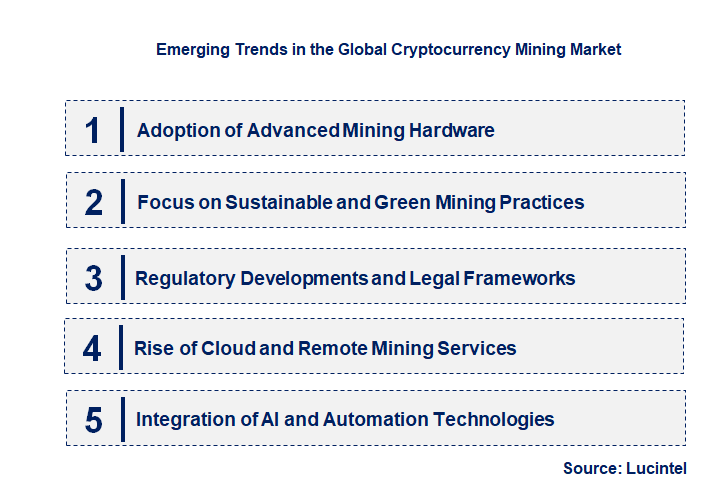
Emerging Trends in the Cryptocurrency Mining Market
The cryptocurrency mining market is experiencing rapid evolution driven by technological advancements, regulatory changes, and shifting economic factors. As digital currencies gain mainstream acceptance, the industry is adapting to new challenges and opportunities. Innovations in hardware, energy efficiency, and sustainability are shaping the future landscape. Additionally, increasing institutional involvement and regulatory scrutiny are influencing market dynamics. These developments are not only transforming how mining operations are conducted but also impacting the overall stability and growth of the cryptocurrency ecosystem. Understanding these emerging trends is crucial for stakeholders aiming to navigate this complex and rapidly changing market environment.• Adoption of Advanced Mining Hardware: The industry is shifting towards more powerful and energy-efficient mining equipment, such as ASICs and high-performance GPUs. These innovations enable miners to increase their computational power while reducing energy consumption, leading to higher profitability and sustainability. As hardware technology advances, smaller players can compete with larger operations, democratizing access to mining. This trend also encourages manufacturers to develop specialized equipment tailored for specific cryptocurrencies, further optimizing mining efficiency and reducing operational costs.
• Focus on Sustainable and Green Mining Practices: Environmental concerns are prompting the industry to adopt greener solutions. Renewable energy sources like solar, wind, and hydroelectric power are increasingly being integrated into mining operations to reduce carbon footprints. Companies are investing in energy-efficient cooling systems and waste heat utilization to minimize environmental impact. This shift not only aligns with global sustainability goals but also helps miners reduce energy costs and avoid regulatory penalties. As sustainability becomes a key factor, green mining practices are likely to become a competitive advantage in the market.
• Regulatory Developments and Legal Frameworks: Governments worldwide are establishing clearer regulations for cryptocurrency mining, affecting operational legality and profitability. Some countries are imposing bans or restrictions due to energy consumption concerns, while others are creating favorable policies to attract miners. Regulatory clarity helps reduce uncertainty, encouraging investment and innovation. Conversely, unpredictable policies can lead to market volatility and operational disruptions. Miners are increasingly seeking jurisdictions with stable legal environments, influencing the geographic distribution of mining activities and shaping industry growth trajectories.
• Rise of Cloud and Remote Mining Services: Cloud mining platforms and remote mining services are gaining popularity, allowing individuals and small-scale investors to participate without significant hardware investments. These services offer flexible, scalable, and cost-effective solutions, broadening access to cryptocurrency mining. However, they also raise concerns about transparency and security. The growth of cloud mining is reshaping market participation, enabling a more diverse range of stakeholders to engage in mining activities and fostering a more inclusive ecosystem.
• Integration of AI and Automation Technologies: Artificial intelligence and automation are being integrated into mining operations to optimize performance and reduce costs. AI algorithms analyze data to improve equipment efficiency, predict maintenance needs, and enhance energy management. Automation streamlines operations, reduces human error, and increases scalability. These technologies enable miners to operate more efficiently in a competitive environment, lowering operational costs and increasing profitability. As AI and automation become more sophisticated, they are set to revolutionize operational strategies and drive innovation within the market. In summary, these emerging trends are fundamentally reshaping the cryptocurrency mining market by enhancing efficiency, promoting sustainability, clarifying regulatory landscapes, expanding participation, and leveraging advanced technologies. Collectively, they are driving growth, reducing environmental impact, and fostering a more resilient and inclusive industry.
Recent Development in the Cryptocurrency Mining Market
The cryptocurrency mining market has experienced rapid evolution driven by technological advancements, regulatory changes, and increasing demand for digital assets. These developments are shaping the future landscape, creating new opportunities and challenges for stakeholders. As the industry matures, understanding these key growth areas is essential for investors, miners, and policymakers to navigate the dynamic environment effectively.• Growth in Sustainable Mining Technologies: Adoption of renewable energy sources and energy-efficient hardware is transforming the industry by reducing environmental impact. This shift not only aligns with global sustainability goals but also lowers operational costs, making mining more profitable and appealing to eco-conscious investors. The integration of green technologies is expected to drive long-term growth and regulatory compliance, fostering a more sustainable and resilient market.
• Expansion of Cloud Mining Services: Cloud mining offers accessible, scalable, and cost-effective solutions for individuals and enterprises to participate in cryptocurrency mining without significant upfront investments. This development broadens market reach, enabling more participants to engage in mining activities. As cloud platforms improve security and transparency, they are likely to attract a larger user base, fueling industry growth and decentralization.
• Regulatory Frameworks and Legal Clarity: Governments worldwide are establishing clearer regulations for cryptocurrency mining, addressing issues like energy consumption, taxation, and licensing. These frameworks provide legal certainty, encouraging investment and innovation while mitigating risks associated with illegal or unregulated mining. Enhanced regulatory clarity is expected to foster industry credibility, attract institutional investors, and promote sustainable growth.
• Advancements in Mining Hardware: The development of more powerful, energy-efficient mining equipment, such as ASICs and GPUs, is boosting mining efficiency and profitability. These innovations enable miners to process transactions faster and with lower energy consumption, reducing operational costs. As hardware technology continues to evolve, it will support the scalability of mining operations and improve overall market competitiveness.
• Growing Adoption of Decentralized Finance (DeFi) and NFTs: The integration of DeFi platforms and non-fungible tokens (NFTs) with cryptocurrency mining is creating new revenue streams and use cases. Miners are increasingly participating in DeFi lending, staking, and NFT creation, diversifying income sources. This convergence is expanding the market’s scope, attracting new participants, and fostering innovation, which collectively drive industry growth and market resilience. The recent developments in sustainable technologies, cloud services, regulatory clarity, hardware innovation, and DeFi integration are collectively transforming the cryptocurrency mining market. These opportunities are enhancing efficiency, inclusivity, and sustainability, leading to increased investment and market stability. As the industry adapts to these changes, it is poised for sustained growth and broader mainstream acceptance.
Strategic Growth Opportunities in the Cryptocurrency Mining Market
The cryptocurrency mining market is experiencing rapid expansion driven by technological advancements, increasing digital asset adoption, and evolving regulatory landscapes. As miners seek more efficient and sustainable solutions, new opportunities emerge across various applications. Strategic growth in this sector hinges on innovation, infrastructure development, and market diversification. Companies that capitalize on these opportunities can enhance profitability, reduce environmental impact, and strengthen their market position amid fierce competition and regulatory challenges.• Expansion of Cloud Mining Services: Cloud mining offers users access to mining hardware and resources remotely, reducing entry barriers and operational costs. This growth opportunity enables companies to tap into a broader customer base, including small investors and enterprises seeking scalable solutions. As cloud infrastructure improves, more secure and efficient platforms will emerge, driving adoption. Strategic investments in cloud mining can diversify revenue streams and foster global market penetration, especially in regions with limited physical infrastructure.
• Adoption of Sustainable Mining Technologies: The shift toward eco-friendly mining solutions presents significant growth potential. Innovations such as renewable energy-powered mining farms, energy-efficient hardware, and waste heat utilization can reduce environmental impact and operational costs. Governments and consumers increasingly favor sustainable practices, creating incentives for companies to adopt green technologies. This opportunity not only enhances corporate social responsibility but also aligns with regulatory trends favoring environmental conservation, thereby attracting environmentally conscious investors and partners.
• Development of Specialized Mining Hardware: The demand for high-performance, energy-efficient mining equipment continues to rise. Developing specialized hardware like ASICs and FPGA devices tailored for specific cryptocurrencies can improve mining efficiency and profitability. This growth avenue involves continuous R&D to stay ahead of technological obsolescence and optimize power consumption. Companies investing in innovative hardware can gain competitive advantages, reduce operational costs, and meet the increasing computational demands of emerging blockchain networks.
• Expansion into Emerging Markets: Emerging economies present untapped opportunities for cryptocurrency mining due to lower energy costs, favorable regulations, and growing digital adoption. Establishing mining operations in these regions can reduce expenses and diversify geographic risk. Infrastructure development, local partnerships, and compliance with regional policies are critical success factors. This expansion can accelerate market growth, foster local economic development, and position companies as early movers in high-potential markets with less saturation.
• Integration of AI and Automation in Mining Operations: Incorporating artificial intelligence and automation enhances operational efficiency, security, and predictive maintenance in mining farms. AI-driven analytics optimize hardware performance and energy consumption, reducing costs and downtime. Automation streamlines management processes, enabling real-time monitoring and rapid response to issues. This technological integration offers a competitive edge by increasing profitability, reducing manual labor, and improving scalability, making mining operations more sustainable and adaptable to market fluctuations. The overall impact of these growth opportunities will significantly shape the future landscape of the cryptocurrency mining market, fostering innovation, sustainability, and global expansion. Companies that strategically leverage these avenues can achieve sustained growth, mitigate risks, and maintain competitive advantages in an evolving industry.
Cryptocurrency Mining Market Driver and Challenges
The cryptocurrency mining market is influenced by a complex interplay of technological advancements, economic conditions, and regulatory frameworks. Rapid innovations in mining hardware and software have enhanced efficiency and profitability, while fluctuating cryptocurrency prices impact market dynamics. Additionally, government policies and regulations around the world shape operational feasibility and investment attractiveness. Market participants must navigate these factors to sustain growth and competitiveness. As the industry evolves, understanding these drivers and challenges becomes crucial for stakeholders aiming to capitalize on opportunities and mitigate risks in this rapidly changing landscape. The factors responsible for driving the cryptocurrency mining market include:-• Technological Innovation: The continuous development of more efficient mining hardware, such as ASICs and GPUs, reduces energy consumption and increases processing power. Software improvements also optimize mining operations, enabling miners to maximize returns. These technological advancements lower operational costs and improve profitability, attracting new entrants and expanding the market. As technology evolves, miners can mine more cryptocurrencies faster and more sustainably, fueling market growth.
• Increasing Cryptocurrency Adoption: Growing acceptance of cryptocurrencies for transactions, investments, and remittances drives demand for mining activities. As more individuals and institutions adopt digital currencies, the need for secure and reliable mining operations increases. This expanding user base boosts the overall market size and incentivizes investment in mining infrastructure, further accelerating industry growth.
• Rising Energy Efficiency and Sustainability Initiatives: The industry’s focus on reducing energy consumption and adopting renewable energy sources aligns with global sustainability goals. Innovations in energy-efficient mining hardware and the integration of renewable power sources lower environmental impact and operational costs. These initiatives attract environmentally conscious investors and regulators, fostering a more sustainable and scalable mining ecosystem.
• Market Expansion in Emerging Regions: Countries with abundant renewable energy resources and favorable regulatory environments are becoming new hubs for cryptocurrency mining. Regions like North America, parts of Europe, and certain Asian countries are witnessing increased investments. This geographic diversification enhances market resilience, reduces dependency on traditional mining centers, and opens new revenue streams for industry players. The challenges in the cryptocurrency mining market are:
• Regulatory Uncertainty: Governments worldwide are implementing or contemplating regulations that could restrict or ban mining activities, citing concerns over energy consumption and financial security. Unclear or rapidly changing policies create an unpredictable environment, deterring investment and operational planning. Miners face risks of sudden legal restrictions, fines, or shutdowns, which can significantly impact profitability and market stability.
• High Energy Consumption and Environmental Concerns: Cryptocurrency mining is energy-intensive, often relying on non-renewable sources, leading to environmental criticism. This has prompted regulatory crackdowns and social opposition, increasing operational costs and limiting expansion opportunities. The industry faces pressure to adopt greener practices, but transitioning to sustainable energy sources remains costly and technically challenging.
• Market Volatility and Price Fluctuations: Cryptocurrency prices are highly volatile, directly affecting mining profitability. Sharp declines can render mining unprofitable, leading to equipment decommissioning and market contraction. Conversely, price surges can attract new entrants, increasing competition and hardware demand. This unpredictability complicates long-term planning and investment, posing a significant challenge to market stability and growth. In summary, the cryptocurrency mining market is driven by technological progress, increasing adoption, sustainability efforts, and regional expansion. However, regulatory uncertainties, environmental concerns, and market volatility pose substantial challenges. These factors collectively influence the industry’s trajectory, requiring stakeholders to adapt strategically. While innovation and market expansion offer growth opportunities, addressing regulatory and environmental issues is essential for sustainable development. Overall, the market’s future hinges on balancing technological advancements with regulatory compliance and environmental responsibility to ensure long-term viability.
List of Cryptocurrency Mining Companies
Companies in the market compete on the basis of product quality offered. Major players in this market focus on expanding their manufacturing facilities, R&D investments, infrastructural development, and leverage integration opportunities across the value chain. With these strategies cryptocurrency mining companies cater increasing demand, ensure competitive effectiveness, develop innovative products & technologies, reduce production costs, and expand their customer base. Some of the cryptocurrency mining companies profiled in this report include-• Advanced Micro Devices
• Alcheminer
• Binance Holdings
• Bitfury Group
• BitGo
• Bitmain
• Bitstamp
• Canaan Creative
• Coinbase
• Ethereum Foundation
Cryptocurrency Mining Market by Segment
The study includes a forecast for the global cryptocurrency mining market by type, process, offering, end use, and region.Cryptocurrency Mining Market by Type [Value from 2019 to 2031]:
• Bitcoin
• Ethereum
• Bitcoin Cash
• Ripple
• Litecoin
• Dash
• Others
Cryptocurrency Mining Market by Process [Value from 2019 to 2031]:
• Mining
• Transaction
Cryptocurrency Mining Market by Offering [Value from 2019 to 2031]:
• Hardware
• Software
Cryptocurrency Mining Market by End Use [Value from 2019 to 2031]:
• Trading
• E-commerce & Retail
• Peer-to-Peer Payment
• Remittance
Cryptocurrency Mining Market by Region [Value from 2019 to 2031]:
• North America
• Europe
• Asia Pacific
• The Rest of the World
Country Wise Outlook for the Cryptocurrency Mining Market
The cryptocurrency mining market has experienced significant shifts globally, driven by technological advancements, regulatory changes, and fluctuating market dynamics. As digital currencies gain mainstream acceptance, countries are adopting diverse strategies to optimize mining operations, address environmental concerns, and regulate industry growth. These developments reflect the evolving landscape of blockchain technology and its economic implications across major economies. Understanding the latest trends in the United States, China, Germany, India, and Japan offers insight into regional priorities and challenges shaping the future of cryptocurrency mining.• United States: The US remains a leader in cryptocurrency mining, with increased investments in renewable energy-powered facilities and advanced mining hardware. Regulatory clarity is improving, encouraging institutional participation. Major companies are expanding operations, and states like Texas and Wyoming are becoming mining hubs due to favorable policies and energy costs. Innovations in cooling technology and efforts to reduce carbon footprints are prominent trends. The market is also witnessing increased adoption of proof-of-stake alternatives to traditional proof-of-work systems.
• China: China has significantly curtailed domestic cryptocurrency mining since 2021, citing environmental concerns and regulatory crackdowns. Many miners have relocated abroad, especially to North America and Central Asia. Despite the ban, underground mining persists, and some regions are exploring blockchain applications beyond mining. The government is focusing on developing its own digital currency, the digital yuan, which influences the broader blockchain ecosystem. The shift has led to a decline in Chinas share of global mining hash rate but spurred innovation in other areas of blockchain technology.
• Germany: Germany is emphasizing sustainable mining practices, integrating renewable energy sources into operations. The country is fostering innovation through research initiatives and supporting small-scale miners. Regulatory frameworks are being refined to balance industry growth with environmental and security concerns. Germanys focus on green energy aligns with EU policies, promoting eco-friendly mining solutions. The market is also exploring blockchain applications in finance and supply chain management, contributing to a diversified ecosystem that supports both traditional and emerging cryptocurrencies.
• India: India is witnessing growing interest in cryptocurrency mining, driven by increasing adoption of digital currencies and blockchain technology. The government is deliberating on comprehensive regulations, aiming to balance innovation with financial stability. Several startups are investing in mining hardware and infrastructure, often utilizing renewable energy sources. The country is also exploring blockchain for government and enterprise applications. However, regulatory uncertainties and high electricity costs pose challenges. Despite this, India’s market is poised for growth as policies evolve to support sustainable and compliant mining activities.
• Japan: Japan maintains a progressive stance on cryptocurrencies, with a well-established regulatory framework that supports mining activities. The country is investing in technological innovation, including energy-efficient mining hardware and blockchain research. Major exchanges and companies are expanding their operations, and there is a focus on integrating blockchain into financial services. Japan’s emphasis on security and compliance fosters a stable environment for miners. Additionally, the country is exploring the use of blockchain for various applications, including digital identity and supply chain management, positioning itself as a key player in the evolving cryptocurrency ecosystem.

Features of the Global Cryptocurrency Mining Market
Market Size Estimates: Cryptocurrency mining market size estimation in terms of value ($B). Trend and Forecast Analysis: Market trends (2019 to 2024) and forecast (2025 to 2031) by various segments and regions. Segmentation Analysis: Cryptocurrency mining market size by various segments, such as by type, process, offering, end use, and region in terms of value ($B). Regional Analysis: Cryptocurrency mining market breakdown by North America, Europe, Asia Pacific, and Rest of the World. Growth Opportunities: Analysis of growth opportunities in different types, processes, offerings, end uses, and regions for the cryptocurrency mining market. Strategic Analysis: This includes M&A, new product development, and competitive landscape of the cryptocurrency mining market. Analysis of competitive intensity of the industry based on Porter’s Five Forces model.
FAQ
Q1. What is the growth forecast for cryptocurrency mining market? Answer: The global cryptocurrency mining market is expected to grow with a CAGR of 12.7% from 2025 to 2031. Q2. What are the major drivers influencing the growth of the cryptocurrency mining market? Answer: The major drivers for this market are the increasing adoption of digital currencies, the rising demand for high performance hardware, and the growing interest in blockchain technologies. Q3. What are the major segments for cryptocurrency mining market? Answer: The future of the cryptocurrency mining market looks promising with opportunities in the trading, E-commerce & retail, peer-to-peer payment, and remittance markets. Q4. Who are the key cryptocurrency mining market companies? Answer: Some of the key cryptocurrency mining companies are as follows:• Advanced Micro Devices
• Alcheminer
• Binance Holdings
• Bitfury Group
• BitGo
• Bitmain
• Bitstamp
• Canaan Creative
• Coinbase
• Ethereum Foundation Q5. Which cryptocurrency mining market segment will be the largest in future? Answer: Lucintel forecasts that, within the type category, bitcoin is expected to witness the highest growth over the forecast period. Q6. In cryptocurrency mining market, which region is expected to be the largest in next 5 years? Answer: In terms of region, APAC is expected to witness the highest growth over the forecast period. Q7. Do we receive customization in this report? Answer: Yes, Lucintel provides 10% customization without any additional cost.
Table of Contents
List of Figures
List of Tables
Methodology
- In-depth interviews of the major players in this market
- Detailed secondary research from competitors’ financial statements and published data
- Extensive searches of published works, market, and database information pertaining to industry news, company press releases, and customer intentions
- A compilation of the experiences, judgments, and insights of Lucintel’s professionals, who have analyzed and tracked this market over the years.


Buy Now
Choose a license that fits your team. Instant PDF delivery.
Prices exclude taxes. Instant delivery. Custom licensing available on request.
Key Questions
- • What are some of the most promising, high-growth opportunities for the cryptocurrency mining market by type (bitcoin, ethereum, bitcoin cash, ripple, litecoin, dash, and others), process (mining and transaction), offering (hardware and software), end use (trading, E-commerce & retail, peer-to-peer payment, and remittance), and region (North America, Europe, Asia Pacific, and the Rest of the World)?
- • Which segments will grow at a faster pace and why?
- • Which region will grow at a faster pace and why?
- • What are the key factors affecting market dynamics? What are the key challenges and business risks in this market?
- • What are the business risks and competitive threats in this market?
- • What are the emerging trends in this market and the reasons behind them?
- • What are some of the changing demands of customers in the market?
- • What are the new developments in the market? Which companies are leading these developments?
- • Who are the major players in this market? What strategic initiatives are key players pursuing for business growth?
- • What are some of the competing products in this market and how big of a threat do they pose for loss of market share by material or product substitution?
- • What M&A activity has occurred in the last 6 years and what has its impact been on the industry? For any questions related to Cryptocurrency Mining Market, Cryptocurrency Mining Market Size, Cryptocurrency Mining Market Growth, Cryptocurrency Mining Market Analysis, Cryptocurrency Mining Market Report, Cryptocurrency Mining Market Share, Cryptocurrency Mining Market Trends, Cryptocurrency Mining Market Forecast, Cryptocurrency Mining Companies, write Lucintel analyst at email: helpdesk@lucintel.com. We will be glad to get back to you soon.


